Thursday, January 25, 2018

"Martyrs Neither Ignoble Nor Few" ~ The death of Hypatia and mob violence against Christians during the reign of Julian the Apostate

Detail from Triumph of Faith by Eugene Thirion.
There is a longstanding romantic attachment to the story of Hypatia, a learned pagan woman who was lamentably murdered and torn to pieces by a Christian mob in Alexandria in the early 5th century AD. Thanks in large part to the animus of Edward Gibbon toward Christianity, Hypatia has morphed in modern times into a rationalist martyr who died for the advance of science, reason and feminism against bloody, fundamentalist mouth-breathers seeking to install a perpetual dark-age patriarchy on all of humanity. If this narrative sounds like a naked attempt to co-opt an ancient event to promote a modern ideology, that's because it is.

As usual, the truth is considerably more complicated than the modern myth-builders would allow you believe. Cherry-picking stories like the murder of Hypatia without acknowledging the historical context only succeeds in setting up a false narrative that is both historically shallow and overtly disingenuous.

Let's start off in Alexandria. According to the historical accounts, Hypatia was killed in AD 415. But what was life like in that city during her days and the those immediately preceding them? Was it Christianity that drove the Alexandrians so wild with bloodlust that they would commit such an atrocity? Writing in the mid-5th century, the ecclesiastical historian Socrates Scholasticus says: "The Alexandrian public is more delighted with tumult than any other people: and if at any time it should find a pretext, breaks forth into the most intolerable excesses; for it never ceases from its turbulence without bloodshed."

But don't just take his word for it. The pagan historian Ammianus Marcellinus, writing about 50 years earlier, describes the great metropolis of Roman Egypt, Alexandria, as "a city which from its own impulses, and without any special cause, is continually agitated by seditious tumults." This is Ammianus's prelude to an act every bit as violent and gruesome as the death of Hypatia, but without the modern cult of admirers, myth-builders and movie-makers.

Following is Ammianus's account of the murder of of George, the Arian Archbishop of Alexandria in AD 361. George was a figure unloved by both pagans and orthodox Christians. He was also a functionary of the Arian emperor Constantius II to whom he owed his office. Apparently, when George suggested that a specific pagan temple be torn down (perhaps the tomb of Alexander the Great himself), the pagans had had enough:
On hearing this, many were struck as if by a thunderbolt, and fearing that he might try to overthrow even that building, they devised secret plots to destroy him in whatever way they could. And lo! on the sudden arrival of the glad news that told of the death of Artemius [the Roman dux of Egypt], all the populace, transported by this unlooked-for joy, grinding their teeth and uttering fearful outcries, made for Georgius and seized him, maltreating him in divers ways and trampling upon him; then they dragged him about spread-eagle fashion, and killed him. And with him Dracontius, superintendent of the mint, and one Diodorus, who had the honorary rank of count, were dragged about with ropes fastened to their legs and both killed....Not content with this, the inhuman mob loaded the mutilated bodies of the slain men upon camels and carried them to the shore; there they burned them on a fire and threw the ashes into the sea, fearing (as they shouted) that their relics might be collected and a church built for them, as for others who, when urged to abandon their religion, endured terrible tortures, even going so far as to meet a glorious death with unsullied faith; whence they are now called martyrs." [Taken from Roman Antiquities by Ammianus Marcellinus, Book XXII, Chapter XI.]
Unlike the murder of Hypatia, however, the killing of George, Dracontius and Diodorus was not a singular event. With the death of Constantius II and the advent of Julian the Apostate, the pagan population in numerous cities assumed that a return to the gory glory days of persecuting the Christians was at hand. Though Julian had strategically taken a less overtly hostile position regarding Christianity, some of the more militant pagans decided to take the Apis bull by the horns.

Here are two accounts from the Ecclesiastical History of Sozomen, an orthodox Christian historian of the mid-5th century, detailing the brutal killings of several Christians by pagans in the early days of the reign of Julian:
I deem it right to relate some particulars concerning the death of the three brethren, Eusebius, Nestabus, and Zeno. The inhabitants of Gaza, being inflamed with rage against them, dragged them from their house, in which they had concealed themselves and cast them into prison, and beat them. They then assembled in the theater, and cried out loudly against them, declaring that they had committed sacrilege in their temple, and had used the past opportunity for the injury and insult of paganism. By these shouts and by instigating one another to the murder of the brethren, they were filled with fury; and when they had been mutually incited, as a crowd in revolt is wont to do, they rushed to the prison. They handled the men very cruelly; sometimes with the face and sometimes with the back upon the ground, the victims were dragged along, and were dashed to pieces by the pavement. I have been told that even women quitted their distaffs and pierced them with the weaving-spindles, and that the cooks in the markets snatched from their stands the boiling pots foaming with hot water and poured it over the victims, or perforated them with spits. When they had torn the flesh from them and crushed in their skulls, so that the brain ran out on the ground, their bodies were dragged out of the city and flung on the spot generally used as a receptacle for the carcasses of beasts; then a large fire was lighted, and they burned the bodies; the remnant of the bones not consumed by the fire was mixed with those of camels and asses, that they might not be found easily. [Taken from the Ecclesiastical History of Sozomen, Book V, Chapter IX]
Next, we move onto Heliopolis in Lebanon where an act of unbelievable barbarity is recorded:
The inhabitants of Gaza and of Alexandria were not the only citizens who exercised such atrocities against the Christians as those I have described. The inhabitants of Heliopolis, near Mount Libanus, and of Arethusa in Syria, seem to have surpassed them in excess of cruelty. The former were guilty of an act of barbarity which could scarcely be credited, had it not been corroborated by the testimony of those who witnessed it. They stripped the holy virgins, who had never been looked upon by the multitude, of their garments, and exposed them in a state of nudity as a public spectacle and objects of insult. After numerous other inflictions they at last shaved them, ripped them open, and concealed in their viscera the food usually given to pigs; and since the swine could not distinguish, but were impelled by the need of their customary food, they also tore in pieces the human flesh. I am convinced that the citizens of Heliopolis perpetrated this barbarity against the holy virgins on account of the prohibition of the ancient custom of yielding up virgins to prostitution with any chance comer before being united in marriage to their betrothed. This custom was prohibited by a law enacted by Constantine, after he had destroyed the temple of Venus at Heliopolis, and erected a church upon its ruins. [Taken from the Ecclesiastical History of Sozomen, Book V, Chapter X]
Detail from the Brescia casket, late 4th century AD.
And finally, we find the brutal torture of the aged Mark, bishop of Arethusa in Syria. The pagans of that town held a longstanding grudge against Mark because he had demolished a "sacred and magnificent temple" during the reign of Constantine. With the accession of Julian as emperor, an edict was sent out requiring those bishops who had demolished pagan temples to rebuild them at their own expense. Faced with this intolerable mandate, Mark fled. However, the Christians remaining in Arethusa were put to persecution and upon hearing this, Mark returned. Sozomen describes what happened to him:
The entire people, instead of admiring him the more as having manifested a deed befitting a philosopher, conceived that he was actuated by contempt towards them, and rushed upon him, dragged him through the streets, pressing and plucking and beating whatever member each one happened upon. People of each sex and of all ages joined with alacrity and fury in this atrocious proceeding. His ears were severed by fine ropes; the boys who frequented the schools made game of him by tossing him aloft and rolling him over and over, sending him forward, catching him up, and unsparingly piercing him with their styles. 
When his whole body was covered with wounds, and he nevertheless was still breathing, they anointed him with honey and a certain mixture, and placing him in a fish-basket made of woven rushes, raised him up on an eminence. It is said that while he was in this position, and the wasps and bees lit upon him and consumed his flesh, he told the inhabitants of Arethusa that he was raised up above them, and could look down upon them below him, and that this reminded him of the difference that would exist between them in the life to come. [Taken from the Ecclesiastical History of Sozomen, Book V, Chapter X]
According to a parallel account in the history of Theodoret, the pagans of Arethusa were so impressed with Mark's constancy and fortitude that they eventually released him and absolved him of the demand to rebuild the temple.

Though obviously sympathetic toward Christianity, Sozomen is an even-handed source who didn't flinch from criticizing his coreligionists when they deserved it. After describing several additional examples of brutal mob-martyrdom of Christians by pagans, Sozomen is quick to point out that Julian did not order these killings, even if he was subsequently lax in punishing the perpetrators. He wraps up this section saying:
"Even if these cruelties were perpetrated contrary to the will of the emperor, yet they serve to prove that his reign was signalized by martyrs neither ignoble nor few." [Taken from the Ecclesiastical History of Sozomen, Book V, Chapter XI]
When put into this context, the dreadful murder of Hypatia does not seem at all out of keeping with the brutal mob vengeance that was meted out in a typical Roman city, particularly in the east. What makes it shocking nonetheless is that the murder was perpetrated by those who professed to be Christians and it is likely that the event was recorded by Christian historians for precisely this reason. Furthermore, this crime was roundly condemned by other Christians, including the Church historian, Socrates Scholasticus, who writing some 20 years after the event, said:
"This affair brought opprobrium, not only upon Cyril, but also upon the whole Alexandrian church. And surely nothing can be farther from the spirit of Christianity than the allowance of massacres, fights, and transactions of that sort." [Taken from the Ecclesiastical History of Socrates Scholasticus Book VII, Chapter XV]
Thus, the murder of Hypatia seems to be less the rule than the exception for the Christian population—a case where the Alexandrian church cast off its Christian garments and reverted to their pagan lust for mob justice.

For a more detailed examination of the extant sources on Hypatia, visit this post: Hypatia -- What Do We Really Know?

Saturday, January 20, 2018

January 20 ~ Martyrdom of Pope Saint Fabian, victim of the persecution of Decius


On this day in Roman history - January 20 - Pope Fabian, the bishop of Rome, was martyred.

In AD 250, the Roman emperor Decius decided that the disasters afflicting the empire were the result of impiety to the gods by the people. To address this issue, Decius decreed that all Romans should publicly offer obeisance to the gods. Any who resisted this command were to be severely punished.

Since Christians steadfastly refused to be bound by this imperial mandate, Decius struck their leaders first. One of the first victims of this persecution was Fabian, the Pope of Rome. It is thought that he perished a martyr while in prison, though a tradition exists that he was beheaded. The Liberian Catalog records that he was martyred on January 20, 250.

Following is Pope Fabian's record from the Liber Pontificalis, first compiled in the 4th century:
Fabianus, by nationality a Roman, son of Fabius, occupied the see 14 years, 1 month and 10 days. He was crowned with martyrdom.
Click here for more info.
He was bishop in the time of Maximus and Africanus (AD 236) until the year when Decius was consul the 2nd time and Quadratus was his colleague (AD 250), and he suffered January 29.
He divided the districts among the deacons and created 7 subdeacons to be associated with the 7 notaries, that they might faithfully compile the acts of the martyrs, omitting nothing. And he commanded many buildings to be erected throughout the cemeteries.
And after his passion, Moyses and Maximus, priests, and Nicostratus, a deacon, were seized and committed to prison. At that time, Novatus arrived from Africa and drew away from the church Novatian and certain confessors. Afterwards, Moyses died in prison, when he had been there 11 months, and therefore many Christians fled to divers places.
He held 5 ordinations in the month of December, 22 priests, 7 deacons, 11 bishops in divers places. He also was buried in the cemetery of Calistus on the Via Appia, January 20. And the bishopric was empty 7 days. 
The persecution under Decius was one of the severest trials the Catholic Church had experienced up to that point. It is thought that thousands were killed, and thousands more publicly renounced their faith to avoid death.

Wednesday, January 17, 2018

"Ho! What's-your-name, I am Pior, your brother." ~ Saint Pior of Scetis in the Egyptian Desert

Saint Anthony the Abbot and Saint Paul the Hermit (by Velazquez, ca. 1634)
Besides being the feast day of Saint Anthony the Abbot, January 17 is also the feast of one of the lesser-known desert fathers, Saint Pior.

As almost no one outside of patristic scholarly circles has ever heard of Saint Pior, here is his brief biography, as taken from the roughly contemporary Ecclesiastical History of Sozomen (penned in the mid 5th century AD):
Pior determined, from his youth, to devote himself to a life of philosophy, and with this view, quitted his father's house after having made a vow that he would never again look upon any of his relations. 
After fifty years had expired, one of his sisters heard that he was still alive, and she was so transported with joy at this unexpected intelligence, that she could not rest till she had seen him. The bishop of the place where she resided was so affected by the groans and tears of the aged woman, that he wrote to the leaders of the monks in the desert of Scetis, desiring them to send Pior to him. The superiors accordingly directed him to repair to the city of his birth, and he could not say nay, for disobedience was regarded as unlawful by the monks of Egypt, and I think also by other monks.
He went with another monk to the door of his father's house, and caused himself to be announced. When he heard the door being opened, he closed his eyes, and calling his sister by name, he said to her, "I am Pior, your brother. Look at me as much as you please." [In the slightly more picturesque version of this story recorded by Palladius in his Lausiac History, Pior opens with, "Ho! What's-your-name, I am Pior, your brother. I am he."] 
His sister was delighted beyond measure at again beholding him, and returned thanks to God. He prayed at the door where he stood, and then returned to the place where he lived.
There he dug a well, and found that the water was bitter, but he persevered in the use of it till his death. Then the height to which he had carried his self-denial was known, for after he died, several attempted to practice philosophy in the place where he had dwelt, but found it impossible to remain there.
Click for more info.
I am convinced that, had it not been for the principles of philosophy which he had espoused, he could easily have changed the water to a sweet taste by prayer, for he caused water to flow in a spot where none had existed previously. It is said that some monks, under the guidance of Moses, undertook to dig a well, but the expected vein did not appear, nor did any depth yield the water, and they were about to abandon the task, when, about midday, Pior joined them. He first embraced them, and then rebuked their want of faith and littleness of soul. He then descended into the pit they had excavated, and, after engaging in prayer, struck the ground thrice with a rod. A spring of water soon after rose to the surface, and filled the whole excavation. After prayer, Pior departed, and though the monks urged him to break his fast with them, he refused, alleging that he had not been sent to them for that purpose, but merely in order to perform the act he had effected. [Taken from the Ecclesiastical History of Sozomen, Book VI, Chapter 29].

Tuesday, January 16, 2018

Saint Anthony the Great ~ "A time is coming when men will go mad..."

Click here to share this image on Facebook.
“A time is coming when men will go mad, and when
they see someone who is not mad, they will attack him,
saying, ‘You are mad; you are not like us.'”

~Saint Anthony the Great
January 17 is the feast day of Saint Anthony the Great, the founder of monasticism. He is reputed to have lived over 100 years, dying in ca. AD 356 after having lived most of his life in the harsh Egyptian desert. Today, he is known by a variety of names, including, among others:
  • Saint Anthony the Abbot 
  • Saint Anthony the Hermit 
  • Saint Anthony of the Desert 
  • Saint Anthony of Egypt
Click here for more info.
The quote above is taken from a work known as Apophthegmata Patrum, or Sayings of the Desert Fathers as translated into English by Benedicta Ward. I have seen bits and pieces of this work all over the internet, but I still need to acquire a copy for myself.

Here are some other samples of quotes from Saint Anthony the Great from the same work:
"God does not allow the same warfare and temptations to this generation as he did formerly, for men are weaker now and cannot bear so much." [My God, what would he say about our own age?]
"Whoever hammers a lump of iron, first decides what he is going to make of it, a scythe, a sword, or an axe. Even so we ought to make up our minds what kind of virtue we want to forge or we labor in vain."
"I saw the snares that the enemy spreads out over the world and I said groaning, "What can get through from such snares?" Then I heard a voice saying to me, 'Humility.'" 
"Whoever has not experienced temptation cannot enter into the Kingdom of Heaven. Without temptations no one can be saved."
These quotes were picked up from a more extensive list here.

An ancient biography of Saint Anthony was written by his near-contemporary, Saint Athanasius of Alexandria, and is available online at newadvent.org. Here is how Saint Athanasius describes the upbringing of Saint Anthony and his call to the ascetic life in about AD 270:
Antony you must know was by descent an Egyptian: his parents were of good family and possessed considerable wealth, and as they were Christians he also was reared in the same Faith. In infancy he was brought up with his parents, knowing nought else but them and his home. But when he was grown and arrived at boyhood, and was advancing in years, he could not endure to learn letters, not caring to associate with other boys; but all his desire was, as it is written of Jacob, to live a plain man at home [Genesis 25:27].
With his parents he used to attend the Lord's House, and neither as a child was he idle nor when older did he despise them; but was both obedient to his father and mother and attentive to what was read, keeping in his heart what was profitable in what he heard. And though as a child brought up in moderate affluence, he did not trouble his parents for varied or luxurious fare, nor was this a source of pleasure to him; but was content simply with what he found nor sought anything further.
After the death of his father and mother he was left alone with one little sister: his age was about eighteen or twenty, and on him the care both of home and sister rested. Now it was not six months after the death of his parents, and going according to custom into the Lord's House, he communed with himself and reflected as he walked how the Apostles left all and followed the Savior; and how they in the Acts sold their possessions and brought and laid them at the Apostles' feet for distribution to the needy, and what and how great a hope was laid up for them in heaven.
Pondering over these things he entered the church, and it happened the Gospel was being read, and he heard the Lord saying to the rich man 'If you would be perfect, go and sell that you have and give to the poor; and come follow Me and you shall have treasure in heaven.' Antony, as though God had put him in mind of the Saints, and the passage had been read on his account, went out immediately from the church, and gave the possessions of his forefathers to the villagers — they were three hundred acres, productive and very fair — that they should be no more a clog upon himself and his sister. And all the rest that was movable he sold, and having got together much money he gave it to the poor, reserving a little however for his sister's sake.
From Athanasius's work may also be found the explanation of the strange painting of Saint Anthony featured above (by Bernardino Parenzano, ca. AD 1494) as he is beset by all variety of demonic forces while he lived alone in the ruins of an abandoned fort:
"But those of his acquaintances who came, since he did not permit them to enter, often used to spend days and nights outside, and heard as it were crowds within clamoring, dinning, sending forth piteous voices and crying, '"Go from what is ours. What do you even in the desert? You can not abide our attack."
"So at first those outside thought there were some men fighting with him, and that they had entered by ladders, but when stooping down they saw through a hole there was nobody, they were afraid, accounting them to be demons, and they called on Antony. Them he quickly heard, though he had not given a thought to the demons, and coming to the door he besought them to depart and not to be afraid, "For thus," said he, "the demons make their seeming onslaughts against those who are cowardly. Sign yourselves therefore with the cross, and depart boldly, and let these make sport for themselves."
"So they departed fortified with the sign of the Cross. But he remained in no wise harmed by the evil spirits, nor was he wearied with the contest, for there came to his aid visions from above, and the weakness of the foe relieved him of much trouble and armed him with greater zeal. For his acquaintances used often to come expecting to find him dead, and would hear him singing, "Let God arise and let His enemies be scattered, let them also that hate Him flee before His face. As smoke vanishes, let them vanish; as wax melts before the face of fire, so let the sinners perish from the face of God." And again, "All nations compassed me about, and in the name of the Lord I requited them."
Saint Anthony the Great's vividly described torments and temptations have been the subject of numerous magnificent and disturbing works of art down through the centuries, by artists from Giotto and Michaelangelo to Bosch and Dali.

Despite secluding himself in the desert, Anthony became known across the world. Athanasius expounds upon his renown, saying:
His fame has been blazoned everywhere; that all regard him with wonder, and that those who have never seen him long for him, is clear proof of his virtue and God's love of his soul. For not from writings, nor from worldly wisdom, nor through any art, was Antony renowned, but solely from his piety towards God. That this was the gift of God no one will deny. For from whence into Spain and into Gaul, how into Rome and Africa, was the man heard of who abode hidden in a mountain, unless it was God who makes His own known everywhere, who also promised this to Antony at the beginning? For even if they work secretly, even if they wish to remain in obscurity, yet the Lord shows them as lamps to lighten all...

Tuesday, January 09, 2018

"The fire marvelous strangely turned back" ~ Saint Marcellinus of Ancona

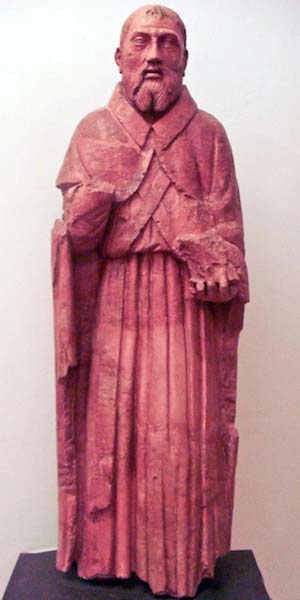
Terracotta statue of
St. Marcellinus of Ancona,
dated to the early 1300s.
The Dialogues of Pope Gregory the Great contain numerous picturesque accounts of late antiquity, all framed within his stories of virtuous men and women of Italy. In many cases, these accounts amount to the only written record of the individuals described that have come down to us from ancient times.

One of these is the curious tale of Saint Marcellinus of Ancona whose feast day is today, January 9. Here is the brief account offered by Pope Saint Gregory to his interlocutor, Peter, of a great miracle wrought by Saint Marcellinus:
GREGORY: "Marcellinus, also a man of holy life, was Bishop of the same city of Ancona [as described in the previous story of St. Constantius], who was so sore troubled with the gout, that being not able to go, his servants were enforced to carry him in their hands. Upon a day, by negligence, the city was set on fire, and though many labored by throwing on of water to quench it, yet did it so increase and go forward that the whole city was in great danger, for it had laid hold of all the houses that were next it, and consumed already a great part of the town, none being able to help or withstand it.
Click for more info.
"In so pitiful a necessity and great danger, the Bishop, carried by his servants, came thither, and commanded himself to be set down right against those furious flames, and in that very place whither the force of the fire did seem most to bend: which being done, the fire marvelous strangely turned back into itself, and as it were cried out, that it could not pass the Bishop. And by this means was it stopped from going forward, [and] went out of itself, not being able to touch any other buildings. By which, Peter, you see what an argument of great holiness it was, for a sick man to sit still, and by his prayers to quench those raging flames." 
PETER: "I do both see it and much wonder at so notable a miracle."
For this reason, the intercession of Saint Marcellinus has been invoked against fire by pious Catholics for centuries.

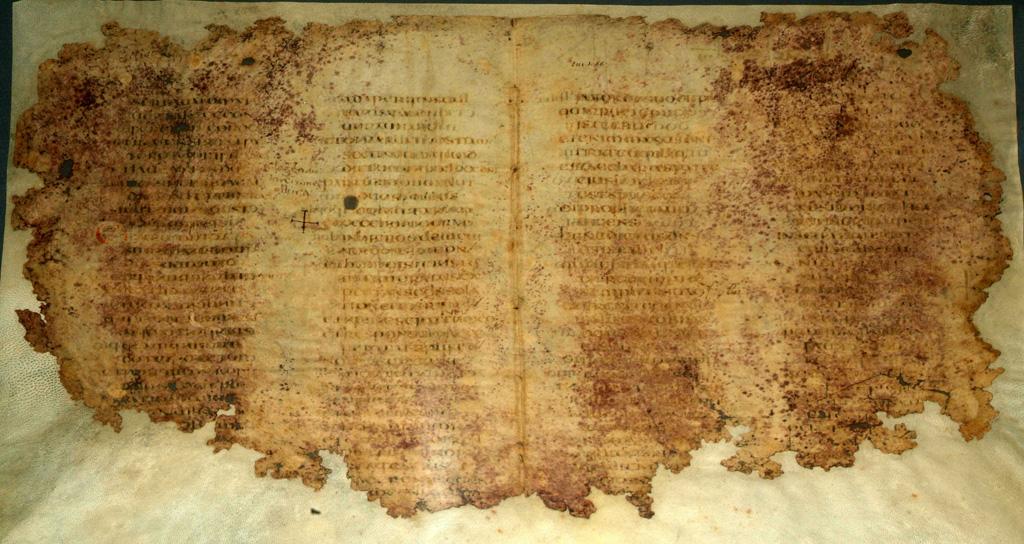
It is said in secondary sources that Marcellinus was bishop of Ancona from AD 550 through AD 566. I could not find confirmation of these dates in any of the ancient sources I am able to access, but I suppose it is based on his association with the Gospels of Saint Marcellinus, a mid-sixth century manuscript that is preserved in the Museo Diocesano di Ancona to this day.

A fragment of the 6th century Gospel manuscript associated with St. Marcellinus.
If true, it means that the fire at Ancona and St. Marcellinus's subsequent miraculous intervention, took place during Gregory's own lifetime. While he clearly heard this tale second-hand—probably from the same friends who related to him the stories of Saint Constantius of Ancona—his witness is nonetheless contemporary and therefore especially noteworthy.

Sunday, January 07, 2018

“If I am Jonah, cast me into the sea!” ~ Saint Germanus of Constantinople is deposed by Emperor Leo III

Painting of Saint Germanus, borrowed from the Mystagogy
Resource Center's Synaxarion of St. Germanos
Today is the anniversary of an act of great bravery and saintly virtue. On January 7 in the year AD 730, an important bishop resigned his office rather than sign on to the heretical demands of the secular authority. In this case, we are talking about Saint Germanus I, archbishop of Constantinople who stood up to the emperor Leo III when the latter forbade the veneration of holy icons. This was the beginning of the so-called “Iconoclast” period of Byzantine history which was to last over a hundred years until the middle of the 9th century AD.

Here is an excerpt from the near-contemporary Chronicle of Theophanes the Confessor recording the event:
In the same year, the lawbreaking Emperor Leo raged against the true faith. He brought in the blessed Germanos and began to entice him with coaxing words. The blessed chief prelate told him, “We have heard there will be a condemnation of the holy and revered icons, but not during your reign.” When the Emperor forced him to say during whose reign he said, “During the reign of Konon.”

The Emperor said, “In fact, my baptismal name is Konon.”

The patriarch said, “Heaven forbid, my lord, that this evil should come to pass through your rule. For he who does it is the forerunner of the Antichrist and the overthrower of the incarnate and divine dispensation.”

Because of this, the tyrant became angry. He put heavy pressure on the blessed man, just as Herod once had on John the Baptist. But the patriarch reminded him of his agreements before he became Emperor: he had given Germanos a pledge secured by God that he would in no way disturb God’s church from its apostolic laws, which God had handed down. But the wretch was not ashamed at this. He watched Germanos and contended with him, and put forth statements to the effect that if he found Germanos opposing his rule, he would condemn the holder of the [patriarchal] throne like a conspirator and not like a confessor.” 
Later, in the same chapter, Theophanes describes how Leo III’s decrees were received in Rome, and the final confrontation between Leo and Germanus:
Click here to share on Facebook. 
“In Byzantium, the champion of pious doctrines—the holy and marvelous priest Germanos—was in his prime, fighting against the wild beast who bore the name Leo and against his henchmen. In the elder Rome, Gregory, a holy and apostolic man who held the same throne as had the prince Peter, caused Rome, Italy, and all the west to secede from both political and ecclesiastical obedience to Leo and his Empire...

But since Germanos was under his control, Leo expelled him from his throne. Through letters, Gregory openly accused Leo of what was known to many...

On January 7, of the thirteenth indiction—a Saturday—the impious Leo convened a silentium against the holy and revered icons at the tribunal of the nineteen Akkubita [a meeting hall in the imperial palace]. But in no way would the noble servant of Christ obey Leo’s abominable, wicked doctrine. He rightly taught the true doctrine, but bade farewell to his position as chief prelate. He gave up his surplice and, after many instructive words said, “ If I am Jonah, cast me into the sea. For, Emperor, I cannot make innovations in the faith without an ecumenical conference.”

He went off to the Platanaion and went into seclusion at his ancestral home, having been patriarch for fourteen years, five months, and seven days.”
Click here for more information.
The above passages are taken from Turtledove’s translation of Theophanes which may be purchased here. This book should be on the shelf of anyone with an interest in Late Antiquity.

Leo III appointed the much more malleable Anastasius as the new patriarch. Things did not end well for him, however. After Leo’s son Constantine V was deposed by Artabasdos, Anastasius changed his opinion on icons and now opposed iconoclasm, declaring Constantine a heretic. However, once Constantine’s forces defeated the usurper and restored him to the throne, Anastasius was deposed as patriarch and severely punished, being blinded and paraded on an ass through the Hippodrome. Later, he changed his position again to favor iconoclasm, begged Constantine’s pardon, and was restored as patriarch.

Now, as we reflect upon these events from nearly 1,300 years ago, it is well to consider whether our modern Catholic leaders more resemble Saint Germanus or the weaselly Anastasius in their dealings with secular authorities.

Friday, January 05, 2018

Sound advice for parents from Saint John Neumann of Philadelphia

Click here to share this image on Facebook.

January 5 is the feast day of Philadelphia's own Saint John Neumann. If you have ever been to his shrine at Fifth Street and Girard Avenue in Northern Liberties, Philadelphia, then you know that his remains are on public display in the lower church of Saint Peter the Apostle parish. Though there are some claims that his body is incorrupt, I do not believe that's the case. In any event, his face is covered by a wax mask which is visible in the photo below.
This photo taken from here.
The biography of Saint John is available in numerous places and is familiar to many Philadelphia-area Catholics. A good brief summary of his life and works may be found by clicking here.

But to get a real sense of what Saint John Neumann was about, it's helpful to delve into some of his writings. Please enjoy the following excerpt from one of his pastoral letters. Here we see the powerful, challenging words of a Catholic prelate who took the teaching role of the bishop seriously. He spoke not words that tickled the ears or made folks comfortable in their sins. Rather, he fearlessly reminded Catholic parents of their grave responsibility to put their own wants and needs second, and to focus on nurturing goodness and piety in their children:
"Frequent the church and not the taverns.
"Banish from your homes dangerous books, the bane of purity in every age, the scourge of modern society.
"Watch over the children whom God hath confided to you, if you would not set the seal to your own condemnation. For Christ's sake who said -"Suffer the little children to come unto Me, and forbid them not, for of such is the Kingdom of God" (Mark 10:14) -- bring them to Him by your good life and holy conversation. Allow them not to grow up in ignorance and vice. Teach them to pray: to pray for all men; benefactors, friends and enemies; to love their homes, their native land, and never to be ashamed of their Religion; rather to be always ready to reply in the spirit of the noble St. Hilary to the Emperor Constantius, "I am a Catholic, I am a Christian; I will not be a Heretic."
Taken from his pastoral letter of November 4, 1854. Click here to read the full letter. 

Would to God that more Catholics, past and present, had listened to this sound advice and taken it to heart. How many of our current societal ills may have been ameliorated?

Friday, December 29, 2017

December 29 -- Feast of Saint Thomas Becket, Martyr.

Click here to share on Facebook.
Saint Thomas Becket is one of those tragic martyrs killed for the faith by political leaders who professed Christianity but acted like the most blood-thirsty, power-hungry heathens. Here is an brief account of his later life and untimely death at the hands of the servants of King Henry II of England:
"A great change took place in the saint's way of life after his consecration as archbishop. Even as chancellor he had practiced secret austerities, but now in view of the struggle he clearly saw before him he gave himself to fastings and disciplines, hair shirts, protracted vigils, and constant prayers. Before the end of the year 1162 he stripped himself of all signs of the lavish display which he had previously affected. On 10 Aug. he went barefoot to receive the envoy who brought him the pallium from Rome. Contrary to the king's wish he resigned the chancellorship.... 
St. Thomas seems all along to have suspected King Henry of a design to strike at the independence of what the king regarded as a too powerful Church....In deference to what he believed to be the pope's wish, the archbishop consented to make some concessions by giving a personal and private undertaking to the king to obey his customs "loyally and in good faith". But when Henry shortly afterwards at Clarendon sought to draw the saint on to a formal and public acceptance of the "Constitutions of Clarendon"...St. Thomas, though at first yielding somewhat to the solicitations of the other bishops, in the end took up an attitude of uncompromising resistance. 
Then followed a period of unworthy and vindictive persecution....His fellow bishops summoned by Henry to a council at Northampton, implored him to throw himself unreservedly upon the king's mercy, but St. Thomas, instead of yielding, solemnly warned them and threatened them. Then, after celebrating Mass, he took his archiepiscopal cross into his own hand and presented himself thus in the royal council chamber. The king demanded that sentence should be passed upon him, but in the confusion and discussion which ensued the saint with uplifted cross made his way through the mob of angry courtiers. He fled away secretly that night (13 October, 1164), sailed in disguise from Sandwich, and after being cordially welcomed by Louis VII of France, he threw himself at the feet of Pope Alexander III, then at Sens.... 
On 1 December, 1170, St. Thomas again landed in England, and was received with every demonstration of popular enthusiasm. But trouble almost immediately ensued....How far Henry was directly responsible for the tragedy which soon after occurred on 20 December is not quite clear.
Oral tradition has it that the king, in a rage, uttered: "Who will rid me of this troublesome priest?"
Four knights came to Thomas at Vesper time with a band of armed men. To their angry question, "Where is the traitor?" the saint boldly replied, "Here I am, no traitor, but archbishop and priest of God."
They tried to drag him from the church, but were unable, and in the end they slew him where he stood, scattering his brains on the pavement. 
Excerpted from this excellent account in the Catholic Encyclopedia. 

Wednesday, December 27, 2017

"O Solomon, I have Surpassed Thee!" ~ The Dedication of Justinian's Hagia Sophia

Click here to share on Facebook.
On this day in history - December 27, AD 537 - the Roman emperor Justinian dedicated his monumental Church of Holy Wisdom (Hagia Sophia) in Constantinople. The huge edifice was actually the third Church of Holy Wisdom built on the site, the previous one having been burned to the ground during the calamitous Nika Rebellion of AD 532. Thus, this tremendous and enduring wonder of the world was built in less than six years.

The mosaic image above shows Justinian offering the Church of Holy Wisdom to the Theotokos and Christ Child and may be seen in the south vestibule of the church above the doorway to the narthex. A more detailed history of this mosaic may be found here.

Upon entering the church during its dedication ceremony, Justinian is reported to have exclaimed, "O Solomon, I have surpassed thee!" 

Hagia Sophia's interior as it looks today.
Justinian spared no expense in beautifying the church. The late Roman historian, Procopius, writing within two decades of the church's dedication, said:
"[The Church] is distinguished by indescribable beauty, excelling both in its size, and in the harmony of its measures, having no part excessive and none deficient; being more magnificent than ordinary buildings, and much more elegant than those which are not of so just a proportion. The church is singularly full of light and sunshine; you would declare that the place is not lighted by the sun from without, but that the rays are produced within itself, such an abundance of light is poured into this church.... 
Hagia Sophia exterior as it appears today, showing Ottoman-era minarets.
 ...No one ever became weary of this spectacle, but those who are in the church delight in what they see, and, when they leave, magnify it in their talk. Moreover it is impossible accurately to describe the gold, and silver, and gems, presented by the Emperor Justinian, but by the description of one part, I leave the rest to be inferred. That part of the church which is especially sacred, and where the priests alone are allowed to enter, which is called the Sanctuary, contains forty thousand pounds' weight of silver."
Click here to read the complete account of Procopius from his book entitled, Buildings.

Monday, December 25, 2017

"Where God wills, the order of nature yields" ~ St. John Chrysostom on Christmas

Adoration of the Child by Gerard van Honthorst, ca. AD 1620.
In celebration of the feast of the birth of Jesus, here are some snippets from one of the Christmas homilies of Saint John Chrysostom, Archbishop of Constantinople in late Roman times. This homily was originally given in Greek in the late fourth or early fifth century AD. The translation was done by Maria Anne Dahlin in 2012 and made available here along with several other Chrysostom sermons on Archive.org.

These excerpts beautifully capture St. John's exuberance regarding the Nativity, a feast held in the greatest reverence because: "the event which occurred upon it, was of all events the most stupendous....That being God, [Jesus] should have condescended to become man, and should have endured to humble himself to a degree surpassing human understanding, is of all miracles the most awful and astonishing." [Walter, On Saint Philogonius, p. 198]

This particular homily is entitled: In Natalem Christi Diem -- On the Day of Christ's Birth. In it, you can get some sense of why St. John was given the epithet "the Golden-Tongued" by his contemporaries. Enjoy!
"I see a new and amazing mystery. My ears resound to the shepherds—not playing a plain song, but singing a heavenly hymn. The angels sing, the archangels harmonize, the cherubim sing hymns, the seraphim give praise, all are celebrating God seen on earth, and man in heaven. He who is above is now below because of stewardship and the one below is above because of the love for man. Today Bethlehem is a type of heaven, receiving the hymning of angels in place of the stars. In place of the sun, making room for the true sun of righteousness. And do not ask how, for where God wills, the order of nature yields. For He willed, He was able, He came down, He saved. All things meet together in God. Today he who is, is born, and he who is, becomes what he was not. For, being God, he became man without setting aside his divinity. For he did not become man by putting off divinity, nor again did he become God by advancing from man, but being the word, through impassibility, he became flesh, while remaining unchangeable by nature.... 
"Because everyone is dancing around, I also want to skip, I want to dance, I want to celebrate. But I dance, not striking the lyre, not waving a bough, not having a flute, not kindling a fire, but, in place of the musical instruments I carry the swaddling-clothes of Christ. For this is my hope, this is my life, this is my salvation, this is my flute, this is my lyre. This is why I go bearing these, because when I speak of the strength in them, I am taking strength with the message I say. Glory to God in the highest. With the shepherds, also, peace on earth, goodwill to men. Today the one who was inexplicably begotten of the Father was born of a virgin. I can not explain it, but he, as begetter, knows. According to nature he was begotten before eternity by the Father. But today, again, he was born according to nature, in this way the grace of the Holy Spirit is established.... 
"Come then, let us feast, come let us celebrate. For the guest is the way of the feast, the paradox also is the word of the begetting. For today the bond is loosed at last, the devil is disfigured, demons flee, death is loosed, the garden is opened, the curse is done away with, sin is put out of the way, the wanderer has gone astray, the truth has returned, the word of piety is spread and runs everywhere. The citizenship above is planted in the earth, angels have fellowship with men, and men speak with angels without fear. Why? Because God came to earth and man into heaven..."
Again, many thanks to Maria Anne Dahlin for making the words of St. John Chrysostom come alive again for a modern audience after 1,600 years! Click here to read the rest of this sermon and others.

Thursday, December 21, 2017

"Eight Days Before the Kalends of January" ~ The Earliest Sources for the December 25 dating of Christmas

A seated marble statue said to depict St. Hippolytus.
It's that festive time of year when those who profess not to care a whit about religion expend countless hours and billions of pixels to demonstrate that Jesus Christ was not born on Christmas. But before you succumb to their pathological zeal, take a few minutes to read some of the ancient sources from which we originally derived the date of December 25 as the nativity of Jesus of Nazareth, the Christ, the Son of the Living God.

The first clear source for this date is Hippolytus of Rome, a somewhat mysterious figure from antiquity who may have been an anti-pope of the third century AD. He was later regarded as a saint thanks to his copious theological writings. Sadly, only fragments of his works have survived to the present day, but among them is a work in which Hippolytus provides an analysis of the Old Testament Book of Daniel. The earliest notice of Christmas being celebrated on December 25 comes from this work, as follows:
"For the first advent of our Lord in the flesh, when he was born in Bethlehem, eight days before the Kalends of January [that is, December 25], the fourth day [that is, Wednesday], while Augustus was in his forty-second year, but from Adam, five thousand and five hundred years. He suffered in the thirty-third year, eight days before the Kalends of April (that is, March 25), the day of preparation [that is, Friday] the eighteenth year of Tiberius Caesar, while Rufus and Roubellion were Consuls." [Hippolytus of Rome, Commentary on Daniel, written ca. AD 205.]
Dedication page of the Chronography of AD 354.
The above passage may be found in French in Hippolyte Commentaire Sur Daniel (1947), translated by Maurice Lefèvre and included in the series Sources Chrétiennes. A detailed provenance of the manuscript may be found at the supremely useful blog maintained by Roger Pearse here.

Another early notice may be found in the Chronography of AD 354. This work is an illuminated calendar produced by an artist named Furius Dionysius Filocalus for a wealthy Roman patrician. As part of this calendar, there is a list entitled "ITEM DEPOSITIO MARTIRVM". The first line on this list says:
VIII kal. Ian. natus Christus in Betleem Iudeae.
This appears to corroborate Hippolytus's date above. Interestingly, Hippolytus is also mentioned in this calendar in a list of the Popes with a notice saying: "In that time the exiled bishop Pontianus and the presbyter Hippolytus were deported to Sardinia on the island of Vocina, Severus and Quintianus being consuls [AD 235]."

After about AD 350, overt references to December 25 as the date of Christ's birth are more numerous, particularly in the Greek east where the date seems to have been more variable before that time. Many in the east had celebrated the Nativity on January 6 -- which would later be recognized as the feast of the Epiphany. Saint John Chrysostom, later bishop of Constantinople but at this point a presbyter in Antioch, offers a meditation on preparing for the Nativity in his homily on the feast of St. Philogonios which was celebrated on December 20. Note that John clearly separates the Nativity from the feast of the Epiphany:
A feast is approaching which is the most solemn and awe-inspiring of all feasts. If one were to call it the metropolis of all feasts, one wouldn't be wrong. What is it? The birth of Christ according to the flesh. In this feast the Epiphany, holy Pascha, the Ascension and Pentecost have their beginning and their purpose. For if Christ hadn't been born according to the flesh, he wouldn't have been baptized, which is Epiphany. He wouldn't have been crucified, which is Pascha. He wouldn't have sent the Spirit, which is Pentecost. So from this event, as from some spring, different rivers flow - these feasts of ours are born. [John Chrysostom, On St. Philogonius, delivered December 20, AD 386]
In a subsequent homily that same year while still in Antioch, St. John offers evidence for the date by citing official Roman secular records of the census of Augustus mentioned in Sacred Scripture, as follows:
“The 25th day of December has been celebrated from the beginning as the birthday of Christ, and the knowledge of it is now transmitted to us….It is manifest from Scripture that Christ was born at the enrollment or census, and the very day was certain from a written document in the Roman archives….It is lawful for anyone to search these ancient records, publicly deposited at Rome, and there to learn the time of this enrollment.” [John Chrysostom, In Diem Natalem, Migne: Patrologia Graeca, 49, 353-354. Translation taken from Hyde: "The Date of Christ's Birth" in The Living Church, December 31, 1904 p. 319.]
It should be noted that several other early Christian writers, including St. Justin Martyr and Tertullian, appealed to these same census records when defending the Christian faith. The records seem to have existed into the 5th century when they were lost after the Goths and Vandals pillaged Rome.

The dating of Christmas to December 25 seems to have been well established in Africa by about this time as well. In his treatise On the Trinity, Saint Augustine of Hippo writes:
For He is believed to have been conceived on the 25th of March, upon which day also He suffered; so the womb of the Virgin, in which He was conceived, where no one of mortals was begotten, corresponds to the new grave in which He was buried, wherein was never man laid, neither before nor since. But He was born, according to tradition, upon December the 25th. [Augustine, On the Trinity, Book IV, Chapter 5, written beginning AD 400, published AD 428]
So it is clear that the roots of the December 25 date for Christmas stretch well back into antiquity.

The other common take-down posed at this time of year is that Christmas was artificially dated to December 25 to superimpose a Christian feast on top of a variety of pagan feasts which happened at around the same time, whether it be Saturnalia, or the birthday of Mithras, or the birthday of Sol Invictis, or the birthday of Horus.

This line of attack has been effectively dealt with many times, so rather than regurgitate the same refutation here, I would point you to this summary article here or this humorous video response by our separated brethren entitled: Horus Ruins Christmas. A balanced and very detailed article on this topic, entitled Sol Invictus and Christmas, is also well worth a read.

Monday, November 27, 2017

"Thou art just, O Lord, and thy judgments are righteous" ~ The deposition and execution of the Roman emperor Maurice and his family

Bronze follis showing the likeness of Maurice.
November 27 marks the anniversary of one of the most cruel and lamentable acts in all of human history -- the execution of the Eastern Roman Emperor Maurice, and five of his six sons, at the hands of the usurper Phocas in AD 602. Having been proclaimed as emperor by the Balkan army who had numerous grievances against Maurice, Phocas entered Constantinople with the assent of the people, and Maurice and the imperial family fled. Their ship was forced ashore by a storm, however, and they sought sanctuary in a church near Chalcedon across the strait from Constantinople.

According to Gibbon, whose account of the events are based largely on the History of Theophylact Simocatta and the Chronographia of Theophanes, Maurice resigned himself to prayer: 
"He patiently awaited the event of the revolution, and addressed a fervent and public prayer to the Almighty, that the punishment of his sins might be inflicted in this world rather than in a future life."
Far from comfortable on his new throne, Phocas was soon reminded of his insecurity by the factions in the Hippodrome. Gibbon continues:
"On the third day, amidst the acclamations of a thoughtless people, Phocas made his public entry in a chariot drawn by four white horses. The revolt of the troops was rewarded by a lavish donative, and the new sovereign, after visiting the palace, beheld from his throne the games of the hippodrome. In a dispute of precedency between the two factions, his partial judgment inclined in favor of the greens. 'Remember that Maurice is still alive,' resounded from the opposite side, and the indiscreet clamor of the blues admonished and stimulated the cruelty of the tyrant."
With this explicit threat offered by the fickle factions echoing in his ears, Phocas wasted no more time:
"The ministers of death were dispatched to Chalcedon. They dragged the emperor from his sanctuary, and the five sons of Maurice were successively murdered before the eyes of their agonizing parent. At each stroke, which he felt in his heart, he found strength to rehearse a pious ejaculation: 'Thou art just, O Lord! and thy judgments are righteous.'...
...The tragic scene was finally closed by the execution of the emperor himself, in the twentieth year of his reign, and the sixty-third of his age. 
The bodies of the father and his five sons were cast into the sea. Their heads were exposed at Constantinople to the insults or pity of the multitude, and it was not till some signs of putrefaction had appeared, that Phocas connived at the private burial of these venerable remains. In that grave, the faults and errors of Maurice were kindly interred. His fate alone was remembered, and at the end of twenty years, in the recital of the history of Theophylact, the mournful tale was interrupted by the tears of the audience. [Gibbon: HDFRE, Chapter XLVI]. 
In total, Maurice had six sons and three daughters. His younger sons—Tiberius, Petrus, Paulus, Justin, and Justinian—were all killed in front of him at the waterfront in Chalcedon, immediately prior to his own execution. Most of them were mere children at the time of their deaths.

Maurice's wife, Constantina, and their three daughters—Anastasia, Theoctista, and Cleopatra—were allowed to live, confined to a monastery. Three years later, Constantina would attempt a conspiracy against Phocas. Unfortunately, she was betrayed and as a result, she and her three daughters were slain on the same jetty where her husband and sons were previously executed.

Bronze follis showing Maurice and Constantina, obverse with Theodosius on the reverse.
Maurice's eldest son, Theodosius, was co-Augustus from AD 590. At the time of Phocas's rebellion in 602, Theodosius was sent to Persia to beg the assistance of Chosroes II. History says that Theodosius was apprehended by the minions of Phocas and executed a few days after his father and brothers. However, a legend relates that he survived and went into hiding. Later, someone calling himself "Theodosius" re-emerged at the side of Chosroes II who used this imposter as a pretext to invade the Roman Empire, eventually leading to the downfall of Phocas in AD 610.

Wednesday, November 22, 2017

USS Baltimore heading for home from Yokohama in 1895.

USS Baltimore flying the "Homeward Bounder" from the
foremast from Three Years Behind the Guns.
For Thanksgiving, here is an excerpt from the excellent memoir of US navy life near the turn of the 20th century, Three Years Behind the Guns. In this passage, we catch a glimpse of how landsman John B. Tisdale spent his first holidays abroad aboard USS Olympia. There is a tinge of melancholy to his words as he and his fellows watch the joyous departure of their companion, USS Baltimore, from Yokohama, flying the "homeward bounder." 

While reading, we should spare a prayer for our good and honorable service men who are spending this Thanksgiving encamped in hostile lands. May all of them be protected by the hand of Almighty God and brought safely home to their loved ones in America.
All night long, unceasingly, in feathery flakes the snow had fallen. At daybreak I should have thought the magic of the night had transplanted us to the Arctic, only there was the undeniable outline of the sacred mountain. It seemed that the old volcano had belched in the night, for the white of his crest had run down over his sides even to the water edge, while on the shore not a red tile remained. The steps of the hettabas and the roofs of our turrets were alike upholstered in ermine. From sky to sea it was one great undulating drift of snow. Specks of emerald breaking through told where the dwarf pines were buried, while streaks of crimson and gold pricked out the outline of temple and towers. I had never thought to realize the beauty of Bret Harte's snow picture in "The Outcasts of Poker Flat"—I cannot write about it; but I have seen snow.
The crisp air is invigorating, but the shoveling of snow from the decks has a tendency to take the poetry out of things, and I am bothered about the poor naked devils who live on the water. How is a handful of charcoal burning in a tea cup going to keep them from freezing to death?  
"When Music, heavenly maid, was young," she took no more joy into early Greece than the brass band that came with other belongings of a flagship, to us from the Baltimore. It plays twice a day, and in the evening it is a full orchestra, to whose strains we while away the dog watch in waltz, hornpipe, or cake walk, as the tune invites.
Last Thursday, November 28, was Thanksgiving. We had turkey on board and behaved like the Americans that we are.  
Click here for more info.
Yesterday, the Baltimore signaled to us for permission to get under way. Granted the bo's'n piped, "A-l-l  h-a-n-d-s on deck to cheer ship!" From the captain and the bandmaster, down we came. The Jackies on both ships stood on the rails or went into the rigging. From the main truck of the Baltimore streamed a "homeward bounder." It is a pennant two hundred and fifty feet long. At its tip a bladder is attached to keep it afloat when it dips to the sea. The homeward bounder has its superstitions too sacred to write, but it is the talisman that will carry the ship through wind and storm until "Safe, safe, at last, the harbor passed," she will anchor in San Francisco Bay. 
I do not quite retain the picture, for "Auld Lang Syne" from the quarter deck sounded so startlingly new to me that everything else became subdued to my wondering where and when I had ever heard it before. But my memory could muster nothing but my first night in a little white alcove, where I cried myself to sleep after mother had left me at Tyler Hall, and when the last note of the blessed song climbed the masts and the Baltimore rode alongside, the band struck up "Home Sweet Home." It was a signal for every man on the Baltimore. Their cheering drowned every other sound, while, from excess of joy, they swung their caps and threw them overboard. It was said that the bay was blue with them. I do not know. There was a mist came in just then, that made everything uncertain except that the men of the Baltimore were going home, while we are anchored here for three long, long years.
If you enjoy antique seafaring lore with a sense of humor, order a copy of Three Years Behind the Guns. It's a fun, entertaining read for powder monkeys and old sea dogs alike.

Tuesday, November 21, 2017

"The imperial majesty should be armed with laws" ~ Justinian publishes the Institutes, November 21, AD 533

Renaissance depiction of Justinian receiving the law books
from Tribonian from the Vatican Museum.
In November of AD 533, Justinian was truly in his glory. He had just heard news of his general Belisarius's victory over the Vandals at the battle of Ad Decimum outside of Carthage, and was expecting additional good tidings from the expedition to reconquer Africa. To this triumph over barbarism, Justinian would add another victory over the confusion and chaos gnawing away at the foundations of his empire by officially publishing his Institutes on November 21, AD 533.

Meant to simplify and codify the morass which the Roman legal code had become, the Institutes were to be the basic textbook of Roman law, suitable for beginning students. We can get a sense of Justinian's pride in his epochal accomplishment by reading his own words as recorded in the preface of the work:
In the name of Our Lord, Jesus Christ.
The Emperor Caesar Flavius Justinian, conqueror of the Alamanni, the Goths, the Franks, the Germans, the Antes, the Alani, the Vandals, the Africans, pious, prosperous, renowned, victorious, and triumphant, ever august,
To the youth desirous of studying the law: 
The imperial majesty should be armed with laws as well as glorified with arms, that there may be good government in times both of war and of peace, and the ruler of Rome may not only be victorious over his enemies, but may show himself as scrupulously regardful of justice as triumphant over his conquered foes. 
Justinian, relief from the
U.S. Supreme Court. 
With deepest application and forethought, and by the blessing of God, we have attained both of these objects. The barbarian nations which we have subjugated know our valor, Africa and other provinces without number being once more, after so long an interval, reduced beneath the sway of Rome by victories granted by Heaven, and themselves bearing witness to our dominion. All peoples too are ruled by laws which we have either enacted or arranged.
Having removed every inconsistency from the sacred constitutions, hitherto inharmonious and confused, we extended our care to the immense volumes of the older jurisprudence; and, like sailors crossing the mid-ocean, by the favor of Heaven have now completed a work of which we once despaired. When this, with God's blessing, had been done, we called together that distinguished man Tribonian, master and exquaestor of our sacred palace, and the illustrious Theophilus and Dorotheus, professors of law, of whose ability, legal knowledge, and trusty observance of our orders we have received many and genuine proofs, and especially commissioned them to compose by our authority and advice a book of Institutes, whereby you may be enabled to learn your first lessons in law no longer from ancient fables, but to grasp them by the brilliant light of imperial learning, and that your ears and minds may receive nothing useless or incorrect, but only what holds good in actual fact.
And thus whereas in past time even the foremost of you were unable to read the imperial constitutions until after four years, you, who have been so honored and fortunate as to receive both the beginning and the end of your legal teaching from the mouth of the Emperor, can now enter on the study of them without delay. After the completion therefore of the fifty books of the Digest or Pandects, in which all the earlier law has been collected by the aid of the said distinguished Tribonian and other illustrious and most able men, we directed the division of these same Institutes into four books, comprising the first elements of the whole science of law. In these the law previously obtaining has been briefly stated, as well as that which after becoming disused has been again brought to light by our imperial aid. Compiled from all the Institutes of our ancient jurists, and in particular from the commentaries of our Gaius on both the Institutes and the common cases, and from many other legal works, these Institutes were submitted to us by the three learned men aforesaid, and after reading and examining them we have given them the fullest force of our constitutions.
Receive then these laws with your best powers and with the eagerness of study, and show yourselves so learned as to be encouraged to hope that when you have compassed the whole field of law you may have ability to govern such portion of the state as may be entrusted to you. 
Given at Constantinople the 21st day of November, in the third consulate of the Emperor Justinian, Father of his Country, ever august.
Taken from: The Institutes of Justinian, 5th edition, 1913, translated by J. B. Moyle.

Sunday, November 05, 2017

Legalizing Marijuana is a Terrible Idea

It seems that many states, my home state of New Jersey included, are hell-bent on legalizing recreational use of cannabis. The arguments in favor of this, though loud and dominant in the media, are not particularly convincing.

Most of the advocates tout the desire to legalize the drug so that the state can raise additional tax revenue off of the sales. Enhancing the ability of an over-bearing confiscatory high-tax state like New Jersey to extract even more revenue from its citizens is never going to be a compelling argument for me.

Slightly better is the argument that legalizing the drug will result in fewer individuals in prison for usage. While I agree that we have far too many individuals in jail for such petty crimes, full-scale legalization of recreational usage seems like an over-reaction to a problem which may be fixed by simply reducing the penalties involved.

But the absolute worst argument in favor of legalization is that cannabis is harmless or somehow beneficial to users. You will find these types of claims all over websites which market marijuana-related products, and they are absolutely false and extremely dangerous. If there are any mild benefits for a healthy person using cannabis, they are far outweighed by the negatives. Sadly, the proponents of marijuana usage will often laugh off any suggestion that using their drug of choice can do harm as a return to "Reefer Madness," a supposedly comical early 20th century belief that using cannabis can cause you to go crazy.

The sad facts are these: the more research that's done, the more science has realized that cannabis usage for healthy people is detrimental, both on a personal neuro-cognitive level, and on a societal level. It is particularly bad for youth as the impact of the active ingredient in cannabis--tetrahydrocannabinol or THC--on the developing brain can be profound and long-lasting. Here is a list of articles detailing some of these findings. I would encourage anyone interested in this issue to at least skim over these studies:

Cannabis as a Neuro-Toxin:
  • Does Cannabis Cause Lasting Brain Damage? (2012)
    "Recent studies using high-resolution imaging techniques, combined with more robust delineations of specific brain regions in very heavy cannabis users, have revealed evidence of dose-related alterations, mostly in the hippocampal and parahippocampal regions."
  • Is Cannabis Neurotoxic for the Healthy Brain? (2013)
    "Our results suggest that in the healthy brain, chronic and long-term cannabis exposure may exert significant effects in brain areas enriched with cannabinoid receptors, such as the hippocampus, which could be related to a neurotoxic action."
Impact of Cannabis on Memory
Impact of Cannabis on Executive Function
(Note: Executive function is the set of mental skills that govern time management, attention, planning and the ability to cope with multiple tasks at the same time.)
Impact of Cannabis Usage on the Developing Brain
  • Effects of Cannabis on the Adolescent Brain (2014)
    "Teens who engage in heavy marijuana use often show disadvantages in neurocognitive performance, macrostructural and microstructural brain development, and alterations in brain functioning."
  • Cannabis and Adolescent Brain Development (2014)
    "Accumulating evidence from both animal and human studies suggests that regular heavy use during this period is associated with more severe and persistent negative outcomes than use during adulthood, suggesting that the adolescent brain may be particularly vulnerable to the effects of cannabis exposure."
  • Adverse Effects of Cannabis on Adolescent Brain Development (2016)
    "These data provide compelling longitudinal evidence suggesting that repeated exposure to cannabis during adolescence may have detrimental effects on brain resting functional connectivity, intelligence, and cognitive function."
Societal Impact of Cannabis Legalization
While the above articles are mostly from scholarly journals, here are some news stories on the impact of cannabis legalization is having on society, largely from mainstream media sources that are otherwise favorable toward legalization:
The message here is that even if voters and state legislatures are stupid enough to legalize this substance, if you care about the health of your brain, you would do well to avoid smoking weed. Fears of "reefer madness" may be overblown, but the conventional wisdom regarding the degraded behavior and reduced prospects of "pot heads" is pretty much on the money.

And let's not forget the ulterior motives of politicians and businesses who are looking to reap the benefits of legalization. Do they really care about the health and safety of the people they supposedly serve? Or are they simply looking for a way to make society more docile, stupid and ultimately easier to rule, while raking in big money? On this question, history is instructive:

A Disgraceful Little War -- The Opium War and Commissioner Lin