Showing posts with label naval warfare. Show all posts

Monday, March 14, 2022

"For many a year they will remember the two stout galleons of Manila." ~ The victory of the Spanish over the Dutch at the Battle of Naval de Manila, AD 1646

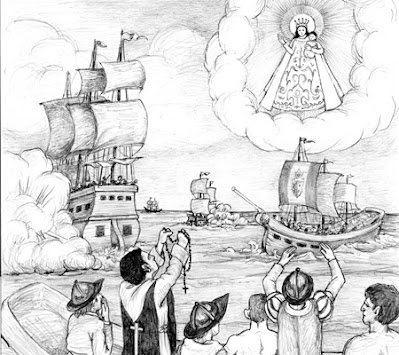
Illustration showing the Battle of Naval de Manila to appear in The Story of the Philippines. 

The more one delves into history, the more one is humbled by what one doesn’t know. Case in point...

March 15 is the anniversary of the beginning of a naval campaign fought between two colonial powers in the year 1646 half-a-world away from Europe. 

Having grown up in an English-speaking country, I often catch myself adopting the conventional historical view of the British navy as presented in literature and film as an unconquerable force. Their most common foes—the Spanish and the French—are normally presented as formidable but hapless. They are numerous enough to appear to be a challenge, but ineptitude, laziness and cowardice always lead to their undoing. This perspective creates an impoverished knowledge of naval history which tends to ignore instances where the naval arms of nations not Britain achieve great victories.

One such victory which I have only encountered very recently (while editing a forthcoming book entitled The Story of the Philippines by Phillip Campbell) is La Naval de Manila—a series of naval battles between the Spanish and Dutch in the Philippine archipelago that decided which European power would rule the Philippines for the next 250 years. Featuring an earthquake, desperate acts of courage, five against-all-odds battles, and a healthy amount of divine intervention, La Naval de Manila has all the elements of a fine epic novel, let alone a thrilling action-adventure movie.

The battle pitted a fleet of eighteen well-armed Dutch corsairs against the scanty forces that the Spanish could assemble to meet the threat. The aim of the Dutch was nothing less than to wrest the Philippines from the Spanish and capture their treasure fleet from New Spain (Mexico). To accomplish this feat, the Dutch organized their ships into three squadrons. These were meant to coordinate their attacks at separate points and thereby spread thin what little defense the Spanish could muster.

Further hampering the Spanish, the capital city of their Philippine possessions—Manila—was a wreck, literally. The city had been rocked four months before by a tremendous earthquake as well as several aftershocks. Describing the magnitude of the quake, Fr. Joseph Fayol, an eyewitness, wrote:

In the first shock, one hundred and fifty of the finest buildings, which in other cities would be called palaces, were totally destroyed; all the other houses were so damaged and dangerous that it has been necessary to demolish them completely. It may be said with truth that only a semblance of Manila remains....Whole Indian villages were overthrown, as their huts are built of so light materials, bamboos and palm-leaves; and hills were leveled. Rivers were dried, which afterward flowed again; others leaving their beds, inundated the villages; great fissures and even chasms, appeared in the open fields. In the Manila River, the disturbance and commotion in its waves was so great that it seemed as if they would flood all the country. [Fayol, Relation of the events on sea and land in the Filipinas Islands...]

To meet the Dutch threat, the Spanish pressed two huge galleons into service, the Encarnación and the Rosario. These already ancient vessels had recently arrived from the arduous journey from Nueva España and were in rough shape. Though ponderous, these great ships possessed a powerful array of weaponry, which was further augmented by guns stripped from forts on land, as described by Fr. Fayol:

In [the Encarnación] were mounted thirty-four pieces of artillery, all of bronze and of the reinforced class, which variously carried balls of thirty, twenty-five, and eighteen pounds. The [Rosario] was equipped with as many as thirty pieces, of the same capacity—although on account of the deficiency in this sort of artillery, it was necessary to dismantle some posts in the fortifications of this city and of Cavite.

The governor-general of the Philippines, Don Diego Fajardo, chose General Lorenzo de Orella as commander and chief of the Spanish squadron. Fr. Fayol offers this heroic description of Don Orella:

...General Lorenzo de Orella y Ugalde, a Biscayan, under whose charge the vessels had sailed from Acapulco [was chosen] not only because of his proved bravery, his experience in the art of war, and his services and commands in both the Northern and Southern Seas, as well as in these islands (particularly in Mindanao, where he fought hand-to-hand with a gigantic Moro and killed him), but because of his well-known Christian spirit of modesty—which, for success, are no less important than valor.

Not trusting to mere earthly power, however, Don Fajardo agreed to allow four priests to accompany the flotilla, two in each ship. As both ships bore religious names, they were sent forth under the protection of Our Lady, the Virgin Mary. Fr. Fayol explains:

As a result of excellent teaching and the fervor of these fathers, arrangements were made that all of the men should, in the first place, purify their consciences with the holy sacraments of penance and communion; that they should take as their special patron saint the Virgin of the Rosary; that in order to bind her further, they should vow to her a feast-day in thanksgiving for the victories which they expected to receive through her agency; and that every day all should recite their prayers aloud, on their knees, and in two choirs—the prayers of the rosary before our Lady's image, the litanies of the most holy name of Mary, and finally an act of contrition.

Beyond these acts of piety, Don Fajardo caused the Blessed Sacrament to be exposed in several churches throughout Manila from the time of the departure of the galleons until their expected return. 

When all was made as ready as temporal and spiritual efforts would allow, the Spanish ships boldly sallied forth to meet the more numerous Dutch in what should have been a very lop-sided affair. However, as Fr. Fayol admits, the Spanish had one thing going in their favor. The hoped-for coordination of the Dutch fleets failed and each one arrived on station at different times, allowing the Spanish the opportunity to fight each of them in detail. The first fleet arrived in Spanish waters in early March and were detected by the Spanish on March 15. Fr. Fayol provides an excellent account of the battle which followed, and I am only too happy to allow his voice to describe the proceedings:  

On arriving at the entrances of Mariveles, the [Spanish] ships were placed in battle array, the artillery loaded, the matches lighted and the linstocks ready, the rigging free, and other preparations made. This was done because the sentinels [on Mariveles Island] warned our men that the enemy were, with their squadron, not far from that place; and that they might expect at any moment to encounter the Dutch—although in fact the latter were not descried until the fifteenth of the said month of March. At nine o'clock in the morning of that day, our almiranta [the Rosario] which had pushed ahead of the flagship perhaps half a league, and was sailing with a northwest wind—fired two cannon-shots and lowered the maintop-sail as a signal that it descried the enemy. The flagship put about, and followed her, and from the maintop they soon saw a sail in the distance, but it was impossible to overtake it; and it soon disappeared, because it was favored by a fresher wind than our ships had.

After that, our galleons were left becalmed until one o'clock; and at that hour were descried from the flagship four hostile sails, which were sailing toward her aft, with an east wind. It was two hours before they reached the flagship, and in that space of time the men were stationed, the ships cleared, the posts reconnoitered, and all other arrangements made, both spiritual and temporal, required by the occasion. The almiranta fell two ship-lengths astern of the flagship, and in this position the ships awaited the enemy, in order to fight them.

As soon as the enemy came near, they extended all their ships, and without attempting to give a broadside to our flagship, passed, in line to larboard, and the enemy's flagship began the battle by firing a cannon. Our commander immediately commanded that response be made with two shots—one with a thirty-pound ball and a cylinder of the same weight, which tore open all their cutwater at the bow. The enemy's ship went on in this condition, and the others continued to exchange shots with our flagship. Recognizing their own strength, the enemy tried to approach the almiranta, which they supposed was not so well armed, being a smaller ship. But they were received with equal valor and spirit on our side, our vessels firing so often and throwing so many balls that they could not be counted.

The fight lasted about five hours, and the mortality and damage were so great that all the anxiety that the heretics had felt to reach our ships when they thought to conquer us was now directed to separating themselves from us. They anxiously awaited the night, which was now approaching, to make their cowardly escape, which they did with lights extinguished. But the enemy's almiranta did not succeed in doing this in safety. It had been the most persistent in the attack upon our flagship, and remained to our leeward. It was so badly damaged that its cannon could not be fired, and hardly could it flee. Our ship was so near it that our commander had the men ready at the bow to board the Dutch ship, but the darkness of night forced us to abandon the chase, on account of the danger from the shoals which the pilots declared were in that place. It was noticed that the enemy did not use lanterns as they had formerly done, seeking protection for their armada. Our commander ordered that they be used in our ships, and that the lights be allowed to shine very brightly, in order that the enemy might come to look for us.

Our people fully intended to renew the pursuit at daybreak, to finish their defeat, but when day came our two galleons found themselves alone, and did not know what course the enemy had taken. They followed the Dutch, in the direction which they thought most probable, as far as Cape Bojeador, which is at the farthest end of this island of Manila. From there our ships returned, as the coasts were now secure, to the port of Bolinao, in order to send to this city dispatches announcing the result of the battle.

This was regarded as a brilliant victory, not only because of the disparity in the number of ships, but because of the little damage our side had sustained. In that battle not a man was killed, and comparatively few were wounded. It was evident that the enemy's loss was great, although we could not then ascertain it correctly. But afterwards we learned that many had been killed and wounded, and that two of their vessels were rendered useless. 

This Spanish victory was only the first in a series of battles which would take place over the next seven months. In each, the elderly Spanish galleons would prove too much for their nimble Dutch adversaries, continuously repulsing their attacks but proving too slow and poorly manned to capture them. 

After the third battle, Don Orella retired and was replaced by Don Sebastian Lopez who was in command of the Spanish ships when the Dutch made their final effort in October of 1646. This battle again ended in failure for the Dutch whose flagship was barely able to escape after a severe mauling. This repulse effectively ended Dutch pretensions in the Philippines. Fr. Fayol concludes his accounts of the battles, saying: 

All these exploits are worthy of great praise...According to the estimate made by well-informed persons, although we fired, in these battles, over 2,000 cannon-shots, and the enemy over five thousand, we had only fourteen killed, and comparatively few wounded. While the enemy, besides the vessels which we sank, arrived at their forts so damaged, and had lost so many men, that for many a year they will remember the two stout galleons of Manila....

Thanksgiving was celebrated by a solemn fiesta, a procession, divine worship, and [a parade of] the squadron, with other demonstrations in fulfillment of the vow made to the Virgin of the Rosary, the city making a new vow to continue this anniversary every year.

[All of the above quotes are taken from Fray Joseph Fayol's Relation of the events on sea and land in the Filipinas Islands during the recent years, until the earthquake and destruction on the feast of St. Andrews in 1645; and the battles and naval victories over the Dutch in 1646. The English translation of this work is taken from The Philippine Islands, 1493-1898, Volumes 34-35, edited by Emma Helen Blair, James Alexander Robertson, 1906.]

The image of Our Lady of La Naval de Manila.
And indeed, this the Fiesta of La Naval de Manila continues to be celebrated in the Philippines to this day. The feast includes a procession of the statue of Our Lady of the Most Holy Rosary of La Naval de Manila, a life-sized figure of the Blessed Virgin that predates the battles, having been carved from elephant ivory in AD 1593. A look at the historical celebration of this feast and the statue of our Lady may be found here

Given the circumstances of the battles, the victories were declared miraculous in nature by the Archdiocese of Manila in 1662. Pope St. Pius X bestowed a canonical crown upon the image in 1907, while Ven. Pius XII recognized the image in an Apostolic letter sent on the 300th anniversary of the victories in 1946. Pope St. John Paul II blessed the statue at a public Mass during his visit to the Philippines in 1981.

Wednesday, April 25, 2018

Prelude to the Battle of Manila Bay -- Late April, 1898

Dewey's flagship Olympia in Hong Kong, painted gray and ready for battle.
This week less 120 years, the protected cruiser USS Olympia was in Hong Kong. The crew was on tenterhooks waiting for word that war had been declared between the United States and Spain. Once that happened, England, China and Japan would become neutral, thus denying Olympia and her squadron a friendly port nearer than San Francisco.

As it happened, when war was declared, Olympia would sail for an unfriendly port -- Manila in the Philippines -- which for nearly 400 years had been a colony of Spain. While waiting in Hong Kong, Commodore Dewey wasted no time preparing his ships for the expected order to sail in battle array.

Following is an excerpt from the memoir Three Years Behind the Guns, which gives the sailor's point of view of the impending clash:
The little commodore has kept us jumping, and we are ready for whatever may come, and already the men are shouting, "Remember the Maine!"

One morning I saw the ship s painter come out from the commodore s cabin, carrying a long, three-inch wide board painted in various shades of neutral greens or grays. When I asked him what they were for, his answer was both unsatisfactory and inelegant, but the following morning at breakfast the uniform announced throughout the squadron was "old working clothes" and then the boatswain piped, "A-l-1 h-a-n-d-s paint ship."

That was on the morning of April 19. By noon ships, masts, boats, launches, guns, and everything, had been treated to a coat of "war paint," which, in the United States navy, is dark gray. Unless one has witnessed the painting of a man-of-war it is difficult to imagine how quickly it can be done. There are barrels of paint all mixed and ready before the order is given, and in ten minutes after, the ship is literally manned with painters. The last painting has transformed our beautiful squadron which had gathered together like a flock of white swans wearing red favors, into a flock of ugly ducklings sulking upon the water; everything save our spirits and our flags were the color of lead.

As soon as the Baltimore reaches Yokohama she will hear the news and hasten to us, and then?

She came in early one morning, was rushed through coaling and painting, and at the request of the governor of Hong-Kong, all hands together sailed away while the men on England's war-ships cheered us as we passed them.

We are cut off from everybody, aliens in a foreign country, but it can't last long. There is going to be something doing.

It was past noon on the twenty-seventh [of April] when our fleet, nine ships all in battle array, was sailing to sea under sealed orders, and with nine crews bursting with expectancy. At five o clock the Olympia's crew was piped to quarters, where we listened to the reading of the following:

COMMODORE DEWEY:

Proceed at once to Manila; engage and destroy the Spanish fleet, when and where you find them.

WM. McKINLEY, President, United States of America.

Click for more info.
We went mad with joy. The news was signaled from ship to ship, and before we turned in that night a new battle-flag was begun and finished. The placing of the stars proved that we had a representative from each State in the Union. I wrote California and my name on the back of one and sewed it on.

But there was more to do than just the making of flags. Next morning the order: "Clear for action" was given in earnest, and things we never thought we could exist without went over board.

From the Chinese-Japanese war we learned that more men were killed by splinters than by shell, and it was rumored the diddy-box must go, but the little Commodore, with the fate of a nation fluttering in his hand, came to our rescue. He said it would be an outrage to take from a man the only thing the Navy allowed him to hold sacred, and he asked that we be permitted to stow them below the protective decks so, here you go! Good-by, Diddy, until until we meet again.
What happened thereafter may be read here: "Open with all guns!" The Battle of Manila Bay, May 1, 1898. If you would prefer a reading of John Tisdale's account from Three Years Behind the Guns, check out this video:

Wednesday, November 22, 2017

USS Baltimore heading for home from Yokohama in 1895.

USS Baltimore flying the "Homeward Bounder" from the
foremast from Three Years Behind the Guns.
For Thanksgiving, here is an excerpt from the excellent memoir of US navy life near the turn of the 20th century, Three Years Behind the Guns. In this passage, we catch a glimpse of how landsman John B. Tisdale spent his first holidays abroad aboard USS Olympia. There is a tinge of melancholy to his words as he and his fellows watch the joyous departure of their companion, USS Baltimore, from Yokohama, flying the "homeward bounder." 

While reading, we should spare a prayer for our good and honorable service men who are spending this Thanksgiving encamped in hostile lands. May all of them be protected by the hand of Almighty God and brought safely home to their loved ones in America.
All night long, unceasingly, in feathery flakes the snow had fallen. At daybreak I should have thought the magic of the night had transplanted us to the Arctic, only there was the undeniable outline of the sacred mountain. It seemed that the old volcano had belched in the night, for the white of his crest had run down over his sides even to the water edge, while on the shore not a red tile remained. The steps of the hettabas and the roofs of our turrets were alike upholstered in ermine. From sky to sea it was one great undulating drift of snow. Specks of emerald breaking through told where the dwarf pines were buried, while streaks of crimson and gold pricked out the outline of temple and towers. I had never thought to realize the beauty of Bret Harte's snow picture in "The Outcasts of Poker Flat"—I cannot write about it; but I have seen snow.
The crisp air is invigorating, but the shoveling of snow from the decks has a tendency to take the poetry out of things, and I am bothered about the poor naked devils who live on the water. How is a handful of charcoal burning in a tea cup going to keep them from freezing to death?  
"When Music, heavenly maid, was young," she took no more joy into early Greece than the brass band that came with other belongings of a flagship, to us from the Baltimore. It plays twice a day, and in the evening it is a full orchestra, to whose strains we while away the dog watch in waltz, hornpipe, or cake walk, as the tune invites.
Last Thursday, November 28, was Thanksgiving. We had turkey on board and behaved like the Americans that we are.  
Click here for more info.
Yesterday, the Baltimore signaled to us for permission to get under way. Granted the bo's'n piped, "A-l-l  h-a-n-d-s on deck to cheer ship!" From the captain and the bandmaster, down we came. The Jackies on both ships stood on the rails or went into the rigging. From the main truck of the Baltimore streamed a "homeward bounder." It is a pennant two hundred and fifty feet long. At its tip a bladder is attached to keep it afloat when it dips to the sea. The homeward bounder has its superstitions too sacred to write, but it is the talisman that will carry the ship through wind and storm until "Safe, safe, at last, the harbor passed," she will anchor in San Francisco Bay. 
I do not quite retain the picture, for "Auld Lang Syne" from the quarter deck sounded so startlingly new to me that everything else became subdued to my wondering where and when I had ever heard it before. But my memory could muster nothing but my first night in a little white alcove, where I cried myself to sleep after mother had left me at Tyler Hall, and when the last note of the blessed song climbed the masts and the Baltimore rode alongside, the band struck up "Home Sweet Home." It was a signal for every man on the Baltimore. Their cheering drowned every other sound, while, from excess of joy, they swung their caps and threw them overboard. It was said that the bay was blue with them. I do not know. There was a mist came in just then, that made everything uncertain except that the men of the Baltimore were going home, while we are anchored here for three long, long years.
If you enjoy antique seafaring lore with a sense of humor, order a copy of Three Years Behind the Guns. It's a fun, entertaining read for powder monkeys and old sea dogs alike.

Friday, August 04, 2017

Civil War Vets Aboard the Cruiser Olympia ~ Seamen Purdy and McCue Re-fight their Ancient Battle

Seaman Gilbert Purdy (standing) spinning yarns in 1888 at the age of 60.
He would serve until 1900.
As the US Navy transformed in the 1890s from an obsolete coast-defense force to a modern, sea-going steel fleet, there remained aboard the ships a few ancient salts who had been in the service as far back as the Civil War. Aboard the protected cruiser Olympia in 1896 were two men who had fought on opposite sides: Seamen Purdy and McCue. Indeed, Purdy had been aboard the USS Kearsarge and McCue aboard CSS Alabama when the two fought their famous duel off Cherbourg in 1864.

Following is an excerpt from the book, Three Years Behind the Guns, a rollicking, page-turning memoir originally written in 1908 by John Tisdale, where we meet Purdy and McCue. Though both elders now serve together aboard the flagship Olympia, the old wounds of the ancient conflict still rankle and occasionally burst into flame again more than 30 years later.

But though both men still feel the call of duty to their very marrow, they also see the day coming when they will disembark for good. Thus their yarns often turn to more contemplative, spiritual concerns.
SONG
The Kearsarge and the Alabama
It was early Sunday morning
     in the year of sixty-four.
The Alabama she cruised out
     along the Frenchman’s shore.
Long time she cruised about,
     long time she held her sway,
But now beneath the Frenchman’s shore
     she lies in Cherbourg Bay.
CHORUS
Hoist up the flag, boys.
     Long may she wave!
God bless America,
     The home of the brave!
This is one of about forty verses of an historic ballad. Old Purdy hums them over as he attends to his light duties as captain of the hold, or occasionally by request, sings them out lustily at the dog-watch. When Seaman McCue chances to be in a spiritous turn of mind he joins in the chorus.

Purdy and McCue! Living relics of the greatest naval battle of our Civil War. It is thirty-three years since they fought, one on the Kearsarge, the other on the Alabama. They were young men then, each defending a principle.

McCue was of the number picked up out of the water by the English yacht, Deerhound, when the Alabama went down with her flag of truce. The destruction of his beloved ship left a wound on the heart of the seaman that never healed. The war ended. Returning to his native land, he found the Confederacy dead and buried while a vital longing for the sea was consuming him. Reasoning that, though wronged, he had always been an American, he enlisted in the United States navy, where he has remained in uninterrupted service ever since.

Click for more info.
Seaman McCue (as he insists upon being called) is a little man with bright blue eyes peeping like spring violets through snowdrifts, for his hair and beard have retained the abundance of youth, though silvered to whiteness by the spray of the fleeting years. How many they have numbered none dare to ask, as Seaman McCue’s distaste for age is made manifest whenever he speaks of his old shipmates now serving on the Independence. They are invariably referred to as “the Guardo Stiffs.” Poor old seaman! It will break his heart, but I sadly fear this will be his last cruise. He is efficient in his duty—sweeping the starboard side of the gun-deck, where his life is rendered as miserable as a pack of young sea devils can make it. As fast as he sweeps someone tears and scatters papers after him just to hear him swear, and yet when the day came that we noticed Mac totter on the boom, and he took to coming from the cutter by the gangway, it was whispered he would be exchanged to one of the ships going home—it was then his tormentors came to his rescue.

They begged the officer to excuse him from pulling an oar, as someone off duty would do it for him. The officer hesitated a moment, when Young, editor of the Bounding Billow, the ship’s paper, and one of the keenest thorns that had pricked him, jumped into the old man’s place, and, lifting his oar, said, “I will pull for Seaman McCue for one hundred years.”

Mac has never uttered one word of thanks. Indeed, he showed much the same disposition he did on the morning of Admiral McNair’s first inspection. Coming upon him in the ranks, the admiral said: “Well, Seaman McCue, I think it about time we old fellows should be excused from duty.” But I think the act of Young entered into his heart, for, although there was little perceptible change in his general bearing, I think he went oftener to church, and I am sure he responded more willingly to the boys entreaty for a sea yarn.

Of Purdy? He must have been a giant when he manned the guns of the Kearsarge, but today he is bent at the waist, and the surfs of time have whitened him even as they have his shipmate.

One’s first sight of Purdy is startling, for in the middle of a high forehead there gleams a bright blue star, visible and outward sign of the star gang.

After the victory over the Alabama, twenty of the Kearsarge crew in solemn covenant swore they would never desert the navy while Uncle Sam had a plank afloat, and to render the vow binding they each consented to be tattooed in a manner that would unfit them for any other station in life. Purdy is the only member of the gang I have seen. I understand there are five or six of them still on the sea.

Purdy and McCue fighting their
battle over again.
These men are not only living relics of a great battle; they are animated encyclopedia of the navy, looking with small favor on modern warfare, jumping at an opportunity to refer to the good old times when they had “iron men and wooden ships,” leaving the inference that we are wooden men on iron ships. These are two of our veterans quietly filling the niches that Time has carved for them; but it is only necessary for some jolly young tar to say: “Today is the nineteenth of June,” directly the dead embers of dissension kindle into a flame amidst whose crackling may be heard the hissing sound of “rebel,” “liar,” “white flag,” and “traitor,” intermingled with seamen’s curses—an unfailing prelude to a rough and-tumble, hand-to-hand fight that might continue to the bitter end were it not that the tormentors who start the fray always step in and separate them. The next day they are as good friends as ever.

It is entirely out of deference to these veterans that I have had the Kearsarge and the Alabama tattooed on my right arm. And it is these good ships that will bear me, when I am old, away from the humdrum of life’s cares back to the blue, blue ocean where I will set me down to rest upon the fluke of a kedge anchor and hearken again to the simple stories told in good faith by Neptune’s own sons. I will listen to Seaman McCue’s deep sea voice as he tells again that he goes to church, not because he believes the Lord is always there, but because He might drop in during divine service, and when the roll was called he would hate to salute and answer “Absent, sir.”

But his faith in the divine presence on the old frigate California is like adamant. Mac was on her for three years, and during that time neither tide nor current had the least influence upon her. Anchor where they might, contrary to all natural laws she always turned her stern to the stream. What caused it? Nothing but the presence on board of the Savior of Men, Who was so angry when the proud ship was ignominiously sold into civil service that He then and there forsook her, and from that hour she turned about and swung with the stream just like other ships. Should one manifest a doubt he will say, “I suppose you would dispute the coming of Paddy White’s ghost for his Christmas rum on the Independence, even if you saw him with your own eyes flying like a white crane out of the cemetery back of the old powder magazine.”

And when I have smiled again at these homely tales from the lips of McCue I will recall that it was Purdy who first opened my eyes to a full understanding of the distress of the Ancient Mariner.

It is his firm belief (and he is not alone in it) that in every bird of the sea there dwells the immortal soul of a sailor.

Whenever I see the old man silently watching the sea-fowls as they skim over the waters I know that he is communing with his old shipmates. These hallucinations are so perfectly harmless, so rapturously enchanting, that I gave rein to my own fancy, and in its flight I recognized in the black-ringed gull upon the foretruck the reincarnation of the bo’s’n of the Kearsarge, and in the whispering winds in the rigging heard him shout: “Cast loose and provide,” just as he piped on the morning of June 19, 1864. 
I was unable to track down any additional information about Seaman McCue, but stories about Purdy are plentiful. In fact, there’s a page devoted to him on the Spanish-American War Centennial website. More info about Seaman Purdy may be found at TogetherWeServed.

Both of these fellows deserve our remembrance and prayers.

Olympia at Hong Kong, April 1898, painted dark gray prior to sailing for
the Philippines less than a month later.

Thursday, July 20, 2017

Three Years Behind the Guns of USFS Olympia

I am happy to present the preface for a brand new edition of the classic Three Years Behind the Guns. Originally published in 1908, this book is a gritty, rambunctious memoir describing a young sailor's life aboard USFS Olympia from 1895 through 1898, including his first-hand account of the battle of Manila Bay.

The book is a treasure, and anyone with an interest in naval history in general, or the museum ship Olympia in particular, should read it. The publisher is donating part of the proceeds to the upkeep of the ship.


Click here for more info. 
May 1, 1898 is often cited as the exact date when the United States of America transformed from a relatively minor regional power, to a bona fide player on the world stage. On that day, the U.S. Asiatic Squadron under Commodore George Dewey in his flagship Olympia, utterly crushed the fleet of the fast-fading Spanish empire at Manila Bay in the Philippines.

Though it was penned during these heady days, Three Years Behind the Guns is not so much a chronicle of this turning point in history, as it is the unique perspective of one young sailor on the events leading up to it. It is a pithy memoir of life aboard a man-o’-war as the age of “wooden ships and iron men” was giving way to the era of big guns, heavy steel, and high speed. Of these new ships, the protected cruiser Olympia was both a prototype and an outstanding example. Though our author is the main character of this memoir, U.S.F.S. Olympia is the leading lady.

Little is known about the author of Three Years Behind the Guns. On the earliest editions of the book, he is listed cryptically as “L. G. T.” In later editions, he is identified as “Lieu Tisdale.” A check of Olympia’s crew roster at Manila Bay, however, reveals no one of that precise name. Instead, there is a listing for “John B. Tisdale, Landsman.” This is probably our fellow, given that within the book itself, he is addressed on numerous occasions as “Jack” by his shipmates, a Japanese girl, and even by himself while soliloquizing. The reason he chose to publish the book anonymously is unknown. [Olympia's crew roster at Manila Bay may be found here.]

Since the days of Ulysses, sailors have been known for their tall-tales, and our Jack is no exception. His numerous anecdotes sparkle with wit and verve, even when they sound suspiciously apocryphal. The reader will find literal fish-stories here—such as when Jack captures a two-foot-long flying fish on the deck or when a shipmate nearly loses a toe while doing some illicit angling. But there are also descriptions of more somber events that are easily verified by outside sources, such as the death Coxswain John Johnson who was killed during gunnery practice, and the wreck of the steamer On-Wo with the loss of 255 passengers and crew. Jack and his Olympian crewmates pulled 38 survivors from the water and were commended for their efforts.

Olympia in a typhoon.
Perhaps the most impressive thumbs-up for the memoir’s authenticity comes from none other than Admiral Dewey himself, the hero of Manila Bay. In an antique advertisement, the admiral provides a generous endorsement of the book, saying: “Many of my friends and I have read it with the greatest interest. I can vouch for many of the facts; and the description of the Battle of Manila Bay is one of the best I have ever seen published. The type and active life of our American seamen is well and interestingly portrayed, and the book is well worth the attention of both young and old.”

When originally published in 1908—ten years after the battle—Jack’s anonymous memoir met with critical acclaim. The New York Times called it: “An intimate record of life aboard an American man-of-war, and is written with such detail, vivacity, and the knack for vivid expression that it keeps one turning pages until the last one is reached. This Jackie has keen eyes and quick ears, and can put the things he saw and thought about into particularly vigorous English.”

The New York Observer added: “Though sufficiently simple and direct in style to hold the interest of the young reader, this book will be found by grown-ups to be absorbing as a novel.”

When first published, the book was billed as a behind-the-scenes look at life aboard a modern American warship at a time when the U.S. was building giant dreadnought battleships by the dozen and recruiting thousands of young fellows to man them. But time and technology were flying by and within another decade, the catastrophe of the Great War had thrown into eclipse the comparatively minor incident of the Spanish-American War. The subsequent epic struggle of World War II with its colossal ships, ocean-spanning battles and city-shattering weaponry made Dewey’s victory at Manila Bay seem as ancient and obscure as Trafalgar or Salamis.

I believe that the modern reader, particularly the student of history, will find Three Years Behind the Guns even more captivating than the reader of 110 years ago. For young readers of today whose grandparents were born during the 1950s, reading about life aboard a warship from the 1890s is like a visit to an old Victorian mansion. If you’ve toured Dewey’s Olympia in Philadelphia where she exists to this day, you know that is a literal truth. The lovely dark wood paneling and antique furniture in the officers’ quarters contrasts sharply with the painted steel and spartan decks of the crew areas, and the grime and oppressive atmosphere of the engineering spaces. This is the scene where the authentic “steam punk” of Tisdale’s story plays out, complete with coming-of-age hijinks, grinding machinery, clouds of black smoke and moments of sad contemplation.

Like Olympia herself, Three Years Behind the Guns is a hybrid—part solid fact, part work of art. Both ship and book are unique historical artifacts of a bygone era, which is one of the reasons why a portion of the sales of this book will be donated to the continuing upkeep of U.S.F.S. Olympia and her steward, the Independence Seaport Museum in Philadelphia. Such beautiful mementos deserve to be maintained if for no other reason than as concrete reminders of how we got here.

A sailor on board Olympia.
This new edition of this classic work will be published in a format that is easily accessible for modern readers. The text is practically untouched from the original. Jack’s unique voice and witty observations come through loud and clear as they did over a century before. His vivid account breathes life into Olympia which he knew not as a retired museum ship, but as the powerful, hardy seahawk that she was in her prime. “The flag-ship is a thing alive,” he wrote. “It has parts and being. We have heard it breathe, and who will question that in Captain Reed, it has both brain and soul?” 

Tisdale originally dedicated Three Years Behind the Guns to “every man who has walked the decks of a man-of-war.” This new edition should be dedicated in particular to the repose of the soul of John B. Tisdale. He was a man who not only walked the decks, but who recorded his impressions with such trenchant good humor and eloquent detail, that people a century and more afterwards might feel as if they are walking along right beside him.

Indeed, if you every find yourself aboard Olympia, go and look for him. You may glimpse his shade still standing faithfully at his post—behind the guns.


To pre-order Three Years Behind the Guns on Amazon.com (due to publish, July 28, 2017), click here.

Friday, May 26, 2017

Footage of the Bismarck firing upon the Hood, and Bismarck under fire from the British fleet

HMS Hood in 1941.
Seventy-six years ago between May 23 and 27 played out one of the great dramas of World War II -- the breakout of the Nazi super-battleship, Bismarck, the sinking of the battlecruiser HMS Hood at the Battle of Denmark Strait, and the subsequent frantic pursuit and destruction of the Bismarck by the British navy under almost miraculous circumstances.

I recall reading the accounts of the battle when I was a kid, accompanied by black-and-white photos of the ships involved, including the British battleship HMS Prince of Wales and the German heavy cruiser Prinz Eugen. Now, in the age of YouTube, I was amazed to discover recently that footage of the Battle of Denmark Strait exists to this day, taken originally by a camera crew on board Prinz Eugen.


This silent film gives the viewer a front-row seat to the battle, which took place May 24, 1941. Beginning at about the 2:30 mark, one can see the tremendous flash as Bismarck fires her main guns, followed by the smaller bursts of her secondary batteries opening up. Also visible are the huge columns of water thrown up by the British shells from Hood and Prince of Wales missing nearby. It's easy to get a sense of the heaving of the seas and the anxiety of the camera crew who must have considered that their lives could be snuffed out in an instant should any of those 1,000 pound armor-piercing shells hit their ship.

Bismarck fires a salvo during the
Battle of Denmark Strait.
At the 3:32 mark of the film, the focus shifts from Bismarck to an ominous cloud of smoke on the horizon where the HMS Hood was but seconds before. Impact from one of Bismarck's 15-inch shells had ignited her aft magazines, destroying the great ship in mere moments and sending over 1,400 souls to a frigid grave in depths of the north Atlantic. Only three men survived. Flashes may be seen erupting from the cloud and it's hard to say if they are secondary explosions from the sinking battlecruiser or muzzle-flashes from Prince of Wales which was steaming about 1/2 mile astern of Hood when she exploded.

As amazing as this film is, I was equally surprised to find out that additional footage exists of Bismarck's demise a few days later. Though nearly within range of air cover from the friendly ports of occupied France, Bismarck was crippled during a desperate air attack by Swordfish torpedo-bombers from HMS Ark Royal on the evening of May 26. A fortunate hit in the stern smashed Bismarck's rudder, rendering the huge ship unmaneuverable and able to make only 10 knots. British battleships HMS Rodney and King George V were able to close the range and pummel the crippled giant into a flaming hulk.


Taken from a British newsreel released soon after the action, the footage above shows about 30 seconds of the battle, as shells fall astern of Bismarck beginning at about the 0:50 mark. The gunners soon find the range, however, and a little later, direct hits may be seen smashing into the ship. Of Bismarck's 2,200-man crew, a mere 110 survived the ship's destruction.

As we approach Memorial Day weekend here in the U.S., it is not inappropriate to remember those who died bravely for other nations as well, for they are no less men with immortal souls. May Almighty God have mercy on them and grant them eternal rest. Let perpetual light shine upon their souls forever. Amen.

Sunday, May 21, 2017

What's new is old again ~ The USS Olympia in black and white

Last Friday, I took the family on a tour of the cruiser USS Olympia, Dewey's famous flagship from Manila Bay, which is now a museum ship at the Independence Seaport Museum in Philadelphia. While there, I assigned my 11 year-old son the duties of official trip photographer. Well, the kid's got a bit of an artistic bone, so I was surprised (but at the same time, not surprised) to find out that he took nearly all of the photos in black and white. Here are the results:

(Click any of the photos to enlarge.)

Inside Olympia's wheel house on the bridge deck. Beautifully restored.

A view of one of Olympia's vertical triple expansion coal-fired steam engines.
State-of-the-art for 1893 and authentic steam-punk.

Olympia's bell, behind the forward funnel. 

One of Olympia's Hotchkiss 6-pounders. With the casemates open, you get
a nice view of the battleship USS New Jersey across the Delaware River.


View over the bow from Olympia's bridge deck. This is approximately the view
Dewey would have had while commanding the US Asiatic fleet at Manila Bay
on May 1, 1898. Ahead may be seen the Moshulu, a floating restaurant. Directly
below is the armored conning tower, and forward of that are the mocked-up
8-inch main guns. The original guns were removed in 1916 and replaced
with open gun platforms. The mock-ups were put into place when Olympia
was made into a museum.

An older photo from my collection showing the Olympia as she looked in 2011,
turned black and white to match the rest. The bow of the submarine USS Becuna
is also visible at left.

If you've never visited Olympia, I highly recommend it. The tour is a bit like visiting a floating Victorian mansion with heavy guns. For the price of admission, you also get access to the submarine USS Becuna, and the rest of the Independence Seaport Museum as well. This is an amazing lesson in US maritime history and is well worth the trip and the price of admission. My kids have gone multiple times and find something new every time. Come on down and check it out!

Monday, May 01, 2017

"Open with all guns." The Battle of Manila Bay, May 1, 1898

USS Olympia leading the way at Manila Bay.
Almost completely forgotten by average Americans today, Commodore Dewey's smashing victory at the Battle of Manila Bay was, for a short time, a sensation which commanded the attention of the entire nation. It transformed Dewey from an unknown naval officer into one of the all-time American heroes, elevating to legendary status his famous command, "You may fire when ready, Gridley."

In another previous post, we looked at some of the events leading up to the battle from a sailor's point of view aboard the USS Olympia taken from the classic memoir, Three Years Behind the Guns by John Tisdale. Now, on the anniversary of this first battle of the Spanish-American War, I offer the following account from an unnamed eye-witness which was cabled to America about a week after the action. Though modern historians are quick to dismiss the Battle of Manila Bay as a very one-sided, almost pre-determined affair, it is well to remember that Dewey could very easily have lost the day if his handling of the fleet had been less than expert or if luck had not been with him...
Not one Spanish flag flies in Manila Bay to-day. Not one Spanish war-ship floats as our prize.
More than two hundred Spanish dead and five hundred to seven hundred wounded attest to the accuracy of the American fire. 
Commodore Dewey attacked the Spanish position at Cavite this morning. He swept five times along the line and scored one of the most brilliant successes in modern warfare.
That our loss is trifling adds to the pleasure of victory without detracting from its value. The number of hits our vessels received proved how brave and stubborn was the defense made by the Spanish forces. 
Miraculous as it may appear, not one of our men was killed, and only eight were wounded. Those who were wounded suffered only slight injuries.
Commodore Dewey arrived off Manila Bay last night and decided to enter the bay at once. With all its lights out the squadron steamed into Boca Grande, with crews at the guns. This was the order of the squadron, which was kept during the whole time of the first battle: — The flagship Olympia, Baltimore, Raleigh, Petrel, Concord, Boston
The flagship passed Corregidor Island without a sign being given that the Spaniards were aware of its approach. Not until the flagship was a mile beyond the Corregidor was a gun tired. Then one heavy shot went screaming over the Raleigh and the Olympia, followed by a second, which fell further astern. The Raleigh, the Concord, and the Boston replied, the Concord's shells exploding apparently exactly inside the shore battery, which fired no more. 
Our squadron slowed down to barely steerage way and the men were allowed to sleep alongside their guns. Commodore Dewey had timed our arrival so that we were within five miles of the city of Manila at daybreak. 
We then sighted the Spanish squadron, Rear-Admiral Montojo commanding, off Cavite. Here the Spaniards had a well-equipped navy yard called Cavite Arsenal. Admiral Montojo's flag was flying on the 3,500-ton protected cruiser Reina Christina. The protected Castilia, of 3,200 tons, was moored ahead, and astern to the port battery, and to seaward were the cruisers Don Juan de Austria, Don Antonio de Ulloa, Isla de Cuba, Isla de Luzon, El Correo, Marques del Duero, and General Lezo. These ships and the flagship remained under way during most of the action.

 
Click here for a short video of another eyewitness account of the battle.

With the United States flag flying at all their mastheads, our ships moved to the attack in line ahead, with the speed of eight knots, first passing in front of Manila, where the action was begun by three batteries mounting guns powerful enough to send a shell over us at a distance of five miles. The Concord's guns boomed out a reply to these batteries with two shots. No more were fired, because Commodore Dewey could not engage with these batteries without sending death and destruction into the crowded city. 
As we neared Cavite two very powerful submarine mines were exploded ahead of the flagship. This was at six minutes past five o'clock. The Spaniards evidently had misjudged our position. Immense volumes of water were thrown high in the air by these destroyers, but no harm was done to our ships. Commodore Dewey had fought with Farragut at New Orleans and Mobile Bay, where he had his first experience with torpedoes. Not knowing how many more mines there might be ahead, he still kept on without faltering. No other mines exploded, however, and it is believed that the Spaniards had only these two in place.
Only a few minutes later the shore battery at Cavite Point sent over the flagship a shot that nearly hit the battery in Manila, but soon the guns got a better range, and the shells began to strike near us or burst close aboard from both the batteries and the Spanish vessels. The heat was intense. Men stripped off all clothing except their trousers. 
As the Olympia drew nearer all was silent on board as if the ship had been empty, except for the whirr of blowers and the throb of engines. Suddenly a shell burst directly over us. From the boatswain's mate at the after 5-inch gun came a hoarse cry. "Remember The Maine!" arose from the throats of five hundred men at the guns. This watchword, was caught up in turrets and firerooms, wherever seaman or fireman stood at his post. "Remember the Maine!" had rung out for defiance and revenge. Its utterance seemed unpremeditated, but was evidently in every man's mind, and now that the moment had come to make adequate reply to the murder of the Maine's crew, every man shouted what was in his heart.
Olympia cleared for action at Manila Bay.
From the Independence Seaport Museum's archives
The Olympia was now ready to begin the fight. Commodore Dewey, his chief of staff, Commander Lamberton, an aid and myself, with Executive Officer Lieutenant Rees and Navigator Lieutenant Calkins, who conned ship most admirably, were on the forward bridge. Captain Gridley was in the conning tower, as it was thought unsafe to risk losing all the senior oflicers by one shell.
"You may fire when ready. Gridley," said the Commodore, and at nineteen minutes of six o'clock, at a distance of 5,500 yards, the starboard 8-inch gun in the forward turret roared forth a compliment to the Spanish forts. 
Presently similar guns from the Baltimore and the Boston sent 250-pound shells hurtling toward the Castilla, and the Reina Christina
The Spaniards seemed encouraged to fire faster, knowing exactly our distance, while we had to guess theirs. Their ships and shore guns were making things hot for us. The piercing scream of shot was varied often by the bursting of time fuse shells, fragments of which would lash the water like shrapnel or cut our hull and rigging. One large shell that was coming straight at the Olympia's forward bridge fortunately fell within less than one hundred feet away. One fragment cut the rigging exactly over the heads of Lamberton, Rees, and myself. Another struck the bridge gratings in line with it. A third passed just under Commodore Dewey and gouged a hole in the deck. Incidents like these were plentiful. 
John Tisdale's classic account of life
aboard USS Olympia before, during
and after the Battle of Manila Bay.
Our men naturally chafed at being exposed without returning fire from all our guns, but laughed at danger and chatted good-humoredly. A few nervous fellows could not help dodging mechanically when shells would burst right over them or close board, or would strike the water and pass overhead, with the peculiar spluttering roar made by a tumbling rifled projectile. Still the flagship steered for the center of the Spanish line, and, as our other ships were astern, the Olympia received most of the Spaniards' attention. 
"Open with all guns," said Dewey, and the ship brought her port broadside bearing. The roar of all the flagship's 5-inch rapid firers was followed by the deep diapason of her after-turret 8-inchers. Soon other vessels were equally hard at work, and we could see that our shells were making Cavite harbor hotter for the Spaniards than they had made the approach for us. 
Protected by their shore batteries and made safe from close attack by shallow water, the Spaniards were in a strong position. They put up a gallant fight. The Spanish ships were sailing back and forth behind the Castilla, and their fire, too, was hot. One shot struck the Baltimore and passed clean through her, fortunately hitting no one. Another ripped up her main deck, disabled a 6-inch gun, and exploded a box of 3-pounder ammunition, wounding eight men.
The Olympia was struck abreast the gun in the wardroom by a shell which burst outside, doing little damage. The signal halyards were cut from Lieutenant Brumby's hand on the after bridge. 
A shell entered the Boston's port quarter and burst in Ensign Dodridge's stateroom, starting a hot fire, and fire was also caused by a shell which burst in the port hammock netting. Both these fires were quickly put out. Another shell passed through the Boston's foremast just in front of Captain Wildes, on the bridge.
After having made four runs along the Spanish line, finding the chart incorrect, Lieutenant Calkins, the Olympia's navigator, told the Commodore he believed he could take the ship nearer the enemy, with lead going to watch the depth of water. The flagship started over the course for the fifth time, running within two thousand yards of the Spanish vessels. At this range even 6-pounders were effective, and the storm of shells poured upon the unfortunate Spanish began to show marked results. 
Three of the enemy's vessels were seen burning and their fire slackened. On finishing this run Commodore Dewey decided to give the men breakfast, as they had been at the guns two hours with only one cup of coffee to sustain them. Action ceased temporarily at twenty-five minutes of eight o'clock, the other ships passing the flagship and the men cheering lustily. 
Our ships remained beyond range of the enemy's guns until ten minutes of eleven o'clock, when the signal for close action again went up. The Baltimore had the place of honor in the lead, with the flagship following and the other ships as before. The Baltimore began firing at the Spanish ships and batteries at sixteen minutes past eleven o'clock, making a series of hits as if at target practice. 
The Spaniards replied very slowly, and the Commodore signaled the Raleigh, the Boston, the Concord, and the Petrel to go into the inner harbor and destroy all the enemy's ships. By her light draught the little Petrel was enabled to move within one thousand yards. Here, firing swiftly, but accurately, she commanded everything still flying the Spanish flag. Other ships were also doing their whole duty, and soon not one red and yellow ensign remained aloft, except on a battery up the coast. 
The Spanish flagship and the Castilla had long been burning fiercely, and the last vessel to be abandoned was the Don Antonio de Ulloa, which lurched over and sank. Then the Spanish flag on the arsenal staff was hauled down, and at half-past twelve o'clock a white flag was hoisted there. 
Signal was made to the Petrel to destroy all the vessels in the inner harbor, and Lieutenant Hughes, with an armed boat's crew, set fire to the Don Juan de Austria, Marques del Duero, the Isla de Cuba, and the El Correo. The large transport Manila and many tug boats and small craft fell into our hands.
"Capture or destroy Spanish squadron," were Dewey's orders. Never were instructions more effectually carried out. Within seven hours after arriving on the scene of action nothing remained to be done. 
Taken from The Life and Letters of Admiral Dewey, 1899.

Following the battle and the triumphant end of the war a mere three months later, the country was in the mood to celebrate its newfound status as a world power. On September 29, 1899, Dewey and his flagship, Olympia, were fêted in New York along with other heavy units of the fleet. Here is some amazing very early motion picture footage of the event, showing Olympia sailing up the Hudson River, firing salutes as she goes.

We are fortunate that Dewey's flagship Olympia is still around and available for tours at the Independence Seaport Museum in Philadelphia. If you've never visited, it's well worth the trip and will be a learning experience to boot. She's a beautiful old ship and he only survivor of America's first steel navy.

USS Olympia as she appears today in Philadelphia.