Showing posts with label Miracles. Show all posts

Saturday, September 03, 2022

"I am tossed with the waves of this wicked world" ~ Pope Saint Gregory the Great and Christian endurance during times of worldly distress

Pope St. Gregory the Great in marble as executed by Nicholas Cordier in AD 1602.
This work resides in the Oratory of Saint Barbara which is part of the church of Saint Gregory
on the Caelian Hill in Rome. This church was built on the site of Gregory's boyhood home
and also contains a statue by the same artist of Gregory's mother, Saint Silvia

September 3 is the feast of Pope St. Gregory the Great. This most significant of popes lived during a time of societal dissolution, when the Roman Empire in the West was in its final death agony. Though the Eastern Empire had re-established dominion in Africa and Italy in the 550s AD under Justinian, the invasion of the brutal Lombards in AD 568 proved unstoppable, leaving Italy in a state of perpetual fracture and chaos that would last centuries.

Following is the opening to Gregory's work, The Dialogues. This great work was written during a period of brief respite, when Gregory had the opportunity to look back on the decades of tumult, death and destruction that he and all of Italy had managed to endure. Even over 1,400 years later, the Dialogues continue to resonate with modern readers, offering a glimpse into a period when it seemed to many that everything good in the world was going to pieces, while cruelty and brutality reigned supreme.

In the Dialogues, Gregory begins by setting a gloomy tone, lamenting that his life of spiritual contemplation had been interrupted and overwhelmed with the care of temporal affairs:

Click here for more info.
Being upon a certain day too much over-charged with the troubles of worldly business, in which oftentimes men are enforced to do more than of duty they are bound, I retired myself into a solitary place, very fit for a sad and melancholy disposition—where each discontentment and dislike concerning such secular affairs might plainly show themselves, and all things that usually bring grief, mustered together, might freely be presented before mine eyes. In which place after that I had sat a long while, in much silence and great sorrow of soul, at length Peter, my dear son and deacon, came unto me—a man whom, from his younger years, I had always loved most entirely, and used him for my companion in the study of sacred scripture: who, seeing me drowned in such a dump of sorrow, spake unto me in this manner:

"What is the matter? Or what bad news have you heard? For certain I am, that some extraordinary sadness doth now afflict your mind."

To whom I returned this answer: "O Peter, the grief which continually 1 endure is unto me both old and new: old through common use, and new by daily increasing. For mine unhappy soul, wounded with worldly business, doth now call to mind in what state it was, when I lived in mine Abbey, and how then it was superior to all earthly matters, far above all transitory and corruptible pelf, how it did usually think upon nothing but heavenly things....For do you not behold at this present, how I am tossed with the waves of this wicked world, and see the ship of my soul beaten with the storms of a terrible tempest? and therefore, when I remember my former state of life, I cannot but sigh to look back, and cast mine eyes upon the forsaken shore.

But Gregory doesn't remain in this state of gloom, and instead suggests that Peter ask him questions. Peter gamely takes up the challenge. When Peter relates that he's never heard of anyone in Italy famous for living virtuously, Gregory sets him straight, offering a series of tales meant to demonstrate how even during times of severe tribulation, the hope of Christ shines forth through the works of the virtuous. He tells numerous stories of saints, heroes and villains from his own lifetime, the most substantial among them is the longest extant biography of the famous Saint Benedict of Nursia. 

Though occasionally considered folk-history similar to the stories in the Golden Legend, the Dialogues served a higher function than simple history—they were meant to be a spiritual exhortation to Gregory’s worn and weary countrymen. To modern readers, these tales of visions, miracles, virtue rewarded and wickedness punished paint a vivid portrait of daily life amid the wreckage of once-prosperous Roman Italy as the region lurched painfully into the so-called Dark Ages. 

Many of the stories in the Dialogues have been featured on this blog, including the following:

Monday, March 14, 2022

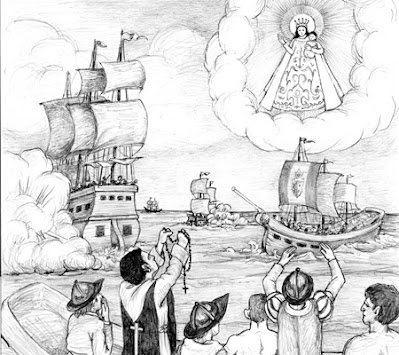
"For many a year they will remember the two stout galleons of Manila." ~ The victory of the Spanish over the Dutch at the Battle of Naval de Manila, AD 1646

Illustration showing the Battle of Naval de Manila to appear in The Story of the Philippines. 

The more one delves into history, the more one is humbled by what one doesn’t know. Case in point...

March 15 is the anniversary of the beginning of a naval campaign fought between two colonial powers in the year 1646 half-a-world away from Europe. 

Having grown up in an English-speaking country, I often catch myself adopting the conventional historical view of the British navy as presented in literature and film as an unconquerable force. Their most common foes—the Spanish and the French—are normally presented as formidable but hapless. They are numerous enough to appear to be a challenge, but ineptitude, laziness and cowardice always lead to their undoing. This perspective creates an impoverished knowledge of naval history which tends to ignore instances where the naval arms of nations not Britain achieve great victories.

One such victory which I have only encountered very recently (while editing a forthcoming book entitled The Story of the Philippines by Phillip Campbell) is La Naval de Manila—a series of naval battles between the Spanish and Dutch in the Philippine archipelago that decided which European power would rule the Philippines for the next 250 years. Featuring an earthquake, desperate acts of courage, five against-all-odds battles, and a healthy amount of divine intervention, La Naval de Manila has all the elements of a fine epic novel, let alone a thrilling action-adventure movie.

The battle pitted a fleet of eighteen well-armed Dutch corsairs against the scanty forces that the Spanish could assemble to meet the threat. The aim of the Dutch was nothing less than to wrest the Philippines from the Spanish and capture their treasure fleet from New Spain (Mexico). To accomplish this feat, the Dutch organized their ships into three squadrons. These were meant to coordinate their attacks at separate points and thereby spread thin what little defense the Spanish could muster.

Further hampering the Spanish, the capital city of their Philippine possessions—Manila—was a wreck, literally. The city had been rocked four months before by a tremendous earthquake as well as several aftershocks. Describing the magnitude of the quake, Fr. Joseph Fayol, an eyewitness, wrote:

In the first shock, one hundred and fifty of the finest buildings, which in other cities would be called palaces, were totally destroyed; all the other houses were so damaged and dangerous that it has been necessary to demolish them completely. It may be said with truth that only a semblance of Manila remains....Whole Indian villages were overthrown, as their huts are built of so light materials, bamboos and palm-leaves; and hills were leveled. Rivers were dried, which afterward flowed again; others leaving their beds, inundated the villages; great fissures and even chasms, appeared in the open fields. In the Manila River, the disturbance and commotion in its waves was so great that it seemed as if they would flood all the country. [Fayol, Relation of the events on sea and land in the Filipinas Islands...]

To meet the Dutch threat, the Spanish pressed two huge galleons into service, the Encarnación and the Rosario. These already ancient vessels had recently arrived from the arduous journey from Nueva España and were in rough shape. Though ponderous, these great ships possessed a powerful array of weaponry, which was further augmented by guns stripped from forts on land, as described by Fr. Fayol:

In [the Encarnación] were mounted thirty-four pieces of artillery, all of bronze and of the reinforced class, which variously carried balls of thirty, twenty-five, and eighteen pounds. The [Rosario] was equipped with as many as thirty pieces, of the same capacity—although on account of the deficiency in this sort of artillery, it was necessary to dismantle some posts in the fortifications of this city and of Cavite.

The governor-general of the Philippines, Don Diego Fajardo, chose General Lorenzo de Orella as commander and chief of the Spanish squadron. Fr. Fayol offers this heroic description of Don Orella:

...General Lorenzo de Orella y Ugalde, a Biscayan, under whose charge the vessels had sailed from Acapulco [was chosen] not only because of his proved bravery, his experience in the art of war, and his services and commands in both the Northern and Southern Seas, as well as in these islands (particularly in Mindanao, where he fought hand-to-hand with a gigantic Moro and killed him), but because of his well-known Christian spirit of modesty—which, for success, are no less important than valor.

Not trusting to mere earthly power, however, Don Fajardo agreed to allow four priests to accompany the flotilla, two in each ship. As both ships bore religious names, they were sent forth under the protection of Our Lady, the Virgin Mary. Fr. Fayol explains:

As a result of excellent teaching and the fervor of these fathers, arrangements were made that all of the men should, in the first place, purify their consciences with the holy sacraments of penance and communion; that they should take as their special patron saint the Virgin of the Rosary; that in order to bind her further, they should vow to her a feast-day in thanksgiving for the victories which they expected to receive through her agency; and that every day all should recite their prayers aloud, on their knees, and in two choirs—the prayers of the rosary before our Lady's image, the litanies of the most holy name of Mary, and finally an act of contrition.

Beyond these acts of piety, Don Fajardo caused the Blessed Sacrament to be exposed in several churches throughout Manila from the time of the departure of the galleons until their expected return. 

When all was made as ready as temporal and spiritual efforts would allow, the Spanish ships boldly sallied forth to meet the more numerous Dutch in what should have been a very lop-sided affair. However, as Fr. Fayol admits, the Spanish had one thing going in their favor. The hoped-for coordination of the Dutch fleets failed and each one arrived on station at different times, allowing the Spanish the opportunity to fight each of them in detail. The first fleet arrived in Spanish waters in early March and were detected by the Spanish on March 15. Fr. Fayol provides an excellent account of the battle which followed, and I am only too happy to allow his voice to describe the proceedings:  

On arriving at the entrances of Mariveles, the [Spanish] ships were placed in battle array, the artillery loaded, the matches lighted and the linstocks ready, the rigging free, and other preparations made. This was done because the sentinels [on Mariveles Island] warned our men that the enemy were, with their squadron, not far from that place; and that they might expect at any moment to encounter the Dutch—although in fact the latter were not descried until the fifteenth of the said month of March. At nine o'clock in the morning of that day, our almiranta [the Rosario] which had pushed ahead of the flagship perhaps half a league, and was sailing with a northwest wind—fired two cannon-shots and lowered the maintop-sail as a signal that it descried the enemy. The flagship put about, and followed her, and from the maintop they soon saw a sail in the distance, but it was impossible to overtake it; and it soon disappeared, because it was favored by a fresher wind than our ships had.

After that, our galleons were left becalmed until one o'clock; and at that hour were descried from the flagship four hostile sails, which were sailing toward her aft, with an east wind. It was two hours before they reached the flagship, and in that space of time the men were stationed, the ships cleared, the posts reconnoitered, and all other arrangements made, both spiritual and temporal, required by the occasion. The almiranta fell two ship-lengths astern of the flagship, and in this position the ships awaited the enemy, in order to fight them.

As soon as the enemy came near, they extended all their ships, and without attempting to give a broadside to our flagship, passed, in line to larboard, and the enemy's flagship began the battle by firing a cannon. Our commander immediately commanded that response be made with two shots—one with a thirty-pound ball and a cylinder of the same weight, which tore open all their cutwater at the bow. The enemy's ship went on in this condition, and the others continued to exchange shots with our flagship. Recognizing their own strength, the enemy tried to approach the almiranta, which they supposed was not so well armed, being a smaller ship. But they were received with equal valor and spirit on our side, our vessels firing so often and throwing so many balls that they could not be counted.

The fight lasted about five hours, and the mortality and damage were so great that all the anxiety that the heretics had felt to reach our ships when they thought to conquer us was now directed to separating themselves from us. They anxiously awaited the night, which was now approaching, to make their cowardly escape, which they did with lights extinguished. But the enemy's almiranta did not succeed in doing this in safety. It had been the most persistent in the attack upon our flagship, and remained to our leeward. It was so badly damaged that its cannon could not be fired, and hardly could it flee. Our ship was so near it that our commander had the men ready at the bow to board the Dutch ship, but the darkness of night forced us to abandon the chase, on account of the danger from the shoals which the pilots declared were in that place. It was noticed that the enemy did not use lanterns as they had formerly done, seeking protection for their armada. Our commander ordered that they be used in our ships, and that the lights be allowed to shine very brightly, in order that the enemy might come to look for us.

Our people fully intended to renew the pursuit at daybreak, to finish their defeat, but when day came our two galleons found themselves alone, and did not know what course the enemy had taken. They followed the Dutch, in the direction which they thought most probable, as far as Cape Bojeador, which is at the farthest end of this island of Manila. From there our ships returned, as the coasts were now secure, to the port of Bolinao, in order to send to this city dispatches announcing the result of the battle.

This was regarded as a brilliant victory, not only because of the disparity in the number of ships, but because of the little damage our side had sustained. In that battle not a man was killed, and comparatively few were wounded. It was evident that the enemy's loss was great, although we could not then ascertain it correctly. But afterwards we learned that many had been killed and wounded, and that two of their vessels were rendered useless. 

This Spanish victory was only the first in a series of battles which would take place over the next seven months. In each, the elderly Spanish galleons would prove too much for their nimble Dutch adversaries, continuously repulsing their attacks but proving too slow and poorly manned to capture them. 

After the third battle, Don Orella retired and was replaced by Don Sebastian Lopez who was in command of the Spanish ships when the Dutch made their final effort in October of 1646. This battle again ended in failure for the Dutch whose flagship was barely able to escape after a severe mauling. This repulse effectively ended Dutch pretensions in the Philippines. Fr. Fayol concludes his accounts of the battles, saying: 

All these exploits are worthy of great praise...According to the estimate made by well-informed persons, although we fired, in these battles, over 2,000 cannon-shots, and the enemy over five thousand, we had only fourteen killed, and comparatively few wounded. While the enemy, besides the vessels which we sank, arrived at their forts so damaged, and had lost so many men, that for many a year they will remember the two stout galleons of Manila....

Thanksgiving was celebrated by a solemn fiesta, a procession, divine worship, and [a parade of] the squadron, with other demonstrations in fulfillment of the vow made to the Virgin of the Rosary, the city making a new vow to continue this anniversary every year.

[All of the above quotes are taken from Fray Joseph Fayol's Relation of the events on sea and land in the Filipinas Islands during the recent years, until the earthquake and destruction on the feast of St. Andrews in 1645; and the battles and naval victories over the Dutch in 1646. The English translation of this work is taken from The Philippine Islands, 1493-1898, Volumes 34-35, edited by Emma Helen Blair, James Alexander Robertson, 1906.]

The image of Our Lady of La Naval de Manila.
And indeed, this the Fiesta of La Naval de Manila continues to be celebrated in the Philippines to this day. The feast includes a procession of the statue of Our Lady of the Most Holy Rosary of La Naval de Manila, a life-sized figure of the Blessed Virgin that predates the battles, having been carved from elephant ivory in AD 1593. A look at the historical celebration of this feast and the statue of our Lady may be found here

Given the circumstances of the battles, the victories were declared miraculous in nature by the Archdiocese of Manila in 1662. Pope St. Pius X bestowed a canonical crown upon the image in 1907, while Ven. Pius XII recognized the image in an Apostolic letter sent on the 300th anniversary of the victories in 1946. Pope St. John Paul II blessed the statue at a public Mass during his visit to the Philippines in 1981.

Saturday, March 10, 2018

The second-most-famous vision of a cross in the sky

Cross in the sky over Jerusalem - as imagined by Jan Luyken, ca. 1700.
Most people are aware of the famous vision seen by Constantine the Great of a cross in the sky with the words, "In hoc signo, vinces" — by this sign you will conquer. Having seen this miraculous vision, Constantine would cause his soldiers to march under Christian symbols, be victorious in his wars, and eventually convert to Christianity. Many citizens of the Roman Empire would follow him.

But not all.

During the reign of Constantine's sons, paganism continued to be practiced throughout the empire. Indeed, thanks to the weak rule and the rumored personal scandals of Constans, a pagan usurper named Magnentius was able to rise in the West in AD 350. Magnentius's henchmen soon captured Constans and put him to death. This dangerous uprising would have to be confronted by the last remaining son of Constantine, Constantius II, the Augustus of the East.

While these political and military maneuverings were going on in the West, a miraculous event occurred in the East in AD 351. In Jerusalem, another cross appeared in the sky, this time huge, long lasting and unmistakable. Here is how the event is described by the historian Hermias Sozomen writing in the 440s AD:
Click for more info.
At the time that Cyril administered the church of Jerusalem after Maximus, the sign of the cross appeared in the heavens. It shone brilliantly, not with divergent rays like a comet, but with the concentration of a great deal of light, apparently dense and yet transparent. Its length was about fifteen stadia from Calvary to the Mount of Olives, and its breadth was in proportion to its length. So extraordinary a phenomenon excited universal terror. Men, women, and children left their houses, the market-place, or their respective employments, and ran to the church, where they sang hymns to Christ together, and voluntarily confessed their belief in God. The intelligence disturbed in no little measure our entire dominions, and this happened rapidly; for, as the custom was, there were travelers from every part of the world, so to speak, who were dwelling at Jerusalem for prayer, or to visit its places of interest, these were spectators of the sign, and divulged the facts to their friends at home. The emperor was made acquainted with the occurrence, partly by numerous reports concerning it which were then current, and partly by a letter from Cyril the bishop. It was said that this prodigy was a fulfillment of an ancient prophecy contained in the Holy Scriptures. It was the means of the conversion of many pagans and Jews to Christianity. [Taken from The Ecclesiastical History of SozomenBook IV, Chapter VI]
Sozomen likely picked up his description of this event from an eye-witness account written by Saint Cyril, Bishop of Jerusalem. Cyril wrote a letter to Constantius announcing the advent of this strange apparition which he himself had witnessed. His letter has come down to us, and contains some additional details:
Click for more info.
The trophy of victory which our Lord and Savior Jesus Christ, the only-begotten Son of God, won over death—I refer to the blessed Cross—has been seen flashing like lightning over Jerusalem. 
In these holy days of the Easter season, on 7 May at about the third hour, a huge cross made of light appeared in the sky above holy Golgotha extending as far as the holy Mount of Olives. It was not revealed to one or two people alone, but appeared unmistakably to everyone in the city. It was not as one might conclude that one had suffered a momentary optical illusion; it was visible to the human eye above the earth for several hours. The flashes it emitted outshone the rays of the sun, which would have outshone and obscured it themselves if it had not presented the watchers with more powerful illumination than the sun. It prompted the whole populace at once to run together into the holy church, overcome with fear and joy at the divine vision. Young and old, men and women of every age, even young girls confined to their rooms at home, natives and foreigners, Christians and pagans visiting from abroad, all together as if with a single voice raised a hymn of praise to God’s Only-begotten Son the wonder-worker. They had the evidence of their own senses that the holy faith of Christians is not based on the persuasive arguments of philosophy, but on the revelation of the Spirit and power; it is not proclaimed by mere human beings but testified from heaven by God himself. [Excerpted from: Yarnold: Cyril of Jerusalem]
What is perhaps most interesting about the above accounts is that we see here yet another occasion where, apparently, a mass conversion of pagans and Jews to Christianity took place as a direct result of witnessing a miraculous event.

As for Constantius, Cyril assures him in the abovementioned letter that the miracle will allow him to "face his enemies with greater heart." Later that year, in September AD 351, Constantius II and Magnentius would clash in the epic battle of Mursa Major in Dalmatia. Magnentius was defeated and forced to retreat. He would survive another two years before meeting his end after the battle of Mons Seleucus in Gaul.

Friday, October 27, 2017

Constantine's Vision of the Cross ~ Early Accounts and Backstory

Constantine's great victory at the Battle of the Milvian Bridge took place on October 28, AD 312. The day before — October 27 — is the date traditionally given for the miraculous vision and dream which Constantine experienced prior to the battle. This vision has been the subject of debate in both scholarly and popular imagination for hundreds of years. But what really happened on that day 1,705 years ago that changed forever the course of human history?

As a prelude to the famous accounts of this vision, it should be noted that Constantine also seems to have had pagan theophany in the early years of his reign. Writing sometime between AD 307 and AD 310, an anonymous Gallic panegyricist describes Constantine’s presence on the frontier as almost miraculous in restoring order after a barbarian incursion. He explains the reason why as follows:
Click for more info.
"Fortune herself so ordered this matter that the happy outcome of your affairs prompted you to convey to the immortal gods what you had vowed at the very spot where you had turned aside toward the most beautiful temple in the whole world, or rather, to the deity made manifest, as you saw. For you saw, I believe, O Constantine, your Apollo, accompanied by Victory, offering you laurel wreaths, each one of which carries a portent of thirty years. For this is the number of human ages which are owed to you without fail—beyond the old age of Nestor." [In Praise of the Later Roman Emperors, page 248-50] 
This reputed vision of Apollo took place at least two years prior to Constantine’s more famous vision of a cross in the sky. Interestingly, this vision fits in well with the Christian accounts of later events.

In his treatise entitled On the Deaths of the Persecutors (written before AD 320), Lactantius offers the earliest account of Constantine's Christian theophany. Incidentally, this passage also provides the date for the Battle of the Milvian Bridge:
Click for more info.
"A civil war broke out between Constantine and Maxentius. Although Maxentius kept himself within Rome, because the soothsayers had foretold that if he went out of it he should perish, yet he conducted the military operations by able generals....At length Constantine, with steady courage and a mind prepared for every event, led his whole forces to the neighborhood of Rome, and encamped them opposite to the Milvian bridge. The anniversary of the reign of Maxentius approached, that is, the sixth of the kalends of November [i.e. the 27th of October], and the fifth year of his reign was drawing to an end.
"Constantine was directed in a dream to cause the heavenly sign to be delineated on the shields of his soldiers, and so to proceed to battle. He did as he had been commanded, and he marked on their shields the letter Χ, with a perpendicular line drawn through it and turned round thus at the top, being the cipher of Christ (XP). Having this sign , his troops stood to arms.” [Of the Deaths of the Persecutors, Chapter 44] 
Writing perhaps 20 years later, Eusebius Pamphilus offers a more detailed account in his Life of the Blessed Emperor Constantine—and what’s more, claims that he heard it directly from Constantine’s own lips, confirmed with an oath. When reading the following, note especially Constantine’s confusion and doubts about the source of the vision and the identity of the God he saw:
Click for more info.
"Being convinced, however, that he needed some more powerful aid than his military forces could afford him, on account of the wicked and magical enchantments which were so diligently practiced by the tyrant, he sought Divine assistance, deeming the possession of arms and a numerous soldiery of secondary importance, but believing the co-operating power of Deity invincible and not to be shaken. He considered, therefore, on what God he might rely for protection and assistance….
"Accordingly he called on him with earnest prayer and supplications that he would reveal to him who he was, and stretch forth his right hand to help him in his present difficulties. And while he was thus praying with fervent entreaty, a most marvelous sign appeared to him from heaven, the account of which it might have been hard to believe had it been related by any other person. But since the victorious emperor himself long afterwards declared it to the writer of this history, when he was honored with his acquaintance and society, and confirmed his statement by an oath, who could hesitate to accredit the relation, especially since the testimony of aftertime has established its truth?

"He said that about noon, when the day was already beginning to decline, he saw with his own eyes the trophy of a cross of light in the heavens, above the sun, and bearing the inscription, CONQUER BY THIS. At this sight he himself was struck with amazement, and his whole army also, which followed him on this expedition, and witnessed the miracle.
"He said, moreover, that he doubted within himself what the import of this apparition could be. And while he continued to ponder and reason on its meaning, night suddenly came on; then in his sleep the Christ of God appeared to him with the same sign which he had seen in the heavens, and commanded him to make a likeness...and to use it as a safeguard in all engagements with his enemies….
"Being struck with amazement at the extraordinary vision, and resolving to worship no other God save Him who had appeared to him, he sent for those who were acquainted with the mysteries of His doctrines, and enquired who that God was, and what was intended by the sign of the vision he had seen." [Life of the Blessed Emperor Constantine, Book I, Chapter 29-32]
It should be noted that Christians at this time, Constantine included, didn’t think that the pagan gods were non-existent. On the contrary, they believed that they were demonic spirits who could and did appear to men. Furthermore, Constantine himself provides evidence that he believed that pagan prophecy was, in fact, true and pointed directly, if inadvertently, toward the salvation of the world under the auspices of Jesus Christ. In his Oration to the Assembly of the Saints, Constantine puts forward his belief that the Erythræan Sibyl, writing in Asia Minor hundreds of years before the birth of Christ, predicted both His coming and His judgment upon mankind.

Furthermore, in the same speech, Constantine calls out Virgil’s 4th Eclogue as a further prophetic writing to support the premise that the coming of Christ was predicted not only by the Hebrew prophets, but by pagan ones as well.

Many, no doubt, look for political reasons behind Constantine’s shift from pagan piety to Christian devotion. But frankly, the political explanations make very little sense. Why would an emperor motivated purely by power, abandon the religious practices favored by an estimated 80-90% of Roman citizens in AD 312 to take up the banner of a small and despised sect which, as recently as six years before was subject to the harshest penalties of Roman law?

It seems clear that Constantine was willing, no matter what the consequences, to follow what he perceived as the divine will. An edict of Constantine, written later in his reign and recorded in Eusebius's Life, gives a glimpse into his mindset, now clearly Christian and devoid of any trace of doubt or pagan syncretism which may have existed earlier:
"To all who entertain just and wise sentiments respecting the character of the Supreme Being, it has long been most clearly evident, and beyond the possibility of doubt, how vast a difference there has ever been between those who maintain a careful observance of the hallowed duties of the Christian religion, and those who treat this religion with hostility or contempt. But at this present time, we may see by still more manifest proofs, and still more decisive instances, but how unreasonable it were to question this truth, and how mighty is the power of the Supreme God: since it appears that they who faithfully observe His commandments, are rewarded with abundant blessings, and are endued with well-grounded hope as well as ample power for the accomplishment of their undertakings. On the other hand, they who have cherished impious sentiments have experienced results corresponding to their evil choice….

"For whoever have addressed themselves with integrity for purpose to any course of action, keeping the fear of God continually before their thougths…such persons, though for a season they may have experienced painful trials, have borne their afflictions lightly, being supported by the belief of greater rewards in store for them. And their character has acquired a brighter lustre in proportion to the severity of their past sufferings….

"I would desire never to be forgetful of the gratitude due to His grace….I am most certainly persuaded that I myself owe my life, my every breath, in short, my very inmost and secret thoughts, entirely to the favor of the Supreme God.” [Life of the Blessed Emperor Constantine, Book II, Chapters 26-29]
For more on the life of this amazing historical personage and his family members, see the following:

Friday, June 09, 2017

“Stalin must one day meet his judgment!” ~ Venerable Fulton Sheen predicts Stalin's death nine days before it happens

From the dangers of moral relativism, to the destruction of the family, the threat of atheism and communism, the allure of false doctrines like situation ethics and biological determinism, sexual immorality, pornography, birth control and abortion, Venerable Archbishop Fulton J. Sheen preached 60 years ago against all of the evils that have now infected the West like metastatic cancer.

It's hard to deny that Sheen had a field of vision that reached far into the future beyond his own lifetime. Of course, anyone with as profound a knowledge of history, philosophy and the human character as Sheen had can appear to be a prophet merely by virtue of his superior wisdom and natural intellectual foresight. But there was something uncanny about Fulton Sheen. As with many of the saints who were on God’s “A-list”, he seemed at times to possess a level of knowledge that bordered on mystical. A camera man, himself a Jew, once said that Sheen had eyes that “burned two holes in the back of your head. Bishop Sheen was a very intense man. [He had] a lot of power. You could feel it.” [Weinstein, The Forgotten Network, p. 157]

Perhaps the best example of Sheen’s mystical foresight took place on February 21, 1953. In front of a large live television audience which, at that time, rivaled the top-rated Milton Berle Show, Sheen presented an episode of his show, Life is Worth Living, entitled “The Death of Stalin.” I wish I could find footage of this particular episode, but it does not appear to exist anywhere online. In this program, Sheen wove an elaborate comparison using the words of Shakespeare’s Julius Caesar to condemn the leaders of the Soviet Union. Delivering Marc Antony's famous speech, Sheen replaced the names of the Roman characters with those of Soviet high officials. In place of Caesar, Sheen named Soviet premier, Joseph Stalin:
“And now Malenkov speaks: ‘Friends, Soviets, countrymen, lend me your ears; I come to bury Stalin, not to praise him.’” 
At the climax of his soliloquy, Sheen fulminated:
“Stalin must one day meet his judgment!”
On March 1, about a week later, Stalin suffered a stroke. By March 5, he was dead. If you doubt these facts, even Snopes admits that they are true.

Considering how many millions of eyes had seen Bishop Sheen all but call down God's wrath upon Stalin but a few days before, the news of the Soviet dictator's death created a buzz. In his autobiography, Sheen gives an idea of the sensation stirred up among the press, most of whom assumed that the Bishop had an earthly source of covert intelligence:
“I received telephone calls from newspapers in almost every state of the Union asking me what inside information I had. I told them that I only knew that he was mortal and would have to pay the last penalty of sin, which was death. And it was just pure luck that the telecast and his demise coincided.” [Sheen, Treasure in Clay, p. 77]  
So the Archbishop, in his humility, ascribed the prediction to mere coincidence—and perhaps it was. But considering Sheen viewed fruits of his preaching as “more of the Spirit and less of Sheen,” there remains a strong possibility that something more than mere happenstance was at work here.

Wednesday, June 07, 2017

The curious tale of Florentius and the bear ~ early 6th century Italy

A Hermit with a Bear by Mikhail Nesterov (1925).
Monday was the feast of Saint Florentius, one of the martyrs killed during the reign of the Roman emperor Decius in the mid-3rd century AD. Given that I operate under the blogonym "Florentius", my ears always perk up a little when I hear the name. Unfortunately, little is known of this Florentius other than that he was martyred under Decius near Perugia along with companions named Marcellinus, Cyriacus, Faustinus, and Julianus.

But his name recalled to my mind a different Saint Florentius from a few centuries later whose atypical life was recorded in The Dialogues of Saint Gregory the Great. This Florentius is commemorated on May 23, so perhaps a post about him is not too far out of place.

Saint Florentius of Nursia was an Italian hermit who lived in the same locale that would later generate the great Saint Benedict, the father of Western monasticism. He was active in this area of central Italy about the time that Theodoric and his Goths first took control in Ravenna—that is, the late 5th century AD. In Gregory's Dialogues, Florentius is closely associated with Euthicius, another saint from the same region. When Euthicius was chosen to be an abbot of a nearby monastery, it fell to Florentius to upkeep the empty oratory left behind by his friend. But Florentius was lonely caring for the oratory all by himself, so he asked God to send him a friend:
Having ended his devotions, [Florentius] went forth, where he found a bear standing before the door, which by the bowing down of his head to the ground, and shewing in the gesture of his body no sign or cruelty, gave the man of God to understand that he was come thither to do him service, and himself likewise did forthwith perceive it. And because he had in the house four or five sheep which had no keeper, he commanded the bear to take charge of them, saying: "Go and lead these sheep to the field, and at noon come back again": which charge he took upon him, and did daily come home at that hour: and so he performed the office of a good shepherd, and those sheep, which before time he used to devour, now fasting himself, he took care to have them safely kept. 
Florentius became famous for his virtue and holy mode of life, and maintained his friendship with his shepherd, Brother Bear. Unfortunately, some became jealous of him:
Four of Euthicius' monks, swelling with envy that their master wrought not any miracles, and that he who was left alone by him was famous for so notable a one, upon very spite went and killed his bear. And therefore, when the poor beast came not at his appointed hour, Florentius began to suspect the matter: but expecting yet until the evening, very much grieved he was that the bear, whom in great simplicity he called his brother, came not home. The next day, he went to the field, to seek for his sheep and his shepherd, whom he found there slain; and making diligent inquisition, he learned quickly who they were that had committed that uncharitable fact. Then was he very sorry, bewailing yet more the malice of the monks than the death of his bear; whom the reverent man Euthicius sent for, and did comfort him what he might.
The evil monks should have known better than to mess with Florentius...
But the holy man Florentius, wonderfully grieved in mind, did in his presence curse them, saying: "I trust in almighty God, that they shall in this life, and in the sight of the world, receive the reward of their malice, that have thus killed my bear which did them no harm;" whose words God's vengeance did straight follow, for the four monks that killed the poor beast were straight so stricken with a leprosy, that their limbs did rot away, and so they died miserably.
Good man that he was, however, Florentius was terrified and sorry for what had been wrought through his prayers.
The man of God, Florentius, was greatly afraid, and much grieved, that he had so cursed the monks; and all his life after he wept, for that his prayer was heard, crying out that himself was cruel, and that he had murdered those men. Which thing I suppose almighty God did, to the end that he should not, being a man of great simplicity, upon any grief whatsoever, afterward presume to curse any.
Pope Gregory, continuing his dialogue with his interlocutor named Peter, turns the incident into a "teachable moment":
PETER: "What? is it any great sin, if in our anger we curse others?"
GREGORY. "Why do you ask me whether it be a great sin, when as St. Paul saith: 'Neither cursers shall possess the kingdom of God?' Think, then, how great the sin is, which doth exclude a man out of heaven."   
PETER: "What if a man, haply not of malice, but of negligence in keeping his tongue, doth curse his neighbor?"
Click to order.
GREGORY: "If before the severe judge idle speech is reprehended, how much more that which is hurtful. Consider, then, how damnable those words be, which proceed of malice, when that talk shall be punished which proceedeth only from idleness."
PETER: "I grant it be most true."
The Dialogues of Saint Gregory the Great, written in the late 6th or early 7th century, is filled with such strange stories of the miraculous and the extraordinary, offering a rare window into life during a time when Roman civilization was crumbling, and Italy was on the cusp of Dark Ages desolation.

Saturday, June 03, 2017

When rain saved the Thundering Legion ~ Legio XII ~ during the Macromannic Wars of Marcus Aurelius

The Miracle of the Rain as depicted on the Column of Marcus Aurelius in Rome.
While researching something completely different, I recently stumbled across the fascinating story of a miraculous cloudburst which saved part of the Roman army during Marcus Aurelius's Macromannic campaign, circa AD 174. It is an intriguing piece of Roman history with numerous and varied ancient sources corroborating it. I was surprised to discover that the story had been exhaustively studied by scholars over the centuries, with at least one full-blown monograph dedicated to it in recent times.

The Macromanni were a Germanic tribal confederation which pierced the Roman frontier in the mid-160s and devastated a swath of the empire from the Danube reaching nearly to the Adriatic coast. In reaction to this invasion, Marcus Aurelius mustered numerous legions from across the empire and began a campaign to push the invaders out and reconfigure the defensive scheme in the region. The war became a complex series of thrust, retreat and counter-thrust lasting over ten years and consuming much of Aurelius's reign.

The miracle of the rain occurred late in the war, probably during the campaign across the Danube to subdue the Quadi, one of the chief tribes of the Macromanni. At one point, a segment of the Roman army including the 12th Legion, also known as the "Fulminata" or Thunderbolt, seems to have been cut off by a large force of Quadi. The Roman historian, Cassius Dio writing about 50 years after the event, described the situation as follows:
The Quadi had surrounded them at a spot favorable for their purpose and the Romans were fighting valiantly with their shields locked together; then the barbarians ceased fighting, expecting to capture them easily as the result of the heat and their thirst. So they posted guards all about and hemmed them in to prevent their getting water anywhere; for the barbarians were far superior in numbers. The Romans, accordingly, were in a terrible plight from fatigue, wounds, the heat of the sun, and thirst, and so could neither fight nor retreat, but were standing at the line and at their several posts, scorched by the heat... [Cassius Dio's quotes are taken from here: Dio on the Rain Miracle.]
The legion, however, was saved by a timely and intense cloudburst:
Suddenly many clouds gathered and a mighty rain, not without divine interposition, burst upon them...At first all turned their faces upwards and received the water in their mouths; then some held out their shields and some their helmets to catch it, and they not only took deep draughts themselves but also gave their horses to drink. And when the barbarians now charged upon them, they drank and fought at the same time; and some, becoming wounded, actually gulped down the blood that flowed into their helmets, along with the water. So intent, indeed, were most of them on drinking that they would have suffered severely from the enemy's onset, had not a violent hail-storm and numerous thunderbolts fallen upon the ranks of the foe.
This much, at least, historians seem to agree upon. Dio's description above is largely accepted, even though this excerpt comes not from the surviving manuscripts of his Roman History, which is partially lost, but from the works of a later Byzantine historian, Xiphilinus. Things get more confused when the miraculous aspects of this event are considered.

Xiphilinus includes Dio's opinion that the rain was of divine origin:
There is a story to the effect that Harnuphis, an Egyptian magician, who was a companion of Marcus, had invoked by means of enchantments various deities and in particular Mercury, the god of the air, and by this means attracted the rain.
This view is supported in a most unusual and unmistakable way by physical evidence from the Column of Marcus Aurelius in Rome (see detail above), which clearly depicts a divinity of some sort pouring down rain and bringing succor to the Roman soldiers and their beasts.

Christians of roughly the same time period, however, had a different spin on the story. Writing a few years after the miracle, Apollinaris of Hierapolis recorded the event as follows, according to a paraphrase from the great Church History of Eusebius Pamphilus:
Bust of a young Marcus Aurelius
from the British Museum.
There is a story about … the emperor Marcus Aurelius when he faced the Germans and Sarmatians. His army was tormented by thirst and he was in dire straits. The soldiers of the so-called Melitenian Legion, which was and still is strengthened by the faith, knelt on the earth in battle order before the foe, as is our custom when we pray, and turned to God with their supplication. While such a display caused the enemy to wonder, at the same time, the story goes, an even greater miracle took place: a thunderstorm put the enemy to flight and destruction, while the rain brought refreshment to the army of those who had called upon the divine, although it was almost perishing with thirst....Ever since that time, the legion that brought about the miracle through their prayers received from the emperor an appropriate epithet and has been called the “Hurling of Thunderbolts” in the language of the Romans. [Taken from Huttner: Early Christianity in the Lycus Valley, p. 232-3.]
Though Apollinaris (or Eusebius) seems to get a key detail wrong—Legio XII had had the epithet "Fulminata" since at least the time of Augustus—his account basically agrees with that of Dio. Tertullian, writing about 20-30 years before Dio, also records the same incident, giving it a similar Christian spin, but adding another detail:
We, however, can on the other side produce a protector, if the letters of the most grave Emperor Marcus Aurelius be searched, in which he testifies that the well-known Germanic drought was dispelled by the shower obtained through the prayers of Christians who happened to be in the army. And although he did not openly abolish the penalty incurred by members of that sect, yet in another way he openly averted it by the addition of a condemnatory sentence on the accusers, and that a more terrible one. [Taken from Kovac: Marcus Aureliusa Rain Miracle and the Marcomannic Wars, p. 23]
Most interesting of all, a document purporting to be this same letter cited by Tertullian above, actually exists to this day. Unfortunately, most scholars consider this epistle—which may be found appended at the end of the First Apology of Justin Martyr though it has no relation to it—to be an interpolation by a later Christian writer, or else an outright fabrication. Whatever it is, its provenance is clearly quite ancient. Here it is in full:
The Emperor Cæsar Marcus Aurelius Antoninus, Germanicus, Parthicus, Sarmaticus, to the People of Rome, and to the sacred Senate greeting: 
I explained to you my grand design, and what advantages I gained on the confines of Germany, with much labor and suffering, in consequence of the circumstance that I was surrounded by the enemy; I myself being shut up in Carnuntum by seventy-four cohorts, nine miles off. And the enemy being at hand, the scouts pointed out to us, and our general Pompeianus showed us that there was close on us a mass of a mixed multitude of 977,000 men, which indeed we saw; and I was shut up by this vast host, having with me only a battalion composed of the first, tenth, double and marine legions. 
Having then examined my own position, and my host, with respect to the vast mass of barbarians and of the enemy, I quickly betook myself to prayer to the gods of my country. But being disregarded by them, I summoned those who among us go by the name of Christians. And having made inquiry, I discovered a great number and vast host of them, and raged against them, which was by no means becoming; for afterwards I learned their power. Wherefore they began the battle, not by preparing weapons, nor arms, nor bugles; for such preparation is hateful to them, on account of the God they bear about in their conscience. Therefore it is probable that those whom we suppose to be atheists, have God as their ruling power entrenched in their conscience. For having cast themselves on the ground, they prayed not only for me, but also for the whole army as it stood, that they might be delivered from the present thirst and famine. For during five days we had got no water, because there was none; for we were in the heart of Germany, and in the enemy's territory. And simultaneously with their casting themselves on the ground, and praying to God (a God of whom I am ignorant), water poured from heaven, upon us most refreshingly cool, but upon the enemies of Rome a withering hail. And immediately we recognized the presence of God following on the prayer — a God unconquerable and indestructible.
Founding upon this, then, let us pardon such as are Christians, lest they pray for and obtain such a weapon against ourselves. And I counsel that no such person be accused on the ground of his being a Christian. But if any one be found laying to the charge of a Christian that he is a Christian, I desire that it be made manifest that he who is accused as a Christian, and acknowledges that he is one, is accused of nothing else than only this, that he is a Christian; but that he who arraigns him be burned alive. And I further desire, that he who is entrusted with the government of the province shall not compel the Christian, who confesses and certifies such a matter, to retract; neither shall he commit him. And I desire that these things be confirmed by a decree of the Senate. And I command this my edict to be published in the Forum of Trajan, in order that it may be read. The prefect Vitrasius Pollio will see that it be transmitted to all the provinces round about, and that no one who wishes to make use of or to possess it be hindered from obtaining a copy from the document I now publish. [Taken from: Epistle of Marcus Aurelius to the senate, in which he testifies that the Christians were the cause of his victory.]
Problems with this document are evident to anyone with even the modicum of familiarity with the history and personalities of the time period. The most obvious issue is that Aurelius himself was considered a persecutor by later Christians, and is often implicated in the severe campaign against the Christians in southern Gaul which took place in AD 177. It is argued that an emperor who looked so favorably upon the Christian God, would be unlikely to embark on such a campaign of eradication a mere three years later.

For an in-depth analysis of this document, see Peter Kovac's book, Marcus Aurelius's Rain Miracle and the Macromannic Wars which is a tour-de-force on this fascinating topic.

Kovac posits that the above letter was written in the early 4th century AD. It is supposed by others that the letter's purpose was to stand in for the authentic epistle of Aurelius mentioned by Tertullian which theoretically had been lost by the time Christians had gained access to the Imperial archives after Constantine. Possibly, the original epistle was destroyed during the persecution of Diocletian when many works of Christian literature were burned.

Regardless of the dispute over the sources, at least two intriguing facts can be gleaned from this episode: 1.) the number of Christians serving in the Roman army by the late 2nd century was not insignificant; and 2.) some sort of extraordinary celestial event did indeed happen which saved part of the Roman army during the Macromannic War.

Wednesday, August 31, 2016

Video primary source for Constantine the Great's vision of a Cross in the heavens

Also, here is a short video reading of the passage from Eusebius detailing the miracle of the Cross in the sky and its immediate aftermath, done by Arx Publishing:


Constantine's miraculous vision of a cross in the heavens with the words, "Conquer by this" is an epochal event in history. This video offers an account of the vision as related to Eusebius Pamphilus, an historian and bishop, who was acquainted with the Emperor and heard the account first-hand from Constantine himself. He recorded the story in his Life of the Blessed Emperor Constantine which was penned shortly after Constantine's death in AD 337.

The complete Life of the Blessed Emperor Constantine may be found here in book form: http://www.evolpub.com/CRE/CREseries.html#CRE8

Constantine shows up randomly on Facebook

Here's a meme I created years ago featuring Constantine the Great, just shared again today by Great Eastern Roman Empire on Facebook:

"He saw with his own eyes the trophy of a cross of light in the heavens, above the sun, and bearing the inscription, CONQUER BY THIS. At the sight he himself was struck with amazement and his whole army with him."

Quote taken from: Life of the Blessed Emperor Constantine by Eusebius Pamphilus, written ca. AD 337. The famous incident of the cross in the sky occurred in AD 312 prior to the Battle of the Milvian Bridge, a victory which secured Constantine's position as Augustus of the West. Many who witnessed it would still have been alive when Eusebius wrote his biography. For more information, see: http://www.evolpub.com/CRE/CREseries.html#CRE8