Showing posts with label Catholic Church. Show all posts

Monday, June 22, 2026

"Nunc dimittis, Domine." ~ The last words of Thomas Jefferson, July 4, 1826

Detail from a portrait of an elderly Thomas Jefferson as painted by Thomas Sulley, 1821.

In a previous post, I examined some of the speculation about George Washington's death, and the curious legend that he had died having confessed himself to a Catholic priest. 

That has gone on to be the most popular post on this blog, garnering over 15,000 views to date. 

In the case of the death of Thomas Jefferson, there is considerably less cause for speculation. For one thing, Jefferson had been a Unitarian/Deist from his youth, and a consistent critic of Catholic beliefs and practices well into his years as a retired elder statesman. His correspondence indicated a disdain for the concept of the Trinity, an abhorrence for the priesthood, and belief that the early Church Fathers, including Saint Paul, had corrupted the teachings of Jesus. 

But anyone who studies Jefferson's life in detail knows that he is a deep old file: a brilliant mind, a gifted scholar, a diligent inventor, yes, but also a man whose shining parts did not extend to consistency in moral or religious beliefs. Many have noted with irony that the man who crafted the very sacred scripture of American liberty, the Declaration of Independence, was himself the master of several hundred bondsmen. The man who once described the teachings of Jesus as "the most sublime and benevolent code of morals which has ever been offered to man" was at the same time he said it very likely fathering children out of wedlock with a woman he owned. 

Jefferson had no love for the Catholic priesthood, particularly the Jesuits. Writing in 1816—two years after the Society of Jesus had had their suppression lifted by the Pope—Jefferson opined to John Adams: "I dislike, with you, their restoration; because it marks a retrograde step from light towards darkness.

In another letter, he said the following to Horatio Spafford: 
"In every country and in every age, the priest has been hostile to liberty. He is always in alliance with the Despot abetting his abuses in return for protection to his own. It is easier to acquire wealth and power by this combination than by deserving them: and to effect this they have perverted the purest religion ever preached to man, into mystery & jargon unintelligible to all mankind & therefore the safer engine for their purposes." March 17, 1814.

Despite these condemnations, Jefferson maintained friendly relations with numerous Catholics, even bishops and priests, and was a staunch defender of their rights. While president in 1804, Jefferson wrote to a convent of Ursuline sisters in New Orleans, lately added to the United States as part of the Louisiana Purchase. Jefferson's letter, written in response to a query sent to him by the sisters, is remarkable for its deep tone of cordiality, almost humility:

I have received, holy sisters, the letter you have written me wherein you express anxiety for the property vested in your institution by the former governments of Louisiana. The principles of the constitution and government of the United States are a sure guarantee to you that it will be preserved to you sacred and inviolate, and that your institution will be permitted to govern itself according to its own voluntary rules, without interference from the civil authority....Be assured it will meet all the protection which my office can give it. I salute you, holy sisters, with friendship & respect. July 14, 1804.

Similarly, Jefferson wrote as president to the first Catholic bishop of the United States, John C. Carroll, in answer to a request made to him regarding the foundation of a Catholic Church in District of Columbia:

I have received at this place the application signed by yourself and several respectable inhabitants of Washington on the purchase of a site for a Roman Catholic church from the Commissioners. As the regulation of price rests very much with them, I have referred the paper to them, recommending to them all the favor which the object of the purchase would urge, the advantages of every kind which it would promise, and their duties permit. I shall be happy on this and on every other occasion of shewing my respect & concern for the religious society over which you preside in these states and in tendering to yourself assurances of my high esteem and consideration. September 3, 1801.

Portrait of Abbé Corrêa in Monticello.
Perhaps even more remarkable was Jefferson's relationship with fellow polymath, José Francisco Corrêa da Serra. Jefferson referred to Corrêa as his "dear friend," and their friendship spanned a number of years of Jefferson's later life. At one point, Jefferson invited Corrêa to reside at Monticello permanently—an offer that was politely declined, though to this day there is bedroom dedicated to him at Jefferson's mansion. Corrêa died in Portugal in 1823, and Jefferson would recall his friend in a letter written in April of 1826, shortly before his own death, as "a distinguished Savant of Europe...profoundly learned in several other branches of science, he was so, above all others, in that of Botany." Abbé Corrêa was an ordained Catholic priest, though perhaps not a particularly devout one. This excellent article at the American Philosophical Society website goes into greater detail about the Abbé Corrêa's life and works.

Given Jefferson's intimacy with a Catholic priest late in life, it is noteworthy to consider the last words of Mr. Jefferson, as recorded in B. L. Rayner's 1834 biography, Life of Thomas Jefferson

When the morning of that day came, he appeared to be thoroughly impressed that he should not live through it, and only expressed a desire that he might survive until mid-day. He seemed perfectly at ease, and ready to die. When the Doctor entered his room, he said, "Well, Doctor, you see I am here yet." 

His disorder being checked, a friend expressed a hope of amendment. His reply was, "that the powers of nature were too much exhausted to be rallied." 

To a member of his family who remarked that he was better, and that the Doctor thought so, he listened with evident impatience, and said, "Do not imagine for a moment that I feel the smallest solicitude as to the result." 

He then calmly gave directions for his funeral, forbidding all pomp and parade — being answered by a hope that it would be long ere the occasion would require their observance, he asked, with a smile, "Do you think I fear to die?" 

A few moments after, he called his family and friends around his bed side, and uttered distinctly the following sentence: "I have done for my country, and for all mankind, all that I could do, and I now resign my soul, without fear, to my God — my daughter to my country." 

These were the last words he articulated — his last solemn declaration to the world — his dying will and testament, bequeathing his most precious gifts, to his God and his country. All that was heard from him afterwards, was a hurried repetition, in indistinct and scarcely audible accents, of his favorite ejaculation, "Nunc Dimittas [sic], Domine — Nunc Dimittas [sic], Domine."

He sunk away imperceptibly, and breathed his last, without a struggle or a murmur, at ten minutes before one o'clock, on the great JUBILEE of American liberty — the day, and hour too, on which the Declaration of Independence received its final reading, and the day, and hour, on which he prayed to Heaven that he might be permitted to depart. [Rayner: Life of Thomas Jefferson, p. 428-429]

Why would Jefferson's last words be in Latin, lifted from the Canticle of Simeon [Luke 2:29] as found in the Vulgate of St. Jerome? And even more puzzling, this prophetic passage is specifically omitted from the famous "Jefferson Bible" which he created to expunge the miraculous accretions that he felt had corrupted the teachings of Jesus. I'm certainly not the first person to wonder at this. A somewhat later biographer from the 1850s found these words so incongruous in the mouth of the elderly Deist, that he put forward the conjecture that the phrase: "Lord, now lettest thou thy servant depart in peace," had been uttered in English, not in Latin. [See Randall: The Life of Thomas Jefferson, p. 547, fn 2]. 

A later account from the doctor who attended Jefferson on his deathbed, Robley Dunglison, claimed that Jefferson never uttered the phrase at all: 

...He then asked “Is it the 4th?” to which I replied “It soon will be.” These were the last words I heard him utter. In Mr. [William] Wirt’s eulogy of him, it is said that he clasped his hands and said “Nunc dimittis” [“Now lettest thou depart”]. No such expression was heard by me; and if any other person had heard it, it would certainly have been communicated to me. [Radbill: An autobiographical ana of Robley Dunglison, MD, p. 36]

Dunglison's work cited above was prepared in 1852, a full 26 years after the death of Jefferson.

The work of William Wirt, which Dunglison cites above, was produced in October 1826—four months after Jefferson's death. Wirt's short account is contained within a longer eulogy of Jefferson and John Adams entitled: A Discourse on the lives and characters of Thomas Jefferson and John Adams: who both died on the Fourth of July, 1826:

When that day came, all that he was heard to whisper, was the repeated ejaculation "Nunc; Domine dimittas [sic]," Now, Lord, let thy servant depart in peace! And the prayer of the patriot was heard and answered. [Wirt: A Discourse on the Lives and Characters..., p. 66]

So how likely is it that Jefferson's last words were actually a Latin phrase from the Vulgate of St. Jerome? Fairly likely, I'd wager. Dr. Dunglison's late account certainly does not preclude the possibility. Furthermore, it should be pointed out that Jefferson used the phrase with some regularity in his correspondence prior to his death. Here are some examples:

"A severe illness the last year, and another from which I am just emerged, admonish me that repetitions may be expected, against which a declining frame cannot long bear up. I am anxious, therefore, to get our University so far advanced as may encourage the public to persevere to its final accomplishment. That secured, I shall sing my nunc demittas [sic].

"Nature will not give you a second life wherein to atone for the omissions of this. pray then, dear and very dear Sir, do not think of deserting us; but view the sacrifices which seem to stand in your way, as the lesser duties, and such as ought to be postponed to this, the greatest of all. Continue with us in these holy labors, until, having seen their accomplishment, we may say with old Simeon ‘nunc dimittis, Domine.’"

"Perhaps our University which you visited in it’s unfinished state when finished & furnished with it’s scientific popln, may tempt you to make a little stay with us. This will probably be by the close of the ensuing year, when it may appear to you worthy of encouraging the youth of your quarter as well as others to seek there the finishing complement of their education. I flatter myself it will assume a standing secondary to nothing in our country. If I live to see this I shall sing with cheerfulness the song of old Simeon’s nunc dimittis Domine."

So if nothing else, it seems abundantly clear that "Nunc dimittis, Domine," was, in fact, a favored expression of Jefferson as mentioned by Rayner in his 1834 biographical account. 

Given that the 1840s and 1850s were a period of intense disapproval of anything that smacked of popery, we should not be too surprised that men during that era strove to expunge any near approach to that egregious sin from the heroes of the American Founding.

In closing, let us recall the uncontested fact, also mentioned by Mr. Wirt, that both Thomas Jefferson and John Adams did indeed pass into eternity on the same day—July 4, 1826—exactly 50 years after the release of the Declaration of Independence.

This is easily one of the strangest coincidences of all of recorded history. 

Wednesday, February 04, 2026

The Youth Movement that Brought Catholicism to Korea

Korean scholars studying the Western Learning in the late 18th century. 
The host city for World Youth Day 2027 will be Seoul, South Korea. The fact that an American Pope will be presiding and that Korean culture generally is pretty popular in the US means that interest in attending should be pretty high among Americans. I suspect that some of my own kids may find their way over there for the event. 

This being the case, what better time for American Catholics to find out about the vibrant past and hopeful future of the Church in Korea? Seoul is a particularly appropriate site for WYD 2027 considering that Catholicism had its origins in Korea largely as the result of a youth movement.

Christianity got a comparatively late start on the Korean peninsula. The first murmurings of Catholic doctrine only arrived in Korea in the 18th century. This was largely due to the closed nature of the country during the Joseon Dynasty (1392-1897). But that hasn't stopped Koreans from catching up quickly. At present, there are nearly 6 million Catholics in Korea, representing about 12% of the total population. 

Perhaps the most awe-inspiring aspect of the advent of Catholicism in Korea is that unlike practically every other country in the world, the Faith did not first arrive there courtesy of foreign missionaries. Indeed, foreigners were strictly forbidden from entering the Joseon kingdom. Though several French martyr-saints would play key roles later on, Catholicism would first emerge in Joseon based solely on the Holy Spirit-inspired intellectual curiosity of a few Korean scholars. 

Western literature began to filter into Korea in the mid-18th century, courtesy of embassies sent from the Joseon royal court to the imperial court of Qing Dynasty China. Interest in Western learning was particularly strong among the young members of noble families. Though brought up to follow the strict doctrines of neo-Confucianism which stressed right living and filial piety, these young scholars were eager to get their hands on anything related to the outside world.  

By the early 1780s, enough Western literature had reached Korea for scholars to set up study-groups to explore Western philosophy and religion. One of these scholars, a young man named Yi Seung-hun, joined an embassy to China. While in Peking, he found a French Catholic priest who instructed him in the Faith and baptized him, giving him the Christian name of Peter. 

Portrait of Peter Yi Seung-hun.
Peter Yi Seung-hun returned to Korea with a treasure trove of Catholic books, crucifixes and artifacts which he presented to his study group. These men were deeply impressed by some of the unique teachings of Catholicism, among them: that God not only exists but actually condescended to appear on Earth in the form of the man Jesus Christ; that all men possess an immortal soul; that a man's soul is destined either for eternal life of bliss in Heaven or eternal torment in Hell based on how well he follows the teachings of Christ in the Gospels.

Among the study group was a revered senior scholar named Yi Byeok who had encouraged Peter Yi to join the embassy to China in the first place. Upon reading the books brought back from China by Peter, Yi Byeok was convinced that Catholic teaching was true. He and several other members of the study group desired baptism and Peter did the honors.

What happened after that was again unique in the history of the Church. Based on their limited knowledge of Church practice, this first handful of Korean Catholics stood up their own church in imitation of the Catholic Church. This included the creation of bishops and priests, and the administration of the sacraments, including Holy Eucharist in a liturgical setting. This pseudo or improvised church endured for several years until in response to letters sent to China seeking guidance, the Korean Catholics were told that they could not celebrate the sacraments without properly ordained priests, and that priests could only be ordained by legitimate bishops.

From that point on, Korean Catholics would petition the Church to send priests and bishops to minister to them. Given that foreigners were absolutely forbidden from entering the Joseon kingdom except on official business with the court, and that any foreigners who attempted to enter without permission could be tortured and executed, it was exceedingly dangerous to attempt to smuggle a Catholic priest into the kingdom.

But what caused the new Korean Catholics the most distress was the instruction that the traditional form of Confucian ancestor worship, including the offering of food and drink to their deceased relatives, was a superstition that could not be reconciled with Catholicism. Failing to perform these rites made one unfilial and a public disgrace. For members of the upper class, the censures for such failures to revere their ancestors were more dramatic. By 1791, Korean Catholics who refused to perform the rites of ancestor worship were being condemned and executed.  

Many noble Catholics, Yi Byeok among them, refused to repudiate ancestor worship and subsequently abandoned the nascent Church. Those brave souls who remained were viewed with increasing suspicion and hostility by the Joseon court. By 1795, Catholicism was considered a subversive foreign religion disruptive to the harmony of the Joseon state, and the first larger scale persecutions of Korean Catholics erupted. 

The reigning monarch at the time was King Jeongjo, a rather high-minded ruler who tolerated a certain amount of internal dissent in the interest of national unity. The idea of kingdom-wide persecution of Korean Catholics would not fly as long as he was in power. During the reign of Jeongjo, a Chinese Catholic priest, Fr. James Zhou Wen-mo, managed to enter Joseon and it is estimated that the Catholic community in the country grew to nearly 10,000 adherents. Peter Yi Seung-hun, who had vacillated due to intense pressure from his family, remained one of the leaders of the Church at this time. Also among the leaders was a man named Alexius Hwang Sa-yeong.

Unfortunately, Jeongjo passed away in 1800. His successor was his 10 year-old son, Sunjo. This boy-king was under the thumb of his great grandmother, Grand Queen Dowager Yesun, who ruled Joseon as regent during Sunjo's minority. Yesun did not share the same scruples as Jeongjo when it came to Catholics. During her regency in 1801, the Shin-yu persecution was initiated, in part as a political maneuver to incriminate a rival faction at court that was more sympathetic to the Catholics. 

The Joseon court produced a edict entitled the Imperial Message Prohibiting the Evil Learning. In no uncertain terms, this document declared Catholic teaching to be in opposition to Confucianism, which was considered the True Learning. The followers of the Evil Learning would be forced to abandon it. As the edict itself declared:
All who disobey will be considered as rebels and guilty of high treason....[T]he head of each unit of five families shall immediately denounce any who persist in following the Evil Learning. All such persons are to receive condign punishment so as to root out the Evil Learning once and for all and to leave no trace of it remaining. [Kim & Chung: Catholic Korea: Yesterday and Today, p. 54-55].
Among the first victims of the Shin-yu persecution was Fr. Zhou who surrendered himself and was executed. Hearing about this event, Alexius Hwang Sa-yeong retreated to the mountains to escape capture. While in hiding, he composed the famous Silk Letter. Written on a sheet of silk roughly one foot by two feet, the Silk Letter was addressed to the Bishop of Peking and related the travails of the Korean Church. In 13,000 Chinese characters, the letter provided estimates of the numbers of Catholics in Korea, an account of the martyrdom of Fr. Chou and other Korean Catholics, and an appeal for help. Most critically, Alexius Hwang suggested that the Bishop enlist the help of the Qing Emperor of China and European nations to intervene with the Joseon court to protect Catholics.

The original Silk Letter of Alexius Hwang (Source)

The Silk Letter was never sent. Alexius Hwang was captured by Joseon government authorities and the letter was confiscated. Its contents seemed to prove the worst suspicions about Catholics. To the deeply isolationist Joseon court, the Silk Letter was incontrovertible evidence that Catholics were a subversive element who would not hesitate to appeal to foreign powers for aid against their own government. As a result, the Shin-yu persecution intensified. Alexius Hwang was found guilty of high treason, was executed and his body dismembered. His family was exiled. 

Peter Yi Seung-hun was also a victim of the Shin-yu persecution. Considered one of the leaders of the Catholic Koreans, he was arrested and tortured over the course of eight days and then executed. Since then, Peter Yi's status as a martyr or an apostate has been the subject of considerable debate. Very recently, the Korean Bishops' Conference declared him a Servant of God—the first step toward canonization.

By the time the Shin-yu Persecution subsided, the Joseon government had executed several hundred Catholics and exiled many more. It seems that a large number also apostatized. As the persecution had focused by design on educated Korean Catholics, the remnants tended to be from the poorer classes and survived in hiding in the provinces. 

Click for more info.
This would be the first of many persecutions that the young Church in Joseon would endure. This pattern of uneasy peace punctuated by periods of intense persecution was the world into which later notable Korean Catholics like Paul Jeong Ha-sang, Andrew Kim Dae-geon, Thomas Choe Yang-eop, and numerous others would soon be born. During the mid-19th century, thousands of faithful Korean Catholics would endure tremendous suffering before the age of martyrdom finally drew to a close after 1866. The victories, defeats, heroic deeds and heartbreaking betrayals of this time are brought to vivid life in Martyr of Blood, Martyr of Sweat: The Letters of Saint Andrew Kim Dae-geon and Thomas Choe Yang-eop, translated, edited, and annotated by Brothers Anthony and Han-yol of the Community of Taizé. If you'd like a good introduction to the early years of Catholicism in Korea, this collection of authentic letters by the first two native-born Korean priests is an excellent source and a very engaging read.

If you're not a big reader, some of the events related above are interwoven through the plot of the series, Yi San. This K-drama tells a romanticized but very poignant version of story of King Jeongjo in which Catholic Koreans and their status as pawns in the factional battles of the Joseon court are mentioned. The drama focuses on the early life of King Jeongjo and his romance with his favored Royal Consort. The main villain in the drama is Queen Dowager Yesun. If you have 70 hours or so to spare, I highly recommend it.

Saturday, January 17, 2026

"It is everyone's duty to serve God." ~ The martyrdom of St. Lucia Park Hui-sun

Three saintly martyrs of Korea: St. Agatha Jeon (left), St. Lucia Park (center),
and St. Julietta Kim (right).
This post is the first in a series drawn from a new book entitled Martyrs of Blood, Martyrs of Sweat: The Letters of Saint Andrew Kim Dae-geon and Venerable Father Thomas Choe Yang-eop, as translated and edited by Brothers Anthony and Han-yol of the Community of Taizé, published by Arx Publishing.

This engrossing work contains all of the extant correspondence of these first two native Korean Catholic priests. Andrew Kim would go on to be martyred and later canonized a saint. Thomas Choe perished of exhaustion and sickness after ministering in his native land for over a decade. 

During their ministries, these two priests would encounter hundreds of secret Korean Catholics who strived to maintain their faith through periodic intense persecutions initiated by the neo-Confucian (and therefore very anti-Christian) Joseon court. These persecutions resulted in the imprisonment, impoverishment, torture and death of hundreds if not thousands of Korean Catholics, and impacted all levels of society.

Following is one example. Park Hui-sun (1801-1839) was born into a wealthy family and would be chosen by the Joseon court to serve as a court lady (Gungnyeo) to the royal family of King Sunjo (reign: 1800-1834). Distinguished by her beauty, wit, skill and prudence, she was promoted to the first rank among the Queen's handmaids. The rest of the story, as told by St. Andrew Kim in his Deeds of Several Important Martyrs of the Gihae Persecution of 1839, is as follows:
Click here for more info.
Lucia was a Gungnyeo, prudent and diligent in her manner, and her nature was always upright, and was outstanding among virgins. 

After her mother died, she was chosen by the royal court as a court maid and she entered the palace. She set an outstanding example for people with a noble life. When she was around 30, she heard about the Christian doctrine and she immediately accepted it. Then, knowing that she would be unable to follow a religious life in the court, she used illness as an excuse, and she was given permission to leave the palace, and she went to a acquaintance’s house to live. Because her father was extremely hostile and hated the Christian faith so much, she could not dare move into his house. 

She soon turned her family to the True God with her example and persuasion. She thanked God often and cherished Him deep in her heart. She regarded worldly fame and glory as nothing and diligently followed a life of faith. She was often engrossed in prayers and meditations, used crude clothing and poor food, and she struggled to discipline herself. She often recalled her Lord’s Passion and shed tears of gratitude. 

Eventually, when the persecution intensified, her entire family fled to a believer’s house. The satellites [servants and informers in the employ of government officers] noticed this and attacked the house. At that time, she acknowledged that this was God’s Providence, and she comforted and encouraged believers on the one hand, and treated the satellites very kindly on the other. 

Following the police official, she was taken to the Sagwancheong, the first court to interrogate criminals. There she confessed the Truth and was taken to the police court. 

The judge asked. “Why do you believe in Christianity while you are a court lady?” 

Lucia answered. “It is everyone’s duty to serve God.” 

Again Lucia was commanded to forsake God and betray other believers, but she refused. She was tortured, but in view of her bravery, she was taken to the Hyeongjo court and was subjected to severe torture. Her flesh was torn and her bones were exposed. As Lucia endured with constant perseverance, she rejoiced that she could, to some extent, imitate the suffering of Christ. After a few days, all her wounds healed completely and her health was restored. When this fact was confirmed, the satellites said that it was done by magic. 

During her punishment, she confused the enemies by explaining much of the Truth of the religion. The judge who had failed to make her apostatize eventually sentenced her to death. 

When Lucia was taken to her execution, she was so happy that she did not stop praying to God. Her head was cut off and she flew to her Lord. Her age was 39. [Martyr of Blood, Martyr of Sweat, pp. 135-6].

A second biography embellishing upon the above is also included in Martyrs of Blood, Martyrs of Sweat, among the writings of Ven. Thomas Choe Yang-eop.

Lucia Park Hui-sun was canonized a saint of the Catholic Church on May 6, 1984, by Pope St. John Paul II, along with her sister, Maria Park Keun-agi. 

A biography of St. Lucia from the Vatican website includes an additional anecdote from her life as a court maid, indicating that her youth and beauty caught the eye of the king. Despite the king's attention—a favor that every court maid coveted—Hui-sun rebuffed the king's advances out of respect for her patroness, the Queen. 

Upon hearing of this incident later on, Bishop Imbert, a martyr and saint in his own right, would remark: "This is an act of bravery and uprightness, the like of which has never been seen in Korea before."

Other related posts of interest:

Thursday, November 27, 2025

"I came out with a joyful heart and gave thanks to God." ~ Thanksgiving in luxury and in persecution

At Mass this morning, our good priest reflected in his homily on thankfulness, as is proper on this Thanksgiving Day here in the US. He specifically called out how we Americans can tend to obsess over our First World problems which can cause us to forget to give thanks for the blessings we have. He gave a general example of the millions upon millions of people on earth who wonder how they will feed their children anything at all each day. Meanwhile, we get upset if the baked potatoes get a little burnt, or if the pasta sauce is watery. 

As Catholics, we have our own version of "First World problems." Most American Catholics have easy access to the spiritual sustenance the Church provides, with multiple options for Mass and the sacraments within easy driving distance. If we don't cotton to the way a particular priest says Mass or runs his parish, we can opt for another that is more to our preference. 

Compare this to a time not so long ago, when many Catholics had vanishingly few opportunities to attend Mass or receive the sacraments—when a priest had to risk his own life just to hear a confession. Here is one such story drawn from the letters of Venerable Father Thomas Choe Yang-eop. Father Choe was the second native-born Korean Catholic priest (the first being Saint Andrew Kim Dae-geon). He was trained in seminary as a young man in Macao and after his ordination, he was smuggled back into Korea to minister to the far-flung and secret Catholic community. At that time, Christianity was outlawed by the reigning Joseon dynasty, and those suspected of following the abominable foreign religion were subject to torture and execution.

The following anecdote was recorded by Fr. Choe in a letter he wrote to his spiritual father, Fr. Pierre Louis Legrégeois in 1850. In it, he laments the travails of Korean Catholics, both poor and noble. In particular, he calls out the plight of noble Korean women who were not permitted to leave their houses or even be seen by men other than their husbands and family members. For Christian maidens living in a pagan family, the situation was almost impossible. If they tried to leave the house to visit a traveling priest like Fr. Choe or to gather with other Christians, they were subject to kidnapping and forced marriage to any man who could catch them. So many of these young women opted to remain in place, pining for the consolation of the sacraments. Father Choe records his experience with one such woman:
I also saw another woman named Anna, who came from a noble family. She had been confined to a house of strict pagans for 19 years, where she had no contact with believers, and she thus remained without the sacraments. Finally, this year the woman was able to pass her news on to a believer who was her relative. This Christian had the opportunity to listen to her and speak to her, and he came to me when I was in a Christian village 50 li from Anna’s house. He told me how eagerly Anna was longing to see me, how fervent she was, and how miserable in the totally pagan house. In a place where the whole village venerates all kinds of superstitions, she had never neglected the duties of a believer for all those years. She constantly longed to receive the sacraments, at every moment, and she prayed and begged God to send her a priest. Anna tried to comfort herself in her loneliness, and as she sometimes picked up a small piece of cloth produced in Europe and looked at it, she would think of Europe and the missionary priests. She comforted herself as she said, “As these goods have been transported from Europe, missionary priests will come from Europe someday.”
When I heard this, I was so moved that I couldn’t stand it. Although there seemed to be no possibility of getting close to this faithful sister and giving her the sacraments, I completely relied on God’s mercy and trusted Anna’s sincerity. I hoped that our Dear Lord and the Virgin Mary would at last have pity on Anna’s so desperate pleading, that they would show me how to administer Confession and Holy Communion to their maidservant who was so faithful.
So I took the believer who told me Anna’s story, together with the Eucharist, our only Consolation in this world, and rushed to the village where Anna lived. The whole village was pagan, and all her family were also pagans. In other words, there was no suitable place to use as a confessional, and there was nowhere to enshrine the Eucharist. I sat in the shade of a tree by the river and waited, as if I was tired from walking on the road and was taking a short break to rest and escape the scorching sun. Meanwhile, I sent the believer who had accompanied me to see if he could find a place where I could meet her. When the believer entered Anna’s house, all the men had gone out to the fields, and there were no adults in the house, Anna was alone with her daughter and several younger children. The believer brought me her written examination of conscience. I read it where I was and immediately went into Anna’s house, summoned her to the outer living room, quickly absolved her and she received the Sacrament, and then I immediately went away. I came out with a joyful heart and gave thanks to God. [Martyr of Blood, Martyr of Sweat, Fr. Choe, Letter 7]

Click for more info.
This story is drawn from a new book entitled Martyr of Blood, Martyr of Sweat: The Letters of Saint Andrew Kim Dae-geon and Venerable Father Thomas Choe Yang-eop, featuring the complete corpus of extant letters from these first two native Korean priests translated by Brother Anthony and Brother Han-yol. Reading the accounts in this book will provide a fresh perspective on our own relatively mild sufferings as compared to the truly miserable travails that the unbelievably courageous and zealous Korean Catholics of the mid-19th century endured while trying to live their faith in the midst of a persistent and brutal persecution. 

For Thanksgiving today, it is proper to give thanks for all the blessings that God has bestowed upon our Church and our nation. We should be grateful for the freedom to practice our Catholic faith without threat of imprisonment, torture, and death, that we can receive the sacraments at practically all hours of the day, and that even if the turkey is a little dry, we have more than enough to eat each day. While being grateful to Almighty God for these good things, we should also endeavor to pray for those who do not enjoy such blessings, and renew our intention to work toward a day all may enjoy the freedom from want and the liberty to worship Almighty God as Catholics.

Saturday, April 12, 2025

What Happened on Holy Saturday? ~ The ancient sources on Christ's Harrowing of Hell

Fresco of Christ's Descent into Hell from the lower Basilica of San Clemente in Rome, 9th Century AD.
In this detail, Christ takes Adam by the hand to lead him out of the underworld.
Wednesday of Holy Week is sometimes referred to as Spy Wednesday, a reference to the betrayal of Our Lord by the traitor Judas Iscariot.

Every Christian knows that on Holy Thursday, we remember the Last Supper, and that Good Friday is the day on which the Lord was crucified and died.

Holy Saturday, however, is different. For most Christians, it is a peaceful time – a day of reflection separating the drama and sorrow of the Passion from the joy of Easter Sunday. On Holy Saturday, there is seemingly not much going on. For the modern Church, it is a quiet time of watching and waiting.

But the traditional teachings of the ancient Church tell a much different story. Something tremendous on a cosmic scale happened on Easter Saturday: Christ’s descent into Hell.

Often called the Harrowing of Hell in English, or the Anastasis in Greek, we find this mysterious event recorded without elaboration in the Apostles’ Creed:

“He descended into Hell.”

It is rumored that Mel Gibson’s follow-up to The Passion of the Christ will attempt to bring this event to the big screen as part of the larger story of the resurrection of Christ. How he will do that is anyone’s guess. But you can bet it will be epic. And probably gruesome.

The harrowing of Hell is mentioned obliquely in Sacred Scripture, most specifically in First Epistle of St. Peter, where the Apostle says:

"Because Christ also died once for our sins, the just for the unjust: that he might offer us to God, being put to death indeed in the flesh, but enlivened in the spirit, in which also coming he preached to those spirits that were in prison: Which had been some time incredulous, when they waited for the patience of God in the days of Noah, when the ark was a building: wherein a few, that is, eight souls, were saved by water." [1 Peter 3:18-20]

This mysterious passage from the Gospel of Matthew is similarly used to support the Harrowing of Hell:

"And the graves were opened: and many bodies of the saints that had slept arose,  And coming out of the tombs after his resurrection, came into the holy city, and appeared to many." [Matthew 27:52-53]

Saint Paul also mentions Christ's descent into the underworld in his Letter to the Ephesians:

"But to every one of us is given grace, according to the measure of the giving of Christ.  Wherefore He saith: Ascending on high, he led captivity captive; he gave gifts to men.  Now that he ascended, what is it, but because he also descended first into the lower parts of the earth? He that descended is the same also that ascended above all the heavens, that he might fill all things." [Ephesians 4:7-10]

Though Christ’s descent into Hell is not described in detail in Sacred Scripture, the event was most certainly an article of faith for the ancient Church. One of the earliest references may be found in an ancient homily for Holy Saturday, sometimes attributed to St. Melito of Sardis, a bishop in Asia Minor who wrote in the late 2nd century AD, within 150 years of Christ's death and resurrection. The following passage from this homily is taken from the Vatican website. The sentences in bold are included in the Catechism of the Catholic Church (635):

"What is happening? Today there is a great silence over the earth, a great silence, and stillness, a great silence because the King sleeps; the earth was in terror and was still, because God slept in the flesh and raised up those who were sleeping from the ages. God has died in the flesh, and the underworld has trembled.

Truly he goes to seek out our first parent like a lost sheep; he wishes to visit those who sit in darkness and in the shadow of death. He goes to free the prisoner Adam and his fellow-prisoner Eve from their pains, he who is God, and Adam's son.

The Lord goes in to them holding his victorious weapon, his cross. When Adam, the first created man, sees him, he strikes his breast in terror and calls out to all: 'My Lord be with you all.' And Christ in reply says to Adam: ‘And with your spirit.’ And grasping his hand he raises him up, saying: ‘Awake, O sleeper, and arise from the dead, and Christ shall give you light.

‘I am your God, who for your sake became your son, who for you and your descendants now speak and command with authority those in prison: Come forth, and those in darkness: Have light, and those who sleep: Rise.

‘I command you: Awake, sleeper, I have not made you to be held a prisoner in the underworld. Arise from the dead; I am the life of the dead. Arise, O man, work of my hands, arise, you who were fashioned in my image. Rise, let us go hence; for you in me and I in you, together we are one undivided person.’" [Ancient homily sometimes attributed to St. Melito of Sardis]

12th century mosaic of the harrowing of Hell from St. Mark's Basilica in Venice.  

Numerous other ancient Church Fathers commented on Christ’s sojourn into hell. Writing at about the same time as St. Melito, St. Clement of Alexandria speculated on the reason for the descent, saying:

“Wherefore the Lord preached the Gospel to those in Hades…. So I think it is demonstrated that the God being good, and the Lord powerful, they save with a righteousness and equality which extend to all that turn to Him, whether here or elsewhere….What then? Did not the same dispensation obtain in Hades, so that even there, all the souls, on hearing the proclamation, might either exhibit repentance, or confess that their punishment was just, because they believed not?... If, then, He preached the Gospel to those in the flesh that they might not be condemned unjustly, how is it conceivable that He did not for the same cause preach the Gospel to those who had departed this life before His advent?” [The Stromata of St. Clement of Alexandria, Book VI, Chapter 6]

Also active in the mid-to-late 2nd Century AD was Saint Irenaeus of Lyons, who wrote clearly concerning this belief on Christ's descent into Hell:

"It was for this reason, too, that the Lord descended into the regions beneath the earth, preaching His advent there also, and [declaring] the remission of sins received by those who believe in Him. Now all those believed in Him who had hope towards Him, that is, those who proclaimed His advent, and submitted to His dispensations, the righteous men, the prophets, and the patriarchs, to whom He remitted sins in the same way as He did to us, which sins we should not lay to their charge, if we would not despise the grace of God. For as these men did not impute unto us (the Gentiles) our transgressions, which we wrought before Christ was manifested among us, so also it is not right that we should lay blame upon those who sinned before Christ's coming." [St. Irenaeaus, Against All Heresies, Book IV, Chapter 27:2].

The context of this passage in Irenaeus's work, Against All Heresies, is complex and well worth reading in its entirety. 

A more descriptive and fanciful account is rendered in the apocryphal Gospel of Nicodemus, which is thought to have been written in the Third or Fourth century AD and appended to the equally apocryphal Acts of Pilate about the Fifth or Sixth century AD. Here is a sample:

"...The Lord of majesty appeared in the form of a man and lightened the eternal darkness and brake the bonds that could not be loosed: and the succor of his everlasting might visited us that sat in the deep darkness of our transgressions and in the shadow of death of our sins. 

When Hell and death and their wicked ministers saw that, they were stricken with fear, they and their cruel officers, at the sight of the brightness of so great light in their own realm, seeing Christ of a sudden in their abode, and they cried out, saying: 'We are overcome by thee. Who art thou that art sent by the Lord for our confusion? Who art thou that without all damage of corruption, and with the signs of thy majesty unblemished, dost in wrath condemn our power?...' 

Then did the King of glory in his majesty trample upon death, and laid hold on Satan the prince and delivered him unto the power of Hell, and drew Adam to him unto his own brightness....

And the Lord stretched forth his hand and made the sign of the cross over Adam and over all his saints, and he took the right hand of Adam and went up out of Hell, and all the saints followed him. Then did holy David cry aloud and say: 'Sing unto the Lord a new song, for he hath done marvelous things. His right hand hath wrought salvation for him and his holy arm. The Lord hath made known his saving health, before the face of all nations hath he revealed his righteousness.'

And the whole multitude of the saints answered, saying: 'Such honor have all his saints. Amen, Alleluia.' [Gospel of Nicodemus/Acts of Pilate, Part II]

Of course, the discussion of Christ's descent into Hell spawned a multitude of theological and eschatological questions, among them: Who were "the saints" who arose following the resurrection mentioned in the Gospel of Saint Matthew? Who were "the spirits that were in prison" mentioned by Saint Peter? Did our Lord actually enter the Hell of the Damned? Or did He visit that mysterious theological construct known as "The Limbo of the Fathers"?

Those questions are beyond the scope of this humble blog, but I will close with Dante Alighieri's view on the matter, as put into the mouth of the poet Virgil, a denizen of the Limbo of the Just, who according to Dante's metaphysical world, was a novice in that shadowy realm when Christ's harrowing occurred, Virgil having died about 20 years prior to the birth of Christ:

"Tell me, my Master, tell me, thou my Lord,"
     Began I, with desire of being certain
     Of that Faith which o'ercometh every error,
"Came any one by his own merit hence,
     Or by another's, who was blessed thereafter?"
     And he, who understood my covert speech,
Replied: "I was a novice in this state,
     When I saw hither come a Mighty One,
     With sign of victory incoronate.
Hence he drew forth the shade of the First Parent,
     And that of his son Abel, and of Noah,
     Of Moses the lawgiver, and the obedient
Abraham, patriarch, and David, king,
     Israel with his father and his children,
     And Rachel, for whose sake he did so much,
And others many, and he made them blessed;
     And thou must know, that earlier than these
     Never were any human spirits saved."
[The Divine Comedy of Dante Alighieri, Inferno, Canto IV]  

Thursday, March 13, 2025

Don Giovanni, Lorenzo Da Ponte, and the Unforgivable Sin

Don Giovanni confronts the statue of Il Commendatore at the climax of the eponymous opera.
During Lent, I usually attempt to limit my consumption of secular entertainment and shift over to works with more overt Catholic themes. With this in mind, I noticed a video pop up on my YouTube feed of a work that had long been familiar to me, but that I had never troubled myself to watch in its entirety. 

This was a production of Mozart’s great opera, Don Giovanni. 

Full disclosure: I’m not a huge fan of opera generally, select Gilbert and Sullivan works notwithstanding. Some of the extended Prima Donna arias can really get under my skin.

In the case of Don Giovanni, however, I was willing to put those prejudices aside. 

But wait. How can an opera full of humorous scenes about a complete profligate womanizing scoundrel and his many romantic conquests be Catholic? Well, I’m glad you asked.

I decided on the 1954 production by Salzburger Festspiele, with Cesare Siepi in the lead role, Wilhelm Furtwängler conducting. When I set up the video to watch with my kids, I asked them whether they thought the opera would be a tragedy or a comedy based on Mozart’s music. Listening to the first few minutes of the overture, they thought it sounded very much like a tragedy. But then, inexplicably, the music transitions into something light-hearted. So by the time the singing began, my teens and 20-somethings weren’t really sure which direction things were going to go.

I suspect that’s what Mozart intended. As the opera progresses, we see Don Giovanni, a nobleman living in very Catholic 17th century Spain, behaving like a heathen, particularly with regard to the fair sex. He attempts rape. He murders the victim’s father. He denounces, insults, betrays and abandons his wife, Donna Elvira. He attempts to seduce a bride on her wedding day. His behavior is so awful that a posse of his victims and their protectors seeks to hunt him down and kill him—without success.

Mozart's accompanying score seems to make light of the main character's crimes. Similarly, the librettist, Lorenzo Da Ponte—an ordained Catholic priest whose eventful life sounds more like that of Don Giovanni than Don Bosco — approaches the above litany of evil deeds with a certain casual humor. Indeed, one of the most famous scenes features Don Giovanni’s lackey, the buffoonish Leporello, reciting the numbers of women his rakish padrone had seduced in various countries, finishing his recitation with a count of the Spanish ladies, declaring emphatically: “mille e tre!” — 1,003.

But even though Don Giovanni's sins against Donna Elvira are awful and grave, she is of a mind to forgive her wayward husband. She wishes that he would reform his life and come back to her. She feels genuine pity for him, but her hopes are continually disappointed. Even in the last scene, she comes to plead with him to reform himself, saying: “I want that you change your life!”  

But Don Giovanni cannot, for life to him are wine, feasting, and seduction. He mocks Elvira and she departs in tearful frustration, but not before seeing something terrifying at Don Giovanni’s door.

In a previous scene, Don Giovanni and Leporello had jokingly invited the funerary statue of one of the nobleman’s victims, the slain Commendatore, to visit them for supper. At the base of the statue had been inscribed: “Of the wicked man who bereaved me of life, I wait here for revenge.” To everyone’s shock, the statue of the Commendatore has now arrived at Don Giovanni’s door to sup. 

But strangely, the animated statue has not come to strike down Don Giovanni himself—but to give him a choice, a final chance. The statue offers an invitation to Don Giovanni: Will he sup with him? Despite Leporello’s urging against it, Don Giovanni will not succumb to fear. Indeed, it has never been said of him that he was afraid. He is too proud. He will accept the statue’s invitation. 

But when he grasps the statue’s hand and feels his life ebbing away, even then Don Giovanni is too proud to repent. “Repent!” the statue commands three times. Three times, Don Giovanni says “No!” But this finally, is too much. Whereas his myriad of previous grave sins would have been forgiven, Don Giovanni is now guilty of the worst sin. The ultimate sin. The unforgivable sin. 

Final impenitence. 

There can be only one path from this point forward. The statues cries: “There is no more time!” Immediately, flames appear. Ghastly creatures appear. Demonic beings appear. Don Giovanni is seized and brought to hell amidst a Mozartian blast of music in the suitably terrifying key of D minor. 

It is worth considering that both Mozart and Lorenzo Da Ponte were Catholics, though certainly imperfect ones. In Da Ponte’s case, he was a fallen priest who, at the time he wrote the libretto for Don Giovanni, had fathered several children out of wedlock. Mozart himself, though devoutly Catholic in many areas of his life, was also a Free Mason.

Both da Ponte and Mozart would have been very familiar with the teaching of the Church on final impenitence. This teaching is drawn from the early Church Fathers who considered final impenitence to be the sin against the Holy Spirit mentioned by Jesus in the Gospel of Matthew:

“Therefore I say to you: Every sin and blasphemy shall be forgiven men, but the blasphemy of the Spirit shall not be forgiven. And whosoever shall speak a word against the Son of man, it shall be forgiven him: but he that shall speak against the Holy Ghost, it shall not be forgiven him, neither in this world, nor in the world to come.” [Matthew 12:31-32]

Saint Augustine of Hippo summarizes the teaching as follows:

“For by the Holy Spirit, by whom the people of God are gathered together into one, is the unclean spirit who is divided against himself cast out. Against this gratuitous gift, against this grace of God, does the impenitent heart speak. This impenitence then is the blasphemy of the Spirit, which shall not be forgiven, neither in this world, neither in the world to come.….But this impenitence or impenitent heart may not be pronounced upon, as long as a man lives in the flesh.” [Augustine of Hippo, Sermon 21 on the New Testament, Chapters 19-21]

Don Giovanni, in his final act, final minutes and seconds on the stage, steadfastly refuses to repent, even when he feels his own dissolution at hand. Is it his love of pleasurable sins that drives him to this point? No, it is not. It is only his pride. For truly it is written: “Pride goeth before destruction.”  [Proverbs 16:18]

Portrait of Lorenzo Da Ponte as an elderly
man in America by Samuel Morse. From
the frontispiece of the 1929 edition
of his Memoirs. 
As a somewhat ironic point of emphasis, let’s revisit the strange meandering life of Don Giovanni’s librettist, Lorenzo da Ponte, in light of the above teaching. 

Da Ponte would eventually leave Europe and settle in America with his wife, Nancy Grahl, in 1805. He spent the remaining 30-odd years of his life on a variety of ventures, from opening a bookstore, writing poetry, and building an opera house in New York City, to serving as a professor of Italian literature at Columbia University. He wrote an extensive memoir of his life, the 1929 edition of which includes the following note at the end:

“Early in 1831, Da P. had sent some of his poems and a letter [to his one-time academic colleague, Monsignor Jacopo Monico, who was at this time, Patriarch of Venice]; and the Patriarch had replied with great deference, expressing, among other good wishes, the hope that Da P. ‘might someday settle his affairs that his last moments should not be embittered by any trace of remorse.’ Da P. now sent the Patriarch the “Sonnets to Ann” with assurances that ‘the holy counsel and Christian good wishes’ of that ‘foremost pillar of the portals of the Church of Christ,’ ‘had produced in his soul the effects desired by such a charitable heart.' That was why, seven years later, sensing the approach of death, he felt free to summon the Rev. John MacCloskey, future Bishop of Albany, to his bedside that he might make confession and receive absolution at the hands of the Church.” [Memoirs of Lorenzo da Ponte, p. 491]

So it seems that the librettist of Don Giovanni eventually proved himself a better Christian gentleman than his own rakish character. 

When presented with the command: “Pentiti!” he responded, “Sì!” 

Saturday, December 28, 2024

“It is better to be Herod’s hog than his heir.” ~ Did Herod's Massacre of the Innocents actually happen?

Detail from The Massacre of the Innocents by Léon Cogniet, 1824.
Three days after the feast of the Nativity of Jesus, the Catholic Church traditionally commemorates the massacre of the Holy Innocents – the children of Bethlehem slain by King Herod following the birth of Christ.

This event is recorded in the Gospel of Saint Matthew in connection with the arrival of the Magi – the Wise Men from the East – who had followed a star to Jerusalem, and had sought out the newborn king of the Jews. According to Matthew’s account, King Herod requested that the Magi return to him after finding the child, ostensibly so that Herod could join in worshipping the newborn King.

But the Magi were suspicious of Herod’s true motives. Matthew’s Gospel gives the account of what happened next:

“And having received an answer in sleep that they should not return to Herod, they went back another way into their country…. Then Herod perceiving that he was deluded by the wise men, was exceeding angry; and sending killed all the men children that were in Bethlehem, and in all the borders thereof, from two years old and under, according to the time which he had diligently inquired of the wise men.  Then was fulfilled that which was spoken by Jeremias the prophet, saying:  ‘A voice in Rama was heard, lamentation and great mourning; Rachel bewailing her children, and would not be comforted, because they are not.’” [Matthew 2:12, 16-18]

Matthew is alone among the evangelists in recording this event. There is also no non-Christian Roman, Greek, or Jewish historian who reports on it directly. As a result, the massacre has fallen under the skepticism of the modern era which views all early Christian sources as highly suspect. Indeed, there exists a tendency in some circles to consider any events recorded in Christian sources which are not corroborated by contemporary non-Christian sources as little more than hagiographic fantasies, interpolations or outright fabrications. Meanwhile non-Christian sources are not treated with anything like that kind of rigor.

As readers to this blog know, I tend to give early Christian writers the benefit of the doubt, and will even give late antique and early medieval writers latitude when they are discussing earlier events, as many of them are relating information from more ancient sources that were subsequently lost.

In the case of Herod's massacre of the children of Bethlehem, I see no reason why Matthew’s account shouldn’t be taken at face value. It is cited by Christian authors as early as Saint Justin Martyr, who mentions Matthew’s account in the mid-second century AD in his Dialogue with Trypho (Chapter 78). It’s worth noting that Trypho was a Jew and Justin was a convert to Christianity from paganism. While Trypho disputes much of what Justin says, it is not recorded that he disputed the historicity of Justin’s mention of Herod’s slaughter of the innocents.

A similar case may be found in Origen’s work, Against Celsus. Celsus was a pagan philosopher who wrote an anti-Christian polemic in the mid-to-late 2nd century AD entitled The True Word. Most of what we know about this work is contained in Origen’s response which was written in the mid-3rd century, and in which he quotes freely from The True Word. As a rhetorical device, Celsus puts some of his arguments into the mouth of a fictional Jew, and it seems fairly clear that Celsus had learned a considerable amount about the relationship between Judaism and Christianity from Jewish associates. Even so, Celsus retained a Hellenistic antipathy toward the Jews as he frequently held their practices up to scorn. We find a passage in Against Celsus, which discusses the massacre of the innocents, saying specifically that Celsus's fictional Jew did not believe that Herod had conspired against the infant Christ, nor that an angel had warned Joseph in a dream to flee into Egypt. (Against Celsus, Book 1: Chapter 61). Later in that same paragraph, however, Celsus assumes that this event did occur. He has his Jewish mouthpiece say to Jesus: 

“But if [the massacre of the innocents] was done in order that you might not reign in [Herod's] stead when you had grown to man's estate, why, after you did reach that estate, do you not become a king?” 

Of course, part of the reason Celsus must doubt that the massacre of the innocents took place is because he has his own thoroughly blasphemous alternate version of the infancy of Christ, the details of which “are frequently identical with those of the Talmud.” (Celsus ~ Jewish Encyclopedia, 1906) 

Finally, we have perhaps the most interesting and obscure of all the ancient references to the massacre of the innocents. It is provided by the pagan writer Macrobius in the early 400s AD. This late Roman author penned a book of various anecdotes compiled on the occasion of the Saturnalia. In one passage, Macrobius provides a litany of jokes and clever sayings, including the following: “On being informed that among the boys under two years of age whom Herod had ordered to be slain in Syria, Herod’s own son had also been slain, Augustus said: “It is better to be Herod’s hog than his son.” This quip probably raises more questions than it answers. At the very least, Macrobius seems to have his facts scrambled given that Herod's son, Antipater, was an adult when he was put to death around the time of Christ's birth. What the quote does reveal is that even a late antique pagan like Macrobius was aware of the massacre of the innocents, an event that was most likely an accepted part of conventional knowledge among the Roman educated classes.

A point often mentioned to nullify the massacre is that the event is nowhere mentioned by the great Jewish historian of the 1st century AD, Flavius Josephus. As useful as he is in recording in detail the reign of Herod, it can not be expected that Josephus provides every detail. It has been pointed out by more than one scholar that Bethlehem was a small town with a likely population of less than 2,000 at the time of Christ's birth. The number of boys under age two was probably fairly small—perhaps 40-50 at the most. Considering the scale of some of the atrocities committed by Herod that Josephus does record, is it surprising that the butchery of 40-50 infants might pass unnoticed? A list of Herod's enormities may be found in the excellent article by Richard T. France, "Herod and the Children of Bethlehem," Novum Testamentem, Vol. 21, Fasc. 2 (Apr., 1979), pp. 98-120

Ciarán Hinds (right) accurately portrayed a paranoid and malevolent
Herod the Great in The Nativity Story (2006).

I tend to agree with the conclusion offered by Dr. France in the above mentioned article: 

"The historical evidence, such as it is, suggests that the incident is not in itself improbable, but very much in keeping with what we know of Herod's reign. Among the more striking atrocities of that period, it was a relatively minor incident, which has understandably not left any clearly independent mark in the very selective records of Herod's reign." 

Rather than being so quick to dismiss scriptural narratives as fabrications, we should at least apply to them the same credibility thresholds that we apply to other ancient sources. 

Saturday, August 10, 2024

A library of memes at the Arx Publishing website


Arx Publishing has recently gone live with a page of glossy quote cards for purchase. If some of them look familiar, it's because nearly all of them have appeared on this blog at some point or another. Most if not all of these memes were created by yours truly.

In the wild pre-throttle days of social media, several of these memes were passed around and enjoyed by thousands of people. In fact, even now, I see some of the earliest ones pop up occasionally on my feeds. A few of them have even been incorporated into other memes. 

If you're on Facebook, you can see my complete output here: Paolo Belzoni on Facebook. They don't get much traction these days on Facebook—I can almost pinpoint the exact day that the Facebook censors put the clamps on my account. But lots of people still see them on Reddit.

At some point, we thought it would be fun to turn these memes into physical artifacts. While everyone else in the world is digitizing physical items, we decided to pull a Chesterton-style paradox and turn some digital objects into physical ones. We started printing out these photo cards to give away at conferences. Arx also includes them in book shipments they send out to individual customers. I know for a fact that some of them end up tacked to people's refrigerators for years.

Here are several low-res samples from the new Arx Meme Page:

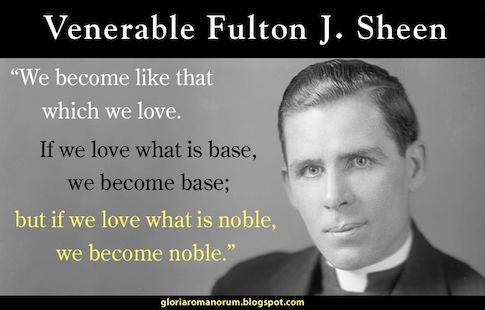
"We become like that which we love. If we love what is base, we become base; but if we love what is noble, we become noble."
~Ven. Fulton J. Sheen
[Source]


"Not by numbers of men, nor by measure of body, but by valor of soul is war wont to be decided."
~Flavius Belisarius
[Source]

"If I am not in God's grace, may He put me there; and if I am, may He so keep me."
~Joan of Arc
[Source]

"The primary duty of charity does not lie in the toleration of false ideas."
~Pope St. Pius X
[Source]

"The divine commandment of purity of soul and body also applies without diminishment to today's youth.
~Ven. Pope Pius XII
[Source]

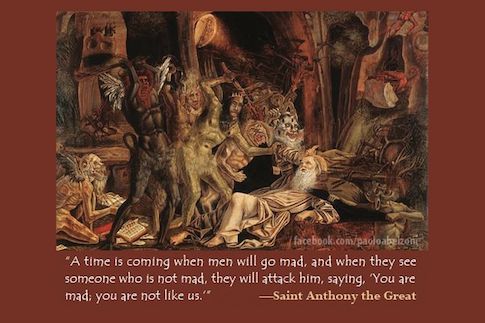
"A time is coming when men will go mad, and when they see someone who is not mad, they will attack him, saying, "You are mad, you are not like us."
~St. Anthony the Great
[Source]

For the record, yes I do benefit financially if someone purchases these. So if you would like to support my work, please feel free to purchase them and hand them out!

Thursday, March 14, 2024

A Review of Cabrini -- A saintly biopic marred by boring Hollywood tropes

Mother Cabrini (played by Cristiana Dell'Anna) receives the reply of
Pope Leo XIII (played by Giancarlo Giannini)

My wife and I went to see Cabrini last night. Given the mixed yet passionate reaction to the film by a variety of folks whose opinions I respect, I was looking forward to it. Having now seen it, I think the mixed reaction is completely appropriate.

My reaction was also mixed, though tending more toward the negative. 

On the positive side, the film had a lot of spoken Italian in it which was fun. It was also well acted and beautifully shot, with a moving soundtrack that reminded me of a cross between The Village and Master and Commander. Though there have been some complaints that Catholic spirituality is not overtly put into the mouth of a Catholic saint (a valid complaint to be sure), Catholic spirituality saturates the background of the film. There are crosses and other Catholic symbols in practically every scene, and several scenes take place in beautiful Catholic churches and buildings. So we end up with some beautiful Catholic settings for a not particularly Catholic film.

The lead role was well played by Cristiana Dell'Anna who provided a convincing likeness of Mother Cabrini. Pope Leo XIII is played sympathetically by Giancarlo Giannini, though I thought he resembled Pope Pius IX more than Leo XIII.

That said, I felt that the film was too dark and brooding for the story of a Catholic saint. The first third of the film is purposely dark, focusing on Mother's illness and all of the "no" answers she receives from the men who are in positions of authority over her. The film does lighten up in spots, but the overall ambience is darkness and obscurity.

What truly drove Mother Cabrini was left largely unexplored. The inferences one must draw from the film are the typical boring Hollywood tropes -- follow your heart; don't let the naysayers get you down; I am woman, hear me roar. The film presents a woman primarily motivated by an altruistic desire to help other Italians. So rather than being driven by the Gospel message of Jesus Christ to take care of the poor, Mother is portrayed, rather, as the celibate CEO of an Italian NGO in America. There is also an insinuation that she is at least partly driven by spite. Every time she faces an obstacle, the Cabrini in the film hears in her head an admonition given early in the film by a patriarchal archbishop: "Stay where you belong." This very worldly urge, rather than any divine inspiration, seems to motivate her to do bold things.

The film also spent considerable time building up the Italian immigrant-as-victim trope. While nativist sentiments were no doubt major obstacles for the first waves of Italian immigrants coming to America, there was another issue at play that the film studiously avoids: the hatred of Catholics by the largely Masonic ruling elite. (This particular angle was effectively brought to the fore in the film For Greater Glory, another imperfect though more inspiring film.) Though forty years after the height of the KnowNothing period when Catholic churches were torched in several cities, there was still a strong antipathy toward Catholics among the upper echelons of American society that persists to this day. While it wasn't long before Italians were accepted as Americans, devout Catholics have never really been. If you need evidence of that, consider the overtly anti-Catholic emails of Hillary Clinton campaign chair, John Podesta in 2016, or how our current "Catholic" president's Department of Justice classifies traditional Catholics among potential terrorist groups

As other reviewers have pointed out, the filmmakers also managed to turn Mother Cabrini into something of a Mary Sue. Whatever she accomplishes, she does via the force of her own powerful will. She draws her strength not from God nor from the Gospel, but from within herself. That is not a Catholic mentality at all, and I'm sure the real Mother Cabrini would have been horrified at being portrayed that way. This seems to have been done in service to a narrative that is not in keeping with the actual life of the saint.

Finally, the ending of the film was anti-climactic and strange. 

SPOILER ALERT -- stop here if you don't want to read what happens at the end...

In the movie, Mother Cabrini achieves her final victory via political blackmail -- threatening the mayor of New York that she will unleash a negative publicity campaign against him and work to get him defeated in the next election unless he allows her hospital project to go forward. She also indicates that she is willing to help him if he helps her -- a sort of "pay to play" arrangement. The fictitious Mayor Gould (who is portrayed effectively by John Lithgow as a racist political animal) is impressed by Mother's rather savvy tactics and agrees to her terms. I have no idea how much of this scenario is based on reality, but it didn't strike me as a particularly fitting denouement to a biopic of a Catholic saint. 

So overall, I give Cabrini two stars. It's worth watching once, but having now seen it, I have no desire to see it again. Instead, I'll go and read more about The Intense Catholic Spirituality of Mother Cabrini.