Showing posts with label memes. Show all posts

Saturday, August 10, 2024

A library of memes at the Arx Publishing website


Arx Publishing has recently gone live with a page of glossy quote cards for purchase. If some of them look familiar, it's because nearly all of them have appeared on this blog at some point or another. Most if not all of these memes were created by yours truly.

In the wild pre-throttle days of social media, several of these memes were passed around and enjoyed by thousands of people. In fact, even now, I see some of the earliest ones pop up occasionally on my feeds. A few of them have even been incorporated into other memes. 

If you're on Facebook, you can see my complete output here: Paolo Belzoni on Facebook. They don't get much traction these days on Facebook—I can almost pinpoint the exact day that the Facebook censors put the clamps on my account. But lots of people still see them on Reddit.

At some point, we thought it would be fun to turn these memes into physical artifacts. While everyone else in the world is digitizing physical items, we decided to pull a Chesterton-style paradox and turn some digital objects into physical ones. We started printing out these photo cards to give away at conferences. Arx also includes them in book shipments they send out to individual customers. I know for a fact that some of them end up tacked to people's refrigerators for years.

Here are several low-res samples from the new Arx Meme Page:
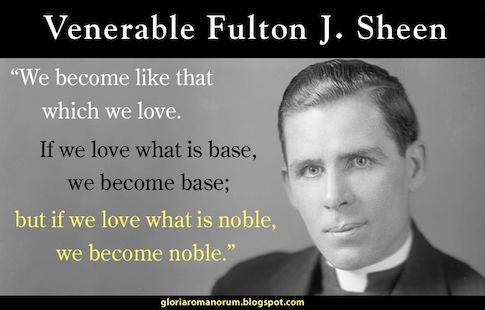
"We become like that which we love. If we love what is base, we become base; but if we love what is noble, we become noble."
~Ven. Fulton J. Sheen
[Source]


"Not by numbers of men, nor by measure of body, but by valor of soul is war wont to be decided."
~Flavius Belisarius
[Source]

"If I am not in God's grace, may He put me there; and if I am, may He so keep me."
~Joan of Arc
[Source]

"The primary duty of charity does not lie in the toleration of false ideas."
~Pope St. Pius X
[Source]

"The divine commandment of purity of soul and body also applies without diminishment to today's youth.
~Ven. Pope Pius XII
[Source]

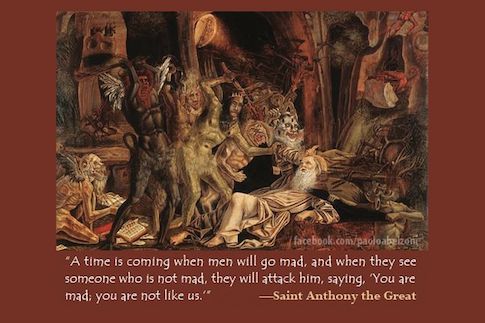
"A time is coming when men will go mad, and when they see someone who is not mad, they will attack him, saying, "You are mad, you are not like us."
~St. Anthony the Great
[Source]

For the record, yes I do benefit financially if someone purchases these. So if you would like to support my work, please feel free to purchase them and hand them out!

Friday, September 09, 2016

Monday, April 22, 2013

April 22, Feast of St. Theodore of Sykeon

Original image of St. Theodore taken from: http://www.cerkiew.pl/index.php?id=swieci&tx_orthcal[sw_id]=802&cHash=bb67994247
"You must first pray that your inward man may be reformed and grow healthy; for when that is healed, the outward man, too, will be restored to health."
~St. Theodore of Sykeon to the east Roman consul Bonosus, a violent man who came to the saint seeking a cure for a physical maladay, ca. AD 608
April 22 is the feast of St. Theodore of Sykeon, a bishop from central Asia Minor who lived during the reign of the murderous Roman emperor, Phocas. We have an extensive biography of St. Theodore written by one of his disciples that has come down to us which makes for exceptionally good reading for historians and devout Christians alike. He had a habit of fearlessly speaking the truth to power, having humbled the cruel Bonosus and rebuked Phocas himself to his face on another occasion.

Here is the above quote in context, taken from the Life of St. Theodore of Sykeon:
"About that time the inhuman consul Bonosus was travelling to the eastern parts of the Empire and as he passed near the monastery he heard tell of the inspired man's holiness and felt a reverence for it, violent and cruel though he was. So he sent a messenger in advance to him beseeching him, if he could endure the fatigue, to come down to the oratory of the holy martyr Gemellus near the posting­station in order that he might do reverence to him there and be deemed worthy of his prayers, saying that he himself was unable to go up to the monastery owing to the pressure of urgent affairs; so the Saint went down and received him and whilst he was praying for him the consul stood but did not bend his neck, so the Saint took hold of the hair of his forehead and pulled it and in this way bent his head down (virtue is wont to act thus with courage and not fear human authority 'For the righteous', it is said, 'is bold as a liont'[ Prov 28:1])

We who were present were thunder­struck and terrified at the just man's daring and imagined that the consul would turn insolent and furious, for we knew well by report that his savagery was like that of a wild beast. But he readily accepted the prayer and the rebuke and showed honor to the Saint by kissing his hands, and then putting his hand on his own chest because of a pain which oppressed him he begged the Saint to pray that he might be freed from it. But the Saint gently tapped with his fingers on the consul's chest and said to him, 'You must first pray that your inward man may be reformed and grow healthy; for when that is healed, the outward man, too, will be restored to health; therefore I will pray for you and do you devote yourself to the good and fear God in order that my prayers may be effective. But if I pray and you neglect to amend your ways, my prayers will be unavailing. Be merciful then and pitiful to all Christian people and do not use harshly the authority entrusted to you, but while examining your own consciousness of sins, sympathize with those that go astray and never shed innocent blood. For if there is to be punishment for the mere insult of a spoken word-for calling another a "fool"-how much more will blood, shed unjustly, be avenged by God?'

These counsels the Saint gave him like a man sowing seed in unfruitful ground, and the consul fetched out a few coins and offered them to him in token of gratitude. But as the Saint did not deign to accept them, he drew back his hand and took out some 'trimisia'* begging the Saint at least to accept those and to give one to every brother in the monastery. But before looking at them Theodore said, 'There are only fifty and not sufficient for giving one to each, however, they can be changed into smaller money and then distributed equally'. But the consul marvelled at his discerning words, as being God­inspired and answered, 'Yes, reverend father, by thy holy prayers, there are only fifty as your holy mouth has said; however, I will send as many more at once as are needed to make up the number'. This he did, for after being dismissed by the Saint he went to his baggage and sent what he had promised."
Taken from: http://www.fordham.edu/halsall/basis/theodore-sykeon.asp

Sunday, March 17, 2013

The real Saint Patrick in his own words

Click here to share on Facebook.
Who was Saint Patrick? Well, for starters, he wasn't Irish. He was born a Roman (Patricius) during the days when Britain was cut off from the empire immediately before the final collapse of Roman power in the west. Though not born an Irishman himself, Patrick had a deep and abiding love for the Irish and dedicated his life to bringing them to Christianity.

Amazingly, two works written by Patrick have come down to us from antiquity. The first is his Confessio, which was written about AD 450 under obscure circumstances. Following is an excerpt from this document, where Patrick tells the story of his ancestry, his capture by pirates, and his captivity in Ireland:
"My name is Patrick. I am a sinner, a simple country person, and the least of all believers. I am looked down upon by many. My father was Calpornius. He was a deacon; his father was Potitus, a priest, who lived at Bannavem Taburniae. His home was near there, and that is where I was taken prisoner. I was about sixteen at the time. At that time, I did not know the true God. I was taken into captivity in Ireland, along with thousands of others. We deserved this, because we had gone away from God, and did not keep his commandments. We would not listen to our priests, who advised us about how we could be saved. The Lord brought his strong anger upon us, and scattered us among many nations even to the ends of the earth. It was among foreigners that it was seen how little I was..."
Patrick later escapes from slavery in Ireland and after a harrowing journey, manages to return to Britain. But God is not finished with him. Later in the same document, Patrick writes about how he was called by God to be an evangelist in Ireland:
"After a few years I was again in Britain with my parents [kinsfolk], and they welcomed me as a son, and asked me, in faith, that after the great tribulations I had endured I should not go anywhere else away from them. And, of course, there, in a vision of the night, I saw a man whose name was Victoricus coming as if from Ireland with innumerable letters, and he gave me one of them, and I read the beginning of the letter: ‘The Voice of the Irish’; and as I was reading the beginning of the letter I seemed at that moment to hear the voice of those who were beside the forest of Foclut which is near the western sea, and they were crying as if with one voice: ‘We beg you, holy youth, that you shall come and shall walk again among us.’ And I was stung intensely in my heart so that I could read no more, and thus I awoke. Thanks be to God, because after so many years the Lord bestowed on them according to their cry."
The Confessio reveals Patrick to be be a man of tremendous faith, courage and humility. Too often, these characteristics are obscured by the legends and pantomime that accompany the celebration of his feast day around the world. But listen to Patrick's own exhortation, reminiscent of Saint Paul boasting of his own weakness, as he encourages the high and mighty of this world to humble themselves before God:
"So be amazed, all you people great and small who fear God! You well-educated people in authority, listen and examine this carefully. Who was it who called one as foolish as I am from the middle of those who are seen to be wise and experienced in law and powerful in speech and in everything? If I am most looked down upon, yet He inspired me, before others, so that I would faithfully serve the nations with awe and reverence and without blame: the nations to whom the love of Christ brought me. His gift was that I would spend my life, if I were worthy of it, to serving them in truth and with humility to the end..."
Click here to read the whole of the Confessio.

For an excellent short biography of this great saint, check out Saint Patrick from the Christian Encounters series. My positive review of this book may be found here.

In a similar vein, I absolutely do not recommend the popular book How the Irish Saved Civilization by Thomas Cahill. My reasons for this negative opinion may be found here.

Happy Saint Patrick's Day #1


The real Saint Patrick was a man of tremendous faith, courage and humility. Too often, these characteristics are obscured by the legends and pantomime that accompany the celebration of his feast day around the world.

Amazingly, two of Patrick's writings have survived from antiquity: his Confession and his Letter to the Soldiers of Coroticus. Here is an excerpt from his Confession about his calling to be an evangelist in Ireland:

"After a few years I was again in Britain with my parents [kinsfolk], and they welcomed me as a son, and asked me, in faith, that after the great tribulations I had endured I should not go anywhere else away from them. And, of course, there, in a vision of the night, I saw a man whose name was Victoricus coming as if from Ireland with innumerable letters, and he gave me one of them, and I read the beginning of the letter: ‘The Voice of the Irish’; and as I was reading the beginning of the letter I seemed at that moment to hear the voice of those who were beside the forest of Foclut which is near the western sea, and they were crying as if with one voice: ‘We beg you, holy youth, that you shall come and shall walk again among us.’ And I was stung intensely in my heart so that I could read no more, and thus I awoke. Thanks be to God, because after so many years the Lord bestowed on them according to their cry."

Find out more about the real Saint Patrick here:
http://www.catholic.org/saints/saint.php?saint_id=89

Sunday, March 10, 2013

Prayers for the Conclave


The Conclave is scheduled to begin on Tuesday, March 12 on the traditional calendar feast of Pope St. Gregory the Great. The faithful are called to pray for the conclave, that the assembled cardinals be receptive to the inspiration of the Holy Spirit. What better way to do this than to remind ourselves of the glorious heritage of the office of the Papacy and some of the brilliant, wise and godly men who have occupied the Roman cathedra.

Too often, those who think poorly of the Church focus on the "bad" Popes. But one need only glance through the 2,000 year history of the papacy--stretching all the way back to the time of Jesus--to see that the good far outnumber the "bad". Here are some memes to help us focus on the outstanding virtues of some of the most noble early Popes. Let us pray to Almighty God that He sends His Holy Spirit to inspire these virtues in the man who will become the next Pontiff--the next Servant of the Servants of God.

Saint Peter, the First Pope
"Dearly beloved, think not strange the burning heat which is to try you, as if some new thing happened to you; But if you partake of the sufferings of Christ, rejoice that when his glory shall be revealed, you may also be glad with exceeding joy. If you be reproached for the name of Christ, you shall be blessed: for that which is of the honor, glory, and power of God, and that which is his Spirit, resteth upon you." [First Epistle of Saint Peter, 4:12-14]
Read more about St. Peter the Liber Pontificalis, an amazing early work that every Catholic should own.

Saturday, March 02, 2013


"I am not the Son of God. I'm just a philosopher who wants people to be nice to each other." #ThingsJesusNeverSaid

What Jesus actually said:
"Amen, amen I say to you: If any man keep my word, he shall not see death for ever."

The Jews therefore said: "Now we know that thou hast a devil. Abraham is dead, and the prophets; and thou sayest: If any man keep my word, he shall not taste death for ever. Art thou greater than our father Abraham, who is dead? and the prophets are dead. Whom dost thou make thyself?"

Jesus answered: "If I glorify myself, my glory is nothing. It is my Father that glorifieth me, of whom you say that he is your God. And you have not known Him, but I know Him. And if I shall say that I know Him not, I shall be like to you, a liar. But I do know Him, and do keep His word. Abraham your father rejoiced that he might see my day: he saw it, and was glad."

The Jews therefore said to him: "Thou art not yet fifty years old, and hast thou seen Abraham?"

Jesus said to them: "Amen, amen I say to you, before Abraham was made, I AM."

They took up stones therefore to cast at him. But Jesus hid himself, and went out of the temple.

John 8:51-59.

Thursday, February 07, 2013

Things Saint Paul never said


Here's another one of these in the same vein.

"Fornicators, idolaters, adulterers, the effeminate, homosexuals, thieves, the covetous, drunkards, railers, extortioners, guess what? You're all going to HEAVEN!" #ThingsSaintPaulNeverSaid

Here is what Saint Paul actually said:
"Do not err: neither fornicators, nor idolaters, nor adulterers, Nor the effeminate, nor liers with mankind, nor thieves, nor covetous, nor drunkards, nor railers, nor extortioners, shall possess the kingdom of God.

And such some of you were; but you are washed, but you are sanctified, but you are justified in the name of our Lord Jesus Christ, and the Spirit of our God. All things are lawful to me, but all things are not expedient. All things are lawful to me, but I will not be brought under the power of any. Meat for the belly, and the belly for the meats; but God shall destroy both it and them: but the body is not for fornication, but for the Lord, and the Lord for the body. Now God hath both raised up the Lord, and will raise us up also by his power. Know you not that your bodies are the members of Christ? Shall I then take the members of Christ, and make them the members of an harlot? God forbid."
Click here to read the entire passage:
http://drbo.org/x/d?b=drb&bk=53&ch=6&l=9#x

Things Jesus Never Said ....

Click here to share on Facebook.
Yes, someone else came up with this general idea (#ThingsJesusNeverSaid - go "like" them on Facebook) but I couldn't resist making this one.

"Judge not, lest ye be judged; and by that I mean remain silent when you see others do evil" #ThingsJesusNeverSaid

The actual quote from Christ as recorded in Matthew 7:1 is as follows:
"Judge not, that you may not be judged, For with what judgment you judge, you shall be judged: and with what measure you mete, it shall be measured to you again. And why seest thou the mote that is in thy brother's eye; and seest not the beam that is in thy own eye? Or how sayest thou to thy brother: Let me cast the mote out of thy eye; and behold a beam is in thy own eye? Thou hypocrite, cast out first the beam in thy own eye, and then shalt thou see to cast out the mote out of thy brother's eye."
To read the entire passage, visit: http://www.drbo.org/chapter/47007.htm

This is not an exculpation of vice. It is an exhortation to virtue and a warning against hypocrisy.

Saturday, February 02, 2013

For the feast of St. Thomas Aquinas, January 28 ~ On Charity and Mortal Sin

"It must be said that charity can, in no way, exist along with mortal sin."
~St. Thomas Aquinas, Quaestiones disputatae: De caritate.


The image is "The Temptation of St. Thomas Aquinas" by Diego Velazquez (1632)

Here is the quote in more context:
Article 6: Whether There Can Be Charity With Mortal Sin?

I answer. It must be said that charity can, in no way, exist along with mortal sin. To prove this, it must be considered, first, that every mortal sin is directly opposed to charity. Whoever chooses something in preference to something else, loves better that which he first chooses. Whence, because man loves his own life and his own continuance more than pleasure, however great that pleasure may be, he is drawn away from pleasure if he thinks that it is infallibly destructive of his own life. This is explained by Augustine when he writes in the LXXXIII Quaestionum, that there is no one who fears pain more than he who seeks pleasure. Sometimes we even see that the most savage of beasts will avoid the greatest pleasures because of the fear of pain. However, one sins mortally in this, that he prefers something other than to live according to God and to cling to God. Thus it is clear that whoever sins mortally, by this fact he loves some other good more than he loves God; for if he would love God, he would choose to live according to God more than to obtain some temporal good. However, it is of the very essence of charity that God be loved above all things, as is clear from what is said above. Therefore every mortal sin is contrary to charity.
The full treatise is well worth reading and may be found here: https://isidore.co/aquinas/english/QDdeVirtutibus2.htm#6

The Greatest Destroyer of Peace is Abortion


"The greatest destroyer of love and peace is abortion." ~Blessed Teresa of Calcutta, said at the National Prayer Breakfast, February 3, 1994

This quote was part of a courageous speech given by Blessed Teresa before US political leaders, including President and Mrs. Clinton and Vice-President and Mrs. Gore--all abortion advocates. Here is the context:
"But I feel that the greatest destroyer of peace today is abortion, because it is a war against the child, a direct killing of the innocent child, murder by the mother herself. And if we accept that a mother can kill even her own child, how can we tell other people not to kill one another? How do we persuade a woman not to have an abortion? As always, we must persuade her with love and we remind ourselves that love means to be willing to give until it hurts. Jesus gave even His life to love us. So, the mother who is thinking of abortion, should be helped to love, that is, to give until it hurts her plans, or her free time, to respect the life of her child. The father of that child, whoever he is, must also give until it hurts.

By abortion, the mother does not learn to love, but kills even her own child to solve her problems. And, by abortion, that father is told that he does not have to take any responsibility at all for the child he has brought into the world. The father is likely to put other women into the same trouble. So abortion just leads to more abortion. Any country that accepts abortion is not teaching its people to love, but to use any violence to get what they want. This is why the greatest destroyer of love and peace is abortion."
Watch the whole of this beautiful speech here: http://www.youtube.com/watch?v=OXn-wf5ylgo

Feminist for Life #2


"Nature in every thing demands respect, and those who violate her laws seldom violate them with impunity." -Mary Wollstonecraft

Taken from Wollstonecraft's "A Vindication of the Rights of Women", 1792.

Here is the quote in context:

"To satisfy this genus of men, women are made systematically voluptuous, and though they may not all carry their libertinism to the same height, yet this heartless intercourse with the sex, which they allow themselves, depraves both sexes, because the taste of men is vitiated; and women, of all classes, naturally square their behaviour to gratify the taste by which they obtain pleasure and power. Women becoming, consequently, weaker, in mind and body, than they ought to be, were one of the grand ends of their being taken into the account, that of bearing and nursing children, have not sufficient strength to discharge the first duty of a mother; and sacrificing to lasciviousness the parental affection, that ennobles instinct, either destroy the embryo in the womb, or cast it off when born. Nature in every thing demands respect, and those who violate her laws seldom violate them with impunity. The weak enervated women who particularly catch the attention of libertines, are unfit to be mothers, though they may conceive; so that the rich sensualist, who has rioted among women, spreading depravity and misery, when he wishes to perpetuate his name, receives from his wife only an half-formed being that inherits both its father's and mother's weakness."

Feminist for Life #1

"The rights of children as individuals begin while yet they remain the foetus." ~Victoria Woodhull in Woodhull and Claflin's newspaper, 1870.

This meme may be shared on Facebook by clicking here.

Victoria Woodhull was an early crusader for women's rights in the United States. Though seriously misguided on a host of moral issues, she yet understood the inherent wickedness of abortion, writing in a later editorial in the same periodical:
"Every one will concede that it is murder to take the life of a human being. But the very pertinent question arises just here, when does human life begin? The beating of the heart, modern science tells us, never begins; that is to say, there is no time in the whole process of the growth of the human body from the moment of conception until death, that pulsations of life are not present in what is to develop into the perfected body. Where, then, shall the line be drawn, on one side of which it shall be murder to cause these pulsations to cease, and upon the other not murder?

...Many women who would be shocked at the very thought of killing their children after birth, deliberately destroy them previously. If there is any difference in the actual crime we should be glad to have those who practice the latter, point it out. The truth of the matter is that it is just as much a murder to destroy life in its embryotic condition, as it is to destroy it after the fully developed form is attained, for it is the self-same life that is taken.

...[T]hey who, having conceived [children] then destroy them, are murderers; and no amount of sophistry nor excuses can, by one iota, mitigate the enormity of the crime. They do even more than murder, they virtually commit suicide, for no woman can practice this crime without in part destroying her own life.

...[W]hile we shall at all times freely discuss the matter, objectively as to its results, we shall not forget to look at the matter subjectively, to find the remedy, which, if we mistake not, is in granting freedom and equality to woman."
[NB. I've fallen behind on posting these, opting instead to post to my Facebook page first where they inevitably get more play. Like me on Facebook if you want to see these earlier and share them with your friends.]

Friday, November 23, 2012

Martyrdom of Blessed Miguel Pro - November 23, 1927

November 23 is the anniversary of the martyrdom of Blessed Miguel Pro. Following is the Wikipedia entry on Pro's arrest and execution:
An assassination attempt by bombing against Álvaro Obregón (which only wounded the ex-president) in November 1927 provided the state with a pretext to capture Pro and his brothers Humberto and Roberto. A young engineer who was involved and confessed his part in the assassination testified the Pro brothers were not involved. Miguel and his brothers were taken to the Detective Inspector's Office in Mexico City.

On November 23, 1927, Fr. Pro was executed without trial. President Calles gave orders to have Pro executed under the pretext of the assassination, but in reality for defying the virtual outlawing of Catholicism.[5] Calles had the execution meticulously photographed, and the newspapers throughout the country carried them on the front page the following day. Presumably, Calles thought that the sight of the pictures would frighten the Cristero rebels who were fighting against his troops, particularly in the state of Jalisco. However, they had the opposite effect.

Fr. Pro and his brothers were visited by Generals Roberto Cruz and Palomera Lopez around 11 p.m. on November 22, 1927. The next day, as Fr. Pro walked from his cell to the courtyard and the firing squad, he blessed the soldiers, knelt and briefly prayed quietly. Declining a blindfold, he faced his executioners with a crucifix in one hand and a rosary in the other and held his arms out in imitation of the crucified Christ and shouted out, "May God have mercy on you! May God bless you! Lord, Thou knowest that I am innocent! With all my heart I forgive my enemies!" Before the firing squad were ordered to shoot, Pro raised his arms in imitation of Christ and shouted the defiant cry of the Cristeros, "Viva Cristo Rey!" -"Long live Christ the King!". When the initial shots of the firing squad failed to kill him, a soldier shot him point blank.
Taken from: http://en.wikipedia.org/wiki/Miguel_Pro

Monday, October 15, 2012

Feast of Saint Teresa of Avila


To celebrate the feast of one of the great Carmelites and a Doctor of the Church, here is a quote from St. Teresa of Avila. In context:
When I see people making great progress, and being resolute and detached and courageous, I conceive a great love for them and should be glad if I could see more of them: I think they are a help to me. People who I see to be timid and who appear to be making half-hearted attempts to do things which so far as human reason can judge they can do perfectly well seem to distress me and make me pray to God for them and to the saints who accomplished these very things which now frighten us. Not that I am good for anything, but I believe that God helps those who set out to do great things for His sake and never fails those who trust in Him alone. And I should like to find someone who would help me to believe this to be so, and to have no anxiety about what I am to eat and put on, but leave it to God.
Taken from The Spiritual Relations, 1560 (The Complete Works of St. Theresa, Volume 1, [1946] Sheed and Ward, pg. 309).

Monday, October 08, 2012

"He hath a daily beauty in his life that makes me ugly."


The quote in this image was taken from Archbishop Sheen's "Life of Christ", Chapter 46: At the Bottom of the List.

Here is the complete quote in context:

"The hatred of Judas against Our Blessed Lord was due to the contrast between his sin and the virtue of the Divine Master. Iago says of Cassio: "He hath a daily beauty in his life that makes me ugly." Judas' disgust with himself was vented on One Who made him uncomfortable by His Goodness. The hatred against Divinity is not the result always of unbelief, but very often the effect of antibelief. Conscience, Christ, and the gift of faith make evil men uneasy in their sin. They feel that if they could drive Christ from the earth, they would be free from "moral inhibitions." They forget that it is their own nature and conscience which makes them feel that way. Being unable to drive God from the heavens, they would drive his ambassadors from the earth. In a lesser sphere, that is why many men sneer at virtue--because it makes vice uncomfortable. A chaste face is a judgment. Judas was more zealous in the cause of his enemies than he ever was in the cause of Our Lord. When men leave Christ, they seek to redeem their reputation by going to extremes."