Thursday, June 14, 2012

Woman Pope elected by rebel Catholic group

Anti-pope Hannah Blima I
In a stunning development, a Facebook conclave of rogue Catholics has elected the first female anti-pope. When the white smoke rose from a pot-belly stove in Mount Holly, New Jersey, it was revealed that the electors had chosen a two-year old woman with red curly hair to be the next pseudo-pontiff. Reportedly assuming the regnal title of Hannah Blima I, the new anti-popess began her reign by throwing a tantrum, after which the Cardinal electors promptly sent her to bed without dessert.

Not questioning the legitimacy of Pope Benedict XVI, who is recognized as a valid Pope, the group called the move a challenge to Michael I, Pius XIII (deceased), Father Guido Sarducci and several other spurious claimants to the bishopric of Rome. "Anti-popes of late have been so lame," an unnamed spokesperson said. "As a result, we declared the seat of the anti-pope vacant and decided to elect our own."

The election was met with rapturous joy on the part of the cardinal electors who had suffered through numerous failed ballots before arriving at a result. "Neque porro quisquam est qui dolorem," declared an exhausted Iohannes Cardinal Rotondos, "Ipsum quia dolor sit amet, consectetur adipisci velit."

Hannah Blima's path to the anti-papacy was not an easy one. She had to overcome challenges from high-powered celebrity opponents such as Yoda, Christopher Robin, Carlo Santa Theresa, and a late surge by perennial omni-candidate, Ron Paul. While Santa Theresa declined his nomination and gallantly threw his support behind Hannah, the Paul camp was bitterly disappointed by the result. "If the media hadn't ignored our candidacy, we certainly would have won," Paul said bitterly in a press release following his defeat.

The election of Hannah Blima I was also greeted with wild enthusiasm by the the embattled Leadership Conference of Women Religious, currently under investigation by the Vatican. "Finally, a pope we can work with!" declared Sister Namaste Labyrinth. "This is a great day for all women, womyn, and wymyn who have been oppressed by the patriarchal intolerance of the gynophobic androcracy that has ruled since they banned Lilith from the Bible."

Rumors abound concerning the ethnic heritage of the pint-sized pontifess with some claiming that she will be under the thumb of a shaddowy figure known as "Yehudis". This has led to further rumors that Hannah Blima I might in fact be Jewish. Her father and press secretary, Claudio Salbatucci was quick to squelch such rumors. "Oy gevalt, I've got NO idea vhat you are talking about. Hannah is no more Jewish than Jackie Mason or Schmuly Boteach. Now if you'll excuse me, I've got a little schpilkas."

Despite all the controversy, Hannah Blima I looked calm as she appeared before the public for the first time. "I don't like lettuce," she replied cryptically in response to a reporter's question about the canonical status of the SSPX. Meanwhile detractors such as the clan McWilliams of Pennsauken grumbled quietly about a new schism after their demands for simoniacal appointments were rebuffed.

All present seemed to sense that while Hannah Blima I's reign as poppet will usher in a new age for the fake church, it will be an era acrimony, controversy, and cute little pink flip-flops.

Monday, June 11, 2012


I've been thinking about Blessed Teresa a lot lately. This image speaks for itself, I think.

Sunday, June 03, 2012

Our TV is Lousy and Now it Must Die! or, What the West Can Learn from South Korean Television

Three years ago, I knew nothing about Korea. Alright, maybe I knew that my father had served there after the Korean War where he got reprimanded for putting up bridge-ties for telephone poles. And I also knew a little about Kim Jong Il, the strange, troll-haired demi-god of communist North Korea. But I knew almost nothing about the history of the country itself.

Now, amazingly, I know much more about Korea and have developed a true appreciation and sympathy for that small country and its rich history. No, I did not take a course, nor did I become best friends with a Korean history professor. I have American television to thank for this unexpected educational epiphany.

Of course, I’m being a bit tongue-in-cheek here. I’m guessing that most who read this column will readily agree that American TV is a vast intellectual and moral wasteland, fit for neither man nor beast. When it’s not assaulting you with endlessly regurgitated double entendres, or using action dramas as a vehicle to preach an obnoxious political message, it’s attempting to yank at your heartstrings with some syrupy human-interest story using real people as props to enhance the brand profile of some soulless mega-corporation. And that’s just the commercial networks. PBS is little more than a self-referential lobbying outfit whose programming seems wholly geared toward convincing people that everything on the planet will perish if we don’t give national and international governing bodies more power.

Before we go on, I have a confession to make. I grew up a TV addict in the 1970s and 80s. My TV viewing only took a hit after the birth of my first child in 2002 when I belatedly figured out that it probably wasn’t the best idea to expose such an innocent soul to the endless stream of sex jokes that makes up the standard prime-time fare. Now, we watch hardly any TV at all in our house. We do still watch sporting events, but even then, I sit there wielding the remote in the attack position, lest I find myself fending off questions like, “Dad, what is Cialis and why are those two old people sitting in bathtubs outside?”

But the point of this essay is less to lament the pathetic state of American entertainment than to laud something that is produced in east Asia that’s not made of cheap plastic—historical dramas from South Korea. When I first stumbled across one of these dramas on a small, independent US TV network (sandwiched awkwardly in between the Greek Hour and a talking-head program featuring very manly-looking women), I figured it was nothing more than a rehash of the corn-ball kung-fu theater of my youth. However, the endorsement of a friend made me curious and sure enough, after watching two episodes of a drama called Dae Joyoung, I was hooked. Soon after, my wife was hooked as well.

http://commons.wikimedia.org/wiki/File:Korea-Seoul-War_Memorial_2611-06_Turtle_Ship_Dragon_Head.jpg
Prow of a Korean turtle ship.
Hard as it may be to believe, costume historical drama is popular in Korea. They run in series of 30+ episodes. The most successful ones, such as The Immortal Yi Soon Shin about Korea’s legendary 16th century admiral and his turtle ships, can run over 120 episodes. Though they are called “dramas”, I’m not talking about soap operas. These programs are written and produced to appeal to both men and women, and as such, there is always an element of romance. But this is nothing like the cheesy Hollyweird “romance” we have come to expect in most Western entertainment which is generally a half-step from pornography. Modesty is assumed. Courtesy is mandatory, even between mortal enemies. Old-fashioned courtly romance is the order of the day.

Did I mention the fighting? One thing I discovered from watching these series is that Korean history is a bit like Irish history: that of a small, independent-minded nation forever struggling under the thumb of a nearby hegemon. Because of this, I suppose, their historical dramas tend to emphasize the heroic—the weak versus the strong, battles against impossible odds, civil war, political intrigue, foreign meddling, betrayal, and self-sacrifice. The heroes are portrayed as virtuous, complex, witty, intelligent, and noble. They are also usually brilliant fighters and martial arts play a prominent role. But before you roll your eyes, remember that production values in the East have come a long way from the “Your karate is good but now you must die!” schlock of the 1970s. The action sequences are beautifully choreographed and shot using magnificent sets, costume, lighting and sound.

What’s more, nearly every series has at least one classic buffoon in it to provide comic relief.

In general, the writing is tremendous. The storylines are original, unpredictable, and endlessly fascinating. The characters are somewhat archetypal, but they are entertaining and endearing archetypes that translate well for Western audiences. The acting seems superb, though the fact that I don’t speak Korean might give the actors a bit more gravitas than they actually have.

Of course, in order to enjoy one of these dramas, you’ll have to put up with a few things:

1. Subtitles. Most of the time, the subtitles are unobtrusive and well done. Occasionally you run into a series where it seems the translation was done by the same guy who wrote the owner’s manual for your 1985 Hyundai Excel.

2. Eunuchs and Concubines and Courtesans. Yes, Eastern civilization approved of some practices that were traditionally frowned upon in the West before our public morals got sucked into the sewer. All three of these character types appear with regularity in Korean historical dramas because all three played prominent roles in Korean history. Despite this, the overall moral tone of the dramas is very high in the best Confucian sense, emphasizing filial piety, generosity, loyalty to country, clan, or patron, benevolence in leadership, and equality of opportunity for all regardless of social class.

3. Goofy Korean pop music. The love ballads with vocals that most of these dramas feature are occasionally bearable, occasionally silly. However, the instrumental incidental music is almost always outstanding. In the best cases, it is a beautifully balanced mix of Eastern and Western music that will stick with you for a long time. If you want to get an idea of the quality of the instrumental music, have a listen at my Korean Drama playlist on YouTube.

4. Internet TV. In terms of quality and ease of access, Internet TV has come a long way—maybe too long as there are now commercials embedded into these videos on most free services. That said, there are still the occasional hiccups having to do with network availabilty and odd copyright issues. If you make the mistake of starting a series on a site that has pirated the videos, don’t be surprised if the series gets yanked when you’re halfway through.

Saint Andrew Kim Taegon,
the first Korean Catholic
priest. He was martyred in
1846 at the age of 25.
5. No reference to Christianity. The spirituality in the shows is generally Confucian with a sprinkling of Buddhism. While religion doesn’t normally play a huge role, the dramas we have watched so far have been respectful to spirituality—those characters who despise “the mandate of Heaven” are always portrayed as evil. Only one drama dealt with Catholicism at all—Yi San, which was set in the late 18th century. Catholicism was outlawed at the time, but the benevolent king Jeongjo (the main character) was kind to the Korean Catholics whom he admired for their work with the poor. The main antagonist in the show, queen dowager Jeongsun, would go down in history as the one responsible for the “Beheading Mountain” Martyrs and the Korean Catholic Persecution of 1801—an event I knew nothing about until I watched this series.

A little curious maybe? Well, if you want to give one of these dramas a shot, I recommend Gye Baek to start with. It’s a shorter one—only 30 episodes—so it’s not a major investment of time if you get drawn in. Gye Baek and several other of these dramas may be found for free (with commercials) on www.crunchyroll.com, a website which specializes in TV series from east Asia.
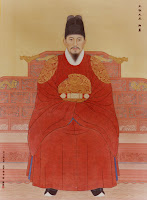
http://commons.wikimedia.org/wiki/File:Jeongjo_of_Joseon.jpg
Official portrait of King
Jeongjo of Joseon. The drama
Yi San is based on his
childhood and rise to the throne.
Having watched several of these dramas from beginning to end, I can’t help but wonder what American culture would be like today if our entertainment industry produced similar epic work about Christian historical heroes. Imagine if there were unapologetic Catholics in Hollywood who made programs which celebrated the traditional Christian virtues without the miserable post-modern angst and moral vacuity that plagues most secular entertainment. Imagine if our kids grew up watching fascinating historical dramas about Constantine or Charles Martel or Saint Louis IX instead of tawdry sit-coms or cartoons laden with secular propaganda. How different things might be if historical men of courage and faith were our children’s heroes rather than effeminate minstrels and thuggish ball-players.

At the very least, our kids would know where they came from and would have a better appreciation for the glorious patrimony which has been handed down to them. And it might actually begin to trouble them when they see their leaders and peers squandering that patrimony so frivolously.

This article appears in the June 2012 issue of Catholic Men's Quarterly.

Wednesday, May 30, 2012

Book Review: Catholic Philosopher Chick

Cate Frank is a young woman in her early 20s. She's into fashion, makeup, guys and Thomas Aquinas. Wait, what? Yes, you heard right. Cate can talk Louis Vuitton or the Summa Theologica with equal facility. She's a convert to the Catholic faith from eastcoast secularism, having lived life in the fast lane in Manhattan for a few years after college. But now Cate has moved on to a higher calling and is pursuing a graduate degree in philosophy--scholastic philosophy--at Franciscan...I mean, Dominican University of Houston. There, she will plumb the challenging depths of Thomistic thought, particularly with regard to the Dumb Ox's view of women, while at the same time navigating the equally dangerous shoals of campus relationships.

Allow me to say up-front that on the surface, this is not my kind of book. I like action. I like apocalyptic wars between good and evil. I like battle-axes and chain-mail, M-1 carbines and P-40 Warhawks, lost causes and martyrdoms. My kind of books have titles like Angels in Iron or Crown of the World or Citadel of God. That said, I found myself enjoying Catholic Philosopher Chick quite a bit more than I thought I would. The writing is very crisp and bouncy. The story has a nice flow to it that kept me engaged, aided by the amiable first-person narration of the main character. Cate comes across as very likeable and real, despite her penchant for dropping fashion brandnames faster than plaid shirts in the clearance aisle at Walmart. One sympathizes with her various trials which, I imagine, will resonate most strongly with young women who are clearly the primary audience for this book.

What I appreciated most about Catholic Philosopher Chick, however, was the genuine effort on the part of the authors (newcomer Rebecca Bratten Weiss and Regina Doman of Angel in the Waters and the Catholic Fairy Tale Novels fame) to adapt for a Catholic audience the contemporary style of writing popular in secular mass-market adult fiction. They did this successfully without succumbing to the trashier aspects of the genre and what's more, managed to seamlessly work in a discussion of Thomistic philosophy which, I imagine, will be alien to a vast majority of those who read this book. That's all to the good, if you ask me. In the end, the authors have created an amusing, fun and very upbeat little book sure to appeal to their audience of young women ages 16 and over.

Finally, though we're told that one should never judge a book by its cover, I thought the cover art for Catholic Philosopher Chick was unique, engaging and a perfect complement to the text.Well done!

Wednesday, May 09, 2012

My feelings on the 2012 presidential race in a nutshell. I'm not going to vote for either Romney or Obama. For the first time in my life, I'll be pulling the lever for a third party candidate for president. The question is, which one?

Saturday, April 07, 2012

Happy Easter 2012

A day early...
The artwork is taken from one of the tapestries in the Vatican Museum.

Thursday, March 29, 2012

Book Review: Black Ships Before Troy

Black Ships Before Troy delivers all the epic legendary drama of Homer's Iliad in a package sure to appeal to kids between the ages of 8 and 13.

If you say "Homer" to most kids these days, the most immediate response is "Simpson". "Ajax" is a cleaning product and names like "Hector", "Achilles", and "Priam" evoke blank stares. To counteract this, I recommend that you get them a copy of Black Ships Before Troy by renowned children's author Rosemary Sutcliffe. Given that the Trojan War cycle is, after Sacred Scripture, one of the main fonts of the Western literary canon, it is important that kids have a basic knowledge of the legends, heroes and villains associated with it. While the Iliad itself may be a tough read for kids, Black Ships Before Troy is not. The writing, however, is not pedestrian. It maintains a poetic quality that is well-suited to the subject matter. The illustrations are also superior and held my children captivated.

For homeschoolers, this book is a great way to introduce your kids to ancient Greece and great literature at the same time. It also provides numerous opportunities to discuss morals and the virtues and flaws of the numerous characters. We read the book out-loud as part of our ongoing studies of Bronze-age Greece and it was interesting to see which characters my kids identified with and which they despised. It was also a chance to examine the pagan religions of the ancients and introduce the kids to the differences between the pagan and Judeo-Christian views of the world.

One further bonus is that Black Ships Before Troy actually goes beyond the text of the Iliad and tells the story of the entire war through the fall of Troy.

So overall, I highly recommend this book, particularly for homeschoolers, as a fantastic appetizer to the feast of ancient history and Western literature. Once your kids have read it, they will be ready to move on to other similar books such as The Wanderings of Odysseus, also by Rosemary Sutcliffe, In Search of a Homeland: The Story of the Aeneid, by Penelope Lively, and The Laviniad: An Epic Poem by my friend Claudio Salvucci.

Saturday, March 17, 2012

The Communist Goals of 1963 and modern Libertarians as Useful Idiots

Click here to read this entry in the Congressional Record.
This past week, Rick Santorum was taken to task for daring to suggest in an eminently reasonable policy statement on his website that we should actually enforce laws already on the books to restrict the distribution of hard-core pornography. 

The hysterical reaction from the libertarian/left was predictable, likening Santorum to everything from a church lady to an American Taliban. 

 Following is a list of Communist Goals that was read into the Congressional Record by A. S. Herlong, Democrat Representative of the State of Florida in 1963. Every now and then, I like to revisit this list to see how the enemies of the civilization are doing accomplishing these goals. While some of the goals on this list are out-of-date historically speaking, many are in the process of being accomplished right now under our very noses. On the whole, the list provides a checklist for how to undermine a nation and set it up for destruction. 

 I hope that some libertarians will read this list and at least come to understand what you are defending and whose rhetoric you are adopting when you claim that a duly elected government has no right to restrict obscenity. 

 [Bold is mine] 

 ---------------------------------------
January 10, 1963
Current Communist Goals 
EXTENSION OF REMARKS OF HON. A. S. HERLONG, JR. OF FLORIDA IN THE HOUSE OF REPRESENTATIVES 
Thursday, January 10, 1963 
Mr. HERLONG. Mr. Speaker, Mrs. Patricia Nordman of De Land, Fla., is an ardent and articulate opponent of communism, and until recently published the De Land Courier, which she dedicated to the purpose of alerting the public to the dangers of communism in America. At Mrs. Nordman's request, I include in the RECORD, under unanimous consent, the following "Current Communist Goals," which she identifies as an excerpt from "The Naked Communist," by Cleon Skousen: 
CURRENT COMMUNIST GOALS
1.    U.S. acceptance of coexistence as the only alternative to atomic war.
2.    U.S. willingness to capitulate in preference to engaging in atomic war.
3.    Develop the illusion that total disarmament [by] the United States would be a demonstration of moral strength.
4.    Permit free trade between all nations regardless of Communist affiliation and regardless of whether or not items could be used for war.
5.    Extension of long-term loans to Russia and Soviet satellites.
6.    Provide American aid to all nations regardless of Communist domination.
7.    Grant recognition of Red China. Admission of Red China to the U.N.
8.    Set up East and West Germany as separate states in spite of Khrushchev's promise in 1955 to settle the German question by free elections under supervision of the U.N.
9.    Prolong the conferences to ban atomic tests because the United States has agreed to suspend tests as long as negotiations are in progress.
10.    Allow all Soviet satellites individual representation in the U.N.
11.    Promote the U.N. as the only hope for mankind. If its charter is rewritten, demand that it be set up as a one-world government with its own independent armed forces.
12.    Resist any attempt to outlaw the Communist Party.
13.    Do away with all loyalty oaths.
14.    Continue giving Russia access to the U.S. Patent Office.
15.    Capture one or both of the political parties in the United States.
16.    Use technical decisions of the courts to weaken basic American institutions by claiming their activities violate civil rights.
17.    Get control of the schools. Use them as transmission belts for socialism and current Communist propaganda. Soften the curriculum. Get control of teachers' associations. Put the party line in textbooks.
18.    Gain control of all student newspapers.
19.    Use student riots to foment public protests against programs or organizations which are under Communist attack.
20.    Infiltrate the press. Get control of book-review assignments, editorial writing, policymaking positions.
21.    Gain control of key positions in radio, TV, and motion pictures.
22.    Continue discrediting American culture by degrading all forms of artistic expression. An American Communist cell was told to "eliminate all good sculpture from parks and buildings, substitute shapeless, awkward and meaningless forms."
23.    Control art critics and directors of art museums. "Our plan is to promote ugliness, repulsive, meaningless art."
24.    Eliminate all laws governing obscenity by calling them "censorship" and a violation of free speech and free press.
25.    Break down cultural standards of morality by promoting pornography and obscenity in books, magazines, motion pictures, radio, and TV.
26.    Present homosexuality, degeneracy and promiscuity as "normal, natural, healthy."
27.    Infiltrate the churches and replace revealed religion with "social" religion. Discredit the Bible and emphasize the need for intellectual maturity which does not need a "religious crutch."
28.    Eliminate prayer or any phase of religious expression in the schools on the ground that it violates the principle of "separation of church and state."
29.    Discredit the American Constitution by calling it inadequate, old-fashioned, out of step with modern needs, a hindrance to cooperation between nations on a worldwide basis.
30.    Discredit the American Founding Fathers. Present them as selfish aristocrats who had no concern for the "common man."
31.    Belittle all forms of American culture and discourage the teaching of American history on the ground that it was only a minor part of the "big picture." Give more emphasis to Russian history since the Communists took over.
32.    Support any socialist movement to give centralized control over any part of the culture--education, social agencies, welfare programs, mental health clinics, etc.
33.    Eliminate all laws or procedures which interfere with the operation of the Communist apparatus.
34.    Eliminate the House Committee on Un-American Activities.
35.    Discredit and eventually dismantle the FBI.
36.    Infiltrate and gain control of more unions.
37.    Infiltrate and gain control of big business.
38.    Transfer some of the powers of arrest from the police to social agencies. Treat all behavioral problems as psychiatric disorders which no one but psychiatrists can understand [or treat].
39.    Dominate the psychiatric profession and use mental health laws as a means of gaining coercive control over those who oppose Communist goals.
40.    Discredit the family as an institution. Encourage promiscuity and easy divorce.
41.    Emphasize the need to raise children away from the negative influence of parents. Attribute prejudices, mental blocks and retarding of children to suppressive influence of parents.
42.    Create the impression that violence and insurrection are legitimate aspects of the American tradition; that students and special-interest groups should rise up and use ["]united force["] to solve economic, political or social problems.
43.    Overthrow all colonial governments before native populations are ready for self-government.
44.    Internationalize the Panama Canal.
45.    Repeal the Connally reservation so the United States cannot prevent the World Court from seizing jurisdiction [over domestic problems. Give the World Court jurisdiction] over nations and individuals alike.
--------------------------------------- 

 Beyond libertarians, however, it is dismaying to me how easily some well-intentioned conservatives have fallen for the narrative that obscenity is a "free speech" issue when it never was before the 1960s. Here are two snippets from Supreme Court decisions that were subsequently overturned by the radical courts of the 1960s, much to this country's detriment:
Chaplinsky vs. New Hampshire (1942): "There are certain well-defined and narrowly limited classes of speech, the prevention and punishment of which have never been thought to raise any Constitutional problem. These include the lewd and obscene, the profane, the libelous, and the insulting or 'fighting' words....It has been well observed that such utterances are no essential part of any exposition of ideas, and are of such slight social value as a step to truth that any benefit that may be derived from them is clearly outweighed by the social interest in order and morality."
Roth vs. The United States (1957) "Obscenity is not within the area of constitutionally protected freedom of speech or press--either (1) under the First Amendment, as to the Federal Government, or (2) under the Due Process Clause of the Fourteenth Amendment, as to the States.... In the light of history, it is apparent that the unconditional phrasing of the First Amendment was not intended to protect every utterance.... The protection given speech and press was fashioned to assure unfettered interchange of ideas for the bringing about of political and social changes desired by the people.... All ideas having even the slightest redeeming social importance--unorthodox ideas, controversial ideas, even ideas hateful to the prevailing climate of opinion--have the full protection of the guaranties, unless excludable because they encroach upon the limited area of more important interests; but implicit in the history of the First Amendment is the rejection of obscenity as utterly without redeeming social importance."
Personally, I am happy to see a national candidate of Santorum's stature address this issue.

Monday, March 12, 2012

Hero of the Culture of Life, Bl. Pope John XXIII

Quoted in Pope Paul VI's epochal encyclical Humanae Vitae, this declaration was originally found in his predecessor, Blessed Pope John XXIII's encyclical, entitled, Mater et Magistra, which was published in May of 1961.

Sunday, March 11, 2012

Hero of the Culture of Death, Margaret Sanger


This quote is take from Margaret Sanger's 1920 book, Women and the New Race, Chapter 5: The Wickedness of Creating Large Families.

Here are a few more choice tidbits from that particular chapter:
The most serious evil of our times is that of encouraging the bringing into the world of large families. The most immoral practice of the day is breeding too many children...
...Let it be remembered that bearing and rearing six or eight children to-day is a far different matter from what it was in the generations just preceding. Physically and nervously, the woman of to-day is not fitted to bear children as frequently as was her mother and her mother’s mother....
...The immorality of bringing into being a large family is a wrong-doing shared by three—the mother, the father and society. Upon all three falls the burden of guilt. It may be said for the mother and father that they are usually ignorant. What shall be said of society? What shall be said of us who permit outworn laws and customs to persist in piling up the appalling sum of public expense, misery and spiritual degradation? The indictment against the large unwanted family is written in human woe.
Interestingly if not ironically, Margaret Higgins Sanger was the sixth of eleven children.

Sunday, March 04, 2012

Rick Santorum - The Family Values Candidate

Rick Santorum is the only candidate left in the race who has got it right on how family issues are affecting our country.

Monday, February 27, 2012

Pro-Ron Paul SuperPAC is funded by global hedge fund manager

Ron Paul, who claims to be a fierce opponent of globalism and big money interests, as well as a strong proponent of traditional morality, is receiving millions of dollars in political support from global hedge fund manager, Peter Theil. An article that appeared in the San Francisco Chronicle yesterday detailed the $2.6 million in donations made by Thiel, co-founder of Pay Pal, to a Pro-Paul super-PAC, Endorse Liberty, that has produced videos attacking Rick Santorum. Newt Gingrich, and Rick Perry. You will note that Mitt Romney is not among those the SuperPAC has attacked.

Thiel also counts himself a libertarian, and a "gay Christian" who has hosted fundraisers for the Republican homosexual agenda-pushing group, GOProud.

The Paul campaign people acknowledge and are happy that Thiel is helping to fund the campaign, though it has clear that this has caused some consternation and internal debate within the campaign already.

Thiel is listed on Wikipedia as president of Clarium Capital, a San Francisco-based investment management and hedge fund company, and managing partner of The Founders Fund.

Most amusingly, Thiel is also a member steering committee of the Bilderberg Group--one of the shadowy, international organizations that Ron Paul frequently fulminates against. In fact, Paul once trashed Rick Perry for meeting with the Bilderberg Group and even called for a criminal investigation of Perry for doing so.

So here we have a "gay Christian" libertarian global hedge fund manager and Bilderberg Group member giving $2.6 million to a Pro-Paul SuperPAC.

I'd be curious to hear how Paul supporters will spin this one.

Friday, February 24, 2012

The highest and noblest thing that history can be...


...is a good story.

Taken from Chesterton's essay in the Illustrated London News entitled "History and Inspiration," October 8, 1910.

Wednesday, February 15, 2012

Saturday, February 11, 2012

This Day in Roman History -- Death of Britannicus

Statue of a young Roman, possibly
Britannicus, from the Vatican collections.
In the year of our Lord 55 on February 11, Tiberius Claudius Caesar Britannicus died one day shy of his 15th birthday. Son of the Roman emperor Claudius and Valeria Messalina (executed for plotting the overthrow of Claudius 7 years before), the boy was called "Britannicus" in celebration of his father's conquest of Britain. According to the historian Suetonius, Claudius doted on young Britannicus:
When he was still very small, Claudius would often take him in his arms and commend him to the assembled soldiers, and to the people at the games, holding him in his lap or in his outstretched hands, and he would wish him happy auspices, joined by the applauding throng.
While Britannicus was just a boy, Claudius adopted Nero, his grandnephew, to assure the succession in case Claudius should die before Britannicus reached adulthood. It was said that Claudius had every intention of making Britannicus his heir "that the Roman people may at last have a genuine Caesar" according to Suetonius. However, Claudius died in AD 53, poisoned it was said by Agrippina the Younger, his third wife and the mother of Nero. Agrippina and her allies in the senate were able gain approval for Nero to rule and he was acclaimed emperor, though some sources say that Claudius meant for the boys to rule jointly or even for Britannicus to rule alone. In any event, Agrippina made sure that Britannicus and the other natural children of Claudius remained isolated politically.

With a few months, Nero and Agrippina felt secure enough to deal with Britannicus permanently. Like his father before him, he was poisoned and it is said that he breathed his last in the presence of his friend Titus--later Roman emperor in his own right.

A scene from the end of the I, Claudius TV series depicts the relationship between Claudius and his son Britannicus and offers a possible explanation for Claudius's apparent favoring of Nero at the end of his life:
Britannicus: Father, you wanted to see me.
Claudius: Yes, come here. Now listen to me, my son, I've something very important to tell you, so listen carefully. No one must know of it. That's why I've sent for you at this hour, so that no one in the palace will know we've been talking. Now, I intend to alter my will in favor of Nero and I want to explain to you exactly why I'm doing so.
Britannicus: That's very considerate.
Claudius: Britannicus...
Britannicus: Why this sudden need to explain? You haven't felt it before. You adopted him as your son, you married him to my sister, you made him Consul-elect and City Warden without one word to me. You owe me nothing.
Claudius: Now don't speak like that.
Britannicus: Well, that's nothing to what I could say! I may be only a child, but I'm not blind and I'm not a stone. Do you think I haven't seen how you preferred him to me.
Claudius: It was for a reason.
Britannicus: You've never loved me. You've never been as a father to me. Never! Time without number you've shown the world what you thought of me and I shall never forgive you for it, never! And you killed my mother! I shall never forgive you for that either. I hate you.
Claudius: Now, you listen to me. Yes, it's true. For a long time after I discovered what your mother had been... how she had deceived me every day of her life, I could not find it in my heart to love you. But you must understand, you must be a man. Try to understand a father's weaknesses. I don't believe you are my son. I believe you are C-Caligula's son. But what difference does that make? You do not have his nature. I tell you this only to explain why, for a time, I could not find it in my heart to love you.
Britannicus: Was it my fault, then, whose son I was? Was I to be punished? Does a child choose his parents?
Claudius: Now, don't cry. Britannicus, please.
Britannicus: May I go now?
Claudius: No. Come here.
Britannicus: Please may I go?
Claudius: Come here. Come here. Come.
Britannicus: Oh, Father! Father!
Claudius: Now, I have something very important to tell you, so listen carefully. First, no matter who your father may have been, you are now my son and I love you more than anyone in the world. Second, Nero is destined to follow me as Emperor.
Britannicus: Why?
Claudius: Now, now, don't argue! It is written. Nothing can alter it! When I am gone, he will try to kill you, as C-Caligula killed Gemellus. And that is why I have treated you as I have. Kept you out of the public eye all this time. I have a plan to save you. Now, Narcissus has arranged it all through Caractacus. You see, the world is now wholly Roman. There is nowhere you could fly to be safe, except the remotest part of Britain. Nero will not be able to touch you there, for there is no one to give you up. Now very soon I shall allow some of Caractacus' young men to return to northern Britain, and you will go with them in disguise. You will stay at the court of Queen Cartimandua. Only she and Caractacus' son will know your real identity. And from there, she will send you north into regions where no Roman's foot has ever trod, but where she has friends and there you will wait.
Britannicus: Please...
Claudius: Nero is mad. He will destroy the Empire. His excesses will demand the return of the Republic and you will return to restore it. The Republic will live again.
Britannicus: No. No, I won't do it. It's not honorable.
Claudius: Britannicus...
Britannicus: No! Do you think that I, a Claudian, will paint my face blue and go and hide among barbarians?
Claudius: There is no shame.
Britannicus: No, I won't do it! I'm not afraid of Nero. Nero is a coward. I can protect myself. Let me put on my manly gown. Once I'm officially a man, I'll match Nero in everything he does. I don't believe in the Republic. No one believes in the Republic anymore. No one does except you. You're old, Father, and out of touch. I want my chance to rule, and rule Rome as it should be ruled. If you love me, give me that chance.
Claudius: Yes. Yes, I should have known that would be your answer. Well, so be it. I've done all I could. You shall have your wish. May the gods protect you. ... Britannicus. Perhaps you will confound the prophecies. Yes. Perhaps you will.
The entire transcript of this episode may be found here. 

Given the monstrous nature of Nero and his reign, it is interesting to speculate how Roman and Christian history may have been different if Britannicus had ruled instead. For a more detailed biography of Britannicus, see the De Imperatoribus Romanis site.

Wednesday, January 04, 2012


Congratulations, Rick Santorum! Even if you end up losing the Iowa Caucus by 100 votes or so, you have done something amazing tonight. You have demonstrated that a shoe-string, shoe-leather campaign run by an articulate candidate with a compelling message can compete successfully with a slick, packaged candidate backed by millions of dollars and the party establishment.

Thanks for giving us hope, Senator Santorum! I look forward to supporting you in the primaries to come!

Please help Senator Santorum continue to make some noise in this campaign by volunteering or donating to the cause:

Rick Santorum for President

Tuesday, December 27, 2011

Rick Santorum for President

Sarah Palin is not running.

Rick Perry has shown himself not up to the challenge (unfortunately).

Herman Cain got borked by the establishment media and could not take the heat (unfortunately).

Ron Paul, for every sensible position, has one that marks him as a kook.

Newt Gingrich is being attacked relentlessly, fairly or unfairly, and because of his very mixed record on many issues, the attacks are weakening him.

Michelle Bachmann's apparent role as Mitt Romney's attack dog has left her mired in single digits in the polls.

So the political class in this country (and I include the elites of both parties and the media in this group) have succeeded in systematically neutralizing any candidate whose name is not Mitt Romney.

Except one.


Rick Santorum

Here are the top 10 reasons conservatives should support Rick Santorum in 2012:

10. Santorum is a good family man, husband, and father. There are no skeletons in his closet and he has shown himself to be very admirable when it comes to caring for his own family. As a homeschooling father, Santorum does more than just talk about family values. He lives them.

9. He is a solid fiscal conservative. Santorum worked tirelessly to pass the Welfare Reform Act of 1996. He has been a steadfast proponent of entitlement reform, particularly advocating for the privatization of Social Security and Medicare. He has opposed the Wall Street bailouts. While in Congress, he sponsored the balanced budget amendment. He has adamantly called for ObamaCare to be repealed and replaced. Santorum has called for the Federal Reserve to be audited and its role pared back to managing inflation.

8. Santorum is a solid social conservative. His campaign has been one of uplifting social conservative values and pointing out that the breakdown of the American family is at the root of nearly all of our most intractable domestic problems.

7. Santorum is unflinchingly 100% pro-life. Santorum's stellar record as a champion for the unborn is well-known. His courage on the issue was demonstrated clearly when he fought for the partial-birth abortion ban and made Barbara Boxer look like a ghoul on the senate floor.

6. Santorum believes in a strong national defense. While not calling for war as some have insinuated, Santorum has been among the most vocal leaders when it comes to understanding and dealing with the threat posed radical Islam. As president, we can expect Santorum to help rebuild and re-arm America in the face of this threat. He is also the only Republican candidate who has said he will reinstate "Don't Ask, Don't Tell."

5. Santorum is pro-family and against homosexual marriage. While other Republicans cower in fear of the homosexual lobby, Santorum has stood strong. With great foresight, he fought for the Federal Marriage Amendment in 2004, bringing the measure to the senate floor even though members of his own party opposed him. Santorum's efforts have earned him the undying enmity of homosexual advocacy groups, yet Santorum does not hate homosexuals. Indeed, he retained a known homosexual on his staff. He has shown himself to be fair-minded but utterly steadfast on this issue.

4. Santorum is very strong on Second Amendment issues. He's a life member of the NRA and has always been an ally of Second Amendment rights groups. While in Congress, he opposed gun bans and lawsuits against gun manufacturers.

3. Santorum understands that government interventions in the economy do more harm than good. He believes in sound economic policies including reduced taxation, reduced spending, reduced regulation. At the same time, he knows that the federal government does play an important role as defined by the Constitution to make sure that the border is secure and has called for federal tort reform to help prevent the legal profession from strangling trade.

2. Santorum has been consistent. He is not a flip-flopper on the issues. He has shown the spine to fight for conservative ideals and the ability to go against the grain when members of his own party want to cave in to the left.

1. Santorum is hated by the hard left. Those who support abortion, homosexuality, fiscal profligacy and a surrender-first foreign policy all despise Rick Santorum. He is so hated by these people that they have slandered his name across the internet, trashing him in the most vile language imaginable. If you can define a man by the depravity of his enemies, Rick Santorum must be a noble soul indeed.

For a more detailed breakdown on Rick Santorum's positions on the issues, I encourage you to visit:

http://www.ricksantorum.com/issues


How is this not better than any of the other candidates running? Is this not precisely the kind of platform conservatives want to get behind and support?

Santorum's conservative critics have hung their hat on a single fault that in retrospect (and compared to those of his opponents) looks quite minute indeed:

In 2004, Santorum supported Arlen Specter. I criticized Santorum for doing this at the time as well. He clearly had chosen to play the role of good soldier when G. W. Bush asked him for a favor. He shouldn't have done it, especially considering how exposed and vulnerable the Bush administration's botched policies would leave Santorum in 2006 when he ran for re-election himself. But in retrospect, Pat Toomey has not shown himself to be a stellar conservative. One of his first actions after getting elected was to support Obama's decision to homosexualize the military. It's really hard for a conservative to claim that Santorum's support of Specter makes him in any way unacceptable as a presidential candidate, particularly when compared to the flaws of the other Republicans in the race.

As the primaries rapidly approach, it is time for serious conservatives to coalesce around one candidate. If we can do so, we'll have our best chance at ensuring a political doppleganger like Mitt Romney (who, even if elected president, will be a disaster for conservatives) is not nominated to lead the Republican party in 2012.

I humbly submit to you that Rick Santorum is the best candidate for conservatives to support in 2012. He is a true-blue conservative who can be counted upon to articulate and advance conservative positions and ideals. He will really take the fight to Obama in the general election and to the Democrat party as president.

And did I mention that Santorum is a Catholic homsechooler, too?

Wednesday, November 16, 2011

Book Review: The Face of God: The Rediscovery of the True Face of Jesus

I am of two minds about this book. I originally received a galley copy and assumed it was yet another private revelation story with little to back it up. However, the fact that Ignatius Press published it made me give the book a second look. As I began to read it, incredulity immediately crept in. The first few pages failed to convince me or hold my attention, so I put the book aside and moved on to greener pastures. My biggest obstacle was simply that the Holy Face of Manoppello was too ugly, too irregular, too obviously painted to be a true image of Our Lord “not made by human hands.”

Then, about a year later, I got a note from a Carmelite friend who had read the finished book and loved it. She had even gone so far as to repeat the experiments Sr. Blandina had carried out, comparing the face on the cloth in Manoppello to that the Shroud of Turin. The book, she said, had convinced her of Badde's thesis--that the cloth in Manoppello was actually the Veronica. With this endorsement on board, I took up the book again and quickly read it from beginning to end. I am glad that I did. Once you get past the occasionally awkward translation from the German, The Face of God reads like a detective story. While not completely convincing, Badde's evidence is compelling enough to force the reader to contemplate the Holy Face anew. Indeed, it was apparently convincing enough for Pope Benedict XVI to make a pilgrimage to visit the Holy Face in 2006.

Having read the book, I now turned to the internet to find more photographs of the Holy Face. Voilà! There is a website loaded with them: The Holy Face of Manoppello. The one thing I immediately discovered upon perusing these images is that the face on the cloth does actually change its appearance based on the angle and the lighting, as Badde claimed. Here is one such image:


And here is another from a different angle:


Having viewed the image in color from a variety of angles, another strange thing happened. Though the image still appears to me to have been drawn by a human hand, it no longer appears ugly. To paraphrase an astute observation on the Holy Face website, the image seems to contain within itself all the attributes of the mysteries of the Rosary. It is sorrowful, joyful, glorious and luminous all at the same time.

As I said, I am still not sold on the theory that this image is the original Veronica that was displayed in Old St. Peter's Basilica for hundreds of years. But at the very least, it is a very old and mysterious relic. The fact that it appears on byssus, or mussel-silk--an immensely costly material that will not hold a pigment and is nearly impossible to stain--adds to the mystery.

In short, this is an engrossing read. If you enjoyed books like Ian Wilson's The Blood and the Shroud, you will most assuredly find The Face of God to be equally intriguing.

Monday, September 05, 2011

Book Review: Shadow of the Bear by Regina Doman

For those of you who know me, you know that Shadow of the Bear is not really my kind of book. First off, it is contemporary fiction which is not my favorite genre. Secondly, it is set in New York City which is one step above Baffin Island in terms of places I'd like to visit. (OK, maybe one step below.) Thirdly, on it's face, it's a story about the trials and tribulations of two teen-aged girls--Rose and Blanche Brier. There are no swords, chain mail, or 12 pounders anywhere to be seen.

But strangely enough, I enjoyed Shadow of the Bear. It is very well written--a real page-turner in the best sense of that phrase. The author, Regina Doman, uniquely crafted the book as a modern retelling of the fairy tale of Snow White and Rose Red. And it works. Though following the framework of the old tale, Doman expertly weaves in modern settings, themes and issues to create a story that's clever and enchanting. Her lead characters are multi-dimensional and completely sympathetic and the story celebrates a number of very positive virtues: steadfastness, courage, trust, and self-sacrifice primary among them.

Of course, I had tremendous appreciation for Doman's unabashed use of Catholic themes. These are central to the story but are used with a light enough touch that they do not come off as preachy. I suspect that most Catholic readers will appreciate her honest insider's view of the Faith as opposed to the lame caricatures of Catholicism that appear in most secular fiction today.

Yes, it's true--Shadow of the Bear is a favorite of young adult readers of the female persuasion and that will probably remain the case in the future. But I don't think it would be a bad thing for young gentlemen to read these books as well. If they can wade through some very female dialog and several passages about clothing, hairstyles and makeup, they might even gain some insight into the sort of behavior that a virtuous young woman expects out of a man. That alone should be worth the price of the book for most young fellows.

As for reading level, due to some rather intense scenes toward the end of the book, I would call Shadow of the Bear suitable for ages 14 and up.

Sunday, September 04, 2011

Yi San - An enthralling Korean historical drama (with Catholics!)

Due to the dearth of anything even close to good on American TV, my wife and I just finished watching yet another Korean historical drama--Yi San (also here). In 77 episodes, this series tells the story of a boy, Yi San, who grows up in the palace as the royal grandson, son of the crown prince. Unfortunately, his father is executed as a traitor and Yi San is thrust into the role of crown prince at the age of 11. However, the same court faction that demanded the death of his father is similarly hostile to Yi San, and the king, his grandfather, is an angry unforgiving taskmaster who is deeply suspicious of him. But the young crown prince finds unexpected help in the form of two orphan commoners--Park Dae Su, a boy about to become a eunuch, and Seong Song Yeong, a palace maid in training and budding artist. These two become secret companions of the crown prince and assist him as he navigates palace intrigues and deadly threats.


This was the forth Korean historical drama we've watched, and as good as the previous ones were, this one beat them hands down. It had more memorable music than Jumong, better acting than Dae Jo Yeong, and a more engaging plot-line than The Great King Sejong. The opening scene of Yi San is one of the most enticing pieces of film-making I've ever seen. Having now watched all the episodes and viewed the opening again, I realize that it contains all of the major themes and plot elements that are played out over entire series: art, military prowess, the majesty of the royal court, treachery, lust for power, and assassination. Watch it, and see if you can resist being drawn into the series:


I did a quick scan of the history after we finished and was happy to see that the series followed the facts pretty well. For me, this is one of the great bonuses of watching these dramas--learning about a civilization that is almost completely neglected in western education.

Yi San reigned as King Jeongjo from 1776 to 1800 which made this the most modern of the historical dramas that we've watched so far. This also meant that the subject of Christianity appeared in the series, and we were gladdened to see a positive portrayal of Catholicism. Upon reading the history, I was amazed to discover that Queen Dowager Jeongsun (portrayed as Yi San's main antagonist in the series), was responsible for the Catholic Persecution of 1801. (Here's a link to the "Beheading Mountain" Martyrs Museum and shrine in Seoul.) There was also an overtly pro-life theme that showed up toward the end of the series. Given this, I can recommend Yi San almost without reservation. I say "almost" because there are three parts of the series that may irk some Catholics:

1. There are several very frank and earthy scenes about how one is made into a eunuch, including a little boy who tries to do the job on himself. These scenes are mostly comic relief, though, and nothing gets shown. They also don't persist past the early episodes.

2. A couple of the artist characters are into creating and collecting illegal obscene art. Again, this is included as comic relief and these characters are treated as harmless buffoons. Glimpses of the obscene art are seen on occasion, and it is slightly amusing to see that "obscene" has a fairly Victorian interpretation in the show.

3. The marriage customs in Korea allowed for polygamy and that makes for some very un-Western relationships, particularly within the royal family where the marriages were nearly all arranged for the sole purpose of producing an heir to the throne.

These items aside, Yi San has a very high moral tone in the best Confucian sense, with an emphasis on benevolence in rule, filial piety, loyalty to family and patron, and equality of opportunity for all classes of society. I found it to be an enthralling and thoroughly enjoyable series. It certainly beats the heck out watching the latest unfunny, double-entendre-laden sitcom or cheesy, teachable-moment drama produced for American TV.

Sunday, August 28, 2011

Book Review: Peter Treegate's War

The second book of the Treegate series, Peter Treegate's War, picks up the tale at the Battle of Bunker Hill, with Peter, his father John Treegate, and his foster father the Maclaren of Spey, among the Americans facing down the advancing Red Coats. John Treegate is there to fight against British tyranny. The Maclaren is there to avenge the Battle of Drummossie Muir where his entire clan was wiped out 30 years before in Scotland. Caught between them is sixteen year-old Peter. After the battle, all three are captured by the British and thrown into a floating prison. There, they meet a character who will loom large in the rest of the series--Peace of God Manly--a fisherman from Salem with a fire-and-brimstone flair.

Similar to its predecessor, Peter Treegate's War is an exceptionally entertaining tale of the American Revolution. Stylistically, it varies a bit from the first book in that it is told from Peter's point of view. I'm not sure why author Leonard Wibberley chose first-person narration for this book, but I felt it took something away from the story. (Admittedly, though, that could be nothing more than a personal bias on my part in favor of the third person narrative.) As literature, the book is an uncomplicated but enjoyable read. As history, it makes for a great introduction to the early years of the Revolutionary War for a reader who has little background. As in the first book, several historical figures are worked into the story, most prominently General Washington with whom Peter has a frank discussion prior to the Battle of Trenton.

What sets Wibberley's books apart, however, are the unforgettable characters and Peter Treegate's War supplies another one. Peace of God Manly is one of those redoubtable types who occasionally appeared in literature 100 years ago but who shows up only rarely today and generally as an object of derision. Peace of God wears his religious faith on his sleeve, shirt, coat and hat. He is vocal about it, constantly introducing himself as "one of John Wesley's poor sinners." And he speaks about Christ in season and out of season, even when it's obvious he's causing consternation or discomfort. At the same time, Peace of God is no pacifist. He doesn't hesitate to discharge a musket, fire a cannon, or even fling a Bible at his foe if the cause is righteous. As distasteful as many moderns may find all this religious zeal, it is impossible not to like Peace of God. Wibberley has done a masterful job creating this character who will play the key role in the next book in the series, Sea Captain from Salem.

Peter Treegate's War is another outstanding selection for readers young and old who are interested in the American Revolution. It's a fast and fun read that will have you hankering for the next book in the series. Highly recommended for kids 12 and up.

Wednesday, August 03, 2011

The real "third way"

Here's an excellent article by Armstrong Williams that explores the two alien extremes that are battling for supremacy over Western civilization: extreme hedonism and extreme puritanism in the form of institutional Islam.

America's deepening immorality

Next time you wonder "why do the Muslims hate us?" don't buy the convenient lie that it's because we're rich and they're poor or because we're Christians and support Israel. The real reason they hate us is because they view us, quite literally, as the Great Satan--a civilization completely without principles or morals. And the negative portrayal of Americans by our own entertainment media only amplifies and confirms that that view.

I would just like to remind everyone that we don't have to choose between hedonism and Islam. There is a "third way" -- it's called Catholicism. You remember: that religion that calls for modesty but doesn't stone you to death if you refuse to comply. Perhaps it's time to revisit that particular philosophy before one of the extremes takes complete control.

Sunday, July 24, 2011

Book Review: John Treegate's Musket

My generation may have been the last one that was trained to honor and respect the Founding Fathers of the American republic without the filmy taint of political correctness. The generation after mine had to suffer through weak pablum of the Liberty Kids variety. For more recent generations, the Founders are often portrayed as amalgams of all of their flaws with none of their virtues highlighted--that is, when they are discussed at all. Yes, the Founders were men of their times. Many of them were slave holders. More than a few were fairly vicious anti-Papists. But that doesn't change the fact that they accomplished an amazing thing: they risked their necks rebelling against the most powerful nation on earth and won the righteous fight for self-rule against impossible odds, all under the idea that men were created equal and endowed by their Creator with certain inalienable rights: life, liberty, and the pursuit of happiness.

It's no mean feat to be able to write a story about a period of history that's been done to death and make it fresh. In John Treegate's Musket, author Leonard Wibberley (better known for his best-seller The Mouse that Roared) recreates the heady days prior to the American Revolution, telling the tale through the eyes of a boy named Peter Treegate. Peter is the son of an important Boston merchant, John Treegate, who fought for the Crown at the climactic battle of the Plains of Abraham. Apprenticed to a cooper, Peter sees the hardships of Boston's merchants and manufacturers first hand. He is also exposed to the hazing and beatings of the older boys. Framed for a murder, Peter flees Boston on a smuggler's brig and embarks on an adventure that will eventually find him at the top of Breeds Hill near Boston a few years later.

Originally written in 1959, John Treegate's Musket is an engaging tale packed with colorful, memorable characters. I particularly liked the Maclaren of Spey--a tough dispossessed Scottish lord living on the Carolina frontier. This conflicted character is occasionally heroic, but is also presented as a relic to a time of brutal wars of succession and endless blood-feuds. Wibberley also incorporates several of the Founding Fathers into the tale, Sam Adams and Paul Revere among them, and puts Peter at the center of the Boston Massacre. I appreciated Wibberley's frank and honest portrayal of the times. He is not overly critical of the Loyalists, and his description of reciprocal raids by Indians and frontiersmen shows the harsh reality of frontier life without assigning victim status to either side.

John Treegate's Musket it the first in a four-book series, the other three being Peter Treegate's War, Sea Captain from Salem, and Treegate's Raiders (newly released). The series makes a great companion to a study of the Revolutionary War era and could also serve as an introduction to this period. The books are marked for ages 14 and up, but I think a 12 year old could easily handle them in terms of reading level and content.

Thursday, July 21, 2011

Book Review: Cross Among the Tomahawks

Click here for more info.
Saint Jean de Brebeuf--also known as Echon--is one of my all-time favorite saints. A towering, masculine figure, he was also a world-class linguist of his time as well as a man of incredible courage and sanctity. So when I received this little book, I was psyched. I was also a little nervous--would a fictional account for younger readers do justice to this amazing model of Christian manhood?

I needn’t have feared. Cross Among the Tomahawks is a well-written and engrossing tale of the period of first contact between the pagan Indian tribes of the Saint Lawrence valley and the Christian French missionaries. Centering on the life of a young Huron named Tsiko, the tale is fast-moving and engaging. Having studied the Jesuit Relations of the Canadian missions in great detail, I can confirm that the history is accurate, making this a great introduction for young readers to the era of exploration and the early missions. The lives and deaths of many of the Jesuit martyrs are described, and the author does not shy away from an account of the awful, though triumphant martyrdom of Brebeuf, sparing little detail.

My criticisms of this book are both very minor: I thought the dialog could have been more artfully executed. One of the most delightful things about the Jesuit Relations are the conversations the Jesuits record between themselves and the Indians. Lomask seems to have missed some of this. Also, I found Lomask’s portrayal of Charles Huault de Montmagny to be unnecessarily critical. “Great Mountain” was a much more impressive historical figure than Lomask presents. For a brief record of his life and acts while governor of New France, see this article in Catholic Men's Quarterly:

Behold the Militant Catholic Man...Charles Huault de Montmagny: Onontio
But these faults aside, this book is fantastic introduction to early colonial history and a fine account of the exemplary life and death of Jean de Brebeuf--a saint for all the ages.

Monday, June 27, 2011

Book Review: Augustine Came to Kent by Barbara Willard

Click for more info.
When I first saw this book, I thought, “Wait, when did Saint Augustine go to Kent? I thought he had lived his whole life in Africa and Italy.” Well, more fool me! Augustine Came to Kent by Barbara Willard is a fictional account of the mission of that other historical Saint Augustine to re-convert Britain to Christianity in the late 6th century.

The story follows the life of Wolfstan, who arrives in Rome a captive from England. Sold on the slave market, he is spotted by Pope Saint Gregory the Great, who when told Wolfstan and his companion are Angles, remarks famously, “Not Angles, but Angels!” Wolfstan becomes a ward of Saint Gregory, marries, and has a son—Wolf. But he always feels a call to return to his homeland. When Saint Gregory calls for a mission to England to be led by the abbot Augustine, Wolfstan and Wolf are eager to brave the perils of the long journey and bring a new birth of Christianity to pagan England.

I found this book to be a good mix of history and fiction where momentous events are related through the eyes of a minor player—Wolfstan’s son, Wolf. The characters are likable and sympathetic. The story flows well and is easily approachable for young readers ages 9 and up. As such, it is a good introduction to a period of the dark ages of which many (your reviewer included) are ignorant. My only quibble is that I wish the story had more narrative drive. There is action, but it always seems to happen “off camera” to be related later. That aside, there is enough happening to hold young readers’ attention, particularly girls who may be more in tune with the developing relationships between the characters.

Monday, June 06, 2011

The Dave Barry of Catholic Homeschooling Moms

Writing humor is difficult. Because humor is so subjective, one of two things usually happen when people try to write it: 1.) It falls flat because only the writer thinks it's funny, or 2.) It falls flat because it is so full of inside jokes that only the writer and the writer's best friend think it's funny.

Rarely does an author come along who is just innately funny--who has that God-given spark of humor in their writing that catches the reader off-guard and causes him to spit a corn flake across the breakfast table. Dave Barry is one I can think of off the top of my head. Susie Lloyd is another. Her book, Bless Me Father for I Have Kids, is a jovial jaunt through the life of a busy Catholic homeschooling mom. Her observations, anecdotes, and mildly cranky tirades make for a quick and delightful read, perfect fodder for anyone living a Catholic lifestyle and enjoying it.

While Mrs. Lloyd's book is clearly aimed at Catholic moms, I enjoyed it just fine as a Catholic dad. I felt a certain affinity for Mr. Lloyd, and though he plays an integral part in this book, he is never ridiculed. This was so refreshing, particularly considering that ridicule of spouse, often in quite nasty terms, is an old mainstay of comedy. In fact, most of the humor contained in this book is amusingly humble and self-deprecating.

While all the chapters in this book made me laugh, the one that had me quoting sections out-loud to whoever happened to be in the room was entitled "Salvation by Scales" which is about the joys and agonies of piano recitals. This was not so much because my own kids are learning piano--they're not at this point--but because it reminded me of my own childhood experiences. Here's a passage:
When the performance begins, these parents [first-timers] pay careful attention to the program, ticking off the songs as each child goes up to play: Moonlight Sonata for the Right Hand, Brandenberg Boogie No. 3 in G Major. And if this is a Christmas concert, expect such classics as Walking in a Boogie Wonderland. You see, before you get to Beethoven's Pathetique, it is first necessary to master the student arrangements in the Snoozboogie series by U. R. Yawning. No problem. There are only about 12 books in the series. With diligent practice, this should take only six years.
As a victim of nine years of the "Snoozboogie" series, I can relate. Nothing bugged me more as a kid than having to learn jazzed-up version of the classics. I think U.R. Yawning may have been a St. Louis Jesuit.

I would definitely recommend this book to Catholic moms. And Catholic dads won't have to turn in their Knights of Columbus cards just for reading it, either. Bless Me Father for I Have Kids is good, lighthearted fun with a core of truth and honest observation underneath the humor. It should help all Catholics--not just homeschoolers--feel a certain comfort in knowing that others experience the same trials and are able to face them with a positive attitude and a good laugh.

Tuesday, May 24, 2011

Rapture Church Sign


A few days late, but I'm posting my rapture church sign here for future reference.

Sunday, April 10, 2011

Book Review: Mara, Daughter of the Nile

Though she has lived as a slave in Egypt for as long as she can remember, young Mara was not always so. She has no recollection of her parents, but she can speak Babylonian--a gift that serves her well. She is also quick-tempered, quick-witted, and has an independent streak that frequently brings trouble from her exasperated master. She longs to be free--and rich--so she can do as she pleases.

Mara's life takes a dramatic turn one day when she is purchased from her master by a mysterious nobleman who has seen her antics in the marketplace of Memphis. Placed on a boat to Thebes by her new master, she is to become part of a palace intrigue to discover the identity of the traitors plotting against Hatshepsut, queen and Pharaoh of Egypt. But her trip up the Nile will lead her in yet another direction as she meets Sheftu, a dashing and handsome nobleman who has plans of his own.

Having read The Golden Goblet by Eloise Jarvis McGraw, Mara, Daughter of the Nile is the perfect follow-up. Written on a more sophisticated level with more mature themes and characters, Mara is a quick and absorbing read. The book is well suited for younger readers age 14 and up, though it will probably appeal more to the young ladies than the gents. There is a romantic element to the book that I suspect many boys will find off-putting, though McGraw handles it tactfully and tastefully--nothing like a modern romance novel.

As with The Golden Goblet, the history was well presented and the reader feels instantly immersed in the life of ancient Egypt. The writing flows well and the plot is well conceived, particularly the various conspiracies and the development of Mara from her starting point as a self-centered, petulant teen. My only criticism of the book concerned the ending which seemed a bit ill-conceived. [Warning: Spoiler!] Having been beaten within an inch of her life, Mara nonetheless manages to make charming banter with Sheftu and there is the equivalent of a "happily-ever-after" love scene. It reminded me of similarly unsatisfactory endings from some Hollywood dramas of the 1950s.

That aside, I enjoyed this book and would recommend it for older kids who have an interest in ancient Egypt.