Showing posts with label American bishops. Show all posts

Wednesday, April 29, 2020

"We Forgot about the Salvation of Souls" ~ Archbishop Sheen's heartfelt warning in Philadelphia, December 8, 1977

Venerable Archbishop Fulton J. Sheen speaking in Philadelphia on the feast of the Immaculate Conception, December 8, 1977.
On December 8, 1977, Venerable Fulton J. Sheen came to the Philadelphia area to preach to a packed house at the Immaculate Heart of Mary parish in Roxborough. This church is about 10 minutes from where I grew up, and I was seven years old at the time of the event. Though I didn't attend, my aunt and uncle did. This was probably the closest I ever came to Archbishop Sheen during my lifetime. It was his first talk after a six-month hiatus recovering from heart surgery.

I was recently reminded of the event by my aunt who gave me a newspaper clipping that she had saved for over 40 years. The article is a disjointed and fairly bland recounting of what must have been a stark and riveting lecture. One almost gets the sense that the reporter was bored by Sheen's presentation, or struggled to comprehend it. The article feels like it was cobbled together from hastily taken notes.

But now, 42 years later, even read through the filter of uninspired reportage, Archbishop Sheen's words radiate a sense of foreboding—a softly spoken clarion call made by an elderly Cassandra who knew well that his days were numbered.

The article appeared under a banner that read: "We Forgot About the Salvation of Souls". Then, beneath that in large type: "Small, Humble Archbishop Speaks."

Following are some excerpts from the article:
Nearly 2,000 persons silently listen to the voice that was once strong and vibrant and now still goes on bringing the word of Christ. But the voice of Archbishop Fulton J. Sheen is not reaching as many as he once did when millions were waiting and watching him speak on nation-wide television.... 
"The last sermon I preached was last June," he said. "Then followed a gap." He remarked that he had open heart surgery. He is now 82.
"But I am privileged to be with you on the feast of the Immaculate Conception." He was there to help celebrate the 25th anniversary of the Immaculate Heart of Mary Parish.  
"Let me tell you about the changes in the Church since this parish began," he said in a soft voice.  
"In the two decades since this church was founded [that is, 1952], we have seen many changes. The Church dies and rises again. Its law is the law of Christ. There is Good Friday, then Easter and the Resurrection. 
"The Church has undergone a great many changes in the past few years. There will be many changes in the years to come. Some sisters thought it would be unbecoming to teach children. The then current word was 'involvement.' Some thought they should not be dedicated to the sanctification of souls. They said they had to be involved in the social and economic world. 
"The only thing that they thought mattered," Archbishop Sheen said, "was the social order."
From this critical opening, the Archbishop pivoted to a bit of recent history:
"In 1974, the Holy Father asked us to preach the Gospel to the people. Evangelization." The little man, a bit pale, pointed his right index finger at the huge assemblage. He said that people had little concern during some of the recent years for the Church. "They were interested in the Panama Canal, the Mideast and India. In the former decade the name of Christ was hardly named." 
"We forgot about the salvation of souls."
Here we see the prescience of Venerable Fulton Sheen on full display. But if he thought things were bad in the Church then, what would he think of our own time when entire orders of teaching sisters have evaporated, and you're more likely to see pant-suited sisters celebrated for riding a bus cross-country in support of the welfare state boondoggle du jour than for teaching children. Of course, modern-day prophet that he was, Sheen no doubt saw what was coming. Perhaps his angel was whispering in his ear.

The article as it was preserved.
At this point, Sheen again pivoted to bring the Blessed Virgin into the conversation, this being especially appropriate given the venue (IHM Parish) and the feast of the Immaculate Conception.
"The Immaculate Heart of Mary gives to us a model on how to live a life for the Church. When you love," the Archbishop warned, "you must be prepared to have your heart wrung and maybe broken. So when you love, you will have your heart broken."
This aphorism is almost word-for-word drawn from The Four Loves by C. S. Lewis. Most likely, Sheen cited Lewis as his source during the talk. But he applies the quote directly to the love our Lady had for her Son, Jesus:
"The Virgin Mary is the model. Mary has had her heart broken, but she loved her son and His mission. Oh, how He trained her to be a mother of all children. Oh, how Mary had to have a broken heart. How many times has she pondered those words, 'Mother, what matters is that I am doing my Father's will.'"
And by that, he didn't mean St. Joseph, of course. The article mentions here that Sheen pointed to the roof of the church and said, "There is my Father in heaven." To continue...
"Mary was taught one lesson after another about having her heart wrung. The climax was when it finally happened on the Cross. Mary was heartbroken. She surrendered her Son to the heavenly Father, sacrificed for the redemption of our sins."
"When they rammed that sword into Jesus, they also plunged it into the side of Mary. In the end, there is only one heart."
"This is the kind of love we have to have for the Church."
Did you catch that? By my interpretation, the good Archbishop was artfully interjecting a little of his own travail into the narrative. Here was a man whose heart was even then being wrung because of his love for the Church which he had served since his ordination in 1919. Here was a man who had allowed himself to be used up and burnt out in his unflagging efforts to preach the Gospel of Jesus Christ. And yet here, at the end of his life, he has caught a glimpse of fell things to come, fell things already in progress within the Church. And his heart, quite literally, is broken.

Sheen continued:
"To remake the Church this is the kind of love we will have to have. We must sacrifice to prove our love. What is the mission of the Church now? Outside is the poor lost sheep. We must find them and bring them to the Lord. But if you love, you must be prepared to love and have your heart broken. I believe that the spirit of love is even descending upon Russia. After years, we have turned a corner: we can leave other things aside. 
"When the good Lord comes, he will show His wounds to the world. 
"The Church has failed in the last ten years.
"Is your heart broken?"
Part of me thinks that the good Archbishop, gifted speaker that he was, left unsaid his own implicit answer to that question: "Mine is."

In his unique, unintentionally prophetic way, Sheen was preparing all of us to have our hearts broken by the grotesque and ongoing failures of the Church that we love, failures that are more evident and horrifying than any that were known in his day. But he was also reminding us to have patience and trust in God: "The Church dies and rises again."

Two years later, on December 9, 1979, Archbishop Sheen would go to his eternal reward. He surely died of a broken heart that the ministrations of mere mortal surgeons could not mend.

Monday, April 06, 2020

"See what the fear of temporal evils does and how great an increase of eternal woes results" ~ Saint Augustine's last letter

Saint Augustine on his deathbed, by Ottaviano Nelli in the Church of Sant'Augostino
in Gubbio, Itay
 In the year AD 430, Roman north Africa was overrun by a warlike barbarian horde known to history as the Vandals. Under the leadership of their brutal king, Gaiseric, the Vandals were bent on plunder, ruin and conquest to such an extent that the name of their nation lives on as a common noun in the English language with negative connotations reverberating across 15 centuries.

With Roman military resistance collapsing on every front before the overwhelming attack, Saint Augustine found himself trapped in his home city of Hippo Regius, deathly ill and under siege by a Vandalic host.

More about this dreadful period of history may be garnered from the video below, which is taken from The Life of Saint Augustine written shortly after the great saint's death by Possidius of Calama. Possidius was an eye-witness to much of what he records:


Also included in Possidius's Life of Saint Augustine is a fascinating letter which the great Doctor of the Church wrote during his final illness. This letter, written to Augustine's fellow bishop, Honoratus of Thiabe, is of import to our present tribulation, particularly as it relates to the response of our Catholic bishops to the COVID-19 outbreak in the United States.

During this critical time in Roman north Africa, as the Vandals lay waste to all before them, many bishops and priests fled, leaving their people without access to the sacraments in the face of the unprecedented mortal danger. Augustine was asked by other bishops for advice on the best course of action. Was it acceptable for them to run and hide from the danger as Saint Paul had done in Damascus? Augustine's response is simply this: that flight is acceptable when the danger is particular to only one or a few, as in case of Saint Paul. However...
When the danger is common to all, that is, to bishops, clergy and laymen, let those who are in need of others not be abandoned by those of whom they are in need. Accordingly, either let them all withdraw to places of safety or else let not those who have a necessity for remaining be left by those through whom their ecclesiastical needs are supplied, so that they may either live together or suffer together whatever their Father wishes them to endure.... 
We ought not, on account of that which is uncertain, to be guilty of that which is certain, namely, neglect of our ministrations. Without these the ruin of the people is certain, not in the things of this life, but of that other which must be cared for with incomparably greater devotion and anxiety....And if some deserted their people, this is what we say ought not to be done. For such were not led by divine authority, but were deceived by human error or constrained by fear.
Now certainly, the situation of Augustine's time and ours are not exactly comparable. However, I have heard certain people, when making a defense of the harsh restrictions Americans find themselves under, compare the viral onslaught to an armed invasion. While I do not agree with such characterizations, I do think that the situations are quite comparable in that they both represent civilizational crises, grave temporal trials, with dangers that threaten all people alike.

As we continue to read Augustine's words, let us imagine he is speaking not to his colleagues of 5th century Roman Africa, but to us in our own times:
Click for more info.
When these dangers have reached their height and there is no possibility of flight, do we not realize how great a gathering there usually is in the church of both sexes and of every age, some clamoring for baptism, others for reconciliation, still others for acts of penance: all of them seeking consolation and the administration and distribution of the sacraments? If, then, the ministers are not at hand, how terrible is the destruction which overtakes those who depart from this world unregenerated or bound by sin! How great is the grief of their brethren in the faith who shall not have their companionship in the rest in the life eternal! Finally how great the lamentation of all and how great the blasphemy of some because of the absence of the ministers and their ministry! See what the fear of temporal evils does and how great an increase of eternal woes results. But if the ministers are present they are a help to all, according to the strength which the Lord gives them: some are baptized, others are reconciled, none are deprived of the communion of the body of the Lord, all are consoled, edified and exhorted to ask of God, who hath the power to avert all the things they fear—prepared for either issue, so that if that cup may not pass from them, His will may be done who can will no evil.
Apparently, some of his colleagues brought up the case of Saint Athanasius who fled from the Arians during the theological crisis of the previous century. Augustine rejects this argument as well, saying that Athanasius was a uniquely powerful figure against Arianism and that the greater Church perceived how needful his voice would be in the continuing struggle. However...
When the peril is common and it is more to be feared that someone may be thought to do this not from a desire of serving, but from a fear of dying, and when more harm may be done by the example of fleeing than good by the obligation of living, it should under no circumstances be done.
Augustine ends his advice with these strong words that ought to give pause, at least, to our contemporary Church leaders:
Accordingly, whoever flees under such circumstances that the necessary ministry of the Church is not lacking because of his flight, does as the Lord commands or permits. But whoever so flees that he deprives the flock of Christ of that nourishment from which it has its spiritual life, is an hireling who sees the wolf coming and flees because he cares not for the sheep.
Augustine concludes his letter with these words. Again, let us imagine he is saying them to us in our current tribulations:
We can find nothing better to do in these dangers than to pray to the Lord our God that He have mercy upon us. And some wise and holy men, with the help of God, have been enabled to will and to do this much, namely not to desert the churches, and in the face of detraction not to waver in maintaining their purpose. 
We have endured now several decades of a Church led by too many who better resemble the hirelings than the true shepherds. It would be well that we Catholics pay close attention to those leaders of our Church in the United States who are attentively providing their flocks with spiritual nourishment, often at the potential risk of their very lives, and those who have left the sheep to fend for themselves without access to sacramental grace.

Augustine's entire letter may be read here at Tertullian.org. You may also click here to find a print copy of The Life of Saint Augustine by Possidius which is well worth reading as "the rest of the story" on Augustine of Hippo from a reliable, authentic ancient source.

Monday, July 08, 2019

Fulton J. Sheen ~ Santo subito?

"We become like that which we love. If we love what is base, 
we become base; but if we love what is noble, we become noble."
—Archbishop Fulton J. Sheen
Deo gratias! The cause of Venerable Archbishop Fulton J. Sheen appears to be moving forward again after his earthly remains were removed from Babylon-on-Hudson to Peoria, Illinois.

With the renewed interest in Archbishop Sheen, I noticed an up-tick in folks sharing some of my oldest memes on social media, including the one above.

This quote may be found in Sheen’s book entitled, Life is Worth Living, which the same title as his celebrated TV show from the 1950s. The reason for this is not coincidental. The essays in the book were transcribed from the TV show. As Archbishop Sheen wrote in the preface with his typical good humor:
“Let it never be said again that it is difficult to write a book. It is now proven that if a person talks only half and hour a week for twenty-six weeks, he already has enough material for a book.”
Here is the context of the quote, from a section in the book entitled, Knowing and Loving:
The will, when it loves anything above it in dignity, goes out to meet the demands of whatever it loves. When the will loves anything that is below it in dignity, it degrades itself. Suppose the dominant love of man was money. Man would degrade himself by loving what is less worthy than himself. In loving it, he becomes like gold. If a man loves only lust, carnality, and the pleasure of the flesh above all things, he thereby degrades his spirit to the level of sex.

We become like that which we love. If we love what is base, we become base; but if we love what is noble, we become noble. Hence the importance of the right kind of ideals and the right kind of heroes. As Our Lord said, Where your treasure is, there is your heart also. “Hence, the least love of God is worth more than the knowledge of all created things. [Sheen: Life is Worth Living, page 47]
This passage is immediately followed by another that is eminently quotable and to which I previously gave the meme treatment as follows:


Here are a few more Sheen posts from the archives:

Thursday, November 15, 2018

The Useless USCCB


I wrote the following message on Facebook a few months ago, but given the miserable failure that the USCCB meeting in Baltimore is proving to be, it seems even more appropriate now.
To the USCCB ~
You fellows had your chance to clean things out in 2002. The fact that one of the leaders of this effort back then, Theodore Cardinal McCarrick, has now been revealed as an abuser himself and a harasser of seminarians has demonstrated that the whole process was a sham. 
As former governor Frank Keating said recently: "Judas Iscariot is walking the earth, and is among the council of bishops." For those who don't remember, Gov. Keating was the leader of the ill-fated National Review Board charged with investigating the scandal in 2002. He quit when he realized that you weren't serious. Hear more from Gov. Keating here: https://www.theamericanconservative.com/dreher/frank-keating-on-the-catholic-bishops-today/ 
Now, the trust is gone. Many of you need to resign, and soon, for the good of the Church.    
See this website for more information about bishops who should have done something about Cardinal McCarrick but failed: http://complicitclergy.com/
Needless to say, there have been no resignations from this group. Only stonewalling, excuse-making, and pitiful attempts to apologize. There need to be consequences, however.

Whatever moral authority our Catholic bishops once had, it's quickly slipping away and this is a disaster for the preaching of the Gospel of Jesus Christ.

I pray that God will cleanse His Church and send us saintly men to be our shepherds. The current group seems to be capable of nothing but sowing confusion, frustration and discord.

Thank God for Archbishop Viganò who wrote the following brief letter to the USCCB. He is perhaps the only man in this whole sordid affair who actually speaks like a believing Catholic:
I am writing to remind you of the sacred mandate you were given on the day of your episcopal ordination: to lead the flock to Christ. Meditate on Proverbs 9:10: The fear of the Lord is the beginning of wisdom! 
Do not behave like frightened sheep, but as courageous shepherds. Do not be afraid of standing up and doing the right thing for the victims, for the faithful and for your own salvation. The Lord will render to every one of us according to our actions and omissions.
I am fasting and praying for you,

Saturday, August 04, 2018

Shepherds and millstones

"To execute is inadmissible!" 
The shepherds cry perched on corrupted thrones.
Their declaration's oddly risible
as angry flocks are searching for millstones.

Our Catholic bishops have had nearly 20 years to clean out the rats nests that have grown up in the chancery offices of the various American dioceses. They have failed, and failed miserably.

Indeed, to characterize the nonfeasance (and in some cases, blatant malfeasance) of the American bishops as merely failure seems an understatement. Sixteen years have now passed since the bishops' conference in Dallas during which the problem of homosexual abuse in the parishes, schools, and seminaries was directly addressed. But the bishops have fixed nothing. Instead, some of them have taken a somewhat different tack in recent years, mounting a public relations campaign to help normalize and welcome those who actively engage in homosexual practices which were, are, and always will be acts of "grave depravity" which can never be approved.

Worse, it is now revealed that a Prince of the Church, Theodore Cardinal McCarrick—a man who played a key role in drafting the weak and ineffective Charter for the Protection of Children and Young People in Dallas in 2002—is himself an abuser of young men. In this light, it is perhaps not surprising that the bishops exempted themselves from the above guidelines.

Now that McCarrick is formally and publicly disgraced, his brothers in the episcopacy have piously disowned him, claiming that they didn't know of his taste for young men. For some of them, at least, this claim is simply not credible. It seems evident that some or even many of our shepherds may entertain tastes similar to "Uncle Ted." The laity can be forgiven for harboring such thoughts as our bishops have done little by their words and actions to dispel the idea.

Our Lord was very explicit about the fate that awaits those who lead young people to sin and destruction:
"It is impossible that scandals should not come: but woe to him through whom they come. It were better for him, that a millstone were hanged about his neck, and he cast into the sea, than that he should scandalize one of these little ones." [source: Luke 17:2]
I am certainly not the only one who sees irony in the fact that the Vatican saw fit to release with fanfare this very week an unprecedented change to the Catechism which declared the death penalty "inadmissible". That this change contradicts millennia of Church teaching is, depressingly, unsurprising. The motto of our present age seems to be: "Tota confunditur Jerusalem." [source: Acts 21:31]

As the corrupt bishops have shown little taste for reform, and no inclination to resign—even when clearly engaged in activities which are sinful and destructive of the Catholic faith—it falls to the laity to act. Will enough answer the call to do battle? The first step, I think, is prayer, lest our actions end up being more destructive than salubrious:
Let the devout cry out to God for justice. May our Lord Jesus Christ, the Just Judge, purge His Church of the abominable corruption that has infected it. May He lance the boil of perversion, heal the wounds of the injured, and drive out the legions of satan who have entrenched themselves in our sacristies. Save your flock, O Christ, from the wolves in shepherd's clothing.

Friday, January 20, 2017

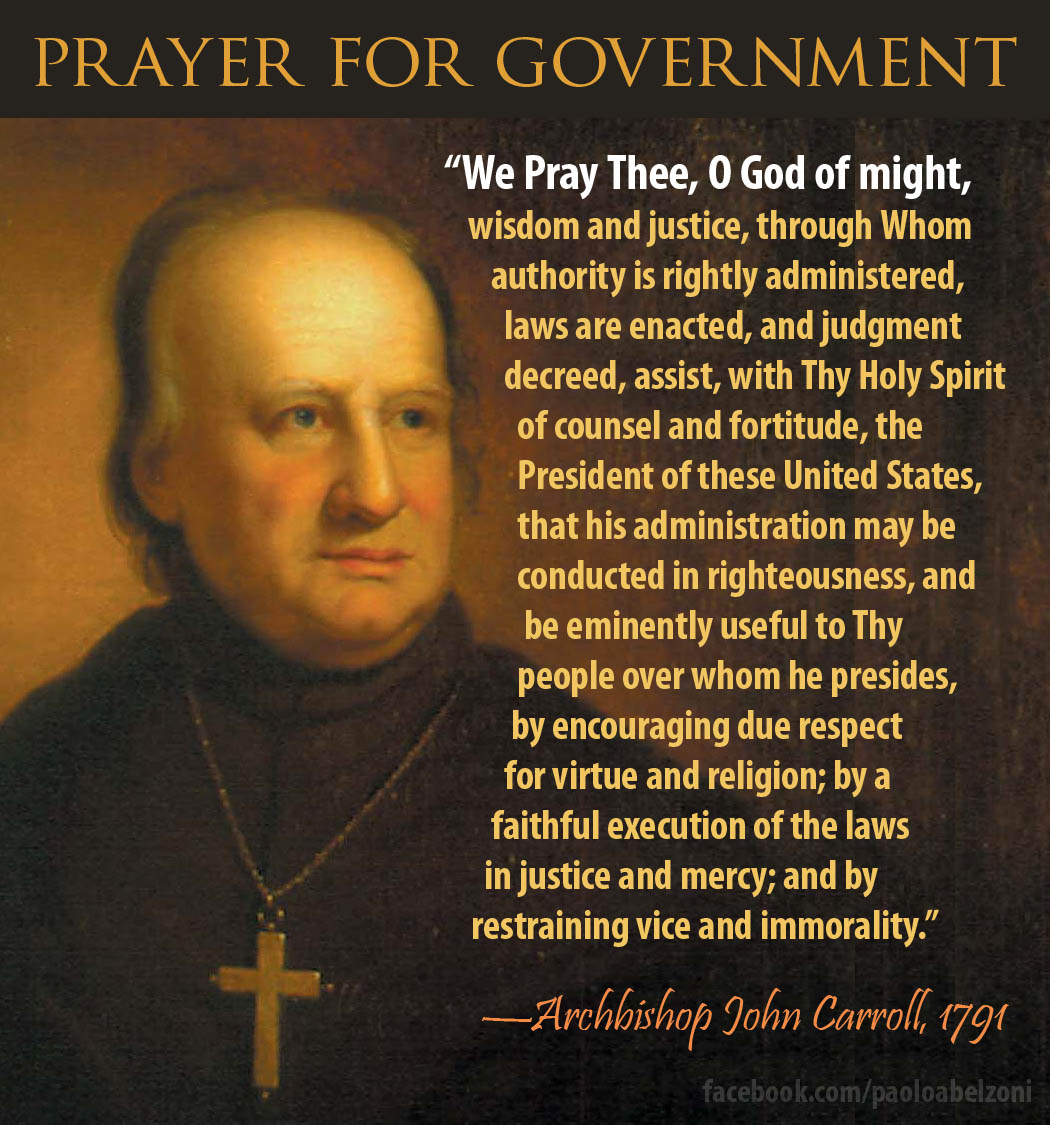
Archbishop John Carroll's Prayer for Government


Prayer for Government, composed by Archbishop John Carroll, first archbishop of the United states, on the occasion of the inauguration of George Washington as president of the United States, in AD 1791. Seems very appropriate for inauguration day 2017.

I believe this prayer was read in every Catholic parish on Sunday after the last Gospel for many years. I suspect the next four years will require a lot of prayer for our civil leaders. It might be a good idea to revive this tradition.
We pray Thee, O almighty and eternal God! Who through Jesus Christ hast revealed Thy glory to all nations, to preserve the works of Thy mercy, that Thy Church, being spread through the whole world, may continue with unchanging faith in the confession of thy name.

We pray The, Who alone art good and holy, to endow with heavenly knowledge, sincere zeal, and sanctity of life, our chief bishop, N. N., the vicar of Our Lord Jesus Christ, in the government of His Church; our own bishop, N. N. (or archbishop); all other bishops, prelates and pastors of the Church; and especially those who are appointed to exercise amongst us the functions of the holy ministry and conduct thy people into the ways of salvation.

We Pray Thee, O God of might, wisdom and justice! through Whom authority is rightly administered, laws are enacted, and judgment decreed, assist, with Thy Holy Spirit of counsel and fortitude, the President of these United States, that his administration may be conducted in righteousness, and be eminently useful to Thy people over whom he presides, by encouraging due respect for virtue and religion; by a faithful execution of the laws in justice and mercy; and by restraining vice and immorality.

Let the light of Thy divine wisdom direct the deliberations of Congress, and shine forth in all the proceedings and laws framed for our rule and government; so that they may tend to the preservation of peace, the promotion of national happiness, the increase of industry, sobriety, and I useful knowledge, and may perpetuate to us the blessings of equal liberty.

We pray for his excellency, the Governor of this State, for the members of the Assembly, for all judges, magistrates, and other officers who are appointed to guard our political welfare, that they may be enabled, by Thy powerful protection, to discharge the duties of their respective stations with honesty and ability.

We recommend likewise to Thy unbounded mercy all our brethren and fellow-citizens, throughout the United States, that they may be blessed in the knowledge, and sanctified in the observance, of Thy most holy law; that they may be preserved in union, and in that peace which the world cannot give; and, after enjoying the blessings of this life, be admitted to those which are eternal.

Finally, we pray to Thee, O Lord of mercy, to remember the souls of Thy servants departed who are gone before us with the sign of faith, and repose in the sleep of peace; the souls of our parents, relatives and friends; of those who, when living, were members of this congregation and particularly of such as are lately deceased; of all benefactors who, by their donations or legacies to this church, witnessed their zeal for the decency of divine worship and proved their claim to our grateful and charitable remembrance. To these, O Lord, and to all that rest in Christ, grant, we beseech Thee, a place of refreshment, light, and everlasting peace, though the same Jesus Christ, our Lord and Savior. Amen.
Taken from The Life and Times of John Carroll, Archbishop of Baltimore (1735-1815).

Thursday, January 08, 2009

Burying talents in Albany

Yet another northeastern diocese is planning to close and consolidate a large number of Catholic churches. This time, it's Albany which for the past 32 years has been withering under the inept rule of Bishop Howard Hubbard. According to an article in the Times Union, roughly 20% of the parishes in Hubbard's diocese would be closing. Fortunately, the good Bishop has assured everyone that the abandoned churches would be sold and put to good use:
First preference, Hubbard said, would go to religious uses. Second would be nonprofits, and third would be the commercial sector.
"Religious uses"? Like what? I'm sure there are some folks who get a nice warm fuzzy feeling when they think of a lovely old Catholic church serving as a mosque or a Mormon temple, or a church of Scientology--but I'm not one of them.

Who's to blame for this disaster? Well, the Times Union seems to be blaming demographics:
Albany, like other dioceses across the Northeast, is grappling with urban flight and a shortage of priests. Since 1960, the city of Troy has lost 34 percent of its population, Albany declined 27 percent, and Schenectady dropped 25 percent.
There are many reasons for urban flight--high taxes, crime, bad economy, etc. I don't know Bishop Hubbard's record on these issues but there's little he can practically do about them. But I do know for a fact that Hubbard has done an exceptional job driving devout Catholics out of his diocese. And let's face it--if a bishop has been in control of a diocese for over 30 years, he has no one to blame but himself if 1.) vocations are almost nonexistent and 2.) Catholics are leaving the Faith in droves.

In short, Bishop Hubbard's excruciatingly long tenure has been an abject failure by any appreciable measure. And this round of closings is the logical conclusion of his failure to uphold and teach the Catholic Faith.

It's long past time for Catholics to start demanding accountability from their bishops. In my opinion, if a bishop has reigned for 10 years and his diocese is still a mess in terms of the faithful leaving the Church and shortage of vocations, he should be forced to resign.

Bishop Hubbard's efforts have been like those of the servant who buried his talent in the ground, to whom our Lord would say:
Wicked and slothful servant, thou knewest that I reap where I sow not, and gather where I have not strewed...Take ye away therefore the talent from him, and give it to him that hath ten talents. For to every one that hath shall be given, and he shall abound: but from him that hath not, that also which he seemeth to have shall be taken away. And the unprofitable servant cast ye out into the exterior darkness. There shall be weeping and gnashing of teeth.
Hubbard should resign immediately before he does any further damage, and his diocese should be given to a prelate who knows how to increase the harvest of souls.