Monday, March 06, 2017

The Authentic Passion of Saints Perpetua and Felicitas

St. Perpetua rebuffs her father's entreaties.
On March 7, AD 203, during the reign of the emperor Septimius Severus, five Christians were martyred in the amphitheater of Carthage under the procurator Hilarian. The three men were named Revocatus, Saturus, and Saturninus. The two women, however, are more famous, having their names entered into the Roman Canon of the Mass: Felicitas, a slave eight months pregnant, and Perpetua, a young Roman matron of noble birth who had recently given birth to a child.

Unlike many of the Acts of these early martyrs, the antiquity and authenticity of the Passion of Perpetua and Felicitas is not seriously challenged by most scholars. Indeed, the first piece of the Acts is thought to have been written or dictated by Perpetua herself, in Latin. Here she describes her father's reaction to the fact that she was under official suspicion of being a Christian:
"When we were still under legal surveillance and my father was liked to vex me with his words and continually strove to hurt my faith because of his love: 
'Father,' said I, 'Do you see (for examples) this vessel lying, a pitcher or whatsoever it may be?' 
And he said, 'I see it.' 
And I said to him, 'Can it be called by any other name than that which it is?' 
And he answered, 'No.'
'So can I call myself nought other than that which I am, a Christian?'
Then my father angry with this word came upon me to tear out my eyes; but he only vexed me, and he departed vanquished, he and the arguments of the devil."
A few days later, Perpetua was thrown into prison along with other Christians. There she experienced visions and was troubled that she was unable to breast-feed her child. Adding to her worries, her father came to see her and entreated her to apostasize in dramatic fashion, grovelling at her feet and tearing out his beard. When this availed nothing, the five abovementioned Christians were brought to public trial. Perpetua continues:
"We went up to the tribunal. The others being asked, confessed. So they came to me. And my father appeared there also, with my son, and would draw me from the step, saying: 'Perform the Sacrifice; have mercy on the child.'
And Hilarian the procurator—he that after the death of Minucius Timinian the proconsul had received in his room the right and power of the sword—said: 'Spare your father's grey hairs; spare the infancy of the boy. Make sacrifice for the Emperors' prosperity.'
And I answered: 'I am a Christian.'
And when my father stood by me yet to cast down my faith, he was bidden by Hilarian to be cast down and was smitten with a rod. And I sorrowed for my father's harm as though I had been smitten myself; so sorrowed I for his unhappy old age. 
Then Hilarian passed sentence upon us all and condemned us to the beasts; and cheerfully we went down to the dungeon...."
After recording several other visions and conversations that she experienced in prison, Perpetua's account ends and the climax of the martyrdom is recounted by another voice. Felicitas is delivered of a baby girl a few days before the scheduled execution, and the child apparently survived her mother to be raised by a sister. On the day of their execution, the martyrs parade to the amphitheater is described as follows in the Acts:
Now dawned the day of their victory, and they went forth from the prison into the amphitheater as it were into heaven, cheerful and bright of countenance; if they trembled at all, it was for joy, not for fear. Perpetua followed behind, glorious of presence, as a true spouse of Christ and darling of God; at whose piercing look all cast down their eyes. Felicity likewise, rejoicing that she had borne a child in safety, that she might fight with the beasts, came now from blood to blood, from the midwife to the gladiator, to wash after her travail in a second baptism. 
And when they had been brought to the gate and were being compelled to put on, the men the dress of the priests of Saturn, the women the dress of the priestesses of Ceres, the noble Perpetua remained of like firmness to the end, and would not. For she said: "For this cause came we willingly unto this, that our liberty might not be obscured. For this cause have we devoted our lives, that we might do no such thing as this; this we agreed with you."
Injustice acknowledged justice; the tribune suffered that they should be brought forth as they were, without more ado. Perpetua began to sing, as already treading on the Egyptian's head. Revocatus and Saturninus and Saturus threatened the people as they gazed. Then when they came into Hilarian's sight, they began to say to Hilarian, stretching forth their hands and nodding their heads: "You judge us," they said, "and God you."
At this the people being enraged besought that they should be vexed with scourges before the line of gladiators (those namely who fought with beasts). Then truly they gave thanks because they had received somewhat of the sufferings of the Lord.
Mosaic of a prisoner gored by a leopard
in the arena, Tunisia, 3rd century AD 
The Christians were then made to fight the wild beasts. Saturninus as mauled by numerous beasts. Revocatus was torn by a leopard, then by a bear. Saturus was dragged by a boar and faced a bear, but emerged largely unharmed from both encounters to be slain finally by the bite of a leopard. Both Perpetua and Felicitas were made to face a cow that had been trained and goaded to behave like a wild bull:
Perpetua was first thrown, and fell upon her loins. And when she had sat upright, her robe being rent at the side, she drew it over to cover her thigh, mindful rather of modesty than of pain. Next, looking for a pin, she likewise pinned up her dishevelled hair; for it was not meet that a martyr should suffer with hair dishevelled, lest she should seem to grieve in her glory. So she stood up; and when she saw Felicity smitten down, she went up and gave her her hand and raised her up.
Not killed by the mad cow, Perpetua cried out to her brother and the other catechumens present:
"Stand fast in the faith, and love you all one another; and be not offended because of our passion."
It seems that four of the five survived their ordeals with the beasts and were slaughtered, in the end, by sword strokes from the gladiators present. In Perpetua's case, however, the gladiator was inexperienced in killing and made a mess of her execution:
Perpetua, that she might have some taste of pain, was pierced between the bones and shrieked out; and when the swordsman's hand wandered still (for he was a novice), herself set it upon her own neck. Perchance so great a woman could not else have been slain (being feared of the unclean spirit) had she not herself so willed it. 
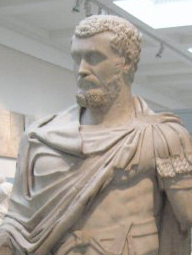
Septimius Severus from the
British Museum.
So perished these five to the glory of God the Father Almighty, and His Son Jesus Christ.

Though this persecution occurred during the reign of Septimius Severus, it is thought to have been a local persecution only, not empire-wide. The reputation of Severus is quite mixed regarding his attitude toward Christianity. The Historia Augusta records that he promulgated an edict making it illegal to convert to Judaism or Christianity. Meanwhile, Tertullian, writing in AD 212 (or 217) in his Ad Scapulam, admits that though persecutions have taken place under Severus, that emperor was:
"graciously mindful of the Christians...Both women and men of highest rank, whom Severus knew well to be Christians, were not merely permitted by him to remain uninjured; but he even bore distinguished testimony in their favour, and gave them publicly back to us from the hands of a raging populace."
Click for more info.
The full account of the Passion of Saints Perpetua and Felicitas is included in I Am a Christian: Authentic Accounts of Christian Martyrdom and Persecution from the Ancient Sources. This book is a collection of some of the best ancient sources on the Roman reaction to Christianity and the persecution of the early Church. Several of the accounts contained in this book are also to be found excerpted in a much more haphazard format on this blog, so if you are a regular reader, they may seem familiar to you.

If you enjoy this blog or are interested in learning more about this period of Roman and early Church history, this inexpensive book is well worth having.

Here are some related posts of interest:

Friday, March 03, 2017

"Why Not Become a Missionary Yourself, My Child?" Feast Day of Saint Katharine Drexel

Mother Drexel by Lori Kauffmann
in The American Martyrology.
March 3 is the feast day of Philadelphia's own Saint Katharine Drexel.

Katharine Mary Drexel was quite an unlikely candidate for sainthood. Though brought up in a devoutly Catholic family, Katharine's youth was one of wealth and luxury. Daughter of one of Philadelphia's elite families, she was expected to do what most girls of her age and status did which was marry the scion of another wealthy family.

When she first revealed her inclination to the religious life, both her parents and her spiritual director, Father James O'Connor (later the first bishop of Omaha, Nebraska) were opposed. Katharine herself had doubts. In one of her notebooks, she made a list of pros and cons. The cons included:
  • I do not know how I could bear the privations and poverty of the religious life. I have never been deprived of luxuries.
  • I hate community life. I should think it maddening to come in constant contact with many different old maidish dispositions. 
Despite her misgivings, God's call won out in the end in a big way. Here is the rest of the story, as told in Religious Orders of Women in the United States (1913), compiled by Elinor Tong Dehey:
Her heart was yearning to embrace the religious life, and if she had followed her own desires she would probably have chosen a contemplative community, and not as might have been expected an active one. Bishop O'Connor still deferred giving Miss Drexel a decision in regard to her vocation. All the pent up longing of her heart was to give herself to God without delay. The more she prayed, the greater became the attraction to leave all for Christ. Bishop O'Connor had always in mind the new Congregation, and fearful of acting hastily had allowed time to elapse before determining to unfold his views to Miss Drexel.

Katharine Drexel ~ Debutante - Heiress - Religious Sister - Saint.
In January, 1887, Miss Drexel and her sister were travelling abroad; while in Rome, Leo XIII. received them in private audience. Miss Katharine, in speaking to His Holiness, mentioned the great need of missionaries among the Indians, and in the simplicity of her soul begged the Holy Father to send some devoted missionary communities to labor among them. With the smile for which he was remarkable lighting up that singularly clear eye by which he seemed to pierce the future, and with a voice the tones of which touched the innermost depths of Miss Drexel's soul, he replied: "Why not become a missionary yourself, my child?"

Coming at the moment when she was struggling between the interior promptings of the Holy Spirit and the prohibitory mandate of her director, this seemed, as undoubtedly it was, the voice of God Himself. Shortly after this, Bishop O'Connor announced to Miss Drexel what he believed to be the will of God in her regard. Divine Providence, he thought, wished to make use of her to form the nucleus of a new society for the conversion of the Indian and negro races. In obedience to the direction of Bishop O'Connor, Miss Drexel entered the novitiate of the Sisters of Mercy, in Pittsburg, Penn., May 6, 1889. St. Mary's Pittsburg, first House of the Sisters of Mercy in the United States, was destined to be the cradle of the new community. It was not long before Miss Drexel was joined by others who wished to share her mission labors, and with her to pre- pare themselves for the work which God was unfolding. Under the direction of the saintly Mother McAuley, the Sisters of the Blessed Sacrament began their novitiate.
This scene is described quite poignantly in Ellen Tarry's Saint Katharine Drexel: Friend of the Oppressed. Part of the Vision Series by Ignatius Press, this book is an excellent short biography of Mother Drexel, suitable for kids ages nine and up. As an adult, I found it edifying as well, and wrote a review of it several years ago that may be found here.

Also notable for kids, if you can find a copy, is Katie--The Young Life of Mother Katharine Drexel, which I reviewed here.

Mother Drexel's childhood home at 1503 Walnut Street seems to have been torn down sometime in the early 20th century. Her summer home remains, however, as part of Aria Jefferson Health's Torresdale campus, along with the Shrine of the True Cross, formerly the Shrine of Saint Michael, which was built by Saint Katharine's sister, Louise Drexel Morrell.
Image of the Drexel summer home (upper left corner) and the Shrine of the
True Cross (lower center) in Torresdale, Philadelphia. 

Thursday, March 02, 2017

The "Gloria Romanorum" Medallion of Justinian

Here are two photos taken at the British Museum in 2011, featuring the obverse and reverse of an electrotype replica gold medallion which was struck during the reign of Justinian I. The original coin was stolen from Cabinet des Médailles of the Bibliothèque Nationale de France in 1831 and has been lost ever since. This representation is a reproduction made from a sulfur cast taken before the medallion was lost.

The Dictionary of Roman Coins of 1889 describes this medallion as follows:
Distinguished not only by its unique character but also by its unusual volume and weight (for, according to Eckhel), it equals five ounces and nearly three drachms, and Mionnet gives its diameter as 38 lines (French measure), this splendid coin was found in the year 1751, near Caesarea ad Argaeum (Mazaca), formerly the capital of Cappadocia, amongst some rubbish in the foundations of an old building, cast out from the depth of twenty feet underground.
The inscription on the obverse reads: "D. N. Justinianus P. P. Aug." or, to expand, "Dominus Noster Justinianus Perpetuus Augustus" ~ Our Lord Justinian, Eternal Augustus. The figure on the obverse is Justinian himself, carrying a lance and wearing the toupha, or feathered crown which can also be seen in drawings of the colossal Justinian statue that once sat atop a column in Constantinople.

The inscription on the reverse reads, "Salus et Gloria Romanorum" ~ Salvation and Glory of the Romans. The word "CONOB" at the bottom indicates that the original medallion was minted in Constantinople. Some have speculated that the warlike rider featured on the reverse being led by a winged victory is a representation of Belisarius, however the presence of the toupha on the rider's head, and the lack of beard, seems to indicate that it is another representation of Justinian.

Historians and numismatists have speculated that the medallion was meant to commemorate the great victory of Belisarius over the Vandal Kingdom in AD 534.

The Shack ~ Heretical literary awfulness comes to the big screen

So apparently they've made a movie out of The Shack. This is not a surprise. If any novel was specifically written to be made into a really bad film, this was the one.

I have not seen the film and have no intention of seeing it. But since the marketing campaign for it has penetrated Catholic media, I recall that I had written a review of this piece of literary detritus about seven years ago when it was at the height of its ill-deserved popularity. That review may be found here in full, but the key points of my criticism were as follows.

The primary problem with The Shack is that the author takes the outrageous liberty of writing long passages in the voice of God, Jesus, the Holy Spirit, and a personification of Wisdom (the Quadrinity?). Doing so in a work of fiction is fraught with peril even when such dialogue is scrupulously aligned with Sacred Scripture and Church tradition. Needless to say, William Young, the author of The Shack, has no such scruples.

When reading The Shack, we learn:
  • Our view of God as "Father" is a product of religious conditioning. 
  • Jesus's life was not meant to be an example to follow. 
  • Jesus did not come to build an institution called the Church. 
  • The real church is about "relationships and sharing life". 
  • Jesus is "not too big on religion." 
  • Jesus isn't a "Christian" and has no desire that others become "Christians." 
  • God doesn't expect us to obey the Law. In fact, "all things are lawful."
Yeah, don't bother.
Are you getting the gist yet? My conclusion in the original review is that The Shack was meant specifically for rich Americans who desire to reconcile a depraved lifestyle with an external embrace of Christianity. Seven years later, I don't feel compelled to revise that assessment.

Interestingly, the supernatural being known as "Lucifer" does not make an appearance in The Shack. The reason for that omission seems obvious. On that note, I would recommend that anyone who is tempted to read The Shack, or watch the movie, would be better served by reading The Screwtape Letters instead.

Wednesday, March 01, 2017

Thoughts from Blessed Cardinal Newman for Ash Wednesday

Click here to share on Facebook.
"We must go through pain, we must practise self-denial, we must curb our wills, and purify our hearts, before we are capable of any lasting solid peace." ~Blessed John Henry Newman

Today is Ash Wednesday, the beginning of the penitential season of Lent.

This quote from Blessed Cardinal Newman seems to capture the essence of why penitence--prayer, fasting and almsgiving--are crucial as preparation for the Paschal triduum. As Our Lord fasted 40 days in the desert in preparation for His mission, ought we not to follow His example?

Here is Cardinal Newman's quote in context, taken from his sermon: Jeremiah: A Lesson for the Disappointed:
"Left to ourselves, we seek good from the world, but cannot find it; in youth we look forward, and in age we look back. It is well we should be persuaded of these things betimes, to gain wisdom and to provide for the evil day. Seek we great things? We must seek them where they really are to be found, and in the way in which they are to be found; we must seek them as He has set them before us, who came into the world to enable us to gain them.
We must be willing to give up present hope for future enjoyment, this world for the unseen. The truth is (though it is so difficult for us to admit it heartily), our nature is not at first in a state to enjoy happiness, even if we had it offered to us. We seek for it, and we feel we need it; but (strange though it is to say, still so it is) we are not fitted to be happy. If then at once we rush forward to seek enjoyment, it will be like a child's attempting to walk before his strength is come. If we would gain true bliss, we must cease to seek it as an end; we must postpone the prospect of enjoying it. For we are by nature in an unnatural state; we must be changed from what we are when born, before we can receive our greatest good. And as in sickness sharp remedies are often used, or irksome treatment, so it is with our souls; we must go through pain, we must practise self-denial, we must curb our wills, and purify our hearts, before we are capable of any lasting solid peace. 
To attempt to gain happiness, except in this apparently tedious and circuitous way, is a labour lost; it is building on the sand; the foundation will soon give way, though the house looks fair for a time. To be gay and thoughtless, to be self-indulgent and self-willed, is quite out of character with our real state. We must learn to know ourselves, and to have thoughts and feelings becoming ourselves. Impetuous hope and undisciplined mirth ill-suit a sinner. Should he shrink from low notions of himself, and sharp pain, and mortification of natural wishes, whose guilt called down the Son of God from heaven to die upon the cross for him? May he live in pleasure here, and call this world his home, while he reads in the Gospel of his Saviour's life-long affliction and disappointment?"
To read the entire sermon, visit: http://www.newmanreader.org/works/parochial/volume8/sermon9.html

Wednesday, February 22, 2017

The Chair of Saint Peter

Photo of the Chair of Saint Peter, taken in 1867 and
included in the Catholic Encyclopedia (1911).
February 22 is commemorated as the Feast of the Chair of Saint Peter at Antioch on the Catholic liturgical calendar, commemorating his foundation of that church. The feast of the Chair of Saint Peter at Rome is celebrated on January 18. A good summary of the history of the two feasts may be found at the New Liturgical Movement site.

The phrase "chair of Saint Peter" has both literal and figurative meanings. In the more abstract sense, The "seat" of Saint Peter is the Holy See -- the Sancta Sedes, or the episcopal jurisdiction of the Pope in Rome, symbolizing the leadership and unity of the One, Holy, Catholic and Apostolic Church. More literally, we think of the actual chair, or cathedra, upon which the Apostle Peter actually sat. While a Chair of Saint Peter in Antioch (of dubious history) exists in Venice, it is believed that the authentic Chair in Saint Peter in Rome may be found to this day at the Vatican.

As early as about AD 200, we have the testimony of Tertullian in De Praescriptione Haereticorum that pilgrims could visit the chair upon which Peter sat in Rome:
Come now, thou who willest to exercise thy curiosity to better purpose in the business of thy salvation: go through the Apostolic Churches where the very thrones of the Apostles at this very day preside over their own districts, where their own genuine letters are read which speak their words and bring the presence of each before our minds. If Achaia is nearest to thee, thou hast Corinth. If thou art not far from Macedonia, thou hast Philippi. If thou canst travel into Asia, thou hast Ephesus. Or if thou art near to Italy, thou hast Rome, where we too have an authority close at hand. What a happy Church is that whereon the Apostles poured out their whole doctrine together with their blood; where Peter suffers a passion like his Lord's, where Paul is crowned...
As for the reputed chair itself, I have included an image of it along with this post (see above). The Catholic Encyclopedia (1911) gives a very detailed provenance for the cathedra which is not necessary to replicate here. A modern description is offered in Roma Sotterranea: Or, Some Account of the Roman Catacombs, Especially of the Cemetery of San Callisto (1869) by Rev. J. Spencer Northcote and Rev. W. R. Brownlow as follows:
A more recent color image of the chair taken
from the St. Peter's Basilica website.
The Chair has four solid legs composed of yellow oak, united by horizontal bars of the same material. In these legs are fixed the iron rings which make the whole a sella gestatoria such as that in which the Sovereign Pontiff is now carried on state occasions, and such as those which the Roman senators began to use in the time of Claudius. The four oak legs were evidently once square, but they are much eaten away by age and have also had pieces cut from them as relics. These time worn portions have been strengthened and rendered more ornamental by pieces of dark acacia wood which form the whole interior part of the chair, and which appear to have hardly suffered at all from the same causes which have so altered the appearance of the oak legs. The panels of the front and sides and the row of arches with the tympanum above them which forms the back are also composed of this wood. But the most remarkable circumstance about these two different kinds of material is that all the ivory ornaments which cover the front and back of the chair are attached to the acacia portions alone and never to the parts composed of oak. Thus the oak framework, with its rings, appears to be of quite a distinct antiquity from that of the acacia portions with their ivory decorations.
For more, check out Roma Sotterranea on Google books. That work also contains an even more detailed history of the Chair, along with a discussion of a second cathedra of Peter existing in the Cemetery of Ostrianus.


Monday, February 20, 2017

Did George Washington die a Catholic?

Traditional portrait of Washington
praying at Valley Forge.
With the celebration of Presidents' Day, and George Washington's birthday just a few days away (February 22), I often recall a passage from a book I had read to my children several years ago entitled: Saint Katharine Drexel: Friend of the Oppressed. The author of this historical novel, Elizabeth Tarry, includes a scene in which the child Kate Drexel dreams about far away lands and her heroes, Saint Francis and George Washington:
More than once, she went to sleep whispering: "Let perpetual light shine upon George Washington. May his soul rest in peace." It was a practice she was to continue for the rest of her life. 
While I'm not sure if this anecdote falls into the historical or the fiction part of Tarry's work, I was intrigued to discover that more connections exist between Washington and Catholicism than I realized, including a story that he experienced a death-bed conversion to the Catholic faith.

Here are some points in favor of Washington's supposed affinity toward Catholicism, as recorded in the Irish Catholic Benevolent Union Journal of March 15, 1884:
  1. He merited it by his virtues.
  2. He had a picture of the Blessed Virgin.
  3. He was acquainted with Catholics, had visited Catholic churches, and contributed to their erection.
  4. Juba, his servant, declared that Washington, "befo' he eat, do dis way (making the sign of the cross). I dunno what it means but he always do it."
  5. Painting of the Blessed Virgin at Mount Vernon.
  6. Rev Francis Neale was called from Piscataway across the Potomac and stayed with General Washington four hours before he died. 
This last claim is especially intriguing. More detail of this story may be drawn from The American Catholic Historical Researches, Volumes 16-17, 1900, in an article examining Washington's supposed conversion to Catholicism, written 101 years after his death:
It has often been the subject of regretful remark among the good people who appreciated the pure and exalted character of Washington that he seemed to make no mention of religion in his last moments and make no preparation for the step into the awful eternity beyond this life. In this connection the writer recently came across a curious legend current among the colored people living for the past few generations along the Maryland and Virginia shores of the Potomac adjoining Mount Vernon...that George Washington on his deathbed was baptized a Catholic.

"Massa George," they say, "was a good man but he done gone back on when he died," and the story they tell is as follows:

The night before Washington died, during a fierce storm, his colored body servant came riding down to the bank of the Potomac and after being ferried across said he had come in search of a Catholic priest. After some delay, one of the old Jesuit Fathers from the mission on the Maryland side was found, taken over the river to Mount Vernon, where he went at once to Mr. Washington's room and remained there with him three hours. When he left he seemed much gratified and said to those about him that there need be no more apprehension for Mr. Washington as the future of his soul was secure. He was then taken back to the Maryland shore and old darkeys tell with unvarying detail that their fathers believed Washington died a Catholic....

In addition the Jesuit record says that on the day after the visit to Mount Vernon the old Jesuit went to the Superior of the mission and relating the fact of his journey, handed the Superior a sealed packet saying I am not permitted to detail what transpired between Mr. Washington and myself in his room at Mount Vernon but I have written it out carefully here and after we both have passed away and occasion requires this can be opened and its contents made public. The Superior took the paper and placed it among the records of the mission where it remained until shortly after the death of the old Jesuit when it was boxed up still unopened with a lot of other papers, and sent to headquarters of the Order in Rome where it is still supposed to be awaiting the fortunate chance that will disclose it to the hand of some appreciative investigator who may throw some light on this very curious historical question.
The story was apparently repeated in a somewhat altered form by Rev. John Scully, SJ in a homily he gave on Sunday, May 13, 1900 at Old Saint Joseph's Church in Philadelphia. The information provided by Fr. Scully is as follows:
Miss Oliva Floyd, whose mother was a Semmes, was a Confederate spy during the War of the Rebellion. She is now a cripple of perhaps seventy years. She remembers often hearing her mother who lived to be eighty six years old, and who died about thirty years ago, speak of the large boat rowed by six or eight men which came from Mt. Vernon to St. Thomas Manor the night before George Washington died. They bore a message to Father Leonard Neale then Superior of the residence at St. Thomas from Washington between whom and the priest there had long existed an intimate friendship. 
The rowers found Father Neale walking up and down the beach reciting the divine office. He immediately went up to the rectory whence he returned in a few minutes probably having provided himself with the priestly stole, the ritual, and some blessed water. He accompanied the boatmen and was detained at Mt. Vernon the greater part of the next day. It was said by all in the neighborhood that General Washington had sent for his old friend, Father Neale, to receive conditional baptism make his confession and be received into the Catholic Church. 
Miss Floyd's mother certainly had means of knowing the truth if this were so as Dr. Crown, (?) Washington's physician, was an intimate friend of the Floyds and the Semmes and had a room which was always kept ready for him in the Floyd mansion, which is only fourteen or fifteen miles from Mt. Vernon, where he slept on his return from and on his way to Mount Vernon.
It should be noted, however, that this information was deemed far from conclusive. Later in the same article, the author, Martin I. J. Griffin, relays his doubts about the authenticity of these stories:
"The Researches thinks the alleged visit of Father Neale improbable. Nothing in Washington's life gives a basis for a belief in its probability....I do not believe he became a Catholic."
Furthermore, as Marian T. Horvat, PhD points out in her post, "Did George Washington Convert to Catholicism?" the first president was a devoted Free Mason and often appeared in Masonic regalia during his life and tenure in office.

While these doubts alone are not sufficient to dispel the conversion story completely, there isn't enough information available to prove the story either. That said, we should probably follow Mother Drexel's lead and pray for the salvation of President Washington's soul. As Archbishop Carroll said in a circular letter to his clergy on the occasion of Washington's death:
"Roman Catholics, in common with our fellow-citizens of the United States, have to deplore the irreparable loss our country has sustained by the death of that great man who contributed so essentially to the establishment and preservation of its peace and prosperity. We are, therefore, called upon by every consideration of respect to his memory and gratitude for his services to bear a public testimony of our high sense of his worth when living and our sincere sorrow for being deprived of that protection which the United States derived from his wisdom, his experience, his reputation, and the authority of his name....[Those wishing to eulogize the President] are advised not to form their discourses on the model of a funeral sermon, deduced from a text of Scripture, but rather to compose an oration, such as might be delivered in an Academy....If these discourses shall be delivered in churches, where the Holy Sacrament is usually kept, it will be proper to remove it previously with due honor, to some decent place." [Archbishop Carroll's circular letter to his clergy, dated Dec. 29, 1799]
In other words, as father of our country, Washington deserved the type of tribute offered by Catholics to virtuous non-Catholics upon their demise. That remains the case today.

Curiously, several Popes would find occasion to pay tribute to Washington. In 1852, during the construction of the Washington monument, Pope Pius IX sent a stone from the Temple of Concord in Rome to be incorporated into the monument. Unfortunately, this so-called "Pope's Stone" would be stolen by anti-Catholic Know-Nothings and dumped into the Potomac, though stories claim that it was dredged up some 40 years later.

In his encyclical to the Catholic bishops of America of 1895 entitled Longinqua, Pope Leo XIII praised Washington as follows:
Precisely at the epoch when the American colonies, having, with Catholic aid, achieved liberty and independence, coalesced into a constitutional Republic the ecclesiastical hierarchy was happily established amongst you; and at the very time when the popular suffrage placed the great Washington at the helm of the Republic, the first bishop was set by apostolic authority over the American Church. The well-known friendship and familiar intercourse which subsisted between these two men seems to be an evidence that the United States ought to be conjoined in concord and amity with the Catholic Church.
Cardinal Pacelli at Mount Vernon in 1936.
On October 22, 1936, Eugenio Cardinal Pacelli visited Mount Vernon as part of a tour of the eastern United States. While there, he placed wreaths at the graves of George and Martha Washington. Later, after he became Pope Pius XII, he said the following in his encyclical, Sertum Laetitiae, written in 1939:
When Pope Pius VI gave you your first Bishop in the person of the American John Carroll and set him over the See of Baltimore, small and of slight importance was the Catholic population of your land. At that time, too, the condition of the United States was so perilous that its structure and its very political unity were threatened by grave crisis. Because of the long and exhausting war the public treasury was burdened with debt, industry languished and the citizenry wearied by misfortunes was split into contending parties. This ruinous and critical state of affairs was put aright by the celebrated George Washington, famed for his courage and keen intelligence. He was a close friend of the Bishop of Baltimore. Thus the Father of His Country and the pioneer pastor of the Church in that land so dear to Us, bound together by the ties of friendship and clasping, so to speak, each the other's hand, form a picture for their descendants, a lesson to all future generations, and a proof that reverence for the Faith of Christ is a holy and established principle of the American people, seeing that it is the foundation of morality and decency, consequently the source of prosperity and progress.
Again, of themselves, these tributes prove nothing regarding the religious status (or lack thereof) of President Washington at the time of his death. But it is amusing to consider the possibility that the Vatican knows a secret about him that the rest of the world does not.

Saturday, February 18, 2017

"Drive out the murderer Barsaumas!" ~ Saint Flavian and the Robber Council of Ephesus

The feast day of Saint Flavian, martyr, falls on February 18. Flavian was archbishop of Constantinople from AD 446 through 449. Though he lived long after the traditional age of Christian martyrs, Flavian is nonetheless accounted one of their number, though he was slain by men calling themselves Christians--indeed, he died either during or in the immediate aftermath of a Church Council.

The deposition of Saint Flavian from Shea's The Pictorial Life of the Saints.
As one of the principle parties at the so-called Robber Council of Ephesus, Flavian found himself on the wrong side of the powerful Patriarch of Alexandria, Dioscorus, and a veritable army of monks led by the Syrian archimandrite, Barsaumas. These two were intent on defending the presbyter Eutyches, who had taught in error that Christ had but a single nature. Dioscorus had the tacit support of the emperor, Theodosius II, and especially of Chrysaphius, the powerful imperial chamberlain. Supporting Flavian was Pope Leo I in Rome, who sent legates to the council. When it became clear that Dioscorus and his henchmen would use force to impose their will, one of these legates, Hilarius (later Pope himself), shouted "Contradicitur!" and then with difficulty escaped the council.

How Flavian was killed is not precisely clear. Here is an account of what happened drawn from the Ecclesiastical History of Evagrius, written not long after the event, as part of Evagrius's explanation of why the Council of Chalcedon was called:
While entertaining these intentions, the emperor [Marcian] is addressed both by the legates of Leo, bishop of the elder Rome, who alleged that Dioscorus had, during the second council of Ephesus, refused to receive the epistle of Leo, containing a formula of the true doctrine; and also by those who had been contumeliously treated by Dioscorus, intreating that their case might be submitted to the decision of a synod. But Eusebius, who had been president of the church of Dorylaeum, was especially urgent, and affirmed that both himself and Flavian had been deposed by the intrigues of Chrysaphius, the minister of Theodosius, because, in reply to his demand of an offering in gold, Flavian had, in acknowledgment of his own appointment, sent the sacred vessels to shame him; and also that Chrysaphius made a near approach to Eutyches in erroneous doctrine. He also said, that Flavian had even been brought to a miserable end by being thrust and trampled on by Dioscorus himself. These circumstances caused the synod at Chalcedon to be assembled; for which purpose the bearers of missives were despatched, and the prelates in all quarters were summoned by pious letters. [The Ecclesiastical History of Evagrius, Book II, Chapter II).
In most accounts modern accounts of this event, Flavian is said to have been gravely injured by this rough handling and perished a few days afterwards. Blame for his death was affixed by many to Dioscorus and Barsaumas, as we can see more clearly in a dramatic scene recorded in the Acts of the Council of Chalcedon shortly after AD 451:
Diogenes the most devout bishop of Cyzicus said: ‘Barsaumas, who entered among them, slaughtered the blessed Flavian. He was standing there and saying, “Slaughter him.” Since he is not in the petition, why has he come in?’ 
All the most devout bishops exclaimed: ‘Barsaumas destroyed all Syria. He incited thousands of monks against us.’ 
The most magnificent and glorious officials said to the monks: ‘In accordance with your request in the petition, our most divine and pious master gave orders both that the holy council should convene and that you should now gain entrance. So now that you have entered, have the patience to learn the decisions of the same most holy council concerning the faith.’ 
Carosus and Dorotheus the most devout archimandrites and the other monks said: ‘We ask that the plaint we have brought be read out.’ 
The most devout bishops exclaimed: ‘Drive out the murderer Barsaumas. The murderer to the stadium! Anathema to Barsaumas! [Send] Barsaumas into exile!’ 
Saint Flavian's name would be forever immortalized, however, by the Tome of Leo which was written before his death. Addressed to Flavian by Pope Leo, this work was a condemnation of Eutyches, a staunch defense of Flavian's position, as well as an act of faith that would become a doctrinal statement on the two natures of Christ, human and divine.

Saturday, February 11, 2017

Death of the Emperor Heraclius and the Loss of Roman Egypt ~ February 11

A medieval plaque showing Heraclius defeating Chosroes II.
After a reign of over thirty years, the Roman Emperor Heraclius passed to his eternal reward on February 11, AD 641.

His reign had begun as a rebellion against a rebellion, casting out the cruel and capricious regime of the usurper Phocas who had previously murdered the legitimate emperor, Maurice and his entire family. Launching his successful rebellion from Carthage, Heraclius ascended the throne at a time of acute crisis for the empire. The Persians had taken advantage of the internal strife and swept over practically the entire Roman east, including Syria, Palestine and Egypt.

Selling the very plate of the churches to fund his army, Heraclius began a counter-attack to eject the Persians from their ill-gotten gains. Rather than attempting to engage the Persian forces in the occupied territories, Heraclius marched directly into the Persian heartland where he inflicted a crushing defeat on the armies of the Persian King of Kings, Chosroes II, at Nineveh in AD 627. It is said that Heraclius himself defeated the Persian general Rhahzadh in single combat, thus earning the coveted spolia opima.

With his victories, Heraclius left Persia devastated and supine and secured what he thought would be a lasting peace in the east. However, in AD 636, a new force arose from the deserts of Arabia and utterly defeated a large Roman field army at the battle of Yarmuk. Under the command of Kahlid, the armies of Islam rolled over the Roman frontiers and occupied much of the Roman east--this time, for good.

As Heraclius lay ill in Constantinople at the beginning of the year AD 641, his heart must have been heavy having seen all of his hard-fought campaigns to come to nothing, and a Muslim army under 'Amr sweeping away all Roman resistance in Egypt. Here is how the situation in Egypt at the time of Heraclius's death was described by first-hand witness, John of Nikiu, a monophysite bishop who bore hostility toward the aggressive Chalcedonianism of Heraclius and his allies:
The Chronicle of John,
Bishop of Nikiu.
And 'Amr left lower Egypt and proceeded to war against Rīf. He sent a few Moslems against the city of Antinoe. And when the Moslem saw the weakness of the Romans and the hostility of the people to the emperor Heraclius because of the persecution wherewith he had visited all the land of Egypt in regard to the orthodox faith, at the instigation of Cyrus the Chalcedonian patriarch, they became bolder and stronger in the war.
And the inhabitants of the city (Antinoe) sought to concert measures with John their prefect with a view to attacking the Moslem; but he refused, and arose with haste with his troops and, having collected all the imposts of the city, betook himself to Alexandria; for he knew that he could not resist the Moslem, and (he feared) lest he should meet with the same fate as the garrison of Fajūm. Indeed, all the inhabitants of the province submitted to the Moslem, and paid them tribute. And they put to the sword all the Roman soldiers whom they encountered. And the Roman soldiers were in a fortress, and the Moslem besieged them, and captured their catapults, and demolished their towers, and dislodged them from the fortress. And they strengthened the fortress of Babylon, and they captured the city of Nakius and made themselves strong there. (Chronicle of John, Bishop of Nikiu, Chapter CXV:9-12)
On February 11, AD 641, Heraclius died. John of Nikiu provides a notice of this event, along with a rather superstitious explanation:
And Heraclius was grieved by the death of John the chief of the local levies, and of John the general who had been slain by the Moslem, as well as by the defeat of the Romans that were in the province of Egypt. And in accordance with the decree of God who takes away the souls of rulers, and of men of war as well as of kings, Heraclius fell ill with fever, and died in the thirty-first year of his reign in the month Yakātīt of the Egyptians, that is, February of the Roman months, in the fourteenth year of the lunar cycle, the 357th year of Diocletian. And some said: 'The death of Heraclius is due to his stamping the gold coinage with the figures of the three emperors—that is, his own and of his two sons on the right hand and on the left—and so no room was found for inscribing the name of the Roman empire.' And after the death of Heraclius they obliterated those three figures. (Chronicle of John, Bishop of Nikiu, Chapter CXVI:1-3)
An example of the gold solidus minted by Heraclius featuring the emperor
and his two sons as mentioned by John of Nikiu.
As the image above shows, not all of these coins were obliterated, apparently. Nevertheless, at the death of Heraclius, the Roman Empire finally passed from being a world power which dominated the Mediterranean, to a regional power scrambling to hold on to its remaining dominions against a new and vigorous set of enemies.

Wednesday, February 08, 2017

Saint Josephine Bakhita and Benedict XVI's Spe Salvi

February 8 is the feast of Saint Josephine Bakhita, canonized by Pope St. John Paul II in 2000. Her perilous and inspiring journey from slavery to sainthood is fairly well-known as it has been the subject of several books and movies. A summary of her biography may also be found in Pope Benedict XVI's encyclical Spe Salvi from 2007. Pope Benedict wrote:
The example of a saint of our time can to some degree help us understand what it means to have a real encounter with this God for the first time. I am thinking of the African Josephine Bakhita, canonized by Pope John Paul II. She was born around 1869—she herself did not know the precise date—in Darfur in Sudan. At the age of nine, she was kidnapped by slave-traders, beaten till she bled, and sold five times in the slave-markets of Sudan. Eventually she found herself working as a slave for the mother and the wife of a general, and there she was flogged every day till she bled; as a result of this she bore 144 scars throughout her life.
Aside: This general was Turk, as Sudan was under Turkish rule from 1821 through 1885. As Sr. Josephine herself recounted in detail, her treatment in this household was abominable, even for a slave. She was beaten nearly to death, and while still recovering, she was subjected to a brutal scarring via knife-cuts over her torso and arms meant to mark her for life as a piece of chattel. Her account of her days as a slave may be read in Bakhita: From Slave to Saint by Roberto Italo Zanini. Returning to Spe Salvi...
Finally, in 1882, she was bought by an Italian merchant for the Italian consul Callisto Legnani, who returned to Italy as the Mahdists advanced. Here, after the terrifying “masters” who had owned her up to that point, Bakhita came to know a totally different kind of “master”—in Venetian dialect, which she was now learning, she used the name “paron” for the living God, the God of Jesus Christ. Up to that time she had known only masters who despised and maltreated her, or at best considered her a useful slave. Now, however, she heard that there is a “paron” above all masters, the Lord of all lords, and that this Lord is good, goodness in person. She came to know that this Lord even knew her, that he had created her—that he actually loved her. She too was loved, and by none other than the supreme “Paron”, before whom all other masters are themselves no more than lowly servants. She was known and loved and she was awaited. What is more, this master had himself accepted the destiny of being flogged and now he was waiting for her “at the Father's right hand”. Now she had “hope” —no longer simply the modest hope of finding masters who would be less cruel, but the great hope: “I am definitively loved and whatever happens to me—I am awaited by this Love. And so my life is good.”

Through the knowledge of this hope she was “redeemed”, no longer a slave, but a free child of God. She understood what Paul meant when he reminded the Ephesians that previously they were without hope and without God in the world—without hope because without God. Hence, when she was about to be taken back to Sudan, Bakhita refused; she did not wish to be separated again from her “Paron”. On 9 January 1890, she was baptized and confirmed and received her first Holy Communion from the hands of the Patriarch of Venice. On 8 December 1896, in Verona, she took her vows in the Congregation of the Canossian Sisters and from that time onwards, besides her work in the sacristy and in the porter's lodge at the convent, she made several journeys round Italy in order to promote the missions: the liberation that she had received through her encounter with the God of Jesus Christ, she felt she had to extend, it had to be handed on to others, to the greatest possible number of people. The hope born in her which had “redeemed” her she could not keep to herself; this hope had to reach many, to reach everybody.
Could a humble woman like Sr. Josephine ever have considered that she would be mentioned so prominently in a Papal Encyclical?

During her life, Sr. Josephine made a profound impact on those who came to know her. During World War I, her convent was at one time turned into a field hospital serving Italian soldiers returning from the front. As Roberto Zanini records in his abovementioned book:
Mother Genoveffa De Battisti remembered: “It was not a rare sight to have officers and soldiers standing around the Little Brown Mother, all wanting to hear her story. Bakhita, equipped with Mother Superior’s permission, and with a simplicity that was all her own, narrated in her ungrammatical language the adventures and facts that she always attributed to the good God, who guided her with special love to become his spouse. Who paid attention to her grammatical mistakes? Who laughed? Nobody. All of them were filled with admiration and compassion for that innocent one who had suffered so much and who had appeared in their eyes to be an extraordinary being. And her lectures about eternal truths? More than one of her listeners would have taken them to heart, treasuring them later during the dangerous trials of war. And the reprimands she would give if she heard someone cursing? It did not matter if it came out of the mouth of a simple foot soldier or an officer—she would give them a warning and then made a point of exhorting and enlightening them about eternal truths until the guilty party promised to make amends and wanted to regain God’s grace.”
In the years since her death in 1947, and especially following her canonization, Saint Josephine Bakhita's story has reached the four corners of the globe. May she continue to intercede on behalf of all of those poor souls who, even to this day, are exploited via human trafficking.

Monday, February 06, 2017

Remembering the 26 Martyrs of Japan


A recent big-ticket Hollywood production by Martin Scorcese--which I have not seen, and probably will not see--deals with the persecution of Christians in Japan in the early 17th century. While that film focuses on those priests who apostasized under torture, a much better and more memorable work could be made about the many who remained faithful.
2022 Update: Such a work has now been written, focusing instead on the Shimabara Rebellion and how a few thousand Japanese Catholics gave everything to resist the destruction of their small Christian community by the forces of the shogun. Check out Masaru by Michael T. Cibenko.
Among the twenty-six martyrs of Japan, twenty of them were native born Japanese. Here are a few of their stories, as taken from The Japanese Martyrs by Rev. Fr. Emmanuel Kenners, published in 1862. All twenty-six were canonized as saints of the Catholic Church in 1862 by Pope Saint Pius IX.
Paulus Michi (Saint Paul Miki). He was a Japanese by birth, and even some historians assert that he was descended from a noble family. He was once a distinguished officer, and by his superior qualities he rendered himself a great favorite at the Court of the Emperor Nobununga. He became a Christian in 1568. He entered the Society of Jesus in 1586, and he made great progress in the spiritual life and in his theological studies. He was also one of the most important preachers in Japan, and it was on account of his great and ardent zeal that he was numbered amongst the Franciscan Fathers, for whom he had always felt a peculiar affection. Having received from God the grace of the apostleship, he could not see how any human power should interfere with his zeal. God moved him (he inwardly felt), he must then follow the motion and the direction of God, and fearless of death, under whatever shape it might present itself, he must evangelize. When a prisoner and bound with chains, he preached to the people whenever he saw them. Thrown amongst criminals condemned for their crimes, he preached to them the salutary doctrine of Christianity. When removed from one place to another he preached, now to the soldiers, now to the people, and at other times he encouraged his Brothers in chains. When fixed upon his Cross he declared, once for all, that there was no other road to heaven than that which, the Christian religion pointed out. He cheerfully forgave his enemies, and those who had condemned him to death, conjuring them with his last breath to become Christians. Having finished his discourse, and seeing the soldier approaching with his spear, he said: “Oh! Lord, into Thy hands I commend my spirit,” and then received the stroke of death. 
Jacobus Kisai. He was a native of the Kingdom of Bigen, in Japan. He had been married, but his wife having apostatized, he left her, and placed his child in a good Christian school. He retired from the world, and entered the Society of Jesus, at Osaka. Being well instructed in religion, he was frequently employed as catechist. He was a man of prayer, and spent the greater part of the day in the contemplation of the Passion of our Lord — his special object of devotion. When he was taken prisoner, all the people took great compassion upon him, on account of his great age. Some showed public sympathy for him, hut he humbly answered: “I am a great sinner.” When he was fixed upon the Cross, his lips were constantly moving in prayer, and his last words were “Jesus, Maria;” and, finally, he resigned his soul, enriched with virtue in a supereminent degree, into the hands of his Savior.
Joannes Goto. He was born of Christian parents in the Island of Goto. He had devoted himself early in life to the service of the Jesuit Missionaries, assisting them at the altar and acting as catechist. He was taken prisoner, and condemned on account of his zeal in propagating the Christian religion. When he arrived at the place of execution, he gave his beads to his father, and to his mother he gave the handkerchief which had been wrapped about his head. He died a cheerful death. His father stood under the Cross, and received on his clothes the blood of his martyred son, and then, kissing the Cross, he withdrew.  
Cosmas Tachegia. He was born in the small kingdom of Oaris, in Japan. His occupation in the world was that of sharpening swords. His disposition was exceedingly mild. He had only very recently been baptized, and he led a most holy life. His constant aim was to labor by prayer, and the punctual observance of the divine law to preserve his baptismal innocence unsullied. He was the companion of Father Martinus, and he acted as his interpreter. He was glad to suffer with the other Fathers, and he looked upon the Cross with delight, believing that it would be instrumental in taking him to heaven, that it would be the key to unlock its gates to admit him into the society of the blessed, where his sufferings would be eternally rewarded with the fruition of its ineffable delights. His Cross was the second on the eastern side.
Franciscus of Miako. He was born at Miako, in Japan, and he was a very skillful physician. He devoted himself entirely to the Fathers, assisting them in their labors, instructing the people, and acting as interpreter for those amongst them who could not express themselves with sufficient clearness in the Japanese language. It seems that he wrote a few treatises to refute the absurdities and to remove  the prejudices of the Japanese people.
Paulus Suzuchi. He was born in the kingdom of Oaris, in Japan. He wrote several tracts for the instruction of the neophytes. He was the principal Catechist, and he devoted all his leisure hours to attendance on the the sick in the hospitals. He was delighted at finding that God had selected him as one of the chosen band who were to seal their religious convictions with their blood. His Cross was the last on the western side of the hill.
The names of the other native Japanese martyrs are below. A brief bio of each may be found in The Japanese Martyrs:

Cajus Franciscus
Michael Cosacki
Thomas Cosacki (son of Michael, age 12)
Paulus Ibarki
Leo Carasuma (brother of Paulus Ibarki)
Petrus Suchegiro
Lewis (a child of 10)
Anthony (a child of 12)
Mathias
Bonaventura
Gabriel
Joachim Saccachibara
Thomas Danchi
John Chimoia

The remaining foreign missionary martyrs also deserve remembrance. Their names are:
Fr. Petrus Baptista
Fr. Martinus de Aguirre
Fr. Francis Blanco
Fr. Philippus a Jesu
Fr. Gonsalvus Garcia
Fr. Francis of St. Michael

All of these above are Franciscans. The whole amazing story about the lives and deaths of these courageous men may be found in Fr. Kenners's The Japanese Martyrs.

Reproduction of a painting of the 26 Martyrs of Nagasaki which originally
appeared in the Church of Sao Paulo in Macau, China, now ruined.

Saturday, February 04, 2017

Charles Huault de Montmagny - The Great Mountain of New France

"Onontio - Great Mountain."
Charles Huault de Montmagny
(AD 1599-1654)
The conventional mythology propagated in many modern, politically-sensitive works of history claims that the first European settlers of North America intruded upon a pristine wilderness and brutalized a peaceful native population. But anyone who has studied the primary-source history of the early colonial period knows this to be a gross misrepresentation. Perhaps nowhere was this absurd notion less true than in New France, a vast region roughly equivalent to eastern Canada.
     When the French planted their first firm settlement on the St. Lawrence River at Quebec in 1608, they could not have known that the century to come would be one of blood and fire. Within a year of their arrival, the tiny colony, led by the fearless explorer Samuel de Champlain, was already entangled in the endless cycle of war and vengeance raiding that plagued the native tribes of the region. Immediately befriended by the Algonquin, Montagnais, and Huron nations that routinely traded along the St. Lawrence, the French were cajoled into assisting these tribes against their traditional enemies, the Iroquois Confederacy. With the aid of a few French musketeers, the allied tribes were quickly able to win two stunning but ultimately fruitless victories over Iroquois war parties.
      When Champlain died at Quebec on Christmas Day 1635, his fledgling colonies along the St. Lawrence were in a precarious condition. Trade with the Dutch colonies along the Hudson River had given the Iroquois access to European-style arms and they soon learned to wield the musket or arquebus with deadly precision. Emboldened by their new weaponry and enflamed by their insatiable desire for revenge, the Iroquois raided up and down the St. Lawrence, destroying the villages of their enemies, killing and capturing innumerable Algonquins, Montagnais, Hurons, and French.
      Charles Huault de Montmagny was the man chosen to succeed Champlain as governor of New France during this time of tumult. Born in Paris in 1599, Montmagny was educated by the Jesuits and studied law at the Universite d’Orleans. He joined the Knights of St. John of Jerusalem in 1622, thus gaining his knowledge of things martial from no lesser masters than those who trained him in religion and the law.
      When he arrived in New France in 1636, Montmagny was faced with an imminent and growing menace posed by the Iroquois as well as a brilliant opportunity to propagate the Catholic faith among the tribes. As a Montagnais chief explained to the new governor:
“We have two powerful enemies who are destroying us, one is ignorance of God, which is killing our souls; the other is the Iroquois, who are slaughtering our bodies.”
Montmagny was determined to protect the Indian allies to the utmost of his ability and to make certain that those who wished to be initiated into the Catholic faith could be instructed under the auspices of the valiant Jesuit missionaries.
      His first test was not long in coming. In August of 1637, an Iroquois war party some 500 strong began ambushing Huron canoes in the vicinity of the new French settlement at Three Rivers. To put the size of this force into perspective, it is well to remember that the entire French population in the whole vast expanse of Canada at the time amounted to only a few hundred. As it happened, Montmagny was present at Three Rivers at the time of this raid and quickly moved to put the place on a secure defensive footing. Expecting an attack, he gathered the terrified allied Indians within the redoubt and armed them with swords, poles, and knives. Though well-trained in European-style warfare, Montmagny did not disdain the rudimentary techniques of the Iroquois. Nor did he underestimate their ability to wage war via guile. When a lone Iroquois canoe appeared in the middle of the river, seemingly taunting the defenders of the redoubt, Montmagny restrained his few men and the Indian allies, correctly discerning an ambush. He dispatched a bark to reconnoiter and a skillful shot from a brass cannon caused the Iroquois hiding along the bank to withdraw. Wrote Fr. Paul le Jeune:
“He put everything in so good order, among both the French and the Savages that there was cause to praise our Lord for the method and resoluteness existing on both sides.”
      Over the next few years, the Iroquois focused their attacks on softer targets and Montmagny was able to spend more of his time and energy propagating the faith among the Indians. A Jesuit seminary was founded to educate the Huron and Algonquin children, and Montmagny did everything in his power to assist the missionaries in their work. Father le Jeune deemed him a “very remarkable example of piety,” leading by personal example. He attended the catechism classes held by the Jesuits, performed innumerable corporal and spiritual works of mercy, and acted as godfather for at least a dozen Indian neophytes.
      When several of the Montagnais who settled near the French contracted a deadly illness, Montmagny did not shrink from visiting their sick. When the son of convert Noël Nagabamat died from the illness, the bereaved chief said to Fr. le Jeune:
“Nikanis, thou shalt say to our Captain, that I thank him for having visited my son during his illness. Assure him that my heart is quite free and that I remember well the promise that I have given to God, to serve Him all my life.” 
 Fr. le Jeune reports that these words greatly affected Montmagny, whom he calls on this occasion, “the Knight of the Holy Spirit, so ready do I find him to perform saintly and courageous deeds and actions replete with the spirit of God.”
      Montmagny was also zealous in defending the newly converted Indians from those who objected to their Christian practices. When a pagan youth found his explicit advances rebuffed by a Christian Montagnais girl, his father entered the village and threatened death to those who believed in the Christian God. When the man refused to be appeased by the elders, he was brought before Montmagny who told him in no uncertain terms that he himself was a man who believed in Jesus Christ and loved prayer. Furthermore, he warned that any attack upon the Christian Indians was an attack upon him personally. Fr. Barthèlemy Vimont adds, “Such a sermon, preached in a Fort armed with cannon, had its effect.”
Map of the St. Lawrence Valley by Sanson, ca. 1650.
      The torture of prisoners among the tribes was a grim reality and Montmagny did all in his power to liberate captives whenever possible. When his allies the Algonquins captured an Iroquois after a sharp encounter, Montmagny ransomed the poor soul mere hours before his horrible death by fire. The grateful prisoner, realizing that he had been saved, repeated the word “Onontio” several times. This was the Indian appellation that Montmagny had gained, meaning “Great Mountain,” a literal translation of his name from the French and an apparent reference to his imposing stature.
      It wasn’t long before renewed Iroquois raiding forced Montmagny to again concentrate on defense. In 1641, a large Iroquois war party appeared near Three Rivers bearing two French prisoners. The Iroquois claimed that their mission was a peaceful one—to trade the French prisoners and forge a treaty—but their true motives were soon laid bare. The alliance they sought was a separate peace with the French, leaving the Iroquois a free hand to ravage their traditional enemies, the Hurons, Montagnais, and Algonquins. Discerning this, Montmagny nonetheless refused to abandon his allies. However, he was not so quick to cast aside even a tenuous chance at peace. He gave presents of knives, blankets, mats, robes, and hatchets to the Iroquois chiefs, respecting the traditional practice of the country, and offered a comprehensive peace that included the allies of the French. This partially placated the Iroquois, but it soon became evident that they were holding out for an even greater prize—a gift of arquebuses. Doubting their good faith, Montmagny refused to grant this request. In response, the Iroquois war party raised an Algonquin scalp above their camp signifying war and began firing upon the French boats that had come out to parley. They raged that Onontio had not given them arquebuses to eat, meaning that he had not given them the requested present. Fr. Vimont reported:
“Their insolence made Monsieur the Governor resolve to give them arquebuses to eat, but not in the way that they asked.”
      Commanding from a bark in the river, Montmagny ordered the French vessels to discharge their cannon upon the Iroquois fort. The Iroquois, however, had contrived a clever strategem to escape the barrage. Hidden in the woods behind their encampment, they had constructed another fort to which they had retreated during the bombardment. When the French ships approached afterwards to inspect the damage, they were met by a hail of shot from Iroquois arquebusiers firing from behind trees on the shoreline. Montmagny’s own ship was hit by numerous balls, but not seriously damaged. When night fell, the Iroquois escaped into the forest.
      After this encounter, Montmagny sought to better secure the settlements against Iroquois raiders by fortifying the mouth of the Richelieu River, the main thoroughfare which carried Iroquois canoes to the St. Lawrence. This project had barely commenced when an Iroquois raiding party descended upon the workers and few soldiers garrisoning the place. Montmagny, who had been aboard ship, rushed to shore and entered the incomplete redoubt to command the defense. The Iroquois attacked with vigor, charging right up to the incomplete palisade wall and firing through the loopholes at the defenders inside. After a protracted struggle, the French were able to repulse the attack, but according to Fr. Vimont:
“Had not Monsieur the Governor been present, all the workmen would have been cut to pieces.”
      This small victory was immediately superseded by a disaster—the capture of Fr. Isaac Jogues, Rene Goupil, and several other French and Huron converts by the Iroquois. These were brought to Iroquoia where they suffered the torments common to most prisoners captured in the wars of the eastern woodlands. At the spot where these poor souls were delivered to an earthly hell, Montmagny caused a high cross to be erected on the day of the exaltation of the Holy Cross.
      Sadly, the French still lacked the manpower to launch any sort of reprisal. The fort at the mouth of the Richelieu River proved only a temporary deterrent which the Iroquois raiders soon found ways to skirt. Throughout the mid-1640s, Montmagny consistently sought a way to achieve a true peace and in the summer of 1645, it appeared he had achieved it. During an exchange of prisoners, a freed Iroquois captive said:
“Onontio, it must be admitted that thou art good and that we are wicked, but our anger has departed; I no longer have any ardor except for peace and joy.”
Read more about this
fascinating era in history
in Iroqouis Wars I and II.
      But as with most peace treaties in the eastern woodlands, this one proved short-lived. Within a year, the Iroquois attacked the Algonquins, Hurons, and French with renewed ferocity, driving deep into the country of the Hurons and scattering the Algonquin and Montagnais tribes near Quebec. Yet by this time, Montmagny’s third term as governor had come to a close and he was recalled to France. With his departure, New France was left without a strong hand on the tiller during a time of acute crisis. Disaster quickly followed as the Indian allies of the French, along with many of their resident Jesuit missionaries, were almost completely annihilated by Iroquois attacks. But Montmagny witnessed none of this. Having returned to France, he later ventured to the West Indies, where he died in 1654.
      Montmagny’s foresight, diligence, personal courage, zeal for the propagation of the Catholic faith, and the reputation he forged among the Indians, had been crucial to the survival of the French colonies in Canada. Indeed, even after his departure in 1647, his successors continued to be called “Onontio,” a testament to the personal impact Montmagny had upon the Indians. In his ten plus years as governor of New France, he had shown himself to be a model Catholic executive, who guarded well those under his protection while greatly respecting the law and giving noteworthy attention to the spreading of the Gospel. Indeed, Charles Huault de Montmagny is an excellent exemplar of a Catholic office-holder and member of “the Church militant.”

I wrote this biographical article on Montmagny several years ago for the sadly departed periodical, Catholic Men's Quarterly. As historical pieces never go out of style, I figured I would reproduce it here.

Friday, February 03, 2017

Who was Saint Blaise?

Saint Blaise blessing a child. From the
altarpiece in the Church of Saint Blaise,
Alsace, France.
Most Catholics’ familiarity with Saint Blaise (also, Blasius) begins and ends with the blessing of the throats on February 3. Who he was is an interesting question. What we know of his life is based almost entirely on a Greek hagiography written in the 8th century and later incorporated into The Golden Legend – a collection of stories of the lives and deeds of the saints compiled in the 13th century.

The accepted facts about Saint Blaise seem to be as follows: He was an Armenian who was bishop of the city of Sebasteia in Anatolia (Sivas in modern Turkey). He was martyred during the reign of the Eastern Roman emperor, Licinius (about AD 315), the colleague and brother-in-law of Constantine who ruled in the west at this time.

The invocation of Blaise’s name concerning diseases of the throat may be attributed to the following passage from The Golden Legend, as translated into pre-modern English by William Caxton:
There was a woman that had a son dying, in whose throat was a bone of a fish athwart, which estrangled him, and she brought him tofore his feet, praying him that he would make her son whole. And Saint Blaise put his hand upon him and made his prayer to God that this child, and all they that demanded benefits of health in his name, that they should be holpen and obtain it, and anon he was whole and guerished [healed]. 
Click here to read the full Life of St. Blaise from The Golden Legend.

This piece of the legend seems to bear out. In an ancient medical work dating from the late 5th or early 6th century AD by Aetius of Amida, the name of Saint Blaise is mentioned in connection with helping clear a throat obstruction:
“To remove a bone stuck in the throat, one should cry out in a loud voice: “As Jesus Christ drew Lazarus from the grave, and Jonah out of the whale, thus Blasius, the martyr and servant of God, commands: ‘Bone come up, or go down.’” [Taken from Garrison: An Introduction to the History of Medicine.
So the good Saint Blaise was considered a wonder-worker in this regard at least 200 years after his death and 200 years before his Greek Acta was compiled.

Thursday, February 02, 2017

The Conversion of Frederick Douglass

As Frederick Douglass is currently in the public eye for 15 seconds, it is well to pay tribute to the great crusader against the scourge of slavery, and to remind the forgetful that he was a man of deep Christian faith. Though it is to be regretted that he never found his way home to the Catholic Church, his account of his conversion to faith in Christ is noteworthy.

Following is an excerpt from his autobiography entitled, My Bondage, My Freedom which speaks for itself:
“My religious nature was awakened by the preaching of a white Methodist minister, named Hanson. He thought that all men, great and small, bond and free, were sinners in the sight of God; that they were, by nature, rebels against his government; and that they must repent of their sins, and be reconciled to God through Christ. I cannot say that I had a very distinct notion of what was required of me; but one thing I knew very well—I was wretched, and had no means of making myself otherwise. Moreover, I knew that I could pray for light. I consulted a good colored man, named Charles Johnson; and, in tones of holy affection, he told me to pray, and what to pray for. I was, for weeks, a poor, broken-hearted mourner, travelling through the darkness and misery of doubts and fears. I finally found that change of heart which comes by “casting all one’s care” upon God, and by having faith in Jesus Christ, as the Redeemer, Friend and Savior of those who diligently seek Him. 
“After this, I saw the world in a new light. I seemed to live in a new world, surrounded by new objects, and to be animated by new hopes and desires. I loved all mankind—slaveholders not excepted; though I abhorred slavery more than ever. My great concern was, now, to have the world converted.”
Read more in context here: My Bondage, My Freedom by Frederick Douglass.