Quick quiz: You are Catholic, correct? How many of the following can you identify?
Bohemond
Dieudonne de Gozon
Janos Hunyadi
George Castriota (Skanderbeg)
Jean de la Valette
Don Juan of Austria
Can you identify any of them? Do you know when they lived or what they did? Why not? My excuse is that my 12 years of Catholic education was woefully deficient in teaching me much about actual Catholic history. What's yours?
In any event, every one of these men was called by God to play a particularly heroic role in preserving the Christian world. If not for their courage and sacrifice, it's not much of a stretch to say that most of us would not be Catholic today. In fact, it's likely many of us would never have existed at all.
Sadly, we live at a time when American civic leaders at the highest levels speak with profound ignorance about the Crusades and Catholic history in general. They are only able to get away with such statements because American Catholics have largely forgotten their patrimony. Defenders of Christendom by James Fitzhenry aims to remedy this deficit, offering an engrossing and enjoyable journey to the days when men "cared less about death than about shame" and were wiling to sacrifice everything to defend the helpless, particularly from the drawn sword of Islam.
Following on the heels of two outstanding previous efforts in the same vein (see also El Cid: God's Own Champion and Saint Fernando III: A Kingdom for Christ), Fitzhenry has done a remarkable job making the Crusading era approachable for modern youth. Though very much a history book, it is written in a narrative style that is far from boring. Including about a dozen spot illustrations, Defenders of Christendom is probably best suited for young people ages 10 and up, but I found it to be an engaging and educational read as a parent of kids that age. I particularly appreciated the way Fitzhenry cited the historical works he consulted throughout the text, giving me a pathway back to his original sources, one of which was very familiar: Krey's The First Crusade: The Accounts of Eye-Witnesses and Participants.
What made Defenders of Christendom most compelling, though, is the immediate parallels that jump to life of their own accord between the Crusading era of the Middle Ages and our own time, when militant, barbaric Islam has risen from the crypt to prey upon innocent Christians without pause or pity. For example, in chronicling the bloody reign of the Islamic conqueror Tamerlane, Fitzhenry describes an incident in India when Tamerlane "ruthlessly ordered the slaughter of hundreds of thousands of helpless captives that he thought of as nothing more than 'food for the sword.'" It is hard to read such words and not immediately flash to the massacres inflicted upon men, women and children in Iraq and Syria today for the heinous crime of following Christ. One must pray that God will raise up Hunyadis, Skanderbegs, and La Valettes in our present generation to meet the modern challenge from both barbaric Islam and hedonistic secularism, and revivify the dream of a unified Christendom.
If you or your kids enjoyed Angels in Iron by Nicholas Prata or Crown of the World by Nathan Sadasivan or my own books on Belisarius, you will find this book right in your wheelhouse.
Saturday, February 28, 2015
Sunday, January 25, 2015
Highly Recommended: The Joyful Beggar by Louis de Wohl
During the late 12th century AD, Italy is a simmering political caldron about to overflow. In the north, the powerful Holy Roman Emperor Otto IV threatens invasion. In Sicily, a young but ambitious Norman king sets his sights on a much greater office. In between, the Popes attempt to protect the independence of the Papal States while encouraging the crusading movement abroad. It is a time when the temporal leaders are only nominal Catholics and when Church leaders are often too concerned with worldly affairs.
Into this setting author Louis de Wohl introduces two characters: Roger of Vandria, a knight-errant whose only goal in life is to regain his lost patrimony, and Francesco Bernadone, the light-hearted young scion of a rich merchant family from Assisi. Their paths cross when Assisi attempts to raid the rival city of Perugia. Both march with the Assisian forces, and both are imprisoned in Perugia after the raid ends in failure and defeat. But where their lives go afterwards is a study in contrasts, brilliantly told by the great story-teller de Wohl.
The Joyful Beggar is subtitled A Novel about Saint Francis of Assisi, but it is much more than that. It is a history lesson on the religious and political turmoil into which the great saint was born and which he, in a very significant and unexpected way, influenced and turned to the good. With great flair, de Wohl brings the historical figures to life: the put-upon yet good-hearted Pope Innocent III, the tyrannical excommunicant Otto IV, the intelligent but worldly Frederick II and his Islamic reflection, Sultan Al-Kamil.
The novel highlights the great moments in St. Francis's life--his call from God to "rebuild the Church which is falling down"; his trek to Rome to have his Friars Minor officially approved; the miraculous growth of the order; his famous meeting with Sultan Al-Kamil. There is also plenty of action supplied by the parallel tale of the dashing Roger of Vandria which frequently intersects with the life of Francis. In the hope of regaining his castle in Sicily, Roger follows the Sicilian king, Frederick II, becoming his henchman. He falls in love with the beautiful Clare Offreduccio and goes on crusade. But ultimately, he comes to respect and admire the incredible courage and drive of the little man from Assisi who he had previously disdained as a coward.
The Joyful Beggar is a great little book. De Wohl's writing moves elegantly back and forth between the parallel story lines, keeping the reader's attention and making for a very enjoyable reading experience. I blew through the book in a couple days and I suspect that it would hold the attention of most young readers aged 14 and older. With deep themes such as the vanity of worldly desires, the ultimate futility of political machinations, and the beauty of following God's call, no matter how difficult, The Joyful Beggar teaches some valuable lessons and helps put the fascinating life of St. Francis into its historical context.
Into this setting author Louis de Wohl introduces two characters: Roger of Vandria, a knight-errant whose only goal in life is to regain his lost patrimony, and Francesco Bernadone, the light-hearted young scion of a rich merchant family from Assisi. Their paths cross when Assisi attempts to raid the rival city of Perugia. Both march with the Assisian forces, and both are imprisoned in Perugia after the raid ends in failure and defeat. But where their lives go afterwards is a study in contrasts, brilliantly told by the great story-teller de Wohl.
The Joyful Beggar is subtitled A Novel about Saint Francis of Assisi, but it is much more than that. It is a history lesson on the religious and political turmoil into which the great saint was born and which he, in a very significant and unexpected way, influenced and turned to the good. With great flair, de Wohl brings the historical figures to life: the put-upon yet good-hearted Pope Innocent III, the tyrannical excommunicant Otto IV, the intelligent but worldly Frederick II and his Islamic reflection, Sultan Al-Kamil.
The novel highlights the great moments in St. Francis's life--his call from God to "rebuild the Church which is falling down"; his trek to Rome to have his Friars Minor officially approved; the miraculous growth of the order; his famous meeting with Sultan Al-Kamil. There is also plenty of action supplied by the parallel tale of the dashing Roger of Vandria which frequently intersects with the life of Francis. In the hope of regaining his castle in Sicily, Roger follows the Sicilian king, Frederick II, becoming his henchman. He falls in love with the beautiful Clare Offreduccio and goes on crusade. But ultimately, he comes to respect and admire the incredible courage and drive of the little man from Assisi who he had previously disdained as a coward.
The Joyful Beggar is a great little book. De Wohl's writing moves elegantly back and forth between the parallel story lines, keeping the reader's attention and making for a very enjoyable reading experience. I blew through the book in a couple days and I suspect that it would hold the attention of most young readers aged 14 and older. With deep themes such as the vanity of worldly desires, the ultimate futility of political machinations, and the beauty of following God's call, no matter how difficult, The Joyful Beggar teaches some valuable lessons and helps put the fascinating life of St. Francis into its historical context.
Friday, October 03, 2014
St. Francis's Letter to All the Faithful
In our day, Saint Francis of Assisi is commonly portrayed as a gentle, happy-go-lucky friar who travelled around Italy preaching about being nice and blessing animals. The real Saint Francis was very far from this distorted caricature. He was a loyal follower of even the hardest teachings of Jesus Christ and a true son and soldier of the Catholic Church. He was not averse to preaching directly to the faithful in terms that would grate the soft sensibilities of many modern religious leaders.
As we near the beginning of the extraordinary synod on the family, it is well to consider the words written by St. Francis in his Letter to All the Faithful:
“All those who refuse to do penance and receive the Body and Blood of our Lord Jesus Christ are blind, because they cannot see the light, our Lord Jesus Christ. They indulge their vices and sins and follow their evil longings and desires, without a thought for the promises they made. In body they are slaves of the world and of the desires of their lower nature, with all the cares and anxieties of this life; in spirit they are slaves of the devil. They have been led astray by him and have made themselves his children, dedicated to doing his work. They lack spiritual insight because the Son of God does not dwell in them, and it is he who is the true wisdom of the Father. It is of such men as these that Scripture says, their skill was swallowed up (Ps. 106: 27). They can see clearly and are well aware what they are doing; they are fully conscious of the fact that they are doing evil, and knowingly lose their souls.” Read the entire letter.Amazingly, despite his occasionally stringent tone, Francis succeeded in converting many and rebuilding the Church in his day. May our own Pope Francis follow in the footsteps of his illustrious namesake, Francis of Assisi, and not fear to preach the authentic truths of the Church loudly and with courage. For mercy is not imparted by redefining sin away, but by helping the sinner reject sin, despise the desire to sin, and aspire to be virtuous as Christ was virtuous.
Saturday, February 01, 2014
A first-hand account of the Plague of Justinian
![]() |
| Plague makes war on humanity in this detail from Bosch's Apocalypse (late 15th century AD) |
Evagrius goes on at length to describe the duration, recurrences and symptoms of the plague. The full account may be found here: The Ecclesiastical History of Evagrius, Book IV, Chapter XXIX, page 161.“I will also describe the circumstances of the pestilence which commenced at that period, and has now prevailed and extended over the whole world for fifty-two years; a circumstance such as has never before been recorded. Two years after the capture of Antioch by the Persians, a pestilence broke out, in some respects similar to that described by Thucydides, in others widely different....Some cities were so severely afflicted as to be altogether depopulated, though in other places the visitation was less violent....Thus it happened in my own case—for I deem it fitting, in due adaptation of circumstances, to insert also in this history matters relating to myself—that at the commencement of this calamity I was seized with what are termed buboes, while still a school-boy, and lost by its recurrence at different times several of my children, my wife, and many of my kin, as well as of my domestic and country servants....Thus, not quite two years before my writing this, being now in the fifty-eighth year of my age, on its fourth visit to Antioch, at the expiration of the fourth indiction from its commencement, I lost a daughter and her son, besides those who had died previously.”
Sunday, December 29, 2013
Book Review: Saint Felix and the Spider
Throughout Christian history, an unusually friendly relationship between a person and an animal--especially a wild animal--is often considered a sign of sanctity. The affinity of St. Francis of Assisi for all of God's creatures is well known, but he is far from the only saint to have developed such friendships. Saint John Bosco had a mysterious large gray dog named "Grigio" that came to his aid. Saint Hugh of Lincoln tamed squirrels, sparrows, and even a wild swan who favored him alone and would not let anyone else approach.
Saint Felix and the Spider is the second children's book by Dessi Jackson about an obscure ancient saint who had a special friendship with faithful arthropods. Her first book, The Saint and His Bees, tells the charming story of Saint Modomnoc and the swarm of honey bees that followed him around.
In Saint Felix and the Spider, Dessi Jackson and illustrator Lydia Grace Kadar-Kallen relate the tale of Felix of Nola, a third century Italian saint who lived during the Decian persecutions. To escape from the Roman soldiers pursuing him, Felix hid in a cave. The soldiers failed to find him because a spider quickly wove a web over the entrance to the cave, making the soldiers think that no one had been in the cave for a long time.
This is a very engaging story for children (ages 4-9) told in charmingly simple prose accompanied by vividly detailed illustrations. A brief biography of Saint Felix is helpfully included at the end. As solid Catholic books for children are often hard to come by, I recommend this one as dealing with a unusual subject in a particularly attractive way. My own children thoroughly enjoyed it.
Saint Felix and the Spider is the second children's book by Dessi Jackson about an obscure ancient saint who had a special friendship with faithful arthropods. Her first book, The Saint and His Bees, tells the charming story of Saint Modomnoc and the swarm of honey bees that followed him around.
In Saint Felix and the Spider, Dessi Jackson and illustrator Lydia Grace Kadar-Kallen relate the tale of Felix of Nola, a third century Italian saint who lived during the Decian persecutions. To escape from the Roman soldiers pursuing him, Felix hid in a cave. The soldiers failed to find him because a spider quickly wove a web over the entrance to the cave, making the soldiers think that no one had been in the cave for a long time.
This is a very engaging story for children (ages 4-9) told in charmingly simple prose accompanied by vividly detailed illustrations. A brief biography of Saint Felix is helpfully included at the end. As solid Catholic books for children are often hard to come by, I recommend this one as dealing with a unusual subject in a particularly attractive way. My own children thoroughly enjoyed it.
Sunday, December 01, 2013
Book Review: Bilbo's Journey by Joseph Pearce
Another Hobbit blockbuster is headed to theaters in a few days, so what better time to review Professor Joseph Pearce's excellent book, Bilbo's Journey: Discovering the Hidden Meaning of the Hobbit.
Most folks know that J. R. R. Tolkien was a devout Catholic, so it is perhaps to be expected that his works, such as The Hobbit, include Catholic undertones. These undertones were explained brilliantly by Prof. Pearce in a lecture I had the pleasure of attending earlier this year at the IHM National Catholic Homeschool Conference in Fredericksburg, VA. In this talk, Prof. Pearce touched upon a multitude of themes in the Hobbit which resonate strongly with the Catholic faith. Bilbo's Journey is an expanded version of that talk which elaborates on these themes, among them:
In short, Bilbo's Journey is a concise and enlightening read that fans of Tolkien will most certainly enjoy and appreciate.
Most folks know that J. R. R. Tolkien was a devout Catholic, so it is perhaps to be expected that his works, such as The Hobbit, include Catholic undertones. These undertones were explained brilliantly by Prof. Pearce in a lecture I had the pleasure of attending earlier this year at the IHM National Catholic Homeschool Conference in Fredericksburg, VA. In this talk, Prof. Pearce touched upon a multitude of themes in the Hobbit which resonate strongly with the Catholic faith. Bilbo's Journey is an expanded version of that talk which elaborates on these themes, among them:
- Bilbo's development from a self-centered creature focused on his own comforts, to an adventurer who puts his comrades' welfare ahead of his own safety.
- The idea of "luck" as a stand-in for Providence.
- Greed as the "dragon sickness" which destroys those who are enslaved by it.
- Humility as a virtue that allows the accomplishment of great deeds whereas pride truly goeth before a fall.
- The ultimate message that happiness is not gained by acquiring goods or treasure, but in putting the needs of others ahead of ones own needs, even if it leads to suffering.
In short, Bilbo's Journey is a concise and enlightening read that fans of Tolkien will most certainly enjoy and appreciate.
Thursday, November 21, 2013
Book Review: Yes, God! What Ordinary Families Can Learn about Parenting from Today's Vocation Stories by Susie Lloyd
G. K. Chesterton once wrote, “The most extraordinary thing in the world is an ordinary man and an ordinary woman and their ordinary children.” Susie Lloyd's newest book, Yes, God! What Ordinary Families Can Learn about Parenting from Today's Vocation Stories, is all about “ordinary” people who have somehow managed to raise extraordinary children. Recognizing that a vocation to the religious life is a gift from God, this book contains a sequence of entertaining vignettes that provide a sneak peak into the amazing family incubators where such vocations are encouraged and nurtured.
Packed within 120 pages, Mrs. Lloyd offers cheerful capsule histories of the early family lives of four priests and three sisters. Each of the stories is told with Susie's usual wit and spunk, making this book a thoroughly enjoyable read that ends much too soon.
Yes, God! is a little gem of a book that every Catholic parent should read and ponder.
Sunday, October 06, 2013
Book review: The Gauntlet by Ronald Welch
Like many boys his age, Peter is fascinated with castles and heroic tales of knights in armor. While on vacation in Wales, Peter and his friend Gwyn tramp about the wilderness, exploring the ruined castle at Carreg Cennen and learning the history of the area from the knowledgeable Vicar of Llanferon. But something strange happens when Peter takes a nap near the ruins of the castle. When he wakes, he finds a mysterious ancient gauntlet on his arm, and to his shock, he is addressed as Peter de Blois by a man in medieval armor. Peter has been transported back to the 14th century!
Originally published in 1951, The Gauntlet is a fun and engrossing bit of historical fiction for young readers. Peter's adventures in 14th century Wales include details of life in a medieval castle, lessons in archery and falconry, a trip to the Abbey of Valle Crucis where Peter learns about the life of the Cistercian monks, a tournament, the relations between the Norman lords and the Welsh people, and a medieval siege and battle. The scenes are well set and the action is well described.
Peter is a boy of about 12 years, so the ideal reader for this book is probably about that age. That said, the book can easily be read and enjoyed by readers older or younger. Enhancing the text are about ten pen-and-ink illustrations which are of excellent quality, though a couple of them make Peter look strangely dainty.
Overall, The Gauntlet is a superb book, and a perfect introduction to the realities of life in the Middle Ages for younger readers. The book is available in several different editions, but I recommend the beautiful hardcover edition by Lepanto Press as pictured with this review.
Originally published in 1951, The Gauntlet is a fun and engrossing bit of historical fiction for young readers. Peter's adventures in 14th century Wales include details of life in a medieval castle, lessons in archery and falconry, a trip to the Abbey of Valle Crucis where Peter learns about the life of the Cistercian monks, a tournament, the relations between the Norman lords and the Welsh people, and a medieval siege and battle. The scenes are well set and the action is well described.
Peter is a boy of about 12 years, so the ideal reader for this book is probably about that age. That said, the book can easily be read and enjoyed by readers older or younger. Enhancing the text are about ten pen-and-ink illustrations which are of excellent quality, though a couple of them make Peter look strangely dainty.
Overall, The Gauntlet is a superb book, and a perfect introduction to the realities of life in the Middle Ages for younger readers. The book is available in several different editions, but I recommend the beautiful hardcover edition by Lepanto Press as pictured with this review.
Wednesday, September 11, 2013
Letter of Saint Andrew Kim Taegon (martyr) to Bishop Jean Joseph Ferréol, 1846
![]() |
Saint Andrew Kim Taegon, martyred near Seoul, Korea in 1846.
|
As a child, Andrew's intelligence impressed a French missionary priest in Korea, and he was sent by his father to Macao to learn Latin and other Western subjects. He later studied for the priesthood and would be ordained in 1844 in Shanghai. After his ordination, he secretly returned to Korea to serve the Catholic community there—a dangerous mission considering Christianity was outlawed in Korea at this time.
Not long after his arrival, Andrew was captured by Korean officials. Following is a letter written by him from prison to Bishop Jean Joseph Ferréol, who had ordained him two years before. It tells his story much better than I could:
My Lord, Your Excellency will have already heard what has happened in the capital since we parted. We set sail as soon as we had completed our preparations, and a favourable wind brought us in safety to the sea of Yen-pieng, which was covered at that time by a quantity of fishing boats. My people bought some fish, and went to the harbour of the island of Suney to sell it again, but not finding purchasers, they sent a sailor ashore to salt it.
In the course of our voyage we passed by Pokang, and the islands of Maihap Thetsinmok and Sotseng Taitseng, and at last cast anchor near Pelintao. I saw there about a hundred fishing junks from Canton; they kept very near to the shore, but the crew were prevented from landing by sentinels, who were posted on the elevations of the coast, and the tops of the hills. Curiosity drew a crowd of Coreans from the neighbouring islands round the Chinese. I myself went near them at night, and was able to speak to the master of a boat. I entrusted him with the letters of your Excellency, and wrote some to MM. Beneux, Libois, and Martre, as well as to two Chinese Christians. I added to these two maps of Corea, with a description of the islands, rocks, and other remarkable features of the coast of Hoang-hai. This place appears very favourable for the introduction of missionaries, and for the transmission of letters, provided sufficient precautions are taken in making use of the Chinese. They make an appointment here for the fishing every year, about the beginning of the third month, and remain there till about the end of the fifth.Saint Andrew Kim Taegon was beheaded in Seoul, Korea, on September 16, 1846.
After having executed your Lordship's orders, we set out again, and returned to the harbour of Suney. Up to this time my voyage had been very prosperous, and I hoped for an equally fortunate termination of it. The fish which we had left was not yet dried, which obliged us to stay longer in port. My servant Veran asked leave to go on shore to reclaim some money which he had left in charge of a family, with whom he had been concealed for seven years for fear of persecution.
After he had gone the mandarin came to our boat, with some of his people, and asked to be allowed to use it to drive away the Chinese junks. Corean law does not allow the boats of the nobles to be taken for the public service, and as I had been made, I do not know how, to pass with the people for a ianpan of high rank, as the nobles are called, I should have fallen in their estimation, and so done an injury to our future expeditions, if I had given up my boat to the mandarin. Besides, Veran had prescribed for me a line of conduct which I was to pursue in similar circumstances. I therefore replied to the mandarin, that my boat was for my own use, and that I could not give it up to him. His officers abused me violently, and took my pilot away with them.
They came back in the evening, and taking away another sailor, brought him into the court, where the answers which both of them made when questioned, threw grave suspicions upon me. The mandarin was aware that the grandmother of one of them was a Christian. The officers then consulted together, and said: "We are thirty; if this person is really noble, perhaps one or two of us may be put to death, but not all; let us go and seize him." They accordingly came at night, accompanied by several women of bad character, and throwing themselves upon us like madmen, they dragged me by the hair, some of which was pulled out, and tying me with a cord, they showered kicks and blows with their hands and with sticks upon me. In the mean time the remaining sailors under cover of the darkness of the night crept quietly down into the boat, and rowed away as fast as they could.
When we reached the shore, the officers stripped me of my clothes, bound and beat me again with every sort of insult and sarcasm, and brought me to the court, where a great many persons were assembled. The mandarin said to me: "Are you a Christian?"
"Yes, I am," I answered.
"Why do you practise this religion contrary to the king's orders? Give it up."
"I practice my religion because it is true; it teaches me to know God, and brings me to eternal happiness: I know of no such thing as apostasy."
The torture was then applied to me, and the judge said, "If you do not apostatise you shall die under the blows."
"As you please, but I will never abandon my God. Do you wish to hear the truth of my religion? Listen. The God whom I worship is the Creator of heaven and earth, of men and of everything that is: He punishes sin and rewards virtue, &c. Whence it follows that all men are bound to do homage to Him. For my part, I thank thee, O mandarin, for making me suffer these tortures for His love. May my God reward you for this benefit, and raise you to a higher rank."
At these words the mandarin and the whole assembly began to laugh. They next brought me a cangue about eight feet long, which I immediately took up, and put on my neck, at which bursts of laughter broke from all parts of the audience. I was thrown into prison with the two sailors, who had already apostatised. My hands and feet, my neck and my loins were tightly bound, so that I could neither walk, nor sit, nor lie down. A crowd of people pressed round me out of curiosity, and I spent part of the night in preaching the faith to them, and they declared that they would embrace it if it were not forbidden by the king.
The officers finding some Chinese articles in my bag believed that I was of that country, and the next day the mandarin sent for me and asked if I was a Chinese.
"No,'' I answered, "I am a Corean."
Not believing what I said he asked, "In what province of China were you born?"
"I was brought up in Macao in the province of Koang-tong; I am a Christian, and curiosity and the desire of propagating my religion brought me to this country."
He then sent me back to prison, from whence, five days later, I was taken by a subaltern and several men to Kaiton, the capital of the province. The governor asked me if I was a Chinese, and I answered as I had done to the mandarin of the island. He put a great many questions to me about my religion, and I gladly took the opportunity of speaking to him of the immortality of the soul, hell, paradise, the existence of God, and the necessity of worshipping Him in order to be happy after death.
He and his people answered, "What you say is good and reasonable: but the king does not allow us to be Christians." They afterwards asked me many things which would have compromised the Christians and the mission, and I was very careful not to reply to them. "If you do not tell us the truth," they said angrily, "we will torment you in various ways.''
"Do what you please," I answered; and running to the instruments of torture I took them up and threw them at the governor's feet, saying, "See, I am ready, strike me. I do not fear your tortures."
The officers removed them immediately, and the servants of the mandarin came up to me and said: "It is the custom for every body who speaks to the governor to call himself So-in" (which means fool.) "What are you saying?" I answered, "I am a great nobleman, and know nothing of such an expression."
Some days afterwards the governor sent for me again, and overwhelmed me with questions about China, sometimes speaking by an interpreter to find out if I was really a Chinese, and ending by ordering me to apostatise. I shrugged my shoulders and smiled to express my pity for him. The two Christians who were arrested with me were overcome by the severity of the torture, and pointed out the house where I had lived in the capital, besides betraying your excellency's servant, Thomas Ly, his brother Matthew, and several others: they confessed that I had communicated with the Chinese junks, and given some letters to one of them. A detachment of soldiers was immediately sent off to the junks, which brought back the letters to the governor. We were very strictly guarded in separate cells, with four soldiers watching us night and day, and a long cord tied to our loins. The soldiers seeing seven scars which had been left on my breast by the ten leeches which I had put on when I was ill at Macao, declared that I was the Great Bear, and amused themselves by many jokes about it.
As soon as the king heard of our arrest he sent some officers to bring us to the capital: he had been told that I was a Chinese. During the journey we were not bound as we were in prison, but our arms were tied with a red cord, as is done with robbers and great criminals, and our heads were covered with bags of black cloth. We suffered greatly on the way from the crowds, who thought I was a foreigner, and pressed to see me, some even climbing up trees and getting on the roofs of houses as I passed.
When we reached Seoul we were thrown into the prison of thieves. The people of the court, hearing me speak, said I was a Corean. The following day I appeared before the judges, who asked me what I was.
"I am a Corean," I answered, "and I was educated in China." Interpreters of Chinese were then called that I might speak with them.
In the persecution of 1839 the person who betrayed us declared that three young Coreans had been sent to Macao to study the language of the Europeans, so that it was impossible that I should not be recognized: besides, one of the Christians who was arrested with me had told them that I was their countryman. I confessed to the judges that I was Andrew Kim, one of the three Coreans mentioned, and I related to them all that I had gone through in order to return to my country.
When I had told my story every one exclaimed, "Poor young man! From his infancy upwards he has been in trouble."
The judges ordered me to conform to the king's orders and to apostatise, but I answered, "The God who orders me to worship Him is above the king, and to deny Him is a sin which the king's order cannot justify."
When it was suggested to me to denounce the Christians I objected to them the duties of charity and the commandment of God to love our neighbour. Being asked about religion I spoke to them at length of the existence and unity of God, of the creation and immortality of the soul, of hell, of the necessity of worshipping our Creator, and of the falsehood of the religions of the heathen.
When I had finished speaking the judges answered: "Your religion is good, but ours is so also, and therefore we practise it."
"If such is your opinion," I replied, "you ought to leave us alone and live at peace with us. But instead of that you persecute us, and treat us worse than the greatest criminals: you confess that our religion is good, and you attack us as if its teaching was abominable.''
They laughed loudly at my reply, and handed to me the letters and papers they had taken. The judges read the two that were written in Chinese; they only contained salutations to friends. They then told me to translate the European letters, but I only explained to them what was of no consequence to the Mission. They asked me about MM. Berneux, Maistre, and Libois, and I answered "esse philosophantes in Sinis,'' that they were studying philosophy in China.
Finding a difference between my letters and those of your Excellency they asked me who had written the latter. I said in general that they were my letters. They showed me those of your Excellency, and desired me to write like them, intending to entrap me, but I was too cunning for them. "These characters," I said, "were written with a metallic pen; if you will bring one I will do as you wish.
"We have no pens of metal."
"Unless I have one I cannot form characters like these."
A quill was then brought, and the judge gave it to me saying, " Cannot you write with this instrument?"
"It is not the same thing, but it will serve to show how a person who uses the European characters can write different hands." Then making a very fine pen I wrote several lines in a small hand, and afterwards I cut off the point and wrote much larger. "You see," I said to them, "these characters are not the same.'' This satisfied them, and they did not press me further, but your Lordship will see from this how far our learned men in Corea are behind those of Europe.
The Christians who were taken with me have not yet been put to any torture in the capital. Charles and his companions are in another prison, where we cannot communicate with them. Of the ten who are here four have apostatised, but three of them repent of their weakness. Matthias Ly, who played so vile a part in 1839, appears full of courage and desirous of martyrdom, His example is followed by the father of the convert Sensiri, by my pilot, and by Peter Nam, who formerly gave such scandal to the faithful. We do not know when we shall be led out to death, but we are full of confidence in the mercy of the Lord, and trust that He will give us strength to confess His holy Name up to our last moment.
The government has decided upon seizing your Excellency's servant Thomas, and several other important persons. The police seem rather tired, and not caring to look for Christians any more, have said that they have all gone away to Itsen Iantsi Ogni, and into the provinces of Tshong-tsheng and Tsella. I entreat your Excellency and M. Daveluy to remain concealed until after my death.
The judge tells me that three vessels, believed to be French, have anchored near the island Oiento. He says they have come by order of the Emperor of France, (a convenient expression in these countries,) and that they threaten to do much harm to Corea; that two of them have gone away with the intention of returning next year, and that the third still remains in Corean waters. The government seems frightened, remembering the death of the three Frenchmen who were martyred in 1839. I was asked if I knew the reason of their coming, and I replied that I knew nothing about it, but that they need not be afraid, for that the French never did harm to any one without good reason. I have spoken to them of the power of France, and of the liberality of her government. I think they believe me, but they object to me that they have killed three Frenchmen without coming to any harm. If French ships have really come to Corea, your Excellency will doubtless be aware of it.
I have had to translate an English map of the world, and have made two copies of it in colours, which have pleased them much; one is intended for the king. Just now I am engaged, by order of the ministers, in making a small compendium of geography. They take me for a very learned man. Poor people!
I recommend Ursula, my mother, to your Excellency. She was allowed to see her son for a day or two after an absence of ten years, and then he was taken from her again. Have pity upon her, I beseech you, and console her in her sorrow.
Prostrating myself in spirit at your Excellency's feet, I salute for the last time my beloved father and revered bishop. I likewise salute Mgr. De Besi, and send my respectful compliments to M. Daveluy.
May we meet in heaven.
From prison, 26th August, 1846,
-Andrew Kim, Priest, Prisoner of Jesus Christ
Wednesday, August 21, 2013
Review of The Religion by Tim Willocks
What do you get when you make one of the most epic sieges in history the setting of a 21st century secular morality play? A truly bizarre literary artifact, that's what.
The Great Siege of Malta of 1565 pitted the all-conquering armies of the Turkish sultan Sulieman the Magnificent against a determined band of Christian defenders led by about 1,000 Knights of St. John. Captained by their gallant Grand Master, Jean Parisot de la Valette, the Christians were determined to fight to the last man for Malta. Though outnumbered more than five-to-one, the Knights and their Maltese allies held the Turkish host and their gigantic artillery pieces at bay for over three months in one of the most heroic displays of military valor since Thermopylae. I decided to read this book because the siege is an amazing moment in history, and the other fictionalized account of it which I read previously (Angels in Iron by Nicholas Prata) was a memorable work which vividly brings to life the Knights of Saint John as well as their Turkish antagonists.
The Religion by Tim Willocks, on the other hand, chooses this epochal siege as the grand setting for a tawdry tale that does violence to both history and good taste. The main protagonist (Tannhauser) is a former Christian, former Janissary and current new-agey libertine materialist with a penchant for wenching, opium, and extreme violence. All of the antagonists, without exception, are Roman Catholic priests and monks--including the shadowy figure of one Michele Ghislieri who would become Pope Saint Pius V. The "Black Legend" looms large in this novel, and the Inquisition (cue scary organ music), imagined as KGB-like spy network that engages in wanton extralegal brutality, plays a major role--at one point even conspiring to murder Grand Master La Valette himself.
I will give the author credit in that the novel is, for the most part, decently written and he has done enough research to get the basic facts and timeline of events correct. The Religion, however, suffers from the following flaws that made it almost unreadable in my opinion:
In summary, if you are a secular sort who enjoys historical fiction that's loaded with sex and takes plentiful cheap-shots at Catholicism, you'll no doubt love this book. If you'd prefer to read a novelization of the Great Siege which is dramatic, intense and close to the history without all the excess baggage, I would heartily recommend Angels in Iron as mentioned above.
The Great Siege of Malta of 1565 pitted the all-conquering armies of the Turkish sultan Sulieman the Magnificent against a determined band of Christian defenders led by about 1,000 Knights of St. John. Captained by their gallant Grand Master, Jean Parisot de la Valette, the Christians were determined to fight to the last man for Malta. Though outnumbered more than five-to-one, the Knights and their Maltese allies held the Turkish host and their gigantic artillery pieces at bay for over three months in one of the most heroic displays of military valor since Thermopylae. I decided to read this book because the siege is an amazing moment in history, and the other fictionalized account of it which I read previously (Angels in Iron by Nicholas Prata) was a memorable work which vividly brings to life the Knights of Saint John as well as their Turkish antagonists.
The Religion by Tim Willocks, on the other hand, chooses this epochal siege as the grand setting for a tawdry tale that does violence to both history and good taste. The main protagonist (Tannhauser) is a former Christian, former Janissary and current new-agey libertine materialist with a penchant for wenching, opium, and extreme violence. All of the antagonists, without exception, are Roman Catholic priests and monks--including the shadowy figure of one Michele Ghislieri who would become Pope Saint Pius V. The "Black Legend" looms large in this novel, and the Inquisition (cue scary organ music), imagined as KGB-like spy network that engages in wanton extralegal brutality, plays a major role--at one point even conspiring to murder Grand Master La Valette himself.
I will give the author credit in that the novel is, for the most part, decently written and he has done enough research to get the basic facts and timeline of events correct. The Religion, however, suffers from the following flaws that made it almost unreadable in my opinion:
- The fictional main character is a sort of deus ex machina responsible for all the defenders' winning stratagems. Rather than give La Valette and his knights credit for their amazing strategic and tactical vision as recorded by history, the author makes them hyper-violent pawns who put Tannhauser's brilliant ideas into practice. It's a good thing this fictional superman showed up, or else the battle would have gone quite differently. Sigh.
- Unnecessary and ubiquitous sex scenes. If you can't stomach sex acts described in grotesque detail, skip this book because there are many such scenes. Way too many. And seriously tacky ones, too. And like a cheesy romance novel, the sex scenes often happen in wholly ludicrous circumstances. There is also a hideous rape scene. By page 100, the author has pretty much exhausted his catalog of terms for a woman's private parts.
- Strange portrayal of women characters. As an unsurprising adjunct to the above, the main women characters in the book are basically two-dimensional sex-toys who both manage to fall for the hero at the same time and yet not despise each other. Given the author's understanding of "love" as little more than an answer to the urgent call of one's generative organs, this is perhaps not surprising
- A slavish dedication to 21st century moral and political trends that made the plot predictable. For example, Catholicism is treated with a contempt that has become practically de rigueur for novelists these days. The author makes up atrocities out of whole cloth to sully the Catholic characters--particularly the Knights. The Catholic characters are all either bloodthirsty fanatics, ignorant barbarians, base hypocrites, scheming churchmen, or deluded simpletons who come to their senses thanks to the syncretist wisdom of Tannhauser. At the same time, Islam is handled with kid gloves. While the author moralizes endlessly about the warlike activities of the Christians, he offers no such condemnation of the fact that the Turks are waging an aggressive war of conquest in the first place. The process of "recruiting" Janissaries was glossed over. The term "bastinado" is mentioned but never explained. The few Turks who are given more than a cursory treatment are noble intellectuals or joyful, kind-hearted common folk. Once you understand that these views are built into the plot, the outcome of the tale will be unsurprising.
In summary, if you are a secular sort who enjoys historical fiction that's loaded with sex and takes plentiful cheap-shots at Catholicism, you'll no doubt love this book. If you'd prefer to read a novelization of the Great Siege which is dramatic, intense and close to the history without all the excess baggage, I would heartily recommend Angels in Iron as mentioned above.
Wednesday, August 07, 2013
This day in Late Roman History (August 7): Happy Birthday, Constantius II
Today is the 1,696th birthday of the Roman emperor Constantius II. One of the sons of Constantine the Great, Constantius was the longest lived and arguably the most politically successful of Constantine's heirs. He was, however, a man of conflicts--rigorous, temperate, suspicious and cruel all at the same time. As a supporter of Arianism, he caused tumult within the Catholic Church and his reign ended abruptly when he died of sickness while on the way to grapple with his usurping nephew. His death in AD 361 left the Roman Empire in the hands of the last pagan emperor, Julian the Apostate.
Here is an excerpt of how the 4th century historian Ammianus Marcellinus eulogized him:
Read the full account here: http://www.tertullian.org/fathers/ammianus_21_book21.htm#C16
Here is an excerpt of how the 4th century historian Ammianus Marcellinus eulogized him:
Always preserving the dignity of the imperial authority, Constantius proudly and magnanimously disdained popularity. In conferring the higher dignities he was very sparing, and allowed very few changes to be made in the administration of the finances. Nor did he ever encourage the arrogance of the soldiers...Nor under him was any general promoted to the title of most illustrious.
In taking care of the soldiers he was very cautious: an examiner into their merits, sometimes over-scrupulous, giving dignities about the palace as if with scales. Under him no one who was not well known to him, or who was favored merely by some sudden impulse, ever received any high appointment in the palace. But only such as had served ten years in some capacity or other could look for such appointments as master of the ceremonies or treasurer....
He was a diligent cultivator of learning, but, as his blunted talent was not suited to rhetoric, he devoted himself to versification; in which, however, he did nothing worth speaking of. In his way of life he was economical and temperate, and by moderation in eating and drinking he preserved such robust health that he was rarely ill, though when ill dangerously so....
He was contented with very little sleep, which he took when time and season allowed; and throughout his long life he was so extremely chaste that no suspicion was ever cast on him in this respect, though it is a charge which, even when it can find no ground, malignity is apt to fasten on princes.
In riding and throwing the javelin, in shooting with the bow, and in all the accomplishments of military exercises, he was admirably skilful. That he never blew his nose in public, never spat, never was seen to change countenance, and that he never in all his life ate any fruit I pass over, as what has been often related before.
Having now briefly enumerated his good qualities with which we have been able to become acquainted, let us now proceed to speak of his vices. In other respects he was equal to average princes, but if he had the slightest reason (even if founded on wholly false information) for suspecting any one of aiming at supreme power, he would at once institute the most rigorous inquiry, trampling down right and wrong alike, and outdo the cruelty of Caligula, Domitian, or Commodus, whose barbarity he rivaled at the very beginning of his reign, when he shamefully put to death his own connections and relations
And his cruelty and morose suspicions, which were directed against everything of the kind, were a cruel addition to the sufferings of the unhappy persons who were accused of sedition or treason....
In such cases he had a mortal hatred of justice, even though his great object was to be accounted just and merciful: and as sparks flying from a dry wood, by a mere breath of wind are sometimes carried on with unrestrained course to the danger of the country villages around, so he also from the most trivial causes kindled heaps of evils....And, as some right-thinking people are of opinion, it was rather an indication of great virtue in Constantius to have quelled the empire without shedding more blood, than to have revenged himself with such cruelty....
But as in his foreign wars this emperor was unsuccessful and unfortunate, on the other hand in his civil contests he was successful; and in all those domestic calamities he covered himself with the horrid blood of the enemies of the republic and of himself; and yielding to his elation at these triumphs in a way neither right nor usual, he erected at a vast expense triumphal arches in Gaul and the two Pannonias, to record his triumphs over his own provinces; engraving on them the titles of his exploits ... as long as they should last, to those who read the inscriptions.
He was preposterously addicted to listening to his wives, and to the thin voices of his eunuchs, and some of his courtiers, who applauded all his words, and watched everything he said, whether in approval or disapproval, in order to agree with it.
The misery of these times was further increased by the insatiable covetousness of his tax-collectors, who brought him more odium than money; and to many persons this seemed the more intolerable, because he never listened to any excuse, never took any measures for relief of the provinces when oppressed by the multiplicity of taxes and imposts; and in addition to all this he was very apt to take back any exemptions which he had granted.
He confused the Christian religion, which is plain and simple, with old women's superstitions; in investigating which he preferred perplexing himself to settling its questions with dignity, so that he excited much dissension; which he further encouraged by diffuse wordy explanations: he ruined the establishment of public conveyances by devoting them to the service of crowds of priests, who went to and fro to different synods, as they call the meetings at which they endeavor to settle everything according to their own fancy.
As to his personal appearance and stature, he was of a dark complexion with prominent eyes; of keen sight, soft hair, with his cheeks carefully shaved, and bright looking. From his waist to his neck he was rather long, his legs were very short and crooked, which made him a good leaper and runner.
Read the full account here: http://www.tertullian.org/fathers/ammianus_21_book21.htm#C16
Monday, August 05, 2013
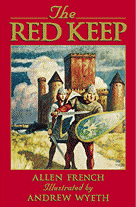
Book Review: The Red Keep by Allen French
Here is a review I wrote in 2007 but for some reason, it never made it onto the blog. Having recommended this book to dozens of people since then who have reported back that the recommendation was a worthy one, I hereby present this review so that even more folks may enjoy this excellent book.The cover art for this book always intrigued me, so at last I decided to pick it up and read it. I was not disappointed. The Red Keep is the story of the petty nobility of 12th century Burgundy that effortlessly places young readers within a historical setting much different from their own. With the political system of the province in a state of flux thanks to the minority of the Duke, one family, the Sauval, amasses power and wealth by robbing travelers and raiding neighboring baronies. The Red Keep is the stronghold of one such barony. It is raided by the Sauval and the Baron is put to the sword--only his daughter, Anne, is rescued by the noble Baron Roger and his men, among them a young page named Conan. In the aftermath of the attack, the damaged keep is left abandoned--the bone of contention around which the story revolves.
The main character, Conan, is immediately sympathetic. He is strong, brave, and chivalrous to a fault, but young man that he is, he makes occasional bone-headed decisions that nearly cost him his life. As the story progresses, Conan's youthful naivete transforms into savvy adulthood as he carefully plans a strategy to thwart the Sauval.
The character of Anne is also appealing. Though she is presented in fighting trim throughout the book, she is not given unrealistic strength or the ability to strike down fighting men twice her size--a common but ludicrous feature of much modern literature. Anne's true strength lies in her courage, her determination to regain her father's fief and her willingness to step outside of the expected female role, even in the face of difficult odds, for the sake of justice. In this, I thought she resembled St. Joan of Arc.
Overall, I loved The Red Keep. The main characters were good and solid, and the antagonists were suitably detestable. The story itself and the writing are also first rate. Add to this the great black and white illustrations by Andrew Wyeth throughout, and you've got a real winner of a book, perfectly suited for kids 10 and up, but easily read and enjoyed by adults as well.
Saturday, July 06, 2013
Review of Between the Forest and the Hills by Ann Lawrence
Great for summer reading, Between the Forest and the Hills is a clever, fast-paced historical novel set at the twilight of Roman Britain, easily approachable for readers as young as 10 but thoroughly enjoyable for adults as well.
The times are changing fast in Roman Britain. With the Western Empire collapsing, the legions have been withdrawn and the British have been told that they're on their own. Saxon encroachments have disrupted ancient lines of communication leaving many towns isolated and at the mercy of the barbarians. But some towns, like Iscium, are remote enough to remain at peace--for a while, anyway.
This character-driven tale is subtitled "A Historical Fantasy" but that term is somewhat misleading. While there are surely a few fanciful elements, there are no goblins or trolls. The town of Iscium is, as far as I can tell, a product of the author's imagination (though the city of Caerleon in Wales was once called Iscia Augusta). The characters too appear to be completely fictional. The setting, however, is quite historical and the reader is lightly transported back to that era of change and transition--when Rome receded and medieval Christendom emerged.
The author's excellent true-to-life depictions of the characters are what really make this book tick. Falx, a Roman boy, displays all the foolish courage and reluctant care of a virtuous lad his age. Malleus the bishop and his pagan friend Frontalis are endearing grumbly old men while Ulna is a wide-eyed Saxon girl, wise in her innocence. Axon and Thena, a young married couple, are forever optimistic despite the often dire circumstances. The Saxon chieftain Torcula is fierce yet reasonable, while the mysterious Teres, like Gandalf in The Lord of the Rings, seems to turn up whenever he is most needed. But the most endearing characters of all may be Hrudin and Concha, the loquacious ravens.
There are a few somewhat ridiculous elements to this book if you are a perceptive reader--elements of post-shadowing (if such a term exists) that were a little too cute and did little to enhance the story in my opinion. Others may disagree. See if you catch them.
One aspect of the book that I really enjoyed, and that caught me somewhat off guard, was the author's treatment of the miraculous. The tone of the characters--especially the Bishop Malleus--toward the miraculous is strongly reminiscent of the sneering contempt of 19th century British academics. This was so pronounced that it was beginning to annoy me and it almost felt like the author was trying to make a point that sounded suspiciously like a pompous modernist theologian attempting to explain Christ feeding the 5,000 without any supernatural means, but via the generosity of the wealthy in the crowd. Yet, just when I had reached my limit, the author skillfully and unexpectedly pulled the rug out from under this idea. The scene where this happens is my favorite in the book.
Between the Forest and the Hills is a tremendously charming and well-conceived tale. It is enjoyable reading for young folks (ages 10 and up) and for old folks, too, and I plan to re-read it with my kids in the not-too-distant future. If you enjoy this book, I would heartily recommend Centurion's Daughter which tells a similar tale of the end of Roman Gaul and the beginning of the kingdom of the Franks.
The times are changing fast in Roman Britain. With the Western Empire collapsing, the legions have been withdrawn and the British have been told that they're on their own. Saxon encroachments have disrupted ancient lines of communication leaving many towns isolated and at the mercy of the barbarians. But some towns, like Iscium, are remote enough to remain at peace--for a while, anyway.
This character-driven tale is subtitled "A Historical Fantasy" but that term is somewhat misleading. While there are surely a few fanciful elements, there are no goblins or trolls. The town of Iscium is, as far as I can tell, a product of the author's imagination (though the city of Caerleon in Wales was once called Iscia Augusta). The characters too appear to be completely fictional. The setting, however, is quite historical and the reader is lightly transported back to that era of change and transition--when Rome receded and medieval Christendom emerged.
The author's excellent true-to-life depictions of the characters are what really make this book tick. Falx, a Roman boy, displays all the foolish courage and reluctant care of a virtuous lad his age. Malleus the bishop and his pagan friend Frontalis are endearing grumbly old men while Ulna is a wide-eyed Saxon girl, wise in her innocence. Axon and Thena, a young married couple, are forever optimistic despite the often dire circumstances. The Saxon chieftain Torcula is fierce yet reasonable, while the mysterious Teres, like Gandalf in The Lord of the Rings, seems to turn up whenever he is most needed. But the most endearing characters of all may be Hrudin and Concha, the loquacious ravens.
There are a few somewhat ridiculous elements to this book if you are a perceptive reader--elements of post-shadowing (if such a term exists) that were a little too cute and did little to enhance the story in my opinion. Others may disagree. See if you catch them.
One aspect of the book that I really enjoyed, and that caught me somewhat off guard, was the author's treatment of the miraculous. The tone of the characters--especially the Bishop Malleus--toward the miraculous is strongly reminiscent of the sneering contempt of 19th century British academics. This was so pronounced that it was beginning to annoy me and it almost felt like the author was trying to make a point that sounded suspiciously like a pompous modernist theologian attempting to explain Christ feeding the 5,000 without any supernatural means, but via the generosity of the wealthy in the crowd. Yet, just when I had reached my limit, the author skillfully and unexpectedly pulled the rug out from under this idea. The scene where this happens is my favorite in the book.
Between the Forest and the Hills is a tremendously charming and well-conceived tale. It is enjoyable reading for young folks (ages 10 and up) and for old folks, too, and I plan to re-read it with my kids in the not-too-distant future. If you enjoy this book, I would heartily recommend Centurion's Daughter which tells a similar tale of the end of Roman Gaul and the beginning of the kingdom of the Franks.
Friday, May 10, 2013
This Day in Christian Roman history -- The birth of the Emperor Claudius Gothicus
![]() |
| Bust of Claudius II Gothicus from Santa Giulia Museum in Brescia, Italy |
Born in the present day Balkan peninsula, little is known of Claudius's early life. His path to the throne was via the Roman army and he distinguished himself as a man of tremendous physical strength--it is related in the Historia Augusta that he could knock out the teeth of a horse or mule with a blow of his fist. He was eventually promoted to the rank of cavalry commander and upon the assassination of the emperor Gallienus, he was declared emperor by the army outside of Milan.
He won the title "Gothicus" by defeating a huge army of Goths which had ravaged the provinces of Illyricum and Pannonia at the Battle of Naissus in AD 269. His victory was so complete that it would be another 100 years before the Goths would menace the Empire again.
Claudius reigned during a time when Christians were actively persecuted by the empire and Claudius himself is considered in legend as the emperor under whom Saint Valentine was martyred in AD 270. What is perhaps most interesting about Claudius, however, is that he identified in some sources as an ancestor of Constantine the Great, the first Christian emperor. For example, in the Panegyrici Latini, one of the pagan panegyricists says, addressing Constantine in about AD 310:
And so I shall begin with the divinity who is the origin of your family, of whom most people, perhaps, are still unaware, but whom those who love you know full well. For an ancestral relationship links you with the deified Claudius, who was the first to restore the discipline of the Roman Empire when it was disordered and in ruins, and destroyed on land and sea huge numbers of Goths who had burst forth from the Straits of the Black Sea. [Taken from: Panegyrici Latini by Nixon and Rogers]A good biography of Claudius Gothicus may be found here:
http://www.roman-emperors.org/claudgot.htm
Monday, April 22, 2013
April 22, Feast of St. Theodore of Sykeon
![]() |
| Original image of St. Theodore taken from: http://www.cerkiew.pl/index.php?id=swieci&tx_orthcal[sw_id]=802&cHash=bb67994247 |
"You must first pray that your inward man may be reformed and grow healthy; for when that is healed, the outward man, too, will be restored to health."April 22 is the feast of St. Theodore of Sykeon, a bishop from central Asia Minor who lived during the reign of the murderous Roman emperor, Phocas. We have an extensive biography of St. Theodore written by one of his disciples that has come down to us which makes for exceptionally good reading for historians and devout Christians alike. He had a habit of fearlessly speaking the truth to power, having humbled the cruel Bonosus and rebuked Phocas himself to his face on another occasion.
~St. Theodore of Sykeon to the east Roman consul Bonosus, a violent man who came to the saint seeking a cure for a physical maladay, ca. AD 608
Here is the above quote in context, taken from the Life of St. Theodore of Sykeon:
"About that time the inhuman consul Bonosus was travelling to the eastern parts of the Empire and as he passed near the monastery he heard tell of the inspired man's holiness and felt a reverence for it, violent and cruel though he was. So he sent a messenger in advance to him beseeching him, if he could endure the fatigue, to come down to the oratory of the holy martyr Gemellus near the postingstation in order that he might do reverence to him there and be deemed worthy of his prayers, saying that he himself was unable to go up to the monastery owing to the pressure of urgent affairs; so the Saint went down and received him and whilst he was praying for him the consul stood but did not bend his neck, so the Saint took hold of the hair of his forehead and pulled it and in this way bent his head down (virtue is wont to act thus with courage and not fear human authority 'For the righteous', it is said, 'is bold as a liont'[ Prov 28:1])Taken from: http://www.fordham.edu/halsall/basis/theodore-sykeon.asp
We who were present were thunderstruck and terrified at the just man's daring and imagined that the consul would turn insolent and furious, for we knew well by report that his savagery was like that of a wild beast. But he readily accepted the prayer and the rebuke and showed honor to the Saint by kissing his hands, and then putting his hand on his own chest because of a pain which oppressed him he begged the Saint to pray that he might be freed from it. But the Saint gently tapped with his fingers on the consul's chest and said to him, 'You must first pray that your inward man may be reformed and grow healthy; for when that is healed, the outward man, too, will be restored to health; therefore I will pray for you and do you devote yourself to the good and fear God in order that my prayers may be effective. But if I pray and you neglect to amend your ways, my prayers will be unavailing. Be merciful then and pitiful to all Christian people and do not use harshly the authority entrusted to you, but while examining your own consciousness of sins, sympathize with those that go astray and never shed innocent blood. For if there is to be punishment for the mere insult of a spoken word-for calling another a "fool"-how much more will blood, shed unjustly, be avenged by God?'
These counsels the Saint gave him like a man sowing seed in unfruitful ground, and the consul fetched out a few coins and offered them to him in token of gratitude. But as the Saint did not deign to accept them, he drew back his hand and took out some 'trimisia'* begging the Saint at least to accept those and to give one to every brother in the monastery. But before looking at them Theodore said, 'There are only fifty and not sufficient for giving one to each, however, they can be changed into smaller money and then distributed equally'. But the consul marvelled at his discerning words, as being Godinspired and answered, 'Yes, reverend father, by thy holy prayers, there are only fifty as your holy mouth has said; however, I will send as many more at once as are needed to make up the number'. This he did, for after being dismissed by the Saint he went to his baggage and sent what he had promised."
Friday, April 19, 2013
This day in Christian Roman history -- The Battle of Callinicus (April 19, AD 531)
![]() |
| Click here to share. |
The Romans under Belisarius had blunted a Persian invasion under the general Azarethes into Mesopotamia and had successfully ushered the Persian host back to the border with minimal damage to the towns and cities of the Roman East. However, with Azarethes about to cross over the Euphrates River and retreat into Persian territory, the officers of the Roman army approached Belisarius and demanded that he attack. According to the historian Procopius, Belisarius balked, thinking it a signal blessing to defeat the enemy without fighting a battle. Presumably an eye-witness, Procopius recorded Belisarius as delivering the following remonstrance to his army:
"O Romans, whither are you rushing? And what has happened to you that you are purposing to choose for yourselves a danger which is not necessary? Men believe that there is only one victory which is unalloyed, namely to suffer no harm at the hands of the enemy, and this very thing has been given us in the present instance by fortune and by the fear of us that overpowers our foes. Therefore it is better to enjoy the benefit of our present blessings than to seek them when they have passed.
For the Persians, led on by many hopes, undertook an expedition against the Romans, and now, with everything lost, they have beaten a hasty retreat. So that if we compel them against their will to abandon their purpose of withdrawing and to come to battle with us, we shall win no advantage whatsoever if we are victorious, for why should one rout a fugitive? While if we are unfortunate, as may happen, we shall both be deprived of the victory which we now have, not robbed of it by the enemy, but flinging it away ourselves, and also we shall abandon the land of the emperor to lie open hereafter to the attacks of the enemy without defenders.
Moreover this also is worth your consideration, that God is always accustomed to succour men in dangers which are necessary, not in those which they choose for themselves. And apart from this it will come about that those who have nowhere to turn will play the part of brave men even against their will, while the obstacles which are to be met by us in entering the engagement are many; for a large number of you have come on foot and all of us are fasting. I refrain from mentioning that some even now have not arrived." [Procopius, The Persian War]Of course, it is not unlikely that the above contains a good bit of Procopian rhetoric inserted ex post facto. Regardless, the speech proved ineffective. The Roman officers continued to importune Belisarius with such vehemence that he feared a mutiny. He offered battle to the Persians on Easter Day, April 19, AD 531.
Here is how I portrayed the resulting battle at the very beginning of Belisarius: Glory of the Romans:
AD 531, Easter Day
Fourth year of the reign of Justinian, Emperor of the Romans
Near Callinicus in Roman Mesopotamia
On the banks of the muddy Euphrates River—the edge of the fertile crescent where it is said that the earthly paradise created by Almighty God once stood—thousands of men now endured an earthly hell. For on Easter Day, rather than giving praise to Jesus Christ for his resurrection to life, the armies of two great empires sought to inflict death upon each other.
The battle need not have happened at all. The invading Persians had been brought to heel by the prowess of Belisarius, the commanding general of the Romans. His reputation was such that the Persians dared not engage with him, and upon his arrival with the Army of the East, the invaders beat a hasty retreat.
Belisarius escorted them to the border, but as the enemy host prepared to ford the Euphrates and escape back into Persia, the officers of the Roman army rebelled against their commander and questioned his courage. Belisarius, for his part, was content to let the Persians escape without bloodshed, counting it a singular blessing to defeat an enemy without losing any of his own men. But the officers under him saw in the retreating enemy a chance for earthly glory. So they raged at their general and demanded that he lead them forth into combat.
Seeing the bloodlust in their eyes and fearing the disorder of a mutiny, Belisarius grudgingly consented.
It was a decision he would subsequently regret.
Belisarius raised his bow toward the enemy and loosed. Before he could draw another shaft, he sensed the hum of an incoming dart. Ducking down at the last instant, the barbed tip struck his steel helm and clanged off.
God save me! he gasped to himself, shaking off the heavy impact.
“Magister! They are taking us from the flank!” screamed Trajan, his lieutenant, pointing with his sword toward a great clamor off to the right of the Roman army.
“No!” Belisarius shouted in disbelief. He jerked his mount around to see with his own eyes and his mouth dropped open in dismay.
A messenger galloped to him, his horse in a froth. “Arethas has deserted us, O Magister! Every last Arab has fled the field!”
“The cowards couldn’t even stand for one charge,” Trajan raged, his fists clenched.
“Not cowards,” Belisarius growled, “They are traitors! How stupid I was to entrust the right wing to them. Despite their boasts, they had no intention of fighting their brother bandits.”
A great wail of despair went up from the Roman lines as the extent of the disaster was realized. Their previous swagger and order quickly dissolved into fear and chaos. In terror, thousands of mail-clad Romans threw down their arms and fled straight toward the nearby Euphrates, hoping to gain safety by swimming to the islands in midstream. Hundreds were cut down in their flight by jubilant Persians who slaughtered them with relish.
A mere thousand picked men stood by Belisarius as he fought on.
Ascan, the implacable Hunnic chieftain, along with several hundred of his best men, remained in the fight as well, forcing back the charging Persians time and again. The elite Persian Immortals, desperate to revenge themselves on the Huns for their losses at Daras the previous year, massed and flung themselves upon Ascan’s men, careless of death. But the wily Hun, perched on his nimble war pony, made them pay dearly each time, dispatching some of their most valiant officers with his own deadly darts.
“We must push through and unite with Ascan’s men,” Belisarius commanded, drawing a javelin. The only way to salvage the day is to recombine our remaining forces and put our backs to the river, he thought, his mind working feverishly.
Anxious to obey their general, his stalwarts shifted front and began to move toward Ascan’s surrounded contingent.
But the Persians were experienced in war and knew well that to secure the victory, it is more important to quell those forces still in the fight than to chase those who run away. Belisarius soon found his path blocked by thousands of Persians foot soldiers who, having returned from the rout, were moving in to finish the job.
“Forward!” Belisarius urged as he forced his way to the point position of his phalanx. Joining the front rank, he struck with his javelin as volleys of arrows from the men in the rear poured over his head. The lightly clad Persian footmen toppled over dead in heaps, but others took their places, their huge wicker shields presenting an impassible obstacle.
Read the rest in the book... Belisarius, Glory of the Romans.Belisarius’s force was within shouting distance when an unexpected stroke from an Immortal’s sword struck Ascan on the side of the face, sending a fountain of blood into the air. Seeing their hated enemy wounded, the Immortals cried out in triumph and rushed forward in a mass. Ascan’s weary men melted away before the implacable Persian assault and the defenseless Hun captain was hacked to pieces—dead before he hit the ground.
The Battle of Callincum as imaged by Igor Dzis. Click here to visit
the artist's page.
With their commander slain, the remaining Huns gave up the fight and attempted to escape as best they could.
At the sight, Belisarius’s remaining men let out a groan of despair.
“That’s it, we’re finished,” cried Trajan.
“Aye,” Belisarius replied, surveying a battlefied bereft of hope. “Nothing remains but to get as many of our men to safety as we can.”
“Should I sound the retreat?” Trajan asked.
“Yes, we will withdraw toward Peter,” Belisarius commanded, pointing to a contingent of footmen who were fighting a well-ordered rear-guard action to protect those fleeing across the river.
Sunday, March 17, 2013
The real Saint Patrick in his own words
![]() |
| Click here to share on Facebook. |
Amazingly, two works written by Patrick have come down to us from antiquity. The first is his Confessio, which was written about AD 450 under obscure circumstances. Following is an excerpt from this document, where Patrick tells the story of his ancestry, his capture by pirates, and his captivity in Ireland:
"My name is Patrick. I am a sinner, a simple country person, and the least of all believers. I am looked down upon by many. My father was Calpornius. He was a deacon; his father was Potitus, a priest, who lived at Bannavem Taburniae. His home was near there, and that is where I was taken prisoner. I was about sixteen at the time. At that time, I did not know the true God. I was taken into captivity in Ireland, along with thousands of others. We deserved this, because we had gone away from God, and did not keep his commandments. We would not listen to our priests, who advised us about how we could be saved. The Lord brought his strong anger upon us, and scattered us among many nations even to the ends of the earth. It was among foreigners that it was seen how little I was..."Patrick later escapes from slavery in Ireland and after a harrowing journey, manages to return to Britain. But God is not finished with him. Later in the same document, Patrick writes about how he was called by God to be an evangelist in Ireland:
"After a few years I was again in Britain with my parents [kinsfolk], and they welcomed me as a son, and asked me, in faith, that after the great tribulations I had endured I should not go anywhere else away from them. And, of course, there, in a vision of the night, I saw a man whose name was Victoricus coming as if from Ireland with innumerable letters, and he gave me one of them, and I read the beginning of the letter: ‘The Voice of the Irish’; and as I was reading the beginning of the letter I seemed at that moment to hear the voice of those who were beside the forest of Foclut which is near the western sea, and they were crying as if with one voice: ‘We beg you, holy youth, that you shall come and shall walk again among us.’ And I was stung intensely in my heart so that I could read no more, and thus I awoke. Thanks be to God, because after so many years the Lord bestowed on them according to their cry."The Confessio reveals Patrick to be be a man of tremendous faith, courage and humility. Too often, these characteristics are obscured by the legends and pantomime that accompany the celebration of his feast day around the world. But listen to Patrick's own exhortation, reminiscent of Saint Paul boasting of his own weakness, as he encourages the high and mighty of this world to humble themselves before God:
"So be amazed, all you people great and small who fear God! You well-educated people in authority, listen and examine this carefully. Who was it who called one as foolish as I am from the middle of those who are seen to be wise and experienced in law and powerful in speech and in everything? If I am most looked down upon, yet He inspired me, before others, so that I would faithfully serve the nations with awe and reverence and without blame: the nations to whom the love of Christ brought me. His gift was that I would spend my life, if I were worthy of it, to serving them in truth and with humility to the end..."Click here to read the whole of the Confessio.
For an excellent short biography of this great saint, check out Saint Patrick from the Christian Encounters series. My positive review of this book may be found here.
In a similar vein, I absolutely do not recommend the popular book How the Irish Saved Civilization by Thomas Cahill. My reasons for this negative opinion may be found here.
Happy Saint Patrick's Day #1
The real Saint Patrick was a man of tremendous faith, courage and humility. Too often, these characteristics are obscured by the legends and pantomime that accompany the celebration of his feast day around the world.
Amazingly, two of Patrick's writings have survived from antiquity: his Confession and his Letter to the Soldiers of Coroticus. Here is an excerpt from his Confession about his calling to be an evangelist in Ireland:
"After a few years I was again in Britain with my parents [kinsfolk], and they welcomed me as a son, and asked me, in faith, that after the great tribulations I had endured I should not go anywhere else away from them. And, of course, there, in a vision of the night, I saw a man whose name was Victoricus coming as if from Ireland with innumerable letters, and he gave me one of them, and I read the beginning of the letter: ‘The Voice of the Irish’; and as I was reading the beginning of the letter I seemed at that moment to hear the voice of those who were beside the forest of Foclut which is near the western sea, and they were crying as if with one voice: ‘We beg you, holy youth, that you shall come and shall walk again among us.’ And I was stung intensely in my heart so that I could read no more, and thus I awoke. Thanks be to God, because after so many years the Lord bestowed on them according to their cry."
Find out more about the real Saint Patrick here:
http://www.catholic.org/
Sunday, March 10, 2013
Prayers for the Conclave
The Conclave is scheduled to begin on Tuesday, March 12 on the traditional calendar feast of Pope St. Gregory the Great. The faithful are called to pray for the conclave, that the assembled cardinals be receptive to the inspiration of the Holy Spirit. What better way to do this than to remind ourselves of the glorious heritage of the office of the Papacy and some of the brilliant, wise and godly men who have occupied the Roman cathedra.
Too often, those who think poorly of the Church focus on the "bad" Popes. But one need only glance through the 2,000 year history of the papacy--stretching all the way back to the time of Jesus--to see that the good far outnumber the "bad". Here are some memes to help us focus on the outstanding virtues of some of the most noble early Popes. Let us pray to Almighty God that He sends His Holy Spirit to inspire these virtues in the man who will become the next Pontiff--the next Servant of the Servants of God.
Saint Peter, the First Pope
"Dearly beloved, think not strange the burning heat which is to try you, as if some new thing happened to you; But if you partake of the sufferings of Christ, rejoice that when his glory shall be revealed, you may also be glad with exceeding joy. If you be reproached for the name of Christ, you shall be blessed: for that which is of the honor, glory, and power of God, and that which is his Spirit, resteth upon you." [First Epistle of Saint Peter, 4:12-14]Read more about St. Peter the Liber Pontificalis, an amazing early work that every Catholic should own.
Saturday, March 02, 2013

"I am not the Son of God. I'm just a philosopher who wants people to be nice to each other." #ThingsJesusNeverSaid
What Jesus actually said:
"Amen, amen I say to you: If any man keep my word, he shall not see death for ever."
The Jews therefore said: "Now we know that thou hast a devil. Abraham is dead, and the prophets; and thou sayest: If any man keep my word, he shall not taste death for ever. Art thou greater than our father Abraham, who is dead? and the prophets are dead. Whom dost thou make thyself?"
Jesus answered: "If I glorify myself, my glory is nothing. It is my Father that glorifieth me, of whom you say that he is your God. And you have not known Him, but I know Him. And if I shall say that I know Him not, I shall be like to you, a liar. But I do know Him, and do keep His word. Abraham your father rejoiced that he might see my day: he saw it, and was glad."
The Jews therefore said to him: "Thou art not yet fifty years old, and hast thou seen Abraham?"
Jesus said to them: "Amen, amen I say to you, before Abraham was made, I AM."
They took up stones therefore to cast at him. But Jesus hid himself, and went out of the temple.
John 8:51-59.
Subscribe to:
Posts (Atom)