Saturday, August 24, 2019

"Proceed to Rome and desolate that city." ~ The Sack of Rome by Alaric, August 24, AD 410

Alaric escorts the Christian treasures of Rome to safety at Saint Peter's Basilica
during the Gothic sack of AD 410. [Click to enlarge].


The sack of Rome, the Eternal City, by Alaric and his Goths occurred on this date, August 24, in anno Domini 410. This catastrophic event, caused as much by the inept diplomacy of the Romans as by the intrepidity of Alaric, was a major turning-point in history that shook the Roman Empire to its very core. Indeed, this event was such a profound shock that it inspired Augustine of Hippo to write his greatest and most influential work, The City of God, as a response. Writing later in a work called Retractiones, Augustine records the event and the immediate reaction to it, saying:
Rome, in an invasion of the Goths advancing under their king Alaric, was overthrown by their disastrous attack. The worshipers of false gods and of many gods, to whom we colloquially refer as pagans, tried to blame this on the Christian religion and began to blaspheme the true God with more bitterness and more severity than usual.” (Augustine, Retractiones, Chapter LXIX]
So shattering was this event that few Roman historians of the time seemed to want to record it in their works. Of those who did, such as Olympiodorus of Thebes, only fragmentary and derivative passages have survived antiquity. Even Jordanes, in his 6th century work On the Origin and Deeds of the Goths, passes over Alaric’s exploit in a cursory way without elaboration.

One ancient source that covered the sack in some detail was Hermias Sozomen’s Ecclesiastical History. Perhaps drawing on the lost history of Olympiodorus, Sozomen provides the following account of the lead-up to the sack, explaining how the foolish decisions of the emperor Honorius and his court at Ravenna offended Alaric and drove him to lay siege to the magnificent ancient capital, Rome:
The Western Empire fell a prey to disorders, because many tyrants arose. After the death of Stilicho, Alaric, the leader of the Goths, sent an embassy to Honorius to treat of peace; but without avail. He advanced to Rome, and laid siege to it; and by posting a large army of barbarians on the banks of the Tiber, he effectually prevented the transmission of all provisions into the city from Portus. After the siege had lasted some time, and fearful ravages had been made in the city by famine and pestilence, many of the slaves, and most of the barbarians by race within the walls, deserted to Alaric. [Sozomen, Ecclesiastical History, Book IX, Chapter 6]
At this time, the first indications of religious strife within the city were made manifest as the pagans among the nobility felt that an appeal to their gods might be effective at warding off the Gothic horde. Sozomen explains:
Click for more info.
Those among the senators who still adhered to pagan superstition, proposed to offer sacrifices in the Capitol and the other temples; and certain Tuscans, who were summoned by the prefect of the city, promised to drive out the barbarians with thunder and lightning; they boasted of having performed a similar exploit at Larnia, a city of Tuscany, which Alaric had passed by for Rome, and had not taken. The event, however, proved that no advantage could be derived from these persons for the city. All persons of good sense were aware that the calamities which this siege entailed upon the Romans were indications of Divine wrath sent to chastise them for their luxury, their debauchery, and their manifold acts of injustice towards each other, as well as towards strangers. [Sozomen, Ecclesiastical History, Book IX, Chapter 6]
These “persons of good sense” were no doubt the Christians in the city who feared that Alaric had been sent by God as an avenger for the blasphemies against Christ committed in Rome. Another ecclesiastical historian of the same period, Socrates Scholasticus, records an incident which emphasizes this point:
It is said that as he was advancing towards Rome, a pious monk exhorted him not to delight in the perpetuation of such atrocities, and no longer to rejoice in slaughter and blood. To whom Alaric replied, 'I am not going on in this course of my own will; but there is a something that irresistibly impels me daily, saying, 'Proceed to Rome, and desolate that city.' [Socrates, Ecclesiastical History, Book VII, Chapter 10]
At the behest of Pope Innocent I and the emperor Honorius, both of whom were in Ravenna at the time, Alaric raised the first siege of Rome and hastened to Ariminum to open negotiations with high hopes that he would be given an exalted rank and honors. But Honorius and his courtiers, misunderstanding their military situation, offered him only money and provisions and were inflexible on all other points. Alaric soon became frustrated with their dithering. Returning to Rome, he renewed the siege of the city and raised up Attalus, the prefect of the city, as a puppet emperor and rival to Honorius.

With Attalus as additional leverage, Alaric tried again to negotiate with Honorius. But while these negotiations were dragging on, a terrible famine struck Rome because the grain supply from Africa had been stopped by officers loyal to Honorius. Attalus proved completely unable to cope with this situation, and was at loggerheads with Alaric over what to do next. As a result, Alaric agreed to strip Attalus of his position in exchange for pledges from Honorius that peace negotiations would continue in earnest.

While talks were still in progress, however, an attack was carried out on Alaric by a rash warlord named Saros, himself Goth in the employ of Honorius. Only supported by 300 men, this attack failed in its intent, but started a chain-reaction with disastrous results. Alaric immediately broke off negotiations and departed with his whole army from the vicinity of Ravenna, heading south. Sozomen picks up the thread:
Alaric retraced his steps, and returned to Rome, and took it by treachery. He permitted each of his followers to seize as much of the wealth of the Romans as he was able, and to plunder all the houses; but from respect towards the Apostle Peter, he commanded that the large and very spacious church erected around his tomb should be an asylum. This was the only cause which prevented the entire demolition of Rome. [Sozomen, Ecclesiastical History, Book IX, Chapter 9]
Sozomen then provides an anecdote of a single incident that took place during the sack:
I shall recount a pious action performed by a barbarian, and record the bravery of a Roman lady for the preservation of her chastity. The barbarian and the lady were both Christians, but not of the same heresy, the former being an Arian, and the latter a zealous follower of the Nicene doctrines. A young man of Alaric's soldiers saw this very beautiful woman, and was conquered by her loveliness, and tried to drag her into intercourse; but she drew back, and exerted herself that she might not suffer pollution. He drew his sword, and threatened to slay her; but he was restrained by the passion which he entertained toward her, and merely inflicted a slight wound on her neck. The blood flowed in abundance, and she offered her neck to the sword; for she preferred to die in her chastity than to survive, after having consorted lawfully with a husband, and then to be attempted by another man. When the barbarian repeated his purpose, and followed it with more fearful threats, he accomplished nothing further; struck with wonder at her chastity, he conducted her to the church of Peter the apostle, and gave six pieces of gold for her support to the officers who were guarding the church, and commanded them to keep her for her husband. [Sozomen, Ecclesiastical History, Book IX, Chapter 10]
A few other anecdotes from the sack may be gleaned from another Christian source, the History Against the Pagans written a few years after the event by Paulus Orosius. As this obscure work and its relationship to the sack of Rome is not particularly well known, I will provide the substantial passages below without comment.
Alaric appeared before trembling Rome, laid siege, spread confusion, and broke into the City. He first, however, gave orders that all those who had taken refuge in sacred places, especially in the basilicas of the holy Apostles Peter and Paul, should be permitted to remain inviolate and unmolested; he allowed his men to devote themselves to plunder as much as they wished, but he gave orders that they should refrain from bloodshed.….

Click for more info.
While the barbarians were roaming through the City, one of the Goths, a powerful man and a Christian, chanced to find in a church building a virgin advanced in years who had dedicated herself to God. When he respectfully asked her for gold and silver, she declared with the firmness of her faith that she had a large amount in her possession and that she would bring it forth at once. She did so. Observing that the barbarian was astonished at the size, weight, and beauty of the riches displayed, even though he did not know the nature of the vessels, the virgin of Christ then said to him: "These are the sacred plate of the Apostle Peter. Presume, if you dare! You will have to answer for the deed. As for me, since I cannot protect them, I dare not keep them."

The barbarian, stirred to religious awe through the fear of God and by the virgin's faith, sent word of the incident to Alaric. He ordered that all the vessels, just as they were, should be brought back immediately to the basilica of the Apostle, and that the virgin also, together with all Christians who might join the procession, should be conducted thither under escort. The building, it is said, was at a considerable distance from the sacred places, with half the city lying between. Consequently the gold and silver vessels were distributed, each to a different person; they were carried high above the head in plain sight, to the wonder of all beholders. The pious procession was guarded by a double line of drawn swords; Romans and barbarians in concert raised a hymn to God in public. In the sacking of the City the trumpet of salvation sounded far and wide and smote the ears of all with its invitation, even those lying in hiding. From every quarter the vessels of Christ mingled with the vessels of Peter, and many pagans even joined the Christians in making profession, though not in true faith. In this way they escaped, but only for a time, that their confusion might afterward be the greater. The more densely the Roman refugees flocked together, the more eagerly their barbarian protectors surrounded them.… [Orosius, The History Against the Pagans, Book VII, Chapter 39]
This scene is recreated in the 19th century German engraving included at the top of this post. Orosius is also instructive with regard to the aftermath of the siege, which he describes as follows:
The third day after they had entered the City, the barbarians departed of their own accord. They had, it is true, burned a certain number of buildings, but even this fire was not so great as that which had been caused by accident in the seven hundredth year of Rome. Indeed, if I review the conflagration produced during the spectacles of Nero, her own emperor, this later fire, brought on by the anger of the conqueror, will surely bear no comparison with the former, which was kindled by the wantonness of the prince. Nor do I need in a comparison of this sort to mention the Gauls, who, after burning and sacking the City, camped upon her ashes for almost an entire year. Moreover, to remove all doubt that the enemy were permitted to act in this manner in order to chastise the proud, wanton, and blasphemous City, it may be pointed out that her most magnificent sites, which the Goths were unable to set on fire, were destroyed at this time by lightning. [Orosius, The History Against the Pagans, Book VII, Chapter 39]
Orosius closes his account of the sack with an interesting comment which seems to indicate that he had visited Rome himself in the aftermath of the sack, or had at least spoken with several eyewitnesses:
Although the memory of the event is still fresh, anyone who saw the numbers of the Romans themselves and listened to their talk would think that "nothing had happened," as they themselves admit, unless perhaps he were to notice some charred ruins still remaining. [Orosius, The History Against the Pagans, Book VII, Chapter 40]
To corroborate the point that the sack did not do permanent, irreparable harm to Rome, Sozomen concludes his account by saying of the citizens of Rome: “Those who were there saved, and they were many, rebuilt the city.” [Sozomen, Ecclesiastical History, Book IX, Chapter 9]

It's worth mentioning that both Sozomen and Orosius wrote in the days before the much more devastating sack of Rome by the Vandals in AD 455. At that point it became clear that the prostration the city had suffered under Alaric was not a singular event—and that much worse might be expected in the future.

Thursday, August 22, 2019

Eugenius takes the throne, AD 392 ~ The Really, Truly Last Pagan Emperor of Rome...Maybe

A gold solidus of Eugenius minted at Lyon ca. AD 393.
[Taken from the Dumbarton Oaks collection]
On August 22, AD 392, an unlikely man was raised to the imperial purple of the Western Roman Empire. His name was Eugenius and for most of his career up to that point, he had been an academic serving the Western imperial court. The pagan historian Zosimus, writing in the early 6th century AD, describes Eugenius’s early career and his path to power:
There was in the court a person named Eugenius, a man of learning, who was a professor and teacher of rhetoric. He had been recommended to the notice of Arbogastes by Rictomeris as a person of a kind and obliging disposition, with a desire that he would make him his familiar friend, being one who would be serviceable to him in any circumstances where the assistance of a real friend would be needful. When Rictomeris was departed to the emperor Theodosius, by daily conversation Eugenius became the sincere friend of Arbogastes, who had no secret which he did not confide to him. [Zosimus, Historia Nea, Book IV]
The Arbogastes mentioned above was a powerful Frankish general who became commander of the Western Roman armies in the 380s. As with many of the Romanized barbarians who managed to attain supreme military command, Arbogast was resentful when the Western emperor attempted to issue him a command or restrain his ambitions. In AD 392, Arbogast had a very public quarrel with Valentinian II, the reigning emperor of the West, and the tension between the two soon became untenable. When Valentinian attempted to strip him of his rank, Arbogast tore up the order, threw it at the emperor’s feet, and dared him to do anything about it. He also began to plot a future without Valentinian’s interference. Zosimus continues:
Recollecting Eugenius, therefore, at this juncture, who by his extraordinary learning and the gravity of his conversation seemed well-adapted for the management of an empire, [Arbogastes] communicated to him his designs. But finding him not pleased with the proposals, he attempted to prevail on him by all the arts he could use, and entreated him not to reject what fortune so favorably offered. Having at length persuaded him, he deemed it advisable in the first place to remove Valentinian, and thus to deliver the sole authority to Eugenius. [Zosimus, Historia Nea, Book IV]
Shortly thereafter, Valentinian II was dead. He was found strangled in his chambers. The official verdict was that he had committed suicide, though some accused Arbogast of having solicited the deed of the bedchamber eunuchs. Zosimus, for his part, claims that Arbogast himself had dealt the emperor the mortal wound. Realizing that he could not take the throne himself, Arbogast decided to elevate his friend Eugenius as emperor of the West. The two together seemed like a formidable pair, Arbogast being “brave and skillful” and Eugenius being “learned and virtuous” according to Zosimus.

A silver siliqua of Eugenius. The resemblance of the
numismatic portraits of Eugenius to those of Julian
the Apostate is striking—particularly Eugenius's beard
which was symbolic of the pagan philosophers.
One of Eugenius’s first acts was to replace all of the officers of the Western court with his own men. Many of these new officers, apparently, were pagans. Furthermore, in response to a petition submitted by Symmachus, one of the leading members of the Roman Senate and Prefect of the City of Rome, Eugenius allowed the Altar of Victory to be placed again in the Senate House at Rome. This famous pagan altar had first been removed in AD 356 at the order of Constantius II. Later replaced by Julian the Apostate, the Altar was removed again by Gratian in AD 383.

The leading Christians in Italy were deeply dismayed by this move. In a letter to Eugenius, Saint Ambrose of Milan acknowledges him as emperor, but promises to exercise the same boldness when speaking to him as he did with his predecessors on the throne. He then rebuked Eugenius for delivering favors and money to pagan officers, saying:
[W]hen your Clemency took up the reins of government it was afterwards discovered that favors of this kind had been granted to men, excellent indeed in matters of state but in religion heathens. And it may, perhaps, be said, august Emperor, that you did not make any restitution to temples, but presented gifts to men who had deserved well of you. But you know that we must constantly act in the cause of God, as is often done in the cause of liberty, also not only by priests, but also by those who are in your armies, or are reckoned in the number of those who dwell in the provinces. When you became Emperor envoys requested that you would make restitution to the temples, and you did not do it; others came a second time and you resisted, and afterwards you thought fit that this should be granted to those very persons who made the petition. [Ambrose, Letter LVII]
But was Eugenius truly a pagan emperor? Or was he merely seeking supporters among the pagan Roman nobility by granting them symbolic favors? It seems likely that he was a lukewarm Christian who was willing to seek allies wherever he could find them. Writing about 50 years after the events, the ecclesiastical historian Hermias Sozomen maintains that Eugenius “was by no means sincere in his profession of Christianity.” He then goes on to describe how Eugenius resorted to pagan fortune-tellers to determine what course of action to take. [Sozomen, Ecclesiastical History, Book VII, Chapter 22]

Though Eugenius may have been a nominal Christian himself, it appears that one of his most important supporters, Virius Nicomachus Flavianus, was a very public and very outspoken pagan. Despite his religious leanings, Flavian had served as the Praetorian Prefect of Italy, Gaul and Africa under Theodosius. With the rise of Eugenius and Arbogast, Flavian switched his allegiance, possibly seeing an opening for a pagan revival, though some scholars have suggested that his motives were purely political (eg., Michele Salzman's article in the Journal of Early Christian Studies here). Regardless, Flavian seems to have influenced Eugenius to embrace the pagan elements which were still very active in Rome. The ecclesiastical historian Rufinus, writing about a decade after the events, records Flavian’s zeal for the old pagan rites:
But the pagans, who are always reviving their errors with new ones, renewed the sacrifices and bloodied Rome with horrid victims, examined sheep guts and from the divination of entrails proclaimed that victory for Eugenius was assured. Flavian, who was then prefect, engaged in this in a spirit of deep superstition and great fervor, and it was owing to his statements that they assumed that Eugenius’s victory was assured, since he had a great reputation for being wise. [Rufinus: Ecclesiastical History, Book 11.33]
Paulinus of Milan, writing in his Life of Saint Ambrose about twenty years after the events, similarly indicates that Flavian and Arbogast were the primary pagan influences on Eugenius who he portrays as a weak Christian, “forgetful of his faith.” When Eugenius arrived in Milan to prepare for the coming battle against Theodosius, Paulinus records that Ambrose had fled, “avoiding rather the sight of the sacrilegious man.” Furthermore, it seems that the churches of Milan rejected Eugenius's attempt to placate them with gifts, and refused to offer prayers for his success in the coming fight. These snubs were not appreciated—Arbogast and Flavian were particularly offended. Paulinus continues:
Click for more info.
Arbogast, Count at that time, and the Prefect Flavian had promised as they were leaving Milan, that when they should return victorious, they would make a stable in the basilica of the church of Milan and would review the clergy under arms. [Paulinus, Life of Saint Ambrose, Chapter VIII]
And so, Arbogast, Eugenius and Flavian marched off to face Theodosius at the Battle of the River Frigidus and there met their fate. Paulinus renders his verdict, saying:
When the wretched men become wickedly credulous of their demons and open their mouths in blasphemy against God, they deprive themselves of hope of victory. Moreover the cause for their disturbance was this: because the gifts of the emperor [Eugenius], who had involved himself in sacrilege, were spurned by the Church nor was the association with the Church in prayer granted him. But the Lord who is wont to protect His Church cast His judgment from heaven and transferred complete victory to the pious emperor Theodosius….Eugenius and his satellites were crushed. [Paulinus, Life of Saint Ambrose, Chapter VIII]
Thus ended what may be termed the last serious attempt at a pagan restoration of the Roman Empire. It remains unclear, however, if Eugenius himself was a pagan or if he was merely a nominal Christian adopting a position tolerant of pagan practices in an attempt to rally the pagan Roman nobility to his cause. To me, the latter seems more likely.

Saturday, August 17, 2019

The Unconquerable Ricimer Dies ~ August 18, AD 472

A fanciful later European engraving of Ricimer. Though he
ruled from behind the throne of the Western Empire for
16 years, his likeness was never preserved.
On August 18, in anno Domini 472, the powerful generalissimo of the Western Roman Empire, Ricimer, passed from this life.

A barbarian of noble birth, half Visigothic and half Suevian, Ricimer first appears in history as a soldier in the Western Roman army under the command of Flavius Aetius. It is in this capacity that he became allied with Majorian, another follower of Aetius. Both men, it seems, participated in the campaigns of Aetius against the Franks, though Majorian later had a falling out with the great commander prior to his famous victory over Attila.

After the assassination of Aetius and Valentinian III in AD 454-5 and the subsequent sack of Rome by the Vandals, Ricimer and Majorian would rise to power together, overthrowing the weak emperor, Avitus. The following brief passage may be found in the Fragmentary History of Priscus:
“Now that they were free from their fear of the Goths, both Majorian and Ricimer openly revolted. Avitus, disquieted partly by the domestic turmoil, partly by the Vandalic wars, retreated from Rome and held fast to the road to Gaul. Majorian and Ricimer attacked him on the road and forced him to flee to a sacred precinct, where he abdicated his rule and removed his imperial attire. No sooner had Majorian’s men lifted the siege than Avitus’s life ended in starvation, after eight months on the throne. Others say that he was strangled.” [Given, Fragmentary History of Priscus, p. 133]
Avitus was the first in a line of emperors who would be dominated and undone by the efforts of Ricimer who soon became invested as Magister Militum, attaining supreme military power in the West. He was not, however, able to take the throne himself due to his clear non-Roman lineage. His Roman colleague Majorian was made emperor in AD 457, but after four years of rule, he was deposed by Ricimer, who viewed him as a threat to his power, and later beheaded. Ricimer then put the more pliable Libius Severus on the throne to serve as a puppet. When Severus died of natural causes four years later (though Cassiodorus claims that Ricimer had him poisoned), Ricimer took full control of the Western Empire during a two-year interregnum.

At the height of his power, Ricimer was called “the unconquerable” by the late Roman poet Sidonius Apollinaris and it was said that he never once lost a battle. Sidonius says further:
“If the Norican is restraining the Ostrogoth, it is that Ricimer is feared. If Gaul ties down the armed might of the Rhine, it is he that inspires dread. And because the Vandal foe plundered me [Italy] while the Alan, his kinsman, swept off what remained, this man took vengeance by the force of his own arms.” [Anderson, Sidonius: Poems and Letters, Volume 1, p. 41]
At this point, the Eastern Roman emperor Leo I intervened, naming Anthemius, a general in Illyricum, as Western Emperor. Ricimer accepted this and soon after married Alypia, the daughter of Anthemius, to solidify his position. Not willing to depend on his powerful new son-in-law as his sole military support, Anthemius appointed his Illyrian colleague Marcellinus to command his army as counter-balance to Ricimer. But if Anthemius thought that Ricimer would meekly surrender his authority in the West, he was sorely mistaken.

When Leo and Anthemius put together a vast armada to destroy the Vandal menace in north Africa in AD 468, Ricimer joined the cause, but under the nominal command of Marcellinus. The great campaign, which emptied the coffers of both the Eastern and Western empires, ended up a complete disaster for the Romans, but a boon for the scheming Ricimer. The Roman fleet was destroyed and the army captured by the Vandals. Both halves of the empire found themselves devoid of troops and bankrupt as a result of the catastrophic defeat. Ricimer, however, had remained on the sidelines, losing none of his soldiers, and many blamed him for not fully supporting the effort and secretly wanting it to fail. Further enhancing Ricimer's position, Marcellinus was later assassinated in Sicily, and some suspected a conspiracy hatched by Ricimer had been responsible for his rival's death.

Following this debacle, Ricimer decided that he’d had enough of Anthemius. Priscus explains what happened next:
Click for more info.
Ricimer began a conflict between himself and the Western emperor Anthemius, and moreover, although he was betrothed to Anthemius’s daughter Alypia, he instigated a civil war in the city [of Rome] that lasted for five months. The magistrates and the people fought for Anthemius, the mass of domestic barbarians for Ricimer. Also present was Odoacer, a man of the Skirian race….

Anthemius lived in the palace, but Ricimer barricaded the locations near the Tiber and plagued those inside with hunger. During an engagement fought by the two sides, much of Anthemius’s party fell. Ricimer deceitfully concluded a treaty with the remaining men and then introduced Olybrius as emperor. For five months altogether, a civil war controlled Rome until Anthemius’s supporters surrendered to the barbarians and left the emperor naked. Anthemius joined the crowd of beggars and placed himself under the protection of the martyr Chrysogonos. There he was beheaded by Gondoubandos, Ricimer’s brother [actually, his nephew], after a reign of five years, three months, and eighteen days.

Ricimer thought Anthemius worthy of a royal burial, while he introduced Olybrius into the royal court. Within thirty days after Olybrius succeeded to the Roman throne in the way described, Ricimer lost his life by vomiting most of his blood. Then Olybrius died of edema. [Given, Fragmentary History of Priscus, p. 170]
Following Ricimer’s death in AD 472, the expiring Western Empire passed through the hands of several weak emperors and warlords until the above-mentioned Odoacer was able to consolidate his power, shrug off attempts of the East to assert authority, and rule in his own right as a barbarian King over Italy.

Friday, August 09, 2019

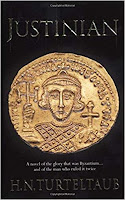
Lustinian ~ A review of H. N. Turtletaub's novel, Justinian

This is a review I wrote over a decade ago. I am posting it here now because I have had reason to refer to it a few times over the past several weeks in response to people asking if this book is any good. I guess there are so few enjoyable novels set in Byzantium that those who are fans of the history eventually stumble across whatever is out there. 


Click for more info.
There's nothing I love better than reading a good novel about Byzantium--The Rome That Did Not Fall, in the words of Gerard Friell. And given Harry "Turtletaub's" reputation as a writer, I thought that this one would be tailor-made for me. I wanted so much to enjoy it.

Unfortunately, I didn't. The reasons for this are several. First, I couldn't find a single sympathetic character in the entire book. Justinian II is presented as a loathsome monomaniac. His faithful companion Myakes, whose conversations with a monk named Elpidios punctuate the narrative, is a lackey who excuses the emperor's excesses and in general plays the part of a lecherous old man. The aforementioned Elpidios is presented as a hypocrite. The lesser characters are all similarly presented with nary a good or honorable motive among any of them. This lack of virtuous characters is a hallmark of much modern fiction and I'd like to say here and now that I *hate* it. Such works are every bit as obnoxious as the saccharine tales of heroism and good hygiene that used to dominate the genre of historical fiction. As Aristotle said, we should aim for the golden mean, but as doing this can prove difficult, we should err on the side of the lesser vice. In Justinian, Turtletaub has chosen to err on the side of the greater.

That said, Turtletaub (or Turtledove, if we drop the pretense) certainly knows his history. Having translated the Chronicle of Theophanes, a Greek primary source which provides much of what we know about the 7th and 8th century in Byzantium, Turtledove's academic qualifications are not to be despised. However, having read his translation of Theophanes, I have a good idea of how he 'enhanced' the Justinian story for modern readers, and to me, that says a lot about what the author thinks of his potential readers and his misanthropic view of mankind in general. It's not a pretty picture.

Perhaps the most dismaying thing about this book is that it is completely unsuited for young readers. I love reading historical fiction with my kids, and there's precious little on Byzantium available for this purpose. But the copious graphic sex scenes, underage sex scenes, rape scenes, etc. in Justinian make the book completely anathema from this perspective. Indeed, I felt at times that someone had pasted some passages from "Penthouse Letters" into the book.

Turtletaub also treats religious figures shabbily, invariably making them either liars, weirdos, hypocrites, weaklings, or stooges--as if religion is always the mark of the scoundrel. And, of course, the supreme villain, Justinian himself, is presented as something of a religious fanatic, believing that God guides and approves his every wicked action. Here again Turltetaub hews closely to the modern secular conventional wisdom that becomes increasingly trite with each passing day.

So in short, unless you are looking for a depressing read that will leave you feeling like you need a shower and a visit to the confessional after you read it, I'd look elsewhere for an enjoyable novel about Byzantium.

Thursday, August 01, 2019

Guest Post ~ "Old Days"

Tooner's Schooners of South Philadelphia, late 1940s.
Anthony "Speed" Schiavo is top row, third from left.
Presenting a retrospective guest post from Anthony P. Schiavo, Sr., written over a decade ago when he was about 75. Anthony, or "Speed" as he was known in South Philadelphia, passed away earlier this week after a full life at the ripe old age of 87.


I look out the window and watch them play in our circle, “the boys” as my wife calls them. When not in school, neighborhood boys regularly play baseball with a hollow bat and wiffle ball or ball hockey on inline skates with hockey sticks, goals, and goalies with pads and masks. It's a small field so I park our car in our driveway to give them room to play. My wife would prefer I park in the street, away from bird droppings and debris from monstrous Christmas trees, planted yearly by our house's original owner. But she's a good neighbor and I'm ... well they don't know it and I don't look it, but I'm one of the boys.

Once, a very long time ago, I played with my friends in our 'ballpark'. We were luckier than these boys, we had 'Abbotts', a dairy maintenance yard at the end of my street in South Philly, bigger and less traveled than the circle they play on. And though my sons on visits ridiculed its size as the place I've told them held epic athletic contests, we were extremely lucky to have it. The best part was that there were few Abbotts vehicles in the yard on weekdays and none on weekends. The place was ours except for occasional visitors who parked there. Even that was hardly ever a problem since cars then were parked unlocked in neutral, there was no 'park'. We simply pushed them into empty parking space out of our way. Cars left unlocked, empty parking space, in South Philly? Yes, it was very long ago.

We played 'halfball' with a broomstick and halves of 'pimple' balls, 'miniature ball' in a ten by ten yard chalked baseball field (ball slapped underhand must hit in the field), and two-hand touch football with a real football or a rolled up and tied newspaper. We played often and long, sometimes into the darkness, as long as we had a critical mass of players, as few as two for halfball and even football. My friend Yogi and I sometimes played football one on one, where we had to pass to ourselves. I was quicker but he was smart and made it hard for me to get started. And he was bigger and muscle counted when the ball was in the air. Yogi is gone now but writing this brings him back clearly, facing me, blocking my way to the goal.

Abbotts was also an informal casino with gambling from pennies to big money. On a concrete platform along a wall with a protective overhang, we played penny ante poker, old men (seventies and eighties) played hilarious pinochle for change with angry outbursts and blatant cheating, and in the center of the yard, returned WWII veterans played dice for enough money to attract hustlers from distant places. They had a lookout for cop cars but with big games, nobody ran, the organizer, who took cuts from big pots, went over and explained the gathering to the cops who always left satisfied.

But my favorite memories of Abbotts were the football games we played against the veterans. Barely past our mid teens, we were no match physically for them and to make matters worse, hitting these guys like we hit each other was unthinkable – they were heroes to us. They slaughtered us but we always looked forward to another game hoping they wouldn't tire of the ease of it. Finally we lured them into a schoolyard to play where speed trumped size and we beat them. Sadly some never played again – it was the end of their youth.

Anthony P. Schiavo, Sr.
1932–2019
I'm not going to try to persuade the boys outside that I'm one of them, me playing in their games is too grotesque to imagine – especially after my spectacular flop on the first pass I had them throw me. But if I could get a message through the age communication barrier, it would be this: enjoy playing but also take it all in, the games, the plays, and especially the faces, not to tell others, they won't care, but to recall how good it was, when they are old men watching new boys play.


Even to his final days, "Speed" felt he was one of the boys, always up for a game of frisbee with his grandkids. You can find one of his short stories -- SNAP! -- on this blog as well.

Monday, July 08, 2019

Fulton J. Sheen ~ Santo subito?

"We become like that which we love. If we love what is base, 
we become base; but if we love what is noble, we become noble."
—Archbishop Fulton J. Sheen
Deo gratias! The cause of Venerable Archbishop Fulton J. Sheen appears to be moving forward again after his earthly remains were removed from Babylon-on-Hudson to Peoria, Illinois.

With the renewed interest in Archbishop Sheen, I noticed an up-tick in folks sharing some of my oldest memes on social media, including the one above.

This quote may be found in Sheen’s book entitled, Life is Worth Living, which the same title as his celebrated TV show from the 1950s. The reason for this is not coincidental. The essays in the book were transcribed from the TV show. As Archbishop Sheen wrote in the preface with his typical good humor:
“Let it never be said again that it is difficult to write a book. It is now proven that if a person talks only half and hour a week for twenty-six weeks, he already has enough material for a book.”
Here is the context of the quote, from a section in the book entitled, Knowing and Loving:
The will, when it loves anything above it in dignity, goes out to meet the demands of whatever it loves. When the will loves anything that is below it in dignity, it degrades itself. Suppose the dominant love of man was money. Man would degrade himself by loving what is less worthy than himself. In loving it, he becomes like gold. If a man loves only lust, carnality, and the pleasure of the flesh above all things, he thereby degrades his spirit to the level of sex.

We become like that which we love. If we love what is base, we become base; but if we love what is noble, we become noble. Hence the importance of the right kind of ideals and the right kind of heroes. As Our Lord said, Where your treasure is, there is your heart also. “Hence, the least love of God is worth more than the knowledge of all created things. [Sheen: Life is Worth Living, page 47]
This passage is immediately followed by another that is eminently quotable and to which I previously gave the meme treatment as follows:


Here are a few more Sheen posts from the archives:

Tuesday, June 18, 2019

"We found two men of stupendous size" ~ The discovery of the relics of Saints Gervasius and Protasius by Ambrose of Milan

Detail from Phillipe de Champaigne's painting entitled: The Discovery of
the Relics of Saints Gervasius and Protasius
(1653) 
June 19 is the feast of the ancient martyrs Gervasius and Protasius. Though nearly forgotten today, these twin brothers were well known in both the early Church and throughout the Middle Ages. To this day, their names may be found in the Litany of the Saints among those of better remembered early martyrs.

Very little is known for sure about the lives and martyrdoms of Gervasius and Protasius, only that they perished before the lifetime of Saint Ambrose in the late 4th century AD. A very brief account of their martyrdom is given in a letter purported to be written by Saint Ambrose. Though of ancient provenance, this letter is believed by most scholars to be a fabrication written by a hand other than Ambrose's somewhat after his time. But it is interesting nonetheless as it contains the text of a libellus (or booklet) that was supposedly found along with the relics of Gervasius and Protasius when they were discovered in late 4th century Milan. The text of this libellus runs as follows:
I the servant of Christ, Philippus, with my son, stole and buried in my house the bodies of the saints: their mother was called Valeria and their father Vitalis; they begot them as twins in a single birth, and called one Protasius, the other Gervasius.
Vitalis, a soldier, was martyred for the crime of being a Christian. His wife, Valeria, was later beaten to death on the same charge while on her way back to Milan. Upon her death, Gervasius and Protasius are left as orphans. The libellus continues:
Gervasius and Protasius sell the house and all the possessions inherited from their parents, giving the money to the poor. They retire for ten years, reading, praying and fasting, then they are martyred.
The count Astasius comes by Milan as he is going to fight the Marcomanni. Pagans ask him to compel Gervasius and Protasius to sacrifice. He orders them to be arrested and brought to him, and tries to convince them to sacrifice, but Gervasius speaks against worshipping idols. Astasius orders him to be scourged until he dies.
Similarly Protasius refuses to sacrifice, fearing no punishment. Astasius orders him to be beaten and again tries to convince him. Protasius tells him that he hopes that he will be forgiven, as Christ wished forgiveness on those who crucified him, and that he is ready for martyrdom. Astasius orders him to be beheaded.
After that, I, the servant of Christ, Philippus, with my son, took away the holy bodies secretly at night and buried them in my house and in this marble sarcophagus, with God alone as a witness, trusting through their prayers to obtain the mercy of the Lord Jesus Christ, who lives and reigns with the Father and the Holy Spirit for ever and ever, Amen.' [Taken from The Cult of the Saints in Late Antiquity database]
It is not clear when the martyrdom of these two saints occurred, with some scholars saying during the reign of Nero, others the reign of Marcus Aurelius, and others during the Great Persecution of Diocletian. The connection of Saint Ambrose with these two saints runs deep for it was he who discovered their remains. In the Life of Saint Ambrose written by his secretary, Paulinus, in the early 5th century AD, we find the following passage relating to the discovery:
Click here for info.
At this same time, the holy martyrs Protase and Gervase revealed themselves to the Bishop [that is, Ambrose]. For they had been placed in the basilica in which today are the bodies of the martyrs Nabor and Felix. And the holy martyrs Nabor and Felix were visited very frequently, but just as the names of the holy martyrs Gervase and Protase were unknown, so also were their burial places, so much so that all walked over their graves who wished to come to the grates by which the sepulchers of the holy martyrs Nabor and Felix were protected from injury.
But when the bodies of the holy martyrs were taken out and placed on biers, thereupon the diseases of many were shown to have been cured. Even a blind man, Severus by name, who to the present day devoutly serves in that same basilica which is called Ambrosian and into which the bodies of the martyrs were carried, as soon as he touched the clothing of the martyrs, immediately received his sight. Bodies also possessed by unclean spirits were cured and returned home with the greatest gratitude. And as the faith of the Catholic Church increased by these blessings effected by the martyrs, so did the heresy of the Arians diminish. [Paulinus, Life of Saint Ambrose, Chapter 5]
Amazingly, this passage is corroborated by Saint Ambrose himself in an extant letter to his sister, Saint Marcellina. Here is the relevant passage:
As I am wont to keep your holiness informed of all that goes on here in your absence, I would have you know that we have found the bodies of some holy martyrs. After the consecration of a Church, many began to interrupt me crying with one voice; “Consecrate this as you did the Roman Basilica.” 

“I will do so,” I replied, “if I find any relics of Martyrs,” and immediately my heart burned within me as if prophetically.

In short the Lord lent us aid, though even the very clergy were alarmed. I caused the ground to be opened before the rails of the Church of Saints Felix and Nabor. I found the suitable tokens; and when some persons were brought for us to lay our hands upon, the power of the holy martyrs became so manifest that before I began to speak, one of them, a woman, was seized by an evil spirit and thrown down upon the ground in the place where the martyrs lay.

We found two men of stupendous size, such as belonged to ancient days. All their bones were entire, and there was much blood. The people flocked thither in crowds throughout the whole of those two days. We arranged all the bones in order, and carried them when evening set in, to the Basilica of Fausta; where we kept vigils throughout the night, and some possessed persons received imposition of hands. The following day we transferred them to the Basilica which they call Ambrosian.

During their transportation a blind man was healed. [Taken from: Saint Ambrose to Saint Marcellina, Letter XXII]
This took place in AD 386. Perhaps even more amazingly, this event is also corroborated by Saint Augustine who was present in Milan at the time, a year before his baptism in AD 387. Writing in his City of God, Augustine says:
The miracle which was wrought at Milan when I was there, and by which a blind man was restored to sight, could come to the knowledge of many; for not only is the city a large one, but also the emperor was there at the time, and the occurrence was witnessed by an immense concourse of people that had gathered to the bodies of the martyrs Protasius and Gervasius, which had long lain concealed and unknown, but were now made known to the bishop Ambrose in a dream, and discovered by him. By virtue of these remains the darkness of that blind man was scattered, and he saw the light of day. [Augustine, City of God, Book XXII, Chapter 9]
The relics of Saint Ambrose (in white) with Saint Gervasius and Protasius (in red).
[By BáthoryPéter 13:53, 5 October 2008 (UTC) - Own work, CC BY-SA 4.0]
Saints Gervasius and Protasius became popular intercessors for the next thousand plus years with numerous shrines erected to their honor. Their remains may be seen in Milan to this day, along with those of Saint Ambrose himself, at the Basilica of Sant’Ambrogio in Milan.

Also in this basilica are 9th century mosaics of saints Ambrose, Gervasius, Protasius, Ambrose's sister Marcellina, Ambrose’s brother Satyrus, and Candida, who is likely the long-time friend of Marcellina mentioned in Paulinus’s Life of Saint Ambrose.

Mosaic from the Basilica of Sant'Ambrogio in Milan showing Christ flanked
by Saints Gervasius (right) and Protasius (Left). Below in the medallions are
Saint Candida (right), Saint Satyrus (center) and Saint Marcellina (left).
Click to enlarge.

Thursday, June 13, 2019

"The ship was utterly consumed with all on board" ~ The persecutions of the Arian Emperor Valens

Eighty orthodox clerics are burnt to death by the order of the Emperor Valens
in this 18th century etching.
The Roman Emperor Valens is an enigmatic and paradoxical historical figure. Placed on the throne of the Eastern Empire by his brother, Valentinian I in AD 364, Valens was a reasonably effective ruler for much of his reign, but lacked much of the political, military and religious acumen of his elder sibling. In his Ecclesiastical History, Hermias Sozomen compares the religious views of the two brothers as follows:
Valens, when he was baptized, employed Eudoxius as his initiator, and was zealously attached to the doctrines of Arius, and would readily have compelled all mankind by force to yield to them. Valentinian, on the other hand, maintained the faith of the council of Nicæa, and favored those who upheld the same sentiments, without molesting those who entertained other opinions. [Ecclesiastical History of Sozomen, Book VI, Chapter 6]
As an Arian and an active persecutor of the orthodox Nicean Christians, Valens occasionally attempted to enforce his will with brutal tactics reminiscent of his pagan predecessors like Diocletian, Decius and Valerian. One such instance occurred after rioting broke out in Constantinople between Arian and orthodox factions over the election of a new bishop for the city. Having been thoroughly beaten and abused by the ascendant Arians, eighty clerics of the orthodox faction approached Valens in Nicomedia with a petition for redress. Sozomen describes Valens reaction as follows:
Click for more info.
Although exceedingly angry, the emperor did not openly manifest any wrath, but secretly commanded the prefect to seize and slay the whole deputation. But the prefect, being apprehensive that a whole popular insurrection would be excited if he were to put so many good and religious men to death without any of the forms of justice, pretended that they were to be sent into exile, and under this pretext compelled them to embark on board a ship, to which they assented with the most perfect resignation. When they had sailed to about the center of the bay, which was called Astacius, the sailors, according to the orders they had received, set fire to the vessel and leaped into the tender. A wind arising, the ship was blown along to Dacibiza, a place on the sea-coast of Bithynia, but no sooner had it neared the shore, than it was utterly consumed with all the men on board. [Eccelsiastical History of Sozomen, Book VI, Chapter 14]
On another occasion, Valens visited the city of Edessa and was infuriated to discover large crowds of orthodox Catholics worshiping in the open air outside the city walls in defiance of his edict which had stripped them of their churches. The emperor’s fury nearly turned into a wholesale slaughter, but his wrath was deflected by the willingness of the Edessenes to suffer martyrdom en masse. Sozomen describes the scene:
[Valens] beheld the members of the Catholic Church assembled for worship in the plain before the walls of the city, for there, too, they had been deprived of their houses of prayer. It is said that the emperor reproached the prefect thoroughly and struck him on the jaw with his fist for having permitted these congregations contrary to his edict. Modestus (for this was the name of the prefect), although he was himself a heretic, secretly warned the people of Edessa not to meet for prayer on the accustomed spot the next day, for he had received orders from the emperor to punish all who should be seized. He uttered such threats with the forethought that none, or at least but a few, would incur danger, and with the desire to appease the wrath of the monarch. But the people of Edessa, totally disregarding the threat, ran together with more than their customary zeal, and filled the usual place of meeting.

Modestus, on being apprised of their proceedings, was undecided as to what measures ought to be adopted, and repaired in embarrassment to the plain with the throng. A woman, leading a child by the hand, and trailing her mantle in a way unbefitting the decency of women, forced her way through the files of the soldiers who were conducted by the prefect, as if bent upon some affair of importance. Modestus remarked her conduct, ordered her to be arrested, and summoned her into his presence, to inquire the cause of her running. She replied that she was hastening to the plain where the members of the Catholic Church were assembled.

"Know you not," replied Modestus, "that the prefect is on his way there for the purpose of condemning to death all who are found on the spot?"

"I have heard so," replied she, "and this is the very reason of my haste, for I am fearful of arriving too late, and thus losing the honor of martyrdom for God."

The governor having asked her why she took her child with her, she replied, "In order that he may share in the common suffering, and participate in the same reward."

Modestus, struck with astonishment at the courage of this woman, went to the emperor, and, acquainting him with what had occurred, persuaded him not to carry out a design which he showed to be disgraceful and disastrous. Thus was the Christian faith confessed by the whole city of Edessa. [Ecclesiastical History of Sozomen, Book VI, Chapter 18]
Valens continued vacillating between persecution and mercy with regard to non-Arians throughout the remainder of his reign. According to Sozomen, his death was predicted by an orthodox monk named Isaac who warned him that victory against the Goths would only be gained if the churches which had been given over to the Arians were returned to the orthodox.

Valens refused.

Shortly thereafter, he was killed by the Goths following the disastrous Roman defeat at the Battle of Adrianople in AD 378.

Friday, June 07, 2019

A Pagan Convert Becomes Empress of the Romans ~ Theodosius II marries Aelia Eudocia, June 7, AD 421

A modern mosaic portrait of Empress Eudocia featured on the exterior of
Alexander Nevsky Cathedral, Sofia, Bulgaria.
On June 7, AD 421, the 20 year-old Eastern Roman Emperor Theodosius II married a beautiful young Greek girl. Though born into a pagan family and given the name Athenais, the young bride had converted to Christianity shortly before her nuptials and took the name Aelia Eudocia. She would go on to become a devout Christian and a controversial figure in the Eastern Roman court dominated by another powerful woman, the empress Pulcheria.

Here is the brief biography of Eudocia provided in the 6th century Ecclesiastical History of Evagrius Scholasticus, written about a century after her death:
Theodosius II espoused Eudocia, who had previously participated in the saving baptism—an Athenian by birth, and distinguished by poetic skill and beauty of person—through the offices of his sister, the princess Pulcheria. By her he had a daughter, Eudoxia, whom when she had reached a marriageable age, the emperor Valentinian afterwards espoused, for which purpose he made a voyage from the elder Rome to the city of Constantine.
Eudocia later went on a pilgrimage to Jerusalem and made a stop in Antioch on her way. There, she delivered a celebrated speech to the people in which she said, paraphrasing Homer: “It is from your blood I proudly trace my line,” in reference to the Greek colonists who had founded Antioch centuries before. Evagrius continues:
Click for more info.
On this occasion, the sons of the Antiochenes honored her with a skillfully executed statue in brass, which has been preserved even to our times. At her suggestion, Theodosius considerably enlarges the bounds of the city, by extending the circuit of the wall as far as the gate which leads to the suburb of Daphne: of which those who are disposed, may assure themselves by visible proof; for the whole wall may still be traced, since the remains afford a sufficient guidance to the eye. Some, however, say that the elder Theodosius extended the wall. He gave, besides, two hundred pounds' weight of gold for the restoration of the baths of Valens, which had been partially burnt.
Evagrius then tells how Eudocia proceeded to Jerusalem, hinting at the scandals and accusations that had forced her out Constantinople and letting the reader know that he does not believe them to be true. He describes the work she did in the city as follows:
When visiting the holy city of Christ, she did many things for the honor of our Savior God, even so far as to erect holy monasteries, and what are termed laurae.…
Evagrius here goes on a long tangent about the life and practices of the various anchorites near Jerusalem. Getting back to Eudocia, he concludes:
After having conversed with many persons of this description, and founded, as I have already said, many such seats of contemplation, and, besides, restored the walls of Jerusalem, the consort of Theodosius also erected a very large sanctuary, conspicuous for elevation and beauty, in honor of Stephen, the first of deacons and martyrs, distant less than a stadium from Jerusalem. Here her own remains were deposited, when she had departed to the unfading life.
Eudocia’s Church of Saint Stephen would later be destroyed by the Persians in AD 614, restored by Saint Sophronius and destroyed again in the aftermath of the Crusades. It would be rebuilt in the late 19th century by French Dominicans.

The above passages were taken from the Ecclesiastical History of Evagrius, Book I, Chapters XX through XXII, a work that is well worth reading for those interested in this period.

Later in her life, Eudocia became embroiled in the theological controversies surrounding the Council of Chalcedon. Uncertain of which side to follow, Eudocia wrote a letter seeking advice to one of the most famous saints of the age: Saint Simeon the Stylite. From atop his pillar, 60 feet off the ground, Saint Simeon responded to the Empress, and his letter has been preserved as follows:
Click for more info.
"Know, my child, that the devil, seeing the wealth of your virtues, sought to sift you as wheat; moreover, that corrupter Theodosius, having become the receptacle and instrument of the evil one, both darkened and disturbed your God-beloved soul. But be of good courage, for your faith has not left you. I wonder, however, exceedingly at this, that having the fountain close at hand you do not recognize it, but hasten to draw the water from afar. You have near by the inspired Euthymius; follow his counsels and admonitions, and it will be well with you." [Taken from The Life of Saint Simeon Stylites translated by Frederick Lent]
For the record, Saint Euthymius was a champion of Chalcedonian orthodoxy.

Though by most accounts a very devout Christian (and considered a saint in the Eastern Churches to this day), Eudocia retained the classical education imparted to her by her pagan father, Leontius, a teacher of rhetoric at Athens. She wrote poetry, including a lyrical rendering of the legendary passion of the early 4th century martyr saints, Cyprian and Justina. Here is an excerpt from this work which may, in fact, contain elements of Eudocia’s own conversion story:
Followers of Christ!
You who truly cherish in your hearts
the well-praised Savior,
see my streaming tears
and learn whence flows my grief.

And you who are still snared
in the dark illusions of idolatry,
mark what I relate of its lies and deceptions.
For never has one lived
more wholly devoted to false gods than I.

To none but me have the demoniac arts
been so deeply taught.

Yes, I am Cyprian, whom my parents
dedicated to Apollo as a child.

The orgiastic tumults of the festival
of the grey dragon were my lullaby.

At seven, I was presented
to the sun-god Mithras.

I lived in the glorious city of Athens
and as it pleased my parents, became its citizen.

When I had attained the age of ten,
I kindled the torch of Demeter
and immersed myself in Cora’s dirge.
I bore Palla’s serpent
to the citadel as a temple-lad.

Then, to the summit
of wooded mount Olympus
I climbed like the fools
who seek there the radiant habitation
of the holy gods.

I saw the hours and found there
the multitudinous winds,
day’s clamorous chorus,
and all the winged fantasies
in whose illusions life slips away….

Then, for the first time,
the demons’ weakness was revealed to me….
[Taken from: Teetgen: The Life and Times of the Empress Pulcheria, pp. 88-89.]
A more thorough biography of this fascinating late Roman woman, including a detailed look at the scandals that caused her exile from the Capital, may be found at the De Imperatoribus Romanis site here.

Friday, May 17, 2019

The Purpose of Opinion Polls is to Influence Public Opinion, Not to Measure It.

Click here to share this image on Facebook.
I created the above graphic four years ago as the presidential election cycle was just ramping up. As we approach election year 2020, it is even more critical to make American citizens aware of this. Public opinion polls, especially this far out from an election, are not about gauging your opinion about a particular candidate. Honestly, the pollsters don't much care what you think.

The true purpose of most opinion polls is to influence public opinion, not to measure it. 

This is especially true the farther from the election you are. Why? Because the election is the only real test of how accurate the pollsters are. A poll taken six months, a year, or eighteen months before an election will not be tested for a long time. By the time of the election, such erroneous or fraudulent polls will be long forgotten.

Pollsters seek to create an illusion of viability in some candidates or issues because they know that many low-information voters will simply glom onto whoever the perceived front-runner is as the election approaches. Rather than allowing this sleight-of-hand to influence your opinion, don’t let the polls determine which candidates are viable for you. Rather, do the research and find out which candidates are on record as having views that mirror your own, and vote for that person, particularly in the primaries.

In short, don't be a low-information voter. Ignore the polls completely, not just because they are inaccurate but because they are purposefully manipulative.

If everyone did that, we wouldn’t be stuck with media-approved “lesser of two evils” candidates in every single election.

Wednesday, May 15, 2019

"Noble in person and excellent in royal manners" ~ Baptism of Desire and the suspicious death of Valentinian II

Potrait of Valentinian II from a statue originally found in Aphrodisias. 
On May 15, anno domini 392, the young Western Roman Emperor Valentinian II was found dead in the imperial residence at Vienne in southern Gaul. It is said he was hanged using his own handkerchief.

Son of the great warrior emperor, Valentinian I, the younger Valentinian had been declared emperor when he was only four years old upon the premature death of is father in AD 375, even though his half-brother, Gratian, already ruled as co-emperor in the West. Under the regency of his mother, the forceful Empress Justina, and the protection of the army, Valentinian II came to an uneasy accommodation with his brother, Gratian. An Arian, Justina dominated the early years of her son's reign while he was still a small child, and is most commonly remembered today as a bitter opponent of Saint Ambrose, archbishop of Milan.

Just as Valentinian II was coming of age, however, a rebellion arose in Britain and the usurper Maximus defeated and killed Gratian. By AD 387, Valentinian II and Justina were forced to flee to the East and seek the protection of the emperor Theodosius in Constantinople. A year later, Theodosius invaded the West and put down the rebellion, re-establishing the now 18 year old Valentinian II on the Western throne and providing him with a powerful guardian — Arbogast.

A Frankish general, Arbogast had little loyalty to Valentinian II and viewed him as an impediment to his own ambitions. The two soon came into conflict and Valentinian, to his chagrin, discovered who truly held the power in the West when his magister militum treated him contemptuously in public and refused to obey orders. The early 6th century pagan historian Zosimus provides a dramatic description of one such incident between the two men:
At length Valentinian, no longer able to submit to his correction, when Arbogastes was approaching him as he sat on the imperial throne, looked sternly upon him, and presented him with a writing, by which he dismissed him from his command. Arbogastes, having read it, replied, "You neither gave me the command, nor can deprive me of it;" and having said this, tore the writing to pieces, threw it down, and retired. From that period their hatred was no longer kept to themselves, but appeared in public. [Zosimus, New History, Book IV]
Such a situation could not long endure without a violent break. Writing about fifty years after the fact, the historian Hermias Sozomen provides the following summary of the events surrounding Valentinian’s death:
Click for more info.
While Theodosius was thus occupied in the wise and peaceful government of his subjects in the East, and in the service of God, intelligence was brought that Valentinian had been strangled. Some say that he was put to death by the eunuchs of the bedchamber, at the solicitation of Arbogastes, a military chief, and of certain courtiers, who were displeased because the young prince had begun to walk in the footsteps of his father, concerning the government, and contrary to the opinions approved by them. Others assert, however, that Valentinian committed the fatal deed with his own hands, because he found himself impeded in attempting deeds which are not lawful in one of his years; and on this account he did not deem it worth while to live; for although an emperor, he was not allowed to do what he wished. [Ecclesiastical History of Sozomen, Book VII, Chapter 22]
Socrates Scholasticus, writing at about the same time, provides similar testimony [see Book V, Chapter 25].

Valentinian’s death was deeply lamented by his former opponent, Ambrose, the great champion of orthodoxy at Milan. This was because Valentinian had recently corresponded with the bishop and declared himself willing to throw off Arianism and accept baptism at his hands. Ambrose was preparing to journey to Vienne to accomplish this theological coup when news arrived that Valentinian was dead. Ambrose has left at least two testimonials of his grief in the form of a letter to Theodosius and a funeral oration which he offered in honor of the deceased young emperor. In his letter to the emperor, Ambrose writes:
I am filled, I confess, with bitter grief, not only because the death of Valentinian has been premature, but also because, having been trained in the faith and moulded by your teaching, he had conceived such devotion towards our God, and was so tenderly attached to myself, as to love one whom he had before persecuted, and to esteem as his father the man whom he had before repulsed as his enemy. [Ambrose of Milan, Letter 51]
Sozomen’s account also includes praise of the young emperor’s character as follows:
It is said that the boy was noble in person, and excellent in royal manners; and that, had he lived to the age of manhood, he would have shown himself worthy of holding the reins of empire, and would have surpassed his father in magnanimity and justice. But though endowed with these promising qualities, he died in the manner above related. [Ecclesiastical History of Sozomen, Book VII, Chapter 22]
But perhaps most interesting aspect is Ambrose’s funeral oration for Valentinian II and the role it has played over the succeeding centuries in forming Catholic doctrine on the concept known as Baptism of Desire. This notion, according to the Catechism of the Catholic Church, means that those who perish prior to baptism, like Valentinian II, may receive the efficacy of the sacrament if they profess an explicit desire to receive it together with penitence for their sins and charity. In his funeral oration in honor of Valentinian II, Saint Ambrose says:
Click for more info.
But I hear that you grieve because he did not receive the sacrament of baptism. Tell me: What else is in your power other than the desire, the request? But he even had this desire for a long time, that, when he should come into Italy, he would be initiated, and recently he signified a desire to be baptized by me, and for this reason above all others he thought that I ought to be summoned. Has he not, then, the grace which he desired; has he not the grace which he requested? And because he asked, he received, and therefore is it said: 'By whatsover death the just man shall be overtaken, his soul shall be at rest.’ (Wisdom 4:7) [Taken from Deferrari: "On Emperor Valentinian" in Funeral Orations by Saint Gregory Nazianzen and Saint Ambrose of Milan]
Though accepted as a dogma of the Catholic Church, the concept of Baptism of Desire remains controversial among Christians to this day. Thus we may see the relevance of Valentinian II’s death reflected in theological debates that carry on even to the present time.

Arbogast would eventually get his comeuppance at the hands of Theodosius at the Battle of the River Frigidus a mere two years later.

Thursday, May 09, 2019

"We are to be thrown overboard by the Empire" ~ The short reign of the last western Roman Emperor, Julius Nepos

A gold solidus of Julius Nepos minted in Thessalonica.
May 9 is one of several possible dates given for the death of the last Western Roman emperor, Julius Nepos, in the year AD 480.

“Wait,” you say. “I thought the last Western Emperor was Romulus Augustulus who was deposed by Odoacer the Scirian in AD 476.” Well, about that…

Julius Nepos was named Western Emperor by the ailing Eastern Roman emperor Leo in AD 473. Leo did this because he opposed the puppet emperor Glycerius who had been raised by the Burgundian general Gundobad. According to the Chronicle of John of Antioch, this Gundobad had personally beheaded the Western emperor Anthemius the previous year in the service of uncle, the treacherous generalissimo, Ricimer. According to the Fragmentary History of Priscus:
Click for more info.
When the Eastern emperor Leo learned of Glycerius’s accession, he marshaled an army against him under the command of Nepos, who when he captured Rome subdued Glycerius without a fight. He drove him out of the palace and appointed him bishop of Salon [that is, Salona in Dalmatia across the Adriatic]. Glycerius made a mockery of the office for eight months. Nepos was immediately proclaimed emperor and began to rule Rome. [Taken from Given: Fragmentary History of Priscus, page 171]
The contemporary poet Apollinaris Sidonius described Julius Nepos as: “a man whose character, no less than the success of his arms, entitles us to hail him as Supreme Augustus.” [Taken from Hodgkin: Italy and Her Invaders, page 346]

Unfortunately for Nepos, he possessed neither sufficient military strength nor support in Italy to establish a lasting reign. The only accomplishment Nepos could claim during the 14 months he held the imperial authority in Italy was the ceding of practically all of Gaul to Euric, king of the Visigoths in exchange for peace. Sidonius, who had been an early supporter of Nepos, laments this shameful negotiation and the subsequent quitting of his homeland by the Romans, saying: “For all these daring experiments of our devotion our reward, as I hear, is that we are to be thrown overboard by the Empire. Oh! blush, I pray you, for this peace which is neither expedient nor honorable.” [Taken from Hodgkin: Italy and Her Invaders, page 493]

The abandonment of Gaul for a tenuous peace seemed an unpopular move in Italy as well. The history of what happened next is exceedingly hazy, but it appears that the Roman forces under a certain Ecdicius were recalled from Gaul, arrived in Italy, and were subsequently placed under the command of Orestes. This Orestes was a man with a long pedigree of service to the Roman empire, most memorably as an ambassador to Attila in AD 449. Once named Magister Militum, Orestes quickly seized the opportunity to depose Nepos and install his own son as emperor—Romulus Augustulus.

As his support in Italy evaporated, Julius Nepos fled to Dalmatia to join his previous adversary, Glycerius, in exile. There he remained quiet as events unfolded in Italy. The barbarian warlord Odoacer deposed Augustulus and declared himself king of Italy in AD 476. Writing to Constantinople in AD 477, the Roman Senate, no doubt as a mouthpiece for Odoacer, declared that they no longer needed an emperor—that the emperor of the East was sufficient for them with Odoacer as their protector—and they returned the imperial insignia of the west to Zeno.

To this embassy, Zeno replied (as per the near-contemporary historian, Malchus):
The western Romans had received two men from the eastern Empire and had driven one out, Nepos, and killed the other, Anthemius. Now, he said, they knew what ought to be done. While their emperor was still alive, they should hold no other thought than to receive him back on his return. [taken from the De Imperatoribus Romanis website ~ Julius Nepos by Ralph W. Mathisen]
Needless to say, Odoacer had no interest in re-instating Nepos, though he seems to have tolerated his presence in nearby Salona for a few more years. In AD 480, however, things suddenly came to a head. Some of the sources claim that Nepos was in the process of gathering resources for an attempt to retake his throne in Italy when he was suddenly slain by two retainers. One source (Photius, writing a summary of the lost history of Malchus) claims that the assassination of Nepos was instigated by none other than Glycerius himself.

Taking advantage of the situation, Odoacer used the assassination as an excuse to invade Dalmatia, thereby extending his rule over the region and establishing the boundaries of the barbarian kingdom of Italy. Odoacer would rule this kingdom until until AD 493 when he was slain by Theodoric the Ostrogoth.

Meanwhile, in the farther reaches of Gaul, a Roman rump state—the so-called "kingdom" of Soissons, survived until AD 486 under the leadership of the general Syagrius.

Thursday, May 02, 2019

“O Athanasius, you think to escape, but you will not escape” ~ May 2, Feast day of Saint Athanasius the Great

Saint Athanasius is exiled from Alexandria.
Today is the feast of Saint Athanasius, 4th century patriarch of Alexandria, and a doctor of the universal Church. Athanasius has been revered through the ages primarily for his Holy Spirit-inspired steadfastness in defending orthodoxy of doctrine, even in the face of overwhelming opposition. He served as patriarch of Alexandria for nearly fifty years, though with frequent interruptions due to his being exiled by Arian heretics during the intervals when they attained political supremacy. In all, Athanasius was exiled from Alexandria five separate times.

An interesting account of Athanasius’s early life and testament of his many virtues may found in the Ecclesiastical History of Hermias Sozomen. Here, Sozomen tells the extraordinary story of how Athanasius first came to the attention of Alexander, Patriarch of Alexandria, while still a boy:
Click here for more info.
[Alexander] chanced to cast his eyes towards the sea, and perceived some children playing on the shore, and amusing themselves by imitating the bishop and the ceremonies of the Church. At first he considered the mimicry as innocent, and took pleasure in witnessing it; but when they touched upon the unutterable [that is, the Holy Mass], he was troubled, and communicated the matter to the chief of the clergy. The children were called together and questioned as to the game at which they were playing, and as to what they did and said when engaged in this amusement. At first they through fear denied. But when Alexander threatened them with torture, they confessed that Athanasius was their bishop and leader, and that many children who had not been initiated had been baptized by him.
Alexander carefully inquired what the priest of their play was in the habit of saying or doing, and what they answered or were taught. On finding that the exact routine of the Church had been accurately observed by them, he consulted the priests around him on the subject, and decided that it would he unnecessary to rebaptize those who, in their simplicity, had been judged worthy of the Divine grace. He therefore merely performed for them such offices as it is lawful only for those who are consecrated to initiating the mysteries. He then took Athanasius and the other children, who had playfully acted as presbyters and deacons, to their own relations under God as a witness that they might be brought up for the Church, and for leadership in what they had imitated.
Alexander soon found Athanasius to be very well educated and wise beyond his years. He invited the young man to dine with him and eventually made him his secretary. When Alexander’s health began to decline, he sought to make Athanasius his successor as patriarch. According to Apolinarius the Syrian (as quoted by Sozomen), Athanasius had other ideas:
In all these matters much disturbance was excited by impiety, but its first effects were felt by the blessed teacher [that is, Alexander] of this man [that is, Athanasius], who was at hand as an assistant, and behaved as a son would to his father. Afterwards this holy man himself underwent the same experience, for when appointed to the episcopal succession he fled to escape the honor, but he was discovered in his place of concealment by the help of God, who had forecast by Divine manifestations to his blessed predecessor, that the succession was to devolve upon him. For when Alexander was on the point of death, he called upon Athanasius, who was then absent. One who bore the same name, and who happened to be present, on hearing him call this way, answered him; but to him Alexander was silent, since he was not summoning this man. Again he called, and as it often happens, the one present kept still, and so the absent one was disclosed. Moreover, the blessed Alexander prophetically exclaimed, "O Athanasius, you think to escape, but you will not escape," meaning that Athanasius would be called to the conflict.
Athanasius’s appointment would generate controversy almost immediately. For his part, Sozomen offered a testimonial in favor of Saint Athanasius in the following terms:
“For my part, I am convinced that it was by Divine appointment that Athanasius succeeded to the high-priesthood; for he was eloquent and intelligent, and capable of opposing plots, and of such a man the times had the greatest need. He displayed great aptitude in the exercise of the ecclesiastical functions and fitness for the priesthood, and was, so to speak, from his earliest years, self-taught.”
The above excerpts from Sozomen are all taken from his Ecclesiastical History, Book II, Chapter 17. Sozomen’s History follows the entire career of Athanasius through his various defeats and triumphs and is well worth reading in that regard. An excellent, detailed summary of Saint Athanasius's eventful life may be found in the Catholic Encyclopedia entry for him here.

To close, here is a quote from Saint Athanasius’s treatise On the Incarnation of the Word in which he argues that the mighty works accomplished in the name of Christ in the aftermath of the Great Persecution of Diocletian constitute ample proof that the resurrected Savior is indeed alive:
The Savior works so great things among men, and day by day is invisibly persuading so great a multitude from every side, both from them that dwell in Greece and in foreign lands, to come over to His faith, and all to obey His teaching, will anyone still hold his mind in doubt whether a Resurrection has been accomplished by the Savior, and whether Christ is alive, or rather is Himself the Life? Or is it like a dead man to be pricking the consciences of men, so that they deny their hereditary laws and bow before the teaching of Christ? Or how, if he is no longer active (for this is proper to one dead), does he stay from their activity those who are active and alive, so that the adulterer no longer commits adultery, and the murderer murders no more, nor is the inflicter of wrong any longer grasping, and the profane is henceforth religious? Or how, if He be not risen but is dead, does He drive away, and pursue, and cast down those false gods said by the unbelievers to be alive, and the demons they worship?
For where Christ is named, and His faith, there all idolatry is deposed and all imposture of evil spirits is exposed, and any spirit is unable to endure even the name, nay even on barely hearing it flies and disappears. But this work is not that of one dead, but of one that lives — and especially of God. [Taken from On the Incarnation of the Word, Chapter 30]
These observations are even more remarkable in that they were ostensibly written about the year AD 318 when Christianity was less than a decade removed from outright government persecution.