Saturday, February 02, 2008

Justinian 31, Factionists 10: The Nika Rebellion of AD 532

A 5th century relief showing the emperor Theodosius II in the imperial Kathisma
at the Hippodrome, Constantinople.
It’s a safe bet that most of you reading these words have been to a professional football game. Many of you—particularly those who live in Philadelphia—have probably witnessed the occasional brawls between the home crowd and those foolish enough to wear an opposing team’s colors. A few of you, I dare say, have been involved in such altercations.

But how often have you witnessed football fans actually kill opposition partisans? Well, perhaps I should qualify that by saying American football fans. When was the last time you heard of agitated sports nuts rioting in the streets and burning down half their city? OK, again, Chicago and Detroit excluded.

In AD 532, the city of Constantinople, the capital of the Roman Empire, was also home to the most rabid sports fans in recorded history. Their sport of choice wasn’t three yards and a cloud of dust on the gridiron, but the old passion of the ancient Romans—four teams and a cloud of dust around the spina. Since the gladiatorial games had been banned nearly 150 years before, chariot races of the variety most memorably portrayed in the film Ben Hur became the singular mania of the Romans. Practically every city in the empire had its track. But Constantinople was the big leagues. Only the greatest charioteers got to race before the 80,000 raucous lunatics who packed into the sprawling Hippodrome.

So central were the races to Roman life in Constantinople that the Hippodrome directly abutted the palace complex, the seat of government. And the emperor’s box, the Kathisma, had a corridor linking it directly with the imperial residence itself. There had traditionally been four teams or factions in Roman chariot racing, each identified by a color: Red, Green, Blue, and White. By the 6th century AD, the Reds and Whites had become the equivalent of the Arizona Cardinals with the Blues and Greens achieving dominance.

But the Blue and Green factionists were more than just drinking buddies who got together to watch the races. They were combination sports clubs, political parties, street gangs, and organized crime syndicates whose goals were usually limited to beating the rival faction—literally.

The 6th century historian Procopius describes the factionists as barbarian wannabes, who let their beards grow long and shaggy. They apparently invented the “mullet” as well, cutting their hair short in the front but letting it grow long in the back. As to their dress, they favored tunics that were wide at the shoulders and narrow in the waist, designed to make them look Terrell Owens-esque. However, as Procopius reports, when they threw up their arms at the races, sunken chests and blubber guts abounded.

Until the ascendancy of Justinian in the 520s, the factionists generally spent most of their energy fighting with each other. Justinian, however, seemed to show an unusual favoritism toward the Blues, effectively making them immune from criminal prosecution. As a result, the Blues left off merely stomping on the Greens and started attacking the general public as well. Procopius describes a familiar scene for anyone who’s ever lived in a bad neighborhood: honest folks went around armed, wore shabby clothes so as not to draw attention to themselves, and scurried home before it got dark.

But eventually the depredations of the Blues went too far and Justinian was forced to take action. The city prefect, Eudaimon, began rounding up the ringleaders of both factions and convicted seven of them on charges of murder. All seven were condemned, but during the executions, the scaffold collapsed. Two of the factionists, a Blue and a Green, survived and were spirited away to sanctuary in a church by some monks. Not to be deterred, Eudaimon set guards around the place to seize the men if they tried to escape.

At the Hippodrome three days later, the Blues and Greens suddenly found a common cause not at all associated with the races—clemency for their brethren holed up in sanctuary. Throughout the day, the factions together appealed to the emperor to have mercy. But Justinian turned a deaf ear. By the 22nd race, the factionists were fed up. Their leaders took counsel—something as unheard of as Redskins and Cowboys fans planning a tailgate together—and the united factions marched out of the Hippodrome chanting “Long live the merciful Blue-Greens.” They were determined to take action, and to prevent imperial soldiers from infiltrating their ranks, they devised a watchword—“nika” or “conquer.”

The mob made its way to Eudaimon’s headquarters, and when their demands were rejected once again, proceeded to burn the place down. Unfortunately, fires in ancient cities were not easy to contain and this particular fire quickly consumed the nearby buildings, including the monumental great church of Hagia Sophia, originally built by Constantine, and rebuilt by Theodosius II. The rioters then began looting private homes and killing the soldiers sent out to suppress them.

Realizing that the situation was spiraling out of control, Justinian sent out the patricians Basilides and Constantiolus to address the mob. When asked why they were rioting, the factionists now gave a more ambitious response. They demanded the ouster of Eudaimon along with two of Justinian’s other top ministers: John the Cappadocian, the ruthlessly efficient head tax collector, and Tribonian, a legendary jurist who was also notorious for selling justice to the highest bidder. To their shock, Justinian gave in immediately, dismissing all three and appointing others in their places.

Far from quelling the riot, Justinian’s concessions had the same effect as failing to penalize illegal chop-blocks in the first quarter of a Raiders’ game—the bad behavior just got worse. Soldiers were again deployed to curb the mob, but the result was more fires and the destruction of part of the palace, the upper stands of the Hippodrome, the famous baths of Zeuxippus, and the Senate house. The emperor was now effectively besieged in the palace which was surrounded by charred and smoking ruins. The factionists ruled the rest of the city.

It was at about this point that the riots took an even more ominous turn for Justinian. The crowds descended on the house of a patrician named Probus, the nephew of the deceased emperor Anastasius, and the cry went up, “Probus for emperor of the Roman world!” In response, Probus fled—a credit to his foresight—and the mob expressed their disappointment by trying to burn his house down. But Anastasius had two other nephews, the patricians Hypatius and Pompeius, both of whom were now holed up inside the imperial palace with Justinian.

Justinian’s next move was more concessions, with the same predictable result. In an effort to placate the angry crowd, he entered the  Kathisma of the Hippodrome carrying the Gospels and pledged a general amnesty. “By this power, I forgive you this wrong-doing and order that none of you be arrested,” the emperor declared. “Be at peace, for the fault lies not with you, but with me. For my sins made me refuse what you asked of me.”

This speech invited the sympathy of a few of the Blues, who cried out, “Augustus Justinian, you conquer!”

But others began chanting for Hypatius. Justinian probably tried to rebuke them, but they yelled back, “You are breaking your oath, you donkey!” Justinian was silenced by this mockery and left the Hippodrome in what must have been a state of extreme agitation.

After this disquieting audience, the emperor likely feared that some of those trapped with him in the palace, to save their own hides from the mob, would kill him and put Hypatius or Pompeius on the throne. Therefore, upon his return from the Hippodrome, Justinian ordered the nephews of Anastasius to their homes. The two men protested, saying that it would be wrong for them to abandon their emperor during such a crisis. But their objections seemed to cement Justinian’s fears, and he remained adamant that they leave at once.

The two managed to escape in secret to their homes, but once word of this got around, the crowds immediately descended upon them and declared Hypatius emperor. The patrician’s wife, Mary, grabbed hold of her husband and urged him to refuse, crying out that the people were leading him on the road to death. But the mob would not be refused. Placing a gold chain on Hypatius’s head in lieu of the imperial diadem, they led him to the Hippodrome and there acclaimed him.

Inside the palace, Justinian, all-powerful emperor of the Roman world, was ready for drastic action--flight. Gathering up his treasure, he had a boat prepared to take him across the Bosphorus out of harms way. However, his wife, the Empress Theodora, stood up and barred the way, doing the Byzantine equivalent of “getting in his grill.” A hard woman who had survived a youth of grotesque debauchery among the same factionists who were now torching the city, Theodora was not about to climb down from the pinnacle of power without a fight. “If it is your wish to save yourself, O Emperor, there is no difficulty,” the empress declared, “As for me, I approve of a certain ancient saying that royalty makes a good burial shroud.”

Theodora’s pep talk fired up Justinian and his remaining loyalists. Among these were two of his best generals—Belisarius, a first-round draft pick fresh from campaigns against the Persians, and Mundus, a Gepid free-agent acquisition who had just returned from the province of Illyricum. Also present was the crafty offensive coordinator, Narses, Justinian’s head chamberlain. From him came the idea of dividing the factionists by means of bribes. And this he did, secretly distributing money to some of the Blues. When these began loudly acclaiming Justinian in the Hippodrome, the partisans of Hypatius bombarded them with rocks.

While Narses was busy sowing discord, Belisarius and Mundus set out with several hundred armed and battle-hardened soldiers in a desperate gamble to crush the rebellion. Out numbered fifty-to-one, their first attempts to force their way into the Hippodrome from the palace were rebuffed by imperial guardsmen who refused to take sides until one or the other was victorious. In desperation, Belisarius and Mundus led their men out of the palace through the dangerous smoldering ruins of the city to approach the Hippodrome from the outside. Entering through gates on opposite ends, the generals knew that they would have to hack their way through the vast multitude gathered inside to reach the conspirators in the imperial box.

And hack they did.

As soon as the mob realized that the fight was on, they attempted to resist. But since few of them were properly armed and their opponents were well-trained soldiers attacking in formation with shield, arrow, and sword, the battle soon turned into a massacre. Breaking away from the main fight, Belisarius and some of his bodyguards fought their way to the Kathisma and there arrested Hypatius and Pompeius. More soldiers poured into the Hippodrome via the passage from the palace and with no way to escape, the rioters were cut down without mercy. The death toll was estimated to be 30,000 or more.

The next day, Hypatius and Pompeius were executed and their bodies thrown into the sea. The body of Hypatius later washed up on shore and Justinian ordered it buried in a cemetery for criminals. Over top of it, he erected a stone which read, “Here lies the emperor of Louppa.”
Justinian I offers his Hagia Sophia to the Blessed Virgin
and Christ Child.
The one enduring result of the so-called Nika rebellion may be seen to this day towering above city of Istambul—Justinian’s magnificent Hagia Sophia, built over the ruins of the previous church destroyed by the rioters.

So the next time you hear someone say that they bleed Eagle Green or that they’re dying to see Eli lead Big Blue to the Super Bowl, just remember that 1,500 years ago, maniacs who made the ephemera of sport their religion and the stadium their cathedral did literally bleed and die for their misplaced passion.

Paolo Belzoni is the author of Belisarius: The First Shall Be Last, a novel of the early life of this Late Roman hero. A detailed description of the Nika Revolt is included in his follow-up novel, Belisarius: Glory of the Romans. He is also a long-suffering fan of the Philadelphia Eagles.

NB: This is article that I wrote several years ago for the sadly departed magazine, Catholic Men's Quarterly. There's also a detailed but novelized account of the Rebellion in my book, Belisarius: Glory of the Romans.

Wednesday, January 30, 2008

Why media conservatives hate John McCain

One of the most frustrating aspects of this election season has been the willingness of our allies in the conservative media to outsmart themselves by supporting liberal Republicans. Some of them latched on to one of these "moderates" from day one. The most egregious example of this tendency is Sean Hannity, who must feel a bit foolish for his slavish promotion of Giuliani, given Rudy's inglorious performance at the polls.

Hugh Hewitt also gets raspberries for becoming a wholly owned subsidiary of Romney, Inc. One wonders if the FEC will be investigating Hewitt for all the free advertising he has given the Republican version of John Kerry. Personally, I'm more than a little insulted by Hewitt's shameless pumping of liberal Mitt under a micro-thin pretense of impartiality. I hope his audience share has suffered accordingly.

Other hosts, not nearly so audacious in their error (Rush Limbaugh most predominant among them), withheld their support from good conservative candidates until it was too late to do much good.

So now three weak sisters remain, with John McCain appearing as the most likely to limp to the nomination. Yet somehow, someway, the media conservatives have decided to rally around Mitt Romney who is perhaps the most liberal of the remaining three in terms of his record. With the sole exception of Michael Medved who, after a worrisome start, has been a level-headed, equal-access paragon of Republican impartiality throughout this extended campaign, the vast majority of media conservatives are now going after McCain hammer and tongs.

Which brings me to a quesiton that's been haunting me for the past month: What's so bad about John McCain that the supposed lights of the conservative movement would rather support a pandering, phony, northeastern liberal like Mitt Romney? I'm no fan of McCain, myself. Indeed, I've called him just about every name in the book over the past eight years. But at least with McCain, you know what you're getting and we can gear up for a serious fight after he gets elected.

With Romney, the GOP base is likely to be lulled into a false sense of security--until he goes Arlen Specter on us. Mitt had a strange propensity in Massachusetts to allow liberalism to advance on all fronts--and help it from behind the scenes--while putting on a dog-and-pony show of opposition. A crypto-liberal like Romney in the White House would be infinitely more dangerous to conservative causes than a mushy moderate like McCain. And given what has happened to the GOP in Massachusetts post-Romney, conservatives could be looking at another 40 years in the wilderness following a Romney term.

So why are these intelligent, plugged-in media conservatives willing to get on board the Romney bandwagon and reject McCain with extreme prejudice? It has to be more than mere political differences. Here's a theory that popped into my head to explain this phenomenon: the animus displayed by media conservatives toward McCain comes not from any true ideological difference, but mainly from fear that McCain would threaten their livelihood.

Last night, I got a bit of confirmation of this theory. A talkshow host who frequents a major forum posted the following:
McCain is a disaster...This should concern all conservatives, in and out of talk radio....At least the best in talk radio, and most of talk radio’s audience, have tried to stop this day from coming....But you go ahead and attack talk radio. I am sure McCain, with his great regard for the First Amendment and the Constitution, will be working with Kennedy, et al, to punish it.
I'm not saying this statement is wrong. McCain has shown himself to be on the wrong side of this issue with his ludicrous campaign finance "reform" act. But let's remember, McCain & Feingold may have been the catalysts for this piece of legislation--but President Bush signed it. I don't recall too many media conservatives holding a similar long-standing grudge against the President for his part in limiting their speech.

What I want to know from our friends in conservative media is this:

1. Is your extreme negative position on McCain based predominantly on worries about your ability to continue to make a (very) comfortable living in a McCain administration?

2. Has Mitt Romney made any soto voce promises to leave talk-radio alone?

I think we, your audience, have a right to know. If that's the case--fine. Come out and say it publicly and make it clear that you are not simply making a political case for "anyone but McCain" but are also lobbying to preserve your livelihood. Otherwise, all this vitriol about how awful and liberal McCain is and how conservatives need to rally around an even bigger liberal like Mitt Romney makes no sense...

...unless you guys really have become more media than conservative.

Wednesday, January 23, 2008

Why is this book a classic?

I was one of the lucky ones who managed to make it through high school without having to read The Catcher in the Rye. However, I was recently challenged on J. D. Salinger's "magnum opus" and, having never read it, I could not respond other than to say, "Don't know." So in the interest of informing myself on the subject, I read it and as I did so, the first thing that popped into my head was this quote from the "Current Communist Goals", a list read into the Congressional Record in January of 1963 by Florida Democrat A. S. Herlong, Jr., based on the research of Cleon Skousen in The Naked Communist:
25. Break down cultural standards of morality by promoting pornography and obscenity in books, magazines, motion pictures, radio, and TV.
There is so much wrong with this book, that it can't possibly qualify as anything like a classic on the strength of Salinger's writing skills alone. In brief, The Catcher in the Rye is a tale of Holden Caulfield, a neurotic, narcissistic sixteen year-old from an upper crusty family who flunks out of prep school and spends a night of debauchery in New York City. Holden has a penchant for calling everyone a phony, yet it soon becomes obvious that he's the biggest phony of them all. The narrative style is first person, so the reader is forced to endure Holden's puerile blather throughout the entirety of the work. The fact that his younger brother died tragically is supposed to add a level of pathos to the story, and I suppose provide an excuse for why Holden acts and thinks the way he does. But in my opinion, the uninspired plot is totally coincidental to what made this book "special" and how it has become a "must read" for every high school student.

This book was (and is) a vehicle for introducing young people to obscenity and "alternative lifestyles"--and making them seem normal, at least in comparison to the occasionally judgmental but always hypocritical main character. The amount of pointless vulgarity and blasphemous language contained in The Catcher in the Rye is so overwhelming, even by today's standards, that the reader quickly becomes numb to it. It was apparently one of the first mass market books to incorporate the phrase "f--k you", and no doubt that made it immediately attractive to those with an agenda of breaking down societal standards.

Salinger is a sloppy writer, with stream-of-consciousness tangents flowing out in every direction. Some of these are meant to be profound, I suppose, but their profundity never reaches above frat-house-level philosophy. Some might say that this was Salinger's point--to recreate the ribald banter and egotistical musings of upper-class teenagers. But to what end? Such talk is trite and tiresome in person, let alone when encountered in the written word.

On the whole, there is nothing inspired or inspiring about The Catcher in the Rye. I can't imagine how anyone who reads it will come away with any positive insights into life, the world, or the human condition--negative ones abound, of course. Recalling how naïve I was as a teenager, I can readily imagine the kind of impact a book like this might have had on me, particularly in light of the false gravitas English professors are wont to bestow upon the works they select for study.

And that brings us back to the question of how this book achieved such status that seemingly every American high school student must be exposed to it. Again, a scanning of the Current Communist Goals may be instructive:
17. Get control of the schools. Use them as transmission belts for socialism and current Communist propaganda. Soften the curriculum. Get control of teachers' associations. Put the party line in textbooks.
Old Uncle Joe knew what he was doing, apparently.

If you are a young person whose professor has selected The Catcher in the Rye as part of your course work, you should take it as an insult. Imagine as you read that this is how your professor views you and everyone in your age bracket--as moody, ill-spoken, amoral losers who awkwardly seek sexual encounters and intoxication at every turn without a second thought. If you don't view yourself that way, I would encourage you to read something better, more positive, and more uplifting--like the book that would have been my favorite as a teenager had it been available at that time: Angels in Iron.

Sunday, January 20, 2008

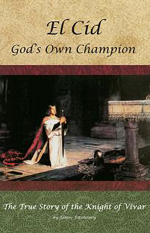
El Cid: God's Own Champion

I'm embarrassed to admit that I have almost no knowledge of Rodrigo Diaz of Vivar, known to history as El Cid, the national hero of Spain. In this, sadly, I suspect I'm not alone among Americans. Thus, I was happy to receive El Cid, God's Own Champion: The True Story of the Knight of Vivar, a new book by James Fitzhenry.

The book is a historical narrative, meant specifically for older kids, perhaps ages 12 and up. It is well written and Fitzhenry's prose has an easy grace that flows well and keeps the reader's attention. Based mainly on Ramon Menendez Pidal's work, The Cid and His Spain, the text chronicles the amazing life of El Cid and gives a glimpse into a time when the threat of radical Islam was even more immediate and dangerous than it is today. The Iberian peninsula in the 11th century was rent with conflicts between the various petty Christian and Islamic principalities, and it was not uncommon for Christian nobles to ally with Islamic ones against other Christians--and vice-versa. Into this confusing morass enters El Cid, an unconquerable hero who accomplishes what seems impossible with the barest handful of men. In this he reminded me of the late Roman hero, Belisarius who found phenomenal military success against similarly daunting odds.

But El Cid's successes provoked the jealousy of his rivals who had the ear of King Alfonso of Castile. Time and again, Alfonso punished and exiled his greatest champion, but through all the injustice, El Cid remained unwaveringly loyal, ever seeking to win back the good graces of his sovereign. In this, too, El Cid's story echoes that of Belisarius who was also unjustly slandered by jealous rivals and who suffered, as a result, the suspicion and punishments of his master, the Emperor Justinian. Of course, the difference is that while Hollywood has made an epic version of the life of El Cid, it has not yet done so for Belisarius. Perhaps this is for the best, however, given what Hollyweird has become these days.

Fitzhenry also portrays El Cid as a paragon of Christian manhood. He is honest to a fault, pious, and humble before his king. He also shows mercy to his enemies and repeatedly tries to win the allegiance of the faithless Muslims of Valencia who repay his friendly overtures and honest justice with sedition and rebellion.

Overall, I enjoyed El Cid, God's Own Champion very much. Because it serves as both a history lesson and an inspiring tale of Catholic manhood, it is an ideal book for parents to read with their kids.

Five stars for this one.

An American Story--My Grandfather's Son by Justice Clarence Thomas


Clarence Thomas is someone that I have admired since I first became aware of him in the early 1990s. As soon as this autobiography appeared, I knew I had to read it. Now that I have done so, I think it needs to be read by anyone and everyone. It offers an inspirational road map to achievement, and devastates the notion that Blacks may advance only with a hand-up from the Democrat party or a hand-out from the government.

As should be obvious from the title, My Grandfather's Son is a paean to Thomas's grandfather, Myers Anderson. "Daddy" as Thomas called him, was one of those honest, religious, tough as boot-leather men who used to proliferate in America. He taught Thomas the value of work--hard work--faith, an education, honesty, and self-respect. In the past, such men helped shape and mold future Supreme Court justices. In our degenerate, emasculated culture today, they'd probably be hauled before child protective services.

Thomas includes some memorable chestnuts from his grandfather in the book, among them:
"Old Man Can't is dead—I helped bury him."
and
"Hard times makes a monkey eat cayenne pepper."
Thomas's view of the Catholic Church and the status of his first marriage is somewhat problematic. His grandfather was a devout Catholic, and Thomas himself attended Catholic school in his youth. His own personal devotion was such that he entered the seminary with his grandfather's blessing. Unfortunately, the racial problems of the 1960s created conflicts between him and his fellow seminarians and left Thomas disillusioned. He eventually left the seminary, wrongly ascribing the racist attitudes of some of his fellow seminarians to the Church as a whole.

The rest of his early life was one of moral confusion. He dissolved his first marriage for reasons that remain vague but seem best explained by immaturity and an inability to sacrifice his own needs for the sake of his wife and young son. He was also a heavy drinker. To his credit, Thomas overcame his alcohol problem and obviously feels considerable guilt about his treatment of his first wife to this day.

The story of how he battled back from the angst, frustration, and moral failings of his early years dominates the middle of the book. Thomas chronicles his intellectual development--his transition from an angry Black radical to a conservative. He came to believe that government intervention is ineffective in helping Blacks and that in the case of issues like forced busing, it had done more harm than good. The result of this intellectual shift is that he was effectively ostracized by other Blacks in his circles for whom the doctrine of the political left was not to be questioned.

Thomas's description of his bruising battle for a seat on the Supreme Court is perhaps the most riveting part of the book. Thomas is effusive in his praise of those who provided moral, political, and spiritual support for him during this protracted fight, John Danforth in particular. He also pulls no punches when it comes to identifying the frauds and slanderers who attempted to destroy him. Joe Biden, Howard Metzenbaum, and (not surprisingly) Anita Hill end up appearing positively villainous along with the entire spectrum of pressure groups on the political left.

By the end of My Grandfather's Son, it becomes very obvious that the political left did far more to destroy this talented Black man than the KKK ever could have. It leaves one wondering how many others the left has beaten down and demoralized to the point that they just surrendered. As Thomas's mother, Leola, is quoted as saying in the aftermath of the Supreme Court confirmation hearings:
"I ain't never votin' fo' another Democrat as long as I can draw breath. I'd vote for a dog first."
If more Blacks came to that realization, it would be to the benefit of the entire country.

Reading this book will also be a stark reminder of the intellectual bankruptcy of the women's movement in the United States. The same radical feminists who attempted to destroy Clarence Thomas using trumped up charges of sexual harassment were nowhere to be found when, a mere six years later, a Democrat president was demonstrated to be guilty of exactly the same kind of tawdry, disgraceful behavior. Wait, I take that back. They were to be found--supporting and exonerating the harasser and excoriating the whistle-blower.

In short, this book is fascinating, moving, well-written, and highly recommended for anyone who wants to understand who Clarence Thomas is and where he came from.

Monday, January 07, 2008

More reasons to run from Flip Romney if you're a Republican

Hat tip to Diogenes on Free Republic for these quotes from Boston newspapers about Flip Romney:
"During the four years of Romney’s tenure, the number of registered Republicans in Massachusetts fell by 31,000. During that same period, the Massachusetts Democratic Party gained 30,000." (Boston Globe 11/2/2006)
“The Massachusetts Republican Party died last Tuesday. The cause of death: failed leadership. The party is survived by a few leftover legislators and a handful of county officials and grassroots activists who have been ignored for years. Services will be public and a mass exodus of taxpayers will follow. In lieu of flowers, send messages to New Hampshire Republican voters warning them about a certain presidential candidate named Romney.” (Boston Herald, 11/12/2006)
“Romney arrived on the scene with great promise, but is leaving the Republican Party here in shambles. Not only are the Republicans yielding the governor’s office for the first time in 16 years, but registered Republicans have fallen by 31,000 since Romney took office, and their legislative presence is at historic lows. But it worked out fine for him: He is now chasing the prize he really covets, the presidency.” (Boston Globe 11/8/2006)
Hey Republicans--if you want the national GOP to resemble the Massachusetts GOP--a pale, impotent reflection of the Democrats--vote for Flip.

Friday, December 28, 2007

Still scratching my head over Justinian's Flea


Justinian's Flea by William Rosen is the latest attempt at a popularization of the Justinianic period--what many consider the last gasp of the Roman Empire and the inception of the Byzantine Empire. The book is centered around the great plague that began in AD 542--the first recorded outbreak of Bubonic Plague, or the Black Death--and uses the devastation caused by this pathogen as an explanation for the collapse of both the Romans and Persians, and the rise of Islam. The book is a decent effort, but ultimately it falls flat.

To Rosen's credit, his writing flows well and his prose is generally crisp and readable. His discussion of the plague bacterium and the physiological impacts of the disease were useful for the reader with little background in medicine or microbiology. The book is reasonably well referenced but idiosyncratic in that the author goes on some fairly extended tangents that have little or nothing to do with the central premise of the book--like an entire chapter on the building of Hagia Sophia, or the discussion of Intelligent Design versus Darwinian Evolution.

That said, my primary problem with the book is that the author frequently trades style for accuracy, presenting events that are very much matters of scholarly debate as if they are closed cases. For example, he presents the accusation that Pope Silverius conspired to betray Rome to the Goths as fact, when much of the primary source evidence indicates that the Empress Theodora wanted Silverius removed. The charge of conspiracy was likely trumped up as an expedient.

The author also explicitly lays the destruction of the Library at Alexandria at the feet of Christians, going so far as to declare that the counter-claims that Julius Caesar and/or Islamic invaders burned it are not only false, but libelous. The astute reader will notice that Rosen doesn't bother to footnote this claim--because it is not supportable. In fact, the Library was probably burnt several times, and the claim that it was destroyed by Christians is probably the least credible, though most well-known thanks to popularity of atheist/deist Edward Gibbon's Decline and Fall of the Roman Empire. For a better discussion of this issue, see this article from the Ohio State University's eHistory site.

Rosen has that annoying tendency so common these days, to go out of his way to condemn the Crusades and the Inquisition, even going so far as to put them on the same level as the Holocaust and the gulags. He says:
"While imperial Rome—autocratic, militaristic, arrogant Rome—is scarcely the Kingdom of Heaven, given the horrors of the blut-und-boden states that replaced it—Crusades, Inquisition, Holocaust, gulag—one might, perhaps, be forgiven some wistfulness at its passing."
I would remind Mr. Rosen that almost all of the Eastern Roman Empire was replaced by states ruled by an ideology that believed in torture, slavery, and "religious cleansing" on a scale that would have appalled the average Crusader, made Torquemada look like a piker, and served as inspiration for modern butchers like Hitler and Stalin. While I don't expect Mr. Rosen to chronicle Islamic atrocities in a book on the Justinianic era, it would be nice if he at least refrained from taking out-of-context cheap-shots at later Christian history as well.

Finally, a couple dumb chronological errors crept into the text, for instance, Augustus Caesar did not found the Roman Empire in AD 74 (p. 4)--he was about 70 years dead by then. And a single Roman Empire ruled by a single emperor existed as late as AD 395--a little over 100 years before the rise of Justinian, not 200 years (p. 36). But stuff like this can be safely blamed on whoever edited the book, not the author.

Over all, Justinian's Flea is a quick read for someone interested in the period. Ultimately, though, it is just biased and inaccurate enough to be unsatisfying. If you are truly interested in the fascinating history of the late Roman world, I would recommend going straight to the source. Try History of the Wars by Procopius. It's a truly engrossing read, containing tons of information about the Justinianic plague, and there are several inexpensive editions of the work on the market today. Also worthy of note is the Ecclesiastical History of Evagrius which is cited several times by Rosen in Justinian's Flea. Evagrius records a great deal about the plague, having lost many of his immediate family to its ravages, and survived it himself.

Friday, December 21, 2007

Flip Romney versus Duncan Hunter

Hat-tip to RedStater for this one.

Let's play compare and contrast, shall we? In a recent debate, both Duncan Hunter and Mitt Romney were asked about the military's "Don't Ask, Don't Tell" policy for keeping the military free of open displays of homosexual behavior.

Here's the question as posed by Ret. Brig. Gen. (or Col., his status is unclear) Keith Kerr, an open supporter of Hillary Clinton and obvious "plant":
Kerr: I want to know why you think that American men and women in uniform are not professional enough to serve with gays and lesbians.
I give you Duncan Hunter's excellent response:
Hunter: General, thanks for your service, but I believe in what Colin Powell said when he said that having openly homosexual people serving in the ranks would be bad for unit cohesion.

The reason for that, even though people point to the Israelis and point to the Brits and point to other people as having homosexuals serve, is that most Americans, most kids who leave that breakfast table and go out and serve in the military and make that corporate decision with their family, most of them are conservatives.

They have conservative values, and they have Judeo-Christian values. To force those people to work in a small tight unit with somebody who is openly homosexual goes against what they believe to be their principles, and it is their principles, is I think a disservice to them. I agree with Colin Powell that it would be bad for unit cohesion.
Now let's compare that with Flip Romney's response to a similar question posed by the moderator of the debate, Anderson Cooper:
Cooper: Governor Romney, you said in 1994 that you looked forward to the day when gays and lesbians could serve, and I quote, "openly and honestly in our nation's military." Do you stand by that?

Romney: This isn't that time. This is not that time. We're in the middle of a war. The people who have...

Cooper: Do you look forward to that time, though, one day?

Romney: I'm going to listen to the people who run the military to see what the circumstances are like. And my view is that, at this stage, this is not the time for us to make that kind of...

Cooper: Is that a change in your position...

Romney: Yes, I didn't think it would work. I didn't think "don't ask/don't tell" would work. That was my -- I didn't think that would work. I thought that was a policy, when I heard about it, I laughed. I said that doesn't make any sense to me.

And you know what? It's been there now for, what, 15 years? It seems to have worked.

Cooper: So, just so I'm clear, at this point, do you still look forward to a day when gays can serve openly in the military or no longer?

Romney: I look forward to hearing from the military exactly what they believe is the right way to have the right kind of cohesion and support in our troops and I listen to what they have to say.
Which guy would YOU want as your Commander-in- Chief?

Flip Romney's Fairy Tale

No one who claims to be pro-life should be supporting "Flip" Romney. While I lived in Boston in the 1990s, I watched him try to out-liberal Ted Kennedy when running for Senate in Massachusetts. Now, he claims to be a staunch conservative. I don't believe that his "conversion" is sincere, even for a second.

American Right to Life Action is running the following commercial in Iowa. I hope it gives the voters there a serious heads-up about this snake oil salesman.

Enjoy!

Monday, December 03, 2007

Extraordinary, Right?

The new Extraordinary rite at a local parish was featured on a local news broadcast. And very positively, I might add.

Here's the link: Local Pastor Adds Latin Mass to Schedule

Here's a transcript [errors mine]:

Reporter: Well today at noon St. Peter Celestine Catholic Church [sic--it's actually St. Peter in Merchantville, not Peter Celestine. That's another parish nearby.] in Merchantville, New Jersey takes a bold step. The pastor is putting a traditional Latin Mass on the church's Sunday schedule. As CBS 3's Pat Ciarrocchi reports, this comes at the encouragement of the Pope, who hopes that tradition will ignite the fires of faith.

[Bells]

Ciarrocchi: At St. Peter's, the bells will sound the same, but at the noon Mass on Sundays now, the prayers of the priest will be in Latin.

Fr. Manuppella: They've heard the Sanctus, the Holy, Holy. They've heard the Agnus Dei, Lamb of God. So there should be no problem with them understanding what is being said because we've been saying it for the last 40 years in English.

[Singing]

Ciarrocchi: Nearly two generations of US Catholics have been worshiping in English, ever since Vatican II reformed liturgical practices. But once Pope Benedict lifted restrictions on using the Latin liturgy, Fr. Anthony Mannupella’s Merchantville congregants wanted to know more. So he created a 12-week course. The response shocked him.

Fr. Mannupella: In offering the course, I prepared myself for about 50 people. But people kept coming, and coming, and coming and I had approximately 300 people.

Ciarrocchi: Significant considering Church studies reveal that only 40% of Catholics attend church weekly.

Parishioner: I think it’s something new for the younger people and I think it will be really inspiring for them.

Ciarrocchi: And very different. For starters, the priest and the congregation will face the same direction. And on the prayer cards…

Fr. Mannupella: It’s all in Latin, there’s not a word in the vernacular. In Latin it would be [singing] Dominus vobiscum—the Lord be with you. [singing] Et cum spiritu tuo. And with your spirit. And then the priest says [singing] Oremus.

Ciarrocchi: Let us pray.

Fr. Mannupella: Let us pray.

Ciarrocchi: One of the other requirements of the Latin Mass is that only altar boys can assist the priest. And then at communion, congregants will once again approach the altar, but this time, they’ll kneel again at the altar rail to receive the Host. And instead of placing communion in the hand, the priest will place it on the tongue.

Fr. Mannupella: They kind of like the idea of that more mystical experience. Ah, more of a transcendent experience.

Ciarrocchi: With the hope being a renewal of the faith that could renew the Catholic Church.

Forget "Godless Compost" -- go see Bella instead

Here's all you need to know about Philip Pullman, the author who is responsible for the book The Golden Compass, upon which the movie of the same name is based:
"I've been surprised by how little criticism I've got. Harry Potter's been taking all the flak. I'm a great fan of J.K. Rowling, but the people - mainly from America's Bible Belt - who complain that Harry Potter promotes Satanism or witchcraft obviously haven't got enough in their lives. Meanwhile, I've been flying under the radar, saying things that are far more subversive than anything poor old Harry has said. My books are about killing God." (source)
Mr. Pullman was also quoted as saying:
"What I'm doing is utterly different [from Tolkien]," he says. "Tolkien would have deplored it." So, too, would have another famous Oxford fantasy writer, C.S. Lewis, a devout Christian whose children's series "The Chronicles of Narnia" exemplified his religious convictions. "I'm trying to undermine the basis of Christian belief," says Pullman. "Mr. Lewis would think I was doing the Devil's work." (source)
Is it coincidence that Hollyweird is putting out this piece of anti-Christian drivel during the run up to Christmas? Of course not. My advice is not simply to ignore this bloated atheist brainwash fest dressed up with loads of fancy CGI. Take the money that you would have spent on "Godless Compost" and go see Bella instead.

The defeat of the Culture of Death involves more than mere boycotts of what is evil. It requires the full support and endorsement of what is good.

Media purposely obtuse on priestesses

The Fox News affiliate in St. Louis, MO ran an article on Saturday about two so-called "Catholic" priestesses who performed a service of some kind in St. Louis. Here are the relevant sentences:
Two Roman Catholic female priests who were recently ordained co-pastored their first mass Saturday night in the central west end. Rose Marie Hudson and Elsie McGrath led the service at the first Unitarian church of St. Louis.
Now, let's play a game--spot all the gross errors contained in these two sentences.

Here are a few to get you started:

1. There can be no priestesses in the Catholic Church.

2. Whatever it was that they celebrated, it wasn't Mass.

3. Actual Catholic priests don't generally say Mass in a Unitarian Church.

4. Mass isn't generally "co-pastored".

There's more, but I chose not to note this when writing to Fox. Such articles deserve only ridicule. Here's my note:

Dear Fox,

Thanks for running your article on the so-called Catholic priestesses. I wanted you to know that I've recently been elected Pope under the regnal title "Pope Ace Ventura XIV" and I would invite you to attend my installation at the "Bro's Step In Lounge" at the corner of 24th and Main.

Hey, why not? My election as pope has exactly as much validity as the so-called ordination of these priestesses. It would be grossly unfair of you to cover their fantasy antics while ignoring mine.

Sincerely,

Pope Ace XIV
I encourage you to educate our friends at Fox as well: Contact Fox St. Louis.

Friday, November 30, 2007

Duncan Hunter at the YouTube/CNN debate

Even though he only got about a quarter of the time Abortiani and RomneyCare got to speak, Duncan Hunter was extremely impressive. He even handled the loaded question posed by Hillary Clinton's plant--the lavender general--with aplomb and resolution. His answer was perfect. This guy's never been to Mitt Romney's Waffle House.

And Hunter's response the next day to Hillary? "Send more!"

Check it out:

Wednesday, November 28, 2007

God King -- Excellent historical fiction for young folks

God King is a very enjoyable and readable historical fiction account of the early reign of Taharka, Pharaoh of Egypt, whose dynasty originated in the kingdom of Kush in present-day Sudan. Young Tarharka is one of the many sons of Shabaka, God King of Egypt. He is neither the eldest nor the most accomplished, but the succession falls to him nonetheless. However, there are schemers in Egypt keen to take advantage of a young king's inexperience. Worse, the mighty Assyrian Sennacherib is gathering his power to the north. Only the Hebrew king Hezekiah holds out against the Assyrians.

In Taharka, the unwilling Pharaoh, Joanne Williamson has created a very sympathetic character. He is naive and trusting at first, yet learns to be strong, resourceful, and merciful. The melding of the scant historical record of the time with the Biblical account of King Hezekiah is skillfully done and the reader truly does get a feel for the time and place.

Overall, this book is a good read for young folks (say, 10 and up) and adults as well. I particularly liked the fact that the book was set in a historical period that is not well studied by your typical 12 year old. Hopefully, it will spur some interest in ancient history among the young. The book is also notable because though Taharka is Black, race never becomes an issue as it often so tediously does in more contemporary fiction for young people. For this reason, I almost hesitate to bring up the subject at all. Let it suffice to say that if more fiction were written from this perspective--where a Black main character is portrayed positively and the other characters are good or evil not based on their race but on their actions--race relations in the real world might actually improve.

Saturday, November 10, 2007

Duncan Hunter -- The man who should be our next president

Here's the first part of an extended interview with Republican presidential candidate, Duncan Hunter. The guy's impressive, I'll say that for him. Serious, solid, smart, sincere.


The rest of the interview is posted on there as well.

Friday, November 09, 2007

Our fabulous lavender Jesuits...

Gone are the days when Jesuit priests were virtuous men who fully embraced the Catholic Faith and prayed to be worthy of a martyr's crown. Let's play "compare and contrast", shall we? First, here's a tale from the 1640s in the upstate New York wilderness:
He [Fr. Isaac Jogues] did not yet know the cause of his companion's [Rene Goupil] death; but the old man who had caused him to be slain having invited him, some days later, to his cabin, and giving him food, when the Father came to offer the blessing and express the sign of the Cross, that Barbarian said to him: "Do not do that; the Dutch tell us that that act is of no account. Know that I have had thy companion killed for having made it upon my grandson; the like shall be done to thee, if thou continue."

The Father answered him that this sign was adorable; that it could not do anything but good to those who should use it; that he had no intention of giving it up. That man dissimulated, for the time, and the Father employed no reserve in this devotion,—asking nothing better than to die for having expressed the mark and sign of the Christian. [Taken from The Jesuit Relations]
Now fast forward about 360 years to the cozy confines of a formerly Catholic American university located about 300 miles from the spot where Fr. Jogues was brutally martyred for his devotion to the Catholic Faith:
Before a packed church of some 400 on the campus of the famed St. Joseph's University, Father Thomas J. Brennan announced that he is homosexual. During the Mass he spoke of his homosexuality as one of "the worst kept secrets" on campus....Fr. Brennan, S.J., is an Assistant Professor of English at the University, who on his website lists "lesbian and gay studies" under "general fields of professional interest". The announcement came at the 10pm Mass to a congregation of mostly students and a smattering of alumni. [Source: Lifesite]
And now a brief historical note on how such an announcement might have been greeted in the past:
In that year [A.D. 528] some of the bishops from various provinces were accused of living immorally in matters of the flesh and of homosexual practices. Amongst them was Isaiah, bishop of Rhodes, an ex-praefectus vigilum at Constantinople, and likewise the bishop from Diospolis in Thrace, named Alexander. In accordance with a sacred ordinance they were brought to Constantinople and were examined and condemned by Victor, the city prefect, who punished them: he tortured Isaiah severely and exiled him and he amputated Alexander's genitals and paraded him around on a litter. The emperor [Justinian] immediately decreed that those detected in pederasty should have their genitals amputated. At that time, many homosexuals were arrested and died after having their genitals amputated. From then on there was fear amongst those afflicted with homosexual lust. [Source: Jeffreys, Elizabeth, Michael Jeffreys, and Roger Scott, trans. (1986) The Chronicle of John Malalas: A Translation. Australian Association for Byzantine Studies: Melbourne, p. 253.
Now, I'm not saying that we should bring back the punishment of castration for priests who have a homosexual compulsion. But for Christ's sake (and I mean that quite literally), can not such men who proudly broadcast that compulsion and scandalize the faithful be removed from public ministry? Or at the very least, be removed from contact with young people?

Or have the last 40 years of outrage, abuse, and lawsuits taught us absolutely nothing?

Cardinal Rigali, call your office.

Thursday, October 25, 2007

J. K. Rowling -- Deathly Hollow

CAVEAT: Of necessity, the following post contains content that discusses disordered human actions that most people find filthy and revolting. However, this issue must be confronted lest the error be spread even farther afield. If this topic disgusts you to the point where you feel the need to berate me for even bringing it up, please stop reading now.

In an article in the Toronto Globe and Mail we read the following about J.K. Rowling:
However, during the 15-minute media conference that preceded the public appearance, the author grew testy as reporters circled back to Dumbledore and Grindelwald. "It's very clear" in Harry Potter and the Deathly Hallows how intense Dumbledore's feelings for the dark wizard are, she said, feelings that astute adult readers will recognize while children will simply construe as manifestations of friendship. The power of love is one of the major themes in the Potter oeuvre, she noted, and "certainly it's never been news to me that a brave and brilliant man [like Dumbledore] would never love other men.

"He's my character," she asserted. "I have the right to know what I know about him and say what I say about him."

Fair enough. But I have the right to say that I don't want your propaganda anywhere near my children.

I consider myself a fairly astute reader but I didn't pick up on any "butt lust connection" between Dumbledore and the Dark Wizard, Grindelwald. I assumed that Rowling was somehow connecting the wizarding world to World War II, considering one was English, the other German, and they had their climactic fight in 1945. This scenario also fit in neatly with the message of "tolerance" which becomes increasingly overt and preachy as the series goes on. Grindelwald (the Nazi) is all about "pure blood" and not mixing with the mudblooded muggles. Meanwhile, Dumbledore (the noble Englishman) is attracted to the dark side but turns away. However, given Rowling's statement above, I guess I wasn't astute enough in my reading here given that I'm generally not prone to assume that two male characters who are friends are actually doing more with their wands than just casting spells. But hey, maybe I'm just old fashioned.

And now, predictably "experts" are urging parents to use Rowling's admission as a "teachable moment." God only knows what such "experts" are really expert at--perhaps hand signals under the stalls in men's rooms.

Personally, I'm glad that Rowling decided to spout off her assinine opinions on disordered types of sexuality before I finished my reviews on the Harry Potter series. To this point, I have been impressed with her skills as a writer but repeatedly perplexed by her confused sense of morality. Well, the perplexity has vanished. The confused sense of morality in the Potter books remains unresolved to the very end because it springs directly from the author herself.

Before the whole "Dumbledore's a homo" flap developed, Rowling was merrily going around telling everyone about the "Christian themes" in the books. And from reading Deathly Hallows in particular, you wouldn't have to be particularly "astute" to pick them up. Let's see, the chapter near the end of the book where Harry 'dies' is called "King's Cross". When Voldemort thinks he's killed Harry, he sends Narcissa Malfoy to check the body, at which point Rowling writes: "He [Harry] felt the hand on his chest contract; her nails pierced him."

There are other hints as well but they are not particularly well thought out and in the end do not reveal any unmistakably Christian message, unlike The Chronicles of Narnia or The Lord of the Rings. Rowling's message seems to be amor vincit omnia which is nice, but it's not anything that a pagan like Virgil wouldn't also agree to. And given Rowling's somewhat loose understanding of what constitutes "love", perhaps the message means even less than what it did for your average virtuous pagan.

As for "tolerance", Rowling, the good, worldly, cowardly Christian that she is, clearly worships at the altar of weakness--unable to take a strong stand or speak the truth to power. And like most of her graying intellectual brethren, Rowling's "tolerance" includes tolerating intolerable things that have been expressly condemned and forbidden since the earliest Christian times and before. Rowling's version of tolerant-über-alles Christianity is that hollow faith offered by the Rembert Weakland/Shelby Spong/Ted Haggard brand of false Christianity. It reminds me of the donkey dressed in a lion's mane at the end of the Chronicles of Narina. Its fruits to date have been scandal, outrage, division, abuse, disease, sterility, and ultimately, empty churches and lost souls.

Perhaps all this is not so surprising because Rowling, it seems, is also supremely confused about her own personal belief system:
"The truth is that, like Graham Greene, my faith is sometimes that my faith will return. It's something I struggle with a lot," Rowling admitted. "On any given moment if you asked me [if] I believe in life after death, I think if you polled me regularly through the week, I think I would come down on the side of yes — that I do believe in life after death. [But] it's something that I wrestle with a lot. It preoccupies me a lot, and I think that's very obvious within the books.”

Obvious within the books. Yeah. Moral confusion. Theological confusion. Personal spiritual confusion. Very obvious.

Rowling has also said in response to some of her Christian critics: "I don't take any responsibility for the lunatic fringes of my own religion.” Sounds pretty intolerant to me, but setting that aside, I'm guessing by that she'd put in the "lunatic fringe" the guy who said:

Be ye therefore followers of God, as most dear children; And walk in love, as Christ also hath loved us, and hath delivered himself for us, an oblation and a sacrifice to God for an odour of sweetness. But fornication, and all uncleanness, or covetousness, let it not so much as be named among you, as becometh saints: Or obscenity, or foolish talking, or scurrility, which is to no purpose; but rather giving of thanks. For know you this and understand, that no fornicator, or unclean, or covetous person (which is a serving of idols), hath inheritance in the kingdom of Christ and of God.

That of course, would be St. Paul (Ephesians, 5:1-5) who also said directly following the above:

Let no man [or woman in this case] deceive you with vain words. For because of these things cometh the anger of God upon the children of unbelief. Be ye not therefore partakers with them. For you were heretofore darkness, but now light in the Lord. Walk then as children of the light. For the fruit of the light is in all goodness, and justice, and truth; Proving what is well pleasing to God: And have no fellowship with the unfruitful works of darkness, but rather reprove them. For the things that are done by them in secret, it is a shame even to speak of. But all things that are reproved, are made manifest by the light; for all that is made manifest is light. [Words in brackets mine]

So that's it. I won't bother reviewing books 6 and 7 in detail because the author has settled the matter for me. According to Rowling, I am a "lunatic fringe" Christian. If I'm going to be accused of being such, then I might as well play the role--I don't want my kids reading anything that would allow her type of lukewarm gobbledeegook but ever-so-mainstream christianity into our home. Thankfully, I didn't buy a single one of the Potter books and my children are still too young to care. The books will now go back where they came from and I'll make sure to fill their places with better literature for kids which exists in abundance if parents will only take a minute and look around for it.

Henceforth, this blog will be dedicated, at least in part, to reviewing such worthy books.

Vote NO on Embryonic Stem Cell Research in NJ

On November 6, 2007, the taxpayers of New Jersey will again be asked to pony up--this time $450 million to fund every anti-lifers' favorite white elephant, Embryonic Stem Cell research. Embryonic Stem Cell research involves the willful creation and destruction of viable human embryos for therapeutic techniques that, to date, have resulted in NO cures.

And of course, the NJ bill does not fund Adult or Cord Stem Cell research, a much more promising and less ethically troubling experimental treatment modality which to date has yielded 73 successful therapeutic uses.

Here in NJ, we're working to get the word out on the grass-roots level. Here's a link to a flyer that lays the issue out simply:

Vote NO on Embryonic Stem Cell research in NJ

I encourage NJ residents to print off copies of this flyer to distribute around the state.

Even if you're not from NJ, please forward this link to family and friends living here.

Wednesday, October 24, 2007

Duncan Hunter and Homeschooling

I'm a big fan of Duncan Hunter for president in 2008. I think he's just the kind of solid, honest, no-nonsense, clear-eyed conservative who would make a fantastic president. He's strong on life, the family, trade, the borders, and taxes and has loads of experience in defense matters, having been chair of the House Armed Services committee. He served with distinction in Vietnam and is also one of the few folks in Congress who put their money where their mouth is in terms of the war against radical Islam--his son, Duncan Jr., has served a couple tours in Iraq.

I just saw this article from SK Johnson who makes a good case for homeschoolers to choose Hunter over Mike Huckabee:

‘A Homeschooler Against Huckabee’

I also agree with SK Johnson in that I'd gladly support Huckabee as well over the other three media-selected so-called front-runners. But Hunter is my guy. I pray he finds a way to win.

Sunday, October 07, 2007

Harry Potter and the Order of the Phoenix -- A critique of the feckless West?

There’s a war brewing. A deadly enemy from the past is back and doing what he does best—consolidating power, gaining new allies and intimidating old ones into renewing their allegiance. As the enemy’s power grows, he’s content to nibble around the edges and not go toe-to-toe with his most formidable foes.

But those who should be in the forefront of opposing the enemy’s murderous plans are failing to act. A government agency entrusted with thwarting the enemy suffers from bureaucratic mismanagement at the highest levels and is more concerned with maintaining high public opinion than in doing its hard duties. Instead of sounding the alarm, the bureaucrats simply refuse to admit the danger exists at all. Worse, rather than admit their failure to deal with the enemy while he was still weak, the government ministers instead use the media to defame and destroy any who attempt to alert the public to the threat and rally the defense.

Sound familiar? Well, it did to me. And I reckon it might sound even more familiar to citizens of some European countries. Perhaps I’m reading too much into this, but Harry Potter and the Order of the Phoenix felt to me like an allegory of the war against radical Islam. At it’s core, the moral of the story seems to be, “If good simply refuses to fight, don’t count on evil to return the favor.” Or perhaps, “Refusing to fight against a known evil makes you almost as bad as the evil itself.”

As a literary work, Order of the Phoenix is a mixed bag. As before, Rowling’s characters are generally very engaging and true-to-life. Ron and Hermione’s development goes on unabated and it becomes clear that a relationship is in the offing. Also provided is more of the backstory for Neville Longbottom who becomes less of a goof and more sympathetic. Also, the highly amusing character of Luna Lovegood is introduced, as is the horrid Dolores Umbridge who is so odious, so obnoxious, so completely awful, that the reader simply can’t wait until she gets her just deserts. Having run into Umbridge-like people at a variety of government agencies and in academia, I can certainly appreciate Rowling’s perspective. What annoyed me about Rowling’s take here was giving Umbridge the title of “Hogwarts High Inquisitor.” That old British canard about the unprecedented horrors of the Spanish Inquisition dies hard, even in the face of research showing that the Inquisitional courts were no worse—and were often a good more lenient—than European temporal courts of the time, including those in Britain.

Unfortunately, Rowling also goes off the rails a bit with Harry. Leaving aside the awkward and obviously ephemeral flirtation between Harry and Cho, Rowling seemed at pains to make Harry behave more like a stereotypical teenager. She does this by putting nasty expressions in his mouth and having him snap rudely and not infrequently at his bosom friends and even his mentor, Dumbledore. If this was an attempt to add a depth and complexity to Harry’s character, it failed in my opinion. Rowling went to such lengths in the previous books to make Harry into a good, noble, and brave character, that I found his sudden unfounded rottenness to be just strange.

Also annoying to me was Harry’s attempted use of an “unforgivable” curse at the climax of the book. If these were supposed to be the calling cards of the Death Eaters, and in any sense truly “unforgivable”, then what is the hero of the story doing using them? With the arsenal of “forgivable” curses at Harry’s disposal, one wonders what would motivate him to attempt to use one of the bad ones. It also ash-cans my theory that only the evil characters use the “unforgivable” curses as part and parcel of what makes them evil. So Fr. Amorth's criticism of the series as drawing an artificial distinction between “light” and “dark” magic appears to have enhanced standing if even the good characters in the story use evil magic without a trace of remorse or punishment for doing so.

Beyond this, I found nothing particularly Christian about Order of the Phoenix, nor anything especially occult-related—at least nothing that wasn’t readily found in the prior books. The underlying symbolism seemed to be almost exclusively political in nature.

On to Book VI.

Sunday, September 09, 2007

Harry Potter and the Goblet of Fire -- When you have to shoot, shoot.

It took four books, but Voldemort, the most powerful of the dark wizards, is back. And his minions, the Death Eaters, couldn't be happier. Harry Potter and the Goblet of Fire tells the tale of how it happened--in about 750 pages. As with the previous novels in the series, the prose is generally crisp, the dialog is occasionally goofy, and the characters are wonderfully well drawn. Though quite a long book, the plot is tight, amusing and keeps you guessing. My only major criticism of the book as literary work regards the ending. As heroes go, Harry's main virtue in these final confrontations always seems to be dumb luck. Voldemort is a bit of a bungling super-villain for whom there's always an element of, "Oops, forgot about that." And not once but twice there were "Tuco" moments where the villain insists on lecturing the hero before doing away with him. "When you have to shoot, shoot. Don't talk." While I suppose these types of scenes aren't quite as trite for young readers who haven't seen them done over and over in dozens of books, TV shows, and movies, for me they were something of a let-down.

On the plus side, this was the first book in the series so far that made me laugh out loud a few times. Something about Hermione's idealistic but naive obsession with her Society for the Promotion of Elvish Welfare struck me as highly amusing. I suppose it was Ron's insistence on calling the organization "spew" that did it.

This was also the darkest book in the series so far. In it we are finally given a more concrete idea of what constitutes "dark" magic. Dark wizards apparently use the three "unforgivable curses"--the imperius curse, which causes the victim to do the spell-caster's bidding, the cruciatus curse which causes the victim horrible pain, and Avada Kedavra, the killing curse. Now this last one looked so much like the "abracadabra", the all purpose Vaudeville magician word, that I went out and looked it up. It seems that J. K. Rowling herself said that it is an Aramaic spell meaning "let the thing be destroyed." Now why she chose to use Aramaic--the language of our Lord--for this worst of all spells, and not Latin like she did for all the rest is beyond me.

Of course, it should be mentioned that Rowling's distinction between good magic and "dark magic" has never been accepted by the Catholic Church as Fr. Amorth, the famous exorcist, has repeatedly pointed out. That said, to this point in the series, all of the "good magic" has been of the comic-book variety--turning people into ferrets or making someone's nose grow tentacles. The "dark magic" is used exclusively by characters who are unmistakably evil.

One interesting little tid-bit in Goblet of Fire that may be thrown into the Christian-vs.-occult-influence debate happens at the Yule Ball. Up to this point, Christmas and Easter at Hogwarts have been mentioned at least in passing in every book. However, while the British are ever so much less stupid about actually calling the holidays by their proper names (unlike some in the U.S. who insist on calling them "Winter/Spring Break" or attempt to replace them with made-up PC holidays from the 1960s), Christmas and Easter have nonetheless lost almost all religious meaning to most Britons. And thus it has been at Hogwarts--Christmas in the first three books has been all about feasting, decorating, and getting presents. But for a split second in Goblet of Fire, Rowling has suits of armor singing, "O Come All Ye Faithful" (page 395). Given all the secular "holiday" tunes she could have inserted there, that she chose an unmistakably Christian one could be telling. Admittedly, it could also be complete coincidence.

Finally, the aspect of Goblet of Fire that I most appreciated was the introduction of the slimy, ethics-free journalist, Rita Skeeter. This character was such an on-target parody of a gossip reporter that you just know that J. K. Rowling was taking some shots at the media. That Ms. Skeeter worked hand-in-glove with the "Ministry of Magic"--a government agency populated with petty bureaucrats and place-seeking brown-noses--made the parody that much more on-the-nose.

Over all, as a work of fantasy fiction that has been marketed with young readers in mind, I found Goblet of Fire to be quite a foreboding read. The scene at the end where Wormtail mixes a potion in a graveyard for which the vital ingredients are a bone from Voldemort's father, some of Harry's blood, and Wormtail's own hand--which he, himself, promptly slices off--was border-line demonic. And for a book with so much discussion of death, I found it more than a little disconcerting that it lacked any notion of Judeo-Christian eschatology. So again, I will refrain from endorsing this book or the series as a whole as in any way suitable for younger Catholic readers until I see where all this is going.

Friday, August 24, 2007

Harry Potter and the Prisoner of Azkaban - Sirius Improvement

After another miserable summer fraught with muggle-trouble, Harry heads back to Hogwarts for his third year. As usual, things start to go wrong even before he gets there. A cold-blooded murderer named Sirius Black has escaped from Azkaban, the prison for wayward wizards, and he's out to get Harry. Worse, the enforcers charged with recapturing Black--the joy-draining dementors--are almost more malevolent than he is. But Harry's got an ally in Professor Lupin, the chronically disheveled Defense Against the Dark Arts teacher, and with the help of his friends Ron and Hermione, a special mischief-maker's map, and a hippogriff named Buckbeak, Harry delves deeper into the mystery of his past and finds an unexpected new protector.

If Harry Potter and the Chamber of Secrets was formulaic and a rehash of Sorcerer's Stone with a few different critters and magical doo-hickeys, The Prisoner of Azkaban is, by contrast, a refreshing change of pace. The overall writing is better, the dialog is more believable and the characters less cardboard. The twisting plot also keeps you guessing which makes for an enjoyable read throughout. And it's a good thing, too. At over 430 pages and a solid two pounds in hardcover, Prisoner of Azkaban is quite the tome.

Rowling introduces the fascinating character of Sirius Black in Prisoner of Azkaban and he is the boogey-man throughout 90% of the book. The best friend of Harry's parents, Black was accused of betraying them to the wicked Voldemort. He was thrown into Azkaban for murdering 13 people, one of whom was Peter Pettigrew, a bungling wizard who chased Black down to avenge his betrayal of the Potters. That, at least, was the official story. The truth, of course, is considerably more complicated.

From my perspective, what is most intriguing about Black is that he is identified as Harry Potter's godfather. Now, some have used this to demonstrate that the Harry Potter books are indeed steeped in a Christian worldview. Why else would Harry have a godfather if he hadn't been baptized? Unfortunately, one doesn't have to do very much web searching to turn up evidence that wiccans do actually have godparents as part of their rituals. Here's an excerpt from a book that I found that clearly indicates the presence of godparents in wicca ritual. There is also the traditional linkage between witchcraft and the notion of the fairy godmother, though I haven't explored that relationship in any great detail. Given this, the argument that Harry is Christian because he has a godfather seems less credible. At the same time, it doesn't positively confirm any linkage between the books and wicca. The use of the term is simply ambiguous.

The major themes in this book are in general agreement with Christian ethic, even if it is not explicitly stated. Good and evil are clearly defined, though it's not always clear who is on which side. The Weasleys, with their large, rambunctious family, are given a central place and are presented very sympathetically. The notions of courage and self-sacrifice are explored in detail, particularly with regard to the love of a mother and father for their child. Harry also shows compassion and mercy, in very much the Christian sense. In one scene, he forbids the killing of Voldemort's creature when he is about to be done in by Harry's protectors.

There are also some hints in the book about an afterlife, though in a form more closely resembling the Star Wars universe than anything Christian. Toward the end of the book, Dumbledore says, "You think the dead we loved ever truly leave us? You think that we don't recall them more clearly than ever in times of great trouble? Your father is alive in you, Harry, and shows himself most plainly when you have need of him" (page 427-8). Kind of like Harry's own Obi-Wan Kenobi. But again, I hesitate to make a call on semi-new-agey stuff like this until I've got a better idea of where it's all going.

Over all, though I enjoyed the writing and the story in Prisoner of Azkaban, I remain conflicted about the series in general, and its suitability for young Catholic readers in particular. I reckon my opinion is going to come down to the wire at the end of Book VII. But I've got to get there first and these books don't seem to get any slimmer as the series progresses. On to Book IV!

Sunday, August 19, 2007

The Red Falcons of Tremoine -- An excellent story for younger readers

Poor Leo lived as an orphan in the care of St. Michael's Abbey. As far as he knew, he had no relations in this world and no family name. He was mocked by the other boys at St. Michael's for his apparently low birth, and his rebellious nature attracted the frequent reproofs of the his guardians, the monks. But the abbot held a secret that no one else knew--that 15-year-old Leo is the legitimate offspring of an ill-fated couple who married in secret because their families were feuding. As such, Leo is the heir of two baronies--Wardlock and Tremoine--both of which remain locked in a bitter grudge.

The Red Falcons of Tremoine is the story of how young Leo becomes aware of his parentage and his subsequent struggle as a bone of contention between his father's family at Wardlock and his mother's family at Tremoine. His humble and elderly grandfather, Maurice of Wardlock, embraces Leo and takes him in as his heir. But the scheming and violent Rolf of Tremoine wants his nephew for his own heir is is willing to go to any length to achieve that end.

The Red Falcons of Tremoine starts out slow, but the persevering reader is well rewarded. The characters are very well drawn, and the action is brisk and in no way predictible--until near the end. I particularly enjoyed the complex character of Rainald, the cold but loyal squire of Baron Rolf. Leo is also an excellent character--good hearted, spirited, and honest, but by no means perfect. Baron Rolf is an exceptional villain whose motivations and internal anguish are made clear. While he is somewhat sympathetic in his complexity, the author by no means excuses the wicked things he does and he comes off as more of a tragic figure, rather than truly evil.

I would heartily recommend this book to older kids above the age of 11 or so. Parents will likely enjoy reading along themselves. The author's historical knowledge is good and one really gets a feel for the life and times of 12th century England. If this kind of excellent historical fiction appeals to you, I would recommend Belisarius: The First Shall Be Last and Big John's Secret (Living History Library) as well.

Posting more reviews...

As long as I'm posting my Harry Potter reviews here, I figured I'd post my reviews of other young-adult fiction as well. Unless otherwise noted, none of these books pose any potential danger to the Catholic formation of young readers. Indeed, most of them are as educational as they are fun to read.

Enjoy!

Harry Potter and the Chamber of Secrets – More of the same

Having read Harry Potter and the Sorcerer’s Stone, I dove into Book 2, Harry Potter and the Chamber of Secrets anxious to see where J. K. Rowling was going to take the story. I also wanted to see if my criticisms of the first book would stand up or get flattened as the story progressed.

Well, as for the story line, it really wasn’t a whole lot different from the first book. A mystery is introduced: the Chamber of Secrets has been opened by the mysterious Heir of Slytherin and whatever was locked in the Chamber has been attacking, but not killing, certain students who are not of pure magical blood. Harry and his friends sleuth around to figure out the mystery, breaking a myriad of school rules in the process and nearly (of course) getting expelled. When Hermione is attacked, Hogwarts is on the point of shutting down for good. It’s up to Harry, Ron, and the famous but useless Professor Gilderoy Lockhart to discover where the Chamber of Secrets is located and defeat the evil that lurks within.

I have to say I enjoyed reading this installment in the series quite a bit less than the previous book. The character of the self-promoting Gilderoy Lockhart, while resonating with the publisher in me, was too overdone to be funny--like a Monty Python skit that is shown over and over again until all the humor is thoroughly beaten out of it. Also in this category was the scene with Ron vomiting up slugs. Several pages of such imagery is more than enough for even the most scatologically-inclined juvenile reader.

On the other hand, I did like the character of Ginny Weasley, Ron's younger sister. In fact, I think that a lot of homeschool families would find the Weasleys very sympathetic. They've got seven kids--six boys and a girl. They're poor, so they're forced to make due with hand-me-down robes and second-hand wands. And they're ridiculed by their social "betters" for their financial straits. That Ron and his brothers are quick to resort to fisticuffs rather than hear their family demeaned may also resonate with some.

One thing that particularly irritated me about The Chamber of Secrets was the introduction of some alternate history taken directly from wicca 101. "Hogwarts was founded over a thousand years ago by the four greatest witches and wizards of the time," the ghost of Professor Binns lectures. "They built this castle together, far from prying Muggle eyes, for it was an age when magic was feared by common people, and witches and wizards suffered much persecution" (pg. 150). I've heard similar nonsense bandied about by real, modern, historically-challenged wiccans, so when I saw this, I just shook my head. Not good. To my eye, this looked like a seed planted by Rowling and it seemed to substantiate Amy Welborn's observation:
"There's only one reason the Harry Potter books are in the least bit controversial. Just one. Wicca. That's it. If we didn't have this ridiculous little "religion" bustling around, forming "covens" in dorm rooms and getting army chaplains, I doubt one parent in a million would even think to waste even a minute being concerned about these books."
But it is a concern. For the record, there is an excellent article in the Catholic Encyclopedia that gives a capsule scholarly history of witchcraft from the Catholic perspective and it is very effective in debunking wicca and its ridiculous alternate history. I hope that the future books in the series do not contain other such seeds--I'll certainly be looking for them.

The Chamber of Secrets also elaborates upon the differences between the magically inclined and those poor benighted creatures known as Muggles--that is, anyone who is "normal" and non-magical. In Rowling's world, there are those among the magical who despise the "Mudbloods"--anyone who is magical but from a Muggle family--and those good magic-users who are tolerant of Muggles, no matter how awful and nasty they may be. There seems to be an obvious intent on Rowling's part to make this a lesson in tolerance somehow, but it seems peculiarly elitist to me. Even the magical beings who tolerate the Muggles still, for them most part, look down on them as curious and generally pathetic creatures in need of study. One could easily imagine a book of poetry in the Hogwart's library containing "The Magical Man's Burden." I'm curious to see where this tangent ends up in the future books.

The climax of the book was also subpar. The horrible creature in the Chamber of Secrets is fairly inept. It kills no one (and the reasons given for this are ludicrous) and is eventually destroyed almost by accident. Though Harry is the hero, he seems to survive his deadly encounters almost completely by luck and the intervention of an "eye-in-the-sky"--all of which makes you wonder why the "eye-in-the-sky" didn't just deal with the problem in the first place.

I've heard it said that Chamber of Secrets is the weakest of the Potter books. Having read only the previous one, I can't comment on that, yet. However, it was certainly weaker than Sorcerer's Stone. The book also did little to quell my criticisms of the original book. Indeed, it enhanced them and added a few new ones. We'll see where all this leads in book three.

Sunday, August 12, 2007

Harry Potter and the Sorcerer's Stone - Escapism and a bit more

As a youth, fantasy lit was for me a way of making a seemingly mundane life more interesting. Harry Potter and the Sorcerer's Stone is the kind of book that would have intrigued me at age 12 or there abouts--a young boy who's something of a misfit in his everyday life, suddenly discovers that he's actually much more. There's something secret, special, and interesting about him that nobody dared guess.

As far as this theme goes, the book is one of many, nothing special. Heck, for a while, almost every Disney movie carried exactly this trope. What makes Harry Potter stand out is the creativity of J. K. Rowling. Is she a prose-master? Not exactly. But as fantasy lit for kids goes, the writing is intelligent, yet fast-paced and readable. The characters, both major and minor, are vivid, sympathetic, and brilliantly developed. Rowling's world-building skills are also incredibly good. The profusion of funny incidental items she introduces into the story, from the Nimbus 2000 flying broom to Bertie Bott's Every Flavor Beans help add a certain quirkiness that is undeniably charming.

However, my opinion of the value of mainly escapist fantasy literature has changed substantially in the 25-odd years since I was 12. In the interim, I have realized that life itself is interesting enough and that if you're easily bored with it, it's most likely because you're a boring person. Therefore, for a book of this sort to have some real value--especially for younger readers--it needs to teach them something good and noble about real life outside of Hogwarts Academy. It is on this point that Harry Potter and the Sorcerer's Stone stumbles. My main criticism of the book can be summed up in one sentence:
"Hermione had become a bit more relaxed about breaking the rules since Harry and Ron had saved her from the mountain troll, and she was much nicer for it." (pg. 181)
Upon finishing the book, it was that sentence that stuck with me. To paraphrase the apparent message: rules are for stuck-up prigs, and if you want to get anywhere and have people like you, you need to break 'em with abandon, even if you lack the experience necessary to fathom why the rules are there in the first place. Again, this is a standard Disney-style trope that I have always hated. And to make matters worse, Harry and his friends are rewarded repeatedly in the aftermath of their rule-breaking. It was a disappointment to me (and a literary mistake, if I may be so bold) at the end that Harry and Gryffindor were awarded enough points at the last possible second to give them the House Cup. It actually made me feel bad for Slytherin--as a Philadelphia sports fan, I know that feeling of being ripped off by the officials all too well.

This annoying element is mostly balanced out, however, by the overriding sense of good and evil that is present throughout the book. "There is no good and evil," says the slavish and simpering Professor Quirrell, servant of the evil Voldemort, "only power and those too weak to seek it" (pg. 291). To its credit, Harry Potter and the Sorcerer's Stone is not a relativistic book. Evil is well defined. Good is also presented, though perhaps a bit more vaguely and occasionally with a Machievellian undercurrent--in the fight against evil, the rules are not all that important. Love, particularly familial and self-sacrificial love, is also extolled.

Having only read the first book in the series, I'll give Rowling the benefit of the doubt when it comes to the rule-breaking stuff. Perhaps she's got a reasonable explanation for it in the future volumes. I'll be looking for it as I read volumes 2 through 7. I must say, though, that there are plenty of fantasy lit books for young people out there that do a much better job of tackling the subject of good and evil than this one, among them Niamh and the Hermit and Dream of Fire.

As for the common criticism that the Harry Potter series is a gateway to the occult, for a well-catechized young person over the age of 13 or 14, this book should cause no problem in that regard. If the reader is an impressionable child of 8 or 9 who is not well-catechized, I would be a lot more cautious. If they must read it, I would strongly encourage a parent to read along with them.

Buried in Potter's Field? A Catholic Homeschooling Father Reads the Harry Potter Series

With the release of the final book in the Harry Potter series, I have finally decided that it's time to break down and read it all start to finish. Why would I do such a thing, you might well ask, when the Pope has warned the faithful about the series, along with Fr. Amorth, the well-known exorcist? The answer is for the same reason I read the noxious and comically ill-written Da Vinci Code. The series has become a cultural phenomenon and I've been asked repeatedly for my opinion of it. Well, if I'm going to comment on it, I should at least have the common courtesy to read it first.

Plus, it has come to my attention that a number of family members and friends, all sterling Catholics, are fans of the series and several well-known Catholic lights have come out in defense of the Potter books (eg. Amy Wellborn and Cardinal Pell of Sydney). Then, there's the recent creation of the "Papists for Potter" Yahoo Group. But the thing that sealed it for me was the rumor that the final volume in the series, Harry Potter and the Deathly Hallows, contained a lot of Christian symbolism and futhermore, that J.K. Rowling is, or at least was, a member of the Chesterton Society.

So I have decided to read and review all of the Potter books from the perspective of a Catholic homeschooling father of five. For the record, none of mine are old enough to read Harry Potter yet--the oldest is five and still working on his phonics. But they're going to grow up in a world where Harry Potter is a cultural phenomenon and the series will, no doubt, eventually become an issue in our house. One way or another, I want to be prepared for it.

I'm also coming from the view-point of a someone who grew up in the 1980s having spent hours-upon-hours playing Advanced Dungeons and Dragons and a variety of sword-and-sorcery type computer games, such as Gauntlet and Bard's Tale. I was also a heavy consumer of such wholesome musical acts as Guns 'n' Roses and Iron Maiden. In the interest of full-disclosure, I did fall away from the Church for a few years in my late-teens. But this had less to do with metal music and video games than exceedingly poor catechesis in high school, simple adolescent sloth, and the generally hedonistic atmosphere at the formerly Catholic university I attended. I never took D&D, video games, or metal very seriously. However, I did know people who took such things very seriously and this attitude certainly had detrimental effects on their development as mature adult Christians.

That said, I embark on reading and reviewing the Harry Potter series with some trepidation. A wise man does not take lightly warnings from both a famous exorcist and Benedict XVI (admittedly, while he was still "merely" Cardinal Ratzinger). Therefore I begin this series of reviews the same way I begin when sitting down to read the books. With a prayer to St. Michael—just in case:

Sancte Michael Archangel, defende nos in proelio, contra nequitiam et insidias diaboli esto praesidium. Imperet illi Deus, supplices deprecamur tuque, Princeps militiae coelestis, Satanam aliosoque malignos, qui ad perditionem animarum pervagantur in mundo, divina virtute, in infernum detrude. Amen.

Wednesday, June 13, 2007

A "conservative rallying cry" with "Dune-like plots-within-plots"?

Thanks to John Desjarlais for the thorough review of my book on CatholicFiction.net. The complete text of the review may be found here:

http://www.catholicfiction.net/2007/06/05/belisarius-by-paulo-belzoni/

Mr. Desjarlais is to be congratulated for coming as close as anyone has yet to picking up all the major themes and sub-themes running throughout the book, along with most of the foreshadowing elements.

Wednesday, April 04, 2007

The Battle of Daras--The First Victory of the Last Great Roman General

“It is possible to govern based on an approach that is distinctly different from one of coercion, force and injustice,” wrote Iranian president Mahmoud Ahmadinejad recently in an open letter he thoughtfully scribed for the benefit of the American people. “It is possible to sincerely serve and promote common human values, and honesty and compassion. It is possible to provide welfare and prosperity without tension, threats, imposition or war.”

These statements sound almost reasonable until it is remembered that they came from the pen of an individual whose repressive regime funds proxy paramilitary forces and outright terrorist groups in Iraq, Lebanon, and Gaza, recently sponsored an international conference of Holocaust deniers, regularly calls for the destruction of the state of Israel, and punishes the “crime” of conversion from Islam to Christianity with torture and death. Perhaps Mr. Ahmadinejad is so detached from reality that he doesn’t realize the rank hypocrisy of his words. More likely, as the letter was meant for the American public, its purpose was purely propagandistic—any passing resemblance to the truth contained therein being merely coincidental.

Mr. Ahmadinejad’s “honesty and compassion” letter is merely the latest thrust in the propaganda battle between Iran and the United States—a war of words that the U.S., in fact, seems to be losing pretty badly. To a student of history, it is perhaps not surprising that the Iranian regime has shown itself so adept at waging a propaganda war—of providing sincere and reasonable sounding pretexts for their subsequent insincere and unreasonable actions.

Iran has a long history of facing off against the West. In the days of King Xerxes—when Iran was known as Persia—their mighty armies nearly destroyed the nascent civilization of ancient Greece. A century and a half later, the West got its revenge when Alexander the Great crossed into Asia and conquered the vast Persian dominions. By the time of Christ, Persia was ruled by the Parthians, a nomadic people whose expert use of cavalry tactics proved a match even for the vaunted Roman legions of Marcus Crassus. While the Parthians were an occasional annoyance to the Romans—the superpower of the first two centuries of the Christian era—they quickly wilted when the full power of Rome was brought to bear against them. In AD 116, the Emperor Trajan conquered the region and made it a province of the Empire for a short time.

But Rome was an empire in decline by the early 3rd century AD and Persia, by contrast, was just beginning to reconstitute itself as a great power. By the time Constantine the Great became sole ruler of the Roman world in the early 4th century AD, a sophisticated Persian kingdom had re-emerged. Ruled by a dynasty known as the Sassanids, this powerful state would prove a deadly enemy to Roman emperors—quite literally in the case of Valerian who was captured on the battlefield and later executed by the Persian king Sapor I.

As the Roman Empire became more exclusively Christian in the 4th and 5th centuries, wars of conquest suddenly seemed unthinkable—and less possible given dire manpower shortages and the rising threat of the Germanic peoples in the West. Thus, for the next century and a half, a general peace reigned on the eastern frontier, broken sporadically by sudden Persian or Arab raids on the frontier towns. The Roman response to these occasional outbreaks of violence was weak and pathologically inept, and Eastern Roman Emperors proved willing to pay tribute to the Persians in exchange for peace—a notion that would have been anathema to their more military-minded predecessors.

This situation came to a head at the beginning of the 6th century when the Eastern Roman Emperor Anastasius refused to pay the annual tribute and the energetic Persian King Cabades I launched an invasion of Roman Mesopotamia in response. This war lasted four years and though it resulted in a stalemate, Roman arms did not distinguish themselves, fighting more often than not from behind strong walls. An uneasy truce kept the peace for 20 years as Cabades dealt with other threats to his kingdom, but by AD 525, he was again ready to tangle with the Romans.

When war broke out, the Roman frontier defenses were unprepared. Cabades first set his Lakhmid Arab allies upon the Roman towns of the East. Under the command of their kinglet, Al-Mundhir, the bloodthirsty Lakhmids devastated all in their path. At the Roman town of Emessa alone, Al-Mundhir sacrificed 400 nuns to the Arab goddess al-Uzza. He defeated the poorly led Roman armies sent out to thwart his incursion and returned home in triumph with two Roman generals among his long train of captives.

But the old soldier, Justin, who had been crowned Roman Emperor unexpectedly in AD 518, was not about to allow such outrage to go unanswered. Of common birth and already an old man when elevated to the throne, Justin and his brilliant nephew and successor Justinian steadily built up the frontier defenses, refortifying a the city of Daras which stood less than a day’s ride from the Persian border.

King Cabades immediately recognized the threat this fortress posed and in AD 530 mustered an army some 40,000 strong to destroy it. Entrusting the command to Perozes, a Persian nobleman, Cabades had every expectation of easy success. After all, Persian armies had a history of getting the better of their Roman counterparts that extended back nearly 200 years.

Against such a foe, the dashing young Roman general Belisarius was dispatched to defend the city. Having attained the exalted rank of Master of Soldiers of the East at the age of 25, Belisarius was born in Thrace—modern day Bulgaria—and had risen meteorically through the ranks. With an army of 25,000, the largest the Romans had been able to muster on the eastern frontier for nearly 150 years, Belisarius made ready to defend Daras against the expected Persian attack.

Not without cause, the Romans had come to respect and fear Persian military might. In his tactical manual, The Strategicon, the late 6th century Roman Emperor Maurice lauded the Persians as “steadfast in enduring hard work and warfare on behalf of their fatherland. They prefer to achieve their results by planning and generalship and stress an orderly approach….They are formidable when laying siege, but even more formidable when besieged.”

By contrast, the Persians treated Roman arms with contempt. When speaking to his army, Perozes derided the Romans, saying: “I would not have you think that the Romans have suddenly become better warriors….If the fighting comes to close quarters, fear will seize them, and this, together with their inexperience, will throw them into their customary disorder.” Furthermore, as he approached the city of Daras to begin the siege, Perozes sent a haughty letter to Belisarius calling upon the young general to make ready a bath—Perozes intended to bathe within the city on the following day.

The Persians were, perhaps, not expecting the sight that greeted them before the gates of Daras. Far from seeking safety behind the walls of the city, Belisarius assembled his entire army in well-ordered ranks, ready for battle. Their appearance must have rattled Perozes who hesitated to order a general assault. Instead, in a manner reminiscent of the Illiad or 1 Kings, he sent forth two champions to challenge the Romans to single combat. Both were defeated in turn by the same man, a Roman wrestler named Andreas. These unexpected failures must have further shaken Perozes, because he immediately withdrew to his camp, hoping for better luck the next day.

During the evening, the opposing generals exchanged letters. Belisarius initiated the negotiations, writing: “The first blessing is peace…..The best general, therefore, is one who is able to bring about peace from war. But you, when affairs were well settled between the Romans and Persians, have seen fit to bring upon us a war without cause….Do not stand in the way of the greatest blessings, lest at some time you be held responsible for the disasters which will no doubt come to pass.”

In reply, Perozes wrote: “I should have been persuaded by what you write were the letter not from Romans for whom the making of promises is easy, but the fulfillment of them is a deed beyond hope. Despairing in view of your deception, we are compelled to come before you in arms. As for you, Romans, from now on you will be obliged to engage us in war until you accord us justice.”

The arrival of an additional 10,000 men bolstered Perozes’s confidence, and he lined up for battle the next day with a full two-to-one advantage over the Romans. The battle began just after noon with an exchange of archery. Though the Romans seemed to be getting the worst of it at first, a stiff wind began to blow at their backs which gave added impetus to their missiles, while retarding those of the Persians.

When the armies came to close-quarters, the hand-to-hand fighting became intense and the Roman left wing began to fall back under a furious attack. The situation was saved by a sudden assault on the Persian flank by a contingent of Huns who were fighting as allies alongside the Romans. Another unit of Herulian allies ambushed the Persian rear at almost the same moment, creating chaos and causing the entire Persian right wing to dissolve into a rout.

Though defeated on one wing, Perozes had yet to commit his best troops, the vaunted Persian Immortals. These heavy cavalry units were the elite of the Persian army and Perozes must have had every confidence that they would easily smash through the Roman right wing. And indeed, their initial onset drove back the Romans and set them running. But Belisarius was ready and launched a heavy flank attack—again, spearheaded by his Hunnic allies—which cut the Immortal wedge in half. Thousands of the Persian elites were enveloped by the Romans and destroyed while the rest beat a hasty retreat after their commander was thrown from his horse and slain.

When the dust cleared, the Persian army was in full flight and there must have been great rejoicing among the Roman soldiers and the people of the city of Daras. “For on that day the Persians had been defeated in battle by the Romans,” wrote an eye-witness—the historian Procopius of Caesarea, “a thing which had not happened for a long time.”

Sadly, this was not to be the end of the fighting. Though an “Eternal Peace” was concluded between the two realms after the Battle of Daras, eternity proved to be less than ten years as the Persians launched a surprise invasion in AD 540 and sacked the magnificent city of Antioch. Only the first recorded emergence of the Black Plague prevented the Persians from conquering the entire Roman east at this time.

The Romans and Persians continued this death struggle for another century, while a third force stood waiting in the wings, slowly gathering its strength. Once the two great powers had bled themselves white, this newcomer burst suddenly onto the scene and took full advantage of their weakness. The whole of Persia was conquered within a few decades and the Christian Roman provinces of Egypt, Palestine, Lebanon, Syria, and North Africa fell in quick succession to this force—the Islamic Jihad.

When one recalls the still unrepented tactics which Islam used to conquer and rule these lands, the words of Mr. Ahmadinejad quoted at the beginning of this article become even more hollow. In response to his insincere letter, I quote the words of Belisarius at Daras: The first blessing is peace. Do not stand in the way of the greatest blessings, lest at some time you be held responsible by God for the disasters which will no doubt come to pass.