Monday, April 06, 2020

"See what the fear of temporal evils does and how great an increase of eternal woes results" ~ Saint Augustine's last letter

Saint Augustine on his deathbed, by Ottaviano Nelli in the Church of Sant'Augostino
in Gubbio, Itay
 In the year AD 430, Roman north Africa was overrun by a warlike barbarian horde known to history as the Vandals. Under the leadership of their brutal king, Gaiseric, the Vandals were bent on plunder, ruin and conquest to such an extent that the name of their nation lives on as a common noun in the English language with negative connotations reverberating across 15 centuries.

With Roman military resistance collapsing on every front before the overwhelming attack, Saint Augustine found himself trapped in his home city of Hippo Regius, deathly ill and under siege by a Vandalic host.

More about this dreadful period of history may be garnered from the video below, which is taken from The Life of Saint Augustine written shortly after the great saint's death by Possidius of Calama. Possidius was an eye-witness to much of what he records:


Also included in Possidius's Life of Saint Augustine is a fascinating letter which the great Doctor of the Church wrote during his final illness. This letter, written to Augustine's fellow bishop, Honoratus of Thiabe, is of import to our present tribulation, particularly as it relates to the response of our Catholic bishops to the COVID-19 outbreak in the United States.

During this critical time in Roman north Africa, as the Vandals lay waste to all before them, many bishops and priests fled, leaving their people without access to the sacraments in the face of the unprecedented mortal danger. Augustine was asked by other bishops for advice on the best course of action. Was it acceptable for them to run and hide from the danger as Saint Paul had done in Damascus? Augustine's response is simply this: that flight is acceptable when the danger is particular to only one or a few, as in case of Saint Paul. However...
When the danger is common to all, that is, to bishops, clergy and laymen, let those who are in need of others not be abandoned by those of whom they are in need. Accordingly, either let them all withdraw to places of safety or else let not those who have a necessity for remaining be left by those through whom their ecclesiastical needs are supplied, so that they may either live together or suffer together whatever their Father wishes them to endure.... 
We ought not, on account of that which is uncertain, to be guilty of that which is certain, namely, neglect of our ministrations. Without these the ruin of the people is certain, not in the things of this life, but of that other which must be cared for with incomparably greater devotion and anxiety....And if some deserted their people, this is what we say ought not to be done. For such were not led by divine authority, but were deceived by human error or constrained by fear.
Now certainly, the situation of Augustine's time and ours are not exactly comparable. However, I have heard certain people, when making a defense of the harsh restrictions Americans find themselves under, compare the viral onslaught to an armed invasion. While I do not agree with such characterizations, I do think that the situations are quite comparable in that they both represent civilizational crises, grave temporal trials, with dangers that threaten all people alike.

As we continue to read Augustine's words, let us imagine he is speaking not to his colleagues of 5th century Roman Africa, but to us in our own times:
Click for more info.
When these dangers have reached their height and there is no possibility of flight, do we not realize how great a gathering there usually is in the church of both sexes and of every age, some clamoring for baptism, others for reconciliation, still others for acts of penance: all of them seeking consolation and the administration and distribution of the sacraments? If, then, the ministers are not at hand, how terrible is the destruction which overtakes those who depart from this world unregenerated or bound by sin! How great is the grief of their brethren in the faith who shall not have their companionship in the rest in the life eternal! Finally how great the lamentation of all and how great the blasphemy of some because of the absence of the ministers and their ministry! See what the fear of temporal evils does and how great an increase of eternal woes results. But if the ministers are present they are a help to all, according to the strength which the Lord gives them: some are baptized, others are reconciled, none are deprived of the communion of the body of the Lord, all are consoled, edified and exhorted to ask of God, who hath the power to avert all the things they fear—prepared for either issue, so that if that cup may not pass from them, His will may be done who can will no evil.
Apparently, some of his colleagues brought up the case of Saint Athanasius who fled from the Arians during the theological crisis of the previous century. Augustine rejects this argument as well, saying that Athanasius was a uniquely powerful figure against Arianism and that the greater Church perceived how needful his voice would be in the continuing struggle. However...
When the peril is common and it is more to be feared that someone may be thought to do this not from a desire of serving, but from a fear of dying, and when more harm may be done by the example of fleeing than good by the obligation of living, it should under no circumstances be done.
Augustine ends his advice with these strong words that ought to give pause, at least, to our contemporary Church leaders:
Accordingly, whoever flees under such circumstances that the necessary ministry of the Church is not lacking because of his flight, does as the Lord commands or permits. But whoever so flees that he deprives the flock of Christ of that nourishment from which it has its spiritual life, is an hireling who sees the wolf coming and flees because he cares not for the sheep.
Augustine concludes his letter with these words. Again, let us imagine he is saying them to us in our current tribulations:
We can find nothing better to do in these dangers than to pray to the Lord our God that He have mercy upon us. And some wise and holy men, with the help of God, have been enabled to will and to do this much, namely not to desert the churches, and in the face of detraction not to waver in maintaining their purpose. 
We have endured now several decades of a Church led by too many who better resemble the hirelings than the true shepherds. It would be well that we Catholics pay close attention to those leaders of our Church in the United States who are attentively providing their flocks with spiritual nourishment, often at the potential risk of their very lives, and those who have left the sheep to fend for themselves without access to sacramental grace.

Augustine's entire letter may be read here at Tertullian.org. You may also click here to find a print copy of The Life of Saint Augustine by Possidius which is well worth reading as "the rest of the story" on Augustine of Hippo from a reliable, authentic ancient source.

Tuesday, March 31, 2020

"Work of Every Description Ceased" ~ First hand accounts of the Plague of Justinian, 6th century AD


Click above for a video excerpt from The Ecclesiastical History of Evagrius
describing a personal encounter with the dreaded Plague of Justinian.

The thought of pandemic troubles many souls these days. It is well to keep in mind that as bad as things may seem with regard to the deaths caused by the COVID-19 virus, we are not even within shouting distance of the type of utter and absolute societal devastation caused by the typical catastrophic historical plague.

One of these epic pestilential events was the so-called Plague of Justinian of the mid-to-late 6th century AD. Erupting in AD 542, the Plague of Justinian is thought to be the first recorded outbreak of a disease which would later be known as the Black Death—Bubonic Plague. While not as well-known as the scourge that wiped out nearly a third of the population of 14th century Europe, Justinian's Plague raged for over 50 years and claimed hundreds-of-thousands if not millions of lives. It was also largely untreatable and the physicians of late antiquity were unable to determine even how it was transmitted. Much later, medical science would discover that the vector was a flea carried by the black rat.

Modern popular histories, like Justinian's Flea, have attempted to make the case that this plague was the direct precursor to the collapse of Roman and Persian power in the near east. But much more interesting to me are the first-person accounts of the plague which have come down to us from antiquity.

The premier source for Justinian's Plague is, of course, Procopius of Caesarea, the great classicizing historian of the 6th century. Procopius was, no doubt, an eyewitness to the awful career of the deadly pathogen. His lengthy account includes the following passage which gives an indication of how the scourge ravaged even the most magnificent city in the world at the time, Constantinople:
...All who had the good fortune to he in health were sitting in their houses, either attending the sick or mourning the dead. And if one did succeed in meeting a man going out, he was carrying one of the dead. And work of every description ceased, and all the trades were abandoned by the artisans, and all other work as well, such as each had in hand. Indeed in a city which was simply abounding in all good things starvation almost absolute was running riot. [Taken from Procopius: History of the Wars, Book II, Chapter xxiii]
Detail of The Plague at Ashdod by Angelo Caroselli, 1631. If you click to
enlarge and look closely at the lower left, you will see the culprit who
helped spread the Plague of Justinian in the 6th century AD.
Presented below is another contemporary account of the Justinianic Plague taken from the Ecclesiastical History of Evagrius. This fascinating work was written in the late 6th century AD by Evagrius Scholasticus, a lawyer originating in Syria near Antioch. Though he deals largely with matters impacting the Christian churches of his time, Evagrius also inserts details of more general interest into his histories, including this account of the Plague and how it affected him on a deeply personal level. A video rendering of the Evagrius's account may be found at the beginning of this post. The full text is provided below for convenience:
I will also describe the circumstances of the pestilence which commenced at that period, and has now prevailed and extended over the whole world for fifty-two years; a circumstance such as has never before been recorded. Two years after the capture of Antioch by the Persians, a pestilence broke out, in some respects similar to that described by Thucydides, in others widely different. It took its rise from Aethiopia, as is now reported, and made a circuit of the whole world in succession, leaving, as I suppose, no part of the human race unvisited by the disease.
Click for more info.
Some cities were so severely afflicted as to be altogether depopulated, though in other places the visitation was less violent. It neither commenced according to any fixed period, nor was the time of its cessation uniform, but it seized upon some places at the commencement of winter, others in the course of the spring, others during the summer, and in some cases, when the autumn was advanced. In some instances, having infected a part of a city, it left the remainder untouched; and frequently in an uninfected city one might remark a few households excessively wasted; and in several places, while one or two households utterly perished, the rest of the city remained unvisited: but, as we have learned from careful observation, the uninfected households alone suffered the succeeding year. But the most singular circumstance of all was this; that if it happened that any inhabitants of an infected city were living in a place which the calamity had not visited, these alone were seized with the disorder. This visitation also befell cities and other places in many instances according to the periods called Indictions; and the disease occurred, with the almost utter destruction of human beings, in the second year of each indiction.
Thus it happened in my own case—for I deem it fitting, in due adaptation of circumstances, to insert also in this history matters relating to myself—that at the commencement of this calamity I was seized with what are termed buboes, while still a school-boy, and lost by its recurrence at different times several of my children, my wife, and many of my kin, as well as of my domestic and country servants; the several indictions making, as it were, a distribution of my misfortunes. Thus, not quite two years before my writing this, being now in the fifty-eighth year of my age, on its fourth visit to Antioch, at the expiration of the fourth indiction from its commencement, I lost a daughter and her son, besides those who had died previously.
The plague was a complication of diseases: for, in some cases, commencing in the head, and rendering the eyes bloody and the face swollen, it descended into the throat, and then destroyed the patient. In others, there was a flux of the bowels. In others buboes were formed, followed by violent fever, and the sufferers died at the end of two or three days, equally in possession, with the healthy, of their mental and bodily powers. Others died in a state of delirium, and some by the breaking out of carbuncles. Cases occurred where persons, who had been attacked once and twice and had recovered, died by a subsequent seizure.
The ways in which the disease; was communicated, were various and unaccountable: for some perished by merely living with the infected, others by only touching them, others by having entered their chamber, others by frequenting public places. Some, having fled from the infected cities, escaped themselves, but imparted the disease to the healthy. Some were altogether free from contagion, though they had associated with many who were afflicted, and had touched many not only in their sickness but also when dead. Some, too, who were desirous of death, on account of the utter loss of their children and friends, and with this view placed themselves as much as possible in contact with the diseased, were nevertheless not infected; as if the pestilence struggled against their purpose.
This calamity has prevailed, as I have already said, to the present time, for two and fifty years, exceeding all that have preceded it. For Philostratus expresses wonder that the pestilence which happened in his time, lasted for fifteen years. The sequel is uncertain, since its course will be guided by the good pleasure of God, who knows both the causes of things, and their tendencies. [Taken from: The Ecclesiastical History of Evagrius, Book IV, Chapter XXIX].
No doubt, this is sobering reading. But we may take some solace in that even in the face of such calamitous losses, the plague eventually subsided, men and women survived, children were raised up, and many turned back to God for comfort in their affliction. We should also give thanks that modern-day medical science is better equipped cope with such pandemic scourges than our ancient forebears who stood practically defenseless in the face of such virulent and deadly contagions.

Wednesday, March 25, 2020

"Ecce ancilla Domini" ~ Feast of the Annunciation from the Latin Vulgate

Click here to share on Facebook.
Happy Solemnity of the Annunciation. This feast commemorating the visit of the angel Gabriel to the Blessed Virgin is celebrated on March 25—exactly nine months before the traditional date of Christmas on December 25. According to the Catholic Encyclopedia, the early history of this feast is as follows:
In the Latin Church this feast is first mentioned in the Sacramentarium of Pope Gelasius (d. 496), which we possess in a manuscript of the seventh century; it is also contained in the Sacramentarium of St. Gregory (d. 604), one manuscript of which dates back to the eighth century. Since these sacramentaries contain additions posterior to the time of Gelasius and Gregory, Duchesne (Origines du culte chrétien, 118, 261) ascribes the origin of this feast in Rome to the seventh century; Probst, however, (Sacramentarien, 264) thinks that it really belongs to the time of Pope Gelasius. The tenth Synod of Toledo (656), and Trullan Synod (692) speak of this feast as one universally celebrated in the Catholic Church.
Here is the account of the event from the Latin Vulgate Gospel of Saint Jerome, according to Saint Luke:
In mense autem sexto, missus est angelus Gabriel a Deo in civitatem Galilaeae, cui nomen Nazareth, ad virginem desponsatam viro, cui nomen erat Joseph, de domo David: et nomen virginis Maria. Et ingressus angelus ad eam dixit:

"Ave gratia plena: Dominus tecum: benedicta tu in mulieribus."

Quae cum audisset, turbata est in sermone ejus, et cogitabat qualis esset ista salutatio. Et ait angelus ei:

"Ne timeas, Maria: invenisti enim gratiam apud Deum. Ecce concipies in utero, et paries filium, et vocabis nomen ejus Jesum: hic erit magnus, et Filius Altissimi vocabitur, et dabit illi Dominus Deus sedem David patris ejus: et regnabit in domo Jacob in aeternum, et regni ejus non erit finis."

Dixit autem Maria ad angelum:

"Quomodo fiet istud, quoniam virum non cognosco?"

Et respondens angelus dixit ei:

"Spiritus Sanctus superveniet in te, et virtus Altissimi obumbrabit tibi. Ideoque et quod nascetur ex te sanctum, vocabitur Filius Dei. Et ecce Elisabeth cognata tua, et ipsa concepit filium in senectute sua: et hic mensis sextus est illi, quae vocatur sterilis: quia non erit impossibile apud Deum omne verbum."

Dixit autem Maria:

"Ecce ancilla Domini: fiat mihi secundum verbum tuum."

Et discessit ab illa angelus.
The English translation may be found here.

The image of the Annunciation shown above was painted by Simone Martini in AD 1333 in Siena.

Saturday, March 14, 2020

"In this world, you will have distress." ~ Of Viruses, Mortality, Art and Lent

A banner reading "memento mori" hangs over a winged skull on this grave
marker in the Old Granary Burying Ground in Boston, 18th century.
As much of the world reacts with hysteria to the COVID-19 plague, Catholics continue our journey through Lent. Indeed, the two events coalesce very appropriately. Lent is a penitential season when we are meant to reflect on our life and remember the inevitability of our death. Few things help to focus the mind on this topic more effectively than a deadly, fast-spreading viral outbreak.

We should recall that in the past our ancestors suffered through numerous plagues much more deadly than the current Corona virus with little or no recourse to medical care: The Black Death, cholera, typhus, tuberculosis, smallpox, etc. The response to these plagues can be seen in the artwork from the period, particularly in the style known as “Memento Mori.” Works created in this style focus on the fragility of human life and the inevitability of death. The phrase it self comes from the Latin warning which was meant to be whispered into the ear of a victorious Roman general as he rode in a celebratory triumph through the city or Rome: “Remember, thou art mortal.” Examples of the style may be seen throughout Christian history and in particular in funerary art like the gravestone shown above from Boston.

In keeping with the somber mood of the Lenten season, and to perhaps soothe some of the craziness associated with the ongoing Corona virus freak-out, here are some classic works of art to help us contemplate our own mortality:

Memento Mori from Pompeii, prior to AD 79.
The pleasure-loving Roman pagans living on the slopes of Mount Vesuvius had a healthy respect for death. Here we see a mosaic which once occupied the floor of a Roman villa. It shows a skull representing death sitting atop a butterfly representing the soul and a wheel which may turn in any direction representing fate or fortune. The skull hangs from a level which balances symbols of wealth on one side with symbols of poverty on the other. After the eruption of AD 79, the mosaic would lay under layers of volcanic ash and pumice for centuries. Read more here.

The advent of Christianity largely dispelled such stark portrayals of death—for a while at least. More commonly seen in the surviving artwork of early Christianity are images showing the sufferings and deaths of the martyrs. Works depicting the martyrdoms of the saints are more often associated with victory over death and eternal life. This image from the 11th century Menologion of the Eastern Emperor Basil II shows Saint Ignatius of Antioch being devoured by lions. Far from despairing, the Saint retains a look of steadfastness as he perseveres to the end.

Saint Ignatius of Antioch is devoured by lions in the arena from the
Menologion of Basil II, ca. early 11th century AD.
By the time of the high Middle Ages, however, death has re-emerged as a potent symbolic figure as can be seen in this illuminated page from a French Book of the Hours dated to AD 1450 pictured below. Here we see the gruesome figure of death who comes for all regardless of rank – from the Pope, to the Holy Roman Emperor, to a Cardinal, a king and a knight. Read more here.

Book of the Hours, ca. AD 1450. Click to enlarge.
The next image conveys a similar message. This detail of Death and the Miser by Hieronymous Bosch shows an elderly wealthy man on his deathbed. A demonic creature may be seen tempting him with a bag of gold even at his end, while an angel encourages him to acknowledge the crucifix. Meanwhile a sinister representation of Death stands at the door ready to cast his irresistible arrow.

Death and the Miser by Hieronymous Bosch,
late 15th century AD. Click to enlarge.
A similar artistic theme is known as Vanitas. Less terrifying than the late Medieval and early Renaissance works, the Vanitas genre hearkens back to the Scriptural passage in Ecclesiastes (1:2): “Vanity of vanities, all is vanity.” This refers to the ephemeral nature of life, and the images created in this style are more allegorical, often featuring a mix of the beautiful works of man in various states of disorder, decay or ruin, usually mixed with symbols of death. This image by the 17th century Dutch painter Matthias Withoos is a good example, showing symbols of art, music, exploration, and architecture (is that the pyramid of Cestius back there?) intermingled with natural overgrowth and skulls:

Vanitas by Matthias Withoos, 17th century AD. Click to enlarge.
Another common theme with a similar style is “Sic transit gloria mundi” – a Latin phrase which translates to: “Thus passes the world’s glory.” Below we see a work done by modern painter, Emily Allchurch, in imitation of a work by the 18th century Italian engraver Giovanni Battista Piranesi. Piranesi's original may be seen here. In her work, Allchurch transplants Piranesi’s fantastical view of the Roman tombs at the intersection of the Via Appia and the Via Ardentina to a more contemporary setting, adding subtle street-signs and making them the approach to the skyscrapers of modern London, hinting that even the seeming permanence of modernity is subject to the same ruin as antiquity.

Sic Transit Gloria Mundi by Emily Allchurch, 2014. Click to enlarge.
All that said, we are enjoined as Christians to be hopeful. Despair and panic are decidedly pagan responses, and even the most enlightened pagans, like Plotinus of Lycopolis, could only offer cool apathy when faced with the certainty of death, saying (in paraphrase): "he is not to be thought great who thinks it strange that wood and stones should fall and mortals die." But the Gospel of Jesus Christ has something better to offer for those standing face-to-face with their own morality. When considering these things, we must remember that Jesus said: “In this world, you will have distress. But have confidence. I have overcome the world.” (John 16:33).

Ultimately, pondering our mortality isn’t the ends of Lent. It is only a prelude to the glory of the resurrection at Easter and the hope of eternal life.

Christ heals a woman who touches the hem of his
garment from Matthew 9:20. Paleo-Christian fresco in
the catacomb of Saints Peter and Marcellinus, Rome,
ca. late 3rd century AD.

Monday, March 09, 2020

When plague in Italy killed 1.5 million people in a single year ~ Saint Frances of Rome and the Plague of 1656

Saint Frances of Rome intercedes on behalf of the plague-stricken
people of Italy. Click to enlarge.
Today, March 9, is the feast day of Saint Frances of Rome. She was an Italian woman who lived in the late 14th and early 15th centuries. A previous post about this amazing saint may be found here. It was claimed that in 40 years of marriage, Saint Frances never once quarreled with her husband.

St. Frances was invoked as an intercessor by the people of Rome even centuries after her death.

In AD 1656, a ship entered the harbor at Barletta carrying a deadly pathogen—very likely, the Black Plague. The town was immediately infected and the impact was dramatic. By the time the plague abated a year later, about half of the town's 20,000 citizens had been killed. It is speculated that the Kingdom of Naples suffered 1.5 million deaths as a result of the plague. Read more here.

Meanwhile, it appears that the affliction was considerably less in Rome by comparison. The city suffered a mere 9,000 deaths during the same period. This reprieve is celebrated in several works of art from this period, including the one shown above by Nicholas Poussin entitled Sainte Françoise Romaine (1657). This work was commissioned by Cardinal Giulio Rospigliosi, who would later be elected Pope Clement IX. Poussin created the image to celebrate the end of the plague and interpretations of its content vary. It shows either Saint Frances appearing in a vision to a devout 17th century Roman woman begging her intercession (as per the Lourve website), or the Blessed Virgin appearing to St. Frances in response to her own prayers (as per Sheila Barker in Art, Architecture, and the Roman Plague of 1656).

In either interpretation, the artist offers a spiritual solution for those in the midst of a deadly pestilence. In the background, an archangel armed with a sword chases a personification of plague: a monstrous being who can be seen carrying off one of the victims.

With the outbreak of the COVID-19 virus in Italy and the subsequent closure of all churches in Rome for a month, may Saint Frances intercede on behalf of of the Italian people and anyone who is suffering from the virus. May Christ bring swift succor to the infected, relief to those who are enduring anxiety, and comfort to those whose family members have died.

Thursday, March 05, 2020

Highlights from the Late Roman / Byzantine Collection at the Met in NYC

Two silver plaques showing Saint Peter and Saint Paul, late 6th century.
I recently had the pleasure of visiting the Metropolitan Museum of Art in New York City with my daughter. It had been about 25 years since I had last visited, and I didn't remember very much about it. One thing that I definitely did not recall from two-and-a-half decades ago was the small but outstanding late Roman / Byzantine collection.

For once, I was able to take some fairly high-quality photos, so I figured I would share a few highlights.

To begin with, the two silver plaques shown above caught my eye immediately. They feature images of Saint Peter and Saint Paul and were identified as having been made in the late 6th century AD. Above the images of the saints may be seen peacocks which were popular Christian motifs symbolizing immortality. Another silver plaque may be seen below:

Silver plaque depicting two saints holding a cross, 6th century.
Here we see two saints, possibly the evangelists Saint John and Saint Matthew, depicted in silver with a large cross between them. The placard below speculated that the plaque may have formed the cover of a religious book.

Perhaps my favorite piece in the collection was this large gold and silver processional cross:

Middle Byzantine processional cross, front. Click to enlarge.
The placard describing the piece said it was a probably made during the 11th century AD. The front of the cross shows Christ in the central medallion, flanked by the Blessed Mother and Saint John the Baptist. Above is a medallion showing the archangel Michael with Gabriel below. On the back of the cross are more medallions showing the archangels Raphael and Uriel at the top and bottom, with Saints Nicholas and John Chrysostom on the arms of the cross. In the central medallion on the back is pictured Saint Thalelaios, along with an inscription at the base identifying the cross as a votive offering from a bishop named Leo. The back of the cross may be seen below.

Middle Byzantine processional cross, back. Click to enlarge.

Nearby the cross was this magnificent book:

Byzantine Lectionary, possibly from Hagia Sophia, 12 century AD.
This illuminated lectionary gives an idea of what a liturgical book from the early 12th century would have looked like. Even 900 years later, the colors are vibrant and the Greek script is clear.

Then, there was the ivory. Here are two examples from the middle Byzantine period. The top one is a casket showing hunting scenes.

Bone casket identified as 12th century Italian or Byzantine. Click to enlarge.

The next are panels from a casket that has long since fallen to pieces. They show scenes from the biblical Book of Joshua, but the cool thing is that the warriors are depicted in late Roman military garb reflective of the Justinianic mosaics in Ravenna complete with javelins, mailed kilts and oval shields. The panels are identified as having been manufactured sometime from AD 900-1100, but based on how the soldiers are attired, I might speculate that it's somewhat older.

Ivory casket panels, 10th-12th century AD. Click to enlarge.

One of the most fascinating objects on display was this bronze hanging lamp. The placard accompanying it identified it as a votive offering possibly left to a church in thanksgiving for the cure of an ailment of the hand. There is an inscription in Greek saying "Christ help me," and another one saying, "Saints Cosmas and Damian be praised."

Bronze hanging lamp, 6th century AD. Click to enlarge.

I managed to get a really detailed photo of this next item thanks in large part to the good lighting in the area--no flash allowed in the museum. Here we see a heavy gold belt made up of Roman solidi and medallions from various imperial reigns.

Belt made of late Roman gold solidi. Click to enlarge.
Emperors featured on these coins included Theodosius II, Justin I, Justinian, and Maurice. Since the majority of the coins feature Maurice and his coins are the most recent, the belt has been dated to the late 6th century AD and it is speculated that the belt may have been worn as part of the insignia of a high political office.

Finally, we encountered this spectacular floor mosaic showing a late Roman woman. It is pictured below with my very modern daughter for scale:

Early 6th century mosaic showing a personification of Ktisis. 
According to the museum's website, Ktisis is the personification of generous giving and the fact that she is holding a measuring tool may indicate that the mosaic was positioned to honor the benefactor responsible for the construction of a building.

Our trip was a bit of a whirlwind and we were only able to spend about three hours in the museum. But it was enough to get a good taste of the collection and to spend some quality time with late antiquity. Not shown here are the many items from the Greco-Roman, American, Asian, Medieval, Persian and ancient Egyptian collections which we also enjoyed thoroughly.

Sunday, March 01, 2020

"He incurred the emperor's anger" ~ The last days and death of Belisarius

Belisarius (ca. 1776) by François-André Vincent.
The life of Belisarius, the greatest military commander of the Roman Empire, came to a close in early March AD 565. Considering how much detail we have of his middle life and military career thanks to his secretary, the historian Procopius of Caesarea, we possess comparatively very little information about his final days. The chronicler John Malalas, writing perhaps 10 years after Belisarius's death, provides some of the only reliable notices of the hero's last acts, beginning with the plot against Justinian which was hatched in AD 562 and in which Belisarius was implicated as a co-conspirator. Malalas offers the following:
In the month of November of the 11th indiction, certain persons devised a plot against the emperor Justinian…Their plan was the following: that as the emperor was sitting in the triclinium in the evening, they would go in and murder him. They stationed their own men in various places so that they could create a disturbance when the plot had been carried out….

Click here for more info.
The plot had been discovered in advance: Markellos was arrested and, having failed in his aim, he drew the dagger which he was wearing and inflicted three wounds on himself and so died. Sergius, the nephew of Aitherios, sought sanctuary in Our Lady Mother of God at Blachernai. Expelled from the precincts on grounds that he had conspired against the emperor, he was questioned. He made a deposition that Isakios the money dealer, from the household of the patrician Belisarios, also knew about the plot, as did Vitus the money dealer, and Paulus, Belisarios’s sub-optio.

Both were arrested and turned over to Prokopios, the city prefect….They denounced Belisarios the patrician and so he incurred the emperor’s anger. (Jeffreys, Chronicle of John Malalas, pp. 301-303).
Justinian then revealed the details of the plot during a public silentium et conventus which was attended by all of the officers of state. Based on the testimony of the conspirators, Belisarius was stripped of his household guard. Malalas points out that Belisarius did not resist in any way.

In another notice from about nine months later, Malalas says that Belisarius was received by the emperor and given back all his honors.

Finally, near the end of his chronicle, Malalas says: “In March of this year (AD 565) in the 13th indiction, Belisarios the patrician died in Byzantion, and his property accrued to the imperial house of Marina.” (Jeffreys, Chronicle of John Malalas, p. 305).

This sparse account is, sadly, the best we have from a contemporary source. The rest of the story is generally cobbled together from sources writing a long time afterwards. From such later sources emerge the legends about how Belisarius spent the nine months of his disgrace and tales of his being blinded by a vindictive Justinian. Taking stock of all these stories and adding copious assumptions of his own, Lord Mahon, the outstanding mid-19th century biographer of Belisarius, posited his own summary of the great warrior’s last years in his seminal work, The Life of Belisarius:
Since the Bulgarian victory [in AD 559], the hero had remained under the displeasure of Justinian. But it required the very extremity of jealous dotage to believe that he, who in the full vigor of manhood had refused a crown and preserved his loyalty amidst the strongest temptations to rebellion, should now at the close of life assume the part of an assassin. Such considerations were overlooked by his sovereign, or suppressed by his enemies.

Click for more info.
In the month of December, Belisarius was ignominiously deprived of his guards and domestics. His fortunes were sequestered, and he was detained a close prisoner in his palace. The trial of the true and supposed conspirators took place in the ensuing year, when a sentence of death was probably pronounced on all and executed on the greater number. The past services of Belisarius, which might have proved his innocence, served at least to mitigate his fate, and according to a frequent practice of the Byzantine court with eminent state prisoners, the decree of death was relaxed into one of blindness, and his eyes were accordingly put out.

It was then that, restored to liberty but deprived of all means of subsistence by the preceding confiscation of his property, Belisarius was reduced to beg his bread before the gates of the convent of Laurus. The platter of wood or earthenware which he held out for charity, and his exclamation, "Give a penny to Belisarius the General,'' remained for many years impressed on the recollection of the people.

It would seem that this spectacle of persecuted merit, aroused some dangerous feelings of indignation and pity, and was therefore speedily removed from public view. Belisarius was brought back, most probably as a prisoner, to his former palace, a portion of his treasures was allotted for his use, and these circumstances may have given some color for the assertion two or three centuries afterwards, of his having been restored to honors and to freedom.

His death, which perhaps was hastened by the grief or the hardships of captivity, ensued in the course of next spring, and Antonina, who survived him, devoted to the cloister the remains of her life and fortune.

Such, in all likelihood, is the authentic narrative of the fall of Belisarius.
Mahon goes on to build a scholarly case that the legend of the blind Belisarius was in fact reflective of what really happened. His evidence, however, failed to convince many of his contemporaries. Thus, despite the popularity of the blind Belisarius legend in the 18th century, the prevailing view today remains that he was received back into Justinian's good graces and passed away in the imperial favor with his sight intact.

Interestingly, Mahon introduces a previously unconsidered source which, he claimed, pointed toward the truth behind the legend. This source is an anonymous guidebook to Constantinople written during the reign of Alexios I Komenos which Mahon found in Anselmo Banduri's Imperium Orientale. Though this mention moved the first mention of the blind Belisarius legend back about a century, in this same guidebook is a note indicating that there was still standing in Constantinople in the late 11th century a gilded statue of Belisarius outside the Chalke palace beside a statue of the emperor Justin I and a cross erected by Justinian. For details, see Finlay: Greece Under the Romans, BC 146 through AD 176.

Wednesday, January 29, 2020

“True and Living Friendship Can Not Thrive Amid Sin” ~ Saint Francis de Sales and the crisis of post-Christian friendship

Click here to share on Facebook.
A lamentable feature of modern post-Christian life in the West is the inability of many people to form strong, lasting friendships. This observation has popped up with increasing frequency in the secular media, particularly as it relates to the Millennial generation. A recent poll that made the rounds last year indicated that 22% of Millennials who responded said that they had no friends at all, 27% said that they had no close friends, and 30% said that they had no best friends.

The article accompanying the poll suggests that social media usage has been a major driver of this phenomenon. Online "friends" may be myriad, but they are also distant and illusory—not really friends at all in the traditional sense. Most young people seem to understand that implicitly.

As families shrink, and young people grow up without knowing the joys of a multitude of siblings and cousins, this lack of friends means that more and more people are feeling isolated, lonely and are lacking any sort of social safety net to help them when they encounter financial, health, or emotional problems.

But this sad dilemma should not be left at the doorstep of social media alone. Rather, I posit that the problem is at least partially due to a general loss of the traditional Christian virtues as a given among most people, and the tendency to fill that void by congregating together based on vain and trivial interests or worse, outright sinful desires and activities. As St. Francis de Sales taught in his excellent work, Philothea: Introduction to the Devout Life, such trivialities can never form the basis of a true friendships. Instead, true friendship requires that we bear with the trivial, actively discourage the sinful, and encourage virtue in our friends. It should go without saying that the same should be true of married couples and family members.

In Philothea, Saint Francis explains the difference between true and false friendship in great detail:
“Friendship demands very close correspondence between those who love one another, otherwise it can never take root or continue. And together with the interchange of friendship, other things imperceptibly glide in, and a mutual giving and receiving of emotions and inclinations takes place; especially when we esteem the object of our love very highly, because then we so entirely open our heart to him, that his influence rules us altogether, whether for good or evil.”
The distorted modern concept of “love” is often rendered as being unconditional and all-accepting. That is, we are enjoined to demonstrate our love for each other by accepting, celebrating, or even adopting the faults and sins of our friends and family members. Saint Francis continues, saying, to the contrary:
“Of course we should love him notwithstanding his faults, but without loving those faults. True friendship implies an interchange of what is good, not what is evil….Saint Gregory Nazianzen tells us how certain persons who loved and admired Saint Basil were led to imitate even his external blemishes, his slow, abstracted manner of speaking, the cut of his beard, and his peculiar gait. And so we see husbands and wives, children, friends, who, by reason of their great affection for one another, acquire—either accidentally or designedly—many foolish little ways and tricks peculiar to each. This ought not to be, for everyone has enough imperfections of their own without adding those of anybody else, and friendship requires no such thing. On the contrary, it rather constrains us to help one another in getting rid of all sorts of imperfections. Of course we should bear with our friend's infirmities, but we should not encourage them, much less copy them.”
It should be pointed out that St. Francis is only talking about small flaws here—personal idiosyncrasies and imperfections. As to actual sinful behaviors and desires, he speaks without any equivocation: these should never be encouraged or tolerated in our friends. To do so renders the friendship a perverse fiction that can not be maintained without considerable self-deception:
“Of course, I am speaking of imperfections only, for, as to sins, we must neither imitate nor tolerate these in our friends. That is but a sorry friendship which would see a friend perish, and not try to save him, would watch him dying of an abscess without daring to handle the knife of correction which would save him. True and living friendship cannot thrive amid sin....Friendship will banish a casual sin by brotherly correction, but if the sin be persistent, friendship dies out—it can only live in a pure atmosphere.”
Click here to share on Facebook.
As to those who attempt to lead their friends into sinful behavior, St. Francis says adamantly that we should not consider anyone who does so a friend:
“Much less can true friendship ever lead any one into sin. Our friend becomes an enemy if he seeks to do so, and deserves to lose our friendship, and there is no surer proof of the hollowness of friendship than its profession between evil-doers. If we love a vicious person, our friendship will be vicious too. It will be like those to whom it is given. Those who draw together for mere temporal profit, have no right to call their union friendship. It is not for love of one another that they unite, but for love of gain.” [de Sales: Philothea, Part III, Chapter 22]
In a previous chapter, St. Francis describes what a true friendship should look like:
“Love every one with the pure love of charity, but have friendship only with those whose interactions are good and true, and the purer the bond which unites you so much higher will your friendship be. If your relationship is based on science it is praiseworthy, still more if it arises from a participation in goodness, prudence, justice and the like. But if the bond of your mutual liking be charity, devotion and Christian perfection, God knows how very precious a friendship it is! Precious because it comes from God, because it tends to God, because God is the link that binds you, because it will last forever in Him. Truly it is a blessed thing to love on earth as we hope to love in Heaven, and to begin that friendship here which is to endure for ever there. I am not now speaking of simple charity, a love due to all mankind, but of that spiritual friendship which binds souls together, leading them to share devotions and spiritual interests, so as to have but one mind between them. Such as these may well cry out, ‘Behold, how good and joyful a thing it is, brethren, to dwell together in unity!’” [de Sales: Philothea, Part III, Chapter 22]
Today, January 29, is the feast day of St. Francis de Sales on the traditional calendar. This great saint and Doctor of the Church had many profound things to say about friendship, love, and other aspects of life that are sadly forgotten today. Click here to read more from his Philothea: Introduction to the Devout Life.

Of course, this is a book that every Catholic should have on their bookshelves, so go ye and order a copy here.

Monday, January 27, 2020

"The Actual Remains of the Great Doctor Were Conveyed to the Imperial City" ~ January 27, Feast of the Translation of Relics of Saint John Chrysostom

The translation of the relics of Saint John Chyrsostom to the Church of the
Holy Apostles in Constantinople, taken from the 11th century work known
as the Menologion of Basil II, now contained in the Vatican Library.
On this date in AD 438, the remains of Saint John Chrysostom were returned to Constantinople to be re-buried following a pious procession and public honors granted by the Emperor Theodosius II and his sister, Saint Pulcheria.

Saint John had been exiled from Constantinople in AD 404 after getting on the bad side of the Empress Eudoxia and squabbling with political and religious factions in the capital. He eventually perished in exile in the city of Comana in eastern Asia Minor.

About thirty years later, one of John’s disciples became patriarch of Constantinople. This man was Saint Proclus who offered a moving homily praising his mentor. This speech, and the apparent sympathy it generated among the people, convinced Theodosius II to command that the relics of St. John be allowed to return from exile. By this act, Proclus and Theodosius II reconciled the Christian factions in Constantinople which had remained bitterly divided since John’s banishment.

Following is a contemporary account of the event from the 5th century historian Socrates Scholasticus:
Proclus the bishop brought back to the Church those who had separated themselves from it on account of Bishop John's deposition, he having soothed the irritation by a prudent expedient. What this was we must now recount. Having obtained the emperor's permission, he removed the body of John from Comana, where it was buried, to Constantinople, in the thirty-fifth year after his deposition. And when he had carried it in solemn procession through the city, he deposited it with much honor in the church termed The Apostles. By this means the admirers of that prelate were conciliated, and again associated in communion with the [catholic] Church. This happened on the 27th of January, in the sixteenth consulate of the Emperor Theodosius. [Socrates Scholasticus, Ecclesiastical History, Book VII, Chapter 45]
More details of the actual translation of the relics, including how they were personally welcomed to the capital by Theodosius II and his sister, Saint Pulcheria, may be found in the 5th century Ecclesiastical History of Theodoret of Cyrrhus, as follows:
At a later time the actual remains of the great doctor were conveyed to the imperial city, and once again the faithful crowd turning the sea as it were into land by their close packed boats, covered the mouth of the Bosphorus towards the Propontis with their torches. The precious possession was brought into Constantinople by the present emperor, who received the name of his grandfather and preserved his piety undefiled. After first gazing upon the bier he laid his head against it, and prayed for his parents and for pardon on them who had ignorantly sinned, for his parents had long ago been dead, leaving him an orphan in extreme youth, but the God of his fathers and of his forefathers permitted him not to suffer trial from his orphanhood, but provided for his nurture in piety, protected his empire from the assaults of sedition, and bridled rebellious hearts. Ever mindful of these blessings he honors his benefactor with hymns of praise. Associated with him in this divine worship are his sisters [Pulcheria, Arcadia and Marina], who have maintained virginity throughout their lives, thinking the study of the divine oracles the greatest delight, and reckoning that riches beyond robbers' reach are to be found in ministering to the poor.[Theodoret, Ecclesiastical History, Book V, Chapter 36]
Later sources have claimed that when the coffin of St. John was opened, his body was found to be incorrupt. I have not been able to discover any ancient references to this miraculous event. However, there is an anonymous late medieval Russian source entitled Dialogue on the Shrines and Other Points of Interest in Constantinople, which says the following:
The tomb of St. John Chrysostom, however, is at the high altar in the sanctuary of Saint Sophia, and is covered with a slab worked in gold and precious stones. [His body] was still whole, and reposes there as if alive. There is nothing dismal about his vestments or hair, but to this day [the body] exudes a strong sweet fragrance. [Majeska: Russian Travelers to Constantinople in the Fourteenth and Fifteenth Centuries, pg. 134]
It is said that the incorrupt ear of St. John may be found at a monastery on Mount Athos. Also at Mount Athos is a relic purporting to be the incorrupt right hand of St. John as pictured below.

A relic believed to be the right hand of St. John Chrysostom.

Thursday, January 23, 2020

"Never was the encouragement of the gods more sure..." ~ The elevation of Honorius as Co-Augustus, January 23, AD 393

Image of Honorius from the consular diptych of Anicius Petronius Probus, AD 406.
January 23 is the anniversary of the elevation of Honorius as Co-Augustus of the Roman Empire by his father, Theodosius the Great. He was a mere boy of nine years-old at the time. Theodosius raised him in AD 393 on the eve of his great conflict with the Western usurpers, Eugenius and Arbogast which would culminate in the Battle of the River Frigidus. After winning the battle and reunifying the empire, Theodosius soon fell ill. On his deathbed, he bequeathed the empire to his two sons, dividing it between Arcadius in the East and Honorius in the West.

Knowing that a boy of eleven could not possibly rule the Western Empire, Theodosius provided Honorius with a supremely capable protector – the half-barbarian general, Stilicho. It was well that he did so because even as he matured, Honorius proved to be among the most inept men ever to attain the imperial purple. In modern parlance, he seemed to be something of a doofus.

The late-Roman Latin poet and panegyricist, Claudian, has provided an obsequious, ridiculous, and unintentionally ironic description of the elevation of Honorius, followed by a stylized oration delivered by Theodosius to his young son offering advice. I will excerpt parts of it below, but when reading it, it is well to remember that Claudian was writing as much for Stilicho as he was for Honorius—if not more so. The poem was written as a Panegyric on the Fourth Consulship of Honorius in AD 398, a mere five years after his elevation. Honorius would have been fourteen at the time, having ruled the West in his own right for three years. Perhaps Claudian still had hope that the young prince would grow out of the indecisive fecklessness which was, no doubt, already beginning to show itself. 

First, we see that the elevation of Honorius was apparently accompanied by a strange astral phenomenon. The allusions to the pagan pantheon and heavenly omens would likely not have seemed strange to a Late Roman Christian prince like Honorius:
Thou, then Caesar, didst become emperor and wert straightway made equal with thy brother. Never was the encouragement of the gods more sure, never did heaven attend with more favoring omens. Black tempest had shrouded the light in darkness and the south wind gathered thick rain-clouds, when of a sudden, so soon as the soldiers had borne thee aloft with customary shout, Phoebus scattered the clouds and at the same moment was given to thee the sceptre, to the world light.…Even at midday did a wondering people gaze upon a bold star ('twas clear to behold) — no dulled nor stunted beams but bright as Boötes' nightly lamp. At a strange hour its brilliance lit up the sky and its fires could be clearly seen though the moon lay hid. May be it was the Queen mother's star or the return of thy grandsire's now become a god, or may be the generous sun agreed to share the heavens with all the stars that hasted to behold thee. The meaning of those signs is now unmistakable.
Then follows Theodosius’s lengthy speech as crafted by Claudian. It includes the following interesting passage which sounds almost didactic in nature as if intending to educate and overawe Claudian's audience who may not have been particularly well versed in Roman history:
“Show no scorn of thine inferiors nor seek to overstep the limits established for mankind. Pride joined thereto defaces the fairest character. They are not submissive Sabaeans whom I have handed over to thy rule, nor have I made thee lord of Armenia; I give thee not Assyria, accustomed to a woman's rule. Thou must govern Romans who have long governed the world, Romans who brooked not Tarquin's pride nor Caesar's tyranny. History still tells of our ancestors' ill deeds; the stain will never be wiped away. So long as the world lasts the monstrous excesses of the Julian house will stand condemned. Will any not have heard of Nero's murders or how Capri's foul cliffs were owned by an agèd lecher [that is, Tiberius]? The fame of Trajan will never die, not so much because, thanks to his victories on the Tigris, conquered Parthia became a Roman province, not because he brake the might of Dacia and led their chiefs in triumph up the slope of the Capitol, but because he was kindly to his country. Fail not to make such as he thine example, my son.”
Claudian goes on at length about the heroes of the Roman Republic, but then puts the following response into young Honorius’s mouth which, frankly, must have seemed absurd to his audience. One can almost hear the barbarian federate troops snickering:
"All this will I do, so God favor my attempts. The peoples and kingdoms committed to my care shall find me not unworthy of thee nor of my brother. But why should I not experience in action what thou hast taught in words? Thou goest to the wintry Alps: take me with thee. Let mine arrows pierce the tyrant's body, and the barbarians pale at my bow. Shall I allow Italy to become the prey of a ruthless bandit? Rome to serve one who is himself but a servant? Am I still such a child that neither power profaned nor just revenge for an uncle's blood shall move me? Fain would I ride through blood. Quick, give me arms. Why castest thou my youth in my teeth? Why thinkest me unequal to the combat? I am as old as was Pyrrhus when alone he o'erthrew Troy and proved himself no degenerate from his father Achilles. If I may not remain in thy camp as a prince I will come even as a soldier."
Returning to the present, Claudian declares that Theodosius’s prayers for his son have been answered in full...but not merely in the person of his son alone...
Behold now, great father, in whatsoever part of heaven thou shinest, be it the southern arch or the cold constellation of the Plough that has won the honour of thy presence; see, thy prayer has been answered; thy son now equals thee in merit, nay, a consummation still more to be desired, he surpasseth thee, thanks to the support of thy dear Stilicho whom thou thyself at thy death didst leave to guard and defend the brothers twain. For us there is nought that Stilicho is not ready to suffer, no danger to himself he is not willing to face, neither hardships of the land nor hazards of the sea.
The above excerpts were taken from here: Panegyric on the Fourth Consulship of Honorius.

There is much more to tell about the eventful but ultimately disastrous reign of Honorius, but let one anecdote recorded by Procopius in his Vandalic Wars about the sack of the city of Rome in AD 410 serve to indicate how sadly incapable he eventually proved to be:
Emperor Honorius in Ravenna received the message from one of the eunuchs, evidently a keeper of the poultry, that Rome had perished. And he cried out and said, "And yet it has just eaten from my hands!" For he had a very large cock, Rome by name; and the eunuch comprehending his words said that it was the city of Rome which had perished at the hands of Alaric, and the emperor with a sigh of relief answered quickly: "But I, my good fellow, thought that my fowl Rome had perished." So great, they say, was the folly with which this emperor was possessed. [Procopius: The Vandalic Wars, Book III, Chapter 2]
Honorius feeding his fowl in The Favorites of the Emperor Honorius
by John William Waterhouse (1883).

Wednesday, January 15, 2020

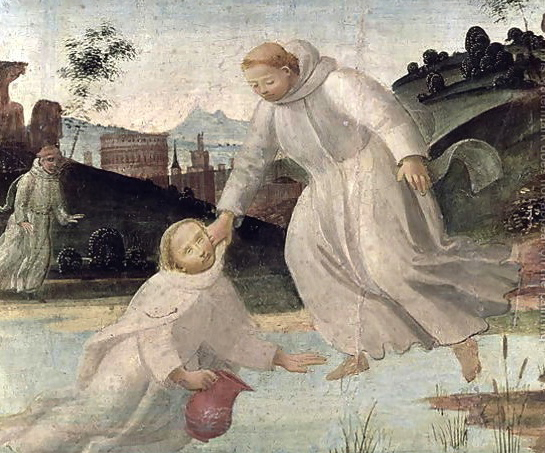
Saint Maurus Walks on Water ~ As told by Pope Saint Gregory the Great

Saint Maurus rescues Saint Placidus by Bartolomeo di Giovanni, ca. AD 1485.
In about AD 530, when Italy was ruled by the unstable successors of the Ostrogothic king Theodoric immediately prior to the Byzantine re-conquest, many noblemen of Rome entrusted their young sons to Benedictus, a holy monk who lived in the mountains of nearby Subiaco. One such boy was Maurus who is identified by Saint Gregory the Great as the son of a noble named Evitius. Another was Placidus, who was brought by Tertullius, a senator.

These two were among earliest disciples of a man who would be known to history as St. Benedict of Nursia.

Writing about 60 years after the fact in his Dialogues, Pope Saint Gregory the Great tells us that Maurus, “growing to great virtue, began to be his master's coadjutor.” Maurus is mentioned as part of several episodes in Gregory’s biography of Benedict as contained in the Dialogues. The best known of these anecdotes runs as follows:
On a certain day, as venerable Benedict was, in his cell, the foresaid young Placidus, the holy man's monk, went out to take up water at the lake, and putting down his pail carelessly, fell in himself after it, whom the water forthwith carried away from the land so far as one may shoot an arrow. The man of God, being in his cell, by and by knew this, and called in haste for Maurus, saying: "Brother Maurus, run as fast as you can, for Placidus, that went to the lake to fetch water, is fallen in, and is carried a good way off." 
Click here for more info.
A strange thing, and since the time of Peter the Apostle never heard of! Maurus, craving his father's blessing, and departing in all haste at his commandment, ran to that place upon the water, to which the young lad was carried by force thereof, thinking that he had all that while gone upon the land: and taking fast hold of him by the hair of his head, in all haste he returned back again: and so soon as he was at land, coming to himself he looked behind him, and then knew very well that he had before run upon the water: and that which before he durst not have presumed, being now done and past, he both marveled, and was afraid at that which he had done.
Coming back to the father, and telling him what had happened, the venerable man did not attribute this to his own merits, but to the obedience of Maurus: but Maurus on the contrary, said that it was done only upon his commandment, and that he had nothing to do in that miracle, not knowing at that time what he did. But the friendly contention proceeding of mutual humility, the young youth himself that was saved from drowning did determine: for he said that he saw when he was drawn out of the water the Abbot's garment upon his head, affirming that it was he that had delivered him from that great danger. 
Saint Maurus would later become famous in his own right. According to tradition, he was sent by Benedict, in company with several other monks, to found a community in the kingdom of the Franks nearby the Loire River. This became Glanfeuil Abbey and the village which grew up around it became known as Saint-Maur-sur-Loire. In the late 19th century, archaeological excavations were undertaken around the modern abbey, which had been destroyed and rebuilt several times over its history, revealing Gallo-Roman sub-structures.

Sadly, the modern abbey was abandoned in 1901 after the monks were driven out of France. It now seems to be privately owned without much external evidence of what it once was. Alas.

On the traditional calendar, the feast of Saint Maurus is commemorated on January 15 along with that of Saint Placidus. These saints are often confused with others of the same or similar names.