Showing posts with label March Saints. Show all posts

Thursday, March 17, 2022

"Ravening wolves have swallowed up the flock of the Lord which was growing up in Ireland." ~ Saint Patrick's authentic letter to the soldiers of Coroticus

Detail from a stained glass window showing Patrick preaching, Carlow Cathedral, Ireland.

Of the two authentic writings of Saint Patrick that have come down to us from antiquity, the first—the Confessio—I have addressed in a previous post entitled: The real Saint Patrick in his own words.

The second is the Letter to the Soldiers of Coroticus. For this St. Patrick’s Day, when war and rumors of war roil our world once again, and stories of atrocities fill up every media outlet, Patrick’s letter to the soldiers of Coroticus, full of condemnation and fulmination against those who would dare lay violent hands upon the innocent, takes on particular import.

Very little is known about the historical circumstances that prompted the writing of the letter, aside from the explanation offered by Patrick himself in the text. Coroticus is thought to have been a petty king or warlord from Scotland, often identified with Ceretic, king of Alt Clut (Strathclyde) in the mid-5th century AD.

I post below the letter in its entirety as taken from the public domain work, Saint Patrick: His Writings and Life by Newport J.D. White (1920) from the Translations of Christian Literature series. I have taken the liberty of interspersing a few comments of my own among the paragraphs with the hope that the reader will be indulgent.

1. Patrick the sinner, unlearned verily—I confess that I am a bishop, appointed by God, in Ireland. Most surely I deem that from God I have received what I am. And so I dwell in the midst of barbarians, a stranger and an exile for the love of God. He is witness if this is so. Not that I desired to utter from my mouth anything so harshly and so roughly; but I am compelled by zeal for God; and the truth of Christ roused me, for the love of my nearest friends and sons, for whom I have not regarded my fatherland and kindred, yea nor my life, even unto death, if I am worthy. I have vowed to my God to teach the heathen, though I be despised by some.

2. With mine own hand have I written and composed these words to be given and delivered and sent to the soldiers of Coroticus—I do not say to my fellow-citizens or to the fellow-citizens of the holy Romans, but to those who are fellow-citizens of demons because of their evil deeds. Behaving like enemies, they are dead while they live, allies of the Scots and apostate Picts, as though wishing to gorge themselves with blood, the blood of innocent Christians, whom I in countless numbers begot to God and confirmed in Christ.

It is thought, based on the above paragraph, that some of the soldiers of Coroticus were, in fact, Christians themselves, though perhaps apostates. It is to these that Patrick’s appeal is particularly addressed, in an effort to shame them into repenting of their evil deeds.

3. On the day following that on which the newly baptized, in white array, were anointed—it was still fragrant on their foreheads while they were cruelly butchered and slaughtered with the sword by the aforesaid persons—I sent a letter with a holy presbyter whom I had taught from his infancy, clergy accompanying him, with a request that they would grant us some of the booty and of the baptized captives whom they had taken. They jeered at them.

4. Therefore I know not what I should the rather mourn: whether those who are slain, or those whom they captured, or those whom the devil grievously ensnared. In everlasting punishment they will become slaves of hell along with him; for verily whosoever committeth sin is a bondservant of sin, and is called a son of the devil.

5. On this account let every man that feareth God learn that aliens they are from me and from Christ my God, for whom I am an ambassador—patricide, fratricide as he is!—ravening wolves eating up the people of the Lord as it were bread. As he saith, O Lord, the ungodly have destroyed thy law, which in the last times he had excellently (and) kindly planted in Ireland; and it was builded by the favour of God.

6. I make no false claim. I have part with those whom he called and predestinated to preach the Gospel amidst no small persecutions, even unto the ends of the earth, even though the enemy casts an evil eye on me by means of the tyranny of Coroticus, who fears neither God nor his priests whom he chose, and to whom he granted that highest, divine, sublime power, that whom they should bind on earth should be bound in heaven.'

7. Whence therefore, ye holy and humble men of heart, I beseech you very much. It is not right to pay court to such men, nor to take food or drink with them; nor ought one to accept their almsgivings, until [doing] sore penance with shedding of tears, they make amends to God, and liberate the servants of God and the baptized handmaidens of Christ, for whom he died and was crucified.

Here Patrick excommunicates the Christians among Coroticus's men, and calls on those who still consider themselves Christians to repent. For those Christians living in Coroticus's domains, Patrick calls upon them to separate themselves from the ungodly man who rules them. This is something of a bold comment particularly to modern ears which can stand no righteous judgments against rulers who enact and celebrate wicked and immoral policies. Could anyone imagine a man like Patrick remaining in public communion with such men and women of our era?

8. The most High approveth not the gifts of the wicked. He that offereth sacrifice of the goods of the poor is as one that sacrificeth the son in the presence of his father. The riches, he saith, which he hath gathered unjustly will be vomited up from his belly. The angel of death draggeth him away. He will be tormented by the fury of dragons. The viper's tongue shall slay him ; unquenchable fire devoureth him. And therefore, Woe to those who fill themselves with what is not their own. And, What is a man profited, if he shall gain the whole world, and lose his own soul?

9. It would be tedious to discuss or declare [their deeds ] one by one, [and] to gather from the whole law testimonies concerning such greed. Avarice is a deadly sin; Thou shalt not covet thy neighbour's goods; Thou shalt do no murder; A murderer cannot be with Christ; He that hateth his brother is reckoned as a murderer. And again, He that loveth not his brother abideth in death. How much more guilty is he that hath stained his hands with the blood of the sons of God whom he recently purchased in the ends of the earth through the exhortation of our littleness.

10. Was it without God, or according to the flesh, that I came to Ireland? Who compelled me? I am bound in the Spirit not to see any one of my kinsfolk. Is it from me that springs that godly compassion which I exercise towards that nation who once took me captive, and made havoc of the menservants and maidservants of my father's house? I was freeborn according to the flesh; I am born of a father who was a decurion; but I sold my noble rank—I blush not to state it, nor am I sorry—for the profit of others; in short, I am a slave in Christ to a foreign nation for the unspeakable glory of the eternal life which is in Christ Jesus our Lord.

In the above paragraph, Patrick echoes some of the themes of his previous Confessio, mentioning his own origins as a Roman of noble birth, and his subsequent capture by Irish raiders and life of slavery. Thus, he knows first hand the terrors of the captive, and the cruel hardships of the bondsman. 

11. And if my own know me not, a prophet hath no honour in his own country. Perchance we are not of the one fold, nor have one God and Father. As he saith, He that is not with me is against me, and he that gathereth not with me scattereth abroad. It is not meet that one pulleth down and another buildeth up. I seek not mine own. It was not any grace in me, but God that put this earnest that I should be one of the hunters or fishers whom long ago God foreshowed would come in the last days.

12. Men look askance at me. What shall I do, O Lord? I am exceedingly despised. Lo, around me are thy sheep torn to pieces and spoiled, and that too by the robbers aforesaid, by the orders of Coroticus with hostile disposition. Far from the love of God is he who betrays Christians into the hands of the Scots and Picts. Ravening wolves have swallowed up the flock of the Lord which verily in Ireland was growing up excellently with the greatest care. And the sons and daughters of Scottic chieftains who were monks and virgins of Christ I cannot reckon. Wherefore, be not pleased with the wrong done to the just ; even unto hell it shall not please thee.

13. Which of the saints would not shudder to jest and feast with such men? They have filled their houses with the spoil of dead Christians. They live by plunder. Wretched men, they know not that it is poison; they offer the deadly food to their friends and sons; just as Eve did not understand that verily it was death that she handed to her husband. So are all they who do wrong; they work death as their eternal punishment.

14. This is the custom of the Roman Gauls: They send holy and fit men to the Franks and other heathen with many thousands of solidi to redeem baptized captives. Thou rather slayest and sellest them to a foreign nation which knows not God. Thou handest over the members of Christ as it were to a brothel. What manner of hope in God hast thou, or has he who consents with thee, or who holds converse with thee in words of flattery? God will judge ; for it is written, Not only those who commit evil, but those that consent with them shall be damned.

Recall that Roman Gaul was, at this time, in the process of being overrun by the Burgundians, Franks, Visigoths, and numerous other barbarian nations, though Roman power would not be completely broken until the Battle of Soissons in AD 486. One gets a sense in the accounts of Priscus, likely written during Patrick's life, how common it was for Romans to be captured and ransomed by barbarian raiders during this unhappy time.

15. I know not what I should say, or what I should speak further about the departed ones of the sons of God, whom the sword has touched roughly above measure. For it is written, “Weep with them that weep,” and again, “If one member suffer, let all the members suffer with it.” On this account the Church bewails and laments her sons and daughters whom the sword has not as yet slain, but who are banished and carried off to distant lands where sin openly, grievously, and shamelessly abounds. There freemen are put up for sale, Christians are reduced to slavery, and, worst of all, to most degraded, most vile and apostate Picts.

16. Therefore in sadness and grief shall I cry aloud: O most lovely and beloved brethen, and sons whom I begot in Christ—I cannot reckon them—what shall I do for you? I am not worthy to come to the aid of either God or men. The wickedness of the wicked hath prevailed against us. We are become as it were strangers. Perchance they do not believe that we receive one baptism, and that we have one God and Father. It is in their eyes a disgraceful thing that we were born in Ireland. As he saith, Have ye not one God? Why do ye, each one, forsake his neighbour?

17. Therefore, I grieve for you, I grieve, O ye most dear to me. But again, I rejoice within myself. I have not laboured for nought, and my going abroad was not in vain. And there happened a crime so horrid and unspeakable! Thanks be to God, it was as baptized believers that ye departed from the world to Paradise. I can see you. Ye have begun to remove to where there shall be no night nor sorrow nor death any more; but ye shall leap like calves loosened from their bands, and ye shall tread down the wicked, and they shall be ashes under your feet.

18. Ye therefore shall reign with apostles and prophets and martyrs. Ye shall take everlasting kingdoms, as he himself witnesseth, saying, They shall come from the east and west, and shall sit down with Abraham and Isaac and Jacob in the kingdom of heaven. Without are dogs and sorcerers and murderers; and liars and false swearers shall have their part in the lake of everlasting fire. Not without just cause the apostle saith, “Where the righteous shall scarcely be saved, where shall the sinner and the ungodly transgressor of the law recognize himself?”

19. Wherefore then, where shall Coroticus with his accursed followers, rebels against Christ, where shall they see themselves?—they who distribute baptized damsels as rewards, and that for the sake of a wretched temporal kingdom, which verily passes away in a moment like a cloud or smoke which is verily dispersed by the wind. So shall the deceitful wicked perish at the presence of the Lord; but let the righteous feast in great constancy with Christ. They shall judge nations, and rule over ungodly kings forever.

It is worth noting that Patrick’s prophecy came true. The temporal power of Coroticus did indeed pass away quickly, and his name is practically lost to history, known mainly to us via the pen of the illustrious man and great saint who condemned his foul deeds. Sic transit gloria mundi.

20. I testify before God and his angels that it will be so, as he has signified to my unskillfulness. The words are not mine, but of God and the apostles and prophets, who have never lied, which I have set forth in Latin. He that believeth shall be saved, but he that believeth not shall be damned. God hath spoken.

21. I beseech very much that whatever servant of God be ready, he be the bearer of this letter, that on no account it be suppressed or concealed by any one, but much rather be read in the presence of all the people, yea, in the presence of Coroticus himself; if so be that God may inspire them to amend their lives to God some time; so that even though late they may repent of their impious doings—murderer of the brethren of the Lord!—-and may liberate the baptized women captives whom they had taken, so that they may deserve to live to God, and be made whole, both here and in eternity.

Peace—to the Father, and to the Son, and to the Holy Ghost. Amen.

NB. Patrick makes liberal use of quotations from Sacred Scripture in this letter. These have been carefully catalogued in the original source. See here

Monday, March 09, 2020

When plague in Italy killed 1.5 million people in a single year ~ Saint Frances of Rome and the Plague of 1656

Saint Frances of Rome intercedes on behalf of the plague-stricken
people of Italy. Click to enlarge.
Today, March 9, is the feast day of Saint Frances of Rome. She was an Italian woman who lived in the late 14th and early 15th centuries. A previous post about this amazing saint may be found here. It was claimed that in 40 years of marriage, Saint Frances never once quarreled with her husband.

St. Frances was invoked as an intercessor by the people of Rome even centuries after her death.

In AD 1656, a ship entered the harbor at Barletta carrying a deadly pathogen—very likely, the Black Plague. The town was immediately infected and the impact was dramatic. By the time the plague abated a year later, about half of the town's 20,000 citizens had been killed. It is speculated that the Kingdom of Naples suffered 1.5 million deaths as a result of the plague. Read more here.

Meanwhile, it appears that the affliction was considerably less in Rome by comparison. The city suffered a mere 9,000 deaths during the same period. This reprieve is celebrated in several works of art from this period, including the one shown above by Nicholas Poussin entitled Sainte Françoise Romaine (1657). This work was commissioned by Cardinal Giulio Rospigliosi, who would later be elected Pope Clement IX. Poussin created the image to celebrate the end of the plague and interpretations of its content vary. It shows either Saint Frances appearing in a vision to a devout 17th century Roman woman begging her intercession (as per the Lourve website), or the Blessed Virgin appearing to St. Frances in response to her own prayers (as per Sheila Barker in Art, Architecture, and the Roman Plague of 1656).

In either interpretation, the artist offers a spiritual solution for those in the midst of a deadly pestilence. In the background, an archangel armed with a sword chases a personification of plague: a monstrous being who can be seen carrying off one of the victims.

With the outbreak of the COVID-19 virus in Italy and the subsequent closure of all churches in Rome for a month, may Saint Frances intercede on behalf of of the Italian people and anyone who is suffering from the virus. May Christ bring swift succor to the infected, relief to those who are enduring anxiety, and comfort to those whose family members have died.

Thursday, March 01, 2018

"Cut off a thong of his skin" ~ The martyrdom of Saint Herculanus AD 549

The Burial of St. Ercolano outside the Gates of Perugia
by Benedetto Bonfigli, ca. 1460.
March 1 is the feast day of the ancient Italian Saint Herculanus of Perugia. (He is also remembered on November 7). Though little-known today, Herculanus was bishop of that city and died a martyr in AD 549 during the disastrous Romano-Gothic War in Italy. Along with Saint Constantius, he is one of the ancient patrons of Perugia.

Practically all we know of the life and death of Herculanus comes from a passage in the Dialogues of Saint Gregory the Great, written down about fifty years after the event. Having surrendered to the Roman armies of Belisarius upon his arrival in central Italy in AD 537, Perugia endured sieges by the resurgent Goths in the 540s, culminating with the city's fall to the Gothic king, Totila, in AD 549.

Here is Pope Gregory’s account of what happened in the aftermath of the siege:
The virtuous Bishop Floridus told me a notable miracle, which was this:
"The great holy man," quoth he, "Herculanus, who brought me up, was Bishop of Perusium, exalted to that dignity from the state of a monk: in whose time the perfidious king Totila besieged it for seven years together, and the famine within was so great that many of the townsmen forsook the place: and before the seventh year was ended, the army of the Goths took the city. 
"The commander of his camp dispatched messengers to Totila, to know his pleasure what he should do with the Bishop, and the rest of the citizens: to whom he returned answer, that he should, from the top of the Bishop's head to his very foot, cut off a thong of his skin, and that done, to strike off his head. And as for the rest of the people, to put them all to the sword.
Click for more info.
"When he had received this order, he commanded the reverent Bishop Herculanus to be carried to the walls, and there to have his head strooken off, and when he was dead, that his skin should be cut from the very crown down to the very foot, as though indeed a thong had been taken from his body—after which barbarous fact they threw his dead corpse over the wall. Then some upon pity, joining the head to the body, did bury him, together with an infant that was there found dead.
"Forty days after, Totila making proclamation that the inhabitants, which were gone, should without all fear come back again, those, which upon extremity of hunger departed, returned home to their houses, and calling to mind the holy life of their Bishop, they sought for his body, that it might, as he deserved, be buried in the church of St. Peter. And when they came to the place where it lay, they digged, and found the body of the infant that was buried together with him, putrefied and full of worms: but the Bishop's body was so sound as though it had been newly put into the earth, and that which is more to be admired, and deserveth greater reverence, his head was so fast joined to his body as though it had never been cut off, neither did any sign of his beheading appear at all. Then they viewed likewise his back, whether that were also whole and sound, and they found it so perfect and well, as though never any knife had touched the same." [Taken from: The Dialogues of Saint Gregory the Great, Book III, Chapter 13]
For a good deal more on Saint Herculanus and the legends that grew up around him in medieval Perugia, The Key to Umbria has some excellent information.

Thursday, March 09, 2017

Saint Frances of Rome ~ March 9

Click to share on Facebook.
“Hope every thing from the mercy of God; it is as boundless as His power.”
–Saint Frances of Rome
This quote is taken from an anecdote in The Life of Saint Frances of Rome. Saint Frances (b. AD 1384, d. AD 1440) was an amazing holy woman who was married 40 years and then became foundress of a religious order after her husband died. It is said that during 40 years of marriage, she and her husband never once had a disagreement.

Here is the context of the above quote:
“Cecca Clarelli, a relation of the Ponziani, is delivered of a little girl in such apparent good health that no one thinks of baptizing her; a grand ceremony for the purpose is preparing in a neighboring church, to take place the following day; but in the middle of the night Francesca arrives, and entreats that the child may be instantly baptised. The parents and the priest object, but the Saint is urgent; she will take no denial; with reluctance her request is complied with, and no sooner has the sacrament been conferred than the infant expires. 
"A child of the same parents, a lovely little girl, is dumb; she is four years old, and not a single word has she ever pronounced. Andreozzo, her father, entreats his wife to carry her to the Saint, and implore her assistance. Francesca's humility cannot endure this direct appeal, and she tries to put them off; but, deeply affected by their tears, she at last touches with her finger the tongue of the little Camilla, and says, "Hope every thing from the mercy of God; it is as boundless as His power." The parents depart full of faith and comfort; and ere they reach their house, the child has uttered with perfect distinctness the blessed names of Jesus and Mary; and from that day forward acquires and retains the power of speech.” 
Click here to read the full Life of St. Frances of Rome by Lady Georgiana Fullerton on Archive.org. A shorter summary of her life may be found here: St. Frances of Rome, Catholic Encyclopedia at NewAdvent.org.

The image is a detail taken from a painting by 17th century artist Giovan Battista Gaulli entitled: Santa Francesca Romana which shows the saint distributing food to the poor. Click here to see the entire painting. It's quite beautiful.

Update for 2020: 

With the outbreak of the COVID-19 virus in Italy and the subsequent closure of all churches in Rome for a month, it should be recalled that Saint Frances was called upon by the citizens of Rome in the 17th century to stop a plague.

Click to enlarge.
The painting above was commissioned by Cardinal Rospigliosi ca. 1657 and was created by Nicholas Poussin. It shows St. Frances appearing to a woman who begs her intercession in the foreground. In the background, an archangel armed with a sword chases a personification of plague: a monstrous being which carries off one of the victims. 

May St. Frances of Rome intercede for the people of Italy, that God may save them from the current scourge and bring them back to their ancient faith.

Wednesday, March 08, 2017

Who was Saint Pontius the Deacon?

St. Cyprian as portrayed by the excellent
Catholic artist, Cecilia Lawrence.
March 8 is the Catholic feast day of Saint Pontius the Deacon, companion of the great Saint Cyprian of Carthage. Pontius is most well known for writing a first-hand account of the martyrdom of Cyprian in AD 258. Saint Jerome calls Pontius out briefly in his work On Famous Men (Chapter 68) as follows:
Pontius, deacon of Cyprian, sharing his exile until the day of his death, left a notable volume on the life and death of Cyprian.
Little more is known about him, save what he himself says in his famous account of his shepherd and colleague. He apparently witnessed the execution of Cyprian with his own eyes, supplying several vivid details:
When [Cyprian] had come to the praetorium, as the proconsul had not yet come forth, a place of retirement was accorded him. There, as he sat moistened after his long journey with excessive perspiration...one of the officers (Tesserarius), who had formerly been a Christian, offered him his clothes, as if he might wish to change his moistened garments for drier ones.
Once the proconsul interrogated Cyprian and read the sentence, Pontius describes how the saint was led to the place of execution and had to encourage his unwilling executioner to perform his office:
And when he left the doors of the praetorium, a crowd of soldiery accompanied him; and that nothing might be wanting in his passion, centurions and tribunes guarded his side....And now, having with his own hands bound his eyes, he tried to hasten the slowness of the executioner, whose office was to wield the sword, and who with difficulty clasped the blade in his failing right hand with trembling fingers, until the mature hour of glorification strengthened the hand of the centurion with power granted from above to accomplish the death of the excellent man, and at length supplied him with the permitted strength. 
 At the end of the document, Pontius rejoices that Cyprian has been accounted worthy of the martyr's laurel, but laments that he himself had not, to that point, suffered for the sake of Christ:
What shall I do now? Between joy at his passion, and grief at still remaining, my mind is divided in different directions, and twofold affections are burdening a heart too limited for them. Shall I grieve that I was not his associate? But yet I must triumph in his victory. Shall I triumph at his victory? Still I grieve that I am not his companion. Yet still to you I must in simplicity confess, what you also are aware of, that it was my intention to be his companion. Much and excessively I exult at his glory; but still more do I grieve that I remained behind.
Read Saint Pontius's Life and Passion of Saint Cyprian, along with all of Saint Cyprian's voluminous writings in The Complete Works of Saint Cyprian of Carthage, which may be ordered in book form here or here.

This edition has the virtue of including footnotes and commentary that are more Catholic-friendly than previous editions done by 19th century Protestant scholars. It also includes one of my favorite features: The Quotable Cyprian.


Monday, March 06, 2017

The Authentic Passion of Saints Perpetua and Felicitas

St. Perpetua rebuffs her father's entreaties.
On March 7, AD 203, during the reign of the emperor Septimius Severus, five Christians were martyred in the amphitheater of Carthage under the procurator Hilarian. The three men were named Revocatus, Saturus, and Saturninus. The two women, however, are more famous, having their names entered into the Roman Canon of the Mass: Felicitas, a slave eight months pregnant, and Perpetua, a young Roman matron of noble birth who had recently given birth to a child.

Unlike many of the Acts of these early martyrs, the antiquity and authenticity of the Passion of Perpetua and Felicitas is not seriously challenged by most scholars. Indeed, the first piece of the Acts is thought to have been written or dictated by Perpetua herself, in Latin. Here she describes her father's reaction to the fact that she was under official suspicion of being a Christian:
"When we were still under legal surveillance and my father was liked to vex me with his words and continually strove to hurt my faith because of his love: 
'Father,' said I, 'Do you see (for examples) this vessel lying, a pitcher or whatsoever it may be?' 
And he said, 'I see it.' 
And I said to him, 'Can it be called by any other name than that which it is?' 
And he answered, 'No.'
'So can I call myself nought other than that which I am, a Christian?'
Then my father angry with this word came upon me to tear out my eyes; but he only vexed me, and he departed vanquished, he and the arguments of the devil."
A few days later, Perpetua was thrown into prison along with other Christians. There she experienced visions and was troubled that she was unable to breast-feed her child. Adding to her worries, her father came to see her and entreated her to apostasize in dramatic fashion, grovelling at her feet and tearing out his beard. When this availed nothing, the five abovementioned Christians were brought to public trial. Perpetua continues:
"We went up to the tribunal. The others being asked, confessed. So they came to me. And my father appeared there also, with my son, and would draw me from the step, saying: 'Perform the Sacrifice; have mercy on the child.'
And Hilarian the procurator—he that after the death of Minucius Timinian the proconsul had received in his room the right and power of the sword—said: 'Spare your father's grey hairs; spare the infancy of the boy. Make sacrifice for the Emperors' prosperity.'
And I answered: 'I am a Christian.'
And when my father stood by me yet to cast down my faith, he was bidden by Hilarian to be cast down and was smitten with a rod. And I sorrowed for my father's harm as though I had been smitten myself; so sorrowed I for his unhappy old age. 
Then Hilarian passed sentence upon us all and condemned us to the beasts; and cheerfully we went down to the dungeon...."
After recording several other visions and conversations that she experienced in prison, Perpetua's account ends and the climax of the martyrdom is recounted by another voice. Felicitas is delivered of a baby girl a few days before the scheduled execution, and the child apparently survived her mother to be raised by a sister. On the day of their execution, the martyrs parade to the amphitheater is described as follows in the Acts:
Now dawned the day of their victory, and they went forth from the prison into the amphitheater as it were into heaven, cheerful and bright of countenance; if they trembled at all, it was for joy, not for fear. Perpetua followed behind, glorious of presence, as a true spouse of Christ and darling of God; at whose piercing look all cast down their eyes. Felicity likewise, rejoicing that she had borne a child in safety, that she might fight with the beasts, came now from blood to blood, from the midwife to the gladiator, to wash after her travail in a second baptism. 
And when they had been brought to the gate and were being compelled to put on, the men the dress of the priests of Saturn, the women the dress of the priestesses of Ceres, the noble Perpetua remained of like firmness to the end, and would not. For she said: "For this cause came we willingly unto this, that our liberty might not be obscured. For this cause have we devoted our lives, that we might do no such thing as this; this we agreed with you."
Injustice acknowledged justice; the tribune suffered that they should be brought forth as they were, without more ado. Perpetua began to sing, as already treading on the Egyptian's head. Revocatus and Saturninus and Saturus threatened the people as they gazed. Then when they came into Hilarian's sight, they began to say to Hilarian, stretching forth their hands and nodding their heads: "You judge us," they said, "and God you."
At this the people being enraged besought that they should be vexed with scourges before the line of gladiators (those namely who fought with beasts). Then truly they gave thanks because they had received somewhat of the sufferings of the Lord.
Mosaic of a prisoner gored by a leopard
in the arena, Tunisia, 3rd century AD 
The Christians were then made to fight the wild beasts. Saturninus as mauled by numerous beasts. Revocatus was torn by a leopard, then by a bear. Saturus was dragged by a boar and faced a bear, but emerged largely unharmed from both encounters to be slain finally by the bite of a leopard. Both Perpetua and Felicitas were made to face a cow that had been trained and goaded to behave like a wild bull:
Perpetua was first thrown, and fell upon her loins. And when she had sat upright, her robe being rent at the side, she drew it over to cover her thigh, mindful rather of modesty than of pain. Next, looking for a pin, she likewise pinned up her dishevelled hair; for it was not meet that a martyr should suffer with hair dishevelled, lest she should seem to grieve in her glory. So she stood up; and when she saw Felicity smitten down, she went up and gave her her hand and raised her up.
Not killed by the mad cow, Perpetua cried out to her brother and the other catechumens present:
"Stand fast in the faith, and love you all one another; and be not offended because of our passion."
It seems that four of the five survived their ordeals with the beasts and were slaughtered, in the end, by sword strokes from the gladiators present. In Perpetua's case, however, the gladiator was inexperienced in killing and made a mess of her execution:
Perpetua, that she might have some taste of pain, was pierced between the bones and shrieked out; and when the swordsman's hand wandered still (for he was a novice), herself set it upon her own neck. Perchance so great a woman could not else have been slain (being feared of the unclean spirit) had she not herself so willed it. 
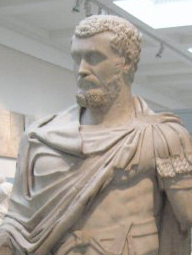
Septimius Severus from the
British Museum.
So perished these five to the glory of God the Father Almighty, and His Son Jesus Christ.

Though this persecution occurred during the reign of Septimius Severus, it is thought to have been a local persecution only, not empire-wide. The reputation of Severus is quite mixed regarding his attitude toward Christianity. The Historia Augusta records that he promulgated an edict making it illegal to convert to Judaism or Christianity. Meanwhile, Tertullian, writing in AD 212 (or 217) in his Ad Scapulam, admits that though persecutions have taken place under Severus, that emperor was:
"graciously mindful of the Christians...Both women and men of highest rank, whom Severus knew well to be Christians, were not merely permitted by him to remain uninjured; but he even bore distinguished testimony in their favour, and gave them publicly back to us from the hands of a raging populace."
Click for more info.
The full account of the Passion of Saints Perpetua and Felicitas is included in I Am a Christian: Authentic Accounts of Christian Martyrdom and Persecution from the Ancient Sources. This book is a collection of some of the best ancient sources on the Roman reaction to Christianity and the persecution of the early Church. Several of the accounts contained in this book are also to be found excerpted in a much more haphazard format on this blog, so if you are a regular reader, they may seem familiar to you.

If you enjoy this blog or are interested in learning more about this period of Roman and early Church history, this inexpensive book is well worth having.

Here are some related posts of interest:

Friday, March 03, 2017

"Why Not Become a Missionary Yourself, My Child?" Feast Day of Saint Katharine Drexel

Mother Drexel by Lori Kauffmann
in The American Martyrology.
March 3 is the feast day of Philadelphia's own Saint Katharine Drexel.

Katharine Mary Drexel was quite an unlikely candidate for sainthood. Though brought up in a devoutly Catholic family, Katharine's youth was one of wealth and luxury. Daughter of one of Philadelphia's elite families, she was expected to do what most girls of her age and status did which was marry the scion of another wealthy family.

When she first revealed her inclination to the religious life, both her parents and her spiritual director, Father James O'Connor (later the first bishop of Omaha, Nebraska) were opposed. Katharine herself had doubts. In one of her notebooks, she made a list of pros and cons. The cons included:
  • I do not know how I could bear the privations and poverty of the religious life. I have never been deprived of luxuries.
  • I hate community life. I should think it maddening to come in constant contact with many different old maidish dispositions. 
Despite her misgivings, God's call won out in the end in a big way. Here is the rest of the story, as told in Religious Orders of Women in the United States (1913), compiled by Elinor Tong Dehey:
Her heart was yearning to embrace the religious life, and if she had followed her own desires she would probably have chosen a contemplative community, and not as might have been expected an active one. Bishop O'Connor still deferred giving Miss Drexel a decision in regard to her vocation. All the pent up longing of her heart was to give herself to God without delay. The more she prayed, the greater became the attraction to leave all for Christ. Bishop O'Connor had always in mind the new Congregation, and fearful of acting hastily had allowed time to elapse before determining to unfold his views to Miss Drexel.

Katharine Drexel ~ Debutante - Heiress - Religious Sister - Saint.
In January, 1887, Miss Drexel and her sister were travelling abroad; while in Rome, Leo XIII. received them in private audience. Miss Katharine, in speaking to His Holiness, mentioned the great need of missionaries among the Indians, and in the simplicity of her soul begged the Holy Father to send some devoted missionary communities to labor among them. With the smile for which he was remarkable lighting up that singularly clear eye by which he seemed to pierce the future, and with a voice the tones of which touched the innermost depths of Miss Drexel's soul, he replied: "Why not become a missionary yourself, my child?"

Coming at the moment when she was struggling between the interior promptings of the Holy Spirit and the prohibitory mandate of her director, this seemed, as undoubtedly it was, the voice of God Himself. Shortly after this, Bishop O'Connor announced to Miss Drexel what he believed to be the will of God in her regard. Divine Providence, he thought, wished to make use of her to form the nucleus of a new society for the conversion of the Indian and negro races. In obedience to the direction of Bishop O'Connor, Miss Drexel entered the novitiate of the Sisters of Mercy, in Pittsburg, Penn., May 6, 1889. St. Mary's Pittsburg, first House of the Sisters of Mercy in the United States, was destined to be the cradle of the new community. It was not long before Miss Drexel was joined by others who wished to share her mission labors, and with her to pre- pare themselves for the work which God was unfolding. Under the direction of the saintly Mother McAuley, the Sisters of the Blessed Sacrament began their novitiate.
This scene is described quite poignantly in Ellen Tarry's Saint Katharine Drexel: Friend of the Oppressed. Part of the Vision Series by Ignatius Press, this book is an excellent short biography of Mother Drexel, suitable for kids ages nine and up. As an adult, I found it edifying as well, and wrote a review of it several years ago that may be found here.

Also notable for kids, if you can find a copy, is Katie--The Young Life of Mother Katharine Drexel, which I reviewed here.

Mother Drexel's childhood home at 1503 Walnut Street seems to have been torn down sometime in the early 20th century. Her summer home remains, however, as part of Aria Jefferson Health's Torresdale campus, along with the Shrine of the True Cross, formerly the Shrine of Saint Michael, which was built by Saint Katharine's sister, Louise Drexel Morrell.
Image of the Drexel summer home (upper left corner) and the Shrine of the
True Cross (lower center) in Torresdale, Philadelphia.