Showing posts with label January Saints. Show all posts

Tuesday, December 27, 2022

Book Review: Matron of Paris by Phillip Campbell

Saint Germain bestows his blessing upon the girl Genevieve, from a 19th century triptych, 
The Pastoral Life of Saint Genevieve by Pierre-Cécile Puvis de Chavannes
Unbeknownst to many outside of the homeschooling community, there is something of a literary renaissance going on in Catholic circles, particularly with regard to historical novels for younger readers. At the moment, there are enough of these high-quality novels on the market to keep even the most avid young reader going for a very long time. 

One of the eras that has attracted particular attention from writers of Catholic historical novels is the fall of the Western Roman Empire. The most recent entry in this category is Matron of Paris, a lively work by Phillip Campbell about the eventful life and miraculous works of St. Genevieve of Nanterre. Some readers may recall my previous post about this patroness of France: Saint Genevieve and Barbarism: From Attila to the Republic.

A Gallo-Roman woman, Genevieve (or Genovefa as she is called in Latin) was born toward the end of the reign of the weak Western Roman Emperor Honorius, circa AD 422. With Roman power in eclipse, barbarian tribes breached the frontier with increasing ease, carving out their own petty principalities in Roman Gaul and oppressing the inhabitants. This was the chaotic and dangerous era into which the girl Genevieve was born. 

Click for more info.
In Matron of Paris: The Story of Saint Genevieve, Phillip Campbell tells the story of this great saint in his usual engaging style, leading the reader from the simple life of a Gallo-Roman peasant girl into the brutal and complicated world of Late Roman / early Merovingian warfare and politics. While following the tale, readers will be introduced to numerous historical characters: from Saint Germanus, bishop of Auxerre, who first recognized Genevieve's sanctity, to Clovis, king of the Franks, whose story would ultimately become intertwined with that of Genevieve. Others who were Genevieve's rough contemporaries are also mentioned — from Aetius, the Roman magister militum who defeated Attila at the Battle of the Catalaunian Plains, to a mysterious saintly presbyter named Patricius who serves briefly at Nanterre before moving on to greener pastures. 

The core of the book, however, follows Genevieve as a mature woman. She becomes the heart and soul of Paris whose prayers and entreaties would hearten the beleaguered city during Atilla's invasion of Gaul. Later in life, her occasionally miraculous interventions would help the Franks and Gallo-Romans become one people. It is during this part of the novel that two other saints enter the story: Saint Clotilde, the Burgundian wife of Clovis, and Saint Remigius of Reims who would baptize the Frankish king. Campbell does a wonderful job weaving the story of Genevieve together with that of Clovis and Clotilde.

I highly recommend Matron of Paris and think it makes a fantastic addition to the literature of late Rome and the early Middle Ages, ideal for readers ages 12 and up. It fits together beautifully with another novel of the same time period, Centurion's Daughter by Justin Swanton. Considering St. Genevieve's feast day is coming up on January 3, the Christmas season is a particularly appropriate time to purchase this book.

For students who want to do a deep study of this period, here is a quick reading list of available resources in rough chronological order, (including my own books):

Thursday, January 20, 2022

"Art thou not Sebastian whom I before commanded to be slain with arrows?" ~ A few interesting points about Saint Sebastian's ancient Passio.

The Burial of Saint Sebastian (1877) by Alejandro Ferrant y Fischermans. Click to enlarge.

Saint Sebastian is one of the great ancient martyrs of the Roman Catholic Church as well as one of the saints most frequently depicted in artwork down through the centuries. The image of Sebastian tied to a stake, his body riddled with arrows, is one of the most immediately recognizable and jarring images of the ancient martyrs.

As with many of the martyrs from the days prior to Constantine, his story has become somewhat muddled. He is mentioned in a homily of Saint Ambrose (On Psalm 118) as having come from Milan. Most of the rest of his biography comes from a Passio of dubious provenance. Scholars of the previous era ascribed this work to Saint Ambrose himself, though more modern scholars tend to dismiss this attribution. Few doubt the antiquity of the Passio, however, and the existing work is commonly dated to the early fifth century—or about a century after the events recorded therein.

As with many of the ancient martyrdom accounts, the Passio has not been translated into English. It does, however, exist excerpted in numerous other works, including a detailed synopsis which may be found at The Cult of Saints in Late Antiquity site, sponsored by Oxford University. 

A different type of synopsis of the Passio may be found in the Homilies of Aelfric of Eynsham, a late 10th century Anglo Saxon abbot who transcribed the Latin tale into Old English for the edification of his monks. Here is the ancient story of Sebastian’s martyrdom as told in part with excerpts from Aelfric’s work. The entirety of the account may be found here: Skeat: Aelfric's Lives of Saints, p. 117 and following.

The Passion of Saint Sebastian, Martyr, January 20

There was a holy servant of God, called Sebastian, who was a long time in the city of Milan for education, and was baptized into Christ with full faith. He was a very prudent man, truthful in word, righteous in judgment, in counsel foreseeing, trusty in need, a prevailing intercessor, shining in goodness, and in all his ways honorable. 

Daily he fulfilled his Lord's service zealously, but he concealed, nevertheless, his deeds from the emperor Diocletian who was the devil's worshipper. Diocletian loved the holy man, notwithstanding, and knew not that he believed in the living God. He set him as prefect over a cohort, and bade that he should always be in his presence; and all the household held him as a father, and honored him with love, because God loved him. He followed the emperor, unknown to him, however, not as if he durst not suffer for his Lord, but he desired to encourage those whom the heathen emperor daily killed for their faith in Christ.

Diocletian, as we know, reigned from AD 284 through AD 305 when he abdicated and retired to a fortified palace on the Dalmatian coast. The notion that secret Christians may have existed in the court of Diocletian is in no way surprising and jives well with the account of Lactantius in On the Deaths of the Persecutors. Indeed, it is possible that Diocletian’s own wife, Prisca, and daughter, Valeria, were secret Christians. 

Sebastian was able to use his position in the court to console the brothers Marcus and Marcellianus who were imprisoned as Christians by Chromatius, the Prefect of Rome, and condemned to death unless they offered sacrifice to the pagan divinities. These brothers were from an aristocratic family and both wavered as their family members attempted to convince them to save their lives by abjuring the Christian faith. Due to the stature of their families, Chromatius offered a thirty day reprieve for the martyrs to consider their position.

During this time, however, Sebastian convinced the family of Marcus and Marcellianus to accept Christ. When the thirty days expired, Tranquillinus, the father of the young men, came before Chromatius and professed his own faith in Christ, mentioning that his gout had been cured following his baptism. As it turns out, Chromatius suffered from the same ailment and would later secretly summon Sebastian and the priest Polycarp so that they might also heal him. In order to effect the healing, Sebastian and Polycarp endured a three day fast, after which they returned to Chromatius and enjoined him to allow them to destroy all the pagan idols in his house. Chromatius agreed, and the two Christians proceeded to burn, smash, or melt down all of the 200 images of the pagan divinities in the house. 

What happens next is very strange indeed, as it seems to tie this ancient Christian literary source to one of the most fascinating archaeological discoveries of the 20th century.

When Chromatius failed to recover after his house was cleansed, Sebastian and Polycarp then deduced that something evil must yet remain in his house. At this point, Chromatius reveals something interesting: 

“I have in my treasure-chest a wonderful instrument, for my information, according to the position of the stars as they stand in the heavens. On that instrument Tarquinius, my father, spent of red gold alone more than two hundred pounds.”

Previously in the same narrative, this instrument is described as follows: 

An excellent work of mechanical contrivance, of glass, and gold, and of glistening crystal. This instrument was designed to show with certainty by the stars what should happen to every man in the course of his life; but it was so formed according to the heathen error.

The remains of the so-called Antikythera Mechanism, believed to be an
ancient machine used to compute the movement of the stars and planets.

Does this sound familiar? If you are at all aware of Mediterranean archaeology, it should. In 1901, some sponge divers found a strange ancient artifact in the waters off the Greek island of Antikythera. This item would become known as the Antikythera Mechanism, a type of ancient gear-driven computer used to predict the movements of the stars. It is tantalizing to think that this passage in the Passio of St. Sebastian is actually describing a similar type of machine. It may also be an indication that the Antikythera mechanism was not unique and that other similar devices were known even as late as the 5th century AD.

To get back to our narrative, Sebastian and Polycarp then discoursed to Chromatius upon the evils and vanity of astrology, indicating that the infernal machine must be disposed of. They even put their lives on the line, saying that if they broke the costly device and Chromatius did not recover from his illness, then they would submit to being thrown into a furnace and killed. Chromatius agreed. The device was broken. And Chromatius subsequently recovered. As a result, he and his son became Christians. 

Now, certainly there will be some who will latch onto this episode as an example of Christians being so "anti-science" that they even destroyed a precious ancient computing device. Before advancing this claim, however, it is well to keep in mind that the device itself, as expensive and finely crafted as it may have been, was not actually used for any scientific purpose. It was used for the superstitious purpose of attempting to predict the future via the movement of the stars.

Chromatius subsequently resigned his position as Prefect of the city of Rome and was replaced by a certain Fabianus, a man who was much more zealous in carrying out the persecutions mandated by Diocletian against Christians than Chromatius had been. This Fabianus soon laid hold of Marcus and Marcellianus, tortured them, and put them to death. Soon after, he denounced Sebastian to Diocletian as well. 

Given that Fabianus was, supposedly, the Prefect of Rome, it is reasonable to conjecture that the denunciation of Sebastian likely took place in AD 303 when Diocletian was in Rome for the celebration of his Vicennalia or 20th anniversary of his reign. This event was meant to be a great, two month long, triumphal festival commemorating the happy and prosperous reign of Diocletian and Maximian. There is evidence, however, that the event became tragic. The Chronography of AD 354 reports that during the event, 13,000 people were killed when the boxes at the circus collapsed. It is also possible that Pope Marcellinus was martyred during this time.  

Writing in On the Deaths of the Persecutors, Lactantius claimed that Diocletian was so perturbed during the celebrations at Rome that he departed the city prematurely before his consulship could even begin on January 1. He would subsequently become gravely ill on his journey back to Nicomedia.

Let us assume that the unhappy vicennalia celebration at Rome is the setting for the scene described below in Aelfric’s homily as the dramatic conclusion of St. Sebastian's Passio:

Then became Diocletian fiendishly angry, and commanded him to be led out in hard bonds, into a field, and there to be bound, and assailed with arrows until he gave up his life. Then the soldiers led away the servant of Christ, and set him for a mark, even as the wicked man commanded, and fastened their arrows into him before and behind, as thickly on every side as a hedgehog's bristles, and so left him alone, lying for dead.

Then came a certain widow, who was a martyr's relict, in the same night, where he lay sorely wounded, desiring to bury his body, and found him living. Then she brought him to her house alive, and within a few days entirely healed him. Then came the Christians, and urged the [Christian] warrior, that he ought to depart far away from the city.

But Sebastian commended himself to God, and went up to the staircase, which stood against the emperor's palace, and when the emperor came, thus cried to him:

“Your idol-priests who dwell in your temples tell you many lies concerning the Christians, saying that they are verily adversaries to your kingdom, and also to your people; but your kingdom prospereth through their good merits, because they pray for the Roman people and for your dominion, without ceasing.”

Then looked Diocletian, the fiendish murderer, towards the holy man, who stood there so loftily, and said haughtily, “Art not thou that Sebastian, whom I before commanded to be slain with arrows?

Sebastian said, “Christ raised me up again to the end that I might declare to thee before all the people your unrighteous persecution against the Christians.”

Then bade the emperor that the soldier of God should be beaten to death with clubs within his own city. Then the murderers did even as the emperor commanded, and by night hid his holy corpse in a foul sewer, saying amongst themselves, that at least the Christians should not get at his body, and make him into a martyr afterwards.

The most ancient extant image
of St. Sebastian, dating from the
mid-6th century AD, may be found in
Sant'Apollinare Nuovo in Ravenna.
 
Here again, we see a common theme—the desire of the persecutors to deny the martyr's body to the Christian community. 

But the Christians did find Sebastian’s remains. They were recovered by a widow named Lucina who claimed to have been visited by Sebastian in a dream. 

The relics of St. Sebastian would then take on a life of their own, being first deposited in the catacombs at Rome. A basilica would be built over the site in the mid-4th century AD—San Sebastiano fuori le Mura—which would become on one of the seven pilgrim churches of Rome. 

Some of his relics would eventually find their way to Soissons in France in the early 9th century where they would remain until they were plundered and thrown into a ditch by Calvinists in 1564.

It is said that a relic of the top of Sebastian’s cranium may be seen to this day in the church of St. Sebastian in Ebersberg, Bavaria.

A good summary of the remaining relics and their locations may be found in St. Sebastian's entry in Butler's Lives of the Saints. 

Wednesday, January 15, 2020

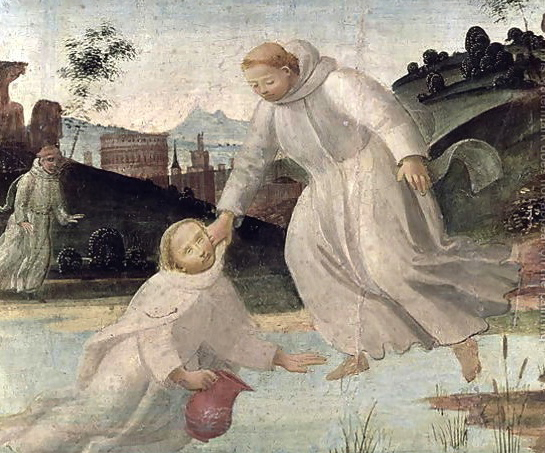
Saint Maurus Walks on Water ~ As told by Pope Saint Gregory the Great

Saint Maurus rescues Saint Placidus by Bartolomeo di Giovanni, ca. AD 1485.
In about AD 530, when Italy was ruled by the unstable successors of the Ostrogothic king Theodoric immediately prior to the Byzantine re-conquest, many noblemen of Rome entrusted their young sons to Benedictus, a holy monk who lived in the mountains of nearby Subiaco. One such boy was Maurus who is identified by Saint Gregory the Great as the son of a noble named Evitius. Another was Placidus, who was brought by Tertullius, a senator.

These two were among earliest disciples of a man who would be known to history as St. Benedict of Nursia.

Writing about 60 years after the fact in his Dialogues, Pope Saint Gregory the Great tells us that Maurus, “growing to great virtue, began to be his master's coadjutor.” Maurus is mentioned as part of several episodes in Gregory’s biography of Benedict as contained in the Dialogues. The best known of these anecdotes runs as follows:
On a certain day, as venerable Benedict was, in his cell, the foresaid young Placidus, the holy man's monk, went out to take up water at the lake, and putting down his pail carelessly, fell in himself after it, whom the water forthwith carried away from the land so far as one may shoot an arrow. The man of God, being in his cell, by and by knew this, and called in haste for Maurus, saying: "Brother Maurus, run as fast as you can, for Placidus, that went to the lake to fetch water, is fallen in, and is carried a good way off." 
Click here for more info.
A strange thing, and since the time of Peter the Apostle never heard of! Maurus, craving his father's blessing, and departing in all haste at his commandment, ran to that place upon the water, to which the young lad was carried by force thereof, thinking that he had all that while gone upon the land: and taking fast hold of him by the hair of his head, in all haste he returned back again: and so soon as he was at land, coming to himself he looked behind him, and then knew very well that he had before run upon the water: and that which before he durst not have presumed, being now done and past, he both marveled, and was afraid at that which he had done.
Coming back to the father, and telling him what had happened, the venerable man did not attribute this to his own merits, but to the obedience of Maurus: but Maurus on the contrary, said that it was done only upon his commandment, and that he had nothing to do in that miracle, not knowing at that time what he did. But the friendly contention proceeding of mutual humility, the young youth himself that was saved from drowning did determine: for he said that he saw when he was drawn out of the water the Abbot's garment upon his head, affirming that it was he that had delivered him from that great danger. 
Saint Maurus would later become famous in his own right. According to tradition, he was sent by Benedict, in company with several other monks, to found a community in the kingdom of the Franks nearby the Loire River. This became Glanfeuil Abbey and the village which grew up around it became known as Saint-Maur-sur-Loire. In the late 19th century, archaeological excavations were undertaken around the modern abbey, which had been destroyed and rebuilt several times over its history, revealing Gallo-Roman sub-structures.

Sadly, the modern abbey was abandoned in 1901 after the monks were driven out of France. It now seems to be privately owned without much external evidence of what it once was. Alas.

On the traditional calendar, the feast of Saint Maurus is commemorated on January 15 along with that of Saint Placidus. These saints are often confused with others of the same or similar names.

Monday, January 21, 2019

"Why are you delaying, executioner?" ~ The martyrdom of Saint Agnes according to the ancient sources

The Martyrdom of Saint Agnes as portrayed in a very Renaissance style by
Paolo Guidotti, late 16th century.
Among the martyrs of Rome during the Great Persecution under Diocletian and Maximian (early 4th century AD), the name of Saint Agnes is certainly one of the most famous. A young girl of perhaps 12 or 13 at the time of her martyrdom, Agnes would later be commemorated in the Roman Canon of the Mass as well as numerous works of art both ancient and modern.

Though no authentic account of her trial has survived antiquity, the passion of Saint Agnes is known from three near contemporary ancient sources. The first is an epitaph which was affixed to her tomb in the catacombs by Pope Damasus in the late 4th century AD. The marble slab containing this epitaph may be seen to this day at the basilica of Saint Agnes in Rome. It reads as follows (in English translation):
Report says that when she had recently been snatched away from her parents, when the trumpet pealed forth its terrible clangor, the virgin Agnes suddenly left the breast of her nurse and willingly braved the threats and rage of the tyrant who wished to have her noble form burned in flames. Though of so little strength she checked her extreme fear, and covered her naked members with her abundant hair lest mortal eye might see the temple of the Lord. O thou dear one, worthy to be venerated by me! O sacred dignity of modesty! Be thou favorable, I beseech thee, O illustrious martyr, to the prayers of Damasus!
The original epitaph of Pope Damasus commemorating the grave site of
Saint Agnes, ca. 370s AD.
The second source is a homily given by Saint Ambrose of Milan, also in the late 4th century. This source contains additional details about the martyrdom of Saint Agnes:
It is the birthday of Saint Agnes, let men admire, let children take courage, let the married be astounded, let the unmarried take an example. But what can I say worthy of her whose very name was not devoid of bright praise? In devotion beyond her age, in virtue above nature, she seems to me to have borne not so much a human name as a token of martyrdom, whereby she showed what she was to be...

...She is said to have suffered martyrdom when twelve years old. The more hateful was the cruelty which spared not so tender an age, the greater in truth was the power of faith which found evidence even in that age. Was there room for a wound in that small body? And she who had no room for the blow of the steel had that wherewith to conquer the steel. But maidens of that age are unable to bear even the angry looks of parents and are wont to cry at the pricks of a needle as though they were wounds. She was fearless under the cruel hands of the executioners, she was unmoved by the heavy weight of the creaking chains, offering her whole body to the sword of the raging soldier as yet ignorant of death but ready for it. Or if she were unwillingly hurried to the altars, she was ready to stretch forth her hands to Christ at the sacrificial fires, and at the sacrilegious altars themselves to make the sign of the Lord the Conqueror, or again to place her neck and both her hands in the iron bands, but no band could enclose such slender limbs.

A new kind of martyrdom! Not yet of fit age for punishment but already ripe for victory, difficult to contend with but easy to be crowned, she filled the office of teaching valor while having the disadvantage of youth. She would not as a bride so hasten to the couch, as being a virgin she joyfully went to the place of punishment with hurrying step, her head not adorned with plaited hair but with Christ. All wept, she alone was without a tear. All wondered that she was so readily prodigal of her life, which she had not yet enjoyed, and now gave up as though she had gone through it. Everyone was astounded that there was now one to bear witness to the Godhead, who as yet could not, because of her age, dispose of herself. And she brought it to pass that she should be believed concerning God, whose evidence concerning man would not be accepted. For that which is beyond nature is from the Author of nature.

What threats the executioner used to make her fear him, what allurements to persuade her, how many desired that she would come to them in marriage! But she answered: “It would be an injury to my Spouse to look on any one as likely to please me. He who chose me first for Himself shall receive me. Why are you delaying, executioner? Let this body perish which can be loved by eyes which I would not.”

She stood, she prayed, she bent down her neck. You could see the executioner tremble as though he himself had been condemned, and his right hand shake, his face grow pale as he feared the peril of another, while the maiden feared not for her own. You have then in one victim a twofold martyrdom, of modesty and of religion. She both remained a virgin and she obtained martyrdom.
Saint Agnes among the procession of female martyrs portrayed in mosaic
in the nave of Saint Apollinare Nuovo in Ravenna, 6th century AD.
The third ancient source is from the Christian Roman poet from Spain, Prudentius. Written about 80 years after the martyrdom of Agnes, Prudentius’s poem contains additional details, some of which are certainly exaggerated for poetic effect. Here is an excerpt in translation:
Within the walls of Rome is laid
Agnes, brave martyr, holy maid;
Twice blest, a martyr’s death to die
And to preserve her chastity.
’Tis said, as yet of tender age,
   But strong in love, that she defied
The edict and the prætor’s rage,
   Still faithful to the Crucified.
By threats and blandishments assailed
In vain, she wavered not nor quailed;
Dauntless and resolute, whate’er
Man’s malice can devise to bear.
Then spake the judge: “This stubborn maid
May hold life cheap, nor be afraid
To bear the lash, and yet may be
Chary of her virginity.
Unless the maiden will incline
Her head before Minerva’s shrine,
Fling her among the vile to be
A toy for foulest ribaldry!”
She said, “I am not left alone:
Christ will not so forget his own.
Bloodstained the sword will be—but I,
Christ helping me, unstained shall die.”
Click here for info.
Prudentius goes on to recount how Agnes was then exposed publicly, though no one dared look upon her. One single youth dared to fix his gaze upon her, but according to Prudentius, he was struck down as if by lightning. A full translation of the poem of Prudentius may be found here.

Although Prudentius’s account contains details which modern readers may find incredible, all three of these ancient sources corroborate the principal facts of Saint Agnes’s martyrdom and bear witness to her extraordinary passion and death.

All three of the above excerpts, along with numerous other accounts of the ancient martyrs, may be found in I Am A Christian: Authentic Accounts of Christian Martyrdom and Persecution from the Ancient Sources.

Wednesday, January 16, 2019

"He bade the lapsed weep for their crimes" ~ The ancient sources for Pope Saint Marcellus who died AD 309

Painting of Saint Marcello in Heavenly Glory which appears above the high
altar of the Basilica of San Marcello al Corso in Rome.
January 16 is the feast day of Pope Saint Marcellus who led the Roman see for a short period during the rule of the pagan emperor/usurper Maxentius over the city of Rome. Marcellus perished in AD 309 and was the last Pope to suffer martyrdom under the pagan administration of the empire.

The 6th century Liber Pontificalis records the highlights of his life, including conflicts with Maxentius that ultimately cost Marcellus his life:
Marcellus, by nationality a Roman, son of Marcellus (or Benedictus) from the district of the Via Lata, occupied the see 4 years. He was bishop in the time of Maxentius, from the 4th consulship of Maxentius, when Maximus was his colleague, until after the consulship.
He established a cemetery on the Via Salaria, and he appointed 25 parish churches as diocese in the city of Rome to provide baptism and penance for the many who were converted among the pagans, and burial for the martyrs.

Click for more info.
He ordained 25 priests in the city of Rome and 2 deacons, in the month of December, and 21 bishops in divers places.

He was seized by Maxentius and held in confinement because he set the church in order, and imprisoned that he might deny his bishopric and degrade himself by sacrifices to demons. Then, forasmuch as he continually despised and scorned the words and commands of Maxentius, he was condemned to the stable.
In her footnote, Louise Ropes Loomis speculates that the “stable” in question here are those maintained as part of the imperial post. This story is not repeated in other sources, says Loomis, but it is not inconsistent with the other facts we know about this turbulent period.

The account in the Liber Pontificalis continues:
But although he served many days in the stable, he did not cease his service to the Lord with prayers and fastings. Moreover in the ninth month, all his clergy came by night and removed him by night from the stable. A certain matron and widow whose name was Lucina, who had lived with her husband Marcus 15 years and had been 19 years a widow, received the blessed man. And she dedicated her house as a church in the name of the blessed Marcellus and there day and night the Lord Jesus Christ was confessed with hymns and prayers.
This is the church known in modern times as San Lorenzo in Lucina where a basilica was subsequently built in the mid-4th century AD, restored and embellished numerous times throughout the centuries. Traces of the original Roman structure may be seen amidst the foundations even to this day.

A fragment of mosaic flooring from beneath the present-day San Lorenzo in Lucina.
The Liber Pontificalis continues:
But Maxentius heard of it and sent and seized the blessed Marcellus a second time and gave orders that in that very church, boards should be laid down and the animals of the stable should be collected and kept there and the blessed Marcellus should tend them. And he died in the service of the animals, clad only in a hair shirt.

And the blessed Lucina took is body and he was buried in the cemetery of Priscilla on the Via Salaria, January 16.

And the bishopric was empty 20 days.

Lucina herself was condemned by proscription.
The remains of the martyred pope were later transferred to the basilica of San Marcello al Corso in Rome. An epitaph of Pope Saint Marcellus, written by Pope Damasus about 80 years after Marcellus’s martyrdom, was found in the cemetery of Priscilla. The epitaph seems to tell a slightly different story than the one found in the Liber Pontificalis:
Click for more info.
The truth-telling ruler, because he bade the lapsed weep for their crimes, became a bitter enemy to all these unhappy men. Hence followed rage and hate, and discord and strife, sedition and slaughter. The bonds of peace are loosed. On account of the crimes of another, who denied Christ in time of peace, he was driven from the borders of his fatherland by the savagery of the tyrant. Damasus wishes to briefly tell these things which he had found out, that people might know the merit of Marcellus.
This translation of the epitaph was taken from I Am a Christian: Authentic Accounts of Christian Martyrdom and Persecution from the Ancient Sources.

Thursday, December 20, 2018

"At the season of the nativity of Our Lord Jesus Christ, masses should be celebrated during the night" ~ The ancient origin of Midnight Mass at Christmas

Fresco from the subterranean basilica of Saint Clement in Rome, showing
Pope Saint Clement (1st century AD) saying Mass. The fresco was likely
 done in the 8th or 9th century, though possibly based on much earlier work.  
As Christmas approaches, it is well to remember that many of the traditional Nativity practices of the Church were instituted deep in antiquity. One such is the celebration of Mass at midnight on Christmas eve. There is evidence that this tradition began as early as about AD 130 and was instituted by Pope Saint Telesphoros. We find the following passage in the Liber Pontificalis which was likely first compiled in the 5th or 6th century:
"[Telesphoros] appointed that at the season of the nativity of Our Lord Jesus Christ, masses should be celebrated during the night, for in general no one presumed to celebrate mass before tierce, the hour when Our Lord ascended the cross. And that at the opening of the sacrifice, the angelic hymn should be repeated, namely: 'Gloria in Excelsis Deo' etc. but only upon the night of the Lord's nativity." [Taken from Loomis: Liber Pontificalis (Book of the Popes), p. 12]
In her notes, Loomis says that this passage is the earliest mention of midnight Mass at Christmas in the extant literature, though she remains skeptical about the passage's accuracy.

As for the institution of the Gloria, it should be kept in mind that the earliest language of the Roman Church was likely Greek, and that the Liber identifies Telesphoros himself as Greek by birth and an anchorite. Therefore, the Gloria was probably incorporated into the Christmas Liturgy in its Greek form. According to tradition, the hymn was not translated into Latin until the time of Saint Hilary of Poitiers around AD 350. But the provenance is confused. A good attempt at clarification may be found here.

In a further note, Loomis says that the Gloria would later be incorporated into Pontifical Masses, and until the Middle Ages, none but the Pope were permitted to include it.

According to the Liber, and confirmed by Irenaeus and Eusebius, Pope Telesphoros died a martyr during the reign of either Hadrian or Antoninus Pius. His feast day is January 5.

For a related post on the earliest sources for the dating of Christmas, see:

Saturday, January 20, 2018

January 20 ~ Martyrdom of Pope Saint Fabian, victim of the persecution of Decius


On this day in Roman history - January 20 - Pope Fabian, the bishop of Rome, was martyred.

In AD 250, the Roman emperor Decius decided that the disasters afflicting the empire were the result of impiety to the gods by the people. To address this issue, Decius decreed that all Romans should publicly offer obeisance to the gods. Any who resisted this command were to be severely punished.

Since Christians steadfastly refused to be bound by this imperial mandate, Decius struck their leaders first. One of the first victims of this persecution was Fabian, the Pope of Rome. It is thought that he perished a martyr while in prison, though a tradition exists that he was beheaded. The Liberian Catalog records that he was martyred on January 20, 250.

Following is Pope Fabian's record from the Liber Pontificalis, first compiled in the 4th century:
Fabianus, by nationality a Roman, son of Fabius, occupied the see 14 years, 1 month and 10 days. He was crowned with martyrdom.
Click here for more info.
He was bishop in the time of Maximus and Africanus (AD 236) until the year when Decius was consul the 2nd time and Quadratus was his colleague (AD 250), and he suffered January 29.
He divided the districts among the deacons and created 7 subdeacons to be associated with the 7 notaries, that they might faithfully compile the acts of the martyrs, omitting nothing. And he commanded many buildings to be erected throughout the cemeteries.
And after his passion, Moyses and Maximus, priests, and Nicostratus, a deacon, were seized and committed to prison. At that time, Novatus arrived from Africa and drew away from the church Novatian and certain confessors. Afterwards, Moyses died in prison, when he had been there 11 months, and therefore many Christians fled to divers places.
He held 5 ordinations in the month of December, 22 priests, 7 deacons, 11 bishops in divers places. He also was buried in the cemetery of Calistus on the Via Appia, January 20. And the bishopric was empty 7 days. 
The persecution under Decius was one of the severest trials the Catholic Church had experienced up to that point. It is thought that thousands were killed, and thousands more publicly renounced their faith to avoid death.

Wednesday, January 17, 2018

"Ho! What's-your-name, I am Pior, your brother." ~ Saint Pior of Scetis in the Egyptian Desert

Saint Anthony the Abbot and Saint Paul the Hermit (by Velazquez, ca. 1634)
Besides being the feast day of Saint Anthony the Abbot, January 17 is also the feast of one of the lesser-known desert fathers, Saint Pior.

As almost no one outside of patristic scholarly circles has ever heard of Saint Pior, here is his brief biography, as taken from the roughly contemporary Ecclesiastical History of Sozomen (penned in the mid 5th century AD):
Pior determined, from his youth, to devote himself to a life of philosophy, and with this view, quitted his father's house after having made a vow that he would never again look upon any of his relations. 
After fifty years had expired, one of his sisters heard that he was still alive, and she was so transported with joy at this unexpected intelligence, that she could not rest till she had seen him. The bishop of the place where she resided was so affected by the groans and tears of the aged woman, that he wrote to the leaders of the monks in the desert of Scetis, desiring them to send Pior to him. The superiors accordingly directed him to repair to the city of his birth, and he could not say nay, for disobedience was regarded as unlawful by the monks of Egypt, and I think also by other monks.
He went with another monk to the door of his father's house, and caused himself to be announced. When he heard the door being opened, he closed his eyes, and calling his sister by name, he said to her, "I am Pior, your brother. Look at me as much as you please." [In the slightly more picturesque version of this story recorded by Palladius in his Lausiac History, Pior opens with, "Ho! What's-your-name, I am Pior, your brother. I am he."] 
His sister was delighted beyond measure at again beholding him, and returned thanks to God. He prayed at the door where he stood, and then returned to the place where he lived.
There he dug a well, and found that the water was bitter, but he persevered in the use of it till his death. Then the height to which he had carried his self-denial was known, for after he died, several attempted to practice philosophy in the place where he had dwelt, but found it impossible to remain there.
Click for more info.
I am convinced that, had it not been for the principles of philosophy which he had espoused, he could easily have changed the water to a sweet taste by prayer, for he caused water to flow in a spot where none had existed previously. It is said that some monks, under the guidance of Moses, undertook to dig a well, but the expected vein did not appear, nor did any depth yield the water, and they were about to abandon the task, when, about midday, Pior joined them. He first embraced them, and then rebuked their want of faith and littleness of soul. He then descended into the pit they had excavated, and, after engaging in prayer, struck the ground thrice with a rod. A spring of water soon after rose to the surface, and filled the whole excavation. After prayer, Pior departed, and though the monks urged him to break his fast with them, he refused, alleging that he had not been sent to them for that purpose, but merely in order to perform the act he had effected. [Taken from the Ecclesiastical History of Sozomen, Book VI, Chapter 29].

Tuesday, January 16, 2018

Saint Anthony the Great ~ "A time is coming when men will go mad..."

Click here to share this image on Facebook.
“A time is coming when men will go mad, and when
they see someone who is not mad, they will attack him,
saying, ‘You are mad; you are not like us.'”

~Saint Anthony the Great
January 17 is the feast day of Saint Anthony the Great, the founder of monasticism. He is reputed to have lived over 100 years, dying in ca. AD 356 after having lived most of his life in the harsh Egyptian desert. Today, he is known by a variety of names, including, among others:
  • Saint Anthony the Abbot 
  • Saint Anthony the Hermit 
  • Saint Anthony of the Desert 
  • Saint Anthony of Egypt
Click here for more info.
The quote above is taken from a work known as Apophthegmata Patrum, or Sayings of the Desert Fathers as translated into English by Benedicta Ward. I have seen bits and pieces of this work all over the internet, but I still need to acquire a copy for myself.

Here are some other samples of quotes from Saint Anthony the Great from the same work:
"God does not allow the same warfare and temptations to this generation as he did formerly, for men are weaker now and cannot bear so much." [My God, what would he say about our own age?]
"Whoever hammers a lump of iron, first decides what he is going to make of it, a scythe, a sword, or an axe. Even so we ought to make up our minds what kind of virtue we want to forge or we labor in vain."
"I saw the snares that the enemy spreads out over the world and I said groaning, "What can get through from such snares?" Then I heard a voice saying to me, 'Humility.'" 
"Whoever has not experienced temptation cannot enter into the Kingdom of Heaven. Without temptations no one can be saved."
These quotes were picked up from a more extensive list here.

An ancient biography of Saint Anthony was written by his near-contemporary, Saint Athanasius of Alexandria, and is available online at newadvent.org. Here is how Saint Athanasius describes the upbringing of Saint Anthony and his call to the ascetic life in about AD 270:
Antony you must know was by descent an Egyptian: his parents were of good family and possessed considerable wealth, and as they were Christians he also was reared in the same Faith. In infancy he was brought up with his parents, knowing nought else but them and his home. But when he was grown and arrived at boyhood, and was advancing in years, he could not endure to learn letters, not caring to associate with other boys; but all his desire was, as it is written of Jacob, to live a plain man at home [Genesis 25:27].
With his parents he used to attend the Lord's House, and neither as a child was he idle nor when older did he despise them; but was both obedient to his father and mother and attentive to what was read, keeping in his heart what was profitable in what he heard. And though as a child brought up in moderate affluence, he did not trouble his parents for varied or luxurious fare, nor was this a source of pleasure to him; but was content simply with what he found nor sought anything further.
After the death of his father and mother he was left alone with one little sister: his age was about eighteen or twenty, and on him the care both of home and sister rested. Now it was not six months after the death of his parents, and going according to custom into the Lord's House, he communed with himself and reflected as he walked how the Apostles left all and followed the Savior; and how they in the Acts sold their possessions and brought and laid them at the Apostles' feet for distribution to the needy, and what and how great a hope was laid up for them in heaven.
Pondering over these things he entered the church, and it happened the Gospel was being read, and he heard the Lord saying to the rich man 'If you would be perfect, go and sell that you have and give to the poor; and come follow Me and you shall have treasure in heaven.' Antony, as though God had put him in mind of the Saints, and the passage had been read on his account, went out immediately from the church, and gave the possessions of his forefathers to the villagers — they were three hundred acres, productive and very fair — that they should be no more a clog upon himself and his sister. And all the rest that was movable he sold, and having got together much money he gave it to the poor, reserving a little however for his sister's sake.
From Athanasius's work may also be found the explanation of the strange painting of Saint Anthony featured above (by Bernardino Parenzano, ca. AD 1494) as he is beset by all variety of demonic forces while he lived alone in the ruins of an abandoned fort:
"But those of his acquaintances who came, since he did not permit them to enter, often used to spend days and nights outside, and heard as it were crowds within clamoring, dinning, sending forth piteous voices and crying, '"Go from what is ours. What do you even in the desert? You can not abide our attack."
"So at first those outside thought there were some men fighting with him, and that they had entered by ladders, but when stooping down they saw through a hole there was nobody, they were afraid, accounting them to be demons, and they called on Antony. Them he quickly heard, though he had not given a thought to the demons, and coming to the door he besought them to depart and not to be afraid, "For thus," said he, "the demons make their seeming onslaughts against those who are cowardly. Sign yourselves therefore with the cross, and depart boldly, and let these make sport for themselves."
"So they departed fortified with the sign of the Cross. But he remained in no wise harmed by the evil spirits, nor was he wearied with the contest, for there came to his aid visions from above, and the weakness of the foe relieved him of much trouble and armed him with greater zeal. For his acquaintances used often to come expecting to find him dead, and would hear him singing, "Let God arise and let His enemies be scattered, let them also that hate Him flee before His face. As smoke vanishes, let them vanish; as wax melts before the face of fire, so let the sinners perish from the face of God." And again, "All nations compassed me about, and in the name of the Lord I requited them."
Saint Anthony the Great's vividly described torments and temptations have been the subject of numerous magnificent and disturbing works of art down through the centuries, by artists from Giotto and Michaelangelo to Bosch and Dali.

Despite secluding himself in the desert, Anthony became known across the world. Athanasius expounds upon his renown, saying:
His fame has been blazoned everywhere; that all regard him with wonder, and that those who have never seen him long for him, is clear proof of his virtue and God's love of his soul. For not from writings, nor from worldly wisdom, nor through any art, was Antony renowned, but solely from his piety towards God. That this was the gift of God no one will deny. For from whence into Spain and into Gaul, how into Rome and Africa, was the man heard of who abode hidden in a mountain, unless it was God who makes His own known everywhere, who also promised this to Antony at the beginning? For even if they work secretly, even if they wish to remain in obscurity, yet the Lord shows them as lamps to lighten all...

Tuesday, January 09, 2018

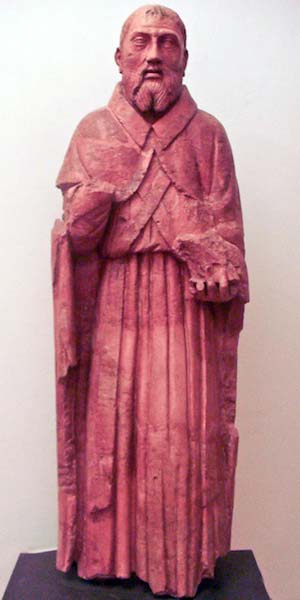
"The fire marvelous strangely turned back" ~ Saint Marcellinus of Ancona

Terracotta statue of
St. Marcellinus of Ancona,
dated to the early 1300s.
The Dialogues of Pope Gregory the Great contain numerous picturesque accounts of late antiquity, all framed within his stories of virtuous men and women of Italy. In many cases, these accounts amount to the only written record of the individuals described that have come down to us from ancient times.

One of these is the curious tale of Saint Marcellinus of Ancona whose feast day is today, January 9. Here is the brief account offered by Pope Saint Gregory to his interlocutor, Peter, of a great miracle wrought by Saint Marcellinus:
GREGORY: "Marcellinus, also a man of holy life, was Bishop of the same city of Ancona [as described in the previous story of St. Constantius], who was so sore troubled with the gout, that being not able to go, his servants were enforced to carry him in their hands. Upon a day, by negligence, the city was set on fire, and though many labored by throwing on of water to quench it, yet did it so increase and go forward that the whole city was in great danger, for it had laid hold of all the houses that were next it, and consumed already a great part of the town, none being able to help or withstand it.
Click for more info.
"In so pitiful a necessity and great danger, the Bishop, carried by his servants, came thither, and commanded himself to be set down right against those furious flames, and in that very place whither the force of the fire did seem most to bend: which being done, the fire marvelous strangely turned back into itself, and as it were cried out, that it could not pass the Bishop. And by this means was it stopped from going forward, [and] went out of itself, not being able to touch any other buildings. By which, Peter, you see what an argument of great holiness it was, for a sick man to sit still, and by his prayers to quench those raging flames." 
PETER: "I do both see it and much wonder at so notable a miracle."
For this reason, the intercession of Saint Marcellinus has been invoked against fire by pious Catholics for centuries.

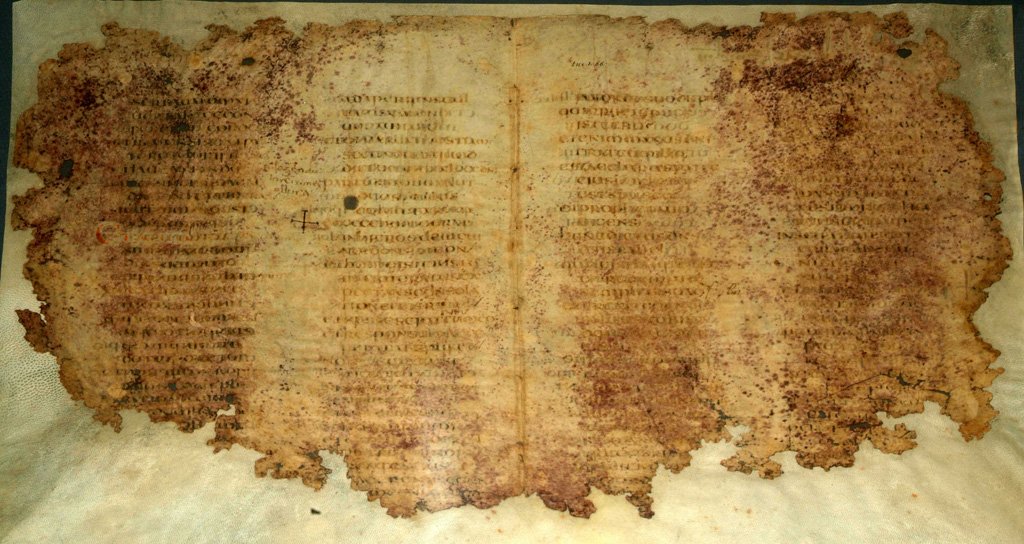
It is said in secondary sources that Marcellinus was bishop of Ancona from AD 550 through AD 566. I could not find confirmation of these dates in any of the ancient sources I am able to access, but I suppose it is based on his association with the Gospels of Saint Marcellinus, a mid-sixth century manuscript that is preserved in the Museo Diocesano di Ancona to this day.

A fragment of the 6th century Gospel manuscript associated with St. Marcellinus.
If true, it means that the fire at Ancona and St. Marcellinus's subsequent miraculous intervention, took place during Gregory's own lifetime. While he clearly heard this tale second-hand—probably from the same friends who related to him the stories of Saint Constantius of Ancona—his witness is nonetheless contemporary and therefore especially noteworthy.

Friday, January 05, 2018

Sound advice for parents from Saint John Neumann of Philadelphia

Click here to share this image on Facebook.

January 5 is the feast day of Philadelphia's own Saint John Neumann. If you have ever been to his shrine at Fifth Street and Girard Avenue in Northern Liberties, Philadelphia, then you know that his remains are on public display in the lower church of Saint Peter the Apostle parish. Though there are some claims that his body is incorrupt, I do not believe that's the case. In any event, his face is covered by a wax mask which is visible in the photo below.
This photo taken from here.
The biography of Saint John is available in numerous places and is familiar to many Philadelphia-area Catholics. A good brief summary of his life and works may be found by clicking here.

But to get a real sense of what Saint John Neumann was about, it's helpful to delve into some of his writings. Please enjoy the following excerpt from one of his pastoral letters. Here we see the powerful, challenging words of a Catholic prelate who took the teaching role of the bishop seriously. He spoke not words that tickled the ears or made folks comfortable in their sins. Rather, he fearlessly reminded Catholic parents of their grave responsibility to put their own wants and needs second, and to focus on nurturing goodness and piety in their children:
"Frequent the church and not the taverns.
"Banish from your homes dangerous books, the bane of purity in every age, the scourge of modern society.
"Watch over the children whom God hath confided to you, if you would not set the seal to your own condemnation. For Christ's sake who said -"Suffer the little children to come unto Me, and forbid them not, for of such is the Kingdom of God" (Mark 10:14) -- bring them to Him by your good life and holy conversation. Allow them not to grow up in ignorance and vice. Teach them to pray: to pray for all men; benefactors, friends and enemies; to love their homes, their native land, and never to be ashamed of their Religion; rather to be always ready to reply in the spirit of the noble St. Hilary to the Emperor Constantius, "I am a Catholic, I am a Christian; I will not be a Heretic."
Taken from his pastoral letter of November 4, 1854. Click here to read the full letter. 

Would to God that more Catholics, past and present, had listened to this sound advice and taken it to heart. How many of our current societal ills may have been ameliorated?

Wednesday, January 18, 2017

Pulcheria ~ Powerful Roman empress and beloved saint


Click above for a video excerpt of Pulcheria's bio from Hermias Sozomen written during her life.
January 19 is the birthday of Saint Pulcheria. Though little remembered today, Pulcheria played an important role in helping the Eastern Roman Empire survive the 5th century intact. She is commemorated as a saint by the Eastern and Western Churches on September 10.
Roman gold solidus showing
Pulcheria Augusta, crowned by God.

Daughter of the Eastern Emperor Arcadius and granddaughter of Theodosius the Great, Pulcheria was pushed into imperial politics at the tender age of 10. When her father died in AD 408, her younger brother, Theodosius II, inherited the throne as a small child, under the regency of two powerful men at court, the praetorian prefects Anthemius and Antiochus. Pulcheria became her brother's confidant and guardian, and by her 15th year, she felt strong enough to dismiss the regents, guiding Theodosius II in her own right.

Below is an account from the Ecclesiastical History of Sozomen which was written soon after Pulcheria's death. It offers a first-hand glimpse into the life of this powerful, holy woman of the early Church.
[The emperor] Arcadius died. He left Theodosius, his son, who was just weaned, as his successor to the empire. He also left three daughters of tender age, named Pulcheria, Arcadia, and Marina....The Divine Power which is the guardian of the universe foresaw that the emperor would be distinguished by his piety, and therefore determined that Pulcheria, his sister, should be the protector of him and of his government.
This princess was not yet fifteen years of age, but had received a mind most wise and divine above her years. She first devoted her virginity to God, and instructed her sisters in the same course of life. To avoid all cause of jealousy and intrigue, she permitted no man to enter her palace. In confirmation of her resolution, she took God, the priests, and all the subjects of the Roman empire as witnesses to her self-dedication. In token of her virginity and the headship of her brother, she consecrated in the church of Constantinople, a holy table, a remarkable fabric and very beautiful to see. It was made of gold and precious stones, and she inscribed these things on the front of the table, so that it might be patent to all.

This detail of the Trier Ivory is thought by some
to show the diminutive Pulcheria (right) receiving
relics of saints from her brother, Theodosius II (left).
After quietly resuming the care of the state, she governed the Roman empire excellently and with great orderliness. She concerted her measures so well that the affairs to be carried out were quickly decreed and completed. She was able to write and to converse with perfect accuracy in the Greek and Latin languages. She caused all affairs to be transacted in the name of her brother, and devoted great attention to bringing him up as a prince in the best possible way and with such information as was suitable to his years. She had him taught by the most skilled men, in horsemanship, and the practice of arms, and in letters. But he was systematically taught by his sister to be orderly and princely in his manners. She showed him how to gather up his robes, and how to take a seat, and how to walk. She trained him to restrain laughter, to assume a mild or a formidable aspect as the occasion might require, and to inquire with urbanity into the cases of those who came before him with petitions. But she strove chiefly, to lead him into piety, and to pray continuously. She taught him to frequent the church regularly, and to honor the houses of prayer with gifts and treasures. And she inspired him with reverence for priests and other good men, and for those who in accordance with the law of Christianity, had devoted themselves to philosophy.

Click for more info.
She provided zealously and wisely that religion might not be endangered by the innovation of spurious dogmas. That new heresies have not prevailed in our times, we shall find to be due especially to her, as we shall subsequently see. With how much fear she worshiped God, it would take long for any one to say, and how many houses of prayer she built magnificently, and how many hostelries and monastic communities she established, the arrangement for the expenses for their perpetual support, and the provision for the inmates.
A bit more about Pulcheria's virtues and piety excerpted from Sozomen may be found on this post.

When Theodosius II died tragically after a fall from a horse in AD 450, Pulcheria played an active role in choosing his successor. According to the Ecclesiastical History of Evagrius, Pulcheria herself recommended Marcian based on his virtues, and consented to marry him to solidify his claim to the throne and in the hopes of providing stability to the empire which was faced with serious threats both internal and external. Evagrius writes:
Click for more info.
[Marcian] received the sovereignty not as an inheritance, but as the prize of virtue, conferred by the unanimous voice both of the senate and men of all ranks, at the suggestion of Pulcheria, whom he also espoused as his partner in the imperial dignity, though she still remained a virgin to old age.
Shortly thereafter, Pulcheria and Marcian, with the support of Pope Saint Leo the Great, assembled the Council of Chalcedon which dealt a decisive blow to the Nestorian heresy and would have a tremendous impact on the Church going forward. A great tribute to her life was given by Leo who wrote to her in AD 451, saying:
"However varied may be the attacks of wicked men upon the Christian Faith, yet when you are present and prepared by the Lord for its defense, it cannot be disturbed. For God will not forsake either the mystery of His mercy or the deserts of your labors, whereby you long ago repelled the crafty foe of our holy religion from the very vitals of the Church." [Read more here.]