Showing posts with label art. Show all posts

Wednesday, July 31, 2024

Mocking Christ in Paris

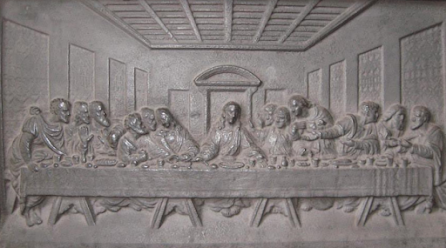
The Last Supper in cast iron, as found in the Mercer Museum, Doylestown, PA
I'm not going to get into the details of the disgusting mockery of the Last Supper perpetrated by those responsible for the opening ceremonies of the 2024 Olympic Games in Paris. Let it suffice to say that the blasphemous display was perfectly in keeping with the evil times in which we live. So I congratulate the Paris Olympics Committee for providing an unmistakable public proof of just how vulgar and odious French culture has become, and broadcasting it to the wide world.

That said, there is a social media trope out there that maintains that the tawdry performance was not meant to ridicule the Last Supper at all. That it was, instead, merely an attempt to mimic a well-known French painting showing the pagan gods at a Bacchanalian. Those who can not appreciate this homage to French art—so the trope goes—as performed by a bunch of overweight men prancing around in their granny's flapper garb, are ignorant, uneducated, intolerant, overly-sensitive, and otherwise bad people who can be safely ignored. 

I took the time to research and respond to one such post that showed up in my feed. I am recording my findings here for posterity because I fully expect that my response will be summarily deleted by the original poster or memory-holed on the particular social media platform where I posted it.

For the record, the original painting was by a Dutchman, Jan Harmensz van Biljert, not a Frenchman. And the painting, The Feast of the Gods, is itself pretty clearly a parody of da Vinci's Last Supper, but with a Bacchanalian twist. 

Furthermore, someone at Paris2024 apparently admitted to Washington Times reporter Valerie Richardson that the insipid performance was, in fact, "inspired" by the Last Supper. 


In case the image gets pulled down later (which has happened before), the text of the email reads as follows:

Dear Valerie,

Thank you for your inquiry. Please find below a statement, which can be attributed to a Paris 2024 spokesperson.

“Clearly, there was never an intention to show disrespect towards any religious group or belief. On the contrary, each of the tableaux in the Paris 2024 Opening Ceremony were intended to celebrate community and tolerance.

“For the ‘Festivities’ segment, Thomas Jolly took inspiration from Leonardo Da Vinci’s famous painting to create the setting. [Bold is mine] He is not the first artist to make reference to what is a world-famous work of art. From Andy Warhol to the Simpsons, many have done it before him.” 

Best,

The Communication Team
Paris 2024

If you need more evidence of the intentionality of this cheap shot at Christians, and the subsequent lying about it, screenshots of later-deleted posts by folks involved may be found here: Lying about the Olympic Last Supper a sign of our times.

May St. Genevieve, St. Louis, St. Joan, and St. Therese pray for France which has fallen down.

Thursday, March 14, 2024

A Review of Cabrini -- A saintly biopic marred by boring Hollywood tropes

Mother Cabrini (played by Cristiana Dell'Anna) receives the reply of
Pope Leo XIII (played by Giancarlo Giannini)

My wife and I went to see Cabrini last night. Given the mixed yet passionate reaction to the film by a variety of folks whose opinions I respect, I was looking forward to it. Having now seen it, I think the mixed reaction is completely appropriate.

My reaction was also mixed, though tending more toward the negative. 

On the positive side, the film had a lot of spoken Italian in it which was fun. It was also well acted and beautifully shot, with a moving soundtrack that reminded me of a cross between The Village and Master and Commander. Though there have been some complaints that Catholic spirituality is not overtly put into the mouth of a Catholic saint (a valid complaint to be sure), Catholic spirituality saturates the background of the film. There are crosses and other Catholic symbols in practically every scene, and several scenes take place in beautiful Catholic churches and buildings. So we end up with some beautiful Catholic settings for a not particularly Catholic film.

The lead role was well played by Cristiana Dell'Anna who provided a convincing likeness of Mother Cabrini. Pope Leo XIII is played sympathetically by Giancarlo Giannini, though I thought he resembled Pope Pius IX more than Leo XIII.

That said, I felt that the film was too dark and brooding for the story of a Catholic saint. The first third of the film is purposely dark, focusing on Mother's illness and all of the "no" answers she receives from the men who are in positions of authority over her. The film does lighten up in spots, but the overall ambience is darkness and obscurity.

What truly drove Mother Cabrini was left largely unexplored. The inferences one must draw from the film are the typical boring Hollywood tropes -- follow your heart; don't let the naysayers get you down; I am woman, hear me roar. The film presents a woman primarily motivated by an altruistic desire to help other Italians. So rather than being driven by the Gospel message of Jesus Christ to take care of the poor, Mother is portrayed, rather, as the celibate CEO of an Italian NGO in America. There is also an insinuation that she is at least partly driven by spite. Every time she faces an obstacle, the Cabrini in the film hears in her head an admonition given early in the film by a patriarchal archbishop: "Stay where you belong." This very worldly urge, rather than any divine inspiration, seems to motivate her to do bold things.

The film also spent considerable time building up the Italian immigrant-as-victim trope. While nativist sentiments were no doubt major obstacles for the first waves of Italian immigrants coming to America, there was another issue at play that the film studiously avoids: the hatred of Catholics by the largely Masonic ruling elite. (This particular angle was effectively brought to the fore in the film For Greater Glory, another imperfect though more inspiring film.) Though forty years after the height of the KnowNothing period when Catholic churches were torched in several cities, there was still a strong antipathy toward Catholics among the upper echelons of American society that persists to this day. While it wasn't long before Italians were accepted as Americans, devout Catholics have never really been. If you need evidence of that, consider the overtly anti-Catholic emails of Hillary Clinton campaign chair, John Podesta in 2016, or how our current "Catholic" president's Department of Justice classifies traditional Catholics among potential terrorist groups

As other reviewers have pointed out, the filmmakers also managed to turn Mother Cabrini into something of a Mary Sue. Whatever she accomplishes, she does via the force of her own powerful will. She draws her strength not from God nor from the Gospel, but from within herself. That is not a Catholic mentality at all, and I'm sure the real Mother Cabrini would have been horrified at being portrayed that way. This seems to have been done in service to a narrative that is not in keeping with the actual life of the saint.

Finally, the ending of the film was anti-climactic and strange. 

SPOILER ALERT -- stop here if you don't want to read what happens at the end...

In the movie, Mother Cabrini achieves her final victory via political blackmail -- threatening the mayor of New York that she will unleash a negative publicity campaign against him and work to get him defeated in the next election unless he allows her hospital project to go forward. She also indicates that she is willing to help him if he helps her -- a sort of "pay to play" arrangement. The fictitious Mayor Gould (who is portrayed effectively by John Lithgow as a racist political animal) is impressed by Mother's rather savvy tactics and agrees to her terms. I have no idea how much of this scenario is based on reality, but it didn't strike me as a particularly fitting denouement to a biopic of a Catholic saint. 

So overall, I give Cabrini two stars. It's worth watching once, but having now seen it, I have no desire to see it again. Instead, I'll go and read more about The Intense Catholic Spirituality of Mother Cabrini.

Tuesday, October 18, 2022

"The Holy Apostle Luke Painted this Image" ~ The traditional Lucan origin of the icon of the Hodegetria

15th century Greek representation of St. Luke painting the Hodegetria icon.

Today is the feast of Saint Luke, a father of the ancient Church renowned as Evangelist, Historian, and Physician. We should be aware of one additional title that is traditionally attributed to this early disciple of Christ: Artist. For the name of Saint Luke is attached to one of the most venerable works of art of the ancient Church—the Hodegetria icon which resided in Constantinople until its destruction in 1453. 

While the origins of the Hodegetria icon are shrouded in mystery, its connection to St. Luke is based upon traditions stretching back to the early centuries of Constantinople as a Christian capital. Among the most ancient sources to record this tradition is a manuscript known as the Anonymous Mercati, a document penned by an English pilgrim who journeyed to Constantinople in the 11th century AD. A translation of the key passage may be found in Pentcheva's work, Icons and Power: The Mother of God in Byzantium. Here is a snippet:

“In the part of the palace near the church of Hagia Sophia, very near to the great palace by the sea, is situated the monastery of the Mother of God, Theotokos. And in this monastery there is a holy icon of the Theotokos, called Hodegetria, which can be translated as “She Who Leads the Way.” … The holy apostle Luke painted this image of the Mother of God holding the Christ Child on her arm.” (Pentcheva, Icons and Power, page 126).

There is a further legend that explains how this icon of the Mother of God, presumably painted by St. Luke in Antioch (Luke’s presumed home town), Jerusalem, or some other city in the Levant, became associated with Constantinople. A late 14th century text known as the Logos Diegematikos holds that the icon was sent from the Levant by the empress Eudocia to her sister-in-law, Saint Pulcheria, in the mid-5th century AD:

“In fact, the empress Eudocia, upon receiving these holy and divine gifts [the Hodegetria icon and relics] from those holy monks like some much-valued treasure, sent them to the empress Pulcheria….Which gift, Pulcheria, as one could say, receiving it with great joy, deposited in the famous and holy sanctuary of the Theotokos and ordered the holy and sacred icon to be in the church as a protection of the palace, the entire city, and the whole world.” (Pentcheva, Icons and Power, page 128).

A previous post on this blog notes that Eudocia was indeed resident in both Antioch and Jerusalem for a time. Readers will also recall posts about Saint Pulcheria here and here, as well as a post demonstrating Pulcheria’s keen interest in bringing relics to Constantinople. Another post, citing a passage in the writings of St. John Damascene in the 8th century, indicates that Pulcheria and her consort, the emperor Marcian, had an interest in Marian relics and had specifically sought (though in vain) for the body of the Mother of God.

Pentcheva believes that the late recording of these acts make it likely that they are mere interpolations of medieval writers. An alternative viewpoint may be found in Grotowsky's The Hodegon: Considerations on the location of the Hodegetria sanctuary in Constantinople (Byzantina Symmeikta, Volume 27). This excellent work compiles and interprets the fragments of history on the Hodegetria that have come down to us. 

This story of St. Luke painting the famous icon has served as fodder for other artists down through the centuries. The version shown at the top of this post was painted by an unknown Greek artist, likely in the early 15th century shortly before the fall of Constantinople to the Turks. Below is a fanciful version, showing Our Lady and the Christ child actually sitting for their portraits, with both the artist and the subjects dressed in Renaissance garb and looking very Dutch.

Saint Luke Painting the Virgin, Derick Baegert, ca. 1470.

Next, we see an even more fanciful, proto-Baroque rendition of the same event as imagined by Florentine artist Giorgio Vasari, complete with Saint Luke’s symbol (the ox) and the heavenly Virgin attended by cherubs. 

Saint Luke Painting a Portrait of the Madonna, ca 1565

As recorded by the 15th century Greek historian Constantine Dukas, the original Hodegetria icon was destroyed by the Turks after the sack of Constantinople in AD 1453. As the story goes, four Turkish looters found it in the Chora monastery where it had been placed to protect the city during the siege. The Turks debated over which of them should possess it, and utilizing the wisdom of Solomon, decided to break it into four pieces. 

There are many likely spurious accounts, however, which maintain that the true icon was spirited out of Constantinople at some point during its long history, with several cities in Italy, including Venice, claiming ownership. The Poles also claim that the icon of Our Lady of Czestochowa is the original Hodegetria. For more on these claims, see, Wolff, "Footnote to an Incident of the Latin Occupation of Constantinople: The Church and the Icon of the Hodegetria" (Traditio, vol. 6 (1948), pp. 319-328).

Left: Image of the Madonna Nicopeia from Saint Mark’s Basilica, Venice. Right: Icon of
Our Lady of Czestochowa which is housed in Jasna Gora Monastery, Czestochowa, Poland.

Wednesday, April 28, 2021

The enigmatic Saint Vitalis and his magnificent shrine in Ravenna

Mosaic of Saint Vitalis (left) being offered the crown of martyrdom by Christ (right)
with an angel (center) from the apse of the Church of San Vitale in Ravenna.

April 28 is the feast day of Saint Vitalis, an ancient Roman martyr about whom very little is known. The summary of his life from Butler's Lives of the Saints contains much of what is known and can reasonably be speculated about Saint Vitalis:

Saint Vitalis is honored as the principal patron of the city of Ravenna, in which he glorified God by martyrdom in the persecution of Nero. He was a citizen of Milan, and is said in his acts to have been the father of SS. Gervasius and Protasius. The divine providence conducted him to Ravenna, where he saw a Christian named Ursicinus, who was condemned to lose his head for his faith, standing aghast at the sight of death, and seeming ready to yield....Vitalis was extremely moved at this spectacle...he therefore boldly and successfully encouraged Ursicinus to triumph over death, and after his martyrdom carried off his body, and respectfully interred it. The judge, whose name was Paulinus, being informed of what he had done, caused him to be apprehended, stretched on the rack, and, after other torments, to be buried alive in a place called the Palm-tree, in Ravenna, as Fortunatus and his acts relate. These acts add that his wife, Valeria, returning from Ravenna to Milan, was beaten to death by certain peasants, because she refused to join them in an idolatrous festival and riot. 

The relics of St. Vitalis are deposited in the great church which bears his name in Ravenna, and was magnificently built by the emperor Justinian, in 547.

Exterior of San Vitale in Ravenna as it looks today.

The Church of San Vitale in Ravenna still exists to this day and is considered one of the finest examples of Late Roman/Byzantine architecture to have survived antiquity. An octagonal structure which may have been modeled on the lost Domus Aurea in Antioch, the Church of San Vitale contains the famous mosaics of Justinian and Theodora, along with numerous other outstanding works depicting Christ, the saints, biblical scenes, etc., including the image at the top of this post showing Vitalis receiving the crown of martyrdom from the hands of Christ. Here are some additional examples:

San Vitale mosaic depicting the hospitality of Abraham. Click to enlarge.

San Vitale mosaic showing the sacrifices of Abel and Melchisedec. Click to enlarge.

Detail of the Theodora Mosaic in San Vitale, possibly showing the
Gothic princess, Matasuntha, granddaughter of King Theodoric. 
Click to enlarge.

Ceiling of the cupola of San Vitale with Lamb of God motif. Click to enlarge.

The famous Justinian mosaic from San Vitale. Click to enlarge.

Most of these images were borrowed and adapted from Wikimedia Commons. To peruse numerous other images of the interior of San Vitale, click here

Ravenna remains on my bucket list for future travels. Until then, I'll have to settle for these 360-degree views provided by Columbia University. By clicking through these, you can get a sense of how utterly awe-inspiring the great Christian basilicas of the Late Antique period must have been.

360-degree view of the nave.

360-degree view of the apse.

Saturday, March 14, 2020

"In this world, you will have distress." ~ Of Viruses, Mortality, Art and Lent

A banner reading "memento mori" hangs over a winged skull on this grave
marker in the Old Granary Burying Ground in Boston, 18th century.
As much of the world reacts with hysteria to the COVID-19 plague, Catholics continue our journey through Lent. Indeed, the two events coalesce very appropriately. Lent is a penitential season when we are meant to reflect on our life and remember the inevitability of our death. Few things help to focus the mind on this topic more effectively than a deadly, fast-spreading viral outbreak.

We should recall that in the past our ancestors suffered through numerous plagues much more deadly than the current Corona virus with little or no recourse to medical care: The Black Death, cholera, typhus, tuberculosis, smallpox, etc. The response to these plagues can be seen in the artwork from the period, particularly in the style known as “Memento Mori.” Works created in this style focus on the fragility of human life and the inevitability of death. The phrase it self comes from the Latin warning which was meant to be whispered into the ear of a victorious Roman general as he rode in a celebratory triumph through the city or Rome: “Remember, thou art mortal.” Examples of the style may be seen throughout Christian history and in particular in funerary art like the gravestone shown above from Boston.

In keeping with the somber mood of the Lenten season, and to perhaps soothe some of the craziness associated with the ongoing Corona virus freak-out, here are some classic works of art to help us contemplate our own mortality:

Memento Mori from Pompeii, prior to AD 79.
The pleasure-loving Roman pagans living on the slopes of Mount Vesuvius had a healthy respect for death. Here we see a mosaic which once occupied the floor of a Roman villa. It shows a skull representing death sitting atop a butterfly representing the soul and a wheel which may turn in any direction representing fate or fortune. The skull hangs from a level which balances symbols of wealth on one side with symbols of poverty on the other. After the eruption of AD 79, the mosaic would lay under layers of volcanic ash and pumice for centuries. Read more here.

The advent of Christianity largely dispelled such stark portrayals of death—for a while at least. More commonly seen in the surviving artwork of early Christianity are images showing the sufferings and deaths of the martyrs. Works depicting the martyrdoms of the saints are more often associated with victory over death and eternal life. This image from the 11th century Menologion of the Eastern Emperor Basil II shows Saint Ignatius of Antioch being devoured by lions. Far from despairing, the Saint retains a look of steadfastness as he perseveres to the end.

Saint Ignatius of Antioch is devoured by lions in the arena from the
Menologion of Basil II, ca. early 11th century AD.
By the time of the high Middle Ages, however, death has re-emerged as a potent symbolic figure as can be seen in this illuminated page from a French Book of the Hours dated to AD 1450 pictured below. Here we see the gruesome figure of death who comes for all regardless of rank – from the Pope, to the Holy Roman Emperor, to a Cardinal, a king and a knight. Read more here.

Book of the Hours, ca. AD 1450. Click to enlarge.
The next image conveys a similar message. This detail of Death and the Miser by Hieronymous Bosch shows an elderly wealthy man on his deathbed. A demonic creature may be seen tempting him with a bag of gold even at his end, while an angel encourages him to acknowledge the crucifix. Meanwhile a sinister representation of Death stands at the door ready to cast his irresistible arrow.

Death and the Miser by Hieronymous Bosch,
late 15th century AD. Click to enlarge.
A similar artistic theme is known as Vanitas. Less terrifying than the late Medieval and early Renaissance works, the Vanitas genre hearkens back to the Scriptural passage in Ecclesiastes (1:2): “Vanity of vanities, all is vanity.” This refers to the ephemeral nature of life, and the images created in this style are more allegorical, often featuring a mix of the beautiful works of man in various states of disorder, decay or ruin, usually mixed with symbols of death. This image by the 17th century Dutch painter Matthias Withoos is a good example, showing symbols of art, music, exploration, and architecture (is that the pyramid of Cestius back there?) intermingled with natural overgrowth and skulls:

Vanitas by Matthias Withoos, 17th century AD. Click to enlarge.
Another common theme with a similar style is “Sic transit gloria mundi” – a Latin phrase which translates to: “Thus passes the world’s glory.” Below we see a work done by modern painter, Emily Allchurch, in imitation of a work by the 18th century Italian engraver Giovanni Battista Piranesi. Piranesi's original may be seen here. In her work, Allchurch transplants Piranesi’s fantastical view of the Roman tombs at the intersection of the Via Appia and the Via Ardentina to a more contemporary setting, adding subtle street-signs and making them the approach to the skyscrapers of modern London, hinting that even the seeming permanence of modernity is subject to the same ruin as antiquity.

Sic Transit Gloria Mundi by Emily Allchurch, 2014. Click to enlarge.
All that said, we are enjoined as Christians to be hopeful. Despair and panic are decidedly pagan responses, and even the most enlightened pagans, like Plotinus of Lycopolis, could only offer cool apathy when faced with the certainty of death, saying (in paraphrase): "he is not to be thought great who thinks it strange that wood and stones should fall and mortals die." But the Gospel of Jesus Christ has something better to offer for those standing face-to-face with their own morality. When considering these things, we must remember that Jesus said: “In this world, you will have distress. But have confidence. I have overcome the world.” (John 16:33).

Ultimately, pondering our mortality isn’t the ends of Lent. It is only a prelude to the glory of the resurrection at Easter and the hope of eternal life.

Christ heals a woman who touches the hem of his
garment from Matthew 9:20. Paleo-Christian fresco in
the catacomb of Saints Peter and Marcellinus, Rome,
ca. late 3rd century AD.

Thursday, March 05, 2020

Highlights from the Late Roman / Byzantine Collection at the Met in NYC

Two silver plaques showing Saint Peter and Saint Paul, late 6th century.
I recently had the pleasure of visiting the Metropolitan Museum of Art in New York City with my daughter. It had been about 25 years since I had last visited, and I didn't remember very much about it. One thing that I definitely did not recall from two-and-a-half decades ago was the small but outstanding late Roman / Byzantine collection.

For once, I was able to take some fairly high-quality photos, so I figured I would share a few highlights.

To begin with, the two silver plaques shown above caught my eye immediately. They feature images of Saint Peter and Saint Paul and were identified as having been made in the late 6th century AD. Above the images of the saints may be seen peacocks which were popular Christian motifs symbolizing immortality. Another silver plaque may be seen below:

Silver plaque depicting two saints holding a cross, 6th century.
Here we see two saints, possibly the evangelists Saint John and Saint Matthew, depicted in silver with a large cross between them. The placard below speculated that the plaque may have formed the cover of a religious book.

Perhaps my favorite piece in the collection was this large gold and silver processional cross:

Middle Byzantine processional cross, front. Click to enlarge.
The placard describing the piece said it was a probably made during the 11th century AD. The front of the cross shows Christ in the central medallion, flanked by the Blessed Mother and Saint John the Baptist. Above is a medallion showing the archangel Michael with Gabriel below. On the back of the cross are more medallions showing the archangels Raphael and Uriel at the top and bottom, with Saints Nicholas and John Chrysostom on the arms of the cross. In the central medallion on the back is pictured Saint Thalelaios, along with an inscription at the base identifying the cross as a votive offering from a bishop named Leo. The back of the cross may be seen below.

Middle Byzantine processional cross, back. Click to enlarge.

Nearby the cross was this magnificent book:

Byzantine Lectionary, possibly from Hagia Sophia, 12 century AD.
This illuminated lectionary gives an idea of what a liturgical book from the early 12th century would have looked like. Even 900 years later, the colors are vibrant and the Greek script is clear.

Then, there was the ivory. Here are two examples from the middle Byzantine period. The top one is a casket showing hunting scenes.

Bone casket identified as 12th century Italian or Byzantine. Click to enlarge.

The next are panels from a casket that has long since fallen to pieces. They show scenes from the biblical Book of Joshua, but the cool thing is that the warriors are depicted in late Roman military garb reflective of the Justinianic mosaics in Ravenna complete with javelins, mailed kilts and oval shields. The panels are identified as having been manufactured sometime from AD 900-1100, but based on how the soldiers are attired, I might speculate that it's somewhat older.

Ivory casket panels, 10th-12th century AD. Click to enlarge.

One of the most fascinating objects on display was this bronze hanging lamp. The placard accompanying it identified it as a votive offering possibly left to a church in thanksgiving for the cure of an ailment of the hand. There is an inscription in Greek saying "Christ help me," and another one saying, "Saints Cosmas and Damian be praised."

Bronze hanging lamp, 6th century AD. Click to enlarge.

I managed to get a really detailed photo of this next item thanks in large part to the good lighting in the area--no flash allowed in the museum. Here we see a heavy gold belt made up of Roman solidi and medallions from various imperial reigns.

Belt made of late Roman gold solidi. Click to enlarge.
Emperors featured on these coins included Theodosius II, Justin I, Justinian, and Maurice. Since the majority of the coins feature Maurice and his coins are the most recent, the belt has been dated to the late 6th century AD and it is speculated that the belt may have been worn as part of the insignia of a high political office.

Finally, we encountered this spectacular floor mosaic showing a late Roman woman. It is pictured below with my very modern daughter for scale:

Early 6th century mosaic showing a personification of Ktisis. 
According to the museum's website, Ktisis is the personification of generous giving and the fact that she is holding a measuring tool may indicate that the mosaic was positioned to honor the benefactor responsible for the construction of a building.

Our trip was a bit of a whirlwind and we were only able to spend about three hours in the museum. But it was enough to get a good taste of the collection and to spend some quality time with late antiquity. Not shown here are the many items from the Greco-Roman, American, Asian, Medieval, Persian and ancient Egyptian collections which we also enjoyed thoroughly.

Monday, April 24, 2017

Late Medieval and Renaissance Art at the Gardner Museum in Boston

During a recent trip to Boston, I visited the Isabella Stewart Gardner Museum. I had been there once over 20 years, and had a vague recollection of the place--enough to remind me that a return trip was necessary.

Though unassuming from the outside, once you enter the Gardner Museum, you are basically stepping into an Italian villa from the 17th century, complete with central courtyard and cloisters. Beyond the gorgeous architecture, the museum houses a first-class collection of artworks from around the world. Frankly, I had forgotten how stunning the collections are, particularly the impressive holdings of Catholic religious works from the late Middle Ages and early Renaissance.

Here are a few photos I took, representing a tiny fraction of the museum's works on display. Please forgive the quality--I went in the evening, so the lighting wasn't great. While these photos don't convey the full experience of visiting this utterly gorgeous edifice, tucked neatly in among some fairly ordinary-looking buildings less than half a mile from Fenway Park, they should be tantalizing enough to entice a visit, no?

Click to enlarge any of these.

Effigy of a knight, tomb sculpture from Salamanca, Spain, ca. 1500.

French altarpiece showing scenes from the Passion of Jesus, ca. 1425.

German statue of St. George
slaying the dragon, ca. 1500.

Risen Christ. Date unknown
(to me, anyway).

The Virgin and Child by Bernardino Pinturicchio, Italian, 1494.

Flemish tapestry from the story of Abraham,
late 16th century.

Saint Engracia, Bartolomé Bermejo, Cordova,
Spain, 1474.

The Resurrection, German or Austrian, 16th century.

Though not Medieval or Renaissance,
here is Ms. Gardner as portrayed by
John Singer Sargent in 1888. She was
48 years old at the time.