Monday, March 14, 2022

"For many a year they will remember the two stout galleons of Manila." ~ The victory of the Spanish over the Dutch at the Battle of Naval de Manila, AD 1646

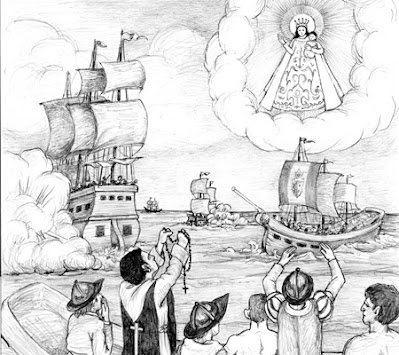
Illustration showing the Battle of Naval de Manila to appear in The Story of the Philippines. 

The more one delves into history, the more one is humbled by what one doesn’t know. Case in point...

March 15 is the anniversary of the beginning of a naval campaign fought between two colonial powers in the year 1646 half-a-world away from Europe. 

Having grown up in an English-speaking country, I often catch myself adopting the conventional historical view of the British navy as presented in literature and film as an unconquerable force. Their most common foes—the Spanish and the French—are normally presented as formidable but hapless. They are numerous enough to appear to be a challenge, but ineptitude, laziness and cowardice always lead to their undoing. This perspective creates an impoverished knowledge of naval history which tends to ignore instances where the naval arms of nations not Britain achieve great victories.

One such victory which I have only encountered very recently (while editing a forthcoming book entitled The Story of the Philippines by Phillip Campbell) is La Naval de Manila—a series of naval battles between the Spanish and Dutch in the Philippine archipelago that decided which European power would rule the Philippines for the next 250 years. Featuring an earthquake, desperate acts of courage, five against-all-odds battles, and a healthy amount of divine intervention, La Naval de Manila has all the elements of a fine epic novel, let alone a thrilling action-adventure movie.

The battle pitted a fleet of eighteen well-armed Dutch corsairs against the scanty forces that the Spanish could assemble to meet the threat. The aim of the Dutch was nothing less than to wrest the Philippines from the Spanish and capture their treasure fleet from New Spain (Mexico). To accomplish this feat, the Dutch organized their ships into three squadrons. These were meant to coordinate their attacks at separate points and thereby spread thin what little defense the Spanish could muster.

Further hampering the Spanish, the capital city of their Philippine possessions—Manila—was a wreck, literally. The city had been rocked four months before by a tremendous earthquake as well as several aftershocks. Describing the magnitude of the quake, Fr. Joseph Fayol, an eyewitness, wrote:

In the first shock, one hundred and fifty of the finest buildings, which in other cities would be called palaces, were totally destroyed; all the other houses were so damaged and dangerous that it has been necessary to demolish them completely. It may be said with truth that only a semblance of Manila remains....Whole Indian villages were overthrown, as their huts are built of so light materials, bamboos and palm-leaves; and hills were leveled. Rivers were dried, which afterward flowed again; others leaving their beds, inundated the villages; great fissures and even chasms, appeared in the open fields. In the Manila River, the disturbance and commotion in its waves was so great that it seemed as if they would flood all the country. [Fayol, Relation of the events on sea and land in the Filipinas Islands...]

To meet the Dutch threat, the Spanish pressed two huge galleons into service, the Encarnación and the Rosario. These already ancient vessels had recently arrived from the arduous journey from Nueva España and were in rough shape. Though ponderous, these great ships possessed a powerful array of weaponry, which was further augmented by guns stripped from forts on land, as described by Fr. Fayol:

In [the Encarnación] were mounted thirty-four pieces of artillery, all of bronze and of the reinforced class, which variously carried balls of thirty, twenty-five, and eighteen pounds. The [Rosario] was equipped with as many as thirty pieces, of the same capacity—although on account of the deficiency in this sort of artillery, it was necessary to dismantle some posts in the fortifications of this city and of Cavite.

The governor-general of the Philippines, Don Diego Fajardo, chose General Lorenzo de Orella as commander and chief of the Spanish squadron. Fr. Fayol offers this heroic description of Don Orella:

...General Lorenzo de Orella y Ugalde, a Biscayan, under whose charge the vessels had sailed from Acapulco [was chosen] not only because of his proved bravery, his experience in the art of war, and his services and commands in both the Northern and Southern Seas, as well as in these islands (particularly in Mindanao, where he fought hand-to-hand with a gigantic Moro and killed him), but because of his well-known Christian spirit of modesty—which, for success, are no less important than valor.

Not trusting to mere earthly power, however, Don Fajardo agreed to allow four priests to accompany the flotilla, two in each ship. As both ships bore religious names, they were sent forth under the protection of Our Lady, the Virgin Mary. Fr. Fayol explains:

As a result of excellent teaching and the fervor of these fathers, arrangements were made that all of the men should, in the first place, purify their consciences with the holy sacraments of penance and communion; that they should take as their special patron saint the Virgin of the Rosary; that in order to bind her further, they should vow to her a feast-day in thanksgiving for the victories which they expected to receive through her agency; and that every day all should recite their prayers aloud, on their knees, and in two choirs—the prayers of the rosary before our Lady's image, the litanies of the most holy name of Mary, and finally an act of contrition.

Beyond these acts of piety, Don Fajardo caused the Blessed Sacrament to be exposed in several churches throughout Manila from the time of the departure of the galleons until their expected return. 

When all was made as ready as temporal and spiritual efforts would allow, the Spanish ships boldly sallied forth to meet the more numerous Dutch in what should have been a very lop-sided affair. However, as Fr. Fayol admits, the Spanish had one thing going in their favor. The hoped-for coordination of the Dutch fleets failed and each one arrived on station at different times, allowing the Spanish the opportunity to fight each of them in detail. The first fleet arrived in Spanish waters in early March and were detected by the Spanish on March 15. Fr. Fayol provides an excellent account of the battle which followed, and I am only too happy to allow his voice to describe the proceedings:  

On arriving at the entrances of Mariveles, the [Spanish] ships were placed in battle array, the artillery loaded, the matches lighted and the linstocks ready, the rigging free, and other preparations made. This was done because the sentinels [on Mariveles Island] warned our men that the enemy were, with their squadron, not far from that place; and that they might expect at any moment to encounter the Dutch—although in fact the latter were not descried until the fifteenth of the said month of March. At nine o'clock in the morning of that day, our almiranta [the Rosario] which had pushed ahead of the flagship perhaps half a league, and was sailing with a northwest wind—fired two cannon-shots and lowered the maintop-sail as a signal that it descried the enemy. The flagship put about, and followed her, and from the maintop they soon saw a sail in the distance, but it was impossible to overtake it; and it soon disappeared, because it was favored by a fresher wind than our ships had.

After that, our galleons were left becalmed until one o'clock; and at that hour were descried from the flagship four hostile sails, which were sailing toward her aft, with an east wind. It was two hours before they reached the flagship, and in that space of time the men were stationed, the ships cleared, the posts reconnoitered, and all other arrangements made, both spiritual and temporal, required by the occasion. The almiranta fell two ship-lengths astern of the flagship, and in this position the ships awaited the enemy, in order to fight them.

As soon as the enemy came near, they extended all their ships, and without attempting to give a broadside to our flagship, passed, in line to larboard, and the enemy's flagship began the battle by firing a cannon. Our commander immediately commanded that response be made with two shots—one with a thirty-pound ball and a cylinder of the same weight, which tore open all their cutwater at the bow. The enemy's ship went on in this condition, and the others continued to exchange shots with our flagship. Recognizing their own strength, the enemy tried to approach the almiranta, which they supposed was not so well armed, being a smaller ship. But they were received with equal valor and spirit on our side, our vessels firing so often and throwing so many balls that they could not be counted.

The fight lasted about five hours, and the mortality and damage were so great that all the anxiety that the heretics had felt to reach our ships when they thought to conquer us was now directed to separating themselves from us. They anxiously awaited the night, which was now approaching, to make their cowardly escape, which they did with lights extinguished. But the enemy's almiranta did not succeed in doing this in safety. It had been the most persistent in the attack upon our flagship, and remained to our leeward. It was so badly damaged that its cannon could not be fired, and hardly could it flee. Our ship was so near it that our commander had the men ready at the bow to board the Dutch ship, but the darkness of night forced us to abandon the chase, on account of the danger from the shoals which the pilots declared were in that place. It was noticed that the enemy did not use lanterns as they had formerly done, seeking protection for their armada. Our commander ordered that they be used in our ships, and that the lights be allowed to shine very brightly, in order that the enemy might come to look for us.

Our people fully intended to renew the pursuit at daybreak, to finish their defeat, but when day came our two galleons found themselves alone, and did not know what course the enemy had taken. They followed the Dutch, in the direction which they thought most probable, as far as Cape Bojeador, which is at the farthest end of this island of Manila. From there our ships returned, as the coasts were now secure, to the port of Bolinao, in order to send to this city dispatches announcing the result of the battle.

This was regarded as a brilliant victory, not only because of the disparity in the number of ships, but because of the little damage our side had sustained. In that battle not a man was killed, and comparatively few were wounded. It was evident that the enemy's loss was great, although we could not then ascertain it correctly. But afterwards we learned that many had been killed and wounded, and that two of their vessels were rendered useless. 

This Spanish victory was only the first in a series of battles which would take place over the next seven months. In each, the elderly Spanish galleons would prove too much for their nimble Dutch adversaries, continuously repulsing their attacks but proving too slow and poorly manned to capture them. 

After the third battle, Don Orella retired and was replaced by Don Sebastian Lopez who was in command of the Spanish ships when the Dutch made their final effort in October of 1646. This battle again ended in failure for the Dutch whose flagship was barely able to escape after a severe mauling. This repulse effectively ended Dutch pretensions in the Philippines. Fr. Fayol concludes his accounts of the battles, saying: 

All these exploits are worthy of great praise...According to the estimate made by well-informed persons, although we fired, in these battles, over 2,000 cannon-shots, and the enemy over five thousand, we had only fourteen killed, and comparatively few wounded. While the enemy, besides the vessels which we sank, arrived at their forts so damaged, and had lost so many men, that for many a year they will remember the two stout galleons of Manila....

Thanksgiving was celebrated by a solemn fiesta, a procession, divine worship, and [a parade of] the squadron, with other demonstrations in fulfillment of the vow made to the Virgin of the Rosary, the city making a new vow to continue this anniversary every year.

[All of the above quotes are taken from Fray Joseph Fayol's Relation of the events on sea and land in the Filipinas Islands during the recent years, until the earthquake and destruction on the feast of St. Andrews in 1645; and the battles and naval victories over the Dutch in 1646. The English translation of this work is taken from The Philippine Islands, 1493-1898, Volumes 34-35, edited by Emma Helen Blair, James Alexander Robertson, 1906.]

The image of Our Lady of La Naval de Manila.
And indeed, this the Fiesta of La Naval de Manila continues to be celebrated in the Philippines to this day. The feast includes a procession of the statue of Our Lady of the Most Holy Rosary of La Naval de Manila, a life-sized figure of the Blessed Virgin that predates the battles, having been carved from elephant ivory in AD 1593. A look at the historical celebration of this feast and the statue of our Lady may be found here

Given the circumstances of the battles, the victories were declared miraculous in nature by the Archdiocese of Manila in 1662. Pope St. Pius X bestowed a canonical crown upon the image in 1907, while Ven. Pius XII recognized the image in an Apostolic letter sent on the 300th anniversary of the victories in 1946. Pope St. John Paul II blessed the statue at a public Mass during his visit to the Philippines in 1981.

Friday, February 18, 2022

"For the worship of abominable idols is the cause, and the beginning and end of all evil." ~ The relationship between idolatry and societal chaos according to Sacred Scripture

The Pachamama idol as it appeared in the Vatican gardens during
the Amazon Synod, October 2019.

"The beginning of fornication is the devising of idols:
and the invention of them is the corruption of life."
Wisdom 14:12

We live in an age when, once again, the words of “Second Coming” by Yeats seem prophetic. The centre is not holding. Anarchy is loosed upon the world. The ceremony of innocence is drowned.

But let’s be honest. Based on what we Catholics have witnessed within our very Church over the past several years, none of this comes as a surprise. As I wrote in a previous article, past ages of the Church have understood that when there is chaos and confusion in the Holy See, there will be chaos throughout the Church and, indeed, in the whole world.

In reading Sacred Scripture with my family the other day, the passage above from the Book of Wisdom stood out. It should be remembered that the Book of Wisdom, sometimes called “The Wisdom of Solomon” is part of the Deuterocanonical literature included in the canon of Sacred Scripture by Catholics and Orthodox and Eastern Christians but rejected by many Protestants. Of this book, Saint Augustine opines:  

“For two books, one called Wisdom and the other Ecclesiasticus, are ascribed to Solomon from a certain resemblance of style, but the most likely opinion is that they were written by Jesus the son of Sirach. Still they are to be reckoned among the prophetical books, since they have attained recognition as being authoritative.” [Augustine: On Christian Doctrine, Book II, Chapter 8]

More modern scholars have speculated that the Wisdom of Solomon was written in Greek in Alexandria during the first century BC. The author most likely invoked the name of Solomon to better catch the attention of his Alexandrian Jewish audience. Given what we know of Alexandria’s reputation in antiquity as not only a center of learning and scholarly dispute, but of grotesque moral depravity, frequent mob violence, insurrection, and lynchings, it is likely that the Wisdom of Solomon was written as an attempt to recall the Jews of that city to the proper conduct in both human and divine affairs.

To that extent, the Jews of Alexandria—as an alien minority in a perverse and dangerous world—may serve as a mirror to faithful Catholics navigating within the greater post-Christian West today. It is in that context that we read the following passage from the Wisdom of Solomon within which the above quote may be found:

And from the beginning also when the proud giants perished, the hope of the world fleeing to a vessel, which was governed by thy hand, left to the world seed of generation [This, I assume, refers to the Ark of Noah]. For blessed is the wood, by which justice cometh [This appears to be a prophecy of the Cross of Christ].

But the idol that is made by hands, is cursed, as well it, as he that made it: he because he made it; and it because being frail it is called a god. But to God the wicked and his wickedness are hateful alike. For that which is made, together with him that made it, shall suffer torments.

Therefore there shall be no respect had even to the idols of the Gentiles: because the creatures of God are turned to an abomination, and a temptation to the souls of men, and a snare to the feet of the unwise. For the beginning of fornication is the devising of idols: and the invention of them is the corruption of life. For neither were they from the beginning, neither shall they be forever. For by the vanity of men they came into the world: and therefore they shall be found to come shortly to an end. [Wisdom 14:6-14]

Further down in this chapter, the prophetic author of Wisdom scribes a passage that could apply to our own times as easily as it did to his:

And it was not enough for them to err about the knowledge of God, but whereas they lived in a great war of ignorance, they call so many and so great evils peace. For either they sacrifice their own children, or use hidden sacrifices, or keep watches full of madness, so that now they neither keep life, nor marriage undefiled, but one killeth another through envy, or grieveth him by adultery: And all things are mingled together, blood, murder, theft and dissimulation, corruption and unfaithfulness, tumults and perjury, disquieting of the good, forgetfulness of God, defiling of souls, changing of nature, disorder in marriage, and the irregularity of adultery and uncleanness.

For the worship of abominable idols is the cause, and the beginning and end of all evil. [Wisdom 14:22-27]

I would encourage you to read the entire passage here

When doing so, please remember to pray for those prelates who have been led astray by the prince of this world and his idols, especially those who have, in their worldly arrogance, dared to set an abomination of desolation in the holy places. They have it within their power to purge the corruption which has entered Christ’s One, Holy, Catholic and Apostolic Church—tomorrow if they wish. May the Holy Spirit inspire them to do so.

I tremble to consider how they will stand before the Just Judge if they fail to repent during this life and continue to lead their flocks so wantonly to destruction.

Thursday, January 20, 2022

"Art thou not Sebastian whom I before commanded to be slain with arrows?" ~ A few interesting points about Saint Sebastian's ancient Passio.

The Burial of Saint Sebastian (1877) by Alejandro Ferrant y Fischermans. Click to enlarge.

Saint Sebastian is one of the great ancient martyrs of the Roman Catholic Church as well as one of the saints most frequently depicted in artwork down through the centuries. The image of Sebastian tied to a stake, his body riddled with arrows, is one of the most immediately recognizable and jarring images of the ancient martyrs.

As with many of the martyrs from the days prior to Constantine, his story has become somewhat muddled. He is mentioned in a homily of Saint Ambrose (On Psalm 118) as having come from Milan. Most of the rest of his biography comes from a Passio of dubious provenance. Scholars of the previous era ascribed this work to Saint Ambrose himself, though more modern scholars tend to dismiss this attribution. Few doubt the antiquity of the Passio, however, and the existing work is commonly dated to the early fifth century—or about a century after the events recorded therein.

As with many of the ancient martyrdom accounts, the Passio has not been translated into English. It does, however, exist excerpted in numerous other works, including a detailed synopsis which may be found at The Cult of Saints in Late Antiquity site, sponsored by Oxford University. 

A different type of synopsis of the Passio may be found in the Homilies of Aelfric of Eynsham, a late 10th century Anglo Saxon abbot who transcribed the Latin tale into Old English for the edification of his monks. Here is the ancient story of Sebastian’s martyrdom as told in part with excerpts from Aelfric’s work. The entirety of the account may be found here: Skeat: Aelfric's Lives of Saints, p. 117 and following.

The Passion of Saint Sebastian, Martyr, January 20

There was a holy servant of God, called Sebastian, who was a long time in the city of Milan for education, and was baptized into Christ with full faith. He was a very prudent man, truthful in word, righteous in judgment, in counsel foreseeing, trusty in need, a prevailing intercessor, shining in goodness, and in all his ways honorable. 

Daily he fulfilled his Lord's service zealously, but he concealed, nevertheless, his deeds from the emperor Diocletian who was the devil's worshipper. Diocletian loved the holy man, notwithstanding, and knew not that he believed in the living God. He set him as prefect over a cohort, and bade that he should always be in his presence; and all the household held him as a father, and honored him with love, because God loved him. He followed the emperor, unknown to him, however, not as if he durst not suffer for his Lord, but he desired to encourage those whom the heathen emperor daily killed for their faith in Christ.

Diocletian, as we know, reigned from AD 284 through AD 305 when he abdicated and retired to a fortified palace on the Dalmatian coast. The notion that secret Christians may have existed in the court of Diocletian is in no way surprising and jives well with the account of Lactantius in On the Deaths of the Persecutors. Indeed, it is possible that Diocletian’s own wife, Prisca, and daughter, Valeria, were secret Christians

Sebastian was able to use his position in the court to console the brothers Marcus and Marcellianus who were imprisoned as Christians by Chromatius, the Prefect of Rome, and condemned to death unless they offered sacrifice to the pagan divinities. These brothers were from an aristocratic family and both wavered as their family members attempted to convince them to save their lives by abjuring the Christian faith. Due to the stature of their families, Chromatius offered a thirty day reprieve for the martyrs to consider their position.

During this time, however, Sebastian convinced the family of Marcus and Marcellianus to accept Christ. When the thirty days expired, Tranquillinus, the father of the young men, came before Chromatius and professed his own faith in Christ, mentioning that his gout had been cured following his baptism. As it turns out, Chromatius suffered from the same ailment and would later secretly summon Sebastian and the priest Polycarp so that they might also heal him. In order to effect the healing, Sebastian and Polycarp endured a three day fast, after which they returned to Chromatius and enjoined him to allow them to destroy all the pagan idols in his house. Chromatius agreed, and the two Christians proceeded to burn, smash, or melt down all of the 200 images of the pagan divinities in the house. 

What happens next is very strange indeed, as it seems to tie this ancient Christian literary source to one of the most fascinating archaeological discoveries of the 20th century.

When Chromatius failed to recover after his house was cleansed, Sebastian and Polycarp then deduced that something evil must yet remain in his house. At this point, Chromatius reveals something interesting: 

“I have in my treasure-chest a wonderful instrument, for my information, according to the position of the stars as they stand in the heavens. On that instrument Tarquinius, my father, spent of red gold alone more than two hundred pounds.”

Previously in the same narrative, this instrument is described as follows: 

An excellent work of mechanical contrivance, of glass, and gold, and of glistening crystal. This instrument was designed to show with certainty by the stars what should happen to every man in the course of his life; but it was so formed according to the heathen error.

The remains of the so-called Antikythera Mechanism, believed to be an
ancient machine used to compute the movement of the stars and planets.

Does this sound familiar? If you are at all aware of Mediterranean archaeology, it should. In 1901, some sponge divers found a strange ancient artifact in the waters off the Greek island of Antikythera. This item would become known as the Antikythera Mechanism, a type of ancient gear-driven computer used to predict the movements of the stars. It is tantalizing to think that this passage in the Passio of St. Sebastian is actually describing a similar type of machine. It may also be an indication that the Antikythera mechanism was not unique and that other similar devices were known even as late as the 5th century AD.

To get back to our narrative, Sebastian and Polycarp then discoursed to Chromatius upon the evils and vanity of astrology, indicating that the infernal machine must be disposed of. They even put their lives on the line, saying that if they broke the costly device and Chromatius did not recover from his illness, then they would submit to being thrown into a furnace and killed. Chromatius agreed. The device was broken. And Chromatius subsequently recovered. As a result, he and his son became Christians. 

Now, certainly there will be some who will latch onto this episode as an example of Christians being so "anti-science" that they even destroyed a precious ancient computing device. Before advancing this claim, however, it is well to keep in mind that the device itself, as expensive and finely crafted as it may have been, was not actually used for any scientific purpose. It was used for the superstitious purpose of attempting to predict the future via the movement of the stars.

Chromatius subsequently resigned his position as Prefect of the city of Rome and was replaced by a certain Fabianus, a man who was much more zealous in carrying out the persecutions mandated by Diocletian against Christians than Chromatius had been. This Fabianus soon laid hold of Marcus and Marcellianus, tortured them, and put them to death. Soon after, he denounced Sebastian to Diocletian as well. 

Given that Fabianus was, supposedly, the Prefect of Rome, it is reasonable to conjecture that the denunciation of Sebastian likely took place in AD 303 when Diocletian was in Rome for the celebration of his Vicennalia or 20th anniversary of his reign. This event was meant to be a great, two month long, triumphal festival commemorating the happy and prosperous reign of Diocletian and Maximian. There is evidence, however, that the event became tragic. The Chronography of AD 354 reports that during the event, 13,000 people were killed when the boxes at the circus collapsed. It is also possible that Pope Marcellinus was martyred during this time.  

Writing in On the Deaths of the Persecutors, Lactantius claimed that Diocletian was so perturbed during the celebrations at Rome that he departed the city prematurely before his consulship could even begin on January 1. He would subsequently become gravely ill on his journey back to Nicomedia.

Let us assume that the unhappy vicennalia celebration at Rome is the setting for the scene described below in Aelfric’s homily as the dramatic conclusion of St. Sebastian's Passio:

Then became Diocletian fiendishly angry, and commanded him to be led out in hard bonds, into a field, and there to be bound, and assailed with arrows until he gave up his life. Then the soldiers led away the servant of Christ, and set him for a mark, even as the wicked man commanded, and fastened their arrows into him before and behind, as thickly on every side as a hedgehog's bristles, and so left him alone, lying for dead.

Then came a certain widow, who was a martyr's relict, in the same night, where he lay sorely wounded, desiring to bury his body, and found him living. Then she brought him to her house alive, and within a few days entirely healed him. Then came the Christians, and urged the [Christian] warrior, that he ought to depart far away from the city.

But Sebastian commended himself to God, and went up to the staircase, which stood against the emperor's palace, and when the emperor came, thus cried to him:

“Your idol-priests who dwell in your temples tell you many lies concerning the Christians, saying that they are verily adversaries to your kingdom, and also to your people; but your kingdom prospereth through their good merits, because they pray for the Roman people and for your dominion, without ceasing.”

Then looked Diocletian, the fiendish murderer, towards the holy man, who stood there so loftily, and said haughtily, “Art not thou that Sebastian, whom I before commanded to be slain with arrows?

Sebastian said, “Christ raised me up again to the end that I might declare to thee before all the people your unrighteous persecution against the Christians.”

Then bade the emperor that the soldier of God should be beaten to death with clubs within his own city. Then the murderers did even as the emperor commanded, and by night hid his holy corpse in a foul sewer, saying amongst themselves, that at least the Christians should not get at his body, and make him into a martyr afterwards.

The most ancient extant image
of St. Sebastian, dating from the
mid-6th century AD, may be found in
Sant'Apollinare Nuovo in Ravenna.
 
Here again, we see a common theme—the desire of the persecutors to deny the martyr's body to the Christian community. 

But the Christians did find Sebastian’s remains. They were recovered by a widow named Lucina who claimed to have been visited by Sebastian in a dream. 

The relics of St. Sebastian would then take on a life of their own, being first deposited in the catacombs at Rome. A basilica would be built over the site in the mid-4th century AD—San Sebastiano fuori le Mura—which would become on one of the seven pilgrim churches of Rome. 

Some of his relics would eventually find their way to Soissons in France in the early 9th century where they would remain until they were plundered and thrown into a ditch by Calvinists in 1564.

It is said that a relic of the top of Sebastian’s cranium may be seen to this day in the church of St. Sebastian in Ebersberg, Bavaria.

A good summary of the remaining relics and their locations may be found in St. Sebastian's entry in Butler's Lives of the Saints. 

Wednesday, January 05, 2022

Guest post ~ "Snap!"

Presenting a retrospective guest post from the late Anthony P. Schiavo, Sr. who would have been 90 years old today. Anthony, or "Speed" as he was known in South Philadelphia, enjoyed science and science fiction. However, it irked him when the fiction prevailed over the science, and occasionally later in life, when the science precluded the spiritual.
In this parody short story that first appeared in the Tarpeian Rock 2003 issue, Speed skewered a familiar franchise that, he felt, played fast and loose with science and spirituality a little too often. I hope you will enjoy...

Did you ever notice that most science fiction that makes it to television just assumes that eventually, empirical data will be discovered that precludes the existence of the spiritual realm? What if....

“Let go you elf-eared adding machine! What in hell are you doing? I have to use the damned MP. Let go, that’s an order!”
     Timothy Janus Jerik, captain of the SpaceWagon CHARTER II, was furious. Despite extraordinary effort—arms flailing and legs straining—First Intellect Aloo Nyvac, held him helpless in the Thoran Clutch. For some reason, Nyvac was preventing him from getting into the Molecular Projector. Obeying Jerik’s order, Nyvac released him but stood in his way. Jerik was dumbfounded. He was used to bizarre theories and actions from Nyvac’s Thoran personality but this was going too far.
     “Look Nyvac, if you’re going to mutiny, have the damned courtesy to use your bLaser. What am I supposed to put in my report? That my wagon was taken over by the use of superior Greco-Roman wrestling?” Jerik was well known for retaining his sense of humor under almost any circumstances. Angry as he was, he had not missed the absurd appearance of the scene he had just played. Besides, there was no real threat to his command. He knew there was a reason. Though he might not understand it—there was a reason. But he was in a hurry.
     “Okay, what in hell’s bothering you? You know I have to get down to New Hawaii. You brought me the report from the Gidget Surf and Turf Colony yourself. Do you realize how serious it is? The Supreme Court of New Hawaii has actually repealed the Laws of Robotics! ‘Highly discriminatory’ they said! The genes of the Ments have all been reprogrammed. LoMent public servants are out of control. They get to work late, leave early, work poorly, and are surly and unresponsive to the public. And they’ve been calling in sick. Sick! LoMents! I’d like to know who thought that using surplus low mentality androids for public service was a good idea.”
     “Probably the same humans who thought that citizens taking turns on the Supreme Court was a good idea.” said Nyvac. But he didn’t smile and he didn’t move.
     Jerik snorted at Nyvac’s comment. “No agricultural permits are being issued down there. Farming may as well be illegal. It’s threatening to turn into a disaster for the cocopinada crop. If we don’t move quickly, it could even turn violent. Besides, we need enforcement $tarBucks badly. We may have an environmental and social cleanup charter but we’re supposed to be paying most of our own way by a little mercenary arm twisting—exactly what they need on New Hawaii. We can’t pass it up for one of your bizarre morality attacks.”
     He pointed to the insignia on his shirt—a connect-the-dots drawing of the Wide Bucket constellation as seen from Olympus enclosing the words CHARTER II. “Do you see this? Do you know what recruits are doing with it? They clip the “R” and call our wagon the 'CHAPTER Eleven' Chamberpot! I’ve been told it’s a big laugh at Space-Navy Headquarters.”
     Uncharacteristically, Nyvac looked pained. “Captain, if Earth is any example, important things get done without public servants and permits; even in spite of them. Besides, history shows that we have almost eighty years to get down to New Hawaii before annihilation of the bureaucracy begins. The skuttle will be repaired in two days, you can use that and still arrive in time. It will take me only a few minutes to explain why you shouldn’t go there or anywhere else by the Molecular Projector for any amount of $tarBucks."
     “Nyvac!” Jerik growled. “What is your problem? We have gone back and forth by MP between the CHARTER and planets and asteroids and other wagons and....Sure we’ve had some malfunctions but we’ve survived, a couple of thousand trips each maybe. You used it this morning! Why are you afraid of it now all of the sudden?"
     “Actually Captain, your record shows twenty-seven hundred and thirty-four projections and mine...”
     “Okay, okay!” Jerik knew argument was useless. “You can have your few minutes. But when you’re finished, I’m getting into the MP and projecting down to New Hawaii, understood?”
     Nyvac said simply, “Captain, do not use that thing—it will destroy your soul.”
     There was silence. Nyvac looked at Jerik with a friendly professorial face, tilted slightly. Jerik however seemed to be having a convulsion. Then, eyes bulging, face aflame, he howled, “Sooooul? Sooooooul? You almost crushed my liver, you’re going crazy and trying to drag me with you to save my soul? Do you think MP stands for Mephistopheles? You don’t have enough jobs on this wagon, you want to be the damned First Theologian too? There is no such thing as a soul, there is only matter, energy, and their properties. Everything else there is doesn’t exist. I mean, nothing else exists! Look at that, you’ve got me doing yogiberries.”
     Nyvac seemed to grow calmer as Jerik grew more explosive. “I chose the word soul to distinguish it from anything physical. Call it what you want Captain, there is something in us not of matter or energy. If you prefer, let us call it ‘being’.”
     “Call it ‘being’ or any damned thing you want—but demonstrate it exists or drop it.”
     Nyvac was prepared. “Captain, let us try a thought experiment. Think about this. You’re standing in a bare chamber facing a black wall with a red wall at your back. God or a device or chance or something we can’t imagine has created an exact physical duplicate of you which is standing in exactly the same position as you but opposite, facing you and the red wall. What do you see?”
     Jerik knew that he had to let this run it’s course. He answered as expected, “I see a man who looks exactly like me standing in front of a black wall.”
     “Now consider the same scene except that you and your duplicate are in reversed positions, you are standing with the black wall at your back and your exact duplicate is standing with the red wall at his back. I ask again, what do you see?”
     To his credit, Jerik did not hesitate or hedge, he again said what was expected. “I see a man who looks exactly like me standing in front of a red wall.” He was hoping to use Occam’s razor to slay the troublesome ‘being’ as an unnecessary concept, but he was getting worried.
     “But Captain, the two situations in the chamber are physically identical. Every atom and sub-atomic particle, photon, quark, neutrino, graviton, ephemeron, everything inside the chamber is in the same position and in the same state in the first scene as in the second—yet you are seeing a different colored wall.”
     A human would have waited for this surprising point to sink in, but Nyvac just went on. “What is different in those two scenes, your being and that of your duplicate, cannot then be physical. All sentient creatures have a being—but not made of matter or energy.
     Although Jerik was expecting the unexpected, he was still surprised by the trap he had fallen into. But he was calmer now. He decided not to debate the conclusion of the thought experiment of the chamber but rather to the extension of that conclusion to the Molecular Projector. “Okay Nyvac, you can have the damned soul or being or whatever. How does the MP kill it when a spacewagon, or skuttle, or elevator, or slamdunkstick doesn’t?”
     Captain, may we try another thought experiment?
     Jerik glared but nodded. “Sure, why not. I had so much fun with the first one.”
     “Captain, if the Molecular Projector transports you down to New Hawaii with a missing atom which is substituted for by an identical atom from the planet, who arrives on New Hawaii?”
     Jerik was no fool. He spotted the trap in this line of reasoning immediately but he wanted to see how Nyvac played it out— to see how and if his mind was working. “I arrive there, replacing an atom is of no consequence.”
     Nyvac continued as expected. “But what if ten percent or fifty percent or all of your atoms are replaced by identical atoms on New Hawaii. Who arrives there then?”
     “It’s still me Nyvac. As you yourself said, my being is not physical. Besides, my being arrives or it doesn’t. It can’t arrive in part. If one atom causes no problem, then two or three or any number will not cause a problem.”
     “But Captain, if none of your atoms need to be projected, what must be projected?”
     Jerik was not as surprised this time. He even had a counter argument. “Look Nyvac, maybe the crucial part of what it sends is information, how to put the body, and therefore the being, back together.
     “But Captain, if you could be projected down to New Hawaii by just sending information, why couldn’t the same information be sent to Olympus and to Earth assembling you in two or three different places from the matter there? And if they did, which would be the real Captain Jerik? Would you feel confident that any of them would be you? How do we know that the Molecular Projector has the ability or even attempts to send your being to the destination if reassembling your body creates a perfect duplicate who’s sure he’s you?”
     This was getting complex. Jerik decided to return to basics. “Listen Nyvac, I don’t care what the MP can do, I know what it does do. It doesn’t make copies, it disassembles objects and puts them back together at the destination. It’s the same as taking a skuttle down except the atoms are scrambled on the way for logistic purposes.”
     “True. Objects are physical and therefore may be disassembled, projected, and reassembled. But conscious beings are unique. We are the only unique objects in the universe. A perfect physical copy of the Mona Lisa is interchangeable with the original but a perfect copy of a person is not interchangeable with the person. Indistinguishable yes, interchangeable no. The Molecular Projector does just what its name says, it projects molecules, nothing more. That which makes us unique, the being, is left behind, disembodied, destroyed. The thread connecting being and body once snapped can never be repaired.”
     Jerik could not see a flaw in this argument but viscerally he remained unconvinced. He switched his defense to psychology—a field he was better at than logic and certainly better at than Nyvac or anyone else on the wagon.
     “Nyvac, do you believe that these arguments went unnoticed till now, till you thought of them? There are many brilliant scientists in SpaceNavy. If your conclusion is correct, how could SpaceNavy not know? Why wouldn’t they do something about it?”
     Jerik had an answer but he wanted to be sure that Nyvac had the same one. He was beginning to see risks for himself where Nyvac was going. If he got there, it could be the end of Jerik’s career or worse. A Captain who wouldn’t use his Molecular Projector would be ridiculed into retirement. And one who told others why was in danger of losing more than his command. On the other hand, he had found that risks often presented opportunities. But he had to know for sure. He waited. He knew Nyvac’s avalanche of logic or slide into irrationality would soon be over.
     “Captain, The Molecular Projector was a spectacular success. It worked better than anyone had imagined. It was dependable, accurate, near light speed, and produced no known harmful effects in many decades of use. It was almost as important as Whip Drive to the conquest of space.
     “But just because something is desirable doesn’t mean it can be done. If SpaceNavy was to execute its mission successfully, it needed to have almost Godlike powers. Molecular Projection, the ability to pass sentient beings almost instantly through deadly or normally impassable territory was one of those powers. If it appeared to work, that was good enough.
     “As of this morning, the Molecular Projector has saved the body of Captain Jerik sixteen times in twenty-four point six two Earth years. Without it, your life expectancy in this command averaged less than one point five four years. SpaceWagon captains need much longer life expectancies than that.” Nyvac then adopted a very personal and serious tone. “Tim, the Molecular Projector kills. It kills the person it is to send and assembles a perfect copy at the destination. Since the copy has all of the memories of the original, it does not know it has just been created. The Captain Jerik who was to take command of this wagon over twenty-four years ago never arrived on board. Two thousand seven hundred and thirty three other versions of you are also gone. You are less than six Earth days old. I was created this morning...”
     “Happy birthday.” interrupted Jerik. But he was only momentarily amused.
     “...but pre-pubsecent.” said Nyvac matter-of-factly.
     “Good God!” said Jerik. “I didn’t know.”
     “Lack of arsenic, which I’ve since corrected. But that’s what got me thinking about Molecular Projection.”
     A Nyvac he didn’t recognize had put Jerik in a box with no apparent way out. He had been in such boxes before, however, and he was beginning to see a golden crack in this one.
     But before Jerik could respond, Nyvac’s eyes unfocused. Looking right through the captain and said, “Nevermore.” And then, “Tapping, tapping, gently tapping, tapping at my chamber door. ’Tis a being, nothing more. Snap snap snap snap, two seven three four, Captain Jeriks nevermore.” And he began to cry quietly.
     Jerik looked at his old friend sadly for a moment. Then he spoke softly into the intracom. “Joints, Mac, Deacon, get up to the bridge, I have to ask you all something.”
     Dr. Stetson Hatfield, affectionately known as “Joints” was a former Toledo chiropractor. Only Jerik knew that his nickname didn’t have anything to do with his old occupation. Youthful escapades with now high ranking officers in SpaceNavy including Jerik, had helped him rise to Chief Medical Officer on a Spacewagon. He was the first to reply, “Okay Timbo, be right up.”
     “Six one eight five, only one is still alive," sobbed Nyvac.
     “Sixty one hundred and eighty five projections? Joints?” said Jerik incredulously.
     Chief Engineer, Sark MacCutty was known as the best wagon mechanic in SpaceNavy. “Aye, Cap’n” he responded, “and I’ll bring your watch, it only needed a battery.”
     “One two two six, nothing he can ever fix.”, wept Nyvac.
     First Theologian, GrandDeacon Jimmyson Skaggrat, serving the needs of believers in well over two hundred religions, cults, superstitions, and assorted bizarre and demented philosophies, was one of the very few of his vocation to avoid disintegrative schizophrenia. He still only had one personality and it was a survivor. He answered cautiously, “You want me on the bridge Captain?”
     “Zero zero zero zero, Deacon Skaggrat is no hero,” muttered Nyvac.
     “That’s what I said,” Jerik snapped impatiently, “your Holiness...is required to settle a question that has come up.” Jerik knew his verbal recovery was ineffective but he didn’t care. He didn’t like Skaggrat much but trusted his scholarship if not his integrity.
     In a few minutes, Hatfield stumbled smiling onto the bridge where the others were waiting. “What’s up Timbo?”
     “Mr. Nyvac has raised very serious physical, medical, and metaphysical questions about the operation of the Molecular Projector. If he is right, the fate of SpaceNavy may depend on our resolution of this matter. If he is wrong...” Jerik trailed off with reluctant resignation. I want to get some technical, medical, and philosophical input on this before I make a decision.
     “Mac, you’ve studied, repaired, and used the Molecular Projector many times. How do you feel about it? Do you think it’s safe?”
     MacCutty answered with visibly injured pride, “Cap’n, it’s the most shipshape MP in SpaceNavy. It’s in perfect working order. I just oiled it myself.”
     “No, I mean theoretically safe.” said Jerik.
     “Cap’n, the scientists who designed the MP make even Mr. Nyvac look like the proverbial galactic idiot. No question has ever been raised.”
     Hatfield did not wait to be asked. “Tim, it’s safe as in a mother’s womb,” he responded—an expression popular and accurate until the late twentieth century. Never one to let a foolish remark stand alone, he continued, “Except of course for MP lag on long hauls of a season or more. I remember a Whip Shot I was on...”
     “Okay,” interrupted Jerik who had no idea what Hatfield was talking about. “You’re sure it’s medically safe—no harmful effects whatsoever?”
     “Hey, it’s the only way to go Timbo. I take it everywhere. Boy do they jump when I pop up in the can.” Hatfield looked at Nyvac and shook his head. “If Nyvac’s broken up over the MP, you’d better put him ashore. He’s sure as hell got the Thoran MindSnap, ol’ Alzheimer’s supremissimo.”
     Actually, as Hatfield well knew, the Thoran MindSnap was nothing like Alzheimers. What snapped in Thorans was the capability, the strength of will, to maintain perfect integrity, perfect logic, perfect loyalty. Though Hatfield now refrained, he had been fond of telling Nyvac that the MindSnap wasn’t a disease but a miracle—it turned a machine into a human being.
     Unfortunately, snapped Thorans made very weak, overemotional ‘human beings.’ SpaceNavy service was impossible.
     Jerik turned to Skaggrat with a question, but not what he had asked the others. That Skaggrat had never used the MP told Jerik what an honest answer would bring. Instead, he tried for a dishonest answer which might in some way help Nyvac. “Deacon, can the soul be separated from the body and the body survive while the soul dies?”
     Skaggrat, anxious to please but still cautious began, “As you know Captain, I am an Ecumenical Theo...” but was interrupted by Jerik.
     “I don’t want to know what the FooBoos on HooPoo think, just tell me what you think! You’re supposed to be the damned expert."
     Skaggrat proceeded using a minefield strategy. “Well Captain, no. No, of course not....Body and soul are inseparable till death...when the soul separates for the transcendent journey....” Seeing no approval on Jerik’s face and guessing he was going down the wrong trail, he went on, “which we have been told of in the great religions...but of course we have no certainty, as there has never been a demonstration that the soul even exists...” Getting a nod from Jerik on this direction, he descended even further into faithlessness and agnosticism, “or even that there is a God anymore...or ever was for that matter.”
     Jerik was appalled but satisfied.
     Nyvac roused himself. He started saying, “Tim, maybe you’d better explain...” but he was interrupted by Jerik with his best SpaceNavy Academy, well practiced, Captain’s command decision manner.
     “First Intellect Nyvac is relieved of duty immediately for medical reasons. His loss on the bridge means that I must remain here for the remainder of the voyage. Because his MP-phobia and breakdown may disturb the crew, Mr. Nyvac will be held incommunicado till we reach Olympus where he will be put ashore for medical treatment by skuttle. I will accompany him to see that he is properly cared for. I don’t expect to be back. I have very good reason to believe that I will be offered a SpaceNavy High Command position on Olympus—I will accept. That way I can continue my career and also keep an eye on Mr. Nyvac.”
     Jerik silenced the expressions of protest and admiration with his hand. “For now, Joints, I want you and Mac to get your gear and go down to New Hawaii right away. Read the report. The cocopinada crop at the Gidget colony is threatened by a loMent insurrection.”
     “Whoa!” said Hatfield.
     “No!” said MacCutty.
     “Hellfire!” said Skaggrat.
     Cocopinada nutfruit juice was the best legal kick in the galaxy. The men were outraged at the loMent’s behavior. Jerik summed up their mission, “Find out what in hell’s going on and fix it before they do it themselves. And bring back two Mega$pacebucks, no less. If they’ve got a cash flow problem, take it in cocopinada.”
     “Aye aye, Cap’n.” said MacCutty.
     “All right, Timbo!” said Hatfield.
     Jerik looked thoughtfully at Skaggrat for a moment, smiled and said, “You too Deacon. You can lose your MP virginity and give those loMents a fiery dose of old time religion with one trip.”
     Skaggrat hesitated and then shouted the first sincere “Halleleujah!” of his life. Having read thousands of religious tracts, he was very uneasy about using the MP and had been able to avoid it thus far. But the thought of a cocopinada-laced holiday on a worldly paradise had blown away his anxiety. All three were pleased to get such shore duty and although it was an unusual mission for them, they were still surprised at their sendoff. Everyone had an icy cocopinada, normally banned in space, and as the three left, Jerik shook their hands firmly and patted them on the back. Nyvac embraced them tearfully.
     “Don’t worry Cap’n, we’ll handle it.” said MacCutty.”
     “Shalom.” said Skaggrat.
     “Snap!” said Hatfield, tapping his temple, winking at Jerik, and fading to a broad grin like the Cheshire cat as they dissolved, disassembled by the Molecular Projector.


To the best of my knowledge, "Speed" never used a Molecular Projector and when his soul finally left his body in 2019 after 87 years, it was the first and only time. Please remember to pray for his happy repose.

Anthony P. Schiavo, Sr. ~ 1932-2019

Friday, December 17, 2021

“What wonder that the whole world was prey to disturbance and confusion?” – Fulcher of Chartres on the relationship between dysfunction in the Holy See and disasters in the world

Scene from the Apocalypse from an illuminated manuscript, ca. AD 1430.

If the world is a complete disastrous mess, blame the Catholic Church. 

Throughout history, this aphorism has popped up with some frequency and in various forms. And while this condemnation has frequently been issued by those of an anti-Papist stripe, it has just as often been uttered by devout Catholics themselves, even saints and popes. How is this possible, you ask? Well, let’s check in with Fulcher of Chartres who in AD 1105 penned the quote that may be seen in the image at the beginning of this post:

“What wonder that the whole world was a prey to disturbance and confusion? For when the Roman Church, which is the source of correction for all Christianity, is troubled by any disorder, the sorrow is communicated from the nerves of the head to the members subject to it, and these suffer sympathetically."

Fulcher was a French priest who took up the cross of the First Crusade in the late 11th century AD. He would later become the chaplain of Baldwin of Boulogne, who would later become the first King of Jerusalem. Fulcher is best known to history for his work, The Deeds of the Franks and the Expedition to Jerusalem, a first-hand chronicle of the great events of his age. Having apparently witnessed everything from the Council of Clermont where the Frankish knights first cried, “Deus vult!” to the re-conquest of Jerusalem and events beyond, Fulcher’s work is among the most valuable accounts of the early crusading era. 

Click for more info.
Let's dip into that work and look at the context of the above quote. All of the quotes from Fulcher in this post are taken from August Krey's excellent compilation, The First Crusade: The Accounts of Eye-Witnesses and Participants

Near the beginning of his work, Fulcher records the situation in Europe prior to the Crusade, and in particular notes the chaotic situation of the Holy See which was beset by an anti-pope who was the darling of great political powers, particularly Henry IV, Emperor of Germany. Fulcher writes: 

But the devil, who always desires man’s destruction and goes about like a raging lion seeking whom he may devour, stirred up to the confusion of the people a certain rival to [Pope] Urban [II], Wibert, by name. Incited by the stimulus of pride and supported by the shamelessness of the aforesaid Emperor of the Bavarians, Wibert attempted to usurp the papal office while Urban’s predecessor, Gregory, that is Hildebrand, was the legitimate Pope; and he thus caused Gregory himself to be cast out of St. Peter’s. So the better people refused to recognize him because he acted thus perversely. 

Wibert would be known to history as anti-pope Clement III. Fulcher continues: 

After the death of Hildebrand, Urban, lawfully elected, was consecrated by the cardinal bishops, and the greater and holier part of the people submitted in obedience to him. Wibert, however, urged on by the support of the aforesaid Emperor and by the instigation of the Roman citizens, for some time kept Urban a stranger to the Church of St. Peter; but Urban, although he was banished from the Church, went about through the country, reconciling to God the people who had gone somewhat astray. Wibert, however, puffed up by the primacy of the Church, showed himself indulgent to sinners, and exercising the office of pope, although unjustly, amongst his adherents, he denounced as ridiculous the acts of Urban. 

But in the year in which the Franks first passed through Rome on their way to Jerusalem, Urban obtained the complete papal power everywhere, with the help of a certain most noble matron, Matilda, by name, who then had great influence in the Roman state. Wibert was then in Germany. So there were two Popes; and many did not know which to obey, or from which counsel should be taken, or who should remedy the ills of Christianity. Some favored the one; some the other. But it was clear to the intelligence of men that Urban was the better, for he is rightly considered better who controls his passions, just as if they were enemies. Wibert was Archbishop of the city of Ravenna. He was very rich and reveled in honor and wealth. It was a wonder that such riches did not satisfy him. Ought he to be considered by all an exemplar of right living who, himself a lover of pomp, boldly assumes to usurp the scepter of Almighty God? Truly, this office must not be seized by force, but accepted with fear and humility.

Fulcher is by no means the first to condemn the intrusion of worldly politics into the nomination and election of popes. Recall that Hermias Sozomen, writing in the mid-5th century AD, offers a similar viewpoint when discussing the deposition of Pope Liberius by the Emperor Constantius II, the subsequent election of Pope Felix II, the return of Liberius creating a situation where there were two Popes in Rome. Sozomen denounced this occasion and mentions that having two men occupy the seat of St. Peter is a sign of discord and is foreign to ecclesiastical law.

Similarly, when Vigillius participated in the unlawful political deposition of Pope St. Silverius in AD 536 and was later elected Pope while Silverius still lived in exile, his reign quickly descended into discord. War, natural disasters, famine, and death on an unimaginable scale due to plague followed all throughout his miserable reign. When he was later seized by agents of the Empress Theodora and put on a ship to Constantinople, the Liber Pontificalis claims that the Roman people threw rocks at the ship in which he was imprisoned, shouting: “Your hunger go with you! Your pestilence go with you! You have done evil to the Romans; may you find evil where you go!” And it did. Vigilius would spend over a decade in Constantinople as a veritable prisoner under intense pressure from the imperial court to alter Church doctrine. Finally, he would acknowledge: “I am receiving the reward for my deeds.”

Getting back to Fulcher, we next see how he connects disorder in the Church at Rome to catastrophic disorders within Christendom and indeed, the world at large, beginning with our quote from above:

What wonder that the whole world was a prey to disturbance and confusion? For when the Roman Church, which is the source of correction for all Christianity, is troubled by any disorder, the sorrow is communicated from the nerves of the head to the members subject to it, and these suffer sympathetically. This Church, indeed, our mother, as it were, at whose bosom we were nourished, by whose doctrine we were instructed and strengthened, by whose counsel we were admonished, was by this proud Wibert greatly afflicted. For when the head is thus struck, the members at once are sick. If the head be sick, the other members suffer. Since the head was thus sick, pain was engendered in the enfeebled members; for in all parts of Europe peace, goodness, faith, were boldly trampled under foot, within the church and without, by the high, as well as by the low. It was necessary both that an end be put to these evils, and that, in accordance with the plan suggested by Pope Urban, they turn against the pagans the strength formerly used in prosecuting battles among themselves....

Fulcher then commences his account of Urban II’s address at the Council of Clermont and the vast Crusading movement he inspired. This effort lasted nearly four centuries, and was still inspiring men of action even into the late 15th century.

By the time the Crusading effort completely petered out in the 16th century, the Church was rent by the rebellion of Protestantism and threatened by the scourge of resurgent Islam which, by this time, had annihilated the Eastern Empire forever and positioned armed forces at the very doorstep of divided Christendom. In frustration, a saintly pope of this time reportedly echoed Fulcher, saying: “All the evils of the world are due to lukewarm Catholics.” He was fortunate enough to find enough men whose faith still burned hot, and inspire the Holy League which beat back the Islamic menace decisively at Lepanto in AD 1571,

It is perhaps apt to consider such things when reflecting upon the wretched state of the Church and the world in our own times. 

Tuesday, November 23, 2021

"That the nation, seeing that their temples are not destroyed, may remove error from their hearts." ~ St. Gregory the Great's letter to St. Mellitus on reconsecrating pagan temples as Christian churches, AD 601

Saint Mellitus refuses communion to the sons of Sabert, king of the East Saxons.
Etching by Hubert François Bourguignon Gravelot, 1743.

There are two facile and credulously accepted claims that make the rounds of Late Roman-interest online fora and social media with some frequency. They are roughly as follows:

“Christianity sought to destroy the art, architecture and culture of classical civilization.”

and 

“Modern Christian holidays are nothing more than ancient pagan holidays with a Christian overlay.”

Both of these declarations are treated uncritically as fact by those who use the outmoded Gibbon as their sole guide to Late Antiquity. The second is also used by those of a Protestant persuasion who wish to prove that Catholicism (and Orthodoxy to a lesser extent) are little better than warmed-over paganism.

Context has been added to the first statement on numerous occasions on this blog, including herehere, and here. The second has been dealt with as well, here and here.

Interestingly, there is a 1,400 year-old letter from Pope Saint Gregory the Great that addresses both of these claims rather directly. Recalling this letter to the attention of our readers is also especially fitting for this season of Thanksgiving in the United States as St. Gregory specifically calls out in his letter one of the reasons for the institution of feasts as to “return thanks to the Giver of all things”.

The letter was recorded by Saint Bede the Venerable as part of his great work, the Ecclesiastical History of the English Nation, which was written shortly before Bede’s death ca. AD 735. By that time, Gregory's letter was over a century old. It was addressed to the abbot Mellitus (later, Saint Mellitus), a missionary who would go on to become the bishop of London and archbishop of Canterbury. In the letter, Gregory offers advice to Mellitus, then still in France, about how to conduct himself as a missionary among the heathen barbarians who ruled over formerly Christian Britain. 

Here is the letter in full, with some comments interspersed:

Chapter XXX: A Copy of the Letter Which Pope Gregory Sent to the Abbot Mellitus, then going into Britain

The aforesaid messengers being departed, the holy father, Gregory, sent after them letters worthy to be preserved in memory, wherein he plainly shows what care he took of the salvation of our nation. The letter was as follows:

To his most beloved son, the Abbot Mellitus; Gregory the servant of the servants of God. 

We have been much concerned since the departure of our congregation that is with you, because we have received no account of the success of your journey. When, therefore, Almighty God shall bring you to the most reverend man our brother bishop, St Augustine, tell him what I have, upon mature deliberation on the affair of the English, determined upon, viz. that the temples of the idols in that nation ought not to be destroyed. Let holy water be made, and sprinkled in the said temples; let altars be erected, and let relics be deposited in them. For if those temples are well built, it is requisite that they be converted from the worship of the devils to the service of the true God; that the nation, seeing that their temples are not destroyed, may remove error from their hearts, and knowing and adoring the true God, may the more familiarly resort to the same places to which they have been accustomed. 

Here we see Gregory advising Mellitus to preserve and reconsecrate pagan temples as Christian churches. To anyone familiar with late Roman history, this advice should come as no great surprise. While certainly a few celebrated examples exist of Christian populations actively tearing down their local pagan temples, examples of pagan temples converted into Christian churches abound, including the Pantheon in Rome which, under Gregory’s successor Pope Boniface IV, became the Church of Saint Mary and the Martyrs. Another famous example was the Parthenon at Athens, which became the Church of Maria Parthenos in the late 6th century AD. A scholarly article written in 2017 by Dutch classicist Feyo Schuddeboom goes into considerable detail about the pagan temples in the city of Rome that were reconsecrated as churches, counting eleven examples. The list may be found in this excellent article by Sarah Bond that appeared in Forbes: Were Pagan Temples All Smashed Or Just Converted Into Christian Ones?

The trend among contemporary scholars seems to view the shift from paganism to Christianity in Late Antiquity as less an abrupt and violent clash of cultures and more a gradual transition that involved, as the Apostle Paul would famously recommend,  “the proving of all things, holding fast that which is good, but refraining from all appearances of evil.” [1 Thessalonians 5:21]. Gregory’s letter, though written regarding the pagan temples in Britain rather than Rome, supports that thesis.

The second section of Gregory’s letter deals with the replacement of pagan feasts with those particular to Christianity: 

And because they have been used to slaughter many oxen to devils, some solemnity must be exchanged for them on this account, as that on the day of the dedication, or the nativities of the holy martyrs, whose relics are deposited, they may build themselves huts of the boughs of trees, about those churches which have been turned to that use from temples, and celebrate the solemnity with religious feasting, and no more offer feasts to the Devil, but kill cattle to the praise of God in their eating, and return thanks to the Giver of all things for their sustenance, to the end that, whilst some gratifications are outwardly permitted them, they may the more easily consent to the inward consolations of God. For there is no doubt that it is impossible to efface every thing at once from their obdurate minds; because he who endeavors to ascend to the highest place, rises by degrees or steps, and not by leaps.

Thus the Lord made himself known to the people of Israel in Egypt; and yet he allowed them the use of the sacrifices which they were wont to offer to the Devil, in his own worship; so as to command them in his sacrifice to kill beasts, to the end that, changing their hearts, they might lay aside one part of the sacrifice, whilst they retained another; that whilst they offered the same beasts which they were wont to offer, they should offer them to God, and not to idols; and thus they would no longer be the same sacrifices. 

This it behooves your affection to communicate to our aforesaid brother, that he being there present, may consider how he is to order all things. God preserve you in safety, most beloved son.

Given the 17th of June, in the nineteenth year of the reign of our lord, the most pious emperor, Mauritius Tiberius, the eighteenth year after the consulship of our said lord. The fourth indiction. (AD 601).

Taken from Giles: The Complete Works of Venerable Bede, Vol. II, The Ecclesiastical History of the English Nation, Book I, Chapter XXX, page 141

Note that Gregory is not calling for Mellitus to take pagan festivals and simply rename them as Christian feasts. Rather, he is suggesting that new feasts be instituted on the date of a particular martyr’s birth or death, or the date upon which a church is consecrated. Numerous such feast days may be found in ancient Catholic martyrologies and missals, including dates for remembering revered local saints as well as those celebrated by the universal Church. Again, Gregory is following the advice of St. Paul – pagan festal practices which are neutral and universal, such as holding banquets, decorating, and celebration may be incorporated into Christian holy days. Those practices, however, which are specific to pagan superstitions such as idol-worship, astrology, gluttony, sinful revels, and the like, must be done away with.

It is interesting to note that the same approach was used by the Jesuits of the 17th century when evangelizing the native tribes of America in New France. I outlined some of the pagan practices which the Jesuit missionaries considered incompatible with Christianity in a previous post—When the Jesuits were Catholic. That post also includes an insightful quote drawn from St. Jean Brebeuf’s speech to the elders of the Huron nation which distinguishes those neutral customs and practices of all nations from those which concern superstitious beliefs:

“As for our ways of doing things, [Fr. Brebeuf] said that it was quite true they were altogether different from theirs—that we had this in common with all nations; that, in fact, there were as many different customs as there were different peoples upon the earth; that the manner of living, of dressing, and of building houses was entirely different in France from what it was here, and in other countries of the world, and that this was not what we found wrong. But, as to what concerned God, all nations ought to have the same sentiments; that the reality of a God was one, and so clear that it was only necessary to open the eyes to see it written in large characters upon the faces of all creatures.” 

Echoes of St. Gregory’s advice may be discerned in this statement, and in the Jesuits' mode of evangelizing the tribes of New France.

It’s worth mentioning as a final word that things fell out poorly for St. Mellitus and the pagans of London. Bede records in his History that King Sabert of the East Saxons was baptized by Mellitus and permitted a bishopric to be set up in London. Upon Sabert’s death in AD 616, however, his three sons looked with scorn upon Mellitus and returned to paganism. The dramatic confrontation between Mellitus and the sons of Sabert, as depicted in the etching at the top of this post, is described by Bede as follows:

This confusion was increased by the death of Sabert, king of the East-Saxons, who departing to the heavenly kingdom, left three sons, still pagans, to inherit his temporal crown. They immediately began to profess idolatry, which, during their father's reign, they had seemed a little to abandon, and they granted free liberty to the people under their government to serve idols. And when they saw the bishop, whilst celebrating mass in the church, give the eucharist to the people, they, puffed up with barbarous folly, were wont, as it is reported, to say to him, "Why do you not give us also that white bread, which you used to give to our father Saba (for so they used to call him), and which you still continue to give to the people in the church?" 

To whom he answered, "If you will be washed in that laver of salvation, in which your father was washed, you may also partake of the holy bread of which he partook; but if you despise the laver of life, you may not receive the bread of life."  

They replied, "We will not enter into that laver, because we do not know that we stand in need of it, and yet we will eat of that bread."

And being often earnestly admonished by him, that the same could not be done, nor any one admitted to partake of the sacred oblation without the holy cleansing, at last, they said in anger, "If you will not comply with us in so small a matter as that is which we require, you shall not stay in our province." And accordingly they obliged him and his followers to depart from their kingdom.

Taken from Giles: The Complete Works of Venerable Bede, Vol. II, The Ecclesiastical History of the English Nation, Book I, Chapter XXX, page 191

Mellitus then removed from London first to Kent and later back to France to await events. He would not return to London, but would eventually succeed St. Laurentius as archbishop of Canterbury in AD 619. 

Meanwhile, the sons of Sabert would come to a bad end, defeated and slain by the Gewissae (or West Saxons) in AD 620.

Thursday, November 04, 2021

Interview with Michael T. Cibenko, the author of Masaru — a new novel for young Catholics

Getting young readers interested in the grand sweep of history is one of my callings in life. So when an outstanding new Catholic historical novel emerges that focuses on some obscure but momentous event that few people know about, I'm all over it. 

Fitting that bill perfectly is Masaru, the tale of a young Catholic samurai in mid-17th century Japan.

Written by New Jersey author Michael T. Cibenko, Masaru tells the story of Shiro Nakagawa, a 17 year-old convert to Catholicism fighting a desperate battle to maintain the faith during the aggressively anti-Catholic Tokugawa Shogunate. Prior to reading this book, I knew very little about the history of Catholicism in Japan, let alone the Shimabara Rebellion in Kyushu which pitted an armed band of Catholic ronin and villagers against the Shogun's army of samurai. Masaru does exactly what a good historical novel is meant to do—it immerses the reader into the historical events, creating realistic, sympathetic and complex characters acting within an enjoyable, fast-moving plot. At the same time, the story kindles a strong desire to know more about the events described. What was the Shimabara Rebellion? Why did it happen? Which episodes in the novel are based on actual historical events? 

Mr. Cibenko has an intriguing story of his own. Upon graduating from college, he worked as an English teacher in Japan, tramping the very ground where the events described in Masaru take place. It was there that he came to know the small but devout community of Japanese Catholics and to study their storied history. It was there also that Michael met his wife.

I had the opportunity to ask Michael a few questions about Masaru and his motivations for writing this exceptional novel, perfect for Catholics young and old. I hope you enjoy the following interview, and will be inspired to pick up a copy of his book!

Masaru places the reader into a fascinating historical period that is very different from life as we experience it today. What aspects of the novel do you hope will speak to young Catholics today most strongly?

MTC: All historical periods are fascinating in their own particular ways. Even though this story takes place long ago in a faraway land, I believe readers will be able to connect with its characters. Regardless of the era into which we’re born, we all experience those universal aspects of the human condition: joy and fear, hope and doubt, love and loneliness. I hope that young Catholics might come away with a deeper appreciation for the faith, and understand there have always been those throughout history who have been persecuted for professing and practicing what we so often take for granted.

Click here for more info.
I loved the quotes and proverbs at the beginning of each chapter. What was your motive for incorporating those particular quotes in the text?

MTC: I have a faint childhood memory of reading a book that utilized interesting quotes (I believe they’re called “epigraphs”) at the beginning of each chapter, and I just thought that was a really neat device for setting a tone. Even when I kept a journal, I always liked to include lines from movies, or lyrics from songs, that reflected what I was experiencing at any given time. For this book, which on some level is about the marriage of Christian and Japanese culture, I wanted to include one quote from “the West” (primarily from Scripture), and one quote from “the East” (primarily Japanese proverbs).  The idea was to have the two quotes in some way reflect or complement one another.  For several of the chapters, it was a fair bit of work finding the right ones!

A manuscript like Masaru can take considerable time, effort, and inspiration to create. Did any surprising or unexpected things happen during the writing of the book? 

MTC: I was certainly surprised by how much research was required. On average, for every page of writing, I probably had to do about ten pages of reading! At first I thought I could mainly rely on my own experiences living in Japan. But when writing about life in the 17th century, I had to consider so many small details. Beyond that, I was continually struck by how so many of the faithful were willing to risk torture and death, rather than renounce the faith. I often found myself asking, "Would I have been able to do that?"

Shiro’s story in Masaru is inspiring. I know he is based on a real person in history—Shiro Amakusa. How does the fictional Shiro compare to the historical figure?

MTC: The decision about what to name the book’s main character was one I considered for quite a while. Though the events of the Shimabara Rebellion are fairly well documented, the real Shiro Amakusa is a person about whom not as much is known. Giving the book’s character the last name of Nakagawa, the family name of my Japanese grandmother, allowed me some freedom to take more creative license. “Masaru” was actually a nickname my grandmother had given me, which reflects the connection of the book’s title to its main character. Though there are surely differences, the real Shiro provided all the inspiration for the one in Masaru.

The events in Masaru are reminiscent of the recent film, Silence by Martin Scorsese—though while the film follows a protagonist who eventually denies his Catholic faith to survive, the characters in Masaru heroically risk all in defense of the faith. Was this film on your mind at all when you wrote Masaru?

MTC: Though I had seen Silence, I was more influenced by a 1962 Japanese movie called The Revolutionary, which tells the tale of the Christian uprising from the perspective of the peasants who were being persecuted. Certain details in Masaru, such as “the raincoat dance,” were depicted in that film. Though it was well made, the actor who played Shiro was, I felt, a bit too old for the role. I'd love to see a film version of the story starring a young unknown actor. 

Michael T. Cibenko
author of Masaru.
How close to the history of the Shimabara Uprising is Masaru? Is there a particular source that you would recommend for readers who want to know more about this time period?

MTC: As much as possible, I tried to stay true to the timeline of historical events. The main liberty I took was in shifting the location of those events from the Shimabara Peninsula to Kumamoto Prefecture, about fifty miles to the southeast.  I had lived in a rural village situated between the towns of Yatsushiro and Hitoyoshi, and I wanted to use that more intimately familiar setting. Much of what I learned about the events of the uprising was during my visit to the Amakusa Christian Museum and many of the historical sites in the region. I realize a trip to Japan is not an easy thing, especially nowadays, but I’d still encourage readers to check out those things online. I’d also recommend Christ’s Samurai by Jonathan Clements, a solid historical account of The Shimabara Rebellion.

~^~^~^~

Thanks, Michael, for relaying your thoughts. Here's hoping that many young Catholics will read and appreciate the outstanding novel you have written!