Monday, February 06, 2017

Remembering the 26 Martyrs of Japan


A recent big-ticket Hollywood production by Martin Scorcese--which I have not seen, and probably will not see--deals with the persecution of Christians in Japan in the early 17th century. While that film focuses on those priests who apostasized under torture, a much better and more memorable work could be made about the many who remained faithful.
2022 Update: Such a work has now been written, focusing instead on the Shimabara Rebellion and how a few thousand Japanese Catholics gave everything to resist the destruction of their small Christian community by the forces of the shogun. Check out Masaru by Michael T. Cibenko.
Among the twenty-six martyrs of Japan, twenty of them were native born Japanese. Here are a few of their stories, as taken from The Japanese Martyrs by Rev. Fr. Emmanuel Kenners, published in 1862. All twenty-six were canonized as saints of the Catholic Church in 1862 by Pope Saint Pius IX.
Paulus Michi (Saint Paul Miki). He was a Japanese by birth, and even some historians assert that he was descended from a noble family. He was once a distinguished officer, and by his superior qualities he rendered himself a great favorite at the Court of the Emperor Nobununga. He became a Christian in 1568. He entered the Society of Jesus in 1586, and he made great progress in the spiritual life and in his theological studies. He was also one of the most important preachers in Japan, and it was on account of his great and ardent zeal that he was numbered amongst the Franciscan Fathers, for whom he had always felt a peculiar affection. Having received from God the grace of the apostleship, he could not see how any human power should interfere with his zeal. God moved him (he inwardly felt), he must then follow the motion and the direction of God, and fearless of death, under whatever shape it might present itself, he must evangelize. When a prisoner and bound with chains, he preached to the people whenever he saw them. Thrown amongst criminals condemned for their crimes, he preached to them the salutary doctrine of Christianity. When removed from one place to another he preached, now to the soldiers, now to the people, and at other times he encouraged his Brothers in chains. When fixed upon his Cross he declared, once for all, that there was no other road to heaven than that which, the Christian religion pointed out. He cheerfully forgave his enemies, and those who had condemned him to death, conjuring them with his last breath to become Christians. Having finished his discourse, and seeing the soldier approaching with his spear, he said: “Oh! Lord, into Thy hands I commend my spirit,” and then received the stroke of death. 
Jacobus Kisai. He was a native of the Kingdom of Bigen, in Japan. He had been married, but his wife having apostatized, he left her, and placed his child in a good Christian school. He retired from the world, and entered the Society of Jesus, at Osaka. Being well instructed in religion, he was frequently employed as catechist. He was a man of prayer, and spent the greater part of the day in the contemplation of the Passion of our Lord — his special object of devotion. When he was taken prisoner, all the people took great compassion upon him, on account of his great age. Some showed public sympathy for him, hut he humbly answered: “I am a great sinner.” When he was fixed upon the Cross, his lips were constantly moving in prayer, and his last words were “Jesus, Maria;” and, finally, he resigned his soul, enriched with virtue in a supereminent degree, into the hands of his Savior.
Joannes Goto. He was born of Christian parents in the Island of Goto. He had devoted himself early in life to the service of the Jesuit Missionaries, assisting them at the altar and acting as catechist. He was taken prisoner, and condemned on account of his zeal in propagating the Christian religion. When he arrived at the place of execution, he gave his beads to his father, and to his mother he gave the handkerchief which had been wrapped about his head. He died a cheerful death. His father stood under the Cross, and received on his clothes the blood of his martyred son, and then, kissing the Cross, he withdrew.  
Cosmas Tachegia. He was born in the small kingdom of Oaris, in Japan. His occupation in the world was that of sharpening swords. His disposition was exceedingly mild. He had only very recently been baptized, and he led a most holy life. His constant aim was to labor by prayer, and the punctual observance of the divine law to preserve his baptismal innocence unsullied. He was the companion of Father Martinus, and he acted as his interpreter. He was glad to suffer with the other Fathers, and he looked upon the Cross with delight, believing that it would be instrumental in taking him to heaven, that it would be the key to unlock its gates to admit him into the society of the blessed, where his sufferings would be eternally rewarded with the fruition of its ineffable delights. His Cross was the second on the eastern side.
Franciscus of Miako. He was born at Miako, in Japan, and he was a very skillful physician. He devoted himself entirely to the Fathers, assisting them in their labors, instructing the people, and acting as interpreter for those amongst them who could not express themselves with sufficient clearness in the Japanese language. It seems that he wrote a few treatises to refute the absurdities and to remove  the prejudices of the Japanese people.
Paulus Suzuchi. He was born in the kingdom of Oaris, in Japan. He wrote several tracts for the instruction of the neophytes. He was the principal Catechist, and he devoted all his leisure hours to attendance on the the sick in the hospitals. He was delighted at finding that God had selected him as one of the chosen band who were to seal their religious convictions with their blood. His Cross was the last on the western side of the hill.
The names of the other native Japanese martyrs are below. A brief bio of each may be found in The Japanese Martyrs:

Cajus Franciscus
Michael Cosacki
Thomas Cosacki (son of Michael, age 12)
Paulus Ibarki
Leo Carasuma (brother of Paulus Ibarki)
Petrus Suchegiro
Lewis (a child of 10)
Anthony (a child of 12)
Mathias
Bonaventura
Gabriel
Joachim Saccachibara
Thomas Danchi
John Chimoia

The remaining foreign missionary martyrs also deserve remembrance. Their names are:
Fr. Petrus Baptista
Fr. Martinus de Aguirre
Fr. Francis Blanco
Fr. Philippus a Jesu
Fr. Gonsalvus Garcia
Fr. Francis of St. Michael

All of these above are Franciscans. The whole amazing story about the lives and deaths of these courageous men may be found in Fr. Kenners's The Japanese Martyrs.

Reproduction of a painting of the 26 Martyrs of Nagasaki which originally
appeared in the Church of Sao Paulo in Macau, China, now ruined.

Saturday, February 04, 2017

Charles Huault de Montmagny - The Great Mountain of New France

"Onontio - Great Mountain."
Charles Huault de Montmagny
(AD 1599-1654)
The conventional mythology propagated in many modern, politically-sensitive works of history claims that the first European settlers of North America intruded upon a pristine wilderness and brutalized a peaceful native population. But anyone who has studied the primary-source history of the early colonial period knows this to be a gross misrepresentation. Perhaps nowhere was this absurd notion less true than in New France, a vast region roughly equivalent to eastern Canada.
     When the French planted their first firm settlement on the St. Lawrence River at Quebec in 1608, they could not have known that the century to come would be one of blood and fire. Within a year of their arrival, the tiny colony, led by the fearless explorer Samuel de Champlain, was already entangled in the endless cycle of war and vengeance raiding that plagued the native tribes of the region. Immediately befriended by the Algonquin, Montagnais, and Huron nations that routinely traded along the St. Lawrence, the French were cajoled into assisting these tribes against their traditional enemies, the Iroquois Confederacy. With the aid of a few French musketeers, the allied tribes were quickly able to win two stunning but ultimately fruitless victories over Iroquois war parties.
      When Champlain died at Quebec on Christmas Day 1635, his fledgling colonies along the St. Lawrence were in a precarious condition. Trade with the Dutch colonies along the Hudson River had given the Iroquois access to European-style arms and they soon learned to wield the musket or arquebus with deadly precision. Emboldened by their new weaponry and enflamed by their insatiable desire for revenge, the Iroquois raided up and down the St. Lawrence, destroying the villages of their enemies, killing and capturing innumerable Algonquins, Montagnais, Hurons, and French.
      Charles Huault de Montmagny was the man chosen to succeed Champlain as governor of New France during this time of tumult. Born in Paris in 1599, Montmagny was educated by the Jesuits and studied law at the Universite d’Orleans. He joined the Knights of St. John of Jerusalem in 1622, thus gaining his knowledge of things martial from no lesser masters than those who trained him in religion and the law.
      When he arrived in New France in 1636, Montmagny was faced with an imminent and growing menace posed by the Iroquois as well as a brilliant opportunity to propagate the Catholic faith among the tribes. As a Montagnais chief explained to the new governor:
“We have two powerful enemies who are destroying us, one is ignorance of God, which is killing our souls; the other is the Iroquois, who are slaughtering our bodies.”
Montmagny was determined to protect the Indian allies to the utmost of his ability and to make certain that those who wished to be initiated into the Catholic faith could be instructed under the auspices of the valiant Jesuit missionaries.
      His first test was not long in coming. In August of 1637, an Iroquois war party some 500 strong began ambushing Huron canoes in the vicinity of the new French settlement at Three Rivers. To put the size of this force into perspective, it is well to remember that the entire French population in the whole vast expanse of Canada at the time amounted to only a few hundred. As it happened, Montmagny was present at Three Rivers at the time of this raid and quickly moved to put the place on a secure defensive footing. Expecting an attack, he gathered the terrified allied Indians within the redoubt and armed them with swords, poles, and knives. Though well-trained in European-style warfare, Montmagny did not disdain the rudimentary techniques of the Iroquois. Nor did he underestimate their ability to wage war via guile. When a lone Iroquois canoe appeared in the middle of the river, seemingly taunting the defenders of the redoubt, Montmagny restrained his few men and the Indian allies, correctly discerning an ambush. He dispatched a bark to reconnoiter and a skillful shot from a brass cannon caused the Iroquois hiding along the bank to withdraw. Wrote Fr. Paul le Jeune:
“He put everything in so good order, among both the French and the Savages that there was cause to praise our Lord for the method and resoluteness existing on both sides.”
      Over the next few years, the Iroquois focused their attacks on softer targets and Montmagny was able to spend more of his time and energy propagating the faith among the Indians. A Jesuit seminary was founded to educate the Huron and Algonquin children, and Montmagny did everything in his power to assist the missionaries in their work. Father le Jeune deemed him a “very remarkable example of piety,” leading by personal example. He attended the catechism classes held by the Jesuits, performed innumerable corporal and spiritual works of mercy, and acted as godfather for at least a dozen Indian neophytes.
      When several of the Montagnais who settled near the French contracted a deadly illness, Montmagny did not shrink from visiting their sick. When the son of convert Noël Nagabamat died from the illness, the bereaved chief said to Fr. le Jeune:
“Nikanis, thou shalt say to our Captain, that I thank him for having visited my son during his illness. Assure him that my heart is quite free and that I remember well the promise that I have given to God, to serve Him all my life.” 
 Fr. le Jeune reports that these words greatly affected Montmagny, whom he calls on this occasion, “the Knight of the Holy Spirit, so ready do I find him to perform saintly and courageous deeds and actions replete with the spirit of God.”
      Montmagny was also zealous in defending the newly converted Indians from those who objected to their Christian practices. When a pagan youth found his explicit advances rebuffed by a Christian Montagnais girl, his father entered the village and threatened death to those who believed in the Christian God. When the man refused to be appeased by the elders, he was brought before Montmagny who told him in no uncertain terms that he himself was a man who believed in Jesus Christ and loved prayer. Furthermore, he warned that any attack upon the Christian Indians was an attack upon him personally. Fr. Barthèlemy Vimont adds, “Such a sermon, preached in a Fort armed with cannon, had its effect.”
Map of the St. Lawrence Valley by Sanson, ca. 1650.
      The torture of prisoners among the tribes was a grim reality and Montmagny did all in his power to liberate captives whenever possible. When his allies the Algonquins captured an Iroquois after a sharp encounter, Montmagny ransomed the poor soul mere hours before his horrible death by fire. The grateful prisoner, realizing that he had been saved, repeated the word “Onontio” several times. This was the Indian appellation that Montmagny had gained, meaning “Great Mountain,” a literal translation of his name from the French and an apparent reference to his imposing stature.
      It wasn’t long before renewed Iroquois raiding forced Montmagny to again concentrate on defense. In 1641, a large Iroquois war party appeared near Three Rivers bearing two French prisoners. The Iroquois claimed that their mission was a peaceful one—to trade the French prisoners and forge a treaty—but their true motives were soon laid bare. The alliance they sought was a separate peace with the French, leaving the Iroquois a free hand to ravage their traditional enemies, the Hurons, Montagnais, and Algonquins. Discerning this, Montmagny nonetheless refused to abandon his allies. However, he was not so quick to cast aside even a tenuous chance at peace. He gave presents of knives, blankets, mats, robes, and hatchets to the Iroquois chiefs, respecting the traditional practice of the country, and offered a comprehensive peace that included the allies of the French. This partially placated the Iroquois, but it soon became evident that they were holding out for an even greater prize—a gift of arquebuses. Doubting their good faith, Montmagny refused to grant this request. In response, the Iroquois war party raised an Algonquin scalp above their camp signifying war and began firing upon the French boats that had come out to parley. They raged that Onontio had not given them arquebuses to eat, meaning that he had not given them the requested present. Fr. Vimont reported:
“Their insolence made Monsieur the Governor resolve to give them arquebuses to eat, but not in the way that they asked.”
      Commanding from a bark in the river, Montmagny ordered the French vessels to discharge their cannon upon the Iroquois fort. The Iroquois, however, had contrived a clever strategem to escape the barrage. Hidden in the woods behind their encampment, they had constructed another fort to which they had retreated during the bombardment. When the French ships approached afterwards to inspect the damage, they were met by a hail of shot from Iroquois arquebusiers firing from behind trees on the shoreline. Montmagny’s own ship was hit by numerous balls, but not seriously damaged. When night fell, the Iroquois escaped into the forest.
      After this encounter, Montmagny sought to better secure the settlements against Iroquois raiders by fortifying the mouth of the Richelieu River, the main thoroughfare which carried Iroquois canoes to the St. Lawrence. This project had barely commenced when an Iroquois raiding party descended upon the workers and few soldiers garrisoning the place. Montmagny, who had been aboard ship, rushed to shore and entered the incomplete redoubt to command the defense. The Iroquois attacked with vigor, charging right up to the incomplete palisade wall and firing through the loopholes at the defenders inside. After a protracted struggle, the French were able to repulse the attack, but according to Fr. Vimont:
“Had not Monsieur the Governor been present, all the workmen would have been cut to pieces.”
      This small victory was immediately superseded by a disaster—the capture of Fr. Isaac Jogues, Rene Goupil, and several other French and Huron converts by the Iroquois. These were brought to Iroquoia where they suffered the torments common to most prisoners captured in the wars of the eastern woodlands. At the spot where these poor souls were delivered to an earthly hell, Montmagny caused a high cross to be erected on the day of the exaltation of the Holy Cross.
      Sadly, the French still lacked the manpower to launch any sort of reprisal. The fort at the mouth of the Richelieu River proved only a temporary deterrent which the Iroquois raiders soon found ways to skirt. Throughout the mid-1640s, Montmagny consistently sought a way to achieve a true peace and in the summer of 1645, it appeared he had achieved it. During an exchange of prisoners, a freed Iroquois captive said:
“Onontio, it must be admitted that thou art good and that we are wicked, but our anger has departed; I no longer have any ardor except for peace and joy.”
Read more about this
fascinating era in history
in Iroqouis Wars I and II.
      But as with most peace treaties in the eastern woodlands, this one proved short-lived. Within a year, the Iroquois attacked the Algonquins, Hurons, and French with renewed ferocity, driving deep into the country of the Hurons and scattering the Algonquin and Montagnais tribes near Quebec. Yet by this time, Montmagny’s third term as governor had come to a close and he was recalled to France. With his departure, New France was left without a strong hand on the tiller during a time of acute crisis. Disaster quickly followed as the Indian allies of the French, along with many of their resident Jesuit missionaries, were almost completely annihilated by Iroquois attacks. But Montmagny witnessed none of this. Having returned to France, he later ventured to the West Indies, where he died in 1654.
      Montmagny’s foresight, diligence, personal courage, zeal for the propagation of the Catholic faith, and the reputation he forged among the Indians, had been crucial to the survival of the French colonies in Canada. Indeed, even after his departure in 1647, his successors continued to be called “Onontio,” a testament to the personal impact Montmagny had upon the Indians. In his ten plus years as governor of New France, he had shown himself to be a model Catholic executive, who guarded well those under his protection while greatly respecting the law and giving noteworthy attention to the spreading of the Gospel. Indeed, Charles Huault de Montmagny is an excellent exemplar of a Catholic office-holder and member of “the Church militant.”

I wrote this biographical article on Montmagny several years ago for the sadly departed periodical, Catholic Men's Quarterly. As historical pieces never go out of style, I figured I would reproduce it here.

Friday, February 03, 2017

Who was Saint Blaise?

Saint Blaise blessing a child. From the
altarpiece in the Church of Saint Blaise,
Alsace, France.
Most Catholics’ familiarity with Saint Blaise (also, Blasius) begins and ends with the blessing of the throats on February 3. Who he was is an interesting question. What we know of his life is based almost entirely on a Greek hagiography written in the 8th century and later incorporated into The Golden Legend – a collection of stories of the lives and deeds of the saints compiled in the 13th century.

The accepted facts about Saint Blaise seem to be as follows: He was an Armenian who was bishop of the city of Sebasteia in Anatolia (Sivas in modern Turkey). He was martyred during the reign of the Eastern Roman emperor, Licinius (about AD 315), the colleague and brother-in-law of Constantine who ruled in the west at this time.

The invocation of Blaise’s name concerning diseases of the throat may be attributed to the following passage from The Golden Legend, as translated into pre-modern English by William Caxton:
There was a woman that had a son dying, in whose throat was a bone of a fish athwart, which estrangled him, and she brought him tofore his feet, praying him that he would make her son whole. And Saint Blaise put his hand upon him and made his prayer to God that this child, and all they that demanded benefits of health in his name, that they should be holpen and obtain it, and anon he was whole and guerished [healed]. 
Click here to read the full Life of St. Blaise from The Golden Legend.

This piece of the legend seems to bear out. In an ancient medical work dating from the late 5th or early 6th century AD by Aetius of Amida, the name of Saint Blaise is mentioned in connection with helping clear a throat obstruction:
“To remove a bone stuck in the throat, one should cry out in a loud voice: “As Jesus Christ drew Lazarus from the grave, and Jonah out of the whale, thus Blasius, the martyr and servant of God, commands: ‘Bone come up, or go down.’” [Taken from Garrison: An Introduction to the History of Medicine.] 
So the good Saint Blaise was considered a wonder-worker in this regard at least 200 years after his death and 200 years before his Greek Acta was compiled.

Thursday, February 02, 2017

The Conversion of Frederick Douglass

As Frederick Douglass is currently in the public eye for 15 seconds, it is well to pay tribute to the great crusader against the scourge of slavery, and to remind the forgetful that he was a man of deep Christian faith. Though it is to be regretted that he never found his way home to the Catholic Church, his account of his conversion to faith in Christ is noteworthy.

Following is an excerpt from his autobiography entitled, My Bondage, My Freedom which speaks for itself:
“My religious nature was awakened by the preaching of a white Methodist minister, named Hanson. He thought that all men, great and small, bond and free, were sinners in the sight of God; that they were, by nature, rebels against his government; and that they must repent of their sins, and be reconciled to God through Christ. I cannot say that I had a very distinct notion of what was required of me; but one thing I knew very well—I was wretched, and had no means of making myself otherwise. Moreover, I knew that I could pray for light. I consulted a good colored man, named Charles Johnson; and, in tones of holy affection, he told me to pray, and what to pray for. I was, for weeks, a poor, broken-hearted mourner, travelling through the darkness and misery of doubts and fears. I finally found that change of heart which comes by “casting all one’s care” upon God, and by having faith in Jesus Christ, as the Redeemer, Friend and Savior of those who diligently seek Him. 
“After this, I saw the world in a new light. I seemed to live in a new world, surrounded by new objects, and to be animated by new hopes and desires. I loved all mankind—slaveholders not excepted; though I abhorred slavery more than ever. My great concern was, now, to have the world converted.”
Read more in context here: My Bondage, My Freedom by Frederick Douglass.

Monday, January 30, 2017

How the Montagnais tribe jerked moose meat

Theodor de Bry woodcut of a 16th century
eastern woodland Indian making stew.
Posting this for no other reason than because this came up in conversation today with regard to the difference between our modern "civilized" way of life, and how aboriginal peoples lived (and in some cases, still live). This is just one of a multitude of anecdotes in this vein that can be culled from the Jesuit Relations.

Also putting it here so I don't forget the reference the next time it comes up in conversation.  
“When they are engaged in drying meat, they will throw down upon the ground a whole side of the Moose, beat it with stones, walk over it, trample upon it with their dirty feet; the hairs of men and of animals, the feathers of birds, if they have killed any, dirt and ashes,—all these are ground into the meat, which they make almost as hard as wood with the smoke. Then when they come to eat this dried meat, all goes together into the stomach, for they have not washed it. In fact, they think that we are very foolish to wash our meat, for some of the grease goes away with the water.”
Taken from the Relation of what occurred in New France on the Great River St. Lawrence, in the year one thousand six hundred thirty-four (AD 1634). by Father Paul le Jeune, SJ, Chapter VI: On Their Vices and Their Imperfections.

Wednesday, January 25, 2017

The Gruesome Death of Arius, AD 336

Here is an account, from the Ecclesiastical History of Sozomen, of the horrible death of the heresiarch Arius in AD 336. It was written about a century after the event, so Sozomen was not an eye-witness (who would want to be?). However, he appends to his own account that of St. Athanasius of Alexandria--the main opponent of Arius during his lifetime and a champion of Orthodoxy.

Of special note is the extra anecdote offered by Saint Athanasius of the horror which people evinced toward the exact spot where Arius expired, and the fact that a wealthy man of the Arian persuasion later purchased the latrine and tore it down so that this foul memorial to Arius might be forgotten.

Here is Sozomen's account, taken from Book II, Chapter XXIX and XXX of his Ecclesiastical History.
Russian portrayal of St. Nicholas
striking Arius (top), and Arius
expiring in the privy (bottom).
After the Synod of Jerusalem, Arius went to Egypt, but as he could not obtain permission to hold communion with the Church of Alexandria, he returned to Constantinople. As all those who had embraced his sentiments, and those who were attached to Eusebius, bishop of Nicomedia, had assembled cunningly in that city for the purpose of holding a council, Alexander, who was then ordering the see of Constantinople, used every effort to dissolve the council. But as his endeavors were frustrated, he openly refused all covenant with Arius, affirming that it was neither just nor according to ecclesiastical canons, to make powerless their own vote, and that of those bishops who had been assembled at Nicæa, from nearly every region under the sun. When the partisans of Eusebius perceived that their arguments produced no effect on Alexander, they had recourse to contumely, and threatened that unless he would receive Arius into communion on a stated day, he should be expelled from the church, and that another should be elected in his place who would be willing to hold communion with Arius. 
They then separated, the partisans of Eusebius to await the time they had fixed for carrying their menaces into execution, and Alexander to pray that the words of Eusebius might be prevented from being carried into deed. His chief source of fear arose from the fact that the emperor had been persuaded to give way. On the day before the appointed day he prostrated himself before the altar, and continued all the night in prayer to God, that his enemies might be prevented from carrying their schemes into execution against him. 
Late in the afternoon, Arius, being seized suddenly with pain in the stomach, was compelled to repair to the public place set apart for emergencies of this nature. As some time passed away without his coming out, some persons, who were waiting for him outside, entered, and found him dead and still sitting upon the seat. When his death became known, all people did not view the occurrence under the same aspect. Some believed that he died at that very hour, seized by a sudden disease of the heart, or suffering weakness from his joy over the fact that his matters were falling out according to his mind; others imagined that this mode of death was inflicted on him in judgment, on account of his impiety. Those who held his sentiments were of opinion that his death was brought about by magical arts. 
It will not be out of place to quote what Athanasius, bishop of Alexandria, stated on the subject. The following is his narrative: 
"Arius, the author of the heresy and the associate of Eusebius, having been summoned before the most blessed Constantine Augustus, at the solicitation of the partisans of Eusebius, was desired to give in writing an exposition of his faith. He drew up this document with great artfulness, and, like the devil, concealed his impious assertions beneath the simple words of Scripture. The most blessed Constantine said to him, ‘If you hold any other doctrines than those which are here set forth, render testimony to the truth. but if you perjure yourself, the Lord will punish you,’ and the wretched man swore that he held no sentiments except those specified in the document.

Soon after he went out, and judgment was visited upon him, for he bent forwards and burst in the middle. With all men life terminates in death. We must not blame a man, even if he be an enemy, merely because he died, for it is uncertain whether we shall live till the evening. But the end of Arius was so singular that it seems worthy of some remark. The partisans of Eusebius threatened to reinstate him in the church, and Alexander, bishop of Constantinople, opposed their intention. Arius placed his confidence in the power and menaces of Eusebius. It was Saturday, and he expected the next day to be re-admitted into the church. The dispute ran high. The partisans of Eusebius were loud in their menaces, while Alexander had recourse to prayer. The Lord was the judge, and declared himself against the unjust. A little before sunset Arius was compelled by a want of nature to enter the place appointed for such emergencies, and here he lost at once both restoration to communion and his life.

The most blessed Constantine was amazed when he heard of this occurrence, and regarded it as the punishment of perjury. It then became evident to every one that the menaces of Eusebius were absolutely futile, and that the expectations of Arius were vain and foolish. It also became manifest that the Arian heresy had met with condemnation from the Savior as well as from the pristine church. Is it not then astonishing that some are still found who seek to exculpate him whom the Lord has condemned, and to defend a heresy of which the author was not permitted by our Lord to be rejoined to the church? We have been duly informed that this was the mode of the death of Arius. It is said that for a long period subsequently no one would make use of the seat on which he died. Those who were compelled by necessities of nature to visit the public place, always avoided with horror the precise spot on which the impiety of Arius had been visited with judgment. At a later epoch a certain rich and powerful man, who had embraced the Arian tenets, bought the place of the public, and built a house on the spot, in order that the occurrence might fall into oblivion, and that there might be no perpetual memorial of the death of Arius."
Saint Athanasius's account also survives in a letter he wrote to Serapion regarding the death of Arius. In that document, Athanasius says that although he wasn't in Constantinople when Arius died, he received this account of the heresiarch's death via a priest named Macarius who was present when it happened.

That heretics should die such hideous deaths would have been no surprise to 4th and 5th century Christian Romans. It was a common view that pagans and heretics who persecuted orthodox Christians would come to horrifically bad ends as God made manifest His justice on earth in real time. Writing in the early 4th century immediately after the end of the last empire-wide persecution of Christians, Lactantius’s book, On the Death of the Persecutors, details the dramatic and gruesome ends of persecuting emperors such as Nero, Domitian, Decius, Valerian and many others. Sozomen himself relates additional stories in that vein when discussing the demise of the pagan emperor Julian the Apostate and the Arian emperor Valens in his Ecclesiastical History.

Friday, January 20, 2017

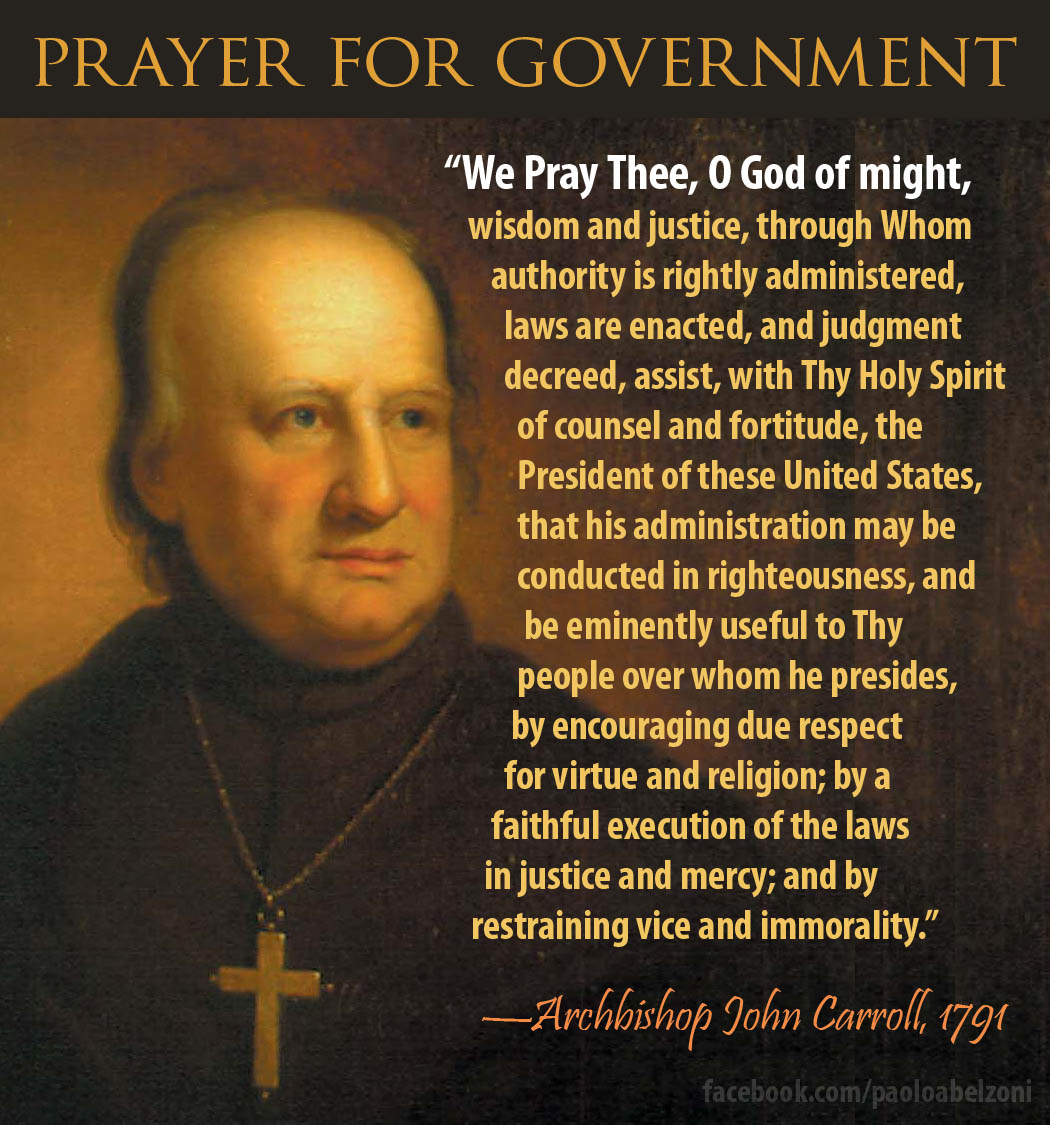
Archbishop John Carroll's Prayer for Government


Prayer for Government, composed by Archbishop John Carroll, first archbishop of the United states, on the occasion of the inauguration of George Washington as president of the United States, in AD 1791. Seems very appropriate for inauguration day 2017.

I believe this prayer was read in every Catholic parish on Sunday after the last Gospel for many years. I suspect the next four years will require a lot of prayer for our civil leaders. It might be a good idea to revive this tradition.
We pray Thee, O almighty and eternal God! Who through Jesus Christ hast revealed Thy glory to all nations, to preserve the works of Thy mercy, that Thy Church, being spread through the whole world, may continue with unchanging faith in the confession of thy name.

We pray The, Who alone art good and holy, to endow with heavenly knowledge, sincere zeal, and sanctity of life, our chief bishop, N. N., the vicar of Our Lord Jesus Christ, in the government of His Church; our own bishop, N. N. (or archbishop); all other bishops, prelates and pastors of the Church; and especially those who are appointed to exercise amongst us the functions of the holy ministry and conduct thy people into the ways of salvation.

We Pray Thee, O God of might, wisdom and justice! through Whom authority is rightly administered, laws are enacted, and judgment decreed, assist, with Thy Holy Spirit of counsel and fortitude, the President of these United States, that his administration may be conducted in righteousness, and be eminently useful to Thy people over whom he presides, by encouraging due respect for virtue and religion; by a faithful execution of the laws in justice and mercy; and by restraining vice and immorality.

Let the light of Thy divine wisdom direct the deliberations of Congress, and shine forth in all the proceedings and laws framed for our rule and government; so that they may tend to the preservation of peace, the promotion of national happiness, the increase of industry, sobriety, and I useful knowledge, and may perpetuate to us the blessings of equal liberty.

We pray for his excellency, the Governor of this State, for the members of the Assembly, for all judges, magistrates, and other officers who are appointed to guard our political welfare, that they may be enabled, by Thy powerful protection, to discharge the duties of their respective stations with honesty and ability.

We recommend likewise to Thy unbounded mercy all our brethren and fellow-citizens, throughout the United States, that they may be blessed in the knowledge, and sanctified in the observance, of Thy most holy law; that they may be preserved in union, and in that peace which the world cannot give; and, after enjoying the blessings of this life, be admitted to those which are eternal.

Finally, we pray to Thee, O Lord of mercy, to remember the souls of Thy servants departed who are gone before us with the sign of faith, and repose in the sleep of peace; the souls of our parents, relatives and friends; of those who, when living, were members of this congregation and particularly of such as are lately deceased; of all benefactors who, by their donations or legacies to this church, witnessed their zeal for the decency of divine worship and proved their claim to our grateful and charitable remembrance. To these, O Lord, and to all that rest in Christ, grant, we beseech Thee, a place of refreshment, light, and everlasting peace, though the same Jesus Christ, our Lord and Savior. Amen.
Taken from The Life and Times of John Carroll, Archbishop of Baltimore (1735-1815).

Wednesday, January 18, 2017

Pulcheria ~ Powerful Roman empress and beloved saint


Click above for a video excerpt of Pulcheria's bio from Hermias Sozomen written during her life.
January 19 is the birthday of Saint Pulcheria. Though little remembered today, Pulcheria played an important role in helping the Eastern Roman Empire survive the 5th century intact. She is commemorated as a saint by the Eastern and Western Churches on September 10.
Roman gold solidus showing
Pulcheria Augusta, crowned by God.

Daughter of the Eastern Emperor Arcadius and granddaughter of Theodosius the Great, Pulcheria was pushed into imperial politics at the tender age of 10. When her father died in AD 408, her younger brother, Theodosius II, inherited the throne as a small child, under the regency of two powerful men at court, the praetorian prefects Anthemius and Antiochus. Pulcheria became her brother's confidant and guardian, and by her 15th year, she felt strong enough to dismiss the regents, guiding Theodosius II in her own right.

Below is an account from the Ecclesiastical History of Sozomen which was written soon after Pulcheria's death. It offers a first-hand glimpse into the life of this powerful, holy woman of the early Church.
[The emperor] Arcadius died. He left Theodosius, his son, who was just weaned, as his successor to the empire. He also left three daughters of tender age, named Pulcheria, Arcadia, and Marina....The Divine Power which is the guardian of the universe foresaw that the emperor would be distinguished by his piety, and therefore determined that Pulcheria, his sister, should be the protector of him and of his government.
This princess was not yet fifteen years of age, but had received a mind most wise and divine above her years. She first devoted her virginity to God, and instructed her sisters in the same course of life. To avoid all cause of jealousy and intrigue, she permitted no man to enter her palace. In confirmation of her resolution, she took God, the priests, and all the subjects of the Roman empire as witnesses to her self-dedication. In token of her virginity and the headship of her brother, she consecrated in the church of Constantinople, a holy table, a remarkable fabric and very beautiful to see. It was made of gold and precious stones, and she inscribed these things on the front of the table, so that it might be patent to all.

This detail of the Trier Ivory is thought by some
to show the diminutive Pulcheria (right) receiving
relics of saints from her brother, Theodosius II (left).
After quietly resuming the care of the state, she governed the Roman empire excellently and with great orderliness. She concerted her measures so well that the affairs to be carried out were quickly decreed and completed. She was able to write and to converse with perfect accuracy in the Greek and Latin languages. She caused all affairs to be transacted in the name of her brother, and devoted great attention to bringing him up as a prince in the best possible way and with such information as was suitable to his years. She had him taught by the most skilled men, in horsemanship, and the practice of arms, and in letters. But he was systematically taught by his sister to be orderly and princely in his manners. She showed him how to gather up his robes, and how to take a seat, and how to walk. She trained him to restrain laughter, to assume a mild or a formidable aspect as the occasion might require, and to inquire with urbanity into the cases of those who came before him with petitions. But she strove chiefly, to lead him into piety, and to pray continuously. She taught him to frequent the church regularly, and to honor the houses of prayer with gifts and treasures. And she inspired him with reverence for priests and other good men, and for those who in accordance with the law of Christianity, had devoted themselves to philosophy.

Click for more info.
She provided zealously and wisely that religion might not be endangered by the innovation of spurious dogmas. That new heresies have not prevailed in our times, we shall find to be due especially to her, as we shall subsequently see. With how much fear she worshiped God, it would take long for any one to say, and how many houses of prayer she built magnificently, and how many hostelries and monastic communities she established, the arrangement for the expenses for their perpetual support, and the provision for the inmates.
A bit more about Pulcheria's virtues and piety excerpted from Sozomen may be found on this post.

When Theodosius II died tragically after a fall from a horse in AD 450, Pulcheria played an active role in choosing his successor. According to the Ecclesiastical History of Evagrius, Pulcheria herself recommended Marcian based on his virtues, and consented to marry him to solidify his claim to the throne and in the hopes of providing stability to the empire which was faced with serious threats both internal and external. Evagrius writes:
Click for more info.
[Marcian] received the sovereignty not as an inheritance, but as the prize of virtue, conferred by the unanimous voice both of the senate and men of all ranks, at the suggestion of Pulcheria, whom he also espoused as his partner in the imperial dignity, though she still remained a virgin to old age.
Shortly thereafter, Pulcheria and Marcian, with the support of Pope Saint Leo the Great, assembled the Council of Chalcedon which dealt a decisive blow to the Nestorian heresy and would have a tremendous impact on the Church going forward. A great tribute to her life was given by Leo who wrote to her in AD 451, saying:
"However varied may be the attacks of wicked men upon the Christian Faith, yet when you are present and prepared by the Lord for its defense, it cannot be disturbed. For God will not forsake either the mystery of His mercy or the deserts of your labors, whereby you long ago repelled the crafty foe of our holy religion from the very vitals of the Church." [Read more here.]

Saturday, January 14, 2017

"Where Christ is with us, a spider’s web our wall shall be...

...where Christ is not, our wall a spider’s web shall be."

Thus wrote Saint Paulinus of Nola in the early-5th century AD in his biography of Saint Felix of Nola, a confessor who passed to eternal life on January 14 during the persecutions of the 250s AD. In some traditions, St. Felix is a martyr, but in the poetic biography of Paulinus, he is acclaimed a confessor--one who fearlessly preaches the Gospel during dangerous times and who suffered for it but who is not granted the grace of martyrdom. Here is an excerpt from Saint Paulinus's life of Saint Felix, as put into prose by Venerable Bede in the 8th century AD, telling the story of how Felix was rescued from capture by the quick thinking of an industrious arachnid:
But the persecution was not yet over. Felix was again sought for, the enemy came to his house, and again essayed to seize him and deliver him over to death. He was by chance away from home, standing in the market-place with his friends, and teaching to the surrounding people, as was his wont, the word of God. His adversaries, hearing that he was there, rushed thither with drawn swords, but when they came to the place, either his countenance or their hearts were changed by a sudden act of Divine Providence, and they no longer knew him, though up to that day they had known him well. They therefore asked the priest himself where Felix was: the prudent man perceived that it was the work of God, and replied, smiling, "I do not know the man you are looking for." And in this he spoke the truth, for nobody does know himself.

Upon this the persecutors turned their attention elsewhere, and asked those whom they met, where Felix was. One of them, by chance, ignorant of their motives, and thinking they were out of their wits, began to reprove them for their folly in not knowing the man they had been talking to, and at the same time pointed out to them where he was gone. Fired to madness they rushed after Felix, who, warned of their coming by the multitude of citizens that preceded, and by the clamors of the people who were confounded at the enemy’s approach, withdrew to a secret place, which had no other defense than a fragment of a half ruined wall.

No sooner, however, had the man of God entered that place, than he was protected by a work of the Divine hand: for a mound of rubbish suddenly arose and closed in the place, and a spider, by Divine warning, immediately hung its floating web on the abandoned spot. The adversaries approached and halted in awe, saying among themselves, "Is it not foolish for us to look for anyone in this place? It is quite clear that no one has been here before ourselves, for if any one had entered, these spider’s webs could not have remained whole, for even the smallest flies will sometimes break through them. The man who told us he was here must have done so deceitfully, to delay us longer from finding him. Let us return, and refrain from searching this place, the very appearance of which shows that no one has been here before us."

Interior of the paleochristian basilica of St. Felix at Cimitile,
Nola, Italy (near Naples).
Thus foiled, they retraced their steps in anger, and fired with rage against him who had by his deceit led them to the place, to witness the wisdom of our pious Creator and Protector. Surely, the highest walls sometimes betray a beleaguered city, as well as defend it: for Christ protected his humble servant from detection and imprisonment at the hands of his armed enemies by a frail spider’s web: as the venerable father Paulinus says truly on this subject,—"Where Christ is with us, a spider’s web our wall shall be; where Christ is not, our wall a spider’s web shall be."

The evening was approaching when his enemies departed; and Felix, when they were gone, withdrew to a safer place of refuge, rejoicing in the Divine protection, and singing within himself,―“Though I should walk in the midst of the shadow of death, I will not fear evil, for Thou art with me.” When day dawned, he withdrew to a more retired place among the buildings of the city, where for six whole months he lived apart from men, relying on the protection of the Divine presence, according to the words of the Psalmist―“His countenance was hidden from the fear Miraculous food and water.of men;” and Providence fed him during this long space of time in a manner wonderful and unknown to men.
Read the complete life of St. Felix by Paulinus/Venerable Bede here or here.

For a delightful modern retelling of the above story, perfect for young children ages 4-9, see Saint Felix and the Spider by Dessi Jackson and Lydia Grace Kadar-Kallen. Nicely illustrated, the book features a brief biography of Saint Felix after the story. My own children loved it. Highly recommended!

Thursday, January 12, 2017

January 12 ~ On this day, AD 532, the burning of Hagia Sophia II

Original steps leading up to the entrance of Theodosius's
Hagia Sophia. Taken from here.
Many people know of Justinian’s monumental basilica, Hagia Sophia, which has stood in Constantinople/Istanbul for nearly 1,500 years. Few people, however, realize that Justinian’s church is actually the third monumental basilica to be built on that site.

Originally completed in about AD 415, the second of the three great basilicas was burnt to the ground on the night of January 12, AD 532 during the Nika riots in Constantinople. For an overview of this tragic revolt that ended in the slaughter of over 30,000, see my previous post: Justinian 31, Factionists 10: The Nika Rebellion of AD 532.

Procopius of Caesarea, possibly an eye-witness, described the destruction of the church as follows:
The lowest dregs of the people in Byzantium once assailed the Emperor Justinian in the rebellion called Nika, which I have clearly described in my History of the Wars. To prove that it was not merely against the emperor but no less against God that they took up arms, they ventured to burn the church of the Christians which the people of Byzantium call Sophia, a name most worthy of God. God permitted them to effect this crime, knowing how great the beauty of this church would be when restored. Thus the church was entirely reduced to ashes. (Taken from The Church of Sancta Sophia, Constantinople).
Sadly, descriptions of the great church of Theodosius II in the surviving literature of the time are few and far between. We get a small sense of what it may have looked like in this brief notice from the Paschal Chronicle within the narrative of the Nika rebellion:
Thereafter, the rioters set fire to the bronze-roofed entrance to the Palace [the Chalke Gate], and it was burnt, together with the portico of the scholarii and the protectors and candidate, and there was a breach. And similarly both the Senate-house, by the Augustaeum as it is called, was burnt, and the whole of the Great Church together with its awesome and marvelous columns was completely demolished on all four sides. (Taken from “The account of the nika riots as evidence for sixth-century constantinopolitan topography,” by Nigel Westbrook.)
Remains of Hagia Sophia II, destroyed AD 532. Taken from here.
Filling in the gaps, we have some archaeological evidence that was unearthed in the open area in front of the existing Hagia Sophia in 1935 by A. M. Schneider. There is an excellent gallery of photos showing some of the monumental stonework associated with Theodosius II’s church on WikiMedia Commons, including the above frieze showing several lambs in a row.

Also floating around out there is this tentative reconstruction of the façade of Theodosius II’s church, showing the “awesome and marvelous columns” as described above in the Paschal Chronicle’s account.

The great church itself is supposed to have had a five-aisle nave and featured a golden altar donated by Saint Pulcheria, sister of Theodosius II. The altar is described as follows by Sozomen in his Ecclesiastical History:
In token of her virginity and the headship of her brother, she [Pulcheria] consecrated in the church of Constantinople, a holy table, a remarkable fabric and very beautiful to see; it was made of gold and precious stones; and she inscribed these things on the front of the table, so that it might be patent to all.
Unfortunately for this structure, it was roofed with wood which made it particularly susceptible to fire. Justinian's grand replacement, would not have this defect.

Monday, January 09, 2017

January 9, AD 475 ~ Beginning of the disastrous reign of Basiliscus as Eastern Roman Emperor

Gold solidus of Basiliscus, ca. AD 476.
That the dissolution of imperial government in the Western Roman Empire took place in September of AD 476 is largely due to the ambitions and failures of one man: Flavius Basiliscus. For a guy whom almost no one today has ever heard of, he was the sine qua non for several major events that sent disruptive waves rippling across the history of the world.

Brother-in-law of the Eastern Roman emperor Leo I, Basiliscus was entrusted with command of the one of the largest military expeditions in Roman history – the 468 AD assault on the Vandalic kingdom which had squatted on Roman territory in north Africa for over 30 years. So crucial was this campaign to restoring the territorial integrity of the Empire that the treasuries of the Western and Eastern empires were emptied to finance it. The overwhelming force of 100,000-plus Roman troops and mercenaries led by Basiliscus reached Africa with little trouble. They were in the process of negotiating a surrender of the Vandals when their fleet was ambushed and destroyed by the elderly but wily Vandal King, Gaiseric, and his fire-ships.

This catastrophic defeat precipitated military, economic and political crises across both halves of the empire, but impacted the already tottering West most heavily. Basiliscus was able to escape the carnage and return to Constantinople where his sister, Verina, was Leo I's wife. When Leo died six years later, and the unpopular Isaurian general Zeno succeeded to the throne, Basiliscus began to agitate for a revolt.

The following passage from the Life of Saint Daniel the Stylite, was written by one of the saint’s disciples who was an eye-witness to these times. In this excerpt, we see the emperor Zeno approaching the famous pillar saint who resided at Anaplus, about 10 miles north of Constantinople, to ask his advice on the plots against him:
The Roman government was being well administered by the will of God, and the State was enjoying a time of quiet and order, and the holy churches were living in peace and unity, when the ever envious and malignant Devil sowed seeds of unjust hatred in the hearts of some who claimed to be the Emperor Zeno's kinsmen, I mean Basiliscus, Armatus and Marcianus and some other senators. When Zeno became aware of the treachery that was being planned against him, he went up to the holy man and confided to him the matter of the plot. The holy man said to him, 'Do not let yourself be troubled about this; for all things that have been foreordained must be accomplished upon you. They will chase you out of the kingdom, and in the place where you find a refuge, you will be in such distress that in your need you will partake of the grass of the earth. But do not lose heart; for it is necessary that you should become a second Nebuchadnezzar, and those who are now expelling you, having felt the lack of you, will recall you in the fullness of time. You will return to your Empire, and more honor and glory shall be added unto you and you shall die in it. Therefore bear all with gratitude; for thus must these things be'. The Emperor thanked him for these words (for he had already put him to the test in the case of other prophecies of his) and after being blessed by the holy man he took his leave and went down to the City.

Now the malicious men whom I mentioned above had free access to the blessed Empress Verina, Basiliscus because he was her brother and chief of the Senate, and Armatus as being her nephew and Zuzus as being the husband of her sister, and Marcianus the husband of her daughter and son of an emperor. They were constantly at her side and by their guile persuaded her to conspire with them to drive Zeno from the throne. As he knew of their wickedness and that he was in danger of assassination, he took his own wife, the Empress Ariadne, and some eunuchs, and unbeknown to all he left the palace one night during a very heavy storm. They crossed the straits and landed at Chalcedon because of their pursuers, and they escaped and reached the province of Isauria. The Empress Verina so controlled the revolution that she secured the crown for her brother Basiliscus; who shortly afterwards attempted to do away with his own sister. However, she fled to the oratory of the Ever-Virgin Mary in Blachernae and remained there as long as Basiliscus lived.
Basiliscus’s brief reign as emperor, which began on January 9, 475, was an unmitigated disaster. His alienation of the orthodox Christians eventually resulted in St. Daniel descending from his pillar for the first time in decades, causing a sensation in Constantinople that ended with both Basiliscus and the patriarch bowing down at the saint’s mutilated feet to beg forgiveness.

St. Daniel the Stylite.
Within a few months, whatever was left of Basiliscus’s base of support was gone. Zeno returned from Isauria and reclaimed the imperial diadem, casting Basiliscus and his family into the outer darkness of Phrygia to eventually die of starvation while locked in a cistern.

It was while Zeno was reconsolidating his power in Constantinople in September of AD 476 that Odoacer made his move and deposed the last Western emperor, Romulus Augustulus. Zeno was too weak to respond with any measure other than to ratify Odoacer as Dux of Italy, which merely confirmed his rule as an accomplished fact.

The excerpt above was taken from the Fordham University Medieval Sourcebook.

The complete life of Daniel the Stylite in book form may be found in an excellent compilation entitled Three Byzantine Saints, edited by Elizabeth Dawes. I own this book and highly recommend it.

Saturday, January 07, 2017

5th century bishop, Possidius of Calama, describes the last days of St. Augustine and the Vandal Conquest of Roman Africa


Saint Augustine, one of the greatest intellects in human history and a Catholic apologist par excellence, lived and proselytized during the twilight of the Roman Empire. As his life drew to a close, however, his homeland of Roman Numidia was overrun by an army of marauding Vandals—a barbaric host which had carved a swath through the enervated provinces of Gaul, Spain and Mauritania. By the time the Vandal armies reached Augustine's province of Numidia in about AD 430, the great bishop lay on his deathbed. His city of Hippo Regius was besieged and the remaining Roman forces under Count Boniface were defeated, leaving all of Africa open to the invaders.

With Augustine at the time of his death was his friend, Possidius, bishop of Calama. Possidius's town had already been captured by the Vandals and he had sought refuge behind the walls of Hippo. Later, Possidus would write his Vita Augustini, which provides one of the few contemporary accounts of the Vandal invasion of Roman Africa. The excerpt in the video above and pasted below is taken from the Vita Augustini of Possidius, Chapter 28.
"...It came about, in accordance with the divine will and command, that a great host of savage foes, Vandals and Alans, with some of the Gothic tribe interspersed, and various other peoples, armed with all kinds of weapons and well trained in warfare, came by ship from the regions of Spain across the sea and poured into Africa and overran it. And everywhere through the regions of Mauretania, even crossing over to other of our provinces and territories, raging with cruelty and barbarity, they completely devastated everything they could by their pillage, murder and varied tortures, conflagrations and other innumerable and unspeakable crimes, sparing neither sex nor age, nor even the priests or ministers of God, nor yet the ornaments or vessels of the churches nor even the buildings. 
Now the man of God did not believe and think as other men did regarding the causes from which this most fierce assault and devastation of the foe had arisen and come to pass. But considering these matters more deeply and profoundly and perceiving in them above all the dangers and the death of souls (since, as it is written, "He that increaseth knowledge increaseth sorrow," and "An understanding heart is a worm in the bones"), more than ever tears were his meat day and night, as he passed through and endured those days of his life, now almost ended, which beyond all others were the most bitter and mournful of his old age. For he saw cities overthrown in destruction, and the resident citizens, together with the buildings on their lands, partly annihilated by the enemy's slaughter and others driven into flight and dispersed.
He saw churches stripped of priests and ministers, and holy virgins and all the monastics scattered in every direction. Here he saw some succumb to torture and others slain by the sword, while still others in captivity, losing their innocency and faith both in soul and body, received from their foes the harsh and evil treatment of slaves. He saw the hymns and praises of God perish from the churches; the church buildings in many places consumed by fire; the regular services which were due to God cease from their appointed places; the holy sacraments no longer desired, or if some one did desire them, no one could easily be found to administer them. When they gathered in flight amid the mountain forests, in the caves and caverns of the rocks or in any other kind of retreat, some were captured and put to death while others were robbed and deprived of the necessary means of sustenance so that they gradually perished of hunger. 
Even the bishops of the churches and the clergy who, by the help of God, did not chance to meet the foe or, if they did meet them, escaped their hands, he saw despoiled and stripped of all their goods and begging in abject poverty, nor could they all be furnished with that by which they might be relieved. Of the innumerable churches he saw only three survive, namely those of Carthage, Hippo and Cirta, which by God's favor were not demolished. These cities too still stand, protected by human and divine aid, although after Augustine's death the city of Hippo, abandoned by its inhabitants, was burned by the enemy. Amid these calamities he was consoled by the thought of a certain wise man who said: "He is not to be thought great who thinks it strange that wood and stones should fall and mortals die."
But Augustine, being exceeding wise, daily bewailed all these events. And it increased his grief and sorrow that this same enemy also came to besiege the city of the Hippo-Regians which had so far maintained its position. With its defence at this time the late Count Boniface had been entrusted with an army of allied Goths. For almost fourteen months they shut up and besieged the city; and they even cut off its sea-coast by blockade. 
Click here for more info.
We ourselves with other of our fellow-bishops from the neighboring regions took refuge in this city and remained in it during the whole time of the siege. Consequently we very frequently conversed together and meditated on the awful judgments of God laid bare before our eyes, saying: "Righteous art thou, O Lord, and upright are thy judgments." And in our common grief, with groanings and tears, we besought the Father of mercies and the Lord of all consolation that He vouchsafe to sustain us in this tribulation."
The English translation of the whole Vita Augustini of Possidius is available in an inexpensive English translation as part of the Christian Roman Empire series.

It may also be found on Amazon.com in print and Kindle editions.

Friday, January 06, 2017

The Epiphany - Some Ancient Sources

The arrival of the Magi as depicted on a Roman sarcophagus
fragment, 
ca. 4th century AD.
The Scriptural recounting in the Gospel of Saint Matthew of the mysterious wise men who visited the baby Jesus bearing gifts is one of the most enduring and compelling scenes in Sacred Scripture. The rudimentary nature of St. Matthew’s description of the Magi’s arrival has encouraged a flowering of apocryphal literature across the centuries which has added depth and detail to the occasion of the Epiphany.

There are numerous references to the Magi in early post-Scriptural literature. Saint Justin Martyr mentions them prominently in his debate with Trypho (Chapter 78) in the mid-second century AD. Magi were of the priestly caste in Persia and were considered wonder-workers throughout the East. Christians did not deny that the Magi were capable of supernatural acts. Justin, for example, termed such “miracles” as counterfeits wrought by the devil. A converted pagan himself, Justin uses the Magi as a kind of archetype for the pre-Christian gentiles more generally who believed in false divinities because of the deceits of demons. However, upon finding Christ, the Magi were converted to the true belief. St. Justin says:
“For the Magi, who were held in bondage for the commission of all evil deeds through the power of that demon, by coming to worship Christ, show that they have revolted from that dominion which held them captive.”
Artistic images of the Magi also date back to the earliest days of Christianity. The image above is from the Catacomb of Priscilla in Rome and shows a faded fresco of the Magi offering gifts to the Virgin and Child above the archway. (Click for a larger image). The artwork in this catacomb is thought to have originated in the mid-third century AD.

With the arrival of Constantine and toleration of Christianity, artistic representations of the Magi become more plentiful. Above is an example from an early 4th century Roman sarcophagus. The three Magi offer their gifts to the Christ Child and Blessed Mother, while St. Joseph looks on from behind. The first Magi points to a set of three dots above the Virgin’s head. Normally a star was represented here. Perhaps three dots represent the Trinity. (Click for a larger image.) For an excellent discussion of the Epiphany in art, please see this site maintained by Prof. Richard Stracke.

The names of the Magi are drawn from a later source: the apocryphal Armenian Gospel of the Infancy. This work, which is believed to date from the early 6th century AD, gives a detailed and fanciful account of the arrival of the Magi, making them kings in command of an army 12,000 strong. Here is a short excerpt drawn from Abraham Terian’s English translation:
And Joseph and Mary, together with the child, stayed (there) not openly but secretly—they say—lest anyone should know. After two days had passed, which was the 23 of the month Tebeth and 8 January, behold, behold the Magi from the east, who had left their land with many armies, arrived in the city of Jerusalem within nine months. And the three Magian kings were brothers. The first, Melkon, was king of the Persians; the second, Gaspar, was king of the Indians; the third, Baltasar, was king of the Arabians…. And the Magi came with joy to the entrance of the cave and saw the child seated in the manger for brute animals, and falling prostrate they worshipped him, both kings and princes and the whole multitude of their throng. And bringing gifts, they presented them to him….

They [the other two] asked Gaspar, the king of India: ‘How did you see him when you were presenting him the frankincense?” Gaspar said: “I saw him as Son of God embodied, seated on the throne of glory and armies of bodiless beings were serving him.” They said to him, “Well said.”

Then they asked Baltasar, the king of Arabia: “How did you see him when you were presenting him the treasure?” Baltasar said, “Physically, I saw him as Son of Man, son of a king, seated on the highest of thrones and countless armies before him.” They said to him, “You too have spoken well.”

Then they asked Melkon, the king of Persia, “How did you see him when you were presenting the myrrh?” Melkon said: “I saw him bodily tortured and dead, then risen from the dead.” They said to him: “You too have spoken well.”

When the kings heard this, they marveled with amazement and said to one another: “What are these new wonders that were shown to us, (our) testimonies being different from one another? We believe the facts we saw with our eyes!”
You have to purchase the book to read more. Warning, it’s an Oxford monograph, so it’s pricey.

Another ancient source, the so-called Incomplete Commentary on Matthew, which appears to be a transcription of homilies delivered by an Arian priest of about the sixth century AD, relates that the Magi continued as believers in the Christ after returning to their homelands, and were later baptized by the apostle, Saint Thomas:
“When they returned, they continued to worship and glorify God all the more eagerly than before, and they proclaimed to everyone in their nation and made many learned. At last, when the apostle Thomas went to that province after the resurrection of the Lord, they joined themselves to him, were baptized by him and assisted in his preaching.”
This excerpt is taken from a translation by James A. Kellerman, available for purchase here.

Tuesday, January 03, 2017

Saint Genevieve and barbarism: From Attila to the Republic

St. Genevieve and Attila, though these Huns look more like Franks to me.
January 3 is the feast of Saint Genevieve (or Genovefa in Latin). History tells that this great late Roman saint was born in the Western Empire about the year AD 422, and passed to eternal life on January 3, AD 512. During her life, she witnessed the momentous events which transformed her home in Roman Gaul to a province of the new Frankish kingdom, and indeed she played an integral part in these events.

Enjoy this excerpt from the Vita Sancta Genovefa, translated into 17th century English. Though reproduced in The Golden Legend, a collection of hagiographical literature compiled in the mid-13th century, the Life of Genevieve is reckoned to have originated from a much earlier source, possibly roughly contemporary with the life of the saint. This excerpt tells of how Genevieve convinced the merchants of Paris to leave their goods in the city during the invasion of Attila, prophesying that Paris would remain safe, while other cities would be devastated:
"Tidings came to Paris that Attila, the felon king of Hungary, had enterprised to destroy and waste the parts of France, and to subdue them to his domination. The burgesses of Paris, for great dread that they had, sent their goods into other cities more sure. Saint Genevieve warned and admonished the good women of the town that they should wake in fastings and in orisons, by which they might assuage the ire of our Lord and eschew the tyranny of their enemies, like as did sometime the two holy women Judith and Esther. They obeyed her, and were long and many days in the church in wakings, fastings and in orisons.
She said to the burgesses that they should not remove their goods, nor send them out of the town of Paris, for the other cities that they supposed should be more sure, should be destroyed and wasted, but by the grace of God, Paris should have none harm. And, some had indignation at her, and said that a false prophet was risen and appeared in their time, and began among them to ask and treat whether they should drown her or stone her. 
Whilst they were thus treating, as God would, the archdeacon of Auxerre came to Paris, after the decease of Saint Germain, and when he understood that they treated together of her death, he came to them, an said: "Fair sirs, for God’s sake do not this mischief, for she of whom ye treat, Saint Germain witnesseth that she was chosen of God in her mother’s belly, and lo! here be the letters that he hath sent to her in which he recommendeth him to her prayers."
When the burgesses heard these words recited by him of Saint Germain, and saw the letters, they marveled and feared God, and left their evil counsel and did no more thereto. Thus our Lord kept her from harm, which keepeth always them that be his, and defendeth, after that the apostle saith, and for her love did so much that the tyrants approached not Paris, thank and glory to God and honor to the virgin."
Read the entire Vita as taken from the Golden Legend here.

Or, check out a more modern translation taken from Sainted Women of the Dark Ages by MacNamara, et al.

If you appreciate this fascinating period of history, when Roman Gaul became the Kingdom of the Franks, you will no doubt enjoy the excellent novel, Centurion's Daugher by Justin Swanton. 

2024 update: There's also a fantastic novel for young readers about St. Genevieve that came out 2023 entitled Matron of Paris. You can read my review of that book here. 

The relics of Saint Genevieve survived in Paris for nearly 1,300 years. Sadly, the anti-Catholic lunacy of the French Revolution brought about the destruction of the relics in 1793. In a bizarre satanic mimicry of justice, the Revolutionaries seized the relics on November 6, 1793 and held a mock trial. An excerpt from Striking Images, Iconoclasms Past and Present by Boldrick et al. tells the rest of the story:
"That evening, the revolutionary committee of the Section du Pantheon delivered up the reliquary of Saint Genevieve to the national Mint where it was broken up to be melted down to support the Republic’s war efforts. They then took the relics to the Hotel de Ville where they derided the objects’ efficacy in eliciting divine intervention, saying that, ‘The transit of this patron of Parisians took place with great tranquility and without miracles.”…They added derisively that ‘As the Parlement [of the ancient regime] could not be present, Saint Genevieve and her reliquary were lowered and transported to the Mint.’…To make the point unambiguously clear, on the municipality’s order, on 3 December 1793 the relics were taken to the Place de Greve and burnt, transforming objects deemed by Catholics to be saintly into profaned ashes that were scattered in the Seine…Indeed, as Sluhovsky has written, citing the contemporary newspaper Moniteur, ‘these bones were put on trial, were found guilty of collaboration with the royal authorities, and were condemned to be burned…to expiate thereby for the crime of participating in the propagation of error."
But Saint Genevieve would have the last word. The Revolutionary Republic would prove as short lived as Attila's empire--devoured just as thoroughly by God's cleansing fire.