Sunday, June 27, 2010

Book Review - Imagine: A Vision for Christians in the Arts

Steve Turner chose the name "Imagine" for this book. That should have been a tip-off. I suspect his intention was to be ironic--to use the name of John Lennon's anthem of socialist secularism to present his thesis for the exact opposite: a vision of Christianity influencing the arts. But Imagine is a maudlin, syrupy song and Turner's book, while presenting many intriguing ideas, is incomplete and actually gets the question backwards. Instead of asking "Why are many Christians hostile to the arts?" Turner should have asked, "Why are the arts so often hostile to Christians?"

Before I tear into this book, I should say that Turner gets a lot of things right. For example, he gives the Catholic Church the proper credit for having always viewed art as a way of approaching the sacred, while Protestantism--particularly the evangelical brand of modern times--often views art as fundamentally worldly and approaching idolatry.

He also correctly identifies the importance of art in all its forms as a means of communicating ideas to large groups of people. And, he recognizes how vital it is for Christians to engage in the arts in order to influence society. I almost said "evangelize" there, but in truth, that's where Turner's argument begins to fall flat. He seems to understand that Christian moral influence on society is a good thing, but worries that actual evangelization via the arts should only be done sotto voce--if at all.

In fairness, I used to believe exactly the same thing and offered many of the same reasons that Turner gives to rationalize this position. However, after considerable reflection over the years, I have identified the true source of this reticence to incorporate my Catholic beliefs into my writing and indeed into practice in my daily life--fear. Cowardice. The desire to be accepted by the great and the beautiful. The urge to be embraced by the elites and to become one of them.

You can usually get some impression of where a man's heart is by who his heroes are. Steve Turner's heroes are all musicians and beat poets from the 1960s through the 1980s--he repeatedly mentions the Beatles, Bob Dylan, Van Morrison, U2, and many others. The name-dropping got so thick at certain points that it made me think that Imagine was less about creating a vision for Christians in the arts than an attempt to reconcile Turner's personal obsession with his Christian faith.

Not surprisingly, Turner aims most of his criticism at Christian rock musicians--an easy target if ever there was one. The contemporary Christian music scene has traditionally been just as he describes: a musical ghetto that specializes in preaching to the choir. But he misunderstands why that is. Like most actual ghettos, the inhabitants of the contemporary Christian ghetto didn't really want to go there--they went there because otherwise, there was nowhere for them to go.

While dismissing the contemporary Christian rock scene, Turner instead holds up the band U2 as an exemplar of how Christians should influence the arts. It is undeniable that U2 has had a major impact on the music scene over the years. And there are undeniable Christian undertones to their music. However, Turner ignores the fact that for U2, the religious imagery is almost always at the service of a political agenda. For example, in the song Pride (In the Name of Love) the Christian religious imagery is used to canonize Martin Luther King who, for all his merits as a civil rights leader, was certainly no saint in the Christian sense.

In fact, U2 seems to do the opposite of what Turner calls for in his book. Rather than use their music to teach a Christian message, U2 seems to use their religious bona-fides as a promotional tool to preach a "social gospel" to their Christian fans. Worse, U2 have used their status as Christian-influenced rockers to give legitimacy to political agendas which are often antithetical to Christianity. Recently, for example, U2 performed at the inauguration of Barack Obama, the single biggest supporter of abortion and "gay" lifestyle issues ever to occupy the White House. Is this kind of thing really how Christian artists should be spreading the Gospel?

And that brings us to politics--an issue that Turner hints at but never addresses directly. Unfortunately, it is an issue that must be addressed if we wish to understand why Christian artists seem to be so absent from mainstream culture and indeed, why mainstream art appears to be intrinsically anti-Christian.

The fact is that since the 1960s, overtly Christian artists have been the target of a blacklist which is worlds more all-encompassing and harsh than any of the largely fictive bans that were imposed on Communist artists during the 1950s. Evidence for this is out there for anyone who wishes to look.
Exhibit A:
Cleon Skousen's Current Communist Goals, as read into the Congressional Record in 1963. See especially points 21 through 28, where Communist operatives were encouraged to infiltrate the American media and cultural institutions to influence things for the worse. They were told to promote ugliness, obscenity, and deviance and replace religion with a "social gospel." Given that Skousen's book was written in 1958--well before the onslaught of pop culture spew we experience today, his conclusions can only be seen as frighteningly prophetic.

Exhibit B:
Secular socialists and communists themselves have admitted that they use "art as a weapon" to promote their ideology and attack those opposed to them, such as orthodox Christians. The concept itself was first promoted by V. I. Lenin in a 1905 pamphlet entitled Party Organization and Party Literature. One need only do a Google search on "art as a weapon communism" to immediately discover how much thought and struggle the secular left has put into this campaign over the years.

Exhibit C:
The research is finally catching up with this subject and books like Red Star Over Hollywood are finally revealing the truth about the secular left domination of Hollywood that continues to this day.
So finally we come to the subject that Turner dances around in Imagine but never quite addresses: that the absence of Christian message in American popular culture today is not by accident. Nor is it because Christians are untalented or uninspired. The absence is by design. Most of those with the decision-making power in media are overtly hostile to Christianity and are keen to suppress Christian messages and promote messages disparaging Christianity. Even if they don't do it consciously, being overtly anti-Christian is part of the media culture. As someone who has worked in media for 15 years (academic and professional publishing), I have seen this again and again on every level--but especially among the decision-makers.

If you doubt any of this, you need only recall the lengths to which Mel Gibson was forced to go to get The Passion of the Christ to market. Remember, this is a movie that ended up making billions of dollars worldwide, and yet Gibson struggled to find a distributor for it. And the movie was slurred by many within the entertainment media with the most vituperative epithets available: antisemitic, pornographic, fascist, etc. Is it possible that the normally money-hungry Hollywood elites were such financial nincompoops in this case that they didn't realize the potential for this movie to be a huge cash-generator? Certainly not. This was the normally unspoken media and artistic antipathy toward Christianity revealed for the world to see.

In such an atmosphere, even inspired and copiously talented Christian artists can't be expected to thrive unless they have already made their name as secular stars. But for whatever reason, Turner ignores all of this. Instead, his advice to Christian artists seems to be: Keep a low profile. Engage the audience on their level. Attempt to insinuate Christian messages into your work in ways that won't offend them.

The most damning passage of Imagine comes when Turner envisions himself reading overtly Christian poetry before an audience at a New York poetry slam:
"...if I read a poem about the delights of nature, the awfulness of betrayal or the horrors of war, I would expect to find a resonance in [the audience's] own histories. But what response would I get if I read a poem about the death of Christ? People might snicker. They might feel uncomfortable. In some art circles, religion, especially Christianity, is a matter for laughs. I could get shouted at....Most likely, I'd be faced with bemusement. Is he serious? Is he being ironic?"
God forbid that Christians be the target of derision and ridicule! My only response to this passage comes from Mark 48:38:
For he that shall be ashamed of me, and of my words, in this adulterous and sinful generation: the Son of man also will be ashamed of him, when he shall come in the glory of his Father with the holy angels.
Interestingly, Turner does not address the one area of contemporary popular culture where Christianity has had--and continues to have--a tremendous impact. Popular country music. I could point to any number of extremely effective popular country songs that have very clear and obvious Christian messages. Here is a short list:

Three Wooden Crosses by Randy Travis
The Little Girl by John Michael Montgomery
What I Love about Sundays by Craig Morgan
Love without End, Amen by George Strait
When I Get Where I'm Going by Brad Paisley
Jesus Take the Wheel by Carrie Underwood
Long Black Train by Josh Turner
The Man I Want to Be by Chris Young

Beyond that, country music is rife with songs that are more subtly infused with Christian, pro-life and positive ideals--exactly what Turner is talking about in his book. Here is a small selection:

The Broken Road by Rascal Flatts
There Goes My Life by Kenny Chesney
Remember When by Alan Jackson
American Honey by Lady Antebellum
I've Been Watching You by Rodney Adkins
Blessed by Martina McBride
The Good Stuff by Kenny Chesney

I would argue that any of these songs, which are devoid of political overtones, are more effective at evangelizing the culture than the entire discography of U2. So why does Turner ignore the country scene? Perhaps he is simply unfamiliar with it. Or perhaps it is because he knows how badly it weakens his thesis. Overt references to Christ and Gospel messages can be done well and achieve popular success without tempering the message.

Turner is very obviously a thoughtful man and a good writer. This book is an easy and interesting read and it makes many good points. However, at the end of the day, I think Turner's key premise is fundamentally flawed. The subtle approach he champions is necessary but not sufficient. What is most needed in this current age are talented artists who are completely unafraid to preach the Gospel overtly through their work. Will the cultural elites criticize and ridicule? Yes, they will. But Scripture gives us a guide on what we are to do during such times:
"Preach the word: be instant in season, out of season: reprove, entreat, rebuke in all patience and doctrine. For there shall be a time, when they will not endure sound doctrine; but, according to their own desires, they will heap to themselves teachers, having itching ears: And will indeed turn away their hearing from the truth, but will be turned unto fables. (2 Timothy 4:2-4)
Instead, of Turner's strategy, I propose that Christians will better evangelize the arts by doing the following:

1.) Pray! Pray that God will inspire you to create something that helps bring His Truth to all people. Offer yourself to Him, that He will fill you with His Grace and use you as His instrument.
2.) Make your spiritual life as air-tight as possible. That means frequent confession. Frequent Mass attendance. Spiritual reading. Recognition and avoidance of the near-occasion of sin. Association with others who are spiritually solid. Finding a trustworthy spiritual director, etc.
3.) Understand that it's ok to spread the Gospel of Christ through your art in subtle ways. However, make sure that you are doing it for the right reasons--and not simply for fear that your work will be ridiculed and rejected.
4.) Be totally and completely unafraid to include overt references to Christ, the Church, and Gospel truths in your work. If you are afraid of criticism, you shouldn't be in the arts to begin with. Count yourself blessed if people deride you because you dare to speak the name of Jesus in public.
5.) Recognize that art is a dangerous vocation which appeals to the world, can be pathologically introspective, and can lead to personal hubris and self-congratulation in direct proportion to the excellence of your own talent. If you are truly talented, have a plan for humbling yourself whenever the adulation goes to your head. The mad desire of the public for true talent has ruined the souls of many, many artists.

I have come to the point in my own life where I believe that the prayers and writings of a single Carmelite in a convent will ultimately have a greater impact on salvation history than several $100 million Hollywood productions or a career in popular music. We who are on the outside are only capable of half-measures because we're so wrapped up in worldly affairs. We struggle to remain the salt of the earth and our savor is so easily lost. And if it is lost, all our previous good work can become tainted with the stain of hypocrisy.

Thus it seems clear that worldly success as an artist, writer, or musician often carries within it the seeds of temptation and spiritual destruction to a much greater extent than most other fields. As a result, a career in the arts should only be entered upon with the greatest care and trepidation. The sad trajectory of Mel Gibson--who made one of the most beautiful and successful Christian movies of all time--should be a cautionary tale for every Christian artist. For what purpose is it to gain the whole world and lose one's soul in the process?

Thursday, June 03, 2010

Book Review: A Landscape with Dragons

This book has cropped up so many times in so many different conversations, that I realized I had to read it. Now that I have, I am of the opinion that every Catholic parent, teacher, or serious writer/artist ought to read it as well. Agree with Mr. O'Brien or not, his argument is thought-provoking and requires serious reflection.

Michael O'Brien is an artist. He is also a writer of no mean talent. He is the author of the international best-seller Father Elijah and many, many other books--a fact that I did not appreciate until immediately before I read this book. In fact, if you visit his author page on Amazon, the man has a literary resume that puts most other contemporary Catholic writers to shame. So he can't simply be dismissed as a hack or a fraud who knows not of what he speaks.

In brief, A Landscape with Dragons posits that much of the literature meant for our children today is demythologizing in nature in that it inverts the classical symbols of Christianity so that the scary is made to appear friendly, the dangerous is made to appear misunderstood, and the diabolical is made to appear harmless. Meanwhile, the good is made to appear hypocritical, the holy becomes buffoonish, and the pure becomes boring. The end result of this trend is the creation of de-Christianized, re-paganized children and ultimately, the warping of society's moral sense as a whole.

O’Brien’s initial concern in this book is the representation of serpents or dragons in modern literature as friendly, good, or tame creatures. He posits that this trend turns on its head the scriptural symbolism of the serpent/dragon as a representation of the devil. But his central thesis goes well beyond this. O’Brien points out that much of what the world presents as “the good” or “conventional wisdom” is actually gnosticism, thinly disguised:
“If you watch this, you will know more, be more grown-up, more smart, more cool, more funny, more able to talk about it with your friends.”
And the messages broadcast in much of the media meant for children and young people only appear to be benevolent and wise on the surface:
"Truth is what you believe it to be. Right and wrong are what you feel right and wrong are for you. Question authority. To become what you want to be, you must rebel. You make yourself. You create your own reality."
If these messages sound familiar, it is because you probably read them in the book of Genesis: “If you eat of the fruit, surely you will not die. You will become like God, knowing good and evil.”

It’s hard to deny that these messages saturate children’s books and movies and such sentiments are often found coming out of the mouths of the “heroes” of these works. O’Brien rightly points out that these tantalizing ideas are infinitely more damaging and destructive than overtly evil messages that are easily detected:
"Evils that appear good are far more destructive in the long run than those that appear with horns, fangs, and drooling with green saliva."
So parents need to be vigilant to make sure their children aren't ingesting harmful messages with their tacit approval. O’Brien understands that this can be an arduous task, but provides a helpful scale for parents to rate materials aimed at their children:
1.) Material that is entirely good.
2.) Material that is fundamentally good but disordered in some details.
3.) Material that appears good on the surface, but is fundamentally disordered.
4.) Material that is blatantly evil, rotten to the core.
He then goes through several popular books and films and analyzes them according to this scale. As A Landscape with Dragons is now 12 years old and was written before the Harry Potter phenomenon, the books and movies O'Brien critiques here are a bit dated: A Wrinkle in Time, The Little Mermaid, Aladdin, the Goosebumps series, etc. But his thesis is solid, and I think the majority of his points are well made, even if he does carry them a bit too far in spots.

I fully expected O’Brien to make unreasonable exceptions for those works which are traditionally accepted and lauded by Catholic critics, such as those of J. R. R. Tolkien and C. S. Lewis. To my surprise, O’Brien even levels a few criticisms at these works, though admittedly, he seemed at pains to do so. But ultimately, I could not with fairness accuse him of holding a double-standard.

O’Brien is not merely a critic, however. At the end of the book, he provides over 100 pages of suggested reading material for children and families, compiled by the good folks at Bethlehem Books. He also offers parents some guidelines for how to determine if a book is good for your child to read. Here he includes one bit of sage advice that is often neglected--pray about it. This section alone is worth the price of the book in my opinion.

My feeling upon completing this book is that Michael O’Brien is on to something. Does he go overboard in spots? Yes. Is he perhaps overly scrupulous? Maybe a little. But his central thesis, buttressed in many places by Aquinas, Chesterton, Lewis, Tolkien and others, is hard to deny.

As I have said on many other occasions, what is really needed to combat these destructive forces attempting to influence children is compelling and authentic literature and media created from a Catholic perspective--and beyond that--media which is utterly unafraid to portray profound truths overtly. How many Catholic saints and heroes from history, unafraid to speak the name of Christ publicly, richly deserve a novel or motion picture portraying their lives and exploits? I can name two dozen of them off the top of my head. If done well by talented artists with excellent production values, such tales would be smash successes along the lines of The Passion of the Christ. All we need are writers and artists with the talent and courage to do it. And we all need to pray that God will send us such individuals.

This is a long review and really, it only scratches the surface of this discussion. In short, if you are a Catholic parent, read this book. If you are a Catholic writer or artist, read this book. If you are a Catholic scholar studying literature, philosophy, or theology, read this book.

Afterword:


Very recently, Mr. O'Brien published a book called Harry Potter and the Paganization of Culture. I have not read this book, but as part of my background research for this review, I read the preface online. In it, Mr. O'Brien detailed the spiritual attacks he endured while reading the Harry Potter series. At one point, he says the following:
Throughout the initial dark period of research and writing, however, an amazing array of breakdowns and catastrophes occurred in the external details of our family life. These were more serious and frequent than the usual ups and downs of car problems, financial crises, sickness, and leaking roofs. It was these and much more--and all at once. I might add that I know seven other Christian writers who have publicly critiqued the Potter series, and all but one of them experienced the same phenomenon. Two had dreams like mine, and most of them had struggled to resist the cloud of oppression combined with an uncanny convergence of external trials.
Hmmmm.

Back in 2007, I read the entirety of the Harry Potter series in about six months with the aim of critiquing it on Amazon.com from a Catholic father's perspective. I published all my reviews on this very blog--the last one, where I blasted JK Rowling with both barrels, may be found here.

When I read Mr. O’Brien’s statement above, I got a funny feeling and remembered my own experience reading Harry Potter. As I was nearing the end of the series, I went through one of the most difficult and spiritually exhausting stretches of my life--our youngest son was born with a complete bowel obstruction that required immediate surgery. He was hospitalized for over two weeks and for a little while, we were concerned he wouldn’t make it. Thanks to excellent medical care and a huge amount of prayers, he is now a thriving two year old.

But I can distinctly remember reading book six of the Potter series while my wife was in labor--and then putting it aside for several weeks to deal with our crisis.

Coincidence? Maybe....

Sunday, May 23, 2010

Book Review: Saint Patrick (Christian Encounters Series)

If you are looking for a short, uncomplicated, to-the-point bio of Saint Patrick, this book fits the bill. At 140-odd pages and a small trim-size, the book can be read in a couple hours and will leave the reader with a solid outline of what we know about Patrick's life. The author does seem to read a little too much into Patrick's true motivations and draws some inferences that seem unsupportable. But these instances are infrequent, unobtrusive, and not overly wild.

I must admit that my favorite part of this book was the two appendices, comprising 40 pages of Saint Patrick's own writings in English translation. The selections are Patrick's confession and his letter to Coroticus, the warlord whose men murdered and enslaved some of Patrick's newly baptized converts. In my opinion, this book is worth purchasing just for these two bits alone.

Here are two quotes from Patrick's writings that I particularly liked:

"I know in part why I did not lead a perfect life like other believers, but I confess to my Lord and do not blush in his sight, because I am not lying; from the time when I came to know him in my youth, the love of God and fear of him increased in me, and right up until now, by God's favour, I have kept the faith."

"I pray God that He gives me perseverance, and that He will deign that I should be a faithful witness for His sake right up to the time of my passing."

Thursday, April 22, 2010

Book Review: The Barbary Pirates

Much contemporary historical fiction is either too vulgar, too politicized, or too full of trite historical clap-trap for me to enjoy. So when I got this book, I began reading it with trepidation. Would this book fit into one of those molds? By the time I was finished, I was pleasantly surprised. Simply put, The Barbary Pirates is a light read, a page-turner, and a load of fun.

The Barbary Pirates is the 4th book of the Ethan Gage series by William Dietrich. I haven't read the previous books, but the author does a decent job of explaining things so that the reader doesn't feel lost. As it is, the book stands as its own entity very well. It tells the tale of American adventurer Ethan Gage. Gage teams up with a trio of historical 'savants' -- naturalist Georges Curvier, inventor Robert Fulton, and geologist William Smith -- to find an ancient artifact of incredible power. The four must find it before the nefarious Egyptian Rite, a shadowy neo-pagan cabal which seeks to use the item to achieve their megalomaniacal aims.

If this plot sounds familiar, it's because it's been done before. Lots of times. Gage carries a long-rifle, but he may as well be wearing a hat and bullwhip. He is Indiana Jones 150 years earlier -- a lovable rogue who is constantly getting into scrapes with both his mortal enemies and with the fair sex.

That said, Dietrich has managed to breathe exciting new life into an old trope. While not particularly deep, The Barbary Pirates is action-packed and full of historical curiosities that span the ages from pre-history to Napoleonic times. The book has the virtue of not taking itself too seriously. As such, it is a much more entertaining and satisfying read than similar books like, for example, The Da Vinci Code.

For what it is, The Barbary Pirates is a good read. It may be the perfect book for beach-reading this summer. I will have to seek out some of the previous books in the series to supplement my own summer reading list.

This date in late Roman history ... April 22

On this day, in Anno Domini 525, the city of Edessa, metropolis of Osroene in western Asia minor, was destroyed by a flood of the river Scirtus. Procopius describes this flood as catastrophic in scope, killing more than 1/3 of the population, or nearly 30,000 people.

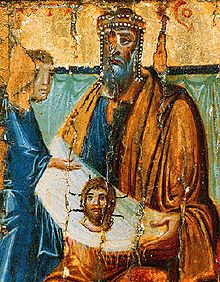
The Roman Emperor Justin had the city rebuilt at great expense. During the reconstruction, an artifact was discovered in a niche above Edessa's western gate--the famed Mandylion of Edessa. This legendary image of the face of Jesus was purportedly brought to Edessa after the death and resurrection of Christ by His disciple, Thaddaeus.

The historian Evagrius Scholasticus, writing in the late 6th century, mentions the Mandylion as being instrumental in defeating a siege of Edessa by the Persian king Chosroes in AD 540.

In recent years, some scholars have attempted to link the Mandylion to the Shroud of Turin. One of the most compelling of these attempts may be found in Ian Wilson's book, The Blood and the Shroud.

Sunday, April 18, 2010

Book Review: Tale of Manaeth

What do you get when you cross the Aenied, Beowulf, and Xena Warrior Princess? Why, you get Tale of Manaeth, of course, a new work of epic fantasy by Phillip Campbell. I received this book thanks to a tip from Maureen Wittmann and based on her description, I thought it would be a book I would enjoy. Indeed, it was!

At its heart, the tale is fairly uncomplicated. The arrogant king Belthazre of Maruda oppresses the people of the smaller neighboring state of Asylia. Much like the Trojan War cycle, the main conflict of the story arises due to lust and jealousy. When Belthazre demands the beautiful daughter of the Asylian king Ioclus--for no reason other than to provoke his envious wife, Queen Narussa--the Asylians are forced to decide whether to knuckle-under or to fight.

Obviously, there is a fight--multiple fights, in fact. Soon, it is up to young Maneath--also called Manissa--the daughter of Ioclus, to rally the Asylians against the invading Marudans. But how can she, a mere girl, defeat a powerful enemy with only a handful of stalwart men, starving and outnumbered?

Well, if you want to find out, read the book.

Tale of Manaeth is dedicated to St. Joan of Arc, and it's not difficult to see why. While the trope of the woman doing battle and taking down men twice her size is a trite and common one in popular fiction, movies and TV today, it was nearly unheard of in history with rare exceptions. St. Joan was one of those exceptions, of course. That said, the character of Manissa in this story, though a stout fighter, is nonetheless undeniably female and never becomes a mere parody of a man. There is none of the cheesiness here that's often associated with the modern "warrior princess."

So on the whole, I rate this book very highly and recommend it. It is especially good for teenage boys who will appreciate the action and combat. It's a fairly violent book, but the violence is of the epic variety and not gratuitous. The style of the writing is quite different from the typical page-turner prose we often see in modern fiction, so it may take some getting used to, especially for younger readers. But if you enjoy heroic tales of war told with the rhythm and style of the ancient epics, you will most certainly appreciate Tale of Manaeth.

Tale of Manaeth is self-published and is available from the author at http://www.taleofmanaeth.com/

Sunday, April 04, 2010

Review of Saint John Bosco and Saint Dominic Savio

This book is the perfect intro to the life of Saint John Bosco for young readers. I have always had a fondness for Saint John Bosco myself, and when I saw this book, I thought it would be a great way to teach my kids about him. So we got this book and we read it together each night. Reading a chapter per night, we got through it in about two weeks.

The kids got a tremendous kick out of this book, as did I. The first part of it, detailing Saint John's early life, is full of poignant and humorous little stories about his various struggles and antics. Saint John Bosco comes across as a real person, not an impossible model of sanctity. He is full of zeal for Jesus and the Blessed Mother, and is one of those rare people who is able to combine that zeal with a magnetic personality. By doing so, he was able to touch the lives of hundreds and thousands of people and bring them closer to our Lord.

Two other saints are also mentioned in this book. Saint Dominic Savio was one of Don Bosco's boys who was a model of extraordinary virtue, even at a very young age. He died at 14 and was named a saint by Pius XII in 1954--the youngest non-martyr saint. The other is Saint Maria Mazzarello, foundress of the Salesian sisters. Don Bosco encouraged Maria to found the order after they both had similar visions of ministering to wayward and poor girls.

This book easily held my kids' attention (ages 7 and 6) and they constantly pestered me to read more. They especially loved the funny stories about Don Bosco's tricks as a young man, and his mysterious "dog" that seemed to appear whenever he was in danger. I'm hoping that it also gave them an appreciation for the religious life, as well as some perspective on how easy our lives our today, compared with those poor souls who lived only 150 years ago, many of whom died so young.

Sunday, March 28, 2010

Bump+ final thoughts

For the past couple months, I have been following the web series Bump+. A pseudo-reality show about three women who were considering abortion, Bump+ started some controversy and even got some heavy-duty press early on, including several interviews on the Laura Ingraham Show.

I spent a lot of time posting on the Bump+ message boards and got quite involved with things over there. Though there were a lot of pro-life people involved with the the series, the producers took pains to keep things neutral in an attempt to encourage those who have had or considered abortions to post and share their stories.

Here is my final post on the Bump+ boards, which I am posting here simply so that I remember it in case they take the message boards down at some point. It may not make much sense out of context.
Florentius says:
March 26, 2010 at 1:59 PM

As one of the “wait and see” posters, I ended up being mildly disappointed with how the series ended. At the end of the day, I don’t think this format was a good way to advance the argument on anything but the most emotional level. And appeal to emotion is a logical fallacy.

We have been told repeatedly that the point of Bump+ was to foster compassionate understanding and to forge new ways to approach this debate. But I say again, as I have said over and over: To what end? So that we can all be kind and respectful to each other as nothing changes and thousands of unborn children continue to be aborted each day?

I found myself in a weird role while watching Bump+. On the one hand, I was highly critical of it here on the boards. Meanwhile, on other boards and in the real world, I found myself defending it from other pro-lifers who wanted nothing to do with it. I urged them to give it a chance and I’m not unhappy that I did.

But now that all is said and done, I think Bump+ was a clever idea that fell mostly flat. I think the viewership numbers bear that out–at least on YouTube. They seemed to spike early on and then peter out as the series went on which indicates an audience losing interest.

I happily recognize the talent and creative energy that went into Bump+. I hope in the future we will see that talent being channeled into projects that can have a more immediate, positive, and wide-ranging impact on our dysfunctional culture.

If you really want to advance an argument, you need to take a bold stance. The middle-of-the-road approach neither inspires nor motivates.

Sunday, March 14, 2010

Book review -- The Shack

This book was mentioned to me by various unrelated people, a few claiming that it had "changed their lives." I had never heard of it and was shocked to discover that it was a huge bestseller. Therefore, when a copy of it was put into my hands, I was eager to read it.

Well, now that I've read it, let me just say that my time could have been put to better use watching dust bunnies roll across the floor. The Shack is a maudlin, manipulative, meandering manifesto. It is a goofy heresy meant to appeal to CSI viewers and readers of "true crime" novels.

Any time an author tries to put words in the mouth of God--even a few words--readers' caution flags should go up. This book puts entire chapters into the mouth of "god"--and Jesus, and the Holy Spirit, and a personification of "Wisdom" for that matter. It would be one thing if these words were completely in line with Scripture and Christian tradition. Of course, they are not--far from it! The author mixes New Age junk in with Scripture to create a stew of half-truths which often sound good on the surface. But the author tips his hand in several places as to what his true agenda might be.

In short, we learn:
Our view of God as "Father" is a product of religious conditioning.
Jesus's life was not meant to be an example to follow.
God encourages us to "do our own thing".
Jesus did not come to build an institution called the Church
The real church is about "relationships and sharing life".
Jesus is "not too big on religion."
Jesus isn't a "Christian" and has no desire that others become "Christians."
God doesn't expect us to obey the Law. In fact, "all things are lawful."
Of all these pernicious lies propagated in The Shack, the last one is arguably the worst. It is also the most easily refuted, using the actual words of Christ as opposed to what the bogus "Jesus" of The Shack says:
"Do not think that I am come to destroy the law, or the prophets. I am not come to destroy, but to fulfill. For amen I say unto you, till heaven and earth pass, one jot, or one tittle shall not pass of the law, till all be fulfilled. He therefore that shall break one of these least commandments, and shall so teach men, shall be called the least in the kingdom of heaven. But he that shall do and teach, he shall be called great in the kingdom of heaven." (Matthew 5:17-19)
There's lots more airy-fairy nonsense packed into this book, but a wise reader should figure out by this point that The Shack will not lead you to anything like a true spiritual epiphany in any Christian sense.

In my opinion, this book was meant to help rich Americans reconcile a depraved lifestyle with an external embrace of Christianity. I would also bet that it was written with the express purpose that it would end up in Oprah's Book Club. It seems to be tailor made for a movie version with Oprah herself playing God. And really, nothing could be more fitting. Oprah has as much to do with God as The Shack has to do with teaching authentic Christianity.

Friday, March 12, 2010

Augustine on contraception and abortion

I just found this today on NewAdvent.com. Posting here for future reference:
Chapter 17 [XV.]— What is Sinless in the Use of Matrimony? What is Attended With Venial Sin, and What with Mortal?

It is, however, one thing for married persons to have intercourse only for the wish to beget children, which is not sinful: it is another thing for them to desire carnal pleasure in cohabitation, but with the spouse only, which involves venial sin. For although propagation of offspring is not the motive of the intercourse, there is still no attempt to prevent such propagation, either by wrong desire or evil appliance. They who resort to these, although called by the name of spouses, are really not such; they retain no vestige of true matrimony, but pretend the honourable designation as a cloak for criminal conduct.

Having also proceeded so far, they are betrayed into exposing their children, which are born against their will. They hate to nourish and retain those whom they were afraid they would beget. This infliction of cruelty on their offspring so reluctantly begotten, unmasks the sin which they had practised in darkness, and drags it clearly into the light of day. The open cruelty reproves the concealed sin.

Sometimes, indeed, this lustful cruelty, or, if you please, cruel lust, resorts to such extravagant methods as to use poisonous drugs to secure barrenness; or else, if unsuccessful in this, to destroy the conceived seed by some means previous to birth, preferring that its offspring should rather perish than receive vitality; or if it was advancing to life within the womb, should be slain before it was born. Well, if both parties alike are so flagitious, they are not husband and wife; and if such were their character from the beginning, they have not come together by wedlock but by debauchery. But if the two are not alike in such sin, I boldly declare either that the woman is, so to say, the husband's harlot; or the man the wife's adulterer.
From Augustine's On Marriage and Concupiscence (Book I)

Friday, March 05, 2010

This day in late Roman History ... March 5

On March 5, AD 363, the emperor Julian marched out of Antioch at the head of 80,000 battle-tested Roman soldiers for his rendezvous with destiny. Known to history as "The Apostate", Julian had become emperor two years before while serving as caesar in the west under Constantinus II. There he had made a reputation for himself as a competent military commander, defeating the Alemanni a series of battles and restoring order to the Rhine frontier.

His success won him the acclaim of his troops, who declared him Augustus in AD 360. This act sparked a civil war between Julian and Constantius, but the latter died while on the march to engage Julian. As a result, Julian became the sole ruler of the empire.

Though a nephew of Constantine the Great, Julian rejected the Christian faith of his uncle and embraced philosophic paganism with an evangelical fervor. As emperor, he sought to undermine the favored status that the Church had enjoyed within the empire. He called Christ, "the Galilean" and referred to Christian churches as "charnel houses". To prove Christ a false prophet, he commenced re-construction of the Temple in Jerusalem--an effort that came to a stunning end when the works were destroyed by an earthquake.

Continuing strife on the eastern frontier forced Julian to take military action against the Persians in AD 363. After an extended and tumultuous stay in Antioch, Julian departed with his soldiers for what would be the final campaign of his career.

Though initially successful, Julian's forces were eventually worn down by hunger and constant attack while deep within Persian territory. During an ambush, Julian was struck by a javelin and mortally wounded. Before he died, he supposedly uttered the phrase, "Thou hast conquered, Galilean."

Wikipedia's entry on Julian is generally fair.

The entry on Julian in the Catholic Encyclopedia is also noteworthy.

Thursday, February 25, 2010

This Day in Late Roman History ... February 25

On this day in AD 493, Odovacar, the Scirian king of Italy concluded a treaty with Theodoric the Ostrogoth which effectively ended the war between them.

Odovacar had deposed the last Western Roman Emperor, Romulus Augustulus, in AD 476 and had ruled Italy himself under the title of "rex" or king for the next 17 years. Attempts by the Eastern Roman emperor Zeno to get Odovacar to recognize even the appearance of Roman suzerainty over Italy were continually rebuffed.

In 489, when faced with a dangerous Ostrogothic horde outside the walls of Constantinople under the command of Theodoric the Amal, Zeno made a virtue out of necessity by offering Theodoric the rule of Italy if he could wrest it from Odovacar. Theodoric accepted the offer and after plundering his way across the Balkans, he invaded Italy and defeated Odovacar in a series of battles. The treaty concluded on February 25 officially ceded Ravenna, the capital of the Western Empire, to Theodoric and allowed for joint rule of Italy between Odovacar and Theodoric.

Within a short time, however, the more powerful Theodoric had Odovacar slain and took the title of king for himself alone. He ruled Italy in his own right for nearly 40 years and was, for most of that time, considered an enlightened monarch by his Roman subjects.

Sunday, February 21, 2010

Review of The Everlasting Man by G. K. Chesterton

In G. K. Chesterton's The Everlasting Man, we have an author of true genius and incredible literary ability covering an enormous range of subjects with the philosophical acumen of a Renaissance polymath. I, on the other hand, am an average fellow with decent reading skills and a rudimentary understanding of theology and philosophy. Therefore, it is fairly ludicrous for me to attempt a critique of this book.

But don't think that will stop me.

I read 100% of The Everlasting Man. But I readily admit that if I understood 50% of it, I did well. Like much of Chesterton's work, the book is more like 40,000 aphorisms strung together than a systematic treatise on a single subject. In it, Chesterton attempts to parallel the celebrated Outline of History by H. G. Wells which had been published in 1919, some 5 years before. But while Wells's work was a materialist history that was criticized by Hillaire Belloc as giving less space to Christ than to the Persian campaign against the Greeks, Chesterton's work focuses on how the reality of Christ and the truth of Christianity has infused all of human history.

As someone who already believes this thesis, Chesterton's work was mostly preaching to the choir in my case. So perhaps the book did not have the same impact on me as it might have on someone who subscribes to the materialist version of history going in. It certainly impacted C. S. Lewis, who gave the work a good bit of credit for his conversion to belief in Christianity.

Chesterton makes the point repeatedly that Christianity is unique and should not be compared to other religions. Unlike Jesus, the founders of other religious traditions never claimed to actually be God. Chesterton writes: "Mahomedans did not misunderstand Mahomet and suppose he was Allah. Jews did not misinterpret Moses and identify him with Jehovah." Instead, the claim made by Christ stands alone among philosophers and great lawgivers. Any others who actually did make such a claim, were deemed madmen: "No one can imagine Aristotle claiming to be the father of gods and men, come down from the sky; though we might imagine some insane Roman Emperor like Caligula claiming it for him, or more probably, for himself."

And that leaves us with a dilemma that utterly demolishes the comforting popular notion that Jesus was merely a wise rabbi who passed on a moral code to his disciples. As C. S. Lewis would later put it more succinctly: "Either this man was, and is, the Son of God: or else a madman or something worse."

There is so much more to this book than I can do justice to here. Rather than go on at length, I will simply give the reader a few choice quotes which will exhibit Chesterton's point of view and rhetorical style far better than my continued rambling:
"Far away to the east there is a high civilization of vast antiquity in China; there are the remains of civilizations in Mexico and South America and other places, some of them apparently so high in civilization as to have reached the most refined forms of devil-worship."
"Now it is very right to rebuke our own race or religion for falling short of our own standards and ideals. But it is absurd to pretend that they fell lower than the other races and religions that professed the very opposite standards and ideals. There is a very real sense in which the Christian is worse than the heathen, the Spaniard worse than the Red Indian, or even the Roman potentially worse than the Carthaginian. But there is only one sense in which he is worse; and that is not in being positively worse. The Christian is only worse because it is his business to be better."
"The truth is that only men to whom the family is sacred will ever have a standard or a status by which to criticize the state. They alone can appeal to something more holy than the gods of the city; the gods of the hearth."
As should be readily appreciated from these quotes, there is much in this book that is directly applicable to our own times. But these are only the barest sample of Chesterton's wit and wisdom. Practically every fourth line of this book is quotable.

In short, I heartily recommend The Everlasting Man. However, let the reader beware: Chesterton assumed a level of knowledge and intellectual patience that is quite honestly beyond most of us today. As a result, I found the book to be somewhat frustrating because so much of it is so clearly over my head.

Wednesday, February 17, 2010

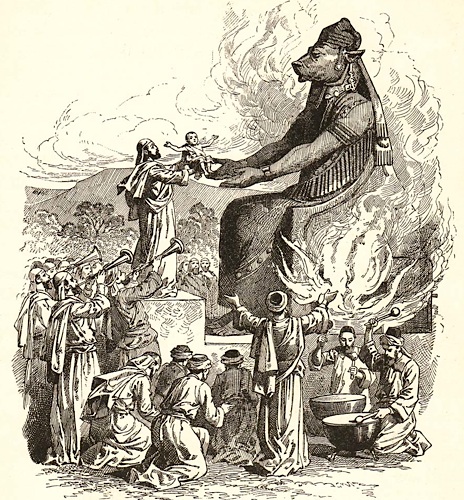
New study debunks claims of systematic infant sacrifice in Carthage -- or does it?

This is the kind of thing that drives me crazy. A press release is put out making the claim that a new study "debunks millennia-old claims of systematic infant sacrifice in ancient Carthage." Sounds intriguing, right?

Then, you read the release. About half-way down is this very curious statement:
"The idea of regular infant sacrifice in Carthage is not based on a study of the cremated remains, but on instances of human sacrifice reported by a few ancient chroniclers, inferred from ambiguous Carthaginian inscriptions, and referenced in the Old Testament."
Ok, do you get that? Apparently, documentary evidence in written sources dating from thousands of years ago is now considered inferior to scant archaeological remains--at least by these guys.

For the record, here is one of the pieces of documentary evidence of Carthaginian child sacrifice, taken from Diodorus Siculus:
In their zeal to make amends for their omission, they selected two hundred of the noblest children and sacrificed them publicly; and others who were under suspicion sacrificed themselves voluntarily, in number not less than three hundred. There was in their city a bronze image of Cronus, extending its hands, palms up and sloping toward the ground, so that each of the children when placed thereon rolled down and fell into a sort of gaping pit filled with fire.
Child sacrifice is also mentioned in Sacred Scripture as being associated with the Caananite god, Moloch, for example:
"Thus shalt thou say to the children of Israel: If any man of the children of Israel, or of the strangers, that dwell in Israel, give of his seed to the idol Moloch, dying let him die: the people of the land shall stone him." Leviticus 20:2
Here is a list of references to Moloch in Scripture.
http://www.drbo.org/cgi-bin/s?t=0&q=moloch&b=drb

Carthage was a colony of the Caananite/Phoenician trading cities.

But there is a real zinger in this press release:
"Our results show that some children were sacrificed, but they contradict the conclusion that Carthaginians were a brutal bunch who regularly sacrificed their own children."
Did you get that? So far from debunking anything, the research actually confirms that the Carthaginians did practice child sacrifice. The best this research team can do is comfort themselves with the knowledge that it may not have been on a massive scale.

Good grief.

Thursday, February 11, 2010

This Day in Late Roman History . . . February 11

On this day in AD 641, Heraclius, one of the most heroic — and tragic — late Roman emperors, died. He ruled for 30 of the most crisis-plagued years the Roman empire had ever experienced.

Under the rule of his predecessor, the cruel usurper Phocas, the Slavs had overrun the Balkans. At the same time, Syria, Egypt, and much of Asia Minor had been conquered by the Persians. The Persian king Chosroes II had even sacked Jerusalem, taking the True Cross back to Persia with him.

Rising from Africa where his father was exarch, Heraclius overthrew Phocas, but was faced with the daunting task of saving the empire from powerful enemies attacking on two fronts. Melting down gold given to him from the churches, Heraclius recruited and trained a new army. Rather than await the coming siege of the capital, Heraclius took the war to the Persians, defeating them in several pitched battles.

His campaign became a crusade. It was a fight to the death between the Christian Romans and fire-worshiping Persians — and in the end, the great Persian empire of the Sassanids lay prostrate on the ground. Heraclius recovered the relics from Jerusalem, and in AD 630, he returned to Jerusalem carrying the True Cross before him.

But his triumph was not long lived. Within six years, the Romans were again defeated in Palestine at Yarmuk by an invading army driven by a new power sweeping out of Arabia—Islam. By the end of his life, nearly all Heraclius had fought so hard to re-conquer had again been swept away, never to be recovered by the empire.

More detailed information on the eventful reign of Heraclius may be found here.

Wednesday, February 10, 2010

Angels in Iron video ad

Here's a video ad from Arx Publishing. Enjoy!


And here's the book in question:

Friday, February 05, 2010

Book Review: Saint Katharine Drexel: Friend of the Oppressed

We purchased this book at the St. Katharine Drexel shrine in suburban Philadelphia. My oldest daughter, who is six, was interested in learning more about St. Katharine's life, so we sat down together a few nights each week and I read it out loud to her. The book caught her imagination immediately and never let go.

From St. Katharine's girlhood with her sisters, to their summers in the country, to their various family trips, the author captures the spirit of family life in the Drexel household with good humor that makes them come across as real people, not unapproachable models of sanctity. My daughter and I particularly enjoyed the stories of their various joys and mishaps while on their European trips. What comes through unmistakably is that the Drexel girls, though surrounded by every material comfort the world could offer, never lost their focus on God, performing their devotions, and enriching their spiritual lives.

Without doubt, this book shows the Drexels as extremely wealthy--which in fact they were. However, this is contrasted with the family's unfailing charity, starting with their practice of the Dorcas where those in need came to the backdoor of the Drexel house. Of course, the ultimate example of that generosity was Katharine herself. Like her hero St. Francis of Assisi, Katharine gave up everything--even millions of dollars--to serve God. One of the most poignant passages for me was toward the end of the book where Mother Katharine is described as wearing her habits until they were threadbare. Having been to her shrine, examples of her austerity abound there, too--such as the tiny pencils, sharpened down to mere nubs, that she used until they could no longer be held.

So in short, this is a charming story about an inspiring modern saint. If you want to encourage a love of Christian charity and an openness to the religious life in your children, read this book with them.

Wednesday, February 03, 2010

Alexander the Great meets Diogenes the Cynic

Alexander and Diogenes by Nicolas André Monsiau

Fr. Rutler on EWTN's series, Christ in the City, mentioned this little story in passing, and it's just so good that I couldn't resist posting it, if only so that I can refer back to it later.
Alexander, passing through Corinth, had a curiosity to see Diogenes, who happened to be there at the time: he found him basking in the sun in the grove of Craneum, where he was mending his tub.

"I am," said he to him, "the great king Alexander."

"And I," replied the philosopher, "am the dog Diogenes."

"Are you not afraid of me?" continued Alexander.

"Are you good or bad?" asked Diogenes.

"Good," rejoined Alexander.

"And who need be afraid of one that is good?" answered Diogenes.

Alexander admired the penetration and freedom of Diogenes; and after some conversation, he said to him, "I see, Diogenes, that you are in want of many things, and I shall be happy to serve you; ask of me what you will."

"Retire, then, a little to one side," replied Diogenes, "you are depriving me of the sun."

It is no wonder that Alexander stood astonished at seeing a man so completely above every human concern.

"Which of the two is richest," continued Diogenes: "he who is content with his cloak and
his bag, or he for whom a whole kingdom does not suffice, and who is daily exposing himself to a thousand dangers in order to extend it?"

The courtiers of the king were indignant that so great a monarch should thus honor such a dog as Diogenes, who did not even rise from his place. Alexander perceived it, and, turning about to them, said, "Were I not Alexander, I should wish to be Diogenes."
Taken from:

Lives of the Ancient Philosophers
Translated from the French of Fenelon with notes and a life of the author
by REV. JOHN Cormack, 1842, pg. 227-228

Wednesday, January 27, 2010

This Day in Late Roman History...January 27

On this day in the year of our Lord 483, the relics of St. John Chrysostom were transported to Constantinople thirty years after his death. Known as a powerful and persuasive preacher, St. John, had been patriarch of Constantinople where he made a habit of speaking the truth to power in the most stark and antagonistic terms. He reserved some of his most biting criticisms for the elites of the Empire, including the Empress Eudoxia herself. His homilies soon gained him the ire of the imperial court and raised up numerous enemies within the Church as well. On two occasions, St. John was deposed and driven from the city. He died in exile in AD 407. A full biography of St. John may be found on NewAdvent.com.

Here are a few quotes:

"Remember, therefore, it matters not how many others sin, yours can never be justified before God, and where it is fashionable to sin it is likewise the fashion to go to hell. The choice is always yours to make."

"We should not bear it with bad grace if the answer to our prayer is long delayed. Rather let us because of this show great patience and resignation."

"Why sow where the ground makes it its care to destroy the fruit? where there are many efforts at abortion? where there is murder before the birth?...Why then dost thou abuse the gift of God, and fight with His laws, and follow after what is a curse as if a blessing, and make the chamber of procreation a chamber for murder, and arm the woman that was given for childbearing unto slaughter?"

Tuesday, January 19, 2010

This Day in Late Roman History...January 19

Exactly 1,631 years ago today, in AD 379, Theodosius was elevated to the rank of co-emperor at the age of 32. His elevation occurred only a few months after the disastrous defeat and slaughter of a Roman field army at Adrianople by the Goths. Theodosius was given the unenviable task of quelling the Gothic invasion and restoring order, all while rebuilding the shattered army. He accomplished these goals admirably.

A Spaniard by birth, Theodosius was last emperor to rule the entire Roman Empire, both east and west. As a result of his accomplishments in both the political and religious arenas, he is known to history as Theodosius the Great.

Saint Ambrose of Milan offered the following praise of Theodosius in the funeral oration offered a few days after the emeperor's death: "I loved the man, for he preferred those who told him the strictest truth, rather than the flatterers."

For more on Theodosius, have a look at the Catholic Encyclopedia's entry. The Wikipedia entry is also instructive, but as in all things wiki, read but verify.

Monday, January 18, 2010

St. Jane Frances de Chantal and spiritual suffering

I have come to have tremendous love for and devotion to St. Francis de Sales of late, having recently read his Philothea. As a result, I have also become aware of his great friend, St. Jane Frances de Chantal.

Saint Jane was an amazing woman in her own right. The mother of six children, her husband was killed in a freak hunting accident when she was but 28 years old. Later, after her children had been properly provided for, she became a nun and foundress of the Congregation of the Visitation, an order which took in those with a vocation who had been rejected by other orders.

Saint Jane was also someone who suffered greatly in spirit. Saint Vincent de Paul wrote, of her:
“She was full of faith, yet all her life had been tormented by thoughts against it. While apparently enjoying the peace and easiness of mind of souls who have reached a high state of virtue, she suffered such interior trials that she often told me her mind was so filled with all sorts of temptations and abominations that she had to strive not to look within herself...But for all that suffering her face never lost its serenity, nor did she once relax in the fidelity God asked of her. And so I regard her as one of the holiest souls I have ever met on this earth”
This should serve as a great comfort to those of us afflicted by the same trials and temptations in today's world. They can be overcome, with God's grace. We must always remember to ask for it.

The website on which I found this quote also had a rather profound observation on interior anguish, which hit me right between the eyes.
It may strike some as unusual that a saint should be subject to spiritual dryness, darkness, interior anguish. We tend to think that such things are the usual condition of “ordinary” sinful people. Some of our lack of spiritual liveliness may indeed be our fault. But the life of faith is still one that is lived in trust, and sometimes the darkness is so great that trust is pressed to its limit.
Yes, trust. There's the key to getting beyond the suffering and making of it a worthy sacrifice. We need to trust that God sees our plight, loves us, and that somehow, good will come from it.

This day in Late Roman History... January 18


Today is the 1478th anniversary of the quelling of the Nika Rebellion in Constantinople. After nearly a week of rioting in which about 1/3 of the city was burnt to the ground, the rebellion ended where it had begun--in the Hippodrome, the massive chariot-racing stadium which could seat 80,000 spectators. The end result was a horrible bloodbath where an estimated 30,000 rioters were slain. Here's a link to an article I wrote on the subject a few years ago.

Justinian 31, Factionists 10: The Nika Rebellion of AD 532

The one enduring result of the Nika Rebellion may be seen to this day towering above city of Istambul--Justinian’s magnificent Hagia Sophia, built over the ruins of the previous church of the same name which was destroyed by the rioters.

Thursday, January 07, 2010

Book Review: Katie--The Young Life of Mother Katharine Drexel

Young Katie Drexel was a child of privilege. Growing up during the difficult years of the Civil War and its aftermath, Katie nonetheless experienced every comfort and pleasure that life in Philadelphia and its environs could offer. Yet although her family was extraordinarily wealthy, her parents were at the same time wonderfully devout and excellent examples of parental love, charity and personal piety.

But Katie also knew sadness. Her mother had died a mere five weeks after her birth, a fact which Katie discovered at age 12. Her dear step-mother, the only mother she had ever known, died when Katie was 25. Her beloved father followed two years later. This left Katie and her two sisters heirs to a tremendous fortune. What the young Katharine Drexel did next is the stuff of miracles--for this pretty young woman with a vast inheritance and no shortage of suitors, turned away from the world and embraced the religious life, all for the sake of Christ. And 45 years after her death in 1955, she was recognized as a saint.

Katie: The Young Life of Mother Katharine Drexel is a short but excellent book. It is particularly well suited to be read with your children. I read it aloud with my oldest daughter (age 6) who had gotten it as a Christmas gift, and I noticed that my oldest son and younger daughter were lurking around as well while we read. By the end, the whole family was listening in. The writing is done in the first person, which adds a sense of familiarity to the book, as do the dozen or so black and white photos of the Drexel family. The prose is easy and approachable so that a kid over the age of 8 should be able to handle it with no problem.

The book closes with an account of the miracle which led to St. Katharine's canonization.

The story was so compelling that we decided to take a family trip to the shrine of Saint Katharine Drexel in Bensalem, PA after we finished. As this book is only about St. Katharine's early life up to her entering the religious life, you'll need to get another one to tell the rest of the story. Fortunately, the shrine has a gift shop, so we were able to walk out with Saint Katharine Drexel: Friend of the Oppressed by Ignatius Press.

Very highly recommended!

Wednesday, January 06, 2010

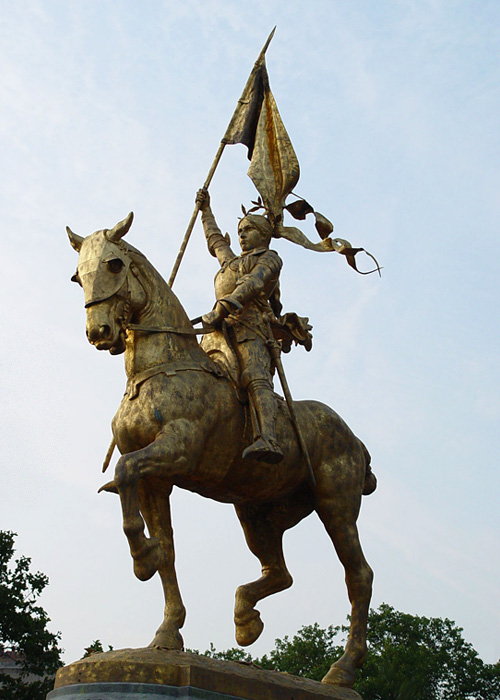
Happy Birthday, St. Joan

Aside from being the traditional date of the feast of the Epiphany, January 6 is also the birthday of one of my favorite saints, Joan of Arc. Here are some quotes of hers that I particularly like:

"I am not afraid ... I was born to do this."

"One life is all we have and we live it as we believe in living it. But to sacrifice what you are and to live without belief, that is a fate more terrible than dying."

"Children say that people are hung sometimes for speaking the truth."

"I would rather die than do something which I know to be a sin, or to be against God's will."

Truly a model of Christian virtue and courage. Here is a link to her full bio from the 1913 Catholic Encyclopedia.

The photo is of a statue of St. Joan in Philadelphia that I have always admired.

Wednesday, December 30, 2009

Constantine — Military Hero and Christian Emperor

At a banquet of the gods on Mount Olympus, the emperors of Rome were called to account to find which of them was the greatest. When Constantine’s turn came and he recounted his long string of triumphs, Silenus, the drunken companion of Dionysus, stood and rebuked him:

“Constantine,” he said, “are you not offering us mere gardens of Adonis as exploits?”

“What do you mean,” Constantine asked, “by gardens of Adonis?”

“I mean,” said Silenus, “those that women plant in pots by scraping together a little earth for a garden bed. They bloom for a little space and fade forthwith.”
This scene appears in a satire called The Caesars written by Constantine’s great-nephew, Julian — known to history as the Apostate.

As can be inferred from this excerpt, Julian didn’t think too highly of the accomplishments of his great-uncle. In fact, his purpose in writing The Caesars was to compare Constantine unfavorably with emperors who had gone before him.

Many so-called post-Christian scholars would readily agree with Julian’s assessment. But such scholars are wrong. Constantine’s war-like deeds had a much wider impact than a mere political consolidation of the empire under his sole rule. Without the military victories of Constantine, and the missionary zeal of that emperor in the aftermath of these victories, the ultimate adoption of Christianity by the mass of citizens in the Roman world would certainly have been long postponed.

But these days, Constantine has been thoroughly “Dan-Brown-ized.” His character has been sullied, distorted, and outright falsified by modern slanderers to the point that almost nothing remains of the real man in the popular imagination.

So who was Constantine and what did his accomplishments really mean?

First and foremost, he was the outstanding soldier and general of his era. He was the son of Constantius Chlorus, a tough provincial soldier who rose through the ranks by his own merits during the chaotic 3rd century AD when the empire teetered on the brink of collapse. Constantine’s mother, Helena, was a saint—literally. When the brutal but effective Diocletian came to power, he tapped Constantius Chlorus to rule Gaul and Britain as his “Caesar” or junior emperor.

With his father in a position of power, the young Constantine was sent off to serve in the retinue of Diocletian himself, no doubt to discourage any rebellious behavior on the part of his father. In this capacity, Constantine participated in the senior Augustus’s campaigns in the Balkans and Egypt. He must have also witnessed the steadily ramped up efforts by Diocletian and his protégé, Galerius, to extirpate forever that most hated sect known as Christians.

The ecclesiastical historian Eusebius Pamphilus reported seeing the young Constantine traveling among the company of Diocletian through the city of Caesarea. “No one was comparable to him for grace and beauty of person, or height or stature,” the bishop wrote. “And he so far surpassed his compeers in personal strength as to be a terror to them.”

But if Constantine possessed physical gifts, he also had the courage and right judgment to know when to use them. While still in the east, now serving under Galerius after the retirement of Diocletian, Constantine received news that his father was dying in far off Britain. Galerius refused to let the young man depart to be at his father’s deathbed and rumors flew that the jealous emperor intended to have Constantine disgraced or executed as soon as Constantius was safely dead. Not waiting on the outcome of events, Constantine fled from the east, riding post horses at a break-neck pace and hamstringing those mounts left behind to hamper pursuit.

Constantine arrived at York just in time to embrace his father before the old man breathed his last. He was then declared emperor by his father’s army—the only legitimate Roman emperor ever to be crowned in Britain.

If Constantius had proved himself to be a solid and capable commander, his son would soon outstrip him in every way. Constantine’s first challenge was to defend the provinces his father had bequeathed to him against barbarian invasion. When Germanic raiders crossed the Rhine to test him, the new emperor met and defeated them with little difficulty.

In Italy, meanwhile, a more dangerous threat emerged. A usurper named Maxentius assumed the imperial power at Rome. Two armies were sent from the east to dislodge him, but Maxentius bribed and absorbed the first and utterly defeated the other, sending the arrogant Galerius retreating back to the Balkans in disgrace. Only Constantine, operating from his base in Gaul, was left to grapple with the tyrant.

Descending into Italy with a force of seasoned troops roughly one-third of that commanded by his opponent, Constantine launched a sequence of brilliant campaigns that soon found him encamped before the massive Aurelian walls of Rome with a trail of broken enemy armies in his path. Here, however, he was stymied, for Maxentius, despite his defeats, retained a considerable numerical advantage. Furthermore, a pagan oracle had encouraged Maxentius to remain safely behind the walls of Rome, and Constantine, possessing neither the means nor the numbers to successfully besiege the city, began to despair of victory.

It was at this moment that God quite literally intervened. Constantine himself described the famous vision to his biographer, the bishop Eusebius Pamphilus:
He said that about mid-day, when the sun was beginning to decline, he saw with his own eyes the trophy of a cross of light in the heavens, above the sun, and bearing the inscription, CONQUER BY THIS. At this sight he himself was struck with amazement, and his whole army also, which happened to be following him on some expedition, and witnessed the miracle.
What happened next is one of the great turning-points in history. Constantine, who had been a worshiper of pagan god Sol Invictus—the unconquerable sun—decided to trust in this new God Who had revealed Himself. He had his men paint the chi-rho on their shields, symbolizing the first two letters of Christ, and he had a standard created, called the Labarum, which featured a cross and the chi-rho. This device would be carried before the army into battle.


Seeing his opponent checked and appreciating his own numerical superiority, Maxentius now sent his troops out of the city to do battle, though he himself remained in Rome in accordance with the oracle to celebrate the Circensian games. Constantine himself led his army to battle and the fight raged for the better part of the day with neither side able to gain the advantage over the other.

The people of Rome were outraged to see Maxentius sitting haughtily in the imperial box at the arena while the army bled on his behalf but a short distance away. They soon began to goad him by shouting, “Constantine can not be conquered!” Fearing an outright revolt, Maxentius caused the Sybilline Books—works of ancient pagan prophecy—to be consulted. Some soothsayer, with a delicious lack of clarity, discovered a line therein which read: “On the same day, the enemy of the Romans should perish.”

Maxentius took this to mean that he would triumph over Constantine, and so bolstered took the field. But as history would demonstrate, the miraculous promise of the Christian God far outweighed the spurious and contradictory oracles of the pagans. The army of Maxentius broke and fled back toward Rome, but in order to reach the city and safety, the routed host had to traverse the Milvian bridge over the Tiber. In the crush to get across, the bridge collapsed and the tyrant and much of his cavalry were drowned.

This sight of Constantine’s army, completely victorious and marching under the standard of the Cross, was a tremendous shock to many pagan Romans. According to Eusebius, “Those who had so lately been deceived by their vain confidence in false deities, acknowledged with unfeigned sincerity the God of Constantine and openly professed their belief in Him as the true and only God.”

This incredible victory also made a deep and abiding impression on Constantine. Though he probably knew something of the faith given that his mother, Helena, was a devout Christian, the young emperor now realized without doubt that his great triumph had been achieved less by his own valor than via the salutary sign of the Cross. As a result, Constantine set his mind to the promotion and propagation of Christian devotion throughout the empire.

His piety was real. His belief in God and the saving power of Jesus Christ was not mere affectation. In an empire that was still about 85% pagan, what did he have to gain by embracing a small and historically despised minority? Rather, Constantine believed to his core that there could be no true happiness, no joy, no hope outside of Christianity. In a later edict, he set out these beliefs in his own words:
To all who entertain just and wise sentiments respecting the character of the Supreme Being, it has long been most clearly evident:…they who faithfully observe His holy laws, and shrink from transgressions of His commandments, are rewarded with abundant blessings, and are endued with well-grounded hope as well as ample power for the accomplishment of their undertakings. On the other hand, they who have cherished impious sentiments have experienced results corresponding to their evil choice.
Lest we assume that Constantine’s belief system was some simplistic notion that God punishes the wicked and rewards the pious in this life, the emperor himself explodes this accusation within the same edict:
Whoever have addressed themselves with integrity of purpose to any course of action, keeping the fear of God continually before their thoughts…such persons, though for a season they may have experienced painful trials, have borne their afflictions lightly, being supported by the belief of greater rewards in store for them.
And Constantine had many painful trials yet in store for him. Following his victory over Maxentius, he divided the empire with Licinius, the successor of the persecuting emperor Galerius who had perished in a spectacularly gruesome way—his insides being devoured by worms. Licinius began his reign as a friend of the Christians and the brother-in-law of Constantine. But the two were quickly at loggerheads, and Licinius’s enmity for Constantine soon also became a visceral hatred for Christianity.

The inevitable war between the two immediately became a religious conflict with Constantine’s legions marching under the Labarum and those of Licinius under unabashedly pagan symbols. Both sides infused their propaganda with blatant religious overtones. Constantine kept a retinue of Christian priests nearby to advise him at all times. Meanwhile, Licinius consulted pagan soothsayers who confidently predicted a total victory for him over Constantine, the despiser of the gods.

The two sides clashed in the Balkans. The climactic Battle of Cibalis was a grinding infantry struggle that the pagan historian Zosimus termed, “one of the most furious that was ever fought.” The battle lasted an entire day and the result was in doubt until Constantine’s right wing—which he himself commanded—broke through and routed Licinius’s forces.

Though defeated, Licinius was still able to muster enough strength to save himself from complete destruction. Constantine, for his part, was willing to give his brother-in-law a second chance. So the two settled down into an uneasy truce which allowed the battered empire a brief respite.

When war broke out afresh eight years later, it was to be a fight to the finish. Between the two of them, Constantine and Licinius mustered nearly 300,000 soldiers, with Licinius holding a slight advantage in overall numbers. The armies faced off at Adrianople in Thrace, where Constantine, by the use of a strategem, was able to hit the Licinian army unexpectedly and precipitate a rout. Constantine pursued Licinius to Byzantium and placed the city under siege. It was here that Constantine appreciated the strategic value of the city which would in no short time become the new capital of the empire—Constantinople.

Meanwhile, Constantine’s fleet gained a victory over the Licinian fleet. Fearing that he would be cut off from his base in the east, Licinius immediately retreated to the Asiatic shore of the Bosporus. In a final gambit, the pagan emperor threw all his available forces at Constantine at Chrysopolis near Chalcedon. The resulting battle was one of the largest and bloodiest of antiquity. Zosimus reported that of the 130,000 men that Licinius flung into battle, barely 30,000 remained to him at the end of the day.

His cause doomed, Licinius fled to Nicomedia where he was captured. He was held under house arrest but was executed a year later while trying to raise yet another army.

With this hard-fought victory, Constantine was now the sole emperor of the Roman world. For the next twelve years until his death in AD 337, he set about restoring peace and stability not only to the empire, but to the Church as well. He immersed himself in those intractable theological disputes that roiled the early Church, calling the Council of Nicaea to deal with the Arian heresy. Though he was ultimately unsuccessful in this endeavor, the Council of Nicaea came to be seen as a benchmark for councils of the universal Church and the creed it produced is still recited to this day.

But more than anything else, Constantine promoted vibrant Christianity to a weary pagan population for whom the old gods had lost the power of consolation and inspiration. He and his mother erected dozens of dazzling new churches across the empire. He issued edicts praising Christianity and condemning pagan superstitions, and he enjoined all his soldiers to recite prayers to God on Sundays.

By the end of his reign, Constantine had pruned back the rotting weeds of paganism and allowed the green shoots of Christianity to sprout up across the empire. Though subsequent Christian emperors would not match Constantine’s military prowess, Christianity would continue to thrive under them unabated from the firm roots set down during his reign.

So Constantine’s exploits were clearly not “gardens of Adonis.” But in fairness, Julian the Apostate could not have known that he himself would be the last pagan emperor of Rome. And while Julian’s vain efforts in the name of pagan revival would wither and fade immediately after his death, those of Constantine which he ridiculed would stand tall and strong through the ages, bearing abundant fruit.

[This article originally appeared in Catholic Men's Quarterly.]

Check out these other articles from my blog which delve more deeply into the fascinating character of Constantine the Great:

Thursday, December 24, 2009

A review of Philothea, or An Introduction to the Devout Life

Having read this book, I can now understand why St. Francis de Sales is a doctor of the Church. Simply put, Philothea, or An Introduction to the Devout Life is a roadmap to Heaven. But unlike many of the theological tracts or mystical tomes which one often finds professing to do the same thing, this book is, very simply, a practical manual for living a devout life in a world that is often antagonistic to Christianity. It is also the closest many will get to having a canonized saint as one's own spiritual director.

The advice offered is excellent, grounded in sacred Scripture and the teachings of the saints, and enlivened with colorful metaphors. (St. Francis obviously had an affinity for bees.) Though St. Francis lived 400 years ago, his guidance easily translates to life in the 21st century. He had a keen insight into the workings of the human mind, the devious yet innocent-seeming temptations presented by the devil, and the challenges faced by the soul seeking to live a pious life amid the petty cares of everyday life. And his insights transcend time and culture.

No one can read this book without finding a section that directly applies to them, whatever their state of life. St. Francis's spiritual exercises, admittedly, are difficult. But who can doubt that following them to the full would have wonderfully efficacious effects on the soul? I have begun instituting a subset of them in my own life and have already reaped benefits. I hope to include more of them as time goes on and my spiritual stamina improves.

St. Francis's advice on correct behavior, attitude, and personal morality is incredibly wise. Those who read and accept these teachings will assuredly live happier, more fulfilling lives, which are more pleasing to God. The several chapters on friendship--specifically true friendship versus worldly friendship--were of particular utility to me. I think many young Catholics would do well to read and ponder St. Francis's words on the subject so as to avoid temptation and the near occasion of sin in their relationships.

In short, this book is a masterpiece of spiritual advice and I can't recommend it highly enough. Best of all, one need not read it cover-to-cover. It may be dipped into for incidental advice based on the reader's own flaws, strengths, state of life, and spiritual needs. If you are looking for a straight-forward, uncomplicated path to Christian devotion, this book is it.

Tuesday, December 15, 2009

Book Review: St. Fernando III: A Kingdom for Christ

Did you know that one of the greatest kings in Spanish history, Fernando III, was also a saint? I didn't. But thanks to author James Fitzhenry, I do now. Fitzhenry, who also penned El Cid: God's Own Champion, has written a detailed yet approachable biography of this fascinating and inspiring example of Catholic manhood entitled St. Fernando III: A Kingdom for Christ. Published by Lepanto Press, who have made a name for themselves by producing beautiful, high-quality Catholic books at a reasonable price, St. Fernando III is geared toward Catholic homeschooled kids, probably in the twelve and older age range. But the writing is exceptional and as a mature reader of eight-and-thirty years, the book easily held my attention.

Replete with family turmoil, civil strife, stunning miracles, romance, and dozens upon dozens of skirmishes, pitched battles, and sieges, the tremendous scope of St. Fernando's worldly accomplishments leave the reader dumbfounded. But the heart of this book is St. Fernando's total devotion to Christ and his Blessed Mother. Everything he did, he offered to God without reservation. In his willingness to suffer personal hardships, unfailing mercy toward his enemies, love for his wife and children, and care for the poor and afflicted, St. Fernando was a model of Christian virtue. In his everyday life, and especially when he faced a crisis, he turned to the Virgin and believed to the depths of his soul that she would intercede for him. And based on the magnificent achievements of his life, who can doubt that she did? For at the same time that the Christian states in the Holy Land were failing despite the best efforts of great crusading armies led by the most important crowned heads of Europe, St. Fernando was able to weld together the small kingdoms of Castile and Leon and use their combined might to reconquer almost all of Andalusia from its Muslim overlords.

So in short, this book is a gem. St. Fernando III is a Catholic hero who deserves to be more widely known. Now thanks to James Fitzhenry and his enjoyable book, he will be.