Showing posts with label historical fiction. Show all posts

Saturday, August 02, 2025

Book Review: Father Michael McGivney and the Knights of Columbus by Emily Tennant

Fr. McGivney hurries through inclement weather on a sick call.
For many years I have appreciated and enjoyed the Vision series – a sequence of biographical novels about the lives of the saints and Catholic heroes written especially for younger readers. The series commenced in the hoary antiquity of the 1940s and has continued over the decades, featuring a variety of authors—some of whom, like Louis de Wohl for example, were writers of supreme talent.

Click for more info.
Several of the books in the series have been reviewed by your humble blogger over the years, among them books on Saint Helena, Blessed Miriam Teresa Demjanovich, and Saints Louis and Zelie Martin. The last two mentioned were recent additions to the series written by GinaMarie Tennant, an author, organist and music teacher who grew up in a large homeschooling family. Perhaps not surprisingly, this same family has produced another writing talent, Emily Tennant, who is the author of the brand new title in the Vision series, Father Michael McGivney and the Knights of Columbus.

What a tremendous idea it was to write this novel. As a Fourth Degree Knight myself, of course I had heard of Fr. McGivney. But I would be lying if I said I knew much about him before reading Miss Tennant’s historical novel about his life. Father McGivney comes across in the work as a man of shining parts who emerged from a humble yet virtuous family to become a humble yet virtuous priest.

As portrayed by Miss Tennant, Fr. McGivney’s life reminded me of that of his rough contemporary, Saint Therese of Lisieux. He lived his own “little way”, performing the menial tasks of a Catholic priest with great fervor and wearing himself out physically in the process. Much like St. Therese, Fr. McGivney died young, entering eternal life at the age of 38.

But also similar to St. Therese, Fr. McGivney’s small acts would be transformed by God in His own good time into tremendous works that impacted millions of people. I doubt that Fr. McGivney realized in 1890 when he died, that the Catholic mutual aid society he created known as the Knights of Columbus, would eventually grow into the charitable leviathan that it has become today, with over 2 million members worldwide.

Father Michael McGivney and the Knights of Columbus is an eminently readable little novel, and is ideal for the young Catholic audience for whom it is intended. The prose is mostly light-hearted and fun. Of course, there are scenes of tragedy that play out throughout the story, but these all coalesce as the rationale for Fr. McGivney’s vision of the Knights of Columbus. In those days, when the father of a young Catholic family passed away, his wife and children often became wards of the state, to be separated among orphanages and other charitable organizations. Fr. McGivney founded the Knights to provide life insurance and other aid to such Catholic families in their moment of need.

The aspect of this novel that I appreciated the most, however, was the author’s attention to historical detail. The book includes a wealth of minor personal anecdotes from Father McGivney's life that lend a distinct flavor of authenticity to the work. As I read, I found myself wondering, “What is the significance of this passage?” As Miss Tennant explains in the Author's Note at the end, nearly all of these seemingly insignificant events were drawn directly from Father's correspondence or church archives—even the many humorous prizes that Father McGivney wins at the various Church fairs came from the old records. 

Steeped as it is in the Catholic history of the United States in the mid-19th century, Father Michael McGivney and the Knights of Columbus is an ideal book to read aloud with your kids. If you are a Knight of Columbus or have one or several in the family, this book should definitely be on your bookshelf.

Thursday, October 17, 2024

The Leper-King of Jerusalem Rides Again. A review of Susan Peek's Crusader King

Click for more info.
This is a review I wrote many years ago (and never posted here) for a book that has stood the test of time: Crusader King: A Novel of Baldwin IV and the Crusades by Susan Peek.

Peek's rendition of the story of the leper king of Jerusalem, Baldwin IV, is at the same time a tragic and uplifting tale. Young Baldwin was stricken with leprosy as a boy and ascended the throne of the tottering Crusader Kingdom of Jerusalem at age 13. Despite scheming nobles angling for his crown even among his own family, and the omnipresent threat of Saladin and his Islamic hordes, the sickly Baldwin managed to hold his throne and safeguard his kingdom for nearly 11 years. 

Crusader King tells one of the great tales of history, and one feels genuine empathy for Baldwin as he struggles to do what he believes God has called him to do. Though his faithless nobles undercut him at every turn, Baldwin is supported by several very loyal Templars, one of whom, Theo, is his boyhood friend. Theo's loyalty and self-sacrificing excellence is really the heart of the book. While everyone else around Baldwin grasps at power, Theo refuses it at every turn, deciding instead to stick by his dying friend, no matter what the cost. Baldwin himself is presented as a devout, strong, and decidedly Catholic hero, suffering his dreadful crosses with courage and trust in God. As a Catholic myself, I found this to be a particular strength of the book.

Crusader King is an easy and quick read. The prose is rather light, even when dealing with difficult subjects—like Baldwin's progressing leprous disfigurement. Peek does use some modern colloquialisms, but mainly in an attempt to portray the informal banter between friends, or the cutting sarcasm among estranged family members. As such, it was wholly appropriate. I found this book to be an engrossing read and it made me seek out the historical accounts to get the actual story. If this was Ms. Peek's intention, she succeeded brilliantly. 

If you enjoy this type of book, or this particular time period in history, I encourage you to seek out Crown of the World: Book 1: Knight of the Temple by Nathan Sadasivan. This historical novel covers the time period immediately before the accession of Baldwin IV and the two books complement each other nicely.

Wednesday, March 06, 2024

Belisarius and Procopius celebrate the defeat of the Goths at the Siege of Rome, March of AD 538 ~ An excerpt from Belisarius, Book III: Rome the Eternal

Belisarius and Procopius chat atop the Pincian Gate in Rome. 
Image created using hotpot.ai/art-generator

In March of the year AD 538, the late Roman general, Belisarius, pulled off one of the most incredible feats in military history: he successfully defended the massive city of Rome—with its 12 miles of circuit walls—with a scant 5,000 soldiers, against a vast army of Goths that outnumbered his own some 15 or 20 to 1. Indeed, by the time the Gothic King Vitiges broke up the siege after twelve frustrating months, it had become unclear which side was the besieged and which was the besieger. Unable to prevent the Romans from bringing in supplies or leaving the city in force, Vitiges found himself bogged down with a stubborn fortified city in front of him, and far flung enemy cavalry units ravaging his supply lines behind him, threatening to cut him off from his base in Ravenna.

What did Belisarius do once it became clear that the Goths were abandoning their camps and moving out? Did he allow the reduced but still tremendous force of Goths to go in peace, counting himself blessed and fortunate that the city had withstood the prolonged siege against such heavy odds? 

He did not. 

Instead, he rode out with every available man and attacked the Gothic rear-guard. 

I recorded Procopius's eye-witness account of the end of the siege in a previous post here.

Belisarius, Book III: Rome the Eternal, provides a dramatized description of this action with Belisarius's biscuit-eaters Longinus and Mundilas leading the charge. Mundilas is injured, while Longinus is killed despite amazing acts of valor. This much is recorded in Procopius's History of the Wars. I embellished the action in the novel.

Here is an excerpt from the novel, presenting a scene on the walls of Rome in the immediate aftermath of the Gothic withdrawal. In this scene, Belisarius has an opportunity to speak privately with his secretary, Procopius of Caesarea—the man who would go on to become the most important historian of the Justinianic period.

I had fun writing this scene. I hope you enjoy it!

 End of Chapter XXXI...

Belisarius secured the gatehouse at the Milvian Bridge that he had been forced to cede when the Gothic host first arrived the previous March. With that act, the great siege of Rome came to an end. Belisarius entered the city to cheering throngs, many of whom had ventured out of the gates to watch the battle from the protection of the tree line. The ecstasy of the Romans was tempered only by the arrival of a cart bearing Mundilas and Longinus—the first gravely injured, the second slain. Meeting the bereaved men of Longinus, Belisarius offered his sincere sympathy, weeping along with them without shame.

Later, Belisarius stood alone atop the Pincian Gate, for once gazing into the city, not outward toward the Gothic camps now in ashes. As the celebration continued unabated well into the night, Belisarius insisted that the gates be manned and the guards be sober, lest the Goths sneak into the city via stratagem while its inhabitants were lulled into a drunken slumber. To drive home the point, Belisarius himself kept vigil all night on the walls.

“Has the great wooden horse arrived yet, O Aeneas?” Procopius laughed. He made his way slowly and carefully up the stone steps, his tottering gait threatening to cast him fifty feet down.

“No sign of it,” Belisarius smiled, offering his secretary a strong hand up. “If you would warn me against it, though, be mindful of the fate of Laocöon. How are you at wrestling with snakes?”

“I would fare no better than the ill-fated Trojan priest, I suppose,” Procopius sighed. “I fear serpents above all things. Here, I have brought you a drink—wine mixed with honey, and a good vintage, too.”

“Though I am on duty, I accept. From any hand but yours I might demur, old friend,” Belisarius replied, recalling the recent attempt to drug the gate guards using spiked wine.

The two stood in silence as Belisarius sipped.

“Was it worth it?” Procopius intoned quietly, casting his bleary gaze over a large group of revelers carousing in the plaza below. “Was recovering this city worth the lives of Longinus and Principius and Tarmutus?”

“Don’t forget about Chorsamantis, Bochas and Cutilas,” Belisarius added. Poor Cutilas had lingered a month after suffering his gruesome head wound, only to perish of fever despite the best efforts of Theoctistus. “May Christ have mercy on their souls.” He made the sign of the cross on his forehead.

“Maxentius, Petronius and Valentine, too,” continued Procopius. “And so many other good men.”

“And Constantinus,” Belisarius added gloomily. “His unhealthy lust for plunder killed him as surely as any Gothic spear. But my answer is yes. This is the Eternal City of Rome, the birthplace of the Empire and the rampart of civilization. Had more good men been willing to give their lives to defend it in past ages, it would never have fallen under the sway of the barbarians to begin with.”

“But if too many good men die, who...who...but wicked men and weaklings will remain to defend Rome?” Procopius asked with a tipsy stammer.

“God will raise up others as He raised up this generation. That is why what you are doing is of such great import.”

“My letters to the praetorian prefect about the grain supply are pointless—irrelevant two weeks after they are written,” Procopius lamented.

“Not your letters, friend. Your history.”

Click here for more information.
“That disorganized pile of waste paper?” Procopius replied, the wine loosening his tongue. “Alas, your words earlier today—was it really today? It feels like weeks ago—your words have put a worry into my heart. What will the ending be? Will our astounding run of blessed good fortune continue? Or will some great disaster turn the tale into an awful tragedy? Or worse, will a sequence of little disasters grind us down into abject failure. You know, when my mood turns this way, I have considered destroying all my notes and abandoning the work completely.”

“Am I truly speaking with the same man who said that he was writing a history to be read for a thousand years?” Belisarius replied in amazement. “Has our victory in the siege somehow drained your cask of optimism?”

“Even victories, it seems, come with a cost in noble lives lost that can never be replaced,” Procopius sighed. “Writing about the death of yet another hearty soul like Longinus makes me never want to write again.”

“That is not well at all,” Belisarius chided, turning deadly serious. “You must persevere and continue to write without flinching and without despair, no matter what outcome God has ordained for our campaign. For if those men died in this cause, their deaths will not be in vain if their names are recorded for posterity so that those who read in the far distant future, hundreds or thousands of years from now, may remember and admire their acts.”

“Of course, you are right,” Procopius grimaced, focusing his eyes on a bonfire burning outside the city. “The purpose of history is to give the future examples of valor to imitate and perfidy to despise. And certainly, the acts of Principius and Longinus did just that.”

“So then you will continue?” Belisarius asked, exhaling a vaporous cloud into the chilly night air.

“Yes, I will continue, Magister,” Procopius replied pensively. “Though I will pray hard that my history doesn’t devolve into a dreary chronicle of disasters and obituaries.”

“Indeed,” Belisarius nodded. “I will do my very best to make sure that you are well supplied with noble deeds and heroic victories to record.”

Procopius smiled a little sadly, but remained silent. Would that you had the power to ensure that, O Magister.

If you want to see how things turn out for Belisarius, check out Book III: Rome the Eternal which is available from Arx Publishing here, on Amazon.com here, on Amazon Kindle here, and other bookselling websites.

Tuesday, April 25, 2023

Padre Pio for a new generation of young Catholics: A Review of "Wounds of Love" by Phillip Campbell

Detail from the cover of Wounds of Love: The Story of Saint Padre Pio.
Like Jeanne d’Arc or Francesco di Bernardone, Francesco Forgione was one of those unique individuals gifted by God to the human race to assure us of His love, His understanding, and above all else, that He is not deaf to our sufferings and entreaties. But unlike these other great visionary saints, Forgione was not a streak of light which flashed across the firmament and returned quickly to heaven. 

Saint Joan’s mission lasted about two years before she was martyred at age 19. 

Saint Francis of Assisi was 45 when he passed to eternity, roughly 20 years elapsing between his call and his death.

Click here for more info.
Saint Pio of Pietrelcina, on the other hand, spent almost the entirety of his long life as a suffering servant of Jesus Christ. Afflicted with ill-health, physical infirmities, the Stigmata, and demonic attacks which left him battered and bruised, Padre Pio was also subjected to slanderous assaults on his character, all over a period of nearly seven decades. Yet during that time, he was able to touch the lives of thousands upon thousands of people, uniting his suffering to that of Christ and translating it into God's grace to heal sinners from all over the world. And his reach was truly immense. At his shrine at San Giovanni Rotondo, there is a wall of shelves filled with thousands of letters received by Padre Pio—in a single year. 

Nearly as many people recall unforgettable personal encounters with the gruff Capuchin saint of San Giovanni Rotondo, either in the flesh, or in the spirit. It is said that he heard about five million confessions over the course of his priesthood. And there are numerous miracle stories. One such story that I heard in person is that of Philadelphia native Frank Tenaglia (1965-2019) who credited Padre Pio with healing him of a grave childhood illness—a miracle which allowed him to praise God with his amazing voice for many years. 

Though there are myriad books about Padre Pio's extraordinary life, very few of these are accessible to younger readers. This has now changed with the release of Wounds of Love: The Story of Saint Padre Pio by Phillip Campbell. I have been waiting for a book like this for years. It’s no easy task to condense the long and eventful life of someone like Padre Pio into the historical fiction format which appeals to young readers, but Phillip Campbell has done a masterful job. His focus on the early life of St. Pio is pitch-perfect. While most readers think of Padre Pio as a rather grumpy elderly man, Campbell’s presentation spends more time introducing readers to the young Francesco Forgione growing in grace and holiness in the bosom of a loving family.  

Wounds of Love includes some of the most famous anecdotes associated with Padre Pio, including the well-known incident reported by General Nathan F. Twining of a Capuchin monk appearing in the sky to thwart Allied bombing runs on San Giovanni Rotondo during World War II. Campbell also relates a few more obscure ones, including one that I had never heard before, despite having read several books on Padre Pio in the past. In Chapter 12, the novel delves into the slanders aimed at Padre Pio by those within the Church in the early 1960s. In an effort to gather evidence against him, someone apparently wiretapped his confessional. Originally, I thought that this outrageous story belonged more to the “fiction” than to the “historical” side of the narrative. But upon further research, I discovered that this inconceivably awful tale was true—and that Padre Pio actually did discover the microphone himself and cut out the wire with a penknife! 

In sum, Wounds of Love is a fantastic book and I heartily recommend it to readers of all ages. If you need additional proof of how the story draws you in, I gave it to my 17-year old son to read and he polished it off in about a week. What's more, he immediately moved on to a more in-depth biography of Padre Pio that we have on our bookshelves. 

Mission accomplished, Mr. Campbell!

Saturday, February 18, 2023

"He weathered their rage like some craggy rock in a howling tempest." ~ Belisarius and the lead-up to the Great Siege of Rome


Given the month, I am mindful of a February nearly 1,500 years ago when Belisarius, newly arrived in Rome after the withdrawal of the Gothic garrison, found his situation far from secure. The Roman citizens, who had welcomed his arrival with glad tidings, now began to suspect that their savior was not intent on pushing on to face the Goths in a decisive battle. Worse, the army of Belisarius that had liberated Rome was not some overwhelming force—far from it. An optimistic observer might have counted their number at 5,000. 

Such an army could not be expected to inflict an open-field defeat upon the vast Gothic hosts of Vitiges, the self-styled King of the Goths and Italians. Worse, it was not even sufficient to guard the 12-mile long circuit walls of Rome in the event of Gothic attack.

With these facts clear to even the most obtuse citizen, the Senate of Rome, still largely intact despite over sixty years of Gothic rule, watched with trepidation as Belisarius and his men began repairing the crumbling fortifications of Rome. The great walls which surrounded the city had been constructed 250 years before by the emperor Aurelian. Though imposing, these fortifications were ruinous and vulnerable in many locations, and Belisarius assiduously set about restoring them. Some of his innovations—such as adding a merlon to each battlement to protect the backs of the defenders—left the Romans impressed. Yet they remained deeply troubled by what these preparations presaged. As Procopius relates:

The Romans applauded the forethought of the general and especially the experience displayed in the matter of the battlement; but they marveled greatly and were vexed that he should have thought it possible for him to enter Rome if he had any idea that he would be besieged, for [Rome] can not possibly be supplied with provisions since it is not on the sea, is enclosed by a wall of so large a circumference, and above all, lying as it does on a level plain, is naturally exceedingly easy of access for its assailants. [Procopius, History of the Wars, Book V, Chapter XIV]

Procopius goes on to say that Belisarius heard all the criticisms of his strategy but redoubled his efforts, even compelling the indignant Romans to bring in all their provisions from the countryside.

In his novel, Count Belisarius, Robert Graves puts the discontent of the Roman citizens over the strategy of Belisarius into the mouth of Pope Silverius. In this, he plants the seed of the conflict that would later emerge between the Pope and the household of Belisarius. Given Graves's rather negative view of the Catholic Church which is evident throughout Count Belisarius, I have always disliked this approach.

In my third book, Belisarius: Rome the Eternal, I have opted to expand this discontent into a scene in which the Roman senators and clergy confront Belisarius at the Lateran Palace, taking the opportunity to work in some history lessons. Rather than using the scene to create conflict between the spiritual and temporal powers in Rome, I have attempted to show how Belisarius turned the situation to his favor, enhancing the loyalty of the doubtful Roman senators who were pretty clearly having second-thoughts at this time immediately before the commencement of the siege. 

Here is part of the scene. I have added a few notes in red, if for no other reason than to remind myself of why the individuals named are present. See what you think:

Click here for more info.
...“Forgive the interruption, O General,” Fidelius said, bowing slightly. “All are now present. And here is Honorius, prefect of the city. Allow me to present him first.”

“At your service,” mumbled Honorius bowing.

“Ah, here is a man I am anxious to meet,” said Belisarius, raising the prefect up by his hand. “I am told you have a crew at your disposal whose purpose it is to repair public monuments and buildings. Is that correct?”

“Certainly. Three hundred men, no less,” Honorius bellowed in response. “Granted, some are slaves, but all have strong backs and are skilled in metalcraft and stonework. For the past months, they have been restoring the great bronze elephants along the Via Sacra, for this was our final order from Theodatus the tyrant.” [This is taken directly from the Variae of Cassiodorus, Book X, Letter 30]

“Laudable as that work may be, I must conscript all of your men starting tomorrow morning. Restoring the fortifications must take immediate precedence over all other construction work in the city,” Belisarius explained. “Let them know that they will be well paid for their labors.”

“Yes, that is something that puzzles us, Magister, if I may,” senator Gennadius Orestes spoke up with a slight chuckle. “Perhaps it is my fatalistic nature getting the better of me, but it almost seems as if you are preparing Rome for a siege.” [Gennadius Orestes was a Roman Senator who was Consul in AD 530]

“But we know that cannot be,” the elderly senator Anicius Basilius added. “Anyone who has studied the history of Rome knows that the city cannot be defended effectively without a great army, several legions at least. The walls are too long, the supply lines impossible to protect, the civilian population too huge. And your men, regrettably, are too few.” [Anicius Basilius was a Roman senator who would later be named consul by Justinian in AD 541]

“That brings us to another question, Magister,” senator Cethegus boomed in his pompous oratorical voice. “Where is your army? Surely, the skeleton crew that marched into the city with you is but the advance guard. When should we expect to see the rest?” [Nicomachus Cethegus was consul in Rome under the Gothic king, Theodoric the Great, in AD 504. He would later flee to Constantinople and play a role in the discord between Justinian and Pope Vigilius.]

Belisarius scowled slightly and scanned the faces gathered about him. It was time to deliver some hard truths to these men, many of whom had grown used to security and prosperity under the long reign of Theodoric. He wasn’t sure how they’d stomach what he had to offer them—the gloomy trio of hardship, want, and a desperate struggle.

“Noble senators, the rest of my army is scattered throughout Sicily and southern Italy. Just as I have brought the core of my forces here to guard Rome, so the remainder secure Neapolis, Cumae, Beneventum, Rhegium, Syracuse, Panormus and a score of other cities. Yes, it is my intention to hold Rome in safety against all attacks by the Goths. If that means enduring a siege, then endure it we must.”

An outcry immediately erupted from the assembled politicians.

“Your men are five thousand at most!” tall Cethegus cried. “You cannot hold the city with so few. It is impossible!”

“Do you not realize, O Magister, that this Vitiges whom the Goths call king, can muster an army of myriads upon myriads?” Orestes shouted. “If you attempt to defend Rome against the full power of the Goths, you will bring upon us destruction that will make the sacks of Alaric and Gaiseric seem like the Saturnalia. Olympius could not defend Rome from the Visigoths despite his lofty name. Petronius Maximus failed utterly to thwart the Vandals despite the greatest blessings of holy Peter. What hope have you, then, to repulse such a force when these others have failed with more resources at their disposal?”

“Peace, senators, peace!” Pope Silverius commanded in a loud voice, but few took heed even among the clergy who had joined the tumult.

Belisarius said nothing, but let the assembled men grumble, rant and vent their frustration. Wearing on his face a look of stoic dispassion, he weathered their rage like some craggy rock in a howling tempest.

Minutes more of clamorous outrage passed during which the expression on the face of Belisarius softened not at all but grew only harder, and it suddenly dawned upon the senators that he would not engage in debate with them. Soon they grew quiet, looking upon him in astonishment, wondering whether their outburst would ultimately elicit a reaction of anger or capitulation from the Magister Militum of Roman Empire, the right hand of the emperor Justinian.

“What say you, O General?” Honorius the prefect ventured, now feeling empowered by the near unanimity of the nobles. “Will you not—ahem—reveal to us your plans for defending Rome and defeating—uh—our enemies?”

Leaping up onto a low platform surrounding a fountain in the middle of the courtyard so that he could better be seen and heard, Belisarius began:

“It is not for you to know my plans, O Senators, for what fool of a general announces his intentions to the wide world? But I will say this: if you compare me with Olympius or Petronius Maximus you do me a great wrong. As you well know, Olympius of ill fame, took the administration of Rome after plotting the disgraceful murder of Stilicho, the greatest warrior of his age, who fearlessly defended the Empire. [Stilicho was the Master of Soldiers and principal support of the Western Emperor Honorius, assassinated in AD 408. Rome would be sacked by Alaric two years later.]

"In the same way, Petronius Maximus proved himself only the greatest of traitors, seeking ascendancy for himself by the assassination of Aetius, a general of such excellence that even the hordes of Attila quailed before him. [Aetius was the Master of Soldiers under the Western Emperor Valentinian III. He defeated Attila at the Battle of the Catalaunian Plains in Gaul in AD 451, but was assassinated following a court intrigue three years later. Soon after, Rome would be sacked again by Gaiseric.]

"Both Aetius and Stilicho feared not death and indeed preferred it to surrender to the enemies of the Empire. Both were ultimately undone not by lack of military prowess, but by short-sighted politicians bent on amassing power and fortune.

“Let us recall these events of a century ago with shame, for we have five-score years of gloomy hindsight to remind us where they led—defeat and fear, sack and slaughter, domination and ruin. But now this will change. I come before you not as a politician or as a bureaucrat, but as a soldier and servant of Justinian Augustus, most happy and victorious emperor of the Romans. I hereby pledge my life to your safety. If during the coming storm you suffer, know that I will suffer before you. If you are injured, know that the enemy will have to knock me down to get at you. If you are in peril of death, know that I will share that peril every day until the peril is gone. As Stilicho and Aetius, I do not fear my own destruction, but I will put everything I have on the line to protect Rome from our enemies.”

In stunned silence, the assembled nobles and clergy listened, amazed that this man whom they considered an unlettered Thracian was more knowledgeable in their own history than most of them. A smile brightened the wrinkled face of Anicius Basilius, and Orestes’s cynical scowl turned to a look of delighted stupefaction.

“You see that my army is small,” Belisarius continued, “but what you do not see is that it is filled with men of the greatest courage. I have, furthermore, requested reinforcements from the thrice-blessed Justinian Augustus, and these he will supply after no little time. But, noble senators and holy fathers, no strategy designed by a man can succeed without trust and ultimately obedience. I have no concerns in this regard when it comes to my soldiers. I know that they are loyal and will, when called upon, sacrifice their lives for the safety of Rome. Thus, the success or failure of this enterprise depends ultimately on the Will of God and on you, the inhabitants of this city. If you will support my efforts, trust my decisions, and obey my commands, there is no question in my mind that we will attain victory.

"If, however, you doubt, despair, demur and disobey, there can be only one result: death for me, defeat for the cause, and destruction for Rome.

“Friends, one year ago, no one believed that Justinian Augustus could liberate Rome. And yet, here I stand before you having accomplished the deed. Will you support me now in preserving the victory? Will you trust me?”

“Magister, please,” Basilius said quietly. “Please step down.” Belisarius stepped from the platform onto the flagstones of the courtyard. Now at eye-level, Basilius grasped Belisarius’s hand and fell to one knee, his aged frame tottering slightly. “You have my trust.”

“I will trust you as well, O Magister,” Orestes said solemnly, repeating the gesture of the older man.

“And I,” Cethegus said humbly.

“As for me, my life already belongs to Justinian Augustus,” Fidelius said with a smile.

The rest of the nobles crowded around to show similar obeisance. Belisarius accepted it, knowing well the sacrifices he would soon demand of these men.

“Command us,” Honorius the prefect said. “Whatever you would have us do, it will be done.”

“I shall confer with my commanders,” Belisarius replied. “Come to the Pincian at first light tomorrow morning.”

“And what of the clergy, Magister?” Pope Silverius asked. “How would you have us serve the people of Rome to aid this endeavor?”

“Far be it from me to advise your Holiness on how best to provide for your flock,” Belisarius replied. “Only do not disrupt the normal cycle of liturgies, feasts and processions in the city. And keep me informed as to the wants of the poor. I will do my utmost to ameliorate their travails.”

Rome the Eternal is deep in the edits, so feel free to hit me with criticisms of this scene if you feel the urge.  My expectation is that edits and some incidental interior art will complete in March, and this book will finally make it into print after over a decade of work. 

Tuesday, December 27, 2022

Book Review: Matron of Paris by Phillip Campbell

Saint Germain bestows his blessing upon the girl Genevieve, from a 19th century triptych, 
The Pastoral Life of Saint Genevieve by Pierre-CĂ©cile Puvis de Chavannes
Unbeknownst to many outside of the homeschooling community, there is something of a literary renaissance going on in Catholic circles, particularly with regard to historical novels for younger readers. At the moment, there are enough of these high-quality novels on the market to keep even the most avid young reader going for a very long time. 

One of the eras that has attracted particular attention from writers of Catholic historical novels is the fall of the Western Roman Empire. The most recent entry in this category is Matron of Paris, a lively work by Phillip Campbell about the eventful life and miraculous works of St. Genevieve of Nanterre. Some readers may recall my previous post about this patroness of France: Saint Genevieve and Barbarism: From Attila to the Republic.

A Gallo-Roman woman, Genevieve (or Genovefa as she is called in Latin) was born toward the end of the reign of the weak Western Roman Emperor Honorius, circa AD 422. With Roman power in eclipse, barbarian tribes breached the frontier with increasing ease, carving out their own petty principalities in Roman Gaul and oppressing the inhabitants. This was the chaotic and dangerous era into which the girl Genevieve was born. 

Click for more info.
In Matron of Paris: The Story of Saint Genevieve, Phillip Campbell tells the story of this great saint in his usual engaging style, leading the reader from the simple life of a Gallo-Roman peasant girl into the brutal and complicated world of Late Roman / early Merovingian warfare and politics. While following the tale, readers will be introduced to numerous historical characters: from Saint Germanus, bishop of Auxerre, who first recognized Genevieve's sanctity, to Clovis, king of the Franks, whose story would ultimately become intertwined with that of Genevieve. Others who were Genevieve's rough contemporaries are also mentioned — from Aetius, the Roman magister militum who defeated Attila at the Battle of the Catalaunian Plains, to a mysterious saintly presbyter named Patricius who serves briefly at Nanterre before moving on to greener pastures. 

The core of the book, however, follows Genevieve as a mature woman. She becomes the heart and soul of Paris whose prayers and entreaties would hearten the beleaguered city during Atilla's invasion of Gaul. Later in life, her occasionally miraculous interventions would help the Franks and Gallo-Romans become one people. It is during this part of the novel that two other saints enter the story: Saint Clotilde, the Burgundian wife of Clovis, and Saint Remigius of Reims who would baptize the Frankish king. Campbell does a wonderful job weaving the story of Genevieve together with that of Clovis and Clotilde.

I highly recommend Matron of Paris and think it makes a fantastic addition to the literature of late Rome and the early Middle Ages, ideal for readers ages 12 and up. It fits together beautifully with another novel of the same time period, Centurion's Daughter by Justin Swanton. Considering St. Genevieve's feast day is coming up on January 3, the Christmas season is a particularly appropriate time to purchase this book.

For students who want to do a deep study of this period, here is a quick reading list of available resources in rough chronological order, (including my own books):

Thursday, March 24, 2022

Masaru Give Away on Goodreads

Click for more info.
I am happy to report that five gratis copies of Masaru are available as part of a giveaway at Goodreads. You may recall that I posted an interview with the author, Michael T. Cibenko, a few months back. Since then, the book has continued to draw positive reviews, boasting an overall 5-star rating on Amazon.com:
"Extraordinary! A little treasure of a book. I haven't encountered a book like this in years - a blend of adventure, rich characters, history, language, and cultural traditions." —Nick, a reviewer on Amazon.com
"The description of the landscape and culture of the people painted a vivid image in my mind! This is a FANTASTIC book to read!" —Jennifer Wagner, a reader on Amazon.com 
Want to try for a free one? Here's how to enter the Goodreads giveaway. Good luck!

Goodreads Book Giveaway

Masaru by Michael T. Cibenko

Masaru

by Michael T. Cibenko

Giveaway ends April 08, 2022.

See the giveaway details at Goodreads.

Enter Giveaway

Friday, August 09, 2019

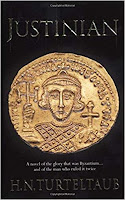
Lustinian ~ A review of H. N. Turtletaub's novel, Justinian

This is a review I wrote over a decade ago. I am posting it here now because I have had reason to refer to it a few times over the past several weeks in response to people asking if this book is any good. I guess there are so few enjoyable novels set in Byzantium that those who are fans of the history eventually stumble across whatever is out there. 


Click for more info.
There's nothing I love better than reading a good novel about Byzantium--The Rome That Did Not Fall, in the words of Gerard Friell. And given Harry "Turtletaub's" reputation as a writer, I thought that this one would be tailor-made for me. I wanted so much to enjoy it.

Unfortunately, I didn't. The reasons for this are several. First, I couldn't find a single sympathetic character in the entire book. Justinian II is presented as a loathsome monomaniac. His faithful companion Myakes, whose conversations with a monk named Elpidios punctuate the narrative, is a lackey who excuses the emperor's excesses and in general plays the part of a lecherous old man. The aforementioned Elpidios is presented as a hypocrite. The lesser characters are all similarly presented with nary a good or honorable motive among any of them. This lack of virtuous characters is a hallmark of much modern fiction and I'd like to say here and now that I *hate* it. Such works are every bit as obnoxious as the saccharine tales of heroism and good hygiene that used to dominate the genre of historical fiction. As Aristotle said, we should aim for the golden mean, but as doing this can prove difficult, we should err on the side of the lesser vice. In Justinian, Turtletaub has chosen to err on the side of the greater.

That said, Turtletaub (or Turtledove, if we drop the pretense) certainly knows his history. Having translated the Chronicle of Theophanes, a Greek primary source which provides much of what we know about the 7th and 8th century in Byzantium, Turtledove's academic qualifications are not to be despised. However, having read his translation of Theophanes, I have a good idea of how he 'enhanced' the Justinian story for modern readers, and to me, that says a lot about what the author thinks of his potential readers and his misanthropic view of mankind in general. It's not a pretty picture.

Perhaps the most dismaying thing about this book is that it is completely unsuited for young readers. I love reading historical fiction with my kids, and there's precious little on Byzantium available for this purpose. But the copious graphic sex scenes, underage sex scenes, rape scenes, etc. in Justinian make the book completely anathema from this perspective. Indeed, I felt at times that someone had pasted some passages from "Penthouse Letters" into the book.

Turtletaub also treats religious figures shabbily, invariably making them either liars, weirdos, hypocrites, weaklings, or stooges--as if religion is always the mark of the scoundrel. And, of course, the supreme villain, Justinian himself, is presented as something of a religious fanatic, believing that God guides and approves his every wicked action. Here again Turltetaub hews closely to the modern secular conventional wisdom that becomes increasingly trite with each passing day.

So in short, unless you are looking for a depressing read that will leave you feeling like you need a shower and a visit to the confessional after you read it, I'd look elsewhere for an enjoyable novel about Byzantium.

Tuesday, October 17, 2017

The Battle of Soissons (AD 486) ~ The final fall of Roman power in Gaul

Approximate extent of the domain of Syagrius, AD 486.
What if I told you that the Western Roman Empire didn't actually fall until AD 486? Yes, most know that Odoacer deposed the puppet emperor Romulus Augustulus in AD 476, and Julius Nepos reigned as "emperor of the West" from Dalmatia until AD 480. But in Gaul, a sizable territory remained under Roman control for another six years after the death of Nepos. This is the so-called “Kingdom of Soissons”, and it had been carved out originally by Aegidius, the last Magister Militum per Gallias.

Aegidius was a former lieutenant of the great Roman commander, Flavius Aetius. After Aetius’s assassination, Aegidius became a partisan of the emperor Majorian, helping him in his campaign against the Visigoths in southern Gaul. When the barbarian Magister Militum Ricimer toppled Majorian, Aegidius refused to recognize Ricimer’s puppet emperor, Libius Severus, and established a separate polity in northern Gaul. Given Aegidius’s apparent facility with creating alliances with his barbarian neighbors and Ricimer’s inability to project power beyond the Alps, Aegidius was able to hold his domain successfully until his death of plague in AD 465. Upon that event, his son Syagrius took control of Soissons and was able to protect it from barbarian incursions for over 20 years.

Things came apart for Syagrius and Soissons, however, with the arrival on the scene of the powerful Frankish king, Clovis I, who desired to add Soissons to his growing possessions. The account of Gregory of Tours, written in the mid-6th century AD, offers a summary of what happened next:
“Childeric died and Clovis his son reigned in his stead. In the fifth year of his reign Siagrius, king of the Romans, son of Egidius, had his seat in the city of Soissons which Egidius, who has been mentioned before, once held. And Clovis came against him with Ragnachar, his kinsman, because he used to possess the kingdom, and demanded that they make ready a battlefield. And Siagrius did not delay nor was he afraid to resist. And so they fought against each other and Siagrius, seeing his army crushed, turned his back and fled swiftly to king Alaric at Toulouse.” [Gregory of Tours (Brehaut, ed.), History of the Franks, pg. 36]
This small passage is the last written remnant we have of a significant Western Roman army doing battle to defend the Empire.

Click for more info.
Interestingly, several years ago this tiny fragment of history was expanded into a full-fledged novel by Justin Swanton entitled Centurion’s Daughter. The book is one of those rare pieces of historical fiction that successfully shines light on a very obscure time without engaging in ridiculous revisionism, allowing the extant history to speak for itself while providing a completely plausible framework.

Here is an excerpt from Swanton’s well-written narrative, told from the point-of-view of Aemilia, a Franco-Roman maiden from Soissons. It has always struck me as a very good representation of a clash of arms between late Romans and Franks:
Over the wind the murmur of a clamor reached her ears: a faint cry that rose and fell. With it came a sound as of a vast drumming. One of the cavalry guards turned to Ennodius. “Doing their warcry, My Lord, and hitting their weapons against their shields. They’ll be coming now.”

For a full minute the cry lingered on the wind, then, drifting like a heavy mist over the land, the thin line of Frankish skirmishers approached the Romans.

Aemilia did not hear the command that let loose a rainstorm of arrows upon the Franks. She saw figures fall. It took a moment for the truth to impact on her mind—within her sight, men were wounded, dying, dead. All she had read about the epic clash of arms, the renown of great soldiers and the glory of battle melted before the reality like wax in a fire….

The Battle of Soissons as imagined by
Justin Swanton in Centurion's Daughter. 
After a few moments, the Frankish skirmishers reached their own bowshot range and stopped to shoot back. A number of them ran closer and hurled javelins at the front ranks. In their turn the Romans added darts and javelins to the blizzard of arrows enveloping the Franks. More and more fell and finally, as if on a signal, the survivors broke and ran.

The horse archers surged after them, individual horsemen pausing now and then to shoot arrows at the retreating Franks. Their pursuit followed up all the way to the main Frankish lines which became their next target.

Some moments passed. Finally, through the front Frankish line, the Frankish cavalry charged. The horse archers ceased shooting and turned, making for their lines at a full gallop with the Franks close behind.

With her attention on the horsemen, Aemilia did not immediately notice what was happening in the center. Once the remnants of the Frankish skirmishers had retreated through the main lines, the frontmost of these began to advance rapidly towards the Roman infantry. At the same time the Frankish cavalry halted in their pursuit of the retreating horse archers. There was a murmur from the riders surrounding Aemilia and Ennodius.

“What’s happening?” Ennodius asked.

“The Franks have stopped their charge,” replied the one who had spoken to Ennodius earlier. “First time I’ve ever seen barbarians do such a thing…My Lord.” Aemilia heard the note of concern in his voice.

The horse archers reached their starting positions and began milling around, slowly reforming their line. Aemilia sensed that Syagrius’s plan had met a hitch: the Franks were not doing what was expected of them.

Thwunk, thwunk, thwunk. The noise startled Aemilia. She glanced to the left. The ballistae, enormous crossbow-like weapons mounted on wheeled bases, were firing their missiles at the Frankish line. The bolts flew with incredible speed over the heads of the Plumbarii and disappeared into the enemy ranks, with what effect she could only imagine.

A few moments later, the archers loosed on the Franks, followed shortly after by a volley of large war darts from the Plumbarii. Then, as the Frankish first line drew near, Aemilia heard the centurions crying out an order, “Second line!” …

[© Justin Swanton. Centurion’s Daughter, page 184-5. Reprinted with permission.]
Needless to say, the situation soon deteriorates for Syagrius, but this excerpt should give you an idea of how well the author captures the action. Swanton offers some additional comments on the research he put into this novel here. He provides a very detailed hypothetical reconstruction of the Battle of Soissons here.

If you like this sort of thing, as I do, you will enjoy Swanton’s writing and thoughtful attention to historical detail. Given the scant information available on these events, he has done an admirable job piecing together a plausible scenario for the final stand of the Western Roman Empire and the emergence of Clovis's powerful kingdom of the Franks.

Thursday, March 30, 2017

The Roman Amphitheater of Pola and Persecution Denial

     Before us rose the three tiers of the amphitheater, of snowy marble, but then reflecting the western rays of a cloudless April evening, and arrayed in a vesture of pink like a sunset Alp....
     “Oh, what perfect loveliness and peace!” said I to an Istrian priest who resided in the city, and who had come aboard at Rovigno.
     “And yet what different associations that amphitheater gives,” he replied....
The above snippet is taken from John Mason Neale's novella, The Daughters of Pola: Family Letters Relating to the Persecution of Diocletian which is about to be republished after being generally unavailable for over a century. Written in 1861, this little gem of a book is a great way to introduce the present generation of readers to an aspect of history that is often downplayed or purposely ignored—namely the eight years of empire-wide persecution of Christians by the Roman government in the early 4th century AD.

The magnificent amphitheater of Pula as it exists today.
The climax of The Daughters of Pola takes place here.
This is important because even among fairly erudite people today, there is a strong undercurrent of revisionist disbelief regarding the persecutions. Some critics will even go so far as to deny that persecutions happened at all, claiming that they were completely made up by later Christian historians.

Anyone who has actually studied the existing primary sources knows well that the persecutions are matters of historical fact. Sadly, the literature of that age, though extant, is often hard to access for modern readers. The critics are right to the extent that many of the numerous martyrdom stories that have come down to us from that age were greatly embellished by later copyists, to the point that the truth behind them is obscured or even lost. However, numerous authentic histories exist, including detailed legal transcripts taken by pagan Roman officials describing the investigations and trials of unrepentant Christians. I have attempted to collate a few of these accounts here on this blog, such as the following:
In The Daughters of Pola, John Mason Neale tells a story that echos all of the above accounts. Trusting his vast erudition as a classicist and scholar of ancient languages, Neale successfully created a narrative from a sequence of letters among the characters. In tone, some of the letters sound uncannily like those of Ausonius whose works have come down to us from the later 4th century. Neale set his tale in the Roman city of Pola (modern day Pula in Croatia), whose fantastically preserved Roman ruins exist to this day. Indeed, the climax of the novel takes place in the magnificent amphitheater of Pola, whose size and state of preservation rivals even the great Colosseum in Rome, as can be seen in the photo above. And indeed, we know of at least one martyrdom that took place in this amphitheater, namely that of Germanus in AD 284.

So while a work of fiction itself, The Daughters of Pola makes for a brief, accessible and beautifully crafted introduction to the authentic sources for modern readers. The novella successfully captures the sound and feel of late antiquity, exploring the tensions that the rise of Christianity and its official condemnation introduced into Roman families and society. As such, it provides a realistic window into the late Roman world when paganism launched its final, furious campaign to crush Christianity, and when the blood of the martyrs led directly to the complete triumph of the Christian faith within a generation.

Sunday, October 06, 2013

Book review: The Gauntlet by Ronald Welch

Like many boys his age, Peter is fascinated with castles and heroic tales of knights in armor. While on vacation in Wales, Peter and his friend Gwyn tramp about the wilderness, exploring the ruined castle at Carreg Cennen and learning the history of the area from the knowledgeable Vicar of Llanferon. But something strange happens when Peter takes a nap near the ruins of the castle. When he wakes, he finds a mysterious ancient gauntlet on his arm, and to his shock, he is addressed as Peter de Blois by a man in medieval armor. Peter has been transported back to the 14th century!

Originally published in 1951, The Gauntlet is a fun and engrossing bit of historical fiction for young readers. Peter's adventures in 14th century Wales include details of life in a medieval castle, lessons in archery and falconry, a trip to the Abbey of Valle Crucis where Peter learns about the life of the Cistercian monks, a tournament, the relations between the Norman lords and the Welsh people, and a medieval siege and battle. The scenes are well set and the action is well described.

Peter is a boy of about 12 years, so the ideal reader for this book is probably about that age. That said, the book can easily be read and enjoyed by readers older or younger. Enhancing the text are about ten pen-and-ink illustrations which are of excellent quality, though a couple of them make Peter look strangely dainty.

Overall, The Gauntlet is a superb book, and a perfect introduction to the realities of life in the Middle Ages for younger readers. The book is available in several different editions, but I recommend the beautiful hardcover edition by Lepanto Press as pictured with this review.

Wednesday, August 21, 2013

Review of The Religion by Tim Willocks

What do you get when you make one of the most epic sieges in history the setting of a 21st century secular morality play? A truly bizarre literary artifact, that's what.

The Great Siege of Malta of 1565 pitted the all-conquering armies of the Turkish sultan Sulieman the Magnificent against a determined band of Christian defenders led by about 1,000 Knights of St. John. Captained by their gallant Grand Master, Jean Parisot de la Valette, the Christians were determined to fight to the last man for Malta. Though outnumbered more than five-to-one, the Knights and their Maltese allies held the Turkish host and their gigantic artillery pieces at bay for over three months in one of the most heroic displays of military valor since Thermopylae. I decided to read this book because the siege is an amazing moment in history, and the other fictionalized account of it which I read previously (Angels in Iron by Nicholas Prata) was a memorable work which vividly brings to life the Knights of Saint John as well as their Turkish antagonists.

The Religion by Tim Willocks, on the other hand, chooses this epochal siege as the grand setting for a tawdry tale that does violence to both history and good taste. The main protagonist (Tannhauser) is a former Christian, former Janissary and current new-agey libertine materialist with a penchant for wenching, opium, and extreme violence. All of the antagonists, without exception, are Roman Catholic priests and monks--including the shadowy figure of one Michele Ghislieri who would become Pope Saint Pius V. The "Black Legend" looms large in this novel, and the Inquisition (cue scary organ music), imagined as KGB-like spy network that engages in wanton extralegal brutality, plays a major role--at one point even conspiring to murder Grand Master La Valette himself.

I will give the author credit in that the novel is, for the most part, decently written and he has done enough research to get the basic facts and timeline of events correct. The Religion, however, suffers from the following flaws that made it almost unreadable in my opinion:
  • The fictional main character is a sort of deus ex machina responsible for all the defenders' winning stratagems. Rather than give La Valette and his knights credit for their amazing strategic and tactical vision as recorded by history, the author makes them hyper-violent pawns who put Tannhauser's brilliant ideas into practice. It's a good thing this fictional superman showed up, or else the battle would have gone quite differently. Sigh.
  • Unnecessary and ubiquitous sex scenes. If you can't stomach sex acts described in grotesque detail, skip this book because there are many such scenes. Way too many. And seriously tacky ones, too. And like a cheesy romance novel, the sex scenes often happen in wholly ludicrous circumstances. There is also a hideous rape scene. By page 100, the author has pretty much exhausted his catalog of terms for a woman's private parts.
  • Strange portrayal of women characters. As an unsurprising adjunct to the above, the main women characters in the book are basically two-dimensional sex-toys who both manage to fall for the hero at the same time and yet not despise each other. Given the author's understanding of "love" as little more than an answer to the urgent call of one's generative organs, this is perhaps not surprising
  • A slavish dedication to 21st century moral and political trends that made the plot predictable. For example, Catholicism is treated with a contempt that has become practically de rigueur for novelists these days. The author makes up atrocities out of whole cloth to sully the Catholic characters--particularly the Knights. The Catholic characters are all either bloodthirsty fanatics, ignorant barbarians, base hypocrites, scheming churchmen, or deluded simpletons who come to their senses thanks to the syncretist wisdom of Tannhauser. At the same time, Islam is handled with kid gloves. While the author moralizes endlessly about the warlike activities of the Christians, he offers no such condemnation of the fact that the Turks are waging an aggressive war of conquest in the first place. The process of "recruiting" Janissaries was glossed over. The term "bastinado" is mentioned but never explained. The few Turks who are given more than a cursory treatment are noble intellectuals or joyful, kind-hearted common folk. Once you understand that these views are built into the plot, the outcome of the tale will be unsurprising.
The Religion also should have been about 200 pages shorter. Much of the relationship navel-gazing could have been safely discarded, along with the backstory of several minor characters. The main character's backstory which is finally revealed toward the end is yet another tedious shot at the Catholic Church and includes the utterly discredited notion that those who pursued science were persecuted by the Church. Anyone who holds that view does so only out of profound and inexcusable historical ignorance. For more information on this subject, I would refer you to How the Catholic Church Built Western Civilization by Tom Woods or to atheist Tim O'Neill's review of God's Philosophers: How the Medieval World Laid the Foundations of Modern Science.

In summary, if you are a secular sort who enjoys historical fiction that's loaded with sex and takes plentiful cheap-shots at Catholicism, you'll no doubt love this book. If you'd prefer to read a novelization of the Great Siege which is dramatic, intense and close to the history without all the excess baggage, I would heartily recommend Angels in Iron as mentioned above.

Monday, August 05, 2013

Book Review: The Red Keep by Allen French

Here is a review I wrote in 2007 but for some reason, it never made it onto the blog. Having recommended this book to dozens of people since then who have reported back that the recommendation was a worthy one, I hereby present this review so that even more folks may enjoy this excellent book.

The cover art for this book always intrigued me, so at last I decided to pick it up and read it. I was not disappointed. The Red Keep is the story of the petty nobility of 12th century Burgundy that effortlessly places young readers within a historical setting much different from their own. With the political system of the province in a state of flux thanks to the minority of the Duke, one family, the Sauval, amasses power and wealth by robbing travelers and raiding neighboring baronies. The Red Keep is the stronghold of one such barony. It is raided by the Sauval and the Baron is put to the sword--only his daughter, Anne, is rescued by the noble Baron Roger and his men, among them a young page named Conan. In the aftermath of the attack, the damaged keep is left abandoned--the bone of contention around which the story revolves.

The main character, Conan, is immediately sympathetic. He is strong, brave, and chivalrous to a fault, but young man that he is, he makes occasional bone-headed decisions that nearly cost him his life. As the story progresses, Conan's youthful naivete transforms into savvy adulthood as he carefully plans a strategy to thwart the Sauval.

The character of Anne is also appealing. Though she is presented in fighting trim throughout the book, she is not given unrealistic strength or the ability to strike down fighting men twice her size--a common but ludicrous feature of much modern literature. Anne's true strength lies in her courage, her determination to regain her father's fief and her willingness to step outside of the expected female role, even in the face of difficult odds, for the sake of justice. In this, I thought she resembled St. Joan of Arc.

Overall, I loved The Red Keep. The main characters were good and solid, and the antagonists were suitably detestable. The story itself and the writing are also first rate. Add to this the great black and white illustrations by Andrew Wyeth throughout, and you've got a real winner of a book, perfectly suited for kids 10 and up, but easily read and enjoyed by adults as well.

Saturday, July 06, 2013

Review of Between the Forest and the Hills by Ann Lawrence

Great for summer reading, Between the Forest and the Hills is a clever, fast-paced historical novel set at the twilight of Roman Britain, easily approachable for readers as young as 10 but thoroughly enjoyable for adults as well.

The times are changing fast in Roman Britain. With the Western Empire collapsing, the legions have been withdrawn and the British have been told that they're on their own. Saxon encroachments have disrupted ancient lines of communication leaving many towns isolated and at the mercy of the barbarians. But some towns, like Iscium, are remote enough to remain at peace--for a while, anyway.

This character-driven tale is subtitled "A Historical Fantasy" but that term is somewhat misleading. While there are surely a few fanciful elements, there are no goblins or trolls. The town of Iscium is, as far as I can tell, a product of the author's imagination (though the city of Caerleon in Wales was once called Iscia Augusta). The characters too appear to be completely fictional. The setting, however, is quite historical and the reader is lightly transported back to that era of change and transition--when Rome receded and medieval Christendom emerged.

The author's excellent true-to-life depictions of the characters are what really make this book tick. Falx, a Roman boy, displays all the foolish courage and reluctant care of a virtuous lad his age. Malleus the bishop and his pagan friend Frontalis are endearing grumbly old men while Ulna is a wide-eyed Saxon girl, wise in her innocence. Axon and Thena, a young married couple, are forever optimistic despite the often dire circumstances. The Saxon chieftain Torcula is fierce yet reasonable, while the mysterious Teres, like Gandalf in The Lord of the Rings, seems to turn up whenever he is most needed. But the most endearing characters of all may be Hrudin and Concha, the loquacious ravens.

There are a few somewhat ridiculous elements to this book if you are a perceptive reader--elements of post-shadowing (if such a term exists) that were a little too cute and did little to enhance the story in my opinion. Others may disagree. See if you catch them.

One aspect of the book that I really enjoyed, and that caught me somewhat off guard, was the author's treatment of the miraculous. The tone of the characters--especially the Bishop Malleus--toward the miraculous is strongly reminiscent of the sneering contempt of 19th century British academics. This was so pronounced that it was beginning to annoy me and it almost felt like the author was trying to make a point that sounded suspiciously like a pompous modernist theologian attempting to explain Christ feeding the 5,000 without any supernatural means, but via the generosity of the wealthy in the crowd. Yet, just when I had reached my limit, the author skillfully and unexpectedly pulled the rug out from under this idea. The scene where this happens is my favorite in the book.

Between the Forest and the Hills is a tremendously charming and well-conceived tale. It is enjoyable reading for young folks (ages 10 and up) and for old folks, too, and I plan to re-read it with my kids in the not-too-distant future. If you enjoy this book, I would heartily recommend Centurion's Daughter which tells a similar tale of the end of Roman Gaul and the beginning of the kingdom of the Franks.

Sunday, August 28, 2011

Book Review: Peter Treegate's War

The second book of the Treegate series, Peter Treegate's War, picks up the tale at the Battle of Bunker Hill, with Peter, his father John Treegate, and his foster father the Maclaren of Spey, among the Americans facing down the advancing Red Coats. John Treegate is there to fight against British tyranny. The Maclaren is there to avenge the Battle of Drummossie Muir where his entire clan was wiped out 30 years before in Scotland. Caught between them is sixteen year-old Peter. After the battle, all three are captured by the British and thrown into a floating prison. There, they meet a character who will loom large in the rest of the series--Peace of God Manly--a fisherman from Salem with a fire-and-brimstone flair.

Similar to its predecessor, Peter Treegate's War is an exceptionally entertaining tale of the American Revolution. Stylistically, it varies a bit from the first book in that it is told from Peter's point of view. I'm not sure why author Leonard Wibberley chose first-person narration for this book, but I felt it took something away from the story. (Admittedly, though, that could be nothing more than a personal bias on my part in favor of the third person narrative.) As literature, the book is an uncomplicated but enjoyable read. As history, it makes for a great introduction to the early years of the Revolutionary War for a reader who has little background. As in the first book, several historical figures are worked into the story, most prominently General Washington with whom Peter has a frank discussion prior to the Battle of Trenton.

What sets Wibberley's books apart, however, are the unforgettable characters and Peter Treegate's War supplies another one. Peace of God Manly is one of those redoubtable types who occasionally appeared in literature 100 years ago but who shows up only rarely today and generally as an object of derision. Peace of God wears his religious faith on his sleeve, shirt, coat and hat. He is vocal about it, constantly introducing himself as "one of John Wesley's poor sinners." And he speaks about Christ in season and out of season, even when it's obvious he's causing consternation or discomfort. At the same time, Peace of God is no pacifist. He doesn't hesitate to discharge a musket, fire a cannon, or even fling a Bible at his foe if the cause is righteous. As distasteful as many moderns may find all this religious zeal, it is impossible not to like Peace of God. Wibberley has done a masterful job creating this character who will play the key role in the next book in the series, Sea Captain from Salem.

Peter Treegate's War is another outstanding selection for readers young and old who are interested in the American Revolution. It's a fast and fun read that will have you hankering for the next book in the series. Highly recommended for kids 12 and up.

Sunday, July 24, 2011

Book Review: John Treegate's Musket

My generation may have been the last one that was trained to honor and respect the Founding Fathers of the American republic without the filmy taint of political correctness. The generation after mine had to suffer through weak pablum of the Liberty Kids variety. For more recent generations, the Founders are often portrayed as amalgams of all of their flaws with none of their virtues highlighted--that is, when they are discussed at all. Yes, the Founders were men of their times. Many of them were slave holders. More than a few were fairly vicious anti-Papists. But that doesn't change the fact that they accomplished an amazing thing: they risked their necks rebelling against the most powerful nation on earth and won the righteous fight for self-rule against impossible odds, all under the idea that men were created equal and endowed by their Creator with certain inalienable rights: life, liberty, and the pursuit of happiness.

It's no mean feat to be able to write a story about a period of history that's been done to death and make it fresh. In John Treegate's Musket, author Leonard Wibberley (better known for his best-seller The Mouse that Roared) recreates the heady days prior to the American Revolution, telling the tale through the eyes of a boy named Peter Treegate. Peter is the son of an important Boston merchant, John Treegate, who fought for the Crown at the climactic battle of the Plains of Abraham. Apprenticed to a cooper, Peter sees the hardships of Boston's merchants and manufacturers first hand. He is also exposed to the hazing and beatings of the older boys. Framed for a murder, Peter flees Boston on a smuggler's brig and embarks on an adventure that will eventually find him at the top of Breeds Hill near Boston a few years later.

Originally written in 1959, John Treegate's Musket is an engaging tale packed with colorful, memorable characters. I particularly liked the Maclaren of Spey--a tough dispossessed Scottish lord living on the Carolina frontier. This conflicted character is occasionally heroic, but is also presented as a relic to a time of brutal wars of succession and endless blood-feuds. Wibberley also incorporates several of the Founding Fathers into the tale, Sam Adams and Paul Revere among them, and puts Peter at the center of the Boston Massacre. I appreciated Wibberley's frank and honest portrayal of the times. He is not overly critical of the Loyalists, and his description of reciprocal raids by Indians and frontiersmen shows the harsh reality of frontier life without assigning victim status to either side.

John Treegate's Musket it the first in a four-book series, the other three being Peter Treegate's War, Sea Captain from Salem, and Treegate's Raiders (newly released). The series makes a great companion to a study of the Revolutionary War era and could also serve as an introduction to this period. The books are marked for ages 14 and up, but I think a 12 year old could easily handle them in terms of reading level and content.