Showing posts with label byzantium. Show all posts

Thursday, March 05, 2020

Highlights from the Late Roman / Byzantine Collection at the Met in NYC

Two silver plaques showing Saint Peter and Saint Paul, late 6th century.
I recently had the pleasure of visiting the Metropolitan Museum of Art in New York City with my daughter. It had been about 25 years since I had last visited, and I didn't remember very much about it. One thing that I definitely did not recall from two-and-a-half decades ago was the small but outstanding late Roman / Byzantine collection.

For once, I was able to take some fairly high-quality photos, so I figured I would share a few highlights.

To begin with, the two silver plaques shown above caught my eye immediately. They feature images of Saint Peter and Saint Paul and were identified as having been made in the late 6th century AD. Above the images of the saints may be seen peacocks which were popular Christian motifs symbolizing immortality. Another silver plaque may be seen below:

Silver plaque depicting two saints holding a cross, 6th century.
Here we see two saints, possibly the evangelists Saint John and Saint Matthew, depicted in silver with a large cross between them. The placard below speculated that the plaque may have formed the cover of a religious book.

Perhaps my favorite piece in the collection was this large gold and silver processional cross:

Middle Byzantine processional cross, front. Click to enlarge.
The placard describing the piece said it was a probably made during the 11th century AD. The front of the cross shows Christ in the central medallion, flanked by the Blessed Mother and Saint John the Baptist. Above is a medallion showing the archangel Michael with Gabriel below. On the back of the cross are more medallions showing the archangels Raphael and Uriel at the top and bottom, with Saints Nicholas and John Chrysostom on the arms of the cross. In the central medallion on the back is pictured Saint Thalelaios, along with an inscription at the base identifying the cross as a votive offering from a bishop named Leo. The back of the cross may be seen below.

Middle Byzantine processional cross, back. Click to enlarge.

Nearby the cross was this magnificent book:

Byzantine Lectionary, possibly from Hagia Sophia, 12 century AD.
This illuminated lectionary gives an idea of what a liturgical book from the early 12th century would have looked like. Even 900 years later, the colors are vibrant and the Greek script is clear.

Then, there was the ivory. Here are two examples from the middle Byzantine period. The top one is a casket showing hunting scenes.

Bone casket identified as 12th century Italian or Byzantine. Click to enlarge.

The next are panels from a casket that has long since fallen to pieces. They show scenes from the biblical Book of Joshua, but the cool thing is that the warriors are depicted in late Roman military garb reflective of the Justinianic mosaics in Ravenna complete with javelins, mailed kilts and oval shields. The panels are identified as having been manufactured sometime from AD 900-1100, but based on how the soldiers are attired, I might speculate that it's somewhat older.

Ivory casket panels, 10th-12th century AD. Click to enlarge.

One of the most fascinating objects on display was this bronze hanging lamp. The placard accompanying it identified it as a votive offering possibly left to a church in thanksgiving for the cure of an ailment of the hand. There is an inscription in Greek saying "Christ help me," and another one saying, "Saints Cosmas and Damian be praised."

Bronze hanging lamp, 6th century AD. Click to enlarge.

I managed to get a really detailed photo of this next item thanks in large part to the good lighting in the area--no flash allowed in the museum. Here we see a heavy gold belt made up of Roman solidi and medallions from various imperial reigns.

Belt made of late Roman gold solidi. Click to enlarge.
Emperors featured on these coins included Theodosius II, Justin I, Justinian, and Maurice. Since the majority of the coins feature Maurice and his coins are the most recent, the belt has been dated to the late 6th century AD and it is speculated that the belt may have been worn as part of the insignia of a high political office.

Finally, we encountered this spectacular floor mosaic showing a late Roman woman. It is pictured below with my very modern daughter for scale:

Early 6th century mosaic showing a personification of Ktisis. 
According to the museum's website, Ktisis is the personification of generous giving and the fact that she is holding a measuring tool may indicate that the mosaic was positioned to honor the benefactor responsible for the construction of a building.

Our trip was a bit of a whirlwind and we were only able to spend about three hours in the museum. But it was enough to get a good taste of the collection and to spend some quality time with late antiquity. Not shown here are the many items from the Greco-Roman, American, Asian, Medieval, Persian and ancient Egyptian collections which we also enjoyed thoroughly.

Monday, January 27, 2020

"The Actual Remains of the Great Doctor Were Conveyed to the Imperial City" ~ January 27, Feast of the Translation of Relics of Saint John Chrysostom

The translation of the relics of Saint John Chyrsostom to the Church of the
Holy Apostles in Constantinople, taken from the 11th century work known
as the Menologion of Basil II, now contained in the Vatican Library.
On this date in AD 438, the remains of Saint John Chrysostom were returned to Constantinople to be re-buried following a pious procession and public honors granted by the Emperor Theodosius II and his sister, Saint Pulcheria.

Saint John had been exiled from Constantinople in AD 404 after getting on the bad side of the Empress Eudoxia and squabbling with political and religious factions in the capital. He eventually perished in exile in the city of Comana in eastern Asia Minor.

About thirty years later, one of John’s disciples became patriarch of Constantinople. This man was Saint Proclus who offered a moving homily praising his mentor. This speech, and the apparent sympathy it generated among the people, convinced Theodosius II to command that the relics of St. John be allowed to return from exile. By this act, Proclus and Theodosius II reconciled the Christian factions in Constantinople which had remained bitterly divided since John’s banishment.

Following is a contemporary account of the event from the 5th century historian Socrates Scholasticus:
Proclus the bishop brought back to the Church those who had separated themselves from it on account of Bishop John's deposition, he having soothed the irritation by a prudent expedient. What this was we must now recount. Having obtained the emperor's permission, he removed the body of John from Comana, where it was buried, to Constantinople, in the thirty-fifth year after his deposition. And when he had carried it in solemn procession through the city, he deposited it with much honor in the church termed The Apostles. By this means the admirers of that prelate were conciliated, and again associated in communion with the [catholic] Church. This happened on the 27th of January, in the sixteenth consulate of the Emperor Theodosius. [Socrates Scholasticus, Ecclesiastical History, Book VII, Chapter 45]
More details of the actual translation of the relics, including how they were personally welcomed to the capital by Theodosius II and his sister, Saint Pulcheria, may be found in the 5th century Ecclesiastical History of Theodoret of Cyrrhus, as follows:
At a later time the actual remains of the great doctor were conveyed to the imperial city, and once again the faithful crowd turning the sea as it were into land by their close packed boats, covered the mouth of the Bosphorus towards the Propontis with their torches. The precious possession was brought into Constantinople by the present emperor, who received the name of his grandfather and preserved his piety undefiled. After first gazing upon the bier he laid his head against it, and prayed for his parents and for pardon on them who had ignorantly sinned, for his parents had long ago been dead, leaving him an orphan in extreme youth, but the God of his fathers and of his forefathers permitted him not to suffer trial from his orphanhood, but provided for his nurture in piety, protected his empire from the assaults of sedition, and bridled rebellious hearts. Ever mindful of these blessings he honors his benefactor with hymns of praise. Associated with him in this divine worship are his sisters [Pulcheria, Arcadia and Marina], who have maintained virginity throughout their lives, thinking the study of the divine oracles the greatest delight, and reckoning that riches beyond robbers' reach are to be found in ministering to the poor.[Theodoret, Ecclesiastical History, Book V, Chapter 36]
Later sources have claimed that when the coffin of St. John was opened, his body was found to be incorrupt. I have not been able to discover any ancient references to this miraculous event. However, there is an anonymous late medieval Russian source entitled Dialogue on the Shrines and Other Points of Interest in Constantinople, which says the following:
The tomb of St. John Chrysostom, however, is at the high altar in the sanctuary of Saint Sophia, and is covered with a slab worked in gold and precious stones. [His body] was still whole, and reposes there as if alive. There is nothing dismal about his vestments or hair, but to this day [the body] exudes a strong sweet fragrance. [Majeska: Russian Travelers to Constantinople in the Fourteenth and Fifteenth Centuries, pg. 134]
It is said that the incorrupt ear of St. John may be found at a monastery on Mount Athos. Also at Mount Athos is a relic purporting to be the incorrupt right hand of St. John as pictured below.

A relic believed to be the right hand of St. John Chrysostom.

Friday, August 09, 2019

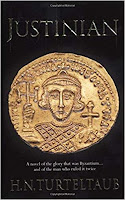
Lustinian ~ A review of H. N. Turtletaub's novel, Justinian

This is a review I wrote over a decade ago. I am posting it here now because I have had reason to refer to it a few times over the past several weeks in response to people asking if this book is any good. I guess there are so few enjoyable novels set in Byzantium that those who are fans of the history eventually stumble across whatever is out there. 


Click for more info.
There's nothing I love better than reading a good novel about Byzantium--The Rome That Did Not Fall, in the words of Gerard Friell. And given Harry "Turtletaub's" reputation as a writer, I thought that this one would be tailor-made for me. I wanted so much to enjoy it.

Unfortunately, I didn't. The reasons for this are several. First, I couldn't find a single sympathetic character in the entire book. Justinian II is presented as a loathsome monomaniac. His faithful companion Myakes, whose conversations with a monk named Elpidios punctuate the narrative, is a lackey who excuses the emperor's excesses and in general plays the part of a lecherous old man. The aforementioned Elpidios is presented as a hypocrite. The lesser characters are all similarly presented with nary a good or honorable motive among any of them. This lack of virtuous characters is a hallmark of much modern fiction and I'd like to say here and now that I *hate* it. Such works are every bit as obnoxious as the saccharine tales of heroism and good hygiene that used to dominate the genre of historical fiction. As Aristotle said, we should aim for the golden mean, but as doing this can prove difficult, we should err on the side of the lesser vice. In Justinian, Turtletaub has chosen to err on the side of the greater.

That said, Turtletaub (or Turtledove, if we drop the pretense) certainly knows his history. Having translated the Chronicle of Theophanes, a Greek primary source which provides much of what we know about the 7th and 8th century in Byzantium, Turtledove's academic qualifications are not to be despised. However, having read his translation of Theophanes, I have a good idea of how he 'enhanced' the Justinian story for modern readers, and to me, that says a lot about what the author thinks of his potential readers and his misanthropic view of mankind in general. It's not a pretty picture.

Perhaps the most dismaying thing about this book is that it is completely unsuited for young readers. I love reading historical fiction with my kids, and there's precious little on Byzantium available for this purpose. But the copious graphic sex scenes, underage sex scenes, rape scenes, etc. in Justinian make the book completely anathema from this perspective. Indeed, I felt at times that someone had pasted some passages from "Penthouse Letters" into the book.

Turtletaub also treats religious figures shabbily, invariably making them either liars, weirdos, hypocrites, weaklings, or stooges--as if religion is always the mark of the scoundrel. And, of course, the supreme villain, Justinian himself, is presented as something of a religious fanatic, believing that God guides and approves his every wicked action. Here again Turltetaub hews closely to the modern secular conventional wisdom that becomes increasingly trite with each passing day.

So in short, unless you are looking for a depressing read that will leave you feeling like you need a shower and a visit to the confessional after you read it, I'd look elsewhere for an enjoyable novel about Byzantium.

Sunday, January 07, 2018

“If I am Jonah, cast me into the sea!” ~ Saint Germanus of Constantinople is deposed by Emperor Leo III

Painting of Saint Germanus, borrowed from the Mystagogy
Resource Center's Synaxarion of St. Germanos. 
Today is the anniversary of an act of great bravery and saintly virtue. On January 7 in the year AD 730, an important bishop resigned his office rather than sign on to the heretical demands of the secular authority. In this case, we are talking about Saint Germanus I, archbishop of Constantinople who stood up to the emperor Leo III when the latter forbade the veneration of holy icons. This was the beginning of the so-called “Iconoclast” period of Byzantine history which was to last over a hundred years until the middle of the 9th century AD.

Here is an excerpt from the near-contemporary Chronicle of Theophanes the Confessor recording the event:
In the same year, the lawbreaking Emperor Leo raged against the true faith. He brought in the blessed Germanos and began to entice him with coaxing words. The blessed chief prelate told him, “We have heard there will be a condemnation of the holy and revered icons, but not during your reign.” When the Emperor forced him to say during whose reign he said, “During the reign of Konon.”

The Emperor said, “In fact, my baptismal name is Konon.”

The patriarch said, “Heaven forbid, my lord, that this evil should come to pass through your rule. For he who does it is the forerunner of the Antichrist and the overthrower of the incarnate and divine dispensation.”

Because of this, the tyrant became angry. He put heavy pressure on the blessed man, just as Herod once had on John the Baptist. But the patriarch reminded him of his agreements before he became Emperor: he had given Germanos a pledge secured by God that he would in no way disturb God’s church from its apostolic laws, which God had handed down. But the wretch was not ashamed at this. He watched Germanos and contended with him, and put forth statements to the effect that if he found Germanos opposing his rule, he would condemn the holder of the [patriarchal] throne like a conspirator and not like a confessor.” 
Later, in the same chapter, Theophanes describes how Leo III’s decrees were received in Rome, and the final confrontation between Leo and Germanus:
Click here to share on Facebook. 
“In Byzantium, the champion of pious doctrines—the holy and marvelous priest Germanos—was in his prime, fighting against the wild beast who bore the name Leo and against his henchmen. In the elder Rome, Gregory, a holy and apostolic man who held the same throne as had the prince Peter, caused Rome, Italy, and all the west to secede from both political and ecclesiastical obedience to Leo and his Empire...

But since Germanos was under his control, Leo expelled him from his throne. Through letters, Gregory openly accused Leo of what was known to many...

On January 7, of the thirteenth indiction—a Saturday—the impious Leo convened a silentium against the holy and revered icons at the tribunal of the nineteen Akkubita [a meeting hall in the imperial palace]. But in no way would the noble servant of Christ obey Leo’s abominable, wicked doctrine. He rightly taught the true doctrine, but bade farewell to his position as chief prelate. He gave up his surplice and, after many instructive words said, “ If I am Jonah, cast me into the sea. For, Emperor, I cannot make innovations in the faith without an ecumenical conference.”

He went off to the Platanaion and went into seclusion at his ancestral home, having been patriarch for fourteen years, five months, and seven days.”
Click here for more information.
The above passages are taken from Turtledove’s translation of Theophanes which may be purchased here. This book should be on the shelf of anyone with an interest in Late Antiquity.

Leo III appointed the much more malleable Anastasius as the new patriarch. Things did not end well for him, however. After Leo’s son Constantine V was deposed by Artabasdos, Anastasius changed his opinion on icons and now opposed iconoclasm, declaring Constantine a heretic. However, once Constantine’s forces defeated the usurper and restored him to the throne, Anastasius was deposed as patriarch and severely punished, being blinded and paraded on an ass through the Hippodrome. Later, he changed his position again to favor iconoclasm, begged Constantine’s pardon, and was restored as patriarch.

Now, as we reflect upon these events from nearly 1,300 years ago, it is well to consider whether our modern Catholic leaders more resemble Saint Germanus or the weaselly Anastasius in their dealings with secular authorities.

Friday, April 21, 2017

The courage of St. Theodore of Sykeon ~ AD 608

"You must first pray that your inward man may be reformed and grow healthy;
for when that is healed, the outward man, too, will be restored to health."
 ~St. Theodore of Sykeon to the east Roman consul Bonosus, ca. AD 608

April 22 is the feast of St. Theodore of Sykeon, a bishop from central Asia Minor who lived during the reign of the murderous Roman emperor, Phocas, in the early 7th century AD.

An extensive biography of St. Theodore written by one of his disciples has come down to us from antiquity which makes for exceptionally good reading for historians and devout Christians alike. St. Theodore had the God-given courage to speak the truth fearlessly to those in power, having humbled the cruel Bonosus and rebuked Phocas himself to his face on another occasion.

Here is the above quote in context, taken from The Life of St. Theodore of Sykeon:
About that time the inhuman consul Bonosus was traveling to the eastern parts of the Empire and as he passed near the monastery he heard tell of the inspired man's holiness and felt a reverence for it, violent and cruel though he was. So he sent a messenger in advance to him beseeching him, if he could endure the fatigue, to come down to the oratory of the holy martyr Gemellus near the posting ­station in order that he might do reverence to him there and be deemed worthy of his prayers, saying that he himself was unable to go up to the monastery owing to the pressure of urgent affairs. So the Saint went down and received him and whilst he was praying for him the consul stood but did not bend his neck, so the Saint took hold of the hair of his forehead and pulled it and in this way bent his head down (virtue is wont to act thus with courage and not fear human authority 'For the righteous', it is said, 'is bold as a lion.' [Prov 28:1]) 
We who were present were thunder­struck and terrified at the just man's daring and imagined that the consul would turn insolent and furious, for we knew well by report that his savagery was like that of a wild beast. But he readily accepted the prayer and the rebuke and showed honor to the Saint by kissing his hands, and then putting his hand on his own chest because of a pain which oppressed him he begged the Saint to pray that he might be freed from it. But the Saint gently tapped with his fingers on the consul's chest and said to him, "You must first pray that your inward man may be reformed and grow healthy; for when that is healed, the outward man, too, will be restored to health. Therefore I will pray for you and do you devote yourself to the good and fear God in order that my prayers may be effective. But if I pray and you neglect to amend your ways, my prayers will be unavailing. Be merciful then and pitiful to all Christian people and do not use harshly the authority entrusted to you, but while examining your own consciousness of sins, sympathize with those that go astray and never shed innocent blood. For if there is to be punishment for the mere insult of a spoken word-for calling another a 'fool'—how much more will blood, shed unjustly, be avenged by God?"  
These counsels the Saint gave him like a man sowing seed in unfruitful ground, and the consul fetched out a few coins and offered them to him in token of gratitude. But as the Saint did not deign to accept them, he drew back his hand and took out some 'trimisia' begging the Saint at least to accept those and to give one to every brother in the monastery. But before looking at them Theodore said, "There are only fifty and not sufficient for giving one to each, however, they can be changed into smaller money and then distributed equally."  
But the consul marveled at his discerning words, as being God­-inspired and answered, "Yes, reverend father, by thy holy prayers, there are only fifty as your holy mouth has said; however, I will send as many more at once as are needed to make up the number." This he did, for after being dismissed by the Saint he went to his baggage and sent what he had promised.
Thus the virtue of the righteous knows how to correct the violent and the savage, and by persuasion makes them yield to those who practice it.

Wednesday, January 18, 2017

Pulcheria ~ Powerful Roman empress and beloved saint


Click above for a video excerpt of Pulcheria's bio from Hermias Sozomen written during her life.
January 19 is the birthday of Saint Pulcheria. Though little remembered today, Pulcheria played an important role in helping the Eastern Roman Empire survive the 5th century intact. She is commemorated as a saint by the Eastern and Western Churches on September 10.
Roman gold solidus showing
Pulcheria Augusta, crowned by God.

Daughter of the Eastern Emperor Arcadius and granddaughter of Theodosius the Great, Pulcheria was pushed into imperial politics at the tender age of 10. When her father died in AD 408, her younger brother, Theodosius II, inherited the throne as a small child, under the regency of two powerful men at court, the praetorian prefects Anthemius and Antiochus. Pulcheria became her brother's confidant and guardian, and by her 15th year, she felt strong enough to dismiss the regents, guiding Theodosius II in her own right.

Below is an account from the Ecclesiastical History of Sozomen which was written soon after Pulcheria's death. It offers a first-hand glimpse into the life of this powerful, holy woman of the early Church.
[The emperor] Arcadius died. He left Theodosius, his son, who was just weaned, as his successor to the empire. He also left three daughters of tender age, named Pulcheria, Arcadia, and Marina....The Divine Power which is the guardian of the universe foresaw that the emperor would be distinguished by his piety, and therefore determined that Pulcheria, his sister, should be the protector of him and of his government.
This princess was not yet fifteen years of age, but had received a mind most wise and divine above her years. She first devoted her virginity to God, and instructed her sisters in the same course of life. To avoid all cause of jealousy and intrigue, she permitted no man to enter her palace. In confirmation of her resolution, she took God, the priests, and all the subjects of the Roman empire as witnesses to her self-dedication. In token of her virginity and the headship of her brother, she consecrated in the church of Constantinople, a holy table, a remarkable fabric and very beautiful to see. It was made of gold and precious stones, and she inscribed these things on the front of the table, so that it might be patent to all.

This detail of the Trier Ivory is thought by some
to show the diminutive Pulcheria (right) receiving
relics of saints from her brother, Theodosius II (left).
After quietly resuming the care of the state, she governed the Roman empire excellently and with great orderliness. She concerted her measures so well that the affairs to be carried out were quickly decreed and completed. She was able to write and to converse with perfect accuracy in the Greek and Latin languages. She caused all affairs to be transacted in the name of her brother, and devoted great attention to bringing him up as a prince in the best possible way and with such information as was suitable to his years. She had him taught by the most skilled men, in horsemanship, and the practice of arms, and in letters. But he was systematically taught by his sister to be orderly and princely in his manners. She showed him how to gather up his robes, and how to take a seat, and how to walk. She trained him to restrain laughter, to assume a mild or a formidable aspect as the occasion might require, and to inquire with urbanity into the cases of those who came before him with petitions. But she strove chiefly, to lead him into piety, and to pray continuously. She taught him to frequent the church regularly, and to honor the houses of prayer with gifts and treasures. And she inspired him with reverence for priests and other good men, and for those who in accordance with the law of Christianity, had devoted themselves to philosophy.

Click for more info.
She provided zealously and wisely that religion might not be endangered by the innovation of spurious dogmas. That new heresies have not prevailed in our times, we shall find to be due especially to her, as we shall subsequently see. With how much fear she worshiped God, it would take long for any one to say, and how many houses of prayer she built magnificently, and how many hostelries and monastic communities she established, the arrangement for the expenses for their perpetual support, and the provision for the inmates.
A bit more about Pulcheria's virtues and piety excerpted from Sozomen may be found on this post.

When Theodosius II died tragically after a fall from a horse in AD 450, Pulcheria played an active role in choosing his successor. According to the Ecclesiastical History of Evagrius, Pulcheria herself recommended Marcian based on his virtues, and consented to marry him to solidify his claim to the throne and in the hopes of providing stability to the empire which was faced with serious threats both internal and external. Evagrius writes:
Click for more info.
[Marcian] received the sovereignty not as an inheritance, but as the prize of virtue, conferred by the unanimous voice both of the senate and men of all ranks, at the suggestion of Pulcheria, whom he also espoused as his partner in the imperial dignity, though she still remained a virgin to old age.
Shortly thereafter, Pulcheria and Marcian, with the support of Pope Saint Leo the Great, assembled the Council of Chalcedon which dealt a decisive blow to the Nestorian heresy and would have a tremendous impact on the Church going forward. A great tribute to her life was given by Leo who wrote to her in AD 451, saying:
"However varied may be the attacks of wicked men upon the Christian Faith, yet when you are present and prepared by the Lord for its defense, it cannot be disturbed. For God will not forsake either the mystery of His mercy or the deserts of your labors, whereby you long ago repelled the crafty foe of our holy religion from the very vitals of the Church." [Read more here.]

Thursday, January 12, 2017

January 12 ~ On this day, AD 532, the burning of Hagia Sophia II

Original steps leading up to the entrance of Theodosius's
Hagia Sophia. Taken from here.
Many people know of Justinian’s monumental basilica, Hagia Sophia, which has stood in Constantinople/Istanbul for nearly 1,500 years. Few people, however, realize that Justinian’s church is actually the third monumental basilica to be built on that site.

Originally completed in about AD 415, the second of the three great basilicas was burnt to the ground on the night of January 12, AD 532 during the Nika riots in Constantinople. For an overview of this tragic revolt that ended in the slaughter of over 30,000, see my previous post: Justinian 31, Factionists 10: The Nika Rebellion of AD 532.

Procopius of Caesarea, possibly an eye-witness, described the destruction of the church as follows:
The lowest dregs of the people in Byzantium once assailed the Emperor Justinian in the rebellion called Nika, which I have clearly described in my History of the Wars. To prove that it was not merely against the emperor but no less against God that they took up arms, they ventured to burn the church of the Christians which the people of Byzantium call Sophia, a name most worthy of God. God permitted them to effect this crime, knowing how great the beauty of this church would be when restored. Thus the church was entirely reduced to ashes. (Taken from The Church of Sancta Sophia, Constantinople).
Sadly, descriptions of the great church of Theodosius II in the surviving literature of the time are few and far between. We get a small sense of what it may have looked like in this brief notice from the Paschal Chronicle within the narrative of the Nika rebellion:
Thereafter, the rioters set fire to the bronze-roofed entrance to the Palace [the Chalke Gate], and it was burnt, together with the portico of the scholarii and the protectors and candidate, and there was a breach. And similarly both the Senate-house, by the Augustaeum as it is called, was burnt, and the whole of the Great Church together with its awesome and marvelous columns was completely demolished on all four sides. (Taken from “The account of the nika riots as evidence for sixth-century constantinopolitan topography,” by Nigel Westbrook.)
Remains of Hagia Sophia II, destroyed AD 532. Taken from here.
Filling in the gaps, we have some archaeological evidence that was unearthed in the open area in front of the existing Hagia Sophia in 1935 by A. M. Schneider. There is an excellent gallery of photos showing some of the monumental stonework associated with Theodosius II’s church on WikiMedia Commons, including the above frieze showing several lambs in a row.

Also floating around out there is this tentative reconstruction of the façade of Theodosius II’s church, showing the “awesome and marvelous columns” as described above in the Paschal Chronicle’s account.

The great church itself is supposed to have had a five-aisle nave and featured a golden altar donated by Saint Pulcheria, sister of Theodosius II. The altar is described as follows by Sozomen in his Ecclesiastical History:
In token of her virginity and the headship of her brother, she [Pulcheria] consecrated in the church of Constantinople, a holy table, a remarkable fabric and very beautiful to see; it was made of gold and precious stones; and she inscribed these things on the front of the table, so that it might be patent to all.
Unfortunately for this structure, it was roofed with wood which made it particularly susceptible to fire. Justinian's grand replacement, would not have this defect.

Sunday, September 18, 2016

September 18, AD 324 -- Constantine defeats Licinius at the Battle of Chrysopolis

Today is the anniversary of the Battle of Chrysopolis in Asia Minor. This was the last major battle between Constantine and Licinius for supremacy within the Roman Empire. With nearly 300,000 combined troops participating in the battle, it was one of the largest and bloodiest battles of ancient history.

The battle was preceded by a large-scale naval conflict in which the Licinian fleet was crushed by Constantine's fleet under the command of his son, the Caesar Crispus at the Hellespont between Europe and Asia Minor. Once control of the sea had been established, Constantine moved his forces into Asia Minor to confront the main body of Licinius's host.

Like many of the great battles from this period, details are scanty. We are fortunate, however, in that we have extant accounts offering two quite different perspectives. Here is a brief account of the battle given by the 5th century pagan historian, Zosimus, in his Historia Nova:

While Licinius was thus occupied, Constantine, who had a great number of transports as well as warlike vessels, and was desirous to make use of them in crossing over and possessing himself of the opposite shore, fearing that the Bithynian coast might be inaccessible to ships of burden, immediately constructed some small vessels, with which he sailed to the sacred promontory, which lies at the entrance of the Pontus, two hundred stadia from Chalcedon. He there landed his army, which, having done, he drew them up upon some adjacent hills. Licinius, though he then saw that Bithynia was already in the hands of his enemy, was rendered so desperate by danger, that he sent for Martinianus from Lampsacus, and in order to encourage his men to fight, told them that he himself would lead them. Having said what he thought necessary to encourage them, he drew them up in order of battle, and marching out of the city, met the enemy, who were prepared for him. A sharp engagement taking place between Chalcedon and the sacred promontory, Constantine had the superiority; for he fell on the enemy with such resolution, that of a hundred and thirty thousand men, scarcely thirty thousand escaped. When the Byzantines heard of this, they immediately threw open their gates to Constantine, as did the Chalcedonians also. Licinius after this defeat went to Nicomedia with what horse were left him, and a few thousands of foot. [Read more here.]
And here is another account given by Eusebius in his Life of the Blessed Emperor Constantine which focuses less on the military maneuvers and more on the religious aspects of the conflict:
Click for more info.
And inasmuch as he who had lately fled before him now dissembled his real sentiments, and again petitioned for a renewal of friendship and alliance, the emperor [Constantine] thought fit, on certain conditions, to grant his request, in the hope that such a measure might be expedient, and generally advantageous to the community. Licinius, however, while he pretended a ready submission to the terms prescribed, and attested his sincerity by oaths, at this very time was secretly engaged in collecting a military force, and again meditated war and strife, inviting even the barbarians to join his standard, and he began also to look about him for other gods, having been deceived by those in whom he had hitherto trusted. And, without bestowing a thought on what he had himself publicly spoken on the subject of false deities, or choosing to acknowledge that God who had fought on the side of Constantine, he made himself ridiculous by seeking for a multitude of new gods. Having now learned by experience the Divine and mysterious power which resided in the salutary trophy, by means of which Constantine’s army had become habituated to victory, he admonished his soldiers never to direct their attack against this standard, nor even incautiously to allow their eyes to rest upon it; assuring them that it possessed a terrible power, and was especially hostile to him; so that they would do well carefully to avoid any collision with it. And now, having given these directions, he prepared for a decisive conflict with him whose humanity prompted him still to hesitate, and to postpone the fate which he foresaw awaited his adversary. The enemy, however, confident in the aid of a multitude of gods, advanced to the attack with a powerful array of military force, preceded by certain images of the dead, and lifeless statues, as their defense. On the other side, the emperor, secure in the armor of godliness, opposed to the numbers of the enemy the salutary and life-giving sign, as at once a terror to the foe, and a protection from every harm. And for a while he paused, and preserved at first the attitude of forbearance, from respect to the treaty of peace to which he had given his sanction, that he might not be the first to commence the contest. But as soon as he perceived that his adversaries persisted in their resolution, and were already drawing their swords, he gave free scope to his indignation, and by a single charge overthrew in a moment the entire body of the enemy, thus triumphing at once over them and their gods. [Read more here.]

Having won this battle, Constantine would follow Licinius and his fleeing remnant and bring him to heel soon after. Since he was Constantine's brother-in-law, he was permitted to live as a prisoner in Thessalonica. However, he would be executed shortly thereafter—accused of attempting to raise a new rebellion against Constantine.

Following is a list of other articles on Constantine the Great which have appeared on this blog:

Tuesday, September 13, 2016

On this day in history, September 13 -- The Battle of Ad Decimum

A 16th century drawing of reliefs on the Column of Arcadius
in Constantinople showing 5th century Roman Soldiers.
On September 13 in the year of Our Lord 533 -- 1483 years ago today -- was fought the Battle of Ad Decimum, wherein the Roman general Belisarius and his army defeated the formidable Vandalic host of King Gelimer. This battle paved the way for the Roman reconquest of the rich provinces of north Africa which had been lost to the Vandals some 80 years before.

We are fortunate in that the primary historian for this event was also an eyewitness. Here is how Procopius of Caesarea describes the run-up to the battle:
On that day, Gelimer commanded his nephew Gibamundus with two thousand of the Vandals to go ahead of the rest of the army on the left side, in order that Ammatas coming from Carthage, Gelimer himself from the rear, and Gibamundus from the country to the left, might unite and accomplish the task of encircling the enemy with less difficulty and exertion. 
But as for me, during this struggle I was moved to wonder at the ways of Heaven and of men, noting how God, who sees from afar what will come to pass, traces out the manner in which it seems best to him that things should come to pass, while men, whether they are deceived or counsel aright, know not that they have failed, should that be the issue, or that they have succeeded, God's purpose being that a path shall be made for Fortune, who presses on inevitably toward that which has been foreordained. For if Belisarius had not thus arranged his forces, commanding the men under John to take the lead, and the Massagetae to march on the left of the army, we should never have been able to escape the Vandals. And even with this planned so by Belisarius, if Ammatas had observed the opportune time, and had not anticipated this by about the fourth part of a day, never would the cause of the Vandals have fallen as it did. 
But as it was, Ammatas came to Decimum about midday, in advance of the time, while both we and the Vandal army were far away, erring not only in that he did not arrive at the fitting time, but also in leaving at Carthage the host of the Vandals, commanding them to come to Decimum as quickly as possible, while he with a few men and not even the pick of the army came into conflict with John's men... [Procopius: History of the Wars, Book III, Chapter 18]. 
Here is an excerpt from my novel, Belisarius: Glory of the Romans, which is an elaboration of the initial action of this battle, where a scout force under the heroic Roman general John of Armenia inflicts a catastrophic loss upon the Vandals. For this scene, I made use not only of the primary historical source, but also of the Strategicon of the Emperor Maurice to fill in some of the tactics.
Riding at the head of his small scouting column, Armenian John knew immediately how vulnerable he was in the narrow valley of Decimum. For that reason, he ordered his men to draw their bows and advance at a gallop, and so they traversed the defile armed and with speed. When they emerged, John immediately spotted something that took his breath away—an armed contingent of Vandals about equal in strength to his own force. 
Click for more info.
What John did not discern was that this small squad was commanded by Ammatas himself who had ventured out of Carthage to scout the lay of the land ahead of his main army. He had commanded the rest of the troops to follow along behind him as soon as they could. Once they arrived, he would line them up in ranks at the mouth of the valley, dig a ditch, and thus act as an impassible obstacle to the Romans on their way to Carthage. As it was, the bulk of the Vandal army of Carthage now advanced haphazardly along the road toward Deciumum with no great urgency in disordered bands of fifty or less.

As soon as Ammatas spied the Romans emerging from the valley, he moved his men to reconnoiter. Realizing that they formed a party no greater than his own, his heart became inflamed with the desire to spill their blood. "Vandals, behold! The invaders are at hand who would take all that is rightfully yours away from you!" he cried to his men. "Let us kill them all and make them regret their mad desire to challenge us!"

Wild with bloodlust, the Vandals gave a fearsome battlecry and followed their commander who charged ahead at full speed. 
When John saw the enemy surging toward him, the imminent danger of battle awoke in him a strange and urgent desire to retreat. Eudocia! his heart screamed. If I am killed here... 
But the instant this weakness arose, he crushed it. Belisarius would not retreat from an equal fight, his mind rejoined. He would show courage and meet the enemy head-on, trusting in God's help. Furthermore, John knew that he could not safely withdraw without causing his troops to panic and rout. For better or worse, battle was at hand and John decided to engage at once and try the enemy's strength. "Arrows!" he shouted, pulling his helm down securely on his head. "Behind me, to the flank, by fours! Eyes on the standard!"

John's superbly trained horse archers fell in behind him and all were soon galloping toward the Vandals, but at an oblique angle. Once the enemy was in range, John drew his bow and loosed. Every man behind him followed his lead. 
The volley hit the Vandal line with devastating results, slaying twenty men outright and toppling another forty from their mounts. The carnage only served to further madden Ammatas, who pressed home his attack, wheeling his column about to smash into the center of the Roman line. 
"Swords!" John cried. "Change front to the left!" His bandifer waved the signal and his men immediately complied. 
Ammatas hit them in a frenzy, he himself spearing one of John's best fighters with his lance on the first rush. But to the Vandals' surprise, the Romans held their ground and fought back with equal vigor. Ammatas had expected the Romans to flee as soon as the first blows were struck and his anger grew white hot as he realized that the enemy were dropping many of his men to the ground. 
"Will you let these worthless Greeklings stand forth against us, O Vandals?" the prince bellowed. "It would be a disgrace to our invincible heritage, for the wretched Romans have never defeated us in battle!"

His men cheered lustily, and with the added impetus, huge Ammatas slew another five Romans in rapid succession with his two-handed greatsword. "Come and taste death!" he screamed, his mount's heaving flanks now stained with the blood of his enemies. Two more Romans fought their way toward him, but before they could even aim a blow, Ammatas had slain them both. 
"The men are wavering!" Boriades shouted breathlessly to John who was beside him at the end of the battle line. "Their commander cuts through us like an all-slaughtering Achilles. Behold, another three have fallen before him." 
John could not respond immediately as he was engaged with a Vandal rider. With deft swordplay, he quickly unhorsed the man, and turned his attention to the center of the battle where Ammatas and his henchmen were killing all who dared challenge them. "You recall how Achilles was slain?" he asked. 
Boriades nodded and both men drew their bows. With anxious energy, Boriades loosed his shaft first and though it flew with power, it clanged harmlessly off the barding of a Vandal horse 
John carefully selected a straight shaft with undamaged fletching. O God, he prayed as he notched it on the string, if it be Your will, let this arrow fly true and seek out him most deserving of justice. He pulled the bowstring back behind his ear and let fly. The dart hissed through the air and thudded home in Ammatas's chest, penetrating armor, flesh and bone. 
At first, the powerful Vandal chieftan was unaware he had been hit. He decapitated yet another Roman, though with the stroke, his right arm tingled and felt weak. His head began to spin and he became aware of a terrible burning pain in his chest. 
"O Prince!" one of his henchmen groaned, his face white. "A dart..." 
Ammatas couldn't respond. His sword now seemed too heavy to lift and he felt himself drifting, sagging, falling. The next thing he knew, his face was in the dust—after that, only darkness 
A tremendous cheer went up from the Romans and a simultaneous cry of dread shattered the Vandals. With their commander slain—the king's own brother—none of them thought about fighting a moment longer. All immediately disengaged and began to flee back toward Carthage. 
"After them!" John cried, throwing caution to the wind. "Let none escape!"
Read the description of the whole battle of Ad Decimum in Belisarius, Book II, Glory of the Romans.

Or, read the account of Procopius in the History of the Wars here.

Saturday, September 10, 2016

The Trier Ivory - A 5th century(?) procession bringing relics to Constantinople

Here is a high-resolution photo of the Trier Ivory which is housed at the treasury of Saint Peter's Cathedral in Trier, Germany. Click the image to see more detail.

It shows a sacred procession bringing relics of a saint to a church in Constantinople. The Roman emperor and empress may be seen meeting the procession at the doors of the church, surrounded by a crowd of nobles, ecclesiastics, and common people. The style of the artwork as well as the dress of the subjects seems to indicate a 5th-6th century AD date of origin, though this is the subject of debate by scholars. It is felt that the empress portrayed here could anyone from Helen, the mother of Constantine (d. AD 330) to Irene (d. AD 803).

I had never seen this particular late Roman artifact prior to yesterday. I find it to be a beautiful and evocative piece. It's a shame we have so little context for it.

Monday, April 22, 2013

April 22, Feast of St. Theodore of Sykeon

Original image of St. Theodore taken from: http://www.cerkiew.pl/index.php?id=swieci&tx_orthcal[sw_id]=802&cHash=bb67994247
"You must first pray that your inward man may be reformed and grow healthy; for when that is healed, the outward man, too, will be restored to health."
~St. Theodore of Sykeon to the east Roman consul Bonosus, a violent man who came to the saint seeking a cure for a physical maladay, ca. AD 608
April 22 is the feast of St. Theodore of Sykeon, a bishop from central Asia Minor who lived during the reign of the murderous Roman emperor, Phocas. We have an extensive biography of St. Theodore written by one of his disciples that has come down to us which makes for exceptionally good reading for historians and devout Christians alike. He had a habit of fearlessly speaking the truth to power, having humbled the cruel Bonosus and rebuked Phocas himself to his face on another occasion.

Here is the above quote in context, taken from the Life of St. Theodore of Sykeon:
"About that time the inhuman consul Bonosus was travelling to the eastern parts of the Empire and as he passed near the monastery he heard tell of the inspired man's holiness and felt a reverence for it, violent and cruel though he was. So he sent a messenger in advance to him beseeching him, if he could endure the fatigue, to come down to the oratory of the holy martyr Gemellus near the posting­station in order that he might do reverence to him there and be deemed worthy of his prayers, saying that he himself was unable to go up to the monastery owing to the pressure of urgent affairs; so the Saint went down and received him and whilst he was praying for him the consul stood but did not bend his neck, so the Saint took hold of the hair of his forehead and pulled it and in this way bent his head down (virtue is wont to act thus with courage and not fear human authority 'For the righteous', it is said, 'is bold as a liont'[ Prov 28:1])

We who were present were thunder­struck and terrified at the just man's daring and imagined that the consul would turn insolent and furious, for we knew well by report that his savagery was like that of a wild beast. But he readily accepted the prayer and the rebuke and showed honor to the Saint by kissing his hands, and then putting his hand on his own chest because of a pain which oppressed him he begged the Saint to pray that he might be freed from it. But the Saint gently tapped with his fingers on the consul's chest and said to him, 'You must first pray that your inward man may be reformed and grow healthy; for when that is healed, the outward man, too, will be restored to health; therefore I will pray for you and do you devote yourself to the good and fear God in order that my prayers may be effective. But if I pray and you neglect to amend your ways, my prayers will be unavailing. Be merciful then and pitiful to all Christian people and do not use harshly the authority entrusted to you, but while examining your own consciousness of sins, sympathize with those that go astray and never shed innocent blood. For if there is to be punishment for the mere insult of a spoken word-for calling another a "fool"-how much more will blood, shed unjustly, be avenged by God?'

These counsels the Saint gave him like a man sowing seed in unfruitful ground, and the consul fetched out a few coins and offered them to him in token of gratitude. But as the Saint did not deign to accept them, he drew back his hand and took out some 'trimisia'* begging the Saint at least to accept those and to give one to every brother in the monastery. But before looking at them Theodore said, 'There are only fifty and not sufficient for giving one to each, however, they can be changed into smaller money and then distributed equally'. But the consul marvelled at his discerning words, as being God­inspired and answered, 'Yes, reverend father, by thy holy prayers, there are only fifty as your holy mouth has said; however, I will send as many more at once as are needed to make up the number'. This he did, for after being dismissed by the Saint he went to his baggage and sent what he had promised."
Taken from: http://www.fordham.edu/halsall/basis/theodore-sykeon.asp

Friday, April 19, 2013

This day in Christian Roman history -- The Battle of Callinicus (April 19, AD 531)

Click here to share.
April 19 is the anniversary of the Battle of Callinicum (or Callinicus), a major battle between the Romans and Persians on the eastern frontier of the Roman Empire.

The Romans under Belisarius had blunted a Persian invasion under the general Azarethes into Mesopotamia and had successfully ushered the Persian host back to the border with minimal damage to the towns and cities of the Roman East. However, with Azarethes about to cross over the Euphrates River and retreat into Persian territory, the officers of the Roman army approached Belisarius and demanded that he attack. According to the historian Procopius, Belisarius balked, thinking it a signal blessing to defeat the enemy without fighting a battle. Presumably an eye-witness, Procopius recorded Belisarius as delivering the following remonstrance to his army:
"O Romans, whither are you rushing? And what has happened to you that you are purposing to choose for yourselves a danger which is not necessary? Men believe that there is only one victory which is unalloyed, namely to suffer no harm at the hands of the enemy, and this very thing has been given us in the present instance by fortune and by the fear of us that overpowers our foes. Therefore it is better to enjoy the benefit of our present blessings than to seek them when they have passed. 
For the Persians, led on by many hopes, undertook an expedition against the Romans, and now, with everything lost, they have beaten a hasty retreat. So that if we compel them against their will to abandon their purpose of withdrawing and to come to battle with us, we shall win no advantage whatsoever if we are victorious, for why should one rout a fugitive? While if we are unfortunate, as may happen, we shall both be deprived of the victory which we now have, not robbed of it by the enemy, but flinging it away ourselves, and also we shall abandon the land of the emperor to lie open hereafter to the attacks of the enemy without defenders. 
Moreover this also is worth your consideration, that God is always accustomed to succour men in dangers which are necessary, not in those which they choose for themselves. And apart from this it will come about that those who have nowhere to turn will play the part of brave men even against their will, while the obstacles which are to be met by us in entering the engagement are many; for a large number of you have come on foot and all of us are fasting. I refrain from mentioning that some even now have not arrived." [Procopius, The Persian War]
Of course, it is not unlikely that the above contains a good bit of Procopian rhetoric inserted ex post facto. Regardless, the speech proved ineffective. The Roman officers continued to importune Belisarius with such vehemence that he feared a mutiny. He offered battle to the Persians on Easter Day, April 19, AD 531.

Here is how I portrayed the resulting battle at the very beginning of Belisarius: Glory of the Romans:


AD 531, Easter Day
Fourth year of the reign of Justinian, Emperor of the Romans
Near Callinicus in Roman Mesopotamia

On the banks of the muddy Euphrates River—the edge of the fertile crescent where it is said that the earthly paradise created by Almighty God once stood—thousands of men now endured an earthly hell. For on Easter Day, rather than giving praise to Jesus Christ for his resurrection to life, the armies of two great empires sought to inflict death upon each other.

The battle need not have happened at all. The invading Persians had been brought to heel by the prowess of Belisarius, the commanding general of the Romans. His reputation was such that the Persians dared not engage with him, and upon his arrival with the Army of the East, the invaders beat a hasty retreat.

Belisarius escorted them to the border, but as the enemy host prepared to ford the Euphrates and escape back into Persia, the officers of the Roman army rebelled against their commander and questioned his courage. Belisarius, for his part, was content to let the Persians escape without bloodshed, counting it a singular blessing to defeat an enemy without losing any of his own men. But the officers under him saw in the retreating enemy a chance for earthly glory. So they raged at their general and demanded that he lead them forth into combat.

Seeing the bloodlust in their eyes and fearing the disorder of a mutiny, Belisarius grudgingly consented.

It was a decision he would subsequently regret.

Belisarius raised his bow toward the enemy and loosed. Before he could draw another shaft, he sensed the hum of an incoming dart. Ducking down at the last instant, the barbed tip struck his steel helm and clanged off.

God save me! he gasped to himself, shaking off the heavy impact.

“Magister! They are taking us from the flank!” screamed Trajan, his lieutenant, pointing with his sword toward a great clamor off to the right of the Roman army.

“No!” Belisarius shouted in disbelief. He jerked his mount around to see with his own eyes and his mouth dropped open in dismay. 

A messenger galloped to him, his horse in a froth. “Arethas has deserted us, O Magister! Every last Arab has fled the field!”

“The cowards couldn’t even stand for one charge,” Trajan raged, his fists clenched.

“Not cowards,” Belisarius growled, “They are traitors! How stupid I was to entrust the right wing to them. Despite their boasts, they had no intention of fighting their brother bandits.”

A great wail of despair went up from the Roman lines as the extent of the disaster was realized. Their previous swagger and order quickly dissolved into fear and chaos. In terror, thousands of mail-clad Romans threw down their arms and fled straight toward the nearby Euphrates, hoping to gain safety by swimming to the islands in midstream. Hundreds were cut down in their flight by jubilant Persians who slaughtered them with relish.

A mere thousand picked men stood by Belisarius as he fought on.

Ascan, the implacable Hunnic chieftain, along with several hundred of his best men, remained in the fight as well, forcing back the charging Persians time and again. The elite Persian Immortals, desperate to revenge themselves on the Huns for their losses at Daras the previous year, massed and flung themselves upon Ascan’s men, careless of death. But the wily Hun, perched on his nimble war pony, made them pay dearly each time, dispatching some of their most valiant officers with his own deadly darts.

“We must push through and unite with Ascan’s men,” Belisarius commanded, drawing a javelin. The only way to salvage the day is to recombine our remaining forces and put our backs to the river, he thought, his mind working feverishly.

Anxious to obey their general, his stalwarts shifted front and began to move toward Ascan’s surrounded contingent.

But the Persians were experienced in war and knew well that to secure the victory, it is more important to quell those forces still in the fight than to chase those who run away. Belisarius soon found his path blocked by thousands of Persians foot soldiers who, having returned from the rout, were moving in to finish the job.

“Forward!” Belisarius urged as he forced his way to the point position of his phalanx. Joining the front rank, he struck with his javelin as volleys of arrows from the men in the rear poured over his head. The lightly clad Persian footmen toppled over dead in heaps, but others took their places, their huge wicker shields presenting an impassible obstacle.
The Battle of Callincum as imaged by Igor Dzis. Click here to visit
the artist's page.
Belisarius’s force was within shouting distance when an unexpected stroke from an Immortal’s sword struck Ascan on the side of the face, sending a fountain of blood into the air. Seeing their hated enemy wounded, the Immortals cried out in triumph and rushed forward in a mass. Ascan’s weary men melted away before the implacable Persian assault and the defenseless Hun captain was hacked to pieces—dead before he hit the ground.

With their commander slain, the remaining Huns gave up the fight and attempted to escape as best they could.

At the sight, Belisarius’s remaining men let out a groan of despair.

“That’s it, we’re finished,” cried Trajan.

“Aye,” Belisarius replied, surveying a battlefied bereft of hope. “Nothing remains but to get as many of our men to safety as we can.”

“Should I sound the retreat?” Trajan asked.

“Yes, we will withdraw toward Peter,” Belisarius commanded, pointing to a contingent of footmen who were fighting a well-ordered rear-guard action to protect those fleeing across the river.
Read the rest in the book... Belisarius, Glory of the Romans.

Thursday, February 11, 2010

This Day in Late Roman History . . . February 11

On this day in AD 641, Heraclius, one of the most heroic — and tragic — late Roman emperors, died. He ruled for 30 of the most crisis-plagued years the Roman empire had ever experienced.

Under the rule of his predecessor, the cruel usurper Phocas, the Slavs had overrun the Balkans. At the same time, Syria, Egypt, and much of Asia Minor had been conquered by the Persians. The Persian king Chosroes II had even sacked Jerusalem, taking the True Cross back to Persia with him.

Rising from Africa where his father was exarch, Heraclius overthrew Phocas, but was faced with the daunting task of saving the empire from powerful enemies attacking on two fronts. Melting down gold given to him from the churches, Heraclius recruited and trained a new army. Rather than await the coming siege of the capital, Heraclius took the war to the Persians, defeating them in several pitched battles.

His campaign became a crusade. It was a fight to the death between the Christian Romans and fire-worshiping Persians — and in the end, the great Persian empire of the Sassanids lay prostrate on the ground. Heraclius recovered the relics from Jerusalem, and in AD 630, he returned to Jerusalem carrying the True Cross before him.

But his triumph was not long lived. Within six years, the Romans were again defeated in Palestine at Yarmuk by an invading army driven by a new power sweeping out of Arabia—Islam. By the end of his life, nearly all Heraclius had fought so hard to re-conquer had again been swept away, never to be recovered by the empire.

More detailed information on the eventful reign of Heraclius may be found here.

Friday, October 02, 2009

On the other hand...

Here's a review of another book which purports to deal with the life and times of Constantine: The Age of Constantine the Great by Jacob Burckhardt.

Don't bother with this one. Burckhardt was a 19th century academic with an ax to grind against Constantine and a mission to rehabilitate the Christian-persecuting Diocletian. He pursues both of those ends with blind and tedious enthusiasm.

The book takes about 240 pages just to get to Constantine at all, as Burckhardt loses his focus amid 60 page digressions on pagan practices in the ancient Mediterranean world.

Perhaps most annoyingly, the modern translator has seen fit to strip out all of Burckhardt's references which makes the book into an unverifiable manifesto as opposed to a serious scholarly work.

There are much better and more accessible works out there on Constantine and his times than this one, such as Constantine and the Christian Empire mentioned below, just to give one example. Or, if you prefer to go straight to the primary source, try: The Life of the Blessed Emperor Constantine: From AD 306 to 337 (Christian Roman Empire Series, vol. 8).