|
| Detail from a 5th century Roman consular diptych possibly showing Flavius Aetius, now housed in the Musee du Berry, Bourges, France. |
Aetius is best known his role as generalissimo of the combined Roman and Visigothic army at the epic Battle of the Catalaunian Plains where Attila and his Huns were defeated and the Visigothic king, Theodoric I, was killed.
Called “the last of the Romans” by Gibbon, Aetius spent most of his adult life striving earnestly to keep the sinking Western Roman Empire afloat. To a large extent, he succeeded, building alliances among the Roman elite and with barbarian nations. Indeed, he may have been too successful. The power he wielded excited envy among other generals and high officials at the imperial court at Ravenna. This jealousy eventually ensnared the young Western emperor Valentinian III himself.
As a child emperor, Valentinian had first ruled under the regency of his mother, Galla Placidia. Upon reaching his majority, he assumed the imperial power in his own right, with Aetius acting as his protector to secure his throne after AD 437. Considering the real political and military power was in the hands of Aetius, it is not surprising that Valentinian would eventually feel that he was little more than a figurehead, particularly as he advanced in years and experience.
As the military and economic situation in the western provinces continued to deteriorate, Aetius’s enemies at court complained to the emperor and found a willing ear. With pressure on the frontiers somewhat alleviated following Attila’s death in AD 453, the anti-Aetius cabal at court felt strong enough to engage in a conspiracy and brought the emperor into the plot. The late Roman historian, Priscus, provides the details:
“A certain [Petronius] Maximus, a well-born and powerful man who had served twice as consul, was antagonistic toward Aetius, the general of the legions in Italy, because he knew that Herakleios (he was a eunuch and carried the greatest weight with the emperor) was also hostile to Aetius on the same pretext: both men were attempting to substitute their own power for Aetius’s. The two men entered into a conspiracy and persuaded the emperor that unless he killed Aetius first, and quickly, he would be killed by him.” [Given: The Fragmentary History of Priscus, page 125]On September 21, AD 454, Aetius entered the palace to present his financial reports—seemingly a very normal part of his duties. From Priscus’s account, it appears that he was completely unaware that an ambush had been planned. As Aetius explained the gloomy revenue projections and tax receipts, the emperor suddenly became irate. Priscus continues:
“Valentinian all at once sprang up from his seat with a cry and said that he would no longer bear being the victim of so many drunken depravities. By holding him responsible for the troubles, he said, Aetius wanted to deprive him of power in the West just as he had deprived him of the Eastern Empire, insinuating that it was Aetius’s fault he did not go and expel Marcian from office.Thus a powerful general who had successfully defended the empire for nearly 30 years was ignominiously slain. Priscus offers the following brief panegyric of Aetius’s deeds:
“As Aetius was marveling at this unexpected outburst and was trying to divert him from his irrational change, Valentinian drew his sword form his sheath and rushed at him with Herakleios, who was also already carrying a knife under his cloak, as he was primicerius of the chambers. Both men repeatedly struck Aetius’s head and killed the man who had accomplished so many manly deeds in both domestic and foreign wars.”
[Given: The Fragmentary History of Priscus, page 126]
“He had acted as regent for Valentinian’s mother Placidia and for her son when he was young by forming an alliance with the barbarians. He outgeneraled Boniface as he was crossing from Libya with a great force, so that Boniface died from an anxiety-induced disease, and Aetius became master of his wife and his wealth. He also used trickery to kill Felix, with whom he served as general, since he know that Felix was planning his murder at Placidia’s instigation. He also prevailed against the Goths in Western Galatia when they kept intruding onto Roman territory, and he brought to terms the Aimorichiani when they were rebelling against the Romans. To put it briefly, he established such a powerful force that not only emperors but also neighboring nations yielded to his commands.” [Given: The Fragmentary History of Priscus, page 126]
 |
| Click for more info. |
“Whether well or not, I do not know. But know that you have cut off your right hand with your left.” [Given: The Fragmentary History of Priscus, page 127]As it turns out, Valentinian III did not long enjoy the fruits of this coup, as he himself was assassinated six months later.
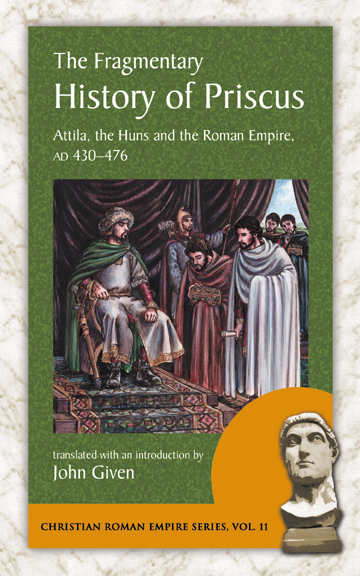
For a more complete (and thoroughly engrossing) account of this history, go ye and read The Fragmentary History of Priscus. Though it has come down to us only in bits and pieces, this edition assembles the fragments into a coherent narrative, offering some of the best primary source data extant for this gloomy period of Roman history.