Friday, August 31, 2018

"The world stands by reason of the intercession of Christians" ~ The Apology of Saint Aristides

A modern Orthodox icon of St. Aristides.
Today is the feast of Saint Aristides of Athens. I’m going to guess, dear reader, that you have never heard of him. If that’s the case, then you are in good company, for I had never heard of him either until today. Aristides was a martyr of the 2nd Century AD. What little is known of his life may best be summarized in this passage from Saint Jerome’s On Illustrious Men:
Aristides, a most eloquent Athenian philosopher, and a disciple of Christ while yet retaining his philosopher's garb, presented a work to Hadrian at the same time that Quadratus presented his. The work contained a systematic statement of our doctrine, that is, an Apology for the Christians, which is still extant and is regarded by philologians as a monument to his genius.
The Eastern Orthodox proclaim Aristides as a martyr, saying that he was hung in Athens on September 13 of AD 134 (or 120), but there doesn’t seem to be any near contemporary documentation supporting this. His Apology was known in antiquity and the early Middle Ages, but was thought lost for a thousand years until it was rediscovered in Armenian and Syriac translations in the 19th century.

Emperor Hadrian.
The Apology of Aristides retains relevance to our own times and is well worth reading in full. In it, the saint offers a comparison of Christianity to the religious beliefs of the barbarians, Greeks, Jews and Egyptians. In the excerpt that follows, Aristides blasts the perverse tales of the Greek pantheon as the source of great wickedness, hinting at the early Christian belief that the pagan gods existed but weren’t actually deities at all, but demons. If the martyrdom accounts of the Orthodox are trustworthy, then it's probably not surprising that Hadrian and his courtiers had an extremely negative reaction to this polemical attack on pagan beliefs and the perverse sexual practices that often accompanied them:
“Because of these stories, O king, much evil has befallen the race of men who are at this present day, since they imitate their gods, and commit adultery, and are defiled with their mothers and sisters, and in sleeping with males: and some of them have dared to kill even their fathers. For if he, who is said to be the head and king of their gods, has done these things, how much more shall his worshipers imitate him! And great is the madness which the Greeks have introduced into their history concerning him: for it is not possible that a god should commit adultery or fornication, or should approach to sleep with males, or that he should be a parricide; otherwise he is much worse than a destructive demon.” 
In contrast, here is how Saint Aristides describes the belief of the Christians:
“…They know and believe in God, the Maker of heaven and earth, in whom are all things and from whom are all things…they do not commit adultery nor fornication, they do not bear false witness, they do not deny a deposit, nor covet what is not theirs: they honor father and mother; they do good to those who are their neighbors, and when they are judges they judge uprightly; and they do not worship idols in the form of man; and whatever they do not wish that others should do to them, they do not practice towards any one, and they do not eat of the meats of idol sacrifices, for they are undefiled: and those who grieve them they comfort, and make them their friends; and they do good to their enemies: and their wives, O king, are pure as virgins, and their daughters modest: and their men abstain from all unlawful wedlock and from all impurity, in the hope of the recompense that is to come in another world…For truly great and wonderful is their teaching to him that is willing to examine and understand it….And I have no doubt that the world stands by reason of the intercession of Christians.” 
Reading the above, one can not help but be struck by how Aristides's words apply to our own time. Prof. Benjamin Wiker recently made the case that the scandals rocking the Catholic Church regarding the sexual abuse of boys and the softening of teachings on matters of sexual immorality more generally by Church leaders represent nothing short of the repaganization of West. To use Prof. Wiker’s own words in his article, From a Moral-Historical Perspective, This Crisis is Worse Than You Realize:
“The very men most authoritatively charged with the evangelization of all the nations are full-steam ahead bringing about the devangelization of the nations. In doing so, these priests, bishops, and cardinals at the very heart of the Catholic Church are acting as willing agents of repaganization, undoing 2,000 years of Church History.” 
When considered in the light of Saint Aristides’s words above, some 21st century bishops certainly seem to behave more like courtiers of Hadrian than colleagues of the ancient martyrs, and are indeed more enamored with the “great madness” of the Greeks than the “truly great and wonderful” teaching of the Christians. The prayer of Aristides which closes his Apology is also quite relevant to the travails of our time:
“Let the tongues of those now be silenced who talk vanity, and who oppress the Christians, and let them now speak the truth….Let them, therefore, anticipate the dread judgment which is to come by Jesus the Messiah upon the whole race of men.”
To read the whole Apology of Saint Aristides, click here.

Click for more info.
It is thought by some scholars that Saint Aristides is also the author of the ancient Christian work known as the Letter to Diognetus. This is another 2nd Century apologetical work which is otherwise anonymous but which bears certain textual similarities to the Aristides’s Apology.

The Letter to Diognetus is included in the brand new book, I Am A Christian: Authentic Accounts of Christian Martyrdom and Persecution from the Ancient Sources which will soon be available from Arx Publishing. Check it out!

Monday, August 27, 2018

Saint Monica, Patroness of Abuse Victims, Pray for Us!

“Go your way and God bless you, for it is not possible 
that the son of these tears should perish.” 
—An unknown African bishop to Saint Monica
Today is the feast day of Saint Monica, the mother of Saint Augustine. This noble lady and archetypal Christian mother is the patroness of (among others) abuse victims, alcoholics, difficult marriages, mothers with wayward children, disappointing children, victims of adultery and victims of unfaithfulness.

Thus, she is quite a popular saint in our time and a particularly appropriate saint to commemorate today as the Church continues to be riddled with abusers and enablers of abuse even at the highest levels.

According to Augustine's Confessions (Book III, Chapter XII), Monica shed many tears while she prayed for her son's conversion from the careless and dissolute lifestyle he lived. Here is the above quote in its original context:
"And meanwhile You granted her [Monica] another answer, which I recall; by a priest of Yours, a certain bishop, reared in Your Church and well versed in Your books. He, when this woman had entreated that he would vouchsafe to have some talk with me, refute my errors, unteach me evil things, and teach me good (for this he was in the habit of doing when he found people fitted to receive it), refused, very prudently, as I afterwards came to see. For he answered that I was still unteachable, being inflated with the novelty of that heresy, and that I had already perplexed various inexperienced persons with vexatious questions, as she had informed him. "But leave him alone for a time," says he, "only pray God for him; he will of himself, by reading, discover what that error is, and how great its impiety."
Click here for more info.
He disclosed to her at the same time how he himself, when a little one, had, by his misguided mother, been given over to the Manichæans, and had not only read, but even written out almost all their books, and had come to see (without argument or proof from any one) how much that sect was to be shunned, and had shunned it. Which when he had said, and she would not be satisfied, but repeated more earnestly her entreaties, shedding copious tears, that he would see and discourse with me, he, a little vexed at her importunity, exclaimed, "Go your way, and God bless you, for it is not possible that the son of these tears should perish." Which answer (as she often mentioned in her conversations with me) she accepted as though it were a voice from heaven."
To read more, click here.

May the faithful shed just as many tears as we pray for the conversion of our dissolute leaders, for peace and healing for their victims, and for renewal of the Church.

Why the Viganò Letter is Credible

Cardinal Gottfried Danneels (second from right) appears on the Loggia with
the newly elected Pope Francis in 2013. Danneels had retired under a cloud
for his audio-recorded badgering of a sex abuse victim.
The testimony written by Archbishop Carlo Maria Viganò has set off shockwaves. Not only does Archbishop Viganò name names of bishops and Cardinals who have covered up the sex abuse scandal, he directly implicates Pope Francis and calls on him—and his inner circle of Cardinals—to resign. To quote Archbishop Viganò’s letter directly:
“Pope Francis has repeatedly asked for total transparency in the Church and for bishops and faithful to act with parrhesia [that is, candor and the courage to speak the truth to power -ed.]. The faithful throughout the world also demand this of him in an exemplary manner. He must honestly state when he first learned about the crimes committed by McCarrick, who abused his authority with seminarians and priests."
Archbishop Viganò then provides the answer:
"In any case, the Pope learned about it from me on June 23, 2013 and continued to cover for him [ie, Cardinal McCarrick -ed.]. He did not take into account the sanctions that Pope Benedict had imposed on him and made him his trusted counselor along with [Cardinal -ed.] Maradiaga." 
These are deeply disturbing allegations and while we don’t yet know for sure whether they are completely true, we do know that they are credible. A very troubling pattern has emerged over the past few years which show that Pope Francis, at the very least, has put his personal imprimatur upon several prelates, including McCarrick, who have been disgraced over their handling of sex abuse cases or who have actively taken the side of the predators over the victims. These include the following:
  1. During the infamous 2015 Synod on the Family, Pope Francis personally appointed retired Belgian Cardinal Gottfried Danneels as one of the Synod fathers. At the time, he was advised to reconsider this appointment because, among other reasons, Cardinal Danneels had tried to cover up a sex abuse and was caught doing so in an audio recording. Also, to say that Danneels was an ineffective teacher of Catholic moral teaching would be a grotesque understatement [warning, the content at the preceding link is utterly vile.] Pope Francis ignored the advice and proceeded to appoint Cardinal Danneels anyway. Danneels also bragged that he had been a leader of the so-called “Saint Gallen’s Mafia”—a group of dissident prelates which had worked to undermine Pope Benedict.

  2. Earlier this year, Pope Francis defended the infamous Bishop Barros of Chile and attacked the bishop’s accusers. He insisted there was “no evidence” against Barros and said, “The day they bring me proof against Bishop Barros, then I will speak. There is not a single piece of proof against him. Everything is calumny. Is that clear?” However, it later emerged that Pope Francis had been advised by Chilean bishops not to appoint Barros in the first place because of credible accusations, but he had ignored this advice and proceeded to appoint Barros anyway. Francis only backed down afterwards when a firestorm erupted in Chile. He accepted Barros’s resignation in June of 2018.

  3. Cardinal Maradiaga, who is called out specifically in the Viganò letter above, is to this day considered one of Pope Francis’s trusted advisers. He even spoke at the recently concluded World Meeting of Families in Dublin. But earlier this year, Maradiaga evinced the same dismissive attitude toward an unprecedented appeal from seminarians in his native Honduras. A letter, signed by 48 seminarians, claimed that they were being victimized by a predatory homosexual cabal in the seminary. In response, Cardinal Maradiaga attacked the seminarians, calling them “gossipers” who wished to portray their fellows in a bad light. He also apparently attempted to protect one of his underlings, Bishop Juan Jose Pineda, who had been implicated as an abuser. However, in July of 2018, Bishop Juan Jose Pineda was forced to resign after the allegations of the seminarians proved valid beyond any doubt. Despite this, and the fact that Maradiaga has also been implicated in misappropriation of Church funds, he continues to be part of Pope Francis’s inner circle.
So sadly, there is a disturbing pattern of behavior here, and it is against this backdrop that the accusations in the Viganò letter become credible. The Pope’s behavior may simply be caused by a tragic ineptitude, gross naivete or a blind desire to put loyalty to friends ahead of the truth—frankly, I prefer that one of the above be the case. Though these above would be great and possibly disqualifying failings, they at least point to the potential (however distant) for reform emanating from the Vatican. There are, however, alternative explanations that are too horrific to even consider at this point.

We will have to see how events play out. To this point, however, I remain impressed by the words of Archbishop Viganò, who said in his letter:
“My conscience requires me also to reveal facts that I have experienced personally, concerning Pope Francis, that have a dramatic significance, which as Bishop, sharing the collegial responsibility of all the bishops for the universal Church, do not allow me to remain silent, and that I state here, ready to reaffirm them under oath by calling on God as my witness.” 
He, of all the individuals involved in these sordid affairs, at least sounds like a Catholic.

May God Almighty thwart the efforts of the prince of this world to corrupt the Church.

May Jesus Christ, the Just Judge, bring down divine justice upon all of those who bring filth and scandal into the Church.

May the Holy Spirit inspire great saints to rise up and cleanse the Church.

May the Blessed Virgin Mary intercede for the faithful and encourage us during this tribulation.

Monday, August 20, 2018

"We live in a period of chastisement" ~ August 20. Feast day of Saint Bernard of Clairvaux

Saint Bernard of Clairvaux preaches the Second Crusade at Vezelai in Burgundy.
August 20 is the feast day of Saint Bernard of Clairvaux (1090-1153), abbot and doctor of the Church, and one of the greatest minds of Medieval Europe. Late in his life in AD 1146, Bernard was called to preach the Second Crusade throughout Europe. In the course of doing so, he gave a speech every bit as stirring as Pope Urban II's call for the original Crusade in AD 1095. Here is an excerpt from that speech, as recorded in The History of the Crusades by Joseph Francis Michaud:
You can not but know that we live in a period of chastisement and ruin; the enemy of mankind has caused the breath of corruption to fly over all regions; we behold nothing but unpunished wickedness. The laws of men or the laws of religion have no longer sufficient power to check depravity of manners and the triumph of the wicked. The demon of heresy has taken possession of the chair of truth, and God has sent forth His malediction upon His sanctuary.
Oh, ye who listen to me, hasten then to appease the anger of Heaven, but no longer implore His goodness by vain complaints; clothe not yourselves in sackcloth, but cover yourselves with your impenetrable bucklers; the din of arms, the dangers, the labors, the fatigues of war are the penances that God now imposes upon you. Hasten then to expiate your sins by victories over the infidels, and let the deliverance of holy places be the reward of your repentance....
Fly then to arms; let a holy rage animate you in the fight, and let the Christian world resound with these words of the prophet, “Cursed be he who does not stain his sword with blood!” If the Lord calls you to the defense of His heritage think not that His hand has lost its power. Could He not send twelve legions of angels or breathe one word and all His enemies would crumble away into dust? But God has considered the sons of men, to open for them the road to His mercy. His goodness has caused to dawn for you a day of safety by calling on you to avenge His glory and His name.
Read the rest of Bernard's speech along with additional context here.

Sadly, the Second Crusade ended in disaster as the Christian princes could not cooperate effectively with each other and their discord gave the advantage to the enemy. Bernard bitterly regretted this failure and wrote an apology to Pope Eugenius III in the form of book called On Consideration. In this book, Bernard offers some useful advice for how an ideal pope should behave. Included among his admonitions is the following:
You ought not to be the last to know the faults of your household, which, as we are aware, is the experience of very many. Wherefore, as I have said, let another manage the rest, but do yourself see to the discipline. Trust that to nobody. If in your presence there is any tendency to arrogant conversation, or showy dress, stretch out your hand against such offences; be yourself an avenger of the wrong done to you. Impunity is the mother of audacity, audacity brings forth excess. 
Holiness becomes the house of a bishop, modesty becomes it, good repute becomes it; the guardian of all discipline. The priests of the household are either more highly esteemed than others, or they are the common talk. In the look, dress, gait of the priests about your person you should allow no trace of immodesty or indecency. Let your fellow bishops learn from you not to have about them boys with their hair curled, or effeminate youths. It is surely unbecoming for a bishop to go hither and thither surrounded by fops who wear the turban and use the curling iron.
Given the sad state of Church today, our bishops would do well to heed this good advice.

Thursday, August 09, 2018

"Prepare for Him a Bed of Coals" ~ Prudentius’s 4th Century poem in honor of Saint Lawrence

The Martyrdom of Saint Lawrence ~ Engraving taken from
Shea's Pictorial Lives of the Saints.
Commemorated on August 10, Saint Lawrence is one of the most famous early martyrs of the Roman Church. He was one of the seven deacons of Rome under Pope Sixtus II, and as such, Lawrence found himself a primary target during the persecution of Christians under the emperor Valerian in AD 258.

Sadly, none of the close contemporary documentary accounts of the martyrdom of Saint Lawrence survived the subsequent persecutions of the Church, though his story was well enough known that the principal facts were passed on for 100 years or so via oral tradition. His story was again set down on parchment after the time of Constantine, the earliest surviving sources being a mention in On the Duties of the Clergy by Saint Ambrose of Milan in the late 4th century, a very brief epitaph by Pope Damasus from about the same time, and a homily of Pope Leo the Great in the mid-5th century.

However, the most detailed ancient account of the martyrdom of Saint Lawrence comes from a work by the Spanish Latin poet, Aurelius Prudentius Clemens, which was written, most likely, in the late 4th century. Though obviously embellished, the key facts of Lawrence's martyrdom are clear through the interpolated speeches. Please enjoy these extended excerpts from the poem which formed part of Prudentius's larger work known as The Peristephanon or The Martyr's Garland. It is from this ancient poem that most of the unique details of Saint Lawrence's martyrdom are drawn.
Hymn in honor of the passion of the blessed martyr Lawrence
Once mother of unholy fanes,
Rome, dedicated now to Christ,
By Lawrence led to victory
You trample on the heathen rites.

Proud kings have bowed before your sword
And conquered peoples felt your sway;
Now pagan gods are made to pass,
Beneath the yoke of your empire.

Though savage tribes had been subdued,
The city of the toga lacked
One glorious title of renown,
The triumph over wanton Jove,

Not by Camillus’s stormy might,
Nor Cossus’ arms or Caesar’s power,
But by the bloody combat waged
By Lawrence in his martyrdom.

Embattled Faith took up the fight,
Of her own blood most prodigal;
For she destroyed death by death
And lost her life to save her life.

The Pontiff Sixtus, from the cross
On which he hung, saw at its foot
His deacon Lawrence weeping sore,
And these prophetic words he spoke:

“Let tears of sorrow cease to flow
At my departure from this life;
My brother, I but lead the way,
And you will follow in three days.”

The holy bishop’s dying words
Sure glory for his friend announced,
For Lawrence on the day foretold,
Victorious, won the martyr’s palm.

. . .

The prefect of imperial Rome,
The agent of an insane prince,
Athirst for money and for blood
Is driven by his greed for gold

To wrest the sacred shrines by force
Suspected riches lurking there,
The talents gathered in vast sums,
And hidden in their secret vaults.

He summons Lawrence to the court
And questions him on coffers filled
With massive ingots of pure gold
And hoarded coins in shining heaps.
The prefect then makes a long speech, enjoining Lawrence to hand over the Church’s treasures. Here’s the gist of it, along with Lawrence's reply:
“This wealth is hid in secret crypts
Of churches where the Christians meet,
And to despoil your dear offspring
Is deemed the highest piety.

“Bring forth the gold you have amassed
By force and evil trickery,
The hoarded treasures you now keep
Enclosed in subterranean vaults.

“The public welfare now demands
That you give up your boundless wealth
To fill the coffers of the state
And pay the armies of your prince.”

. . .

Untroubled, Lawrence made reply
To this perfidious overture,
And as if ready to obey
He gently nodded his assent.

“Our church is very rich,” he said.
“I must confess that it has wealth;
Our treasuries are filled with gold
Not found elsewhere in all the world.

“Not even high Augustus holds
Such wealth within his mighty grasp,
Though every silver coin forged
His image and inscription bears.

“Yet I refuse not to yield up
The riches of our Lord and God;
I shall display for all to see
The treasures that belong to Christ.

“However, one request I make:
Vouchsafe to me a short delay
That I may carry out my pledge
With greater ease and richer gain.

“I need this time to take account
Of all the goods possessed by Christ,
And then to estimate their worth
And reckon up the total sum.”
The prefect, in his greed, grants Lawrence three days to collect the wealth of the Church. Lawrence does this, but the wealth he collects is not exactly what the prefect had in mind.
He hastens through the city streets
And in three days he gathers up
The poor and sick, a mighty throng
Of all in need of kindly alms.
Here, Prudentius gives an account of the various infirmities of the mass of beggars Lawrence has collected. Soon enough, however, he must face the prefect again.
By now the fated day had come:
The cruel judge, insane with greed,
Commanded Lawrence angrily
To bring at once the promised gold.

To him the martyr made reply:
“I pray you come with me and view
The wondrous riches of our God
Displayed for you in the sacred shrines.

. . .

The prefect deigns to follow him;
The sacred portal soon they reach,
Where stands a ghastly multitude
Of poor drawn up in grim array.

The air is rent with cries for alms;
The prefect shudders in dismay,
And turns on Lawrence glaring eyes,
With threats of dreadful punishment.

The saint, undaunted, answers him
“Why do you gnash your teeth in rage
At this unwelcome spectacle?
Do you scorn these as foul and mean?

. . .

“These poor of ours are sick and lame,
But beautiful and whole within.
They bear with them a spirit fair
And free from taint and misery.

“Your followers are strong of frame,
But marred by inward leprosy.
Depravity is halt and lame,
And sightless fraud is blind indeed.”
Lawrence continues in this vein and gives a lengthy speech which is very likely a poetic embellishment added by Prudentius, but perhaps containing a kernel of fact. He finishes as follows:
“These riches are now yours; take them
To beautify your lofty Rome,
To fill the treasury of your prince,
And your own fortunes to augment.”
The prefect responds, enraged:
“Do you imagine, slippery knave,
That this buffoonery you have staged,
This sanctimonious farce, this hoax,
Will go without due punishment?

. . .

“But I will see to it forthwith
That you will quit this earthly life,
Not by the short and easy route
Of sudden death, as you desire.

“I will prolong and stay your life
In pains and anguish without end,
And death in lingering agony
Will bar a merciful release.

“Prepare for him a bed of coals,
Lest raging flames that burn too high
May seize too soon the upstart’s face
And penetrate his inmost heart.”
The executioners do as they are told, and Lawrence is laid upon the fire. Prudentius describes how the odor of the martyr’s burning flesh smelled noxious to the heathens, but sweet to the faithful. Then, the poet records a literal example of gallows humor that has since been one of the traditionally recognized unique markers of Lawrence’s martyrdom.
When slow, consuming heat had seared
The flesh of Lawrence for a space,
He calmly from his gridiron made
This terse proposal to the judge:

“Pray turn my body, on one side
Already broiled sufficiently,
And see how well your Vulcan’s fire
Has wrought its cruel punishment.”

The prefect bade him to be turned.
Then Lawrence spoke: “I am well baked,
And whether better cooked or raw,
Make a trial by a taste of me.”
Lawrence then offers a very historically literate prayer for Rome, that the city in all its past earthly glory, may come to reject its pagan pantheon and accept the heavenly glory of Christ and His redeeming grace. At the end of his prayer, Lawrence offers a prophecy, probably invented or exaggerated by Prudentius who already knew the outcome.
“I see in future times a prince,
Adorer of the one true God,
Who will not suffer Rome to serve
The idols foul of pagan cults.

“The heathen temples he will close,
Wall up their doors of ivory,
And make secure their brazen bolts,
That none may pass their vile thresholds.

“Of bloody sacrifices cleansed,
The marble altars then will gleam,
And statues honored now as gods
Will stand, mere harmless blocks of bronze.”
This future prince is most likely Theodosius the Great who closed the pagan temples of Rome during the time when Prudentius was active. Prudentius then brings his hymn to an end, making the martyrdom of Lawrence the beginning of the end of pagan worship in Rome:
From that day forth the worship paid
To sordid pagan gods grew cold;
The temples unfrequented stood,
While people to Christ’s altars thronged.

. . .

The holy martyr’s valiant death
Of pagan temples was the end;
Then Vesta saw Palladian fires
Untended with impunity.

The Roman people, who were wont
The cup of Numa to adore
Christ’s sanctuaries now frequent
And hymn the holy martyr’s praise.

Illustrious senators themselves,
Once flamins and Lupercal priests,
Now kiss the threshold of the shrines
Where martyrs and apostles rest.

We see patrician families,
The parents, both of noble birth,
Their children dedicate to God,
The dearest pledges of their love.

The pontiff once with chaplet crowned
Is signed now with the cross of Christ,
And, Lawrence, to thy temple comes
The vestal of the Claudian house.
Thus we see how about 130 years after the martyrdom of Saint Lawrence, and about 80 years after the last persecution in Rome, the Christian religion now reigns supreme in the city.

Click for info.
The full poem of Prudentius on the martyrdom of Saint Lawrence is well worth reading. The above excerpts were taken from the English translation of Prudentius's Poems, Volume 1, done by Sister M. Clement Eagan in 1962 which may be found in this excellent edition published by The Catholic University of America Press. I highly recommend purchasing the entire book (if you can find it), filled as it is with Prudentius’s late 4th century poetical take on the ancient martyrs, many of whom are known to us only from his accounts. Other poems from the Peristephanon which have appeared on this blog in the past include the Martyrdom of Saints Peter and Paul and an excerpt from the Martyrs of Calahorra.

Click for info.
More about Saint Lawrence and many other early Christian martyrs may be found in I Am a Christian: Authentic Accounts of Christian Martyrdom and Persecution from the Ancient Sources. It includes the above mentioned epitaph for Saint Lawrence written by Pope Saint Damasus in the late 4th century, as well as the excerpts about Lawrence in the writings of Saint Ambrose and Pope Saint Leo the Great. If you have enjoyed my posts about the saints and martyrs of antiquity and the various persecutions endured by the Church in late Roman times, this book distills a good number of the authentic accounts in one place, beginning with the earliest martyrs and proceeding through the soft persecution of Julian the Apostate. It is history that every Christian ought to know but is sadly neglected in modern education.

Saturday, August 04, 2018

Shepherds and millstones

"To execute is inadmissible!" 
The shepherds cry perched on corrupted thrones.
Their declaration's oddly risible
as angry flocks are searching for millstones.

Our Catholic bishops have had nearly 20 years to clean out the rats nests that have grown up in the chancery offices of the various American dioceses. They have failed, and failed miserably.

Indeed, to characterize the nonfeasance (and in some cases, blatant malfeasance) of the American bishops as merely failure seems an understatement. Sixteen years have now passed since the bishops' conference in Dallas during which the problem of homosexual abuse in the parishes, schools, and seminaries was directly addressed. But the bishops have fixed nothing. Instead, some of them have taken a somewhat different tack in recent years, mounting a public relations campaign to help normalize and welcome those who actively engage in homosexual practices which were, are, and always will be acts of "grave depravity" which can never be approved.

Worse, it is now revealed that a Prince of the Church, Theodore Cardinal McCarrick—a man who played a key role in drafting the weak and ineffective Charter for the Protection of Children and Young People in Dallas in 2002—is himself an abuser of young men. In this light, it is perhaps not surprising that the bishops exempted themselves from the above guidelines.

Now that McCarrick is formally and publicly disgraced, his brothers in the episcopacy have piously disowned him, claiming that they didn't know of his taste for young men. For some of them, at least, this claim is simply not credible. It seems evident that some or even many of our shepherds may entertain tastes similar to "Uncle Ted." The laity can be forgiven for harboring such thoughts as our bishops have done little by their words and actions to dispel the idea.

Our Lord was very explicit about the fate that awaits those who lead young people to sin and destruction:
"It is impossible that scandals should not come: but woe to him through whom they come. It were better for him, that a millstone were hanged about his neck, and he cast into the sea, than that he should scandalize one of these little ones." [source: Luke 17:2]
I am certainly not the only one who sees irony in the fact that the Vatican saw fit to release with fanfare this very week an unprecedented change to the Catechism which declared the death penalty "inadmissible". That this change contradicts millennia of Church teaching is, depressingly, unsurprising. The motto of our present age seems to be: "Tota confunditur Jerusalem." [source: Acts 21:31]

As the corrupt bishops have shown little taste for reform, and no inclination to resign—even when clearly engaged in activities which are sinful and destructive of the Catholic faith—it falls to the laity to act. Will enough answer the call to do battle? The first step, I think, is prayer, lest our actions end up being more destructive than salubrious:
Let the devout cry out to God for justice. May our Lord Jesus Christ, the Just Judge, purge His Church of the abominable corruption that has infected it. May He lance the boil of perversion, heal the wounds of the injured, and drive out the legions of satan who have entrenched themselves in our sacristies. Save your flock, O Christ, from the wolves in shepherd's clothing.

Wednesday, July 11, 2018

Saint Benedict Chases the Devil off a Boulder

A Miracle of Saint Benedict
by Luca Giordano (ca. 1678).
Today is the feast of one of my all-time favorite saints, Benedict of Nursia. To celebrate, here is a passage from a biography written shortly after Saint Benedict's death in the 6th century AD by none other than Pope Saint Gregory the Great, detailing one of the great hermit's many miracles:
Upon a certain day, when the monks were building up the cells of the same Abbey, there lay a stone which they meant to employ about that business: and when two or three were not able to remove it, they called for more company, but all in vain, for it remained so immovable as though it had grown to the very earth: whereby they plainly perceived that the devil himself did sit upon it, seeing so may men's hands could not so much as once move it: wherefore, finding that their own labors could do nothing, they sent for the man of God, to help them with his prayers against the devil, who hindered the removing of that stone. The holy man came, and after some praying, he gave it his blessing, and then they carried it away so quickly, as though it had been of no weight at all.
This passage is found in The Dialogues of Pope Gregory the Great which is an excellent read. For another anecdote about Benedict meeting with Totila, king of the Goths, click here.

Here is my own version of this vignette which I have added to the forthcoming third volume of my Belisarius series. Here's a pre-edited excerpt. See what you think:
Arriving at the town of Casinum, Belisarius was surprised to find a thriving community of monks diligently building cells on the hillside high above. Directing the army to bivouac outside the town for the evening, Belisarius and a few of his guardsmen scaled the steep hill to see what information they could glean from these hermits.
“Greetings, good brothers,” Belisarius shouted. “Can you spare a little water for my friends and I?”
Click here for more info.
“Yes, tribune, you are most welcome,” a stout monk replied, throwing down his mattock. “Your arrival provides a timely excuse for us to rest from our labors. We have been trying to move this rock for hours now, yet it will not budge. We have summoned Father Benedictus to help us.”
“Allow us to assist,” Belisarius replied, removing his helm and unbuckling his corselet. “As soldiers, we are used to imposing our will upon the stubborn earth.”
He gratefully accepted a full skin of water from the monk as he appraised the great boulder before them. He perceived that the monks had cleared the earth from its base, yet the stone remained firmly stuck in the ground as if attached to the mountain itself. With help from his biscuit-eaters, Belisarius leaned into the bolder attempting to push it free by main strength. Unigastus swung a pick at its base while Athenodorus used a mattock for a lever. Sweating and straining, the three were unable to move it at all. After an hour of such fruitless labor and two broken picks, the three collapsed at the base of the boulder, worn out.
On a ridge above them, a tall monk with a long brown beard appeared in the company of two others. He had penetrating pale green eyes the color of cut white grapes that seemed to radiate sanctity, and a stern face that reflected the divine authority bestowed upon him by the Almighty. Surveying the obstinate stone, the the tall monk quickly offered a diagnosis: “It is plain that the devil sits upon this rock. Until he is removed, none of you will be able to move it.” Raising his eyes and spirit to heaven, he offered a blessing over the boulder, then turned and departed the way he had come.
Belisarius looked skeptically at Unigastus and Athenodorus. “Dare we try it now?” he said with a laugh. His two men leapt to their feet. To their astonishment, the stone immediately shifted as they put their shoulders to it. With a further push, they dislodged it, then rolled it easily onto a great wheeled oxcart as the long-laboring monks rejoiced.
“Who was he who offered the blessing?” Belisarius demanded. “Was that Father Benedictus of whom you spoke? If so, I would meet with him at once.”
The stout monk smiled, and began to lead Belisarius up the rocky hill, but they were intercepted by one of those who had gone previously to fetch the holy man. “Father Benedictus told us that he will not meet with you, Belisarius. Yes, he knows who you are, and he knows why you are here. You serve the great and the powerful of this world, while he is humble and weak. No, it is better that you don’t speak with him.”
“Why?” Belisarius retorted. “I wish to do him honor. Did we not just help his monks in their labor?”
“But for God, your help would have been in vain. Father Benedictus said that a man of your stature is too tall to hear someone as diminutive as he.”
Stinging from the rebuke, Belisarius felt a hot rage boiling up inside him. A thought entered his mind: Do they think they can shrug me off so easily? I am the emperor’s representative in Italy. If I wish to speak to this hermit, by God, I will speak to him. These haughty monks won’t thwart me.
But his anger subsided as quickly as it had arisen. Unbidden, an image of the Theotokos and her heavenly Child appeared before his mind’s eye, and he recalled his failure to visit the Hodegetria shrine before leaving Constantinople. Now downcast, he picked up his helm and armor, and turned to leave.
“Be of good cheer, though, Belisarius,” the monk said. “Father Benedictus also said that his prayers will go with you to Rome. You are to greet the Holy Father on his behalf.”
I am happy to report that I am now more than halfway through this third book, which has consumed more time than either the previous two. Hopefully, it will be worth the wait!

Tuesday, July 10, 2018

The 1,500th Anniversary of Accession of Justin I as Roman Emperor

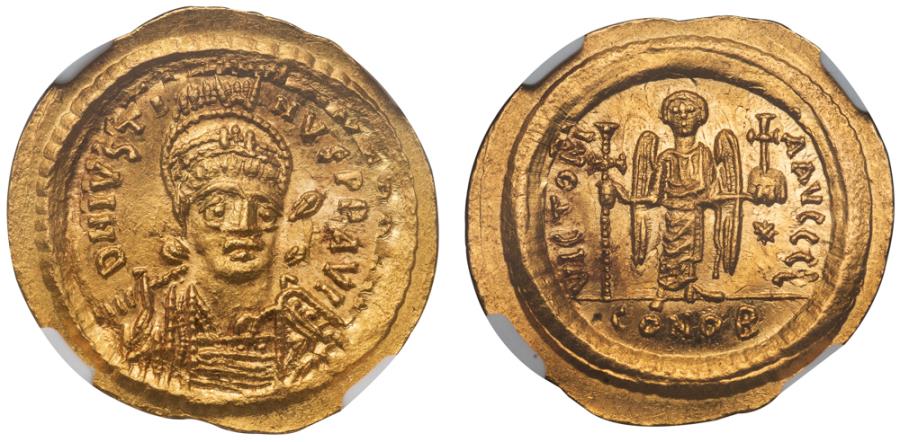
A gold tremissus of Justin I.
When the elderly Eastern Roman Emperor Anastasius died on July 8, AD 518, he left no son and no clear successor. This unsettled situation led immediately to a mad scramble by the powerful in Constantinople to win the throne for one of their own candidates. As a result of this struggle, the throne ended up belonging to an elderly man who could take a punch: Justin I.

By all accounts, Justin came from peasant stock in the hinterlands of Thrace, long one of the most productive recruiting grounds for the late Roman army. Of his family, little is known. They are thought to have been poor herdsmen from an area which, at the time of Justin’s birth (ca. AD 450), had been devastated repeatedly by the Huns. To escape the poverty and poor prospects of his home, Justin set out to try his luck in the capital, Constantinople. Like many young men at that time, he was recruited into the Roman army where he found great success and rose steadily through the ranks. Eventually, he was made a senator and became the Comes (or Count) of the Excubitors under emperor Anastasius—a position equivalent to the general of the palace guards. Already in his late 60s by this point, he had enjoyed a brilliant career, going from poor peasant to a member of the elite in Constantinople.

When Anastasius died without an heir, however, Justin suddenly found himself in the middle of a welter of court intrigue. What followed is best described in the epochal book, Justin I. Here A. A. Vasiliev paraphrases a near-contemporary account of the events written by Peter the Patrician and saved for posterity in a 10th century compilation called On Ceremonies by Constantine Porphyrogenitus:
Since there was neither Augusta nor Emperor to influence the election, and since almost no provision had been made to meet the situation, a certain confusion took place….Immediately, the Silentiaries, personal attendants of the emperor of senatorial rank with the title Clarissimi, sent word to Celer, the master of offices, and to Justin, who at that time was commander of the Excubitors, to come to the palace. Upon their arrival, Celer summoned the Candidates and other Scholarians who were in a strict sense bodyguards of the imperial person and were under the control of the master of offices. And Justin called together the Excubitors, soldiers and ordinary officers as well as those of higher rank, that is, the whole body of the palace guards who were under his command, and he said to them: “Our lord as man has passed away. We must all deliberate together and elect [an emperor] pleasing to God and useful to the empire.” In the same way, Celer addressed the Candidates and chiefs of the Scholarians.
While these maneuverings were going on in the palace, word apparently got out about the emperor’s death to the demes – the Blue and Green race factions who flexed considerable political muscle in Constantinople. They gathered in the Hippodrome and began chanting to make their desires known:
“Long live the Senate! Senate of the Romans, you conquer!” We demand the emperor, given by God, for the army. We demand the emperor, given by God, to the world.”
Inside the palace, the political and ecclesiastical authorities began to deliberate, no doubt feeling the heat from the chanting factionists nearby in the Hippodrome. The senators, officers, and the Patriarch gathered in the great hall known as the Triklinos of the Nineteen Akkubita, but were unable to agree on a candidate. Vasiliev, paraphrasing Peter, continues:
As time was passing by, the Magister Celer said to them: “While it is still possible to us, let us decide and act. If we decide promptly on the name, all will follow us and keep silent. But if we fail to come promptly to a decision, then we shall have to follow others.”
Even following this urgent appeal, the palace officers were unable to agree, and the disputes became violent. First, the Excubitors went ahead and proclaimed a certain John as emperor. This candidate was immediately rejected by the Blue factionists who started a riot during which several people were killed. The Scholarians, meanwhile, put forth a candidate of their own, but the excubitors seized him violently and would have killed him had he not been saved by Justin’s nephew—a certain Petrus Sabbatius, otherwise known as Justinian. This Justinian was also put forward as a candidate by the Excubitors, but he adamantly refused to accept. Meanwhile, Vasiliev continues:
As each of these persons had been proposed, their advocates knocked at the Ivory Gate, through which probably the shortest way led to the imperial personal quarters in the palace, and called upon the chamberlains to deliver the imperial robes. But on the announcement of the names of the proposed candidates, the chamberlains refused to do so.
With the situation in chaos and continuing to deteriorate, a strong faction of senators was able to convince their colleagues that Justin, the count of the Excubitors, should be named as emperor.
Some of the Scholarians resented this choice and rushed upon Justin, and in the heat of the altercation one of them struck the future emperor a blow of the fist and split his lip. The decision of the senators, however, backed by the army and the demes prevailed. Justin was brought to the Hippodrome; even the antagonistic factions of the Blues and Greens agreed upon him; the chamberlains immediately sent him the imperial robes….Standing on a shield Justin received a chain which was placed upon his head….The military insignia, the labara and the standards, which lay on the ground, were immediately raised, as was customary on such proclamations….The soldiers held their shields over his head, and under this shelter, he donned the imperial garb in the box [the Kathisma of the Hippodrome]. Then the Patriarch John placed the crown on his head. Justin took the lance and the shield, and reappeared in the Kathisma. All cried: “Justin August, you conquer!”
The new emperor first announced his donative to the army—five nomismata of gold and one pound of silver for each soldier. He then gave an address which Vasiliev renders from Peter’s account as follows:
Justin, Victorious, ever Augustus: “Having received the imperial power through the will of Almighty God and your unanimous choice, we invoke celestial providence.”

All cried: “Abundance to the world! Reign as thou has lived! Abundance to the government! Celestial Lord, save the earthly one! Justin August, you conquer! Long live the new Constantine! We are slaves of the emperor!”
Justin: "May God, through his grace, enable us to achieve everything that is beneficial to you and to the state!”

All cried: “Son of God, have pity on him! Thou hast elected him! Have pity on him! Justin August, you conquer!”
Justin: Our concern is to provide you, by divine grace, with every kind of prosperity, and to conserve all of you with all benevolence, affection, and in a state of full tranquility.” 
All cried: “Worthy of the Empire! Worthy of the Trinity! Worthy of the City! Long may thou live, Imperator! We demand honest magistrates for the world.”

Justin: “Because of the celebration of our happy enthronement I will grant everyone of you [the soldiers, that is] five nomismata and a pound of silver.”

All cried: “May God protect a Christian emperor! Such are the unanimous vows of the world!” 
Justin: “God be with you!”
Thereafter, Justin processed to the great Church, Hagia Sophia [that is, the second Hagia Sophia as built by Theodosius II which burned during the Nika Rebellion 14 years later] and the coronation ceremony continued.

A gold solidus of Justin I.
Given the number of eminent and wealthy men who could have stepped into the role at that moment, it is noteworthy that the senate, the court, the demes and the army settled on a grizzled old soldier who was one of the unlikeliest individuals ever to sit upon the throne. A man of humble birth, Justin had serious shortcomings, foremost of which was his lack of formal education. Vasiliev casts doubt on the legends that Justin was illiterate to the point that he couldn’t sign his own name. But it’s clear that the new emperor realized that his dearth of formal academic training would make him easy prey for the clever men of letters who inhabited the court. To make up for this deficiency, Justin employed a secret weapon—a young man of unquestionable loyalty whom he had caused to be educated in the capital and who had already shown a unique spark of intellect and depth of vision—his nephew, Justinian.

Vasiliev's book, Justin I, published in 1950, remains the most authoritative source on Justin and his reign and is well worth reading. Fortunately, it is readily available on Archive.org.

Friday, June 29, 2018

"The feast ennobled by the blood of Peter and of Paul" ~ One of the oldest accounts of the martyrdom of Peter and Paul in Rome

Christ enthroned between St. Paul (left) and St. Peter (right).
4th or 5th century AD, from the Catacomb of Marcellinus in Rome.
June 29 is commemorated as the feast of Saints Peter and Paul, co-founders of the Roman Church. To celebrate this feast, here is a poem written in the late 4th century AD by the Latin poet Prudentius as part of his work, the Peristephanon or Martyr's Garland. The poem follows the way of a pilgrim visiting the shrines in Rome on the very feast of Saints Peter and Paul, and dwells a little on the details of the martyrdoms of the two Apostles.

The poem is significant as one of the earliest accounts of Saint Peter's inverted crucifixion. It also gives an indication of the types of shrines that existed in Rome (or immediately outside) to commemorate Peter and Paul's grave sites during late antiquity.
The Martyrdom of St. Peter and St. Paul
By Aurelius Prudentius Clemens
May, friend, what means this stir today? What summons gathers all
   These happy troops along the streets of Rome?
The feast ennobled by the blood of Peter and of Paul
   Calls forth the worshippers to leave their home. 
The self-same day with interval of one revolving year
   Beheld the pair by death triumphant crowned.
Full well doth Father Tiber know, gliding those marshes near,
   Hallowed with trophies twain that turfy ground. 
Both Cross and Sword he witnessed, twice the ghastly shower saw fall,
   The self-same herb bedewed with martyr’s blood.
A victim first fell Peter, in Nero’s judgment-hall
   Condemned to hang upon the towering wood.  
But he, in fear to emulate his Master, cannot brook
   To court the doom that our salvation earned:
And he claimeth from his murderer one boon, that he may look
   On the Tree’s nether limb with head down-turned. 
So then his hands transfixed below, the top his feet upbore:
   Greater in spirit as more vile in guise,
Remembering “Who abaseth self exalted shall he soar,”
   To give his soul to heaven, he bowed his eyes. 
Soon as the circling seasons brought the swift recurring date,
   And Orient Sun reushered in the day,
The tyrant spat on holy Paul the venom of his hate,
   Christ’s world-worn Teacher resolute to slay.  
He had seen the goal—had written “I am ready to depart
   And be with Christ,” with heaven-inspired pen.
The headsman does his office. Beats no more that noble heart;
   Nor day nor hour has failed his prescient ken.  
On either bank, nigh each to each, their ashes now repose,
   Where winds the stream between the two hallowed graves;
The gilded shrine that on the right doth Peter’s bones enclose
   ’Neath sough of olives sacred Tiber laves. 
Trickling adown the slope from brow of overhanging hill,
   There oozes a perennial source of oil.
That fountain flows through fabric now of costly marble, till
   In gleaming bath its circling eddies boil. 
Below with hollow undertone the rushing streams descend
   From sparkling basin, white as drifted snow;
Art’s many-colored hues above with amber wavelets blend
   Resplendent moss and gold’s green-tinted glow. 
Lo! where with mantling purple overshadowed lies the pool,
   The fretted roof reflected seems to swim.
Christ the true Shepherd there portrayed, to waters clean and cool,
   Is leading on His flock that thirst for Him. 
By Tiber’s current, where the turf on the left bank is grazed,
    And Ostia’s road guardeth the hallowed ground,
Our prince’s favor there to Paul a stately fane upraised,
   And pranked with golden plates the circuit round. 
With branching foil of metal blaze on high the burnished beams,
   The aisles are ruddy as the morning ray;
Of pillars white ’neath gilded vault a fourfold order gleams,
   And arches dyed as green as leas in May.  
The Father gave these pledges to the nation of the gown:
   To be revered for aye twin temples spring;
Two roads lead forth Rome’s worshippers, to feasts one light doth crown,
   To each we hasten, and at each we sing.  
Where Tiber’s spanned by Hadrian’s bridge, we reach the stream’s left side:
   From vigil and from ritual the priest
Thither hies back to offerings fresh. Thus Rome keeps holy tide:
   Now homeward wend and celebrate each feast.
This version in English is taken from Translations from Prudentius by Francis St. John Thackeray, a text that is, sadly, out of print. It is included along with other selections from Prudentius in this book: I Am A Christian: Authentic Accounts of Christian Martyrdom and Persecution from the Ancient Sources pictured at right.

Thursday, June 28, 2018

"You have received us with bombs" ~ The assassination of Archduke Franz Ferdinand and the end of Christian Europe

Click here to share this image on Facebook.
It is not too far-fetched to say that Christian Europe officially died on June 28, 1914. On that day, the heir to the imperial throne of Austria-Hungary and his wife were gunned down on the streets of Sarajevo. In modern parlance, we would call the assassin, 19 year-old Serbian radical Gavrilo Princip, a terrorist. His act would lead directly to the outbreak of the Great War a little over a month later.

Following is an article that appeared in The Outlook, an important New York-based political and social journal, from a week after the assassinations. It is notable that the terrible ramifications of the slaying had yet to be recognized—stories regarding the political maneuvering of Theodore Roosevelt and the situation in Mexico were given priority in this issue.
The Assassinations at Sarajevo 
All friends of Austria-Hungary were shocked by the murder on June 28 of the heir to the throne, the Archduke Franz Ferdinand, and his wife, the Duchess of Hohenberg. Those in exalted stations are never free from some sudden attack by some crazed man, as the cases of Lincoln and Garfield and McKinley, of King Humbert of Italy and King George of Greece, remind us.

In the present instance, murder has removed those who were about to succeed to great power. Franz Ferdinand was not a popular prince. He was reserved, taciturn, moody, opinionated, supposed to be under Jesuit control, a jingo, a militarist—not all together a happy combination. Accident made him, as the nephew of the venerable Austrian Emperor, heir to the throne. The world looked on with misgiving. For of all monarchs the Emperor of Austria-Hungary has best known how to manage the conglomeration of the many different nationalities which make up the Dual Empire. It might well be triple, as Franz Ferdinand himself suggested not long ago, the third part to be Slav.

With bitter irony, the Prince met his death at the hands of a Slav—a Serb. The Archduke and his wife were entering Sarajevo, the capital of Bosnia, when a bomb was burst immediately behind their motor, shattering the motor which followed it and injuring its occupants. Moved by this circumstance, the Archduke, before replying later to the Mayor’s message of welcome, said: “An amazing indignity has been perpetrated. You have received us with bombs.” With his wife, he then drove towards the hospital to inquire after the condition of the sufferers from the bomb, when a young man sprang out of the crowd and aimed a pistol at the Duchess. Her husband immediately threw himself in front of her to shield her. The weapon used was an automatic pistol. Both occupants of the motor received mortal wounds from which they soon expired…

The tragedy gains deeper pathos because it leaves the venerable head of the house of Hapsburg (Emperor Franz Joseph) so utterly alone. His has been a life overborne by grief. A quarter of a century ago, he lost in a most tragic way, his only son. Sixteen years ago, his wife was murdered. His brother, Maximilian, became Emperor of Mexico, only to be shot there, and Carlotta, Maximilian’s wife, became an inmate of an insane asylum. The Emperor’s sister-in-law, the Duchess of Alencon, was burned to death in Paris. The Archduke John, who suddenly renounced his rank and became plain Johann Orth, disappeared. And now comes the loss of another nephew, the heir presumptive.

As the children of Franz Ferdinand’s morganatic marriage are debarred from the throne, the new heir presumptive is Charles Francis Joseph (later Blessed Karl of Austria), the son of the late Archduke Otto, who married Josefa, daughter of the late King of Saxony.

The assassination of the Archduke and his wife was followed by bloody riots at Mostar, the capital of Herzegovina, between Mohammedan Croats and the Serbs. In the attempts of the Croats (aided by Austrians) to drive the Serbs back into their own quarters many serious incendiary fires were started, which at one time threatened the destruction of the city. It was reported that in the street fighting in Mostar, over two hundred Serbs were killed. Rioting also broke out in other towns in Herzegovina.
The assassination of Archduke Franz Ferdinand and Duchess Sophie destroyed their young family—their three children, Sophie, Maximilian and Ernst were sometimes described as the first orphans of the Great War. The assassination also led directly to the destruction of the last vestiges of Christian Europe. Considering the events that have followed up to the present, and the dark and uncertain future that Europe faces today, it is perhaps not out of place to remember these victims as signs of contradiction to the mess that liberal democracy and socialism have made of the once cultured and prosperous nations of the continent.

Tuesday, June 26, 2018

"You have won, O Galilean!" ~ Who killed Julian the Apostate?

Julian receives the mortal wound as depicted
in this 19th century engraving.
On the 26th of June AD 363, the last pagan Roman Emperor, Flavius Claudius Julianus, known to history as Julian the Apostate, perished from a wound he received while fighting off a Persian ambush. The pagan historian Ammianus Marcellinus—a witness to the event and an admirer of Julian—described the scene as follows:
When we marched on from this place, the Persians, since their frequent losses made them dread regular battles with the infantry, laid ambuscades, and secretly attended us, from the high hills on both sides watching our companies as they marched, so that the soldiers, suspicious of this, all day long neither raised a palisade nor fortified themselves with stakes. And while the flanks were strongly protected and the army, as the nature of the ground made necessary, advanced in square formation, but with the battalions in open order, it was reported to the emperor, who even then unarmed had gone forward to reconnoiter, that the rear guard had suddenly been attacked from behind.
Excited by the misfortune, he forgot his coat-of‑mail, and merely caught up a shield in the confusion; but as he was hastening to bring aid to those in the rear, he was recalled by another danger — the news that the van, which he had just left, was just as badly off. While he was hastening to restore order there without regard to his own peril, a Parthian band of mailed cavalry on another side attacked the center companies, and quickly overflowed the left wing, which gave way, since our men could hardly endure the smell and trumpeting of the elephants, they were trying to end the battle with pikes and volleys of arrows.
But while the emperor rushed hither and thither amid the foremost ranks of the combatants, and as the Persians turned in flight, they hacked at their legs and backs, and those of the elephants. Julianus, careless of his own safety, shouting and raising his hands tried to make it clear to his men that the enemy had fled in disorder, and, to rouse them to a still more furious pursuit, rushed boldly into the fight. His guards, who had scattered in their alarm, were crying to him from all sides to get clear of the mass of fugitives, as dangerous as the fall of a badly built roof, when suddenly — no one knows whence — a cavalryman's spear grazed the skin of his arm, pierced his ribs, and lodged in the lower lobe of his liver. While he was trying to pluck this out with his right hand, he felt that the sinews of his fingers were cut through on both sides by the sharp steel. Then he fell from his horse, all present hastened to the spot, he was taken to camp and given medical treatment. [Taken from the Roman History of Ammianus Marcellinus, Book XXV, Chapter 3]
Julian's wound was mortal and though he lingered a few days, ultimately died of a hemorrhage.

The identity of Julian's slayer has remained a mystery to this day. As seen above, Marcellinus indicates that no one knew who threw the javelin that pierced Julian. Another of Julian's friends, the pagan philosopher Libanius, was quick to affix blame to those whom Julian hated most. The Christian historian Sozomen, writing about 60-70 years after the event, explains:
Click here for info.
Libanius, the sophist, a native of Syria, the most intimate friend of Julian, expressed himself in the following terms concerning the person who had committed the deed:
"You desire to know by whom the emperor was slain. I know not his name. We have a proof, however, that the murderer was not one of the enemies; for no one came forward to claim the reward, although the king of Persia caused proclamation to be made, by a herald, of the honors to be awarded to him who had performed the deed. We are surely beholden to the enemy for not arrogating to themselves the glory of the action, but for leaving it to us to seek the slayer among ourselves.
"Those who sought his death were those who lived in habitual transgression of the laws, and who had formerly conspired against him, and who therefore perpetrated the deed as soon as they could find an opportunity. They were impelled by the desire of obtaining a greater degree of freedom from all control than they could enjoy under his government; and they were, perhaps, mainly stimulated by their indignation at the attachment of the emperor to the service of the gods, to which they were averse."
In the document above quoted, Libanius clearly states that the emperor fell by the hand of a Christian, and this, probably, was the truth. It is not unlikely that some of the soldiers who then served in the Roman army might have conceived the idea, since Greeks and all men until this day have praised tyrannicides for exposing themselves to death in the cause of liberty, and spiritedly standing by their country, their families, and their friends. [Taken from: The Ecclesiastical History of Sozomen, Book VI, Chapters 1-2]
It is notable that Sozomen, though a Christian, is persuaded by Libanius's logic and agrees that the culprit was probably a Christian. Interestingly, Libanius elaborates on the identity of the culprit in a separate tract entitled, Avenging Julian, in which he warned the newly crowned emperor Theodosius I to be wary of assassins. Writing in about AD 380, Libanius says the following:
"Our renowned Julian received that blow in the side as he strove to unite part of his line that had broken, spurring his horse towards them, cheering and threatening. The assailant who inflicted the wound was a Taiene [Saracen], acting in obedience to their leader’s command. This action, indeed, would probably secure for the chief a reward from the people who were keen to have him killed." [Taken from: Selected Works of Libanius: The Julianic Orations as found in the article Killing Julian by Benjamin James Rogaczewski]
Libanius insinuates that this Saracen was in the pay of Christian masters because, as above, no one had come forward among the Persians to claim the reward for having slain the Roman Emperor. Of course, there are numerous problems with this type of logic, for example: the slayer may himself have been killed in the heat of battle; or the javelin may have been a random lucky cast from a Persian, or accidental friendly fire from a Roman. Writing in the early 5th century, the Christian historian Socrates offers a completely different explanation, as follows:
"Some say that a certain Persian hurled the javelin, and then fled; others assert that one of his own men was the author of the deed, which indeed is the best corroborated and most current report. But Callistus, one of his body-guards, who celebrated this emperor's deeds in heroic verse, says in narrating the particulars of this war, that the wound of which he died was inflicted by a demon. This is possibly a mere poetical fiction, or perhaps it was really the fact; for vengeful furies have undoubtedly destroyed many persons." [Taken from The Ecclesiastical History of Socrates, Book III, Chapter 21]
Writing later in the 5th century, the Christian historian Theodoret lists the extant theories regarding the slayer, but maintains that ultimately the identity doesn't matter and in the process, provides one of the most memorable vignettes regarding the death of Julian:
"The name of the man who dealt that righteous stroke no one knows to this day. Some say that he was wounded by an invisible being, others by one of the Nomads who were called Ishmaelites [that is, a Saracen]; others by a trooper who could not endure the pains of famine in the wilderness. But whether it were man or angel who plied the steel, without doubt the doer of the deed was the minister of the will of God. It is related that when Julian had received the wound, he filled his hand with blood, flung it into the air and cried, 'You have won, O Galilean.'" [Taken from: The Ecclesiastical History of Theodoret, Book III, Chapter 20]
Socrates offers the following summation of both the man Julian and his inglorious death, which strikes me as a pretty accurate assessment:
Be the case however as it may, this is certain, that the ardor of his natural temperament rendered him incautious, his learning made him vain, and his affectation of clemency exposed him to contempt. Thus Julian ended his life in Persia, as we have said, in his fourth consulate, which he bore with Sallust his colleague. This event occurred on the 26th of June, in the third year of his reign, and the seventh from his having been created Cæsar by Constantius, he being at that time in the thirty-first year of his age. [Taken from The Ecclesiastical History of Socrates, Book III, Chapter 21]
For a detailed scholarly analysis of the death of Julian, check out Killing Julian by Benjamin James Rogaczewski.

Other posts about Julian from this blog include:

Tuesday, June 12, 2018

"The Oblivion of a Silent Age" ~ The effort of Diocletian and Galerius to wipe out Christian literature during the Great Persecution

A later representation of Saints Emeterius and Celedonius in Calahorra Cathedral.
In a previous post entitled The Scriptures Destroyed by Fire ~ An official Roman transcript of the Great Persecution of AD 304, we examined the transcript of an investigation of several Christians in Roman north Africa. The accused were under suspicion of possessing and hiding Christian literature which had been banned by imperial edict. This document gives an idea of how thorough the Roman legal apparatus could be when enforcing the law, even as far from the centers of power as the town of Cirta, situated about 200 miles west of Carthage.

We know that destroying Christian books and literature was a facet of the Great Persecution because it is explicitly mentioned by Eusebius in his Ecclesiastical History. Aside from the above-mentioned transcript of the investigation in Cirta, there are other ancient sources which back up this aspect of the persecution—that is, the desire of Diocletian and and Galerius to completely extirpate all written knowledge of Christianity from the face of the earth. Here are a few additional examples.

In the authentic acts of Saints Chionia, Agape and Irene who were martyred during the Great Persecution in Thessalonica, there exists another official trial transcript which is believed by most scholars to be genuine. In it we find the following exchange between Dulcetius, governor of the province of Macedonia, and Saint Chionia:
Dulcetius: "Have you not some books, papers, or other writings, relating to the religion of the impious Christians?" 
Chionia said: "We have none: the emperors now reigning have taken them all from us."
Soon after, Chionia and Agape were condemned to death, while Irene was sent back to prison. It seems that a search was done of Irene's home and Christian writings were indeed found there. Dulcetius called Irene before him to face cross-examination regarding this new evidence.
Dulcetius: "Your madness to plain, since you have kept to this day so many books, parchments, codicils, and papers of the scriptures of the impious Christians. You were forced to acknowledge them when they were produced before you, though you had before denied you had any. You will not take warning from the punishment of your sisters, neither have you the fear of death before your eyes: your punishment therefore is unavoidable. In the mean time I do not refuse even now to make some condescension in your behalf. Notwithstanding your crime, you may find pardon and be freed from punishment, if you will yet worship the gods. What say you then? Will you obey the orders of the emperors? are you ready to sacrifice to the gods, and eat of the victims?"

Irene: "By no means: for those that renounce Jesus Christ, the Son of God, are threatened with eternal fire."

Traditional image of Saints Agape,
Irene and Chionia.
Dulcetius: "Who persuaded you to conceal those books and papers so long?"

Irene: "Almighty God, who has commanded us to love him even unto death; on which account we dare not betray him, but rather choose to be burnt alive, or suffer any thing whatsoever than discover such writings."

Dulcetius: "Who knew that those writings were in the house?" 
Irene: "Nobody, but the Almighty, from whom nothing is hid: for we concealed them even from our own domestics, lest they should accuse us."

...

Dulcetius: "After you returned from the mountains, as you say, did you read those books to anybody?" 
Irene: "They were hid at our own house, and we durst not produce them; and we were in great trouble, because we could not read them night and day, as we had been accustomed to do."

Dulcetius: "Your sisters have already suffered the punishments to which they were condemned. As for you, Irene, though you were condemned to death before your flight for having hid these writings, I will not have you die so suddenly; but I order that you be exposed naked in a brothel, and be allowed one loaf a day, to be sent you from the palace; and that the guards do not suffer you to stir out of it one moment, under pain of death to them."
A hint of how successful the efforts had been to annihilate Christian writings during the Great Persecution may be found in The Peristephanon or Martyr's Garland of the late 4th century Latin poet from Spain, Prudentius. In the poem celebrating the martyrs of Calahorra, Saints Emeterius and Celedonius, written about 80 years after their deaths, we read the following lines:
But oh, the oblivion of a silent age!
     Extinguishing the record of such deeds,
The infidel long since destroyed the page,
     Which else had taught us how a martyr bleeds,

Envying to learned times that they should tell
     That passion’s history for all future years,
The order, time, and way how it befell—
     Sweet words to sound forever in men’s ears.

Yet this alone is what we cannot say,
     Whether, in prison pent, their hair grew long,
Or of their torments reckon the array...
[Taken from: A Hymn of Prudentius, published in The Month, Magazine and Review, 1873]
This provides a reasonable explanation as to why so many accounts of the ancient martyrs are fantastic stories of considerably later provenance, no doubt generated from dubious oral tradition. In many cases, probably little more was known than the name of the saint and the place of his or her martyrdom. It also makes the several authentic accounts that somehow survived the flames—such as that of Chionia, Agape, and Irene—that much more precious.

Click for more info.
The complete Passion of Saints Chionia, Agape, and Irene along with the full poem commemorating the martyrs of Calahorra by Prudentius may be found among the accounts related in the book, I Am A Christian: Authentic Accounts of Christian Martyrdom and Persecution from the Ancient Sources. Also included in this book is a chapter on the "traditores" and the burning of Christian books, as well as the account of the martyrs of Abitina who also suffered, in part, for hiding Christian literature.