Sunday, March 17, 2013

The real Saint Patrick in his own words

Click here to share on Facebook.
Who was Saint Patrick? Well, for starters, he wasn't Irish. He was born a Roman (Patricius) during the days when Britain was cut off from the empire immediately before the final collapse of Roman power in the west. Though not born an Irishman himself, Patrick had a deep and abiding love for the Irish and dedicated his life to bringing them to Christianity.

Amazingly, two works written by Patrick have come down to us from antiquity. The first is his Confessio, which was written about AD 450 under obscure circumstances. Following is an excerpt from this document, where Patrick tells the story of his ancestry, his capture by pirates, and his captivity in Ireland:
"My name is Patrick. I am a sinner, a simple country person, and the least of all believers. I am looked down upon by many. My father was Calpornius. He was a deacon; his father was Potitus, a priest, who lived at Bannavem Taburniae. His home was near there, and that is where I was taken prisoner. I was about sixteen at the time. At that time, I did not know the true God. I was taken into captivity in Ireland, along with thousands of others. We deserved this, because we had gone away from God, and did not keep his commandments. We would not listen to our priests, who advised us about how we could be saved. The Lord brought his strong anger upon us, and scattered us among many nations even to the ends of the earth. It was among foreigners that it was seen how little I was..."
Patrick later escapes from slavery in Ireland and after a harrowing journey, manages to return to Britain. But God is not finished with him. Later in the same document, Patrick writes about how he was called by God to be an evangelist in Ireland:
"After a few years I was again in Britain with my parents [kinsfolk], and they welcomed me as a son, and asked me, in faith, that after the great tribulations I had endured I should not go anywhere else away from them. And, of course, there, in a vision of the night, I saw a man whose name was Victoricus coming as if from Ireland with innumerable letters, and he gave me one of them, and I read the beginning of the letter: ‘The Voice of the Irish’; and as I was reading the beginning of the letter I seemed at that moment to hear the voice of those who were beside the forest of Foclut which is near the western sea, and they were crying as if with one voice: ‘We beg you, holy youth, that you shall come and shall walk again among us.’ And I was stung intensely in my heart so that I could read no more, and thus I awoke. Thanks be to God, because after so many years the Lord bestowed on them according to their cry."
The Confessio reveals Patrick to be be a man of tremendous faith, courage and humility. Too often, these characteristics are obscured by the legends and pantomime that accompany the celebration of his feast day around the world. But listen to Patrick's own exhortation, reminiscent of Saint Paul boasting of his own weakness, as he encourages the high and mighty of this world to humble themselves before God:
"So be amazed, all you people great and small who fear God! You well-educated people in authority, listen and examine this carefully. Who was it who called one as foolish as I am from the middle of those who are seen to be wise and experienced in law and powerful in speech and in everything? If I am most looked down upon, yet He inspired me, before others, so that I would faithfully serve the nations with awe and reverence and without blame: the nations to whom the love of Christ brought me. His gift was that I would spend my life, if I were worthy of it, to serving them in truth and with humility to the end..."
Click here to read the whole of the Confessio.

For an excellent short biography of this great saint, check out Saint Patrick from the Christian Encounters series. My positive review of this book may be found here.

In a similar vein, I absolutely do not recommend the popular book How the Irish Saved Civilization by Thomas Cahill. My reasons for this negative opinion may be found here.

Happy Saint Patrick's Day #1


The real Saint Patrick was a man of tremendous faith, courage and humility. Too often, these characteristics are obscured by the legends and pantomime that accompany the celebration of his feast day around the world.

Amazingly, two of Patrick's writings have survived from antiquity: his Confession and his Letter to the Soldiers of Coroticus. Here is an excerpt from his Confession about his calling to be an evangelist in Ireland:

"After a few years I was again in Britain with my parents [kinsfolk], and they welcomed me as a son, and asked me, in faith, that after the great tribulations I had endured I should not go anywhere else away from them. And, of course, there, in a vision of the night, I saw a man whose name was Victoricus coming as if from Ireland with innumerable letters, and he gave me one of them, and I read the beginning of the letter: ‘The Voice of the Irish’; and as I was reading the beginning of the letter I seemed at that moment to hear the voice of those who were beside the forest of Foclut which is near the western sea, and they were crying as if with one voice: ‘We beg you, holy youth, that you shall come and shall walk again among us.’ And I was stung intensely in my heart so that I could read no more, and thus I awoke. Thanks be to God, because after so many years the Lord bestowed on them according to their cry."

Find out more about the real Saint Patrick here:
http://www.catholic.org/saints/saint.php?saint_id=89

Sunday, March 10, 2013

Prayers for the Conclave


The Conclave is scheduled to begin on Tuesday, March 12 on the traditional calendar feast of Pope St. Gregory the Great. The faithful are called to pray for the conclave, that the assembled cardinals be receptive to the inspiration of the Holy Spirit. What better way to do this than to remind ourselves of the glorious heritage of the office of the Papacy and some of the brilliant, wise and godly men who have occupied the Roman cathedra.

Too often, those who think poorly of the Church focus on the "bad" Popes. But one need only glance through the 2,000 year history of the papacy--stretching all the way back to the time of Jesus--to see that the good far outnumber the "bad". Here are some memes to help us focus on the outstanding virtues of some of the most noble early Popes. Let us pray to Almighty God that He sends His Holy Spirit to inspire these virtues in the man who will become the next Pontiff--the next Servant of the Servants of God.

Saint Peter, the First Pope
"Dearly beloved, think not strange the burning heat which is to try you, as if some new thing happened to you; But if you partake of the sufferings of Christ, rejoice that when his glory shall be revealed, you may also be glad with exceeding joy. If you be reproached for the name of Christ, you shall be blessed: for that which is of the honor, glory, and power of God, and that which is his Spirit, resteth upon you." [First Epistle of Saint Peter, 4:12-14]
Read more about St. Peter the Liber Pontificalis, an amazing early work that every Catholic should own.

Saturday, March 02, 2013


"I am not the Son of God. I'm just a philosopher who wants people to be nice to each other." #ThingsJesusNeverSaid

What Jesus actually said:
"Amen, amen I say to you: If any man keep my word, he shall not see death for ever."

The Jews therefore said: "Now we know that thou hast a devil. Abraham is dead, and the prophets; and thou sayest: If any man keep my word, he shall not taste death for ever. Art thou greater than our father Abraham, who is dead? and the prophets are dead. Whom dost thou make thyself?"

Jesus answered: "If I glorify myself, my glory is nothing. It is my Father that glorifieth me, of whom you say that he is your God. And you have not known Him, but I know Him. And if I shall say that I know Him not, I shall be like to you, a liar. But I do know Him, and do keep His word. Abraham your father rejoiced that he might see my day: he saw it, and was glad."

The Jews therefore said to him: "Thou art not yet fifty years old, and hast thou seen Abraham?"

Jesus said to them: "Amen, amen I say to you, before Abraham was made, I AM."

They took up stones therefore to cast at him. But Jesus hid himself, and went out of the temple.

John 8:51-59.

Thursday, February 07, 2013

Things Saint Paul never said


Here's another one of these in the same vein.

"Fornicators, idolaters, adulterers, the effeminate, homosexuals, thieves, the covetous, drunkards, railers, extortioners, guess what? You're all going to HEAVEN!" #ThingsSaintPaulNeverSaid

Here is what Saint Paul actually said:
"Do not err: neither fornicators, nor idolaters, nor adulterers, Nor the effeminate, nor liers with mankind, nor thieves, nor covetous, nor drunkards, nor railers, nor extortioners, shall possess the kingdom of God.

And such some of you were; but you are washed, but you are sanctified, but you are justified in the name of our Lord Jesus Christ, and the Spirit of our God. All things are lawful to me, but all things are not expedient. All things are lawful to me, but I will not be brought under the power of any. Meat for the belly, and the belly for the meats; but God shall destroy both it and them: but the body is not for fornication, but for the Lord, and the Lord for the body. Now God hath both raised up the Lord, and will raise us up also by his power. Know you not that your bodies are the members of Christ? Shall I then take the members of Christ, and make them the members of an harlot? God forbid."
Click here to read the entire passage:
http://drbo.org/x/d?b=drb&bk=53&ch=6&l=9#x

Things Jesus Never Said ....

Click here to share on Facebook.
Yes, someone else came up with this general idea (#ThingsJesusNeverSaid - go "like" them on Facebook) but I couldn't resist making this one.

"Judge not, lest ye be judged; and by that I mean remain silent when you see others do evil" #ThingsJesusNeverSaid

The actual quote from Christ as recorded in Matthew 7:1 is as follows:
"Judge not, that you may not be judged, For with what judgment you judge, you shall be judged: and with what measure you mete, it shall be measured to you again. And why seest thou the mote that is in thy brother's eye; and seest not the beam that is in thy own eye? Or how sayest thou to thy brother: Let me cast the mote out of thy eye; and behold a beam is in thy own eye? Thou hypocrite, cast out first the beam in thy own eye, and then shalt thou see to cast out the mote out of thy brother's eye."
To read the entire passage, visit: http://www.drbo.org/chapter/47007.htm

This is not an exculpation of vice. It is an exhortation to virtue and a warning against hypocrisy.

Saturday, February 02, 2013

For the feast of St. Thomas Aquinas, January 28 ~ On Charity and Mortal Sin

"It must be said that charity can, in no way, exist along with mortal sin."
~St. Thomas Aquinas, Quaestiones disputatae: De caritate.


The image is "The Temptation of St. Thomas Aquinas" by Diego Velazquez (1632)

Here is the quote in more context:
Article 6: Whether There Can Be Charity With Mortal Sin?

I answer. It must be said that charity can, in no way, exist along with mortal sin. To prove this, it must be considered, first, that every mortal sin is directly opposed to charity. Whoever chooses something in preference to something else, loves better that which he first chooses. Whence, because man loves his own life and his own continuance more than pleasure, however great that pleasure may be, he is drawn away from pleasure if he thinks that it is infallibly destructive of his own life. This is explained by Augustine when he writes in the LXXXIII Quaestionum, that there is no one who fears pain more than he who seeks pleasure. Sometimes we even see that the most savage of beasts will avoid the greatest pleasures because of the fear of pain. However, one sins mortally in this, that he prefers something other than to live according to God and to cling to God. Thus it is clear that whoever sins mortally, by this fact he loves some other good more than he loves God; for if he would love God, he would choose to live according to God more than to obtain some temporal good. However, it is of the very essence of charity that God be loved above all things, as is clear from what is said above. Therefore every mortal sin is contrary to charity.
The full treatise is well worth reading and may be found here: https://isidore.co/aquinas/english/QDdeVirtutibus2.htm#6

The Greatest Destroyer of Peace is Abortion


"The greatest destroyer of love and peace is abortion." ~Blessed Teresa of Calcutta, said at the National Prayer Breakfast, February 3, 1994

This quote was part of a courageous speech given by Blessed Teresa before US political leaders, including President and Mrs. Clinton and Vice-President and Mrs. Gore--all abortion advocates. Here is the context:
"But I feel that the greatest destroyer of peace today is abortion, because it is a war against the child, a direct killing of the innocent child, murder by the mother herself. And if we accept that a mother can kill even her own child, how can we tell other people not to kill one another? How do we persuade a woman not to have an abortion? As always, we must persuade her with love and we remind ourselves that love means to be willing to give until it hurts. Jesus gave even His life to love us. So, the mother who is thinking of abortion, should be helped to love, that is, to give until it hurts her plans, or her free time, to respect the life of her child. The father of that child, whoever he is, must also give until it hurts.

By abortion, the mother does not learn to love, but kills even her own child to solve her problems. And, by abortion, that father is told that he does not have to take any responsibility at all for the child he has brought into the world. The father is likely to put other women into the same trouble. So abortion just leads to more abortion. Any country that accepts abortion is not teaching its people to love, but to use any violence to get what they want. This is why the greatest destroyer of love and peace is abortion."
Watch the whole of this beautiful speech here: http://www.youtube.com/watch?v=OXn-wf5ylgo

Feminist for Life #2


"Nature in every thing demands respect, and those who violate her laws seldom violate them with impunity." -Mary Wollstonecraft

Taken from Wollstonecraft's "A Vindication of the Rights of Women", 1792.

Here is the quote in context:

"To satisfy this genus of men, women are made systematically voluptuous, and though they may not all carry their libertinism to the same height, yet this heartless intercourse with the sex, which they allow themselves, depraves both sexes, because the taste of men is vitiated; and women, of all classes, naturally square their behaviour to gratify the taste by which they obtain pleasure and power. Women becoming, consequently, weaker, in mind and body, than they ought to be, were one of the grand ends of their being taken into the account, that of bearing and nursing children, have not sufficient strength to discharge the first duty of a mother; and sacrificing to lasciviousness the parental affection, that ennobles instinct, either destroy the embryo in the womb, or cast it off when born. Nature in every thing demands respect, and those who violate her laws seldom violate them with impunity. The weak enervated women who particularly catch the attention of libertines, are unfit to be mothers, though they may conceive; so that the rich sensualist, who has rioted among women, spreading depravity and misery, when he wishes to perpetuate his name, receives from his wife only an half-formed being that inherits both its father's and mother's weakness."

Feminist for Life #1

"The rights of children as individuals begin while yet they remain the foetus." ~Victoria Woodhull in Woodhull and Claflin's newspaper, 1870.

This meme may be shared on Facebook by clicking here.

Victoria Woodhull was an early crusader for women's rights in the United States. Though seriously misguided on a host of moral issues, she yet understood the inherent wickedness of abortion, writing in a later editorial in the same periodical:
"Every one will concede that it is murder to take the life of a human being. But the very pertinent question arises just here, when does human life begin? The beating of the heart, modern science tells us, never begins; that is to say, there is no time in the whole process of the growth of the human body from the moment of conception until death, that pulsations of life are not present in what is to develop into the perfected body. Where, then, shall the line be drawn, on one side of which it shall be murder to cause these pulsations to cease, and upon the other not murder?

...Many women who would be shocked at the very thought of killing their children after birth, deliberately destroy them previously. If there is any difference in the actual crime we should be glad to have those who practice the latter, point it out. The truth of the matter is that it is just as much a murder to destroy life in its embryotic condition, as it is to destroy it after the fully developed form is attained, for it is the self-same life that is taken.

...[T]hey who, having conceived [children] then destroy them, are murderers; and no amount of sophistry nor excuses can, by one iota, mitigate the enormity of the crime. They do even more than murder, they virtually commit suicide, for no woman can practice this crime without in part destroying her own life.

...[W]hile we shall at all times freely discuss the matter, objectively as to its results, we shall not forget to look at the matter subjectively, to find the remedy, which, if we mistake not, is in granting freedom and equality to woman."
[NB. I've fallen behind on posting these, opting instead to post to my Facebook page first where they inevitably get more play. Like me on Facebook if you want to see these earlier and share them with your friends.]

Monday, January 14, 2013

Chesterton: Without the family we are helpless before the State.

"Without the family we are helpless before the State."

Taken from the endless font of Catholic wisdom, Gilbert Keith Chesterton. Here is the quote in context:
The masters of modern plutocracy know what they are about. They are making no mistake; they can be cleared of the slander of inconsistency. A very profound and precise instinct has let them to single out the human household as the chief obstacle to their inhuman progress. Without the family we are helpless before the State, which in our modern case is the Servile State. To use a military metaphor, the family is the only formation in which the charge of the rich can be repulsed. It is a force that forms twos as soldiers form fours; and, in every peasant country, has stood in the square house or the square plot of land as infantry have stood in squares against cavalry. How this force operates this, and why, I will try to explain in the last of these articles. But it is when it is most nearly ridden down by the horsemen of pride and privilege, as in Poland or Ireland, when the battle grows most desperate and the hope most dark, that men begin to understand why that wild oath in its beginnings was flung beyond the bonds of the world; and what would seem as passing as a vision is made permanent as a vow.
Taken from: The Superstition of Divorce.

Monday, December 03, 2012

"There is no future without children."


This meme was inspired by an article in the NY Times by Ross Douthat entitled "The Birthrate and America's Future."  It reminded me of this address by Pope Benedict XVI earlier this year:
Pope says no future without children, urges support for large families
Pilgrims cheer during the pope's general audience at the Vatican Feb. 15. (CNS/Paul Haring)
By Carol Glatz Catholic News Service

VATICAN CITY (CNS) -- Pope Benedict XVI called on governments and communities to help large families, saying children represent hope and the well-being of every nation.

"There is no future without children," he said at the end of his general audience Feb. 15 in a greeting to members of an Italian association of large families.

"In today's social context, a family made up of many children constitutes a witness of faith, courage and optimism," he said. "I hope that adequate social and legislative measures are promoted that safeguard and sustain large families, which represent richness and hope for the whole country," he said. 
To read the whole article, click here: http://www.catholicnews.com/data/stories/cns/1200616.htm


Friday, November 23, 2012

Martyrdom of Blessed Miguel Pro - November 23, 1927

November 23 is the anniversary of the martyrdom of Blessed Miguel Pro. Following is the Wikipedia entry on Pro's arrest and execution:
An assassination attempt by bombing against Álvaro Obregón (which only wounded the ex-president) in November 1927 provided the state with a pretext to capture Pro and his brothers Humberto and Roberto. A young engineer who was involved and confessed his part in the assassination testified the Pro brothers were not involved. Miguel and his brothers were taken to the Detective Inspector's Office in Mexico City.

On November 23, 1927, Fr. Pro was executed without trial. President Calles gave orders to have Pro executed under the pretext of the assassination, but in reality for defying the virtual outlawing of Catholicism.[5] Calles had the execution meticulously photographed, and the newspapers throughout the country carried them on the front page the following day. Presumably, Calles thought that the sight of the pictures would frighten the Cristero rebels who were fighting against his troops, particularly in the state of Jalisco. However, they had the opposite effect.

Fr. Pro and his brothers were visited by Generals Roberto Cruz and Palomera Lopez around 11 p.m. on November 22, 1927. The next day, as Fr. Pro walked from his cell to the courtyard and the firing squad, he blessed the soldiers, knelt and briefly prayed quietly. Declining a blindfold, he faced his executioners with a crucifix in one hand and a rosary in the other and held his arms out in imitation of the crucified Christ and shouted out, "May God have mercy on you! May God bless you! Lord, Thou knowest that I am innocent! With all my heart I forgive my enemies!" Before the firing squad were ordered to shoot, Pro raised his arms in imitation of Christ and shouted the defiant cry of the Cristeros, "Viva Cristo Rey!" -"Long live Christ the King!". When the initial shots of the firing squad failed to kill him, a soldier shot him point blank.
Taken from: http://en.wikipedia.org/wiki/Miguel_Pro

Monday, November 19, 2012

The heart of the problem...

As long as the Republican Party is run by people that don't believe in the platform and who aren't willing to articulate and fight for the beliefs of the base, then conservatives can expect defeat after defeat. It's time to demand new leadership.

The definition of insanity...


...is doing the same thing over and over again and expecting different results.

If the Republican Party isn't going to be a home for conservatives anymore, we're going to need a new party.

Saturday, November 10, 2012

Feast of Pope Saint Leo the Great

"The envoys had been well chosen to satisfy that punctilious pride which insisted that only men of the highest dignity among the Romans should be sent to treat with the Lord of Scythia and Germany (Attila). Avienus, who had, two years before, worn the robes of consul, was on of the ambassadors. Trigetius, who had wielded the power of prefect and who, seventeen years before, had been dispatched upon a similar mission to Gaiseric the Vandal, was another. But it was not upon these men, but upon their greater colleague that the eyes of all the barbarian warriors and statesmen were fixed. Leo, Bishop of Rome, had come on behalf of his flock, to sue for peace from the idolater....We cannot withhold a tribute of admiration from the high temper of this Roman Bishop, who in the ever-deepening degradation of his country still despaired not, but had the courage and endurance to work for a far-distant future...The barbarian king had all material power in his hand....The Pontiff had no power but in the world of intellect...Leo's success as an ambassador was complete." [Hodgkin: Italy and Her Invaders, Vol. II, 1880]

Thursday, November 08, 2012

Lukewarm Catholics


"All the evils of the world are due to lukewarm Catholics." ~Pope Saint Pius V

Hard to argue with this following the result of the 2012 election with pro-abortion zealot Barack Obama getting somewhere north of 52% of the “Catholic” vote.  Disgraceful.

Monday, October 22, 2012

Saint Kateri Tekakwitha -- Canonized, October 21, 2012

Click here to share this image on Facebook.
This quote is taken from Kateri Tekakwitha: The Iroquois Saint, a biography of the Saint Kateri written by Fr. Pierre Cholonec in 1696. Fr. Cholonec knew Kateri personally and his biography would go on to become one of the primary documents which helped advance her canonization.

Here is the quote in context:
Click here for more info
or to order a copy
of this book.
It was then the end of Autumn, when the Indians are accustomed to form their parties to go out to hunt during the winter in the forests. The sojourn which Catherine had already made there, and the pain she had suffered at being deprived of the religious privileges she possessed in the village, had induced her to form the resolution, as I have already mentioned, that she would never during her life return there.
I thought however that the change of air, and the diet, which is so much better in the forest, would be able to restore her health, which was now very much impaired. It was for this reason that I advised her to follow the family and others who went to the hunting grounds. She answered me in that deeply devotional manner which was so natural to her, “It is true, my Father, that my body is served most luxuriously in the forest, but the soul languishes there, and is not able to satisfy its hunger. On the contrary, in the village the body suffers; I am contented that it should be so, but the soul finds its delight in being near to Jesus Christ. Well then, I will willingly abandon this miserable body to hunger and suffering, provided that my soul may have its ordinary nourishment.”
The photo in the image above is one that I took of a statue of Saint Kateri in Auriesville, NY.

Friday, October 19, 2012

Feast of the North American Martyrs


Today is the feast of the much beloved North American Martyrs, those hearty priests and lay apostles who braved the rigors of the American wilderness and suffered so much for the love of Christ and the conversion of poor souls. Here is an extract from the Jesuit Relations of the martyrdom endured by one of these intrepid men, Saint Jean de Brébeuf, who may be seen in the image above as the bearded figure on the right with his hands bound before him.
Father Jean de Brébeuf and Father Gabriel L'Alemant had set out from our cabin, to go to a small Village, called St. Ignace, distant from our cabin about a short quarter of a League, to instruct the Savages and the new Christians of that Village. It was on the 16th day of March, in the morning, that we perceived a great fire at the place to which these two good Fathers had gone. This fire made us very uneasy; we did not know whether it were enemies, or if the fire had caught in some of the huts of the village. The Reverend Father Paul Ragueneau, our Superior, immediately resolved to send some one to learn what might be the cause. But no sooner had we formed the design of going there to see, than we perceived several savages on the road, coming straight toward us. We all thought it was the Iroquois who were coming to attack us; but, having considered them more closely, we perceived that they were Hurons who were fleeing from the fight, and who had escaped from the combat. these poor savages caused great pity in us. They were all covered with wounds. One had his head fractured; another his arm broken; another had an arrow in his eye; another had his hand cut off by a blow from a hatchet. In fine, the day was passed in receiving into our cabins all these poor wounded people, and in looking with compassion toward the fire, and the place where were those two good Fathers. We saw the fire and the barbarians, but we could not see anything of the two Fathers.

This is what these Savages told us of the taking of the Village of St. Ignace, and about Fathers Jean de Brébeuf and Gabriel L'Allemant:

"The Iroquois came, to the number of twelve hundred men; took our village, and seized Father Brébeuf and his companion; and set fire to all the huts. They proceeded to vent their rage on those two Fathers; for they took them both and stripped them entirely naked, and fastened each to a post. They tied both of their hands together. They tore the nails from their fingers. They beat them with a shower of blows from cudgels, on the shoulders, the loins, the belly, the legs, and the face—there being no part of their body which did not endure this torment."

The savages told us further, that, although Father de Brébeuf was overwhelmed under the weight of these blows, he did not cease continually to speak of God, and to encourage all the new Christians who were captives like himself to suffer well, that they might die well, in order to go in company with him to Paradise. While the good Father was us encouraging these good people, a wretched Iron renegade—who had remained a captive with he Iroquois, and whom Father de Brébeuf had formerly instructed and baptized—hearing him speak Paradise and Holy Baptism, was irritated, and said to him, "Echon," that is Father de Brébeuf's name in Huron, "thou sayest that Baptism and the sufferings of this life lead straight to Paradise; thou wilt go soon, for I am going to baptize thee, and to make thee suffer well, in order to go the sooner to thy Paradise." The barbarian, having said that, took a kettle full of boiling water, which he poured over his body three different times, in derision of Holy baptism. And, each time that he baptized him in this manner, the barbarian said to him, with bitter sarcasm, "Go to Heaven, for thou art well baptized." After that, they made him suffer several other torments. The 1st was to make hatchets red-hot, and to apply them to the loins and under the armpits. They made a collar of these red-hot hatchets, and put it on the neck of this good Father. This is the fashion in which I have seen the collar made for other prisoners: They make six hatchets red-hot, take a large withe of green wood, pass the 6 hatchets over the large end of the withe, take the two ends together, and then put it over the neck of the sufferer. I have seen no torment which more moved me to compassion than that. For you see a man, bound naked to a post, who, having this collar on his neck, cannot tell what posture to take. For, if he lean forward, those above his shoulders weigh the more on him; if he lean back, those on his stomach make him suffer the same torment; if he keep erect, without leaning to one side or other, the burning ratchets, applied equally on both sides, give him a terrible torture.

After that they put on him a belt of bark, full of pitch and resin, and set fire to it, which roasted his whole body. During all these torments, Father de Brébeuf endured like a rock, insensible to fire and flames, which astonished all the bloodthirsty wretches who tormented him. His zeal was so great that he preached continually to these infidels, to try to convert them. His executioners were enraged against him for constantly speaking to them of God and of their conversion. To prevent him from speaking more, they cut off his tongue, and both his upper and lower lips. After that, they set themselves to strip the flesh from his legs, thighs, and arms, to the very bone; and then put it to roast before his eyes, in order to eat it.

While they tormented him in this manner, those wretches derided him, saying: "Thou seest plainly that we treat thee as a friend, since we shall be the cause of thy Eternal happiness; thank us, then, for these good offices which we render thee—for, the more thou shalt suffer, the more will thy God reward thee. "

Those butchers, seeing that the good Father began to grow weak, made him sit down on the ground; and, one of them, taking a knife, cut off the skin covering his skull. Another one of those barbarians, seeing that the good Father would soon die, made an opening in the upper part of his chest, and tore out his heart, which he roasted and ate. Others came to drink his blood, still warm, which they drank with both hands—saying that Father de Brébeuf had been very courageous to endure so much pain as they had given him, and that, by drinking his blood, they would become courageous like him.

Monday, October 15, 2012

Feast of Saint Teresa of Avila


To celebrate the feast of one of the great Carmelites and a Doctor of the Church, here is a quote from St. Teresa of Avila. In context:
When I see people making great progress, and being resolute and detached and courageous, I conceive a great love for them and should be glad if I could see more of them: I think they are a help to me. People who I see to be timid and who appear to be making half-hearted attempts to do things which so far as human reason can judge they can do perfectly well seem to distress me and make me pray to God for them and to the saints who accomplished these very things which now frighten us. Not that I am good for anything, but I believe that God helps those who set out to do great things for His sake and never fails those who trust in Him alone. And I should like to find someone who would help me to believe this to be so, and to have no anxiety about what I am to eat and put on, but leave it to God.
Taken from The Spiritual Relations, 1560 (The Complete Works of St. Theresa, Volume 1, [1946] Sheed and Ward, pg. 309).

Monday, October 08, 2012

"He hath a daily beauty in his life that makes me ugly."


The quote in this image was taken from Archbishop Sheen's "Life of Christ", Chapter 46: At the Bottom of the List.

Here is the complete quote in context:

"The hatred of Judas against Our Blessed Lord was due to the contrast between his sin and the virtue of the Divine Master. Iago says of Cassio: "He hath a daily beauty in his life that makes me ugly." Judas' disgust with himself was vented on One Who made him uncomfortable by His Goodness. The hatred against Divinity is not the result always of unbelief, but very often the effect of antibelief. Conscience, Christ, and the gift of faith make evil men uneasy in their sin. They feel that if they could drive Christ from the earth, they would be free from "moral inhibitions." They forget that it is their own nature and conscience which makes them feel that way. Being unable to drive God from the heavens, they would drive his ambassadors from the earth. In a lesser sphere, that is why many men sneer at virtue--because it makes vice uncomfortable. A chaste face is a judgment. Judas was more zealous in the cause of his enemies than he ever was in the cause of Our Lord. When men leave Christ, they seek to redeem their reputation by going to extremes."

Monday, October 01, 2012

St. Thérèse of Lisieux and St. Joan of Arc

Click to enlarge. Click here to share on Facebook.
“At last, I have found my vocation. My vocation is love!”
~Saint Thérèse Martin, The Little Flower
The photo is of St. Thérèse in costume from a performance of her play, Joan of Arc Fulfills her Mission.

St. Thérèse had a devotion to St. Joan and prayed actively for her canonization. Here is a canticle which St. Thérèse wrote for that purpose (copied from the Maid of Heaven website). Joan of Arc was declared a saint of the Catholic Church in 1920, twenty-four years after St. Thérèse's death.

Canticle To Obtain The Canonization Of The Venerable Joan of Arc

1. God of hosts, the whole Church
Soon wishes to honor at the altar
A martyr, a warrior virgin,
Whose sweet name resounds in Heaven.

Refr. 1 Refrain
By Your power,
O King of Heaven,
Give to Joan of France
The halo and the altar. Repeat

2. A conqueror for guilty France
No, that is not the object of her desire.
Joan alone is capable of saving it.
All heroes weigh less than a martyr!

3. Lord, Joan is Your splendid work,
A heart of fire, a warrior's soul:
You gave them to the timid virgin
Whom You wished to crown with laurels.

4. In her humble meadow Joan heard
Voices from Heaven calling her into combat.
She left to save her country.
The sweet child commanded the army.

5. She won over the souls of proud warriors
The Divine luster of Heaven's messenger,
Her pure gaze, her fiery words
Were able to make bold brows give way....

6. By a prodigy unique in history,
People then saw a trembling monarch
Regain his crown and his glory
By means of a child's weak arm.

7. It is not Joan's victories
We wish to celebrate this day.
My God, we know her true glories
Are her virtues, her love.

8. By fighting, Joan saved France.
But her great virtues
Had to be marked with the seal of suffering,
With the divine seal of Jesus her Spouse!

9. Sacrificing her life at the stake,
Joan heard the voice of the Blessed.
She left this exile for her homeland.
The savior Angel re-ascended into Heaven!...

10. Joan, you are our only hope.
From high in the Heavens, deign to hear our voices.
Come down to us, come convert France.
Come save her a second time.

Refr. 2 Refrain
By the power
Of the Victorious God
Save, save France
Angel Liberator!... repeat

11. Chasing the English out of all France,
Daughter of God, how beautiful were your steps!
But remember that in the days of your childhood
You tended only weak lambs...

Refr. 3 Refrain
Take up the defense
Of the powerless
Preserve innocence
In the souls of children. repeat

12. Sweet martyr, our monasteries are yours.
You know well that virgins are your sisters,
And like you the object of their prayers
Is to see God reign in every heart.

Refr. 4 Refrain
To save souls
Is their desire.
Ah! Give them your fire
Of apostle and martyr! repeat

13. Fear will be banished from every heart
When we shall see the Church crown
The pure brow of Joan our Saint,
And then we shall be able to sing:

Refr. 5 Refrain
Our hope
Rests in you,
Saint Joan of France,
Pray, pray for us! repeat

Saint Kateri Tekakwitha, to be canonized on October 21, 2012


“Ah, my father, I am not any longer my own. I have given myself entirely to Jesus Christ and it is not possible to change masters.”
~Saint Kateri Tekakwitha, who will be canonized on October 21, 2012

This quote is taken from Kateri Tekakwitha, The Iroquois Saint written by Fr. Pierre Cholonec, 1715

Sayings of Jesus 4


“He that shall deny Me before men, I will also deny him before My Father who is in heaven." -Jesus Christ.” [Matthew 10:33]

Monday, September 10, 2012

Venerable Fulton J. Sheen on courtship


“When a man loves a woman, he has to become worthy of her. The higher her virtue, the more noble her character, the more devoted she is to truth, justice, goodness, the more a man has to aspire to be worthy of her.” ~Archbishop Fulton J. Sheen in Life is Worth Living, page 61

Here's another one for Bishop Sheen. I particularly like this quote as it was very true in my case. Feel free to share.

Sunday, September 02, 2012

An image for the Feast of St. Gregory the Great, September 3

I'm having fun making up these "memes" and posting them around. Here's one for Pope Saint Gregory the Great. I tried to find a quote that really jumped out at me from The Dialogues of St. Gregory the Great, but nothing seemed to fit this image I found, painted by Goya in the late 18th century.

This quote, on the contrary, really seemed to work well. It was written as a remonstrance to Theodolinda, the Queen of the Lombards, after news had reached Gregory that the queen had broken off communion with the Church because some rogue bishops had told her that the Roman Church had renounced the Council of Chalcedon.

In the modern context, this quote made me reflect on the plight of parents who endeavor to raise virtuous, high-character Christian children, only to see them snatched away by the false promises of the world. Indeed, one can clearly hear in Gregory's rebuke the stern but loving tone of a father attempting to dissuade his spiritual daughter from the error of her ways.  His careworn and patient appearance in Goya's painting meshes nicely with this sentiment.

The full text of Gregory's letter may be found here:


Monday, August 27, 2012

The Feasts of Saint Monica and Saint Augustine


I put this together in honor of the feast of St. Monica today, and St. Augustine tomorrow. Here's the complete quote in context:
CHAPTER I
1. “Great art thou, O Lord, and greatly to be praised; great is thy power, and infinite is thy wisdom.” And man desires to praise thee, for he is a part of thy creation; he bears his mortality about with him and carries the evidence of his sin and the proof that thou dost resist the proud. Still he desires to praise thee, this man who is only a small part of thy creation. Thou hast prompted him, that he should delight to praise thee, for thou hast made us for thyself and restless is our heart until it comes to rest in thee. Grant me, O Lord, to know and understand whether first to invoke thee or to praise thee; whether first to know thee or call upon thee. But who can invoke thee, knowing thee not? For he who knows thee not may invoke thee as another than thou art. It may be that we should invoke thee in order that we may come to know thee. But “how shall they call on him in whom they have not believed? Or how shall they believe without a preacher?” Now, “they shall praise the Lord who seek him,” for “those who seek shall find him,” and, finding him, shall praise him. I will seek thee, O Lord, and call upon thee. I call upon thee, O Lord, in my faith which thou hast given me, which thou hast inspired in me through the humanity of thy Son, and through the ministry of thy preacher.
Taken from: http://www.ccel.org/ccel/augustine/confessions.iv.html

Saturday, August 18, 2012

Sayings of Jesus 3

 Then Jesus lifting up himself, said to her: "Woman, where are they that accused thee? Hath no man condemned thee?"

Who said: "No man, Lord."

And Jesus said: "Neither will I condemn thee. Go, and now sin no more"
The Gospel according to Saint John, chapter 8, verses 10-11.

Friday, August 17, 2012

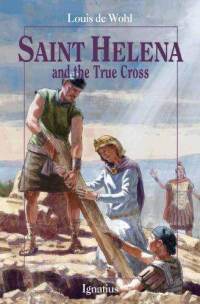
Book Review: Saint Helena and the True Cross

The daughter of a British petty king, the princess Helena is the lawful wife of the Roman governor, Constantius Chlorus. When Britain is treacherously taken over by a usurper, Helena is separated from her husband and forced to live in secret with her son, Constantine. When Constantius returns, however, it is with a new wife and a new title—Caesar of the western empire. Dejected, Helena finds comfort in the words of the Christian priest, Albanus. But Christianity is officially illegal under the persecuting emperor Diocletian, and Helena soon finds her new friends in grave danger. Summoning all her courage, Helena decides to confront her former husband and in doing so, possibly change the course of history forever.

For some time, I have had my eye out for a historical fiction treatment of the life of Constantine—preferably one that I could read with my kids. Though focusing on Constantine's saintly mother, Saint Helena and the True Cross fit the bill very well. I read it with my older kids and, as it turned out, everyone except the 15 month old listened in. The story was interesting and full of historical detail which allowed me to to diverge at certain points to give lessons about Roman and Christian history.

Re-released in 2012 by Ignatius Press, Saint Helena and the True Cross is not a new book. It was originally published in 1958 by Vision Books as part of their renowned series for younger readers. Written by Louis de Wohl, it contains all of the historical detail and narrative drive that one would expect from the author of such classics as Citadel of God and The Restless Flame. The book is an engaging retelling of the life of one of history's most amazing women, as well as a history lesson on the life of her famous son, Constantine the Great. Young readers and old will appreciate the epic sweep of the tale—from Britain, to Italy, to Jerusalem--all brought together via Louis de Wohl's masterful skill as a storyteller.

Helena herself is presented as an audacious, impetuous woman who was never to be denied when she had her mind set on something. And from what we know about her life, she must have been just that. De Wohl does take some liberties with the history concerning Helena's background, but this does not impact the story overmuch. Helena's search for the True Cross at the end of the novel is drawn almost entirely from sacred and historical tradition (particularly the account found in The Life of the Blessed Emperor Constantine by the Church historian, Eusebius Pamphilus) and makes for very compelling reading.

Though I thoroughly enjoyed Saint Helena and the True Cross and found it a fitting tribute to a great saint of the Church, I still think that Constantine deserves a sympathetic novel of his own--probably several. His life was simply epic. For more about Constantine's incredible life and career, feel free to check out my article from a recent issue of Catholic Men's Quarterly, Constantine: Military Hero and Christian Emperor, or the outstanding biography by Charles M. Odahl entitled Constantine and the Christian Empire.

Wednesday, August 15, 2012

August 15 - Feast of the Assumption of our Blessed Lady

"[T]he Apostles took up her body on a bier and placed it in a tomb; and they guarded it, expecting the Lord to come. And behold, again the Lord stood by them; and the holy body having been received, He commanded that it be taken in a cloud into paradise: where now, rejoined to the soul, [Mary] rejoices with the Lord's chosen ones."

~Saint Gregory of Tours, Eight Books of Miracles 1:4 [AD 575]

Saturday, August 11, 2012

The Sayings of Jesus, image 1


This is the first of what I hope will be a series of images on the sayings of Our Lord. There's so much garbage floating around the meme-o-sphere and so few images that celebrate the profound words and teachings of the Word incarnate. Let's rectify that if we can.

Sunday, August 05, 2012

Dr. Ray -- Live in Tarrytown!

I had the privilege of hearing Catholic psychologist Dr. Ray Guarendi give two presentations this weekend at the IHM Catholic Homeschool Conference in Tarrytown, New York. If you've never had the privilege of hearing Dr. Ray speak in person, it's a real treat. He's not a podium-bound lecturer--his talk is more like a stand-up comedy routine. He uses his humor to effectively convey sound parenting advice, in this case to an audience of about 150 Catholic homeschoolers.

Want a good laugh? Here's a link to a talk that Dr. Guarendi gave in 2009 at the Man-to-Man Catholic men's conference. It's a variation of the talk he gave at the conference I attended yesterday, but the salient points are all there. It's about an hour long but I promise, it won't seem that long at all.

Thursday, August 02, 2012


Presenting a new image with a quote from the proto-Church historian, Eusebius Pamphilus, bishop of Caesarea, about the miraculous vision of Constantine. Eusebius wrote this account approximately a year after the death of Constantine in AD 337, so it is likely that many people who witnessed the miracle (which would have taken place AD 312) were still alive at the time.

The statue featured in this image is located at York in the UK. Constantine was the only legitimate Roman emperor crowed in the British Isles.

The full Life of the Blessed Emperor Constantine was recently put back into print by Evolution Publishing and is a good read.

Sunday, July 01, 2012

More wisdom from the Venerable Archbishop Sheen

I loved this quote from the first moment I read it...which was about 12 hours ago.


Sheen on books

Click here to share on FaceBook.
The advancement of the cause of Archbishop Fulton Sheen has precipitated a flurry of articles about him and a well-deserved review of some of the great man's words and works. A few of his quotes which I haven't seen before have been circulating on Facebook, such as:
"If you do not live what you believe, you will end up believing what you live."
I also saw that in February 1953, Sheen said in one of his broadcasts of Life is Worth Living: "Stalin must one day meet his judgment." A few days later, Stalin suffered a massive stroke and was dead within a week.

After watching a video of one of his last homilies, given during the Easter Triduum in 1979, I felt the urge to make up a couple graphics featuring some Sheen quotes. This is the first one.
"Any book which inspires us to lead a better life is a good book."
This quote may be found originally in Sheen's Way to Happy Living (1955).

Thursday, June 14, 2012

Woman Pope elected by rebel Catholic group

Anti-pope Hannah Blima I
In a stunning development, a Facebook conclave of rogue Catholics has elected the first female anti-pope. When the white smoke rose from a pot-belly stove in Mount Holly, New Jersey, it was revealed that the electors had chosen a two-year old woman with red curly hair to be the next pseudo-pontiff. Reportedly assuming the regnal title of Hannah Blima I, the new anti-popess began her reign by throwing a tantrum, after which the Cardinal electors promptly sent her to bed without dessert.

Not questioning the legitimacy of Pope Benedict XVI, who is recognized as a valid Pope, the group called the move a challenge to Michael I, Pius XIII (deceased), Father Guido Sarducci and several other spurious claimants to the bishopric of Rome. "Anti-popes of late have been so lame," an unnamed spokesperson said. "As a result, we declared the seat of the anti-pope vacant and decided to elect our own."

The election was met with rapturous joy on the part of the cardinal electors who had suffered through numerous failed ballots before arriving at a result. "Neque porro quisquam est qui dolorem," declared an exhausted Iohannes Cardinal Rotondos, "Ipsum quia dolor sit amet, consectetur adipisci velit."

Hannah Blima's path to the anti-papacy was not an easy one. She had to overcome challenges from high-powered celebrity opponents such as Yoda, Christopher Robin, Carlo Santa Theresa, and a late surge by perennial omni-candidate, Ron Paul. While Santa Theresa declined his nomination and gallantly threw his support behind Hannah, the Paul camp was bitterly disappointed by the result. "If the media hadn't ignored our candidacy, we certainly would have won," Paul said bitterly in a press release following his defeat.

The election of Hannah Blima I was also greeted with wild enthusiasm by the the embattled Leadership Conference of Women Religious, currently under investigation by the Vatican. "Finally, a pope we can work with!" declared Sister Namaste Labyrinth. "This is a great day for all women, womyn, and wymyn who have been oppressed by the patriarchal intolerance of the gynophobic androcracy that has ruled since they banned Lilith from the Bible."

Rumors abound concerning the ethnic heritage of the pint-sized pontifess with some claiming that she will be under the thumb of a shaddowy figure known as "Yehudis". This has led to further rumors that Hannah Blima I might in fact be Jewish. Her father and press secretary, Claudio Salbatucci was quick to squelch such rumors. "Oy gevalt, I've got NO idea vhat you are talking about. Hannah is no more Jewish than Jackie Mason or Schmuly Boteach. Now if you'll excuse me, I've got a little schpilkas."

Despite all the controversy, Hannah Blima I looked calm as she appeared before the public for the first time. "I don't like lettuce," she replied cryptically in response to a reporter's question about the canonical status of the SSPX. Meanwhile detractors such as the clan McWilliams of Pennsauken grumbled quietly about a new schism after their demands for simoniacal appointments were rebuffed.

All present seemed to sense that while Hannah Blima I's reign as poppet will usher in a new age for the fake church, it will be an era acrimony, controversy, and cute little pink flip-flops.

Monday, June 11, 2012


I've been thinking about Blessed Teresa a lot lately. This image speaks for itself, I think.

Sunday, June 03, 2012

Our TV is Lousy and Now it Must Die! or, What the West Can Learn from South Korean Television

Three years ago, I knew nothing about Korea. Alright, maybe I knew that my father had served there after the Korean War where he got reprimanded for putting up bridge-ties for telephone poles. And I also knew a little about Kim Jong Il, the strange, troll-haired demi-god of communist North Korea. But I knew almost nothing about the history of the country itself.

Now, amazingly, I know much more about Korea and have developed a true appreciation and sympathy for that small country and its rich history. No, I did not take a course, nor did I become best friends with a Korean history professor. I have American television to thank for this unexpected educational epiphany.

Of course, I’m being a bit tongue-in-cheek here. I’m guessing that most who read this column will readily agree that American TV is a vast intellectual and moral wasteland, fit for neither man nor beast. When it’s not assaulting you with endlessly regurgitated double entendres, or using action dramas as a vehicle to preach an obnoxious political message, it’s attempting to yank at your heartstrings with some syrupy human-interest story using real people as props to enhance the brand profile of some soulless mega-corporation. And that’s just the commercial networks. PBS is little more than a self-referential lobbying outfit whose programming seems wholly geared toward convincing people that everything on the planet will perish if we don’t give national and international governing bodies more power.

Before we go on, I have a confession to make. I grew up a TV addict in the 1970s and 80s. My TV viewing only took a hit after the birth of my first child in 2002 when I belatedly figured out that it probably wasn’t the best idea to expose such an innocent soul to the endless stream of sex jokes that makes up the standard prime-time fare. Now, we watch hardly any TV at all in our house. We do still watch sporting events, but even then, I sit there wielding the remote in the attack position, lest I find myself fending off questions like, “Dad, what is Cialis and why are those two old people sitting in bathtubs outside?”

But the point of this essay is less to lament the pathetic state of American entertainment than to laud something that is produced in east Asia that’s not made of cheap plastic—historical dramas from South Korea. When I first stumbled across one of these dramas on a small, independent US TV network (sandwiched awkwardly in between the Greek Hour and a talking-head program featuring very manly-looking women), I figured it was nothing more than a rehash of the corn-ball kung-fu theater of my youth. However, the endorsement of a friend made me curious and sure enough, after watching two episodes of a drama called Dae Joyoung, I was hooked. Soon after, my wife was hooked as well.

http://commons.wikimedia.org/wiki/File:Korea-Seoul-War_Memorial_2611-06_Turtle_Ship_Dragon_Head.jpg
Prow of a Korean turtle ship.
Hard as it may be to believe, costume historical drama is popular in Korea. They run in series of 30+ episodes. The most successful ones, such as The Immortal Yi Soon Shin about Korea’s legendary 16th century admiral and his turtle ships, can run over 120 episodes. Though they are called “dramas”, I’m not talking about soap operas. These programs are written and produced to appeal to both men and women, and as such, there is always an element of romance. But this is nothing like the cheesy Hollyweird “romance” we have come to expect in most Western entertainment which is generally a half-step from pornography. Modesty is assumed. Courtesy is mandatory, even between mortal enemies. Old-fashioned courtly romance is the order of the day.

Did I mention the fighting? One thing I discovered from watching these series is that Korean history is a bit like Irish history: that of a small, independent-minded nation forever struggling under the thumb of a nearby hegemon. Because of this, I suppose, their historical dramas tend to emphasize the heroic—the weak versus the strong, battles against impossible odds, civil war, political intrigue, foreign meddling, betrayal, and self-sacrifice. The heroes are portrayed as virtuous, complex, witty, intelligent, and noble. They are also usually brilliant fighters and martial arts play a prominent role. But before you roll your eyes, remember that production values in the East have come a long way from the “Your karate is good but now you must die!” schlock of the 1970s. The action sequences are beautifully choreographed and shot using magnificent sets, costume, lighting and sound.

What’s more, nearly every series has at least one classic buffoon in it to provide comic relief.

In general, the writing is tremendous. The storylines are original, unpredictable, and endlessly fascinating. The characters are somewhat archetypal, but they are entertaining and endearing archetypes that translate well for Western audiences. The acting seems superb, though the fact that I don’t speak Korean might give the actors a bit more gravitas than they actually have.

Of course, in order to enjoy one of these dramas, you’ll have to put up with a few things:

1. Subtitles. Most of the time, the subtitles are unobtrusive and well done. Occasionally you run into a series where it seems the translation was done by the same guy who wrote the owner’s manual for your 1985 Hyundai Excel.

2. Eunuchs and Concubines and Courtesans. Yes, Eastern civilization approved of some practices that were traditionally frowned upon in the West before our public morals got sucked into the sewer. All three of these character types appear with regularity in Korean historical dramas because all three played prominent roles in Korean history. Despite this, the overall moral tone of the dramas is very high in the best Confucian sense, emphasizing filial piety, generosity, loyalty to country, clan, or patron, benevolence in leadership, and equality of opportunity for all regardless of social class.

3. Goofy Korean pop music. The love ballads with vocals that most of these dramas feature are occasionally bearable, occasionally silly. However, the instrumental incidental music is almost always outstanding. In the best cases, it is a beautifully balanced mix of Eastern and Western music that will stick with you for a long time. If you want to get an idea of the quality of the instrumental music, have a listen at my Korean Drama playlist on YouTube.

4. Internet TV. In terms of quality and ease of access, Internet TV has come a long way—maybe too long as there are now commercials embedded into these videos on most free services. That said, there are still the occasional hiccups having to do with network availabilty and odd copyright issues. If you make the mistake of starting a series on a site that has pirated the videos, don’t be surprised if the series gets yanked when you’re halfway through.

Saint Andrew Kim Taegon,
the first Korean Catholic
priest. He was martyred in
1846 at the age of 25.
5. No reference to Christianity. The spirituality in the shows is generally Confucian with a sprinkling of Buddhism. While religion doesn’t normally play a huge role, the dramas we have watched so far have been respectful to spirituality—those characters who despise “the mandate of Heaven” are always portrayed as evil. Only one drama dealt with Catholicism at all—Yi San, which was set in the late 18th century. Catholicism was outlawed at the time, but the benevolent king Jeongjo (the main character) was kind to the Korean Catholics whom he admired for their work with the poor. The main antagonist in the show, queen dowager Jeongsun, would go down in history as the one responsible for the “Beheading Mountain” Martyrs and the Korean Catholic Persecution of 1801—an event I knew nothing about until I watched this series.

A little curious maybe? Well, if you want to give one of these dramas a shot, I recommend Gye Baek to start with. It’s a shorter one—only 30 episodes—so it’s not a major investment of time if you get drawn in. Gye Baek and several other of these dramas may be found for free (with commercials) on www.crunchyroll.com, a website which specializes in TV series from east Asia.
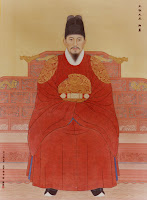
http://commons.wikimedia.org/wiki/File:Jeongjo_of_Joseon.jpg
Official portrait of King
Jeongjo of Joseon. The drama
Yi San is based on his
childhood and rise to the throne.
Having watched several of these dramas from beginning to end, I can’t help but wonder what American culture would be like today if our entertainment industry produced similar epic work about Christian historical heroes. Imagine if there were unapologetic Catholics in Hollywood who made programs which celebrated the traditional Christian virtues without the miserable post-modern angst and moral vacuity that plagues most secular entertainment. Imagine if our kids grew up watching fascinating historical dramas about Constantine or Charles Martel or Saint Louis IX instead of tawdry sit-coms or cartoons laden with secular propaganda. How different things might be if historical men of courage and faith were our children’s heroes rather than effeminate minstrels and thuggish ball-players.

At the very least, our kids would know where they came from and would have a better appreciation for the glorious patrimony which has been handed down to them. And it might actually begin to trouble them when they see their leaders and peers squandering that patrimony so frivolously.

This article appears in the June 2012 issue of Catholic Men's Quarterly.

Wednesday, May 30, 2012

Book Review: Catholic Philosopher Chick

Cate Frank is a young woman in her early 20s. She's into fashion, makeup, guys and Thomas Aquinas. Wait, what? Yes, you heard right. Cate can talk Louis Vuitton or the Summa Theologica with equal facility. She's a convert to the Catholic faith from eastcoast secularism, having lived life in the fast lane in Manhattan for a few years after college. But now Cate has moved on to a higher calling and is pursuing a graduate degree in philosophy--scholastic philosophy--at Franciscan...I mean, Dominican University of Houston. There, she will plumb the challenging depths of Thomistic thought, particularly with regard to the Dumb Ox's view of women, while at the same time navigating the equally dangerous shoals of campus relationships.

Allow me to say up-front that on the surface, this is not my kind of book. I like action. I like apocalyptic wars between good and evil. I like battle-axes and chain-mail, M-1 carbines and P-40 Warhawks, lost causes and martyrdoms. My kind of books have titles like Angels in Iron or Crown of the World or Citadel of God. That said, I found myself enjoying Catholic Philosopher Chick quite a bit more than I thought I would. The writing is very crisp and bouncy. The story has a nice flow to it that kept me engaged, aided by the amiable first-person narration of the main character. Cate comes across as very likeable and real, despite her penchant for dropping fashion brandnames faster than plaid shirts in the clearance aisle at Walmart. One sympathizes with her various trials which, I imagine, will resonate most strongly with young women who are clearly the primary audience for this book.

What I appreciated most about Catholic Philosopher Chick, however, was the genuine effort on the part of the authors (newcomer Rebecca Bratten Weiss and Regina Doman of Angel in the Waters and the Catholic Fairy Tale Novels fame) to adapt for a Catholic audience the contemporary style of writing popular in secular mass-market adult fiction. They did this successfully without succumbing to the trashier aspects of the genre and what's more, managed to seamlessly work in a discussion of Thomistic philosophy which, I imagine, will be alien to a vast majority of those who read this book. That's all to the good, if you ask me. In the end, the authors have created an amusing, fun and very upbeat little book sure to appeal to their audience of young women ages 16 and over.

Finally, though we're told that one should never judge a book by its cover, I thought the cover art for Catholic Philosopher Chick was unique, engaging and a perfect complement to the text.Well done!

Wednesday, May 09, 2012

My feelings on the 2012 presidential race in a nutshell. I'm not going to vote for either Romney or Obama. For the first time in my life, I'll be pulling the lever for a third party candidate for president. The question is, which one?

Saturday, April 07, 2012

Happy Easter 2012

A day early...
The artwork is taken from one of the tapestries in the Vatican Museum.