Thursday, August 18, 2022
The Four Things I Posted that Got Me Sent to the Digital Gulag
Saturday, August 13, 2022
The Destruction of Fort Drum, the Famous Concrete Battleship of Manila Bay
![]() |
| Broadside view of Fort Drum guarding Manila Bay during the interwar years. |
The United States is credited with building a battleship that, to this day, is certified as completely unsinkable. It sported four 14-inch naval rifles in two turrets with impressive arcs of fire, along with a variety of smaller guns in casemates along the sides.
Though completely unsinkable, this battleship had one major drawback — it could not move. In fact, it was fixed in place in Manila Bay in the Philippines.
It was also made of concrete.
The name of this battleship was not New Jersey, or Missouri, or North Carolina.
It was Fort Drum.
If you visit the Philippines today, you will find the burnt-out hulk of the unsinkable concrete battleship silently rusting away in Manila Bay.
Fort Drum was originally the island of El Fraile, one of the smallest islands of the Philippine archipelago. Meaning “The Friar” in Spanish, the island’s peaceful moniker would become ironic when the Spanish added gun emplacements prior to the Spanish-American War. Though these weapons proved ineffective at stopping Admiral Dewey's squadron from penetrating Manila Bay on May 1 of 1898 to engage the Spanish fleet, the Americans did not forget the strategic placement of El Fraile once they had taken the Philippine archipelago for themselves.
Beginning in 1909, the US flattened the craggy heights of El Fraile and completely reconstructed the small island using steel and concrete. They reshaped the island completely until it resembled the oblong shape of a ship’s hull. At 350 feet wide and 144 feet at the beam, Fort Drum had the rough dimensions of a battleship of the time. The addition of two main gun turrets, casemated secondary armament and a lattice-work mast and spotting top completed the illusion.
![]() |
| Bow view of Fort Drum's cage-style mast and "B" turret, compared with that of its rough contemporary, the battleship USS Delaware. |
When the Japanese invaded the Philippines in late 1941, Fort Drum proved a thorn in the invaders' side, firing effectively on troop transports attempting to land on Corregidor. When defeat became inevitable, Fort Drum was the last American outpost in the Philippines to surrender. Before departing, however, the Americans spiked the fort's main guns, leaving them inoperable.
The situation was turned on its head in April of 1945 when Fort Drum became one of the last outposts held by the Japanese in Manila Bay. But much like their fanatical late-war defense of such island fortresses as Iwo Jima and Okinawa, the Japanese defenders of Fort Drum refused to surrender. What happened next forms one of the most memorable vignettes from Phillip Campbell's new text for young readers, The Story of the Philippines: God's Rampart in Asia:
While American soldiers were already overrunning Manila, the concrete fortress of Fort Drum defied all U.S. attempts at taking it. U.S. army Lieutenant Miles Schafer and Captain Benny Biancho of the 38th Infantry Regiment scratched their heads.
“It’s like a concrete battleship,” said Lieutenant Schafer.
“Correction, it is a concrete battleship—with four massive 14-inch guns in two turrets,” responded Captain Biancho.
Click here for more info. “Poor fellas don’t realize the battle is already lost for them,” said
Schafer, shaking his head. “If only they’d just surrender.”
Rata-tat. Rata-tata!
Machine-gun fire erupted from Fort Drum. Schafer and Biancho took cover. The bullets sailed harmlessly overhead and plinked into the water.
“The Japs won’t surrender. For them, it’s a matter of honor. They would rather die,” said Biancho. “We’re going to have to force them out somehow. It’s gonna be tough because that entire island is one concrete block.
“We’ve come up with a solution for that,” chimed in a third man. It was Major General William Chase, commander of the 38th Infantry Division. Schafer and Biancho stood at attention. “At ease men,” said the Major General. “The top brass has a plan for breaking the Japs out of Fort Drum. We tried it at Fort Hughes back in March and it worked like a charm. It’s a doozey, but it sure does the trick.”
“We’re all ears, sir,” said Biancho.
Rata-tata! Another volley of machine-gun fire exploded from Fort Drum. The three men huddled and listened to General Chase’s plan, struggling to hear over the mortar rounds that also flew out of the embattled fort.
The next day everything was in position to carry out the plan. A landing ship medium—a type of troop transport ship used for amphibious landings—moved into position near Fort Drum. It had been modified with a large bridge structure. On board were Captain Biancho, Lieutenant Schafer, and a hundred men of the 38th. When the ship got close enough, Biancho called out, “Lower bridge!”
“Lower bridge!” Schafer echoed. A team of men scrambled into action, working pulleys and cranks to lower the bridge. It landed on the concrete deck of Fort Drum with a heavy thud. Another team of several dozen men stormed across the bridge and on to the deck. The huge 14-inch cannons of Fort Drum had been spiked and rendered useless by the Americans when they surrendered in 1942, but the men were wary of a suicidal ambush by the Japanese defenders using small arms and grenades. However, the Japanese had retreated into the assumed security of the fort’s lower decks, waiting to attack the Americans when they attempted to enter.
“The deck is secure, sir!” called Lieutenant Schafer.
“Excellent!” cried Biancho from the landing ship. Then, turning to his crew: “Fuel team, move!” Another team of soldiers came running from the ship to the bridge, dragging a large, long hose. The hose was connected to a tank on board the landing ship that was filled with 2,500 gallons of diesel fuel mixed with gasoline.
“Find the air vents!” ordered Schafer. The first team had already located the air vents, the small two square-foot openings atop the deck that provided access to the interior of the fort. The soldiers broke the vent coverings off the opening while the fuel team shoved the hose into the duct. The hose being in place, the team leader gave a thumbs up. Schafer saw the thumbs up and gave a thumbs up to Biancho. Biancho nodded, and turning to one of his officers on the Landing Ship, gave him the signal to turn on the pump. The man cranked a large wheel, opening the valves of the tank and sending gallons of the diesel fuel through the hose.
The hose began belching out hundreds of gallons of fuel down into the darkness of the ventilation duct. Within a few moments the fuel team could hear the panicked cries of the Japanese soldiers within echoing up the duct. They must have realized what was about to happen when they saw their command station being flooded with fuel. The U.S. soldiers did not waver though—they stood stoically atop the deck, holding the hose firm until all 2,500 gallons had been evacuated into the vent.
“Clear deck!” shouted Lieutenant Schafer. In an instant, all the soldiers upon the deck of Fort Drum retreated back across the bridge onto the landing ship. Lieutenant Schafer was the last man to leave the deck. In his hands he dragged a massive wooden spool threaded with copper wire. As he retreated, he unwound the spool. The wire was connected to a timed detonator that had been lowered down the ventilation shaft. He hopped back into the landing ship.
“How much wire do you have left?” said Biancho.
“I’d say 400 yards,” replied Schafer. Captain Biancho nodded. “Move us out about 400 yards!” he called to the ship pilot. When the ship had moved off 400 yards, the spool was almost completely unwound. A pair of soldiers took the wire from the spool and fused it into a detonator, a metallic black box with an ominous red button. It only took a moment to splice the wire into the detonator.Schafer handed Captain Biancho the box. “Care to do the honors?” he said to the captain.
Biancho took the box. “Here’s a present from Uncle Sam!” he yelled towards Fort Drum. Then he pressed the red button with his thumb.
Fort Drum rumbled and exploded in a blast of destruction that shocked even Biancho and Schafer. The concrete deck of the fortress fragmented into thousands of pieces and was flung hundreds of feet into the air by the force of the explosion. Smoke and flame engulfed the entire concrete island.
“Cover!” shouted Schafer. The men on the landing ship covered their heads. Moments later a shower of dirt and pebbles rained down upon them. Fortunately, the heavier pieces of concrete had not fallen so far out, or the landing ship could have been severely damaged.
The men uncovered their heads and looked at the hell they had made of Fort Drum: wreathed in flame, smoke pouring from every opening, the 14-inch gun turrets charred and useless, metal glowing orange, crumbling pieces of concrete deck falling into the orange inferno that had once been the command station.
Captain Biancho grinned. “Schafer, send a message to Major General Chase. Tell him Fort Drum has fallen. Manila is ours.”
* * *
The destruction of Fort Drum was total. Every single one of the sixty-eight Japanese soldiers inside was killed, obliterated in the explosion.
The capture of Fort Drum marked the end of major U.S. operations in Manila, although the city was not completely cleared of Japanese troops until early March. The invasion of Luzon was the largest American operation in the Pacific War, involving more U.S. troops than had fought in North Africa, France, or Italy.
If you enjoyed this vignette, check out Phillip Campbell's The Story of the Philippines: God's Rampart in Asia. While the book is an outstanding introduction for young readers (ages 12-18) to the history of the Philippine archipelago from earliest times right up through the the 2020s, even an old guy like me learned a tremendous amount reading it!
Sunday, June 19, 2022
Speaking Boldly of the Past ~ Phillip Campbell's Power from On High: Theocratic Kingship from Constantine to the Reformation
As an aficionado of Phillip Campbell’s books for younger readers (The Story of Civilization, The Story of the Philippines, etc.), I am used to his more informal, witty, slightly chatty style, interspersed with sometimes comical vignettes. Power from On High: Theocratic Kingship from Constantine to the Reformation is a very different type of book. It is a more scholarly tome exploring the evolution of the role of Christian monarch from its inception during the later Roman Empire through a millennium of the Middle Ages until the retirement of Emperor Charles V in AD 1556.
Given the renewed interest in Christian monarchy among some in traditional Catholic circles, this is a timely study. Reading Power from On High reminded me somewhat of Machiavelli's Discourses on Livy in that it is an attempt by a contemporary scholar to ponder antique forms of government. Of course, Machiavelli was attempting to inform and influence the political thought of his own day with examples from antiquity. Though Campbell is attempting nothing so overt with this work, it is interesting to note that he begins his preface with an example of how modern politicians utilize propaganda to project an image of themselves for public consumption. Just so, Campbell argues, did the Christian kings of the Medieval period advertise their allegiance to the Catholic Church as a means of legitimizing their rule.
![]() |
| Click here for more info. |
Of course, the piece of this book that I found the most fascinating was the first third or so which dealt with the emergence of Christian kingship. This section begins with pre-Christian concepts of kingship and how these merged with and mutated Greco-Roman democratic and republican ideals, culminating with the emergence of the Roman dominate monarchy of Diocletian and Constantine. Campbell doesn't quite get down to the granular level of Elizabeth Digeser in her outstanding work, The Making of a Christian Empire: Lactantius and Rome. What this section does do very effectively is set the stage for the core of the book which covers Medieval kingship.
I particularly enjoyed the segment on parrhesia which, I am embarrassed to say, is a term had not encountered before. Derived from ancient Greek, parrhesia refers to "freedom of speech," or more precisely, the ability to speak the truth to power boldly. The word is used to describe how Jesus spoke to the Pharisees as well as how Peter and John would later address the council of princes, priests and scribes in Jerusalem in Acts of the Apostles. Campbell provides several noteworthy examples of parrhesia among Christian religious leaders who had the audacity to confront and even rebuke Christian political figures. Saint Athanasisus is shown confronting Constantine the Great regarding false accusations made against him in a way that would have been unthinkable for any common citizen. Examples of of Saint Ambrose doing the same with Theodosius I are also offered.
The only passage in this section that could have used a bit more elucidation was an anecdote in which the same Saint Ambrose boldly confronted the usurper, Eugenius, in a letter explaining why the former had failed to meet the latter in Milan. In this circumstance, it was most likely not a Christian bishop reproving a Christian emperor. Eugenius had taken the throne through the machinations of the Frankish general, Arbogast, and it was widely believed that Arbogast had arranged the murder of the rightful Western emperor, Valentinian II. Worse, Eugenius was viewed as potentially being a second Julian the Apostate, having removed the Christian courtiers of Valentinian II and replaced them with pagans, and restored the pagan Altar of Victory to the Senate House in Rome. Christian historians of the era considered Eugenius a lukewarm Christian at best, a "sacrilegious man" at worst. Ambrose's letter of rebuke was probably meant for public consumption as a stroke against Eugenius to weaken the resolve of his Christian Roman followers. The great saint likely had little hope that Eugenius would have his very unchristian behavior curbed by bold remonstrance. Indeed, Eugenius's ally, Arbogast, is said to have quipped upon leaving Milan that when he and Eugenius returned victorious, they would make a stable in the basilica of the church of Milan and would review the clergy under arms. Fortunately for Ambrose and the Christian Empire, Eugenius and Arbogast were defeated by Theodosius at the Battle of the Frigidus River.
Returning to Power from On High, the majority of the book covers in some detail the Medieval ideal of kingship and the frequent squabbles between kings and princes on one side, and popes and bishops on the other, to define the boundaries between ecclesiastical and temporal authority. Campbell's discussions of the ebb and flow of this battle over the course of centuries—from Charlemagne the Great, the archetypal Christian Emperor crowned by the Pope in Rome, to Otto the Great who deposed two popes and imposed one of his own. Though my knowledge of the history of this era is pretty shallow, I enjoyed learning about the various conflicts and how they impacted political and religious events downstream from them.
The centerpiece of the book is the chapter on the Investiture Controversy. For me, the Investiture Controversy was one of those items in a history textbook that I knew were important, but for what reason, I could not say. This chapter helped put the controversy into sharper focus. I had not appreciated that medieval Christian kingship was often thought of as a type of priesthood by virtue of the anointing that the king commonly received upon taking the throne. This priesthood, at least at first, was thought to encompass only the priest's function as preacher. Later, this sacred function would extend to the Christian monarch's supposed prerogative to create bishops in his own realm. It was over this function that the Investiture Controversy would be fought. Campbell does a nice job putting the controversy into its historical context, explaining why investiture was such a furiously contentious issue, especially in Germany, during the high Middle Ages.
For those who are troubled by how the Church functions in our own time and who are at a loss to understand how and why certain men get appointed bishop and others who are seemingly more worthy are neglected, this look at history is enlightening. It gives modern readers a sense of what the modern Church has lost since the abolition of Christian monarchs in the early 20th century. With a secular state that is often hostile to Christianity ruling all formerly Christian nations, the Church is always forced into a defensive posture. We end up in a situation like Saint Ambrose as he rebuked the semi-pagan Eugenius, striving to jog his nominally Christian conscience with little hope of success. But, sadly, very few of our modern bishops have the divinely-inspired courage of Ambrose.
To conclude, if you are a modern Catholic who is curious about how Christian kings once interacted with the Church, you should read Phillip Campbell's Power from On High. If you are a curious reader looking for insight into intractable modern political dilemmas, you should read this book. If you are an informed general reader seeking to learn about the political history of the Christian West, you should read this book. And finally, if you are a traditional Catholic who yearns for the re-establishment of Christian monarchies, you should read this book.
Saturday, June 11, 2022
Telling the Story of the Philippines ~ Eastern History for the Catholic Student
A unique new book is about to release this month: Phillip Campbell's Story of the Philippines: God's Rampart in Asia.
If you are a Catholic homeschooling family like we are, you probably know Mr. Campbell's work quite well. Beyond his numerous student-friendly classes at Homeschool Connections, he is also the author of the very popular Story of Civilization series published by TAN. If you are not familiar with these excellent books and their associated resources, and you have kids ages 8-18, check them out. Our kids have read and re-read the books, and the audio books have accompanied us on many a long car ride.
In The Story of the Philippines, Campbell once again employs the formula he used so effectively in The Story of Civilization, combining straight-up history with clever and often amusing vignettes. The vignettes help bring the history to life, allowing the reader to witness events through the eyes of those who experienced them, whether Butuanese ambassadors to the court of Song Dynasty China, merchants from the kingdom of Tondo attacked by Japanese pirates, or Moro rebels deciding whether or not to make peace with the Spaniards. We even get a glimpse of the Battle of Manila Bay through the eyes of our old friend, John B. Tisdale.
In one of my favorite vignettes from the book, we meet one of the first native Filipino saints, Pedro Calungsod, and Blessed Father San Vitores who were missionaries among the Chomorro people of Guam in the 1660s. With permission from the publisher, I offer this vignette below to give you a sense of how good this book is. Enjoy!
Taken from: The Story of the Philippines: God's Rampart in Asia, by Phillip Campbell, Chapter 15:
The lay catechist Pedro Calungsod and the Jesuit Father Diego Luis de San Vitores were walking up the road from the village of Tumon. After baptizing Mata’pang’s daughter, the two men had spent a good part of the day speaking with the Chamorro villagers and teaching the boys of the village to use the Rosary. The prayer beads of the missionaries were particularly popular among the Chamorro. The two exhausted men trudged up the dusty road wearily. They were looking forward to returning to their mission, but Pedro was a bit worried.“Those medicine men did not look very happy to see us,” said Pedro. “Do you suppose they will give us any trouble when Mata’pang returns?”“It’s hard to say,” said Father San Vitores. “I know they are threatened by us, but I don’t think they mean us any harm. So far the people here have given us a warm welcome.”“True, but have you heard the rumors this Choco fellow is spreading?” said Pedro with a look of concern.Father San Vitores nodded. “I have indeed. He is trying to make the people doubt the sacraments. Make them afraid of us.”Some distance behind the men, towards the village, there was a great rustling noise.“What is that sound, Father?” said Pedro, turning back. He squinted, looking back down the road towards the village, sheltering his eyes from the setting sun with his hand. “It sounds like a celebration.”“Not a celebration, my son,” said Father San Vitores. “It’s an angry mob.”Indeed, moments later a mob of Chamorro from the village came running up the road and overtook the two men. At their head was Mata’pang, their powerful chieftain. He was shirtless, as most of the Chamorro went about. His face was red, the veins on the side of his head bulging. In his hand he clutched several spears. Several macanjas flanked Mata’pang, shouting with their faces contorted in anger.“This looks bad, Father!” exclaimed Pedro.“Stand steadfast, Pedro,” said Father San Vitores. “The peace of Christ will strengthen us.”“You, priest!” Mata’pang shouted as he approached the men. Father San Vitores stepped forward calmly to try to reason with Mata’pang. He held out a large crucifix in a gesture of blessing. “Mata’pang, peace be with you. Tell me, why have you—” but Mata’pang was in no mood to talk. As soon as he was close enough, he lifted one of the spears and hurled it at the priest. Father San Vitores ducked quickly and the spear passed over him. Mata’pang then threw one at Pedro. A young, athletic man, Pedro was easily able to dodge the cast.
St. Pedro Calungsod and
Bl. Diego Luis de San Vitores
from The Story of the Philippines“Run, Pedro!” called out Father San Vitores.“I will not abandon you, father!” Pedro yelled, stepping forward to protect the priest. At that moment Mata’pang cast another spear. This one struck Pedro squarely in the chest. He fell to the ground, clutching his bleeding breast with the spear still protruding. “Christ, save me!” he called out as he tumbled into the dust.Immediately one of the Chamorro who was with Mata’pang fell upon Pedro and struck his head with a machete, splitting his skull. Pedro groaned. “My son!” Father San Vitores called out. The priest knelt beside Pedro and absolved him quickly before the young man’s eyes rolled up into his head. “May Christ receive your soul!” he murmured, holding the crucifix before the eyes of his dying companion.Almost as soon as he did, the priest felt a searing pain in his gut. He looked down and saw a bloody spearhead protruding from his belly. Did that come out of me? He thought to himself in shock. He reached around behind himself. His fingers touched the solid wooden shaft protruding from his back. The blood ran down the tip of the spearhead and dripped into the dust. Lord, into thy hands I commend my spirit, he prayed silently before collapsing.
Mata’pang and his men stripped the bodies of the two men, tied heavy stones to their feet, and sank them in the ocean. Then Mata’pang took the crucifix of Father San Vitores and smashed it with a rock while blaspheming God. Pedro Calungsod and Father Diego Luis de San Vitores would both be revered as martyrs. Pedro was canonized in 2012 by Pope Benedict XVI and is now honored as a saint. His feast day is April 2. Father San Vitores was beatified in 1985 by John Paul II.
![]() |
| Click here for more info. |
Thursday, May 05, 2022
Pope Francis on Abortion ~ "Abortion is not a lesser evil. It is a crime, it is absolutely evil."
![]() |
| Pope Francis pulls no punches on the subject of abortion. |
It can not be denied that the Catholic and secular left love Pope Francis more than any other pope in recent history. For those currently having meltdowns over the possibility that one of the most egregiously awful Supreme Court rulings in American history (Roe v. Wade) may soon be overturned (God willing!), it is perhaps well to reflect on what the Holy Father has had to say about the topic of abortion over the years.
Though it is perhaps not a topic he relishes teaching about, on those occasions when Pope Francis has spoken out against abortion, he does not mince words. Not at all.
Here is a list of his statements against abortion from the beginning of his papacy through very recent days:
- “Abortion compounds the grief of many women who now carry with them deep physical and spiritual wounds after succumbing to the pressures of a secular culture which devalues God’s gift of sexuality and the right to life of the unborn.” April 26, 2014
- “Abortion is not a “lesser evil”. It is a crime. It is wiping out one to save another. That is what the mafia does. It is a crime, it is absolutely evil.” February 17, 2016
- “Before, it was a sin, you couldn’t kill little children, but today you can, it’s not seen as a big deal. It is a perverse new state of affairs.” November 22, 2017
- “Abortion is never the answer. Human life is sacred and inviolable and the use of prenatal diagnosis for selective purposes must be strongly discouraged, because it is the expression of an inhuman eugenic mentality, which deprives families of the possibility of welcoming, embracing and loving their weakest children.” May 25, 2019
- "The second problem, that of abortion: it's more than a problem, it's homicide, whoever has an abortion, kills. No mincing words. Take any book on embryology for medical students. The third week after conception, all the organs are already there, even the DNA... it is a human life, this human life must be respected, this principle is so clear! To those who cannot understand, I would ask this question: Is it right to kill a human life to solve a problem? Is it right to hire a hitman to kill a human life? Scientifically, it is a human life. Is it right to take it out to solve a problem? That is why the Church is so harsh on this issue, because if it accepts this, it is as if it accepts daily murder. A Head of State told me that the demographic decline began because in those years there was such a strong law on abortion that six million abortions were performed and this left a decline in births in the society of that country.” September 15, 2021
- “There is the discarding of children that we do not want to welcome with the law of abortion that sends them to the dispatcher and kills them directly. And today this has become a ‘normal’ method, a practice that is very ugly. It is really murder. Is it right to eliminate, to take a human life to solve a problem? Is it right to hire a hitman to solve a problem? That’s what abortion is.” September 27, 2021
Friday, April 08, 2022
The Church Fathers Were Trads
![]() |
| Engraving of Pope Saint Damasus I by Nicolas San Giorgio, AD 1877. |
When reading the Ecclesiastical History of Hermias Sozomen—a work written immediately before the Council of Chalcedon when the universal Church was roiled by a variety of heresies—one picks up the venerable author’s animus for innovation. Indeed, Book IV, Chapter 27 begins with the following passage:
When the spirit of innovation becomes regarded with popular favor, it is scarcely possible to arrest its progress. Inflated as it always is with arrogance, it contemns the institutions of the Fathers, and enacts laws of its own. It even despises the theological doctrines of antiquity, and seeks out zealously a new form of religion of its own devising.
The context of this quote is the turmoil which nearly overwhelmed the Church during the reign of the Arian emperor Constantius II, who gave a free hand to those bishops who had embraced the novelties of Arius to oppress those who supported the decisions of the Council of Nicaea of AD 325.
A quick text search of the rest of Sozomen’s history reveals similar admonitions against novelty and innovation, including a letter from the Church Council convened at Ariminum (Rimini) in Italy in AD 359, during which the bishops of the West petitioned Constantius uphold the Nicene creed and not to allow novel doctrines:
We therefore entreat your Clemency to listen to our deputies and to regard them favorably and not to allow the dead to be dishonored by the introduction of alterations and novelties. We pray you to preserve the tradition which we received from our ancestors, who were all wise and prudent and who, we have reason to believe, were led by the Spirit of God. For these innovations not only lead believers to infidelity, but also delude unbelievers…. Again, we beseech you that nothing be taken away from or added to the faith. Let it remain unchanged even as it has continued from the reign of your father to the present time, so that we may not in the future be compelled to leave our churches and undertake long journeys, but that the bishop and people may dwell together in peace… [Book IV, Chapter XVIII]
Click for more info.
Constantius would not heed this request, however, and would attempt to force the bishops to reject the Nicene formulary of the Faith, even deposing a pope in the process.
Later, Sozomen quotes a letter from Pope St. Damasus to the bishops of Illyria (see the image at the beginning of this post) which says much the same thing:
Those who devise strange doctrines ought not to be followed, but the opinions of our fathers ought to be retained, whatever may be the diversity of opinion around us. [Book VI, Chapter XXIV]
Interestingly, appeal to tradition was such a powerful rhetorical weapon in the ancient Church that prelates who would later be condemned as heretics attempted to wield it. In an account of the Council of Antioch of AD 342, Sozomen recounts how the assembled bishops—including the Arian Eusebius of Nicomedia who was now Bishop of Constantinople—after deposing Saint Athanasius, went on to affirm that “they received the faith which had, from the beginning, been handed down by tradition.” [Book III, Chapter 5]
Given the above, it may be pointed out that this spirit of suppressing novelty and holding fast to tradition has been effectively turned on its head by our bishops over the past century. Sadly, those men who are called specifically to preserve the venerable teachings of the Church oftentimes seem almost manic in their rush to discard them. In place of the holy and eternal doctrines that the Church has always taught, they propose doctrinal and pastoral innovations that look, sound and feel eerily similar to the ephemeral doctrines and practices of the princes of this world.
It is also worth contemplating whether this voluptuous embrace of novelty has caused the Church founded by Jesus Christ to be built up over the past several decades, or to collapse into heap of rubble. In the West, at least, the answer is set starkly before our eyes.
![]() |
| Ruins of St. Bonaventure Catholic Church, Philadelphia, PA. Built in 1906, demolished in 2013 after lying abandoned for 20 years. Photo from Hidden City. |
Wednesday, March 30, 2022
“Follow Your Heart” is awful advice ~ The dangers of Disney wisdom in a Post-Christian age
But just as these cartoons are considered hopelessly quaint and old-fashioned today, so are the notions of morality which undergird them. Consider that we have now moved from the youthful innocence of Disney in the mid-20th century which produced such family-friendly fare as Lady and the Tramp and The Jungle Book, to a situation where Disney executives are openly demanding the promotion of deviant sexual practices to children and banning so-called gendered greetings at their parks like “ladies and gentlemen, boys and girls” because they are considered not inclusive.
Disney is a microcosm of how Americans at large have lost or killed their consciences—their ability to discern right from wrong or even admit that right and wrong exist. The Disney of the 1940s could safely encourage viewers to “follow their hearts” because the vast majority of people had reasonably well-formed consciences. That’s why Archbishop Fulton Sheen could have a top-rated TV show in the 1950s, and it is also why so many Americans in the early 1960s could respond with outrage when their Black brothers and sisters continued to be treated unjustly as second-class citizens.
But in a nation with no ability to discern right from wrong, with no understanding of how morality works, where acting in selfish ways is celebrated and even considered virtuous, the hollow advice to “follow your heart” suddenly becomes dangerous. It becomes a bomb within our families which threatens to destroy not only the individual but everyone around him, creating a blast radius that harms all of society.
A few sages of that earlier era knew even then that something was terribly wrong in America and the West. Venerable Pope Pius XII called out and condemned the relativistic new morality that was emerging at that time known as “situation ethics.” Venerable Fulton J. Sheen himself was aware of the very same trends. As early as 1936, he recognized that there was a nasty undercurrent actively eroding the moral pylons which supported Western civilization. Many of his modern contemporaries, he felt, were willfully deadening their consciences. He wrote:
“Would to God that our modern mind instead of denying guilt, would look to the Cross, admit its guilt, and seek forgiveness; would that those who have uneasy consciences that worry them in the light, and haunt them in the darkness, would seek relief, not on the plane of medicine but on the plane of Divine Justice.” ~Ven. Fulton J. Sheen: Calvary and the Mass
Who can deny that this trend of silencing the conscience via the use of psychiatry and drugs (legal and illegal) has accelerated since Sheen’s time, and at break-neck speed?
By 1953 when his popularity was at its zenith, Sheen elaborated, saying that many had now succeeded in killing off their consciences—but at what cost? He wrote:
“Some men believe that if they could drive God from the earth, the inheritance of sin would be there without remorse; and if they could but silence conscience, they could inherit peace without justice. It was just this mentality that sent our Lord to the Cross. If the voice of God could be stifled, they believed that they could enjoy the voice of Satan in peace…How many, even of those who have killed conscience can say, “I am happy; there is nothing I want?” ~Ven. Fulton J. Sheen: Victory over Vice
The honest answer to Sheen’s rhetorical question is: None.
If you doubt that, consider the following trends that are prevalent in our increasingly atheistic and amoral society:
- Over 50% Of Liberal, White Women Under 30 Have A Mental Health Issue.
- Deaths from drug ODs, suicide soaring among millennials, report shows
- 39% of youth with same-sex attraction seriously considered attempting suicide; 71% reported feeling sad or hopeless for at least 2 weeks in the past year
- Why are Women so Miserable?
Since 2005, many hundreds if not thousands of articles pondering that last question have been written, and every possible reason for why women in particular are so utterly miserable in the post-Christian West has been proposed. My personal favorite is a 2017 article in the UK Guardian which posits that: “To be happier, women should try giving up on being good.” In the conclusion to this article, columnist Tim Lott writes: “Maybe women are unhappier than men because they pin themselves to higher moral standards. I think I would rather be happy than good.”
Did you get a whiff of brimstone reading that?
Sheen knew why people without God are miserable, just as the repentant reprobate Augustine of Hippo knew 1,600 years ago when he wrote: “Thou hast made us for Thyself, O Lord, and our hearts are restless until they rest in Thee.” [Augustine, Confessions, Book I, Chapter 1]
The truth is this: When you are raised with a poorly formed conscience, a perverted sense of right and wrong, or worst of all—the inability to even define what is good, to discern selfishness from selflessness—you will be miserable.
For such a person with a badly formed or dead conscience, “follow your heart” is the most catastrophic advice that can be given. Often that poor soul’s untutored heart will lead him directly to destruction.
Thursday, March 24, 2022
Masaru Give Away on Goodreads
![]() |
| Click for more info. |
"Extraordinary! A little treasure of a book. I haven't encountered a book like this in years - a blend of adventure, rich characters, history, language, and cultural traditions." —Nick, a reviewer on Amazon.com
"The description of the landscape and culture of the people painted a vivid image in my mind! This is a FANTASTIC book to read!" —Jennifer Wagner, a reader on Amazon.com
Goodreads Book Giveaway
Enter GiveawayTuesday, March 22, 2022
Full of Yahoos
Just putting these here for future reference and usage. First, the MP4 version with sound...
From the very under-appreciated 1996 version of Gulliver's Travels with Ted Danson. The full feature is available on YouTube here.
Thursday, March 17, 2022
"Ravening wolves have swallowed up the flock of the Lord which was growing up in Ireland." ~ Saint Patrick's authentic letter to the soldiers of Coroticus
| Detail from a stained glass window showing Patrick preaching, Carlow Cathedral, Ireland. |
Of the two authentic writings of Saint Patrick that have come down to us from antiquity, the first—the Confessio—I have addressed in a previous post entitled: The real Saint Patrick in his own words.
The second is the Letter to the Soldiers of Coroticus. For this St. Patrick’s Day, when war and rumors of war roil our world once again, and stories of atrocities fill up every media outlet, Patrick’s letter to the soldiers of Coroticus, full of condemnation and fulmination against those who would dare lay violent hands upon the innocent, takes on particular import.
Very little is known about the historical circumstances that prompted the writing of the letter, aside from the explanation offered by Patrick himself in the text. Coroticus is thought to have been a petty king or warlord from Scotland, often identified with Ceretic, king of Alt Clut (Strathclyde) in the mid-5th century AD.
I post below the letter in its entirety as taken from the public domain work, Saint Patrick: His Writings and Life by Newport J.D. White (1920) from the Translations of Christian Literature series. I have taken the liberty of interspersing a few comments of my own among the paragraphs with the hope that the reader will be indulgent.
1. Patrick the sinner, unlearned verily—I confess that I am a bishop, appointed by God, in Ireland. Most surely I deem that from God I have received what I am. And so I dwell in the midst of barbarians, a stranger and an exile for the love of God. He is witness if this is so. Not that I desired to utter from my mouth anything so harshly and so roughly; but I am compelled by zeal for God; and the truth of Christ roused me, for the love of my nearest friends and sons, for whom I have not regarded my fatherland and kindred, yea nor my life, even unto death, if I am worthy. I have vowed to my God to teach the heathen, though I be despised by some.
2. With mine own hand have I written and composed these words to be given and delivered and sent to the soldiers of Coroticus—I do not say to my fellow-citizens or to the fellow-citizens of the holy Romans, but to those who are fellow-citizens of demons because of their evil deeds. Behaving like enemies, they are dead while they live, allies of the Scots and apostate Picts, as though wishing to gorge themselves with blood, the blood of innocent Christians, whom I in countless numbers begot to God and confirmed in Christ.
It is thought, based on the above paragraph, that some of the soldiers of Coroticus were, in fact, Christians themselves, though perhaps apostates. It is to these that Patrick’s appeal is particularly addressed, in an effort to shame them into repenting of their evil deeds.
3. On the day following that on which the newly baptized, in white array, were anointed—it was still fragrant on their foreheads while they were cruelly butchered and slaughtered with the sword by the aforesaid persons—I sent a letter with a holy presbyter whom I had taught from his infancy, clergy accompanying him, with a request that they would grant us some of the booty and of the baptized captives whom they had taken. They jeered at them.
4. Therefore I know not what I should the rather mourn: whether those who are slain, or those whom they captured, or those whom the devil grievously ensnared. In everlasting punishment they will become slaves of hell along with him; for verily whosoever committeth sin is a bondservant of sin, and is called a son of the devil.
5. On this account let every man that feareth God learn that aliens they are from me and from Christ my God, for whom I am an ambassador—patricide, fratricide as he is!—ravening wolves eating up the people of the Lord as it were bread. As he saith, O Lord, the ungodly have destroyed thy law, which in the last times he had excellently (and) kindly planted in Ireland; and it was builded by the favour of God.
6. I make no false claim. I have part with those whom he called and predestinated to preach the Gospel amidst no small persecutions, even unto the ends of the earth, even though the enemy casts an evil eye on me by means of the tyranny of Coroticus, who fears neither God nor his priests whom he chose, and to whom he granted that highest, divine, sublime power, that whom they should bind on earth should be bound in heaven.'
7. Whence therefore, ye holy and humble men of heart, I beseech you very much. It is not right to pay court to such men, nor to take food or drink with them; nor ought one to accept their almsgivings, until [doing] sore penance with shedding of tears, they make amends to God, and liberate the servants of God and the baptized handmaidens of Christ, for whom he died and was crucified.
Here Patrick excommunicates the Christians among Coroticus's men, and calls on those who still consider themselves Christians to repent. For those Christians living in Coroticus's domains, Patrick calls upon them to separate themselves from the ungodly man who rules them. This is something of a bold comment particularly to modern ears which can stand no righteous judgments against rulers who enact and celebrate wicked and immoral policies. Could anyone imagine a man like Patrick remaining in public communion with such men and women of our era?
8. The most High approveth not the gifts of the wicked. He that offereth sacrifice of the goods of the poor is as one that sacrificeth the son in the presence of his father. The riches, he saith, which he hath gathered unjustly will be vomited up from his belly. The angel of death draggeth him away. He will be tormented by the fury of dragons. The viper's tongue shall slay him ; unquenchable fire devoureth him. And therefore, Woe to those who fill themselves with what is not their own. And, What is a man profited, if he shall gain the whole world, and lose his own soul?
9. It would be tedious to discuss or declare [their deeds ] one by one, [and] to gather from the whole law testimonies concerning such greed. Avarice is a deadly sin; Thou shalt not covet thy neighbour's goods; Thou shalt do no murder; A murderer cannot be with Christ; He that hateth his brother is reckoned as a murderer. And again, He that loveth not his brother abideth in death. How much more guilty is he that hath stained his hands with the blood of the sons of God whom he recently purchased in the ends of the earth through the exhortation of our littleness.
10. Was it without God, or according to the flesh, that I came to Ireland? Who compelled me? I am bound in the Spirit not to see any one of my kinsfolk. Is it from me that springs that godly compassion which I exercise towards that nation who once took me captive, and made havoc of the menservants and maidservants of my father's house? I was freeborn according to the flesh; I am born of a father who was a decurion; but I sold my noble rank—I blush not to state it, nor am I sorry—for the profit of others; in short, I am a slave in Christ to a foreign nation for the unspeakable glory of the eternal life which is in Christ Jesus our Lord.
In the above paragraph, Patrick echoes some of the themes of his previous Confessio, mentioning his own origins as a Roman of noble birth, and his subsequent capture by Irish raiders and life of slavery. Thus, he knows first hand the terrors of the captive, and the cruel hardships of the bondsman.
11. And if my own know me not, a prophet hath no honour in his own country. Perchance we are not of the one fold, nor have one God and Father. As he saith, He that is not with me is against me, and he that gathereth not with me scattereth abroad. It is not meet that one pulleth down and another buildeth up. I seek not mine own. It was not any grace in me, but God that put this earnest that I should be one of the hunters or fishers whom long ago God foreshowed would come in the last days.
12. Men look askance at me. What shall I do, O Lord? I am exceedingly despised. Lo, around me are thy sheep torn to pieces and spoiled, and that too by the robbers aforesaid, by the orders of Coroticus with hostile disposition. Far from the love of God is he who betrays Christians into the hands of the Scots and Picts. Ravening wolves have swallowed up the flock of the Lord which verily in Ireland was growing up excellently with the greatest care. And the sons and daughters of Scottic chieftains who were monks and virgins of Christ I cannot reckon. Wherefore, be not pleased with the wrong done to the just ; even unto hell it shall not please thee.
13. Which of the saints would not shudder to jest and feast with such men? They have filled their houses with the spoil of dead Christians. They live by plunder. Wretched men, they know not that it is poison; they offer the deadly food to their friends and sons; just as Eve did not understand that verily it was death that she handed to her husband. So are all they who do wrong; they work death as their eternal punishment.
14. This is the custom of the Roman Gauls: They send holy and fit men to the Franks and other heathen with many thousands of solidi to redeem baptized captives. Thou rather slayest and sellest them to a foreign nation which knows not God. Thou handest over the members of Christ as it were to a brothel. What manner of hope in God hast thou, or has he who consents with thee, or who holds converse with thee in words of flattery? God will judge ; for it is written, Not only those who commit evil, but those that consent with them shall be damned.
Recall that Roman Gaul was, at this time, in the process of being overrun by the Burgundians, Franks, Visigoths, and numerous other barbarian nations, though Roman power would not be completely broken until the Battle of Soissons in AD 486. One gets a sense in the accounts of Priscus, likely written during Patrick's life, how common it was for Romans to be captured and ransomed by barbarian raiders during this unhappy time.
15. I know not what I should say, or what I should speak further about the departed ones of the sons of God, whom the sword has touched roughly above measure. For it is written, “Weep with them that weep,” and again, “If one member suffer, let all the members suffer with it.” On this account the Church bewails and laments her sons and daughters whom the sword has not as yet slain, but who are banished and carried off to distant lands where sin openly, grievously, and shamelessly abounds. There freemen are put up for sale, Christians are reduced to slavery, and, worst of all, to most degraded, most vile and apostate Picts.
16. Therefore in sadness and grief shall I cry aloud: O most lovely and beloved brethen, and sons whom I begot in Christ—I cannot reckon them—what shall I do for you? I am not worthy to come to the aid of either God or men. The wickedness of the wicked hath prevailed against us. We are become as it were strangers. Perchance they do not believe that we receive one baptism, and that we have one God and Father. It is in their eyes a disgraceful thing that we were born in Ireland. As he saith, Have ye not one God? Why do ye, each one, forsake his neighbour?
17. Therefore, I grieve for you, I grieve, O ye most dear to me. But again, I rejoice within myself. I have not laboured for nought, and my going abroad was not in vain. And there happened a crime so horrid and unspeakable! Thanks be to God, it was as baptized believers that ye departed from the world to Paradise. I can see you. Ye have begun to remove to where there shall be no night nor sorrow nor death any more; but ye shall leap like calves loosened from their bands, and ye shall tread down the wicked, and they shall be ashes under your feet.
18. Ye therefore shall reign with apostles and prophets and martyrs. Ye shall take everlasting kingdoms, as he himself witnesseth, saying, They shall come from the east and west, and shall sit down with Abraham and Isaac and Jacob in the kingdom of heaven. Without are dogs and sorcerers and murderers; and liars and false swearers shall have their part in the lake of everlasting fire. Not without just cause the apostle saith, “Where the righteous shall scarcely be saved, where shall the sinner and the ungodly transgressor of the law recognize himself?”
19. Wherefore then, where shall Coroticus with his accursed followers, rebels against Christ, where shall they see themselves?—they who distribute baptized damsels as rewards, and that for the sake of a wretched temporal kingdom, which verily passes away in a moment like a cloud or smoke which is verily dispersed by the wind. So shall the deceitful wicked perish at the presence of the Lord; but let the righteous feast in great constancy with Christ. They shall judge nations, and rule over ungodly kings forever.
It is worth noting that Patrick’s prophecy came true. The temporal power of Coroticus did indeed pass away quickly, and his name is practically lost to history, known mainly to us via the pen of the illustrious man and great saint who condemned his foul deeds. Sic transit gloria mundi.
20. I testify before God and his angels that it will be so, as he has signified to my unskillfulness. The words are not mine, but of God and the apostles and prophets, who have never lied, which I have set forth in Latin. He that believeth shall be saved, but he that believeth not shall be damned. God hath spoken.
21. I beseech very much that whatever servant of God be ready, he be the bearer of this letter, that on no account it be suppressed or concealed by any one, but much rather be read in the presence of all the people, yea, in the presence of Coroticus himself; if so be that God may inspire them to amend their lives to God some time; so that even though late they may repent of their impious doings—murderer of the brethren of the Lord!—-and may liberate the baptized women captives whom they had taken, so that they may deserve to live to God, and be made whole, both here and in eternity.
Peace—to the Father, and to the Son, and to the Holy Ghost. Amen.
Monday, March 14, 2022
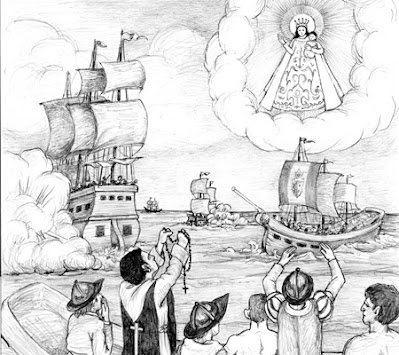
"For many a year they will remember the two stout galleons of Manila." ~ The victory of the Spanish over the Dutch at the Battle of Naval de Manila, AD 1646
| Illustration showing the Battle of Naval de Manila to appear in The Story of the Philippines. |
The more one delves into history, the more one is humbled by what one doesn’t know. Case in point...
In the first shock, one hundred and fifty of the finest buildings, which in other cities would be called palaces, were totally destroyed; all the other houses were so damaged and dangerous that it has been necessary to demolish them completely. It may be said with truth that only a semblance of Manila remains....Whole Indian villages were overthrown, as their huts are built of so light materials, bamboos and palm-leaves; and hills were leveled. Rivers were dried, which afterward flowed again; others leaving their beds, inundated the villages; great fissures and even chasms, appeared in the open fields. In the Manila River, the disturbance and commotion in its waves was so great that it seemed as if they would flood all the country. [Fayol, Relation of the events on sea and land in the Filipinas Islands...]
In [the Encarnación] were mounted thirty-four pieces of artillery, all of bronze and of the reinforced class, which variously carried balls of thirty, twenty-five, and eighteen pounds. The [Rosario] was equipped with as many as thirty pieces, of the same capacity—although on account of the deficiency in this sort of artillery, it was necessary to dismantle some posts in the fortifications of this city and of Cavite.
The governor-general of the Philippines, Don Diego Fajardo, chose General Lorenzo de Orella as commander and chief of the Spanish squadron. Fr. Fayol offers this heroic description of Don Orella:
...General Lorenzo de Orella y Ugalde, a Biscayan, under whose charge the vessels had sailed from Acapulco [was chosen] not only because of his proved bravery, his experience in the art of war, and his services and commands in both the Northern and Southern Seas, as well as in these islands (particularly in Mindanao, where he fought hand-to-hand with a gigantic Moro and killed him), but because of his well-known Christian spirit of modesty—which, for success, are no less important than valor.
Not trusting to mere earthly power, however, Don Fajardo agreed to allow four priests to accompany the flotilla, two in each ship. As both ships bore religious names, they were sent forth under the protection of Our Lady, the Virgin Mary. Fr. Fayol explains:
As a result of excellent teaching and the fervor of these fathers, arrangements were made that all of the men should, in the first place, purify their consciences with the holy sacraments of penance and communion; that they should take as their special patron saint the Virgin of the Rosary; that in order to bind her further, they should vow to her a feast-day in thanksgiving for the victories which they expected to receive through her agency; and that every day all should recite their prayers aloud, on their knees, and in two choirs—the prayers of the rosary before our Lady's image, the litanies of the most holy name of Mary, and finally an act of contrition.
Beyond these acts of piety, Don Fajardo caused the Blessed Sacrament to be exposed in several churches throughout Manila from the time of the departure of the galleons until their expected return.
When all was made as ready as temporal and spiritual efforts would allow, the Spanish ships boldly sallied forth to meet the more numerous Dutch in what should have been a very lop-sided affair. However, as Fr. Fayol admits, the Spanish had one thing going in their favor. The hoped-for coordination of the Dutch fleets failed and each one arrived on station at different times, allowing the Spanish the opportunity to fight each of them in detail. The first fleet arrived in Spanish waters in early March and were detected by the Spanish on March 15. Fr. Fayol provides an excellent account of the battle which followed, and I am only too happy to allow his voice to describe the proceedings:
On arriving at the entrances of Mariveles, the [Spanish] ships were placed in battle array, the artillery loaded, the matches lighted and the linstocks ready, the rigging free, and other preparations made. This was done because the sentinels [on Mariveles Island] warned our men that the enemy were, with their squadron, not far from that place; and that they might expect at any moment to encounter the Dutch—although in fact the latter were not descried until the fifteenth of the said month of March. At nine o'clock in the morning of that day, our almiranta [the Rosario] which had pushed ahead of the flagship perhaps half a league, and was sailing with a northwest wind—fired two cannon-shots and lowered the maintop-sail as a signal that it descried the enemy. The flagship put about, and followed her, and from the maintop they soon saw a sail in the distance, but it was impossible to overtake it; and it soon disappeared, because it was favored by a fresher wind than our ships had.
After that, our galleons were left becalmed until one o'clock; and at that hour were descried from the flagship four hostile sails, which were sailing toward her aft, with an east wind. It was two hours before they reached the flagship, and in that space of time the men were stationed, the ships cleared, the posts reconnoitered, and all other arrangements made, both spiritual and temporal, required by the occasion. The almiranta fell two ship-lengths astern of the flagship, and in this position the ships awaited the enemy, in order to fight them.
As soon as the enemy came near, they extended all their ships, and without attempting to give a broadside to our flagship, passed, in line to larboard, and the enemy's flagship began the battle by firing a cannon. Our commander immediately commanded that response be made with two shots—one with a thirty-pound ball and a cylinder of the same weight, which tore open all their cutwater at the bow. The enemy's ship went on in this condition, and the others continued to exchange shots with our flagship. Recognizing their own strength, the enemy tried to approach the almiranta, which they supposed was not so well armed, being a smaller ship. But they were received with equal valor and spirit on our side, our vessels firing so often and throwing so many balls that they could not be counted.
The fight lasted about five hours, and the mortality and damage were so great that all the anxiety that the heretics had felt to reach our ships when they thought to conquer us was now directed to separating themselves from us. They anxiously awaited the night, which was now approaching, to make their cowardly escape, which they did with lights extinguished. But the enemy's almiranta did not succeed in doing this in safety. It had been the most persistent in the attack upon our flagship, and remained to our leeward. It was so badly damaged that its cannon could not be fired, and hardly could it flee. Our ship was so near it that our commander had the men ready at the bow to board the Dutch ship, but the darkness of night forced us to abandon the chase, on account of the danger from the shoals which the pilots declared were in that place. It was noticed that the enemy did not use lanterns as they had formerly done, seeking protection for their armada. Our commander ordered that they be used in our ships, and that the lights be allowed to shine very brightly, in order that the enemy might come to look for us.
Our people fully intended to renew the pursuit at daybreak, to finish their defeat, but when day came our two galleons found themselves alone, and did not know what course the enemy had taken. They followed the Dutch, in the direction which they thought most probable, as far as Cape Bojeador, which is at the farthest end of this island of Manila. From there our ships returned, as the coasts were now secure, to the port of Bolinao, in order to send to this city dispatches announcing the result of the battle.
This was regarded as a brilliant victory, not only because of the disparity in the number of ships, but because of the little damage our side had sustained. In that battle not a man was killed, and comparatively few were wounded. It was evident that the enemy's loss was great, although we could not then ascertain it correctly. But afterwards we learned that many had been killed and wounded, and that two of their vessels were rendered useless.
All these exploits are worthy of great praise...According to the estimate made by well-informed persons, although we fired, in these battles, over 2,000 cannon-shots, and the enemy over five thousand, we had only fourteen killed, and comparatively few wounded. While the enemy, besides the vessels which we sank, arrived at their forts so damaged, and had lost so many men, that for many a year they will remember the two stout galleons of Manila....Thanksgiving was celebrated by a solemn fiesta, a procession, divine worship, and [a parade of] the squadron, with other demonstrations in fulfillment of the vow made to the Virgin of the Rosary, the city making a new vow to continue this anniversary every year.
[All of the above quotes are taken from Fray Joseph Fayol's Relation of the events on sea and land in the Filipinas Islands during the recent years, until the earthquake and destruction on the feast of St. Andrews in 1645; and the battles and naval victories over the Dutch in 1646. The English translation of this work is taken from The Philippine Islands, 1493-1898, Volumes 34-35, edited by Emma Helen Blair, James Alexander Robertson, 1906.]
| The image of Our Lady of La Naval de Manila. |