Showing posts with label Church Fathers. Show all posts

Wednesday, December 24, 2025

"Having obtained a share in the birth of Christ let us renounce the works of the flesh." ~ The Ancient Church Fathers on the Nativity of Christ

Fresco portrait of Pope Saint Leo the Great (enhanced) from the Church of Santa Maria
Antiqua in Rome, dated to the early 8th century—about 350 years after his death.

As explained in a previous post, the Nativity of Jesus has been celebrated by Christians on December 25 since antiquity. The feast of the Nativity has always been an opportunity for homiletic fireworks on a grand scale, and the Fathers of the Church took full advantage of the sacred day to wax eloquent.

In keeping with this theme, here are a few excerpts from some of the earliest extant homilies delivered by various Church Fathers to commemorate the birth of Jesus Christ, Son of the Living God.

The first comes from Pope Liberius who reigned in the mid-4th century AD. You may remember from a previous post, that Liberius was ejected from the papal see by the Roman Emperor Constantius II, son of Constantine the Great, for the crime of being insufficiently tolerant of Arianism. 

The excerpt below from Liberius was recorded by Saint Ambrose in a letter to his sister Marcellina. Pope Liberius had delivered this sermon on the occasion of Marcellina taking the veil as a consecrated virgin—an event which apparently took place on Christmas day, likely in AD 353 or there abouts. In the sermon, Liberius leans heavily into the nature of the incarnation of Christ, and one can clearly discern the familiar echoes of the Nicene Creed and its refutation of Arianism: 

"Today, indeed, He was born after the manner of men, of a Virgin, but was begotten of the Father before all things, resembling His mother in body, His Father in power. Only-begotten on earth, and Only-begotten in heaven. God of God, born of a Virgin, Righteousness from the Father, Power from the Mighty One, Light of Light, not unequal to His Father; nor separated in power, not confused by extension of the Word or enlargement as though mingled with the Father, but distinguished from the Father by virtue of His generation." [Pope Liberius (AD 352-366), as quoted by St. Ambrose in a letter to his sister Marcellina]

This next excerpt is from Saint Ephraim the Syrian who flourished the mid-4th century. Ephraim is known particularly for his hymns, and the excerpt below is taken from one of the score or so that he wrote for the celebration of the Nativity of Christ. Interestingly, this hymn seems to indicate that the birth of Christ happened at about the same time as the winter solstice (December 21) when "He came forth from the womb in this month in which the sun gives longer light."  

"At the birth of the Son the king was enrolling all men for the tribute-money, that they might be debtors to Him: the King came forth to us Who blotted out our bills, and wrote another bill in His own Name that He might be our debtor. The sun gave longer light, and foreshadowed the mystery by the degrees which it had gone up. It was twelve days since it had gone up, and today is the thirteenth day: a type exact of the Son's birth and of His Twelve.

Moses shut up a lamb in the month Nisan on the tenth day; a type this of the Son that came into the womb and shut Himself up therein on the tenth day. He came forth from the womb in this month in which the sun gives longer light.

The darkness was overcome, that it might proclaim that Satan was overcome; and the sun gave longer light, that it might triumph, because the First-born was victorious. Along with the darkness the dark one was overcome, and with the greater light our Light conquered!" [Saint Ephraim the Syrian, Fourth Hymn on the Nativity of Christ, written prior to AD 373]

Scenes from the Nativity and infancy of Christ from the Ivory throne
of Maximianus, Archbishop of Ravenna, early 6th century AD.

This next excerpt is from the aforementioned Saint Ambrose of Milan and may be traced back to AD 377, a mere three years after he had been made bishop by acclamation even prior to his baptism, having been baptized and ordained bishop on the same day. This tract demonstrates that he had successfully made the  transition from able Roman provincial administrator, to spiritual father of a major metropolitan see, while retaining his well-known and appreciated humility: 

"Therefore Christ became a little one, He became a child, so that you might become a perfect man. H was wrapped in swaddling bands, so that you might be freed from the bonds of death. He lay in a manger so that you might be raised to the altar. He dwelt on earth so that you might live among the stars. There was no room for him at the inn, this was so that you might have many rooms in the heavenly mansions. 'He who was rich made himself poor for your sake, so that you might be rich.' (1 Cor 8:9). The Lord's poverty is my inheritance and His weakness is my strength. For Himself He preferred poverty and want, so that for others He might have abundant wealth. It is I who am washed by those tears that He shed as a crying infant, it is my sins that are wiped away by those tears. [St. Ambrose of Milan, from Commentary of Saint Ambrose on the Gospel of Luke, Book II, Chapter 41]

Finally, given the regnal title of the reigning pontiff, we present a passage taken from a sermon given by the original, Pope Saint Leo the Great about 75 years after Saint Ambrose. In this excerpt, Leo wraps up his Christmas sermon with an admonition to his flock to adhere to the moral commands of Christ and resist the urge to live according to the desires of the flesh—a fair warning to all Christians, ancient and modern alike:

"Let us then, dearly beloved, give thanks to God the Father, through His Son, in the Holy Spirit, 'Who for His great mercy, wherewith He has loved us, has had pity on us: and when we were dead in sins, has quickened us together in Christ' (Ephesians 2:4-5), that we might be in Him a new creation and a new production. Let us put off then the old man with his deeds: and having obtained a share in the birth of Christ let us renounce the works of the flesh. Christian, acknowledge your dignity, and becoming a partner in the Divine nature, refuse to return to the old baseness by degenerate conduct. Remember the Head and the Body of which you are a member. Recollect that you were rescued from the power of darkness and brought out into God's light and kingdom. By the mystery of Baptism you were made the temple of the Holy Ghost: do not put such a denizen to flight from you by base acts, and subject yourself once more to the devil's thralldom: because your purchase money is the blood of Christ, because He shall judge you in truth Who ransomed you in mercy, who with the Father and the Holy Spirit reigns for ever and ever. Amen." [Pope Saint Leo the Great, Sermon 21, mid-5th century AD]

Saturday, February 03, 2024

Is the floor of Hell paved with the skulls of bishops?


The well-used quote: "The floor of hell is paved with the skulls of bishops," may be found in a variety of forms. Perhaps the most colorful version of it is: "The road to Hell is paved with the bones of priests and monks, and the skulls of bishops are the lamp posts that light the path."
 
This saying has been attributed to one of several Fathers of the ancient Church and to Protestant revolutionaries from more recent times. Most often, it is claimed to be from the writings of St. Athanasius or St. John Chrysostom. After a thorough search, I have come to the conclusion that this saying is of more modern provenance, likely originating from a Protestant polemic which made very liberal use of a homily from St. John Chrysostom. 
 
So to respond to the question posed in the title of this post: Is the literal floor of Hell paved with the literal skulls of bishops? The answer is: No, probably not as such.

That said, I looked up the homily of St. John Chrysostom to which this quote is often attributed, and what I found there is, perhaps, even more daunting than the rhetorically evocative version that most folks are familiar with. The work in question is St. John's Third Homily on the Acts of the Apostles. The passage in question is the following which I am pasting here for future reference:

"I do not think there are many among Bishops that will be saved, but many more that perish: and the reason is, that it is an affair that requires a great mind. Many are the exigencies which throw a man out of his natural temper; and he had need have a thousand eyes on all sides. Do you not see what a number of qualifications the Bishop must have? To be apt to teach, patient, holding fast the faithful word in doctrine [see 1 Timothy 3:2-9; Titus 1:7-9]. What trouble and pains does this require!
 
And then, others do wrong, and he bears all the blame. To pass over every thing else: if one soul depart unbaptized, does not this subvert all his own prospect of salvation? The loss of one soul carries with it a penalty which no language can represent. For if the salvation of that soul was of such value, that the Son of God became man, and suffered so much, think how sore a punishment must the losing of it bring! And if in this present life he who is cause of another's destruction is worthy of death, much more in the next world. Do not tell me, that the presbyter is in fault, or the deacon. The guilt of all these comes perforce upon the head of those who ordained them.
 
Let me mention another instance. It chances, that a bishop has inherited from his predecessor a set of persons of indifferent character. What measures is it proper to take in respect of bygone transgressions (for here are two precipices) so as not to let the offender go unpunished, and not to cause scandal to the rest? Must one's first step be to cut him off? There is no actual present ground for that. But is it right to let him go unmarked? Yes, say you; for the fault rests with the bishop who ordained him. Well then? Must one refuse to ordain him again, and to raise him to a higher degree of the ministry? That would be to publish it to all men, that he is a person of indifferent character, and so again one would cause scandal in a different way. But is one to promote him to a higher degree? That is much worse.

 If then there were only the responsibility of the office itself for people to run after in the episcopate, none would be so quick to accept it. But as things go, we run after this, just as we do after the dignities of the world. That we may have glory with men, we lose ourselves with God. What profit in such honor? How self-evident its nothingness is! When you covet the episcopal rank, put in the other scale, the account to be rendered after this life. Weigh against it, the happiness of a life free from toil, take into account the different measure of the punishment. I mean, that even if you have sinned, but in your own person merely, you will have no such great punishment, nothing like it: but if you have sinned as bishop, you are lost." 

Read the entire Third Homily of St. John Chrysostom on Acts of the Apostles here.

What more is there to say, really? Except this -- may our bishops understand the gravity of what they do when they preach that which is contrary to traditional Church doctrine and morality.

Tuesday, October 18, 2022

"The Holy Apostle Luke Painted this Image" ~ The traditional Lucan origin of the icon of the Hodegetria

15th century Greek representation of St. Luke painting the Hodegetria icon.

Today is the feast of Saint Luke, a father of the ancient Church renowned as Evangelist, Historian, and Physician. We should be aware of one additional title that is traditionally attributed to this early disciple of Christ: Artist. For the name of Saint Luke is attached to one of the most venerable works of art of the ancient Church—the Hodegetria icon which resided in Constantinople until its destruction in 1453. 

While the origins of the Hodegetria icon are shrouded in mystery, its connection to St. Luke is based upon traditions stretching back to the early centuries of Constantinople as a Christian capital. Among the most ancient sources to record this tradition is a manuscript known as the Anonymous Mercati, a document penned by an English pilgrim who journeyed to Constantinople in the 11th century AD. A translation of the key passage may be found in Pentcheva's work, Icons and Power: The Mother of God in Byzantium. Here is a snippet:

“In the part of the palace near the church of Hagia Sophia, very near to the great palace by the sea, is situated the monastery of the Mother of God, Theotokos. And in this monastery there is a holy icon of the Theotokos, called Hodegetria, which can be translated as “She Who Leads the Way.” … The holy apostle Luke painted this image of the Mother of God holding the Christ Child on her arm.” (Pentcheva, Icons and Power, page 126).

There is a further legend that explains how this icon of the Mother of God, presumably painted by St. Luke in Antioch (Luke’s presumed home town), Jerusalem, or some other city in the Levant, became associated with Constantinople. A late 14th century text known as the Logos Diegematikos holds that the icon was sent from the Levant by the empress Eudocia to her sister-in-law, Saint Pulcheria, in the mid-5th century AD:

“In fact, the empress Eudocia, upon receiving these holy and divine gifts [the Hodegetria icon and relics] from those holy monks like some much-valued treasure, sent them to the empress Pulcheria….Which gift, Pulcheria, as one could say, receiving it with great joy, deposited in the famous and holy sanctuary of the Theotokos and ordered the holy and sacred icon to be in the church as a protection of the palace, the entire city, and the whole world.” (Pentcheva, Icons and Power, page 128).

A previous post on this blog notes that Eudocia was indeed resident in both Antioch and Jerusalem for a time. Readers will also recall posts about Saint Pulcheria here and here, as well as a post demonstrating Pulcheria’s keen interest in bringing relics to Constantinople. Another post, citing a passage in the writings of St. John Damascene in the 8th century, indicates that Pulcheria and her consort, the emperor Marcian, had an interest in Marian relics and had specifically sought (though in vain) for the body of the Mother of God.

Pentcheva believes that the late recording of these acts make it likely that they are mere interpolations of medieval writers. An alternative viewpoint may be found in Grotowsky's The Hodegon: Considerations on the location of the Hodegetria sanctuary in Constantinople (Byzantina Symmeikta, Volume 27). This excellent work compiles and interprets the fragments of history on the Hodegetria that have come down to us. 

This story of St. Luke painting the famous icon has served as fodder for other artists down through the centuries. The version shown at the top of this post was painted by an unknown Greek artist, likely in the early 15th century shortly before the fall of Constantinople to the Turks. Below is a fanciful version, showing Our Lady and the Christ child actually sitting for their portraits, with both the artist and the subjects dressed in Renaissance garb and looking very Dutch.

Saint Luke Painting the Virgin, Derick Baegert, ca. 1470.

Next, we see an even more fanciful, proto-Baroque rendition of the same event as imagined by Florentine artist Giorgio Vasari, complete with Saint Luke’s symbol (the ox) and the heavenly Virgin attended by cherubs. 

Saint Luke Painting a Portrait of the Madonna, ca 1565

As recorded by the 15th century Greek historian Constantine Dukas, the original Hodegetria icon was destroyed by the Turks after the sack of Constantinople in AD 1453. As the story goes, four Turkish looters found it in the Chora monastery where it had been placed to protect the city during the siege. The Turks debated over which of them should possess it, and utilizing the wisdom of Solomon, decided to break it into four pieces. 

There are many likely spurious accounts, however, which maintain that the true icon was spirited out of Constantinople at some point during its long history, with several cities in Italy, including Venice, claiming ownership. The Poles also claim that the icon of Our Lady of Czestochowa is the original Hodegetria. For more on these claims, see, Wolff, "Footnote to an Incident of the Latin Occupation of Constantinople: The Church and the Icon of the Hodegetria" (Traditio, vol. 6 (1948), pp. 319-328).

Left: Image of the Madonna Nicopeia from Saint Mark’s Basilica, Venice. Right: Icon of
Our Lady of Czestochowa which is housed in Jasna Gora Monastery, Czestochowa, Poland.

Saturday, September 03, 2022

"I am tossed with the waves of this wicked world" ~ Pope Saint Gregory the Great and Christian endurance during times of worldly distress

Pope St. Gregory the Great in marble as executed by Nicholas Cordier in AD 1602.
This work resides in the Oratory of Saint Barbara which is part of the church of Saint Gregory
on the Caelian Hill in Rome. This church was built on the site of Gregory's boyhood home
and also contains a statue by the same artist of Gregory's mother, Saint Silvia. 

September 3 is the feast of Pope St. Gregory the Great. This most significant of popes lived during a time of societal dissolution, when the Roman Empire in the West was in its final death agony. Though the Eastern Empire had re-established dominion in Africa and Italy in the 550s AD under Justinian, the invasion of the brutal Lombards in AD 568 proved unstoppable, leaving Italy in a state of perpetual fracture and chaos that would last centuries.

Following is the opening to Gregory's work, The Dialogues. This great work was written during a period of brief respite, when Gregory had the opportunity to look back on the decades of tumult, death and destruction that he and all of Italy had managed to endure. Even over 1,400 years later, the Dialogues continue to resonate with modern readers, offering a glimpse into a period when it seemed to many that everything good in the world was going to pieces, while cruelty and brutality reigned supreme.

In the Dialogues, Gregory begins by setting a gloomy tone, lamenting that his life of spiritual contemplation had been interrupted and overwhelmed with the care of temporal affairs:

Click here for more info.
Being upon a certain day too much over-charged with the troubles of worldly business, in which oftentimes men are enforced to do more than of duty they are bound, I retired myself into a solitary place, very fit for a sad and melancholy disposition—where each discontentment and dislike concerning such secular affairs might plainly show themselves, and all things that usually bring grief, mustered together, might freely be presented before mine eyes. In which place after that I had sat a long while, in much silence and great sorrow of soul, at length Peter, my dear son and deacon, came unto me—a man whom, from his younger years, I had always loved most entirely, and used him for my companion in the study of sacred scripture: who, seeing me drowned in such a dump of sorrow, spake unto me in this manner:

"What is the matter? Or what bad news have you heard? For certain I am, that some extraordinary sadness doth now afflict your mind."

To whom I returned this answer: "O Peter, the grief which continually 1 endure is unto me both old and new: old through common use, and new by daily increasing. For mine unhappy soul, wounded with worldly business, doth now call to mind in what state it was, when I lived in mine Abbey, and how then it was superior to all earthly matters, far above all transitory and corruptible pelf, how it did usually think upon nothing but heavenly things....For do you not behold at this present, how I am tossed with the waves of this wicked world, and see the ship of my soul beaten with the storms of a terrible tempest? and therefore, when I remember my former state of life, I cannot but sigh to look back, and cast mine eyes upon the forsaken shore.

But Gregory doesn't remain in this state of gloom, and instead suggests that Peter ask him questions. Peter gamely takes up the challenge. When Peter relates that he's never heard of anyone in Italy famous for living virtuously, Gregory sets him straight, offering a series of tales meant to demonstrate how even during times of severe tribulation, the hope of Christ shines forth through the works of the virtuous. He tells numerous stories of saints, heroes and villains from his own lifetime, the most substantial among them is the longest extant biography of the famous Saint Benedict of Nursia. 

Though occasionally considered folk-history similar to the stories in the Golden Legend, the Dialogues served a higher function than simple history—they were meant to be a spiritual exhortation to Gregory’s worn and weary countrymen. To modern readers, these tales of visions, miracles, virtue rewarded and wickedness punished paint a vivid portrait of daily life amid the wreckage of once-prosperous Roman Italy as the region lurched painfully into the so-called Dark Ages. 

Many of the stories in the Dialogues have been featured on this blog, including the following:

Friday, April 08, 2022

The Church Fathers Were Trads

Engraving of Pope Saint Damasus I by Nicolas San Giorgio, AD 1877.

When reading the Ecclesiastical History of Hermias Sozomen—a work written immediately before the Council of Chalcedon when the universal Church was roiled by a variety of heresies—one picks up the venerable author’s animus for innovation. Indeed, Book IV, Chapter 27 begins with the following passage:

When the spirit of innovation becomes regarded with popular favor, it is scarcely possible to arrest its progress. Inflated as it always is with arrogance, it contemns the institutions of the Fathers, and enacts laws of its own. It even despises the theological doctrines of antiquity, and seeks out zealously a new form of religion of its own devising.

The context of this quote is the turmoil which nearly overwhelmed the Church during the reign of the Arian emperor Constantius II, who gave a free hand to those bishops who had embraced the novelties of Arius to oppress those who supported the decisions of the Council of Nicaea of AD 325. 

A quick text search of the rest of Sozomen’s history reveals similar admonitions against novelty and innovation, including a letter from the Church Council convened at Ariminum (Rimini) in Italy in AD 359, during which the bishops of the West petitioned Constantius uphold the Nicene creed and not to allow novel doctrines:

Click for more info.
We therefore entreat your Clemency to listen to our deputies and to regard them favorably and not to allow the dead to be dishonored by the introduction of alterations and novelties. We pray you to preserve the tradition which we received from our ancestors, who were all wise and prudent and who, we have reason to believe, were led by the Spirit of God. For these innovations not only lead believers to infidelity, but also delude unbelievers…. Again, we beseech you that nothing be taken away from or added to the faith. Let it remain unchanged even as it has continued from the reign of your father to the present time, so that we may not in the future be compelled to leave our churches and undertake long journeys, but that the bishop and people may dwell together in peace… [Book IV, Chapter XVIII]

Constantius would not heed this request, however, and would attempt to force the bishops to reject the Nicene formulary of the Faith, even deposing a pope in the process. 

Later, Sozomen quotes a letter from Pope St. Damasus to the bishops of Illyria (see the image at the beginning of this post) which says much the same thing:

Those who devise strange doctrines ought not to be followed, but the opinions of our fathers ought to be retained, whatever may be the diversity of opinion around us. [Book VI, Chapter XXIV]

Interestingly, appeal to tradition was such a powerful rhetorical weapon in the ancient Church that prelates who would later be condemned as heretics attempted to wield it. In an account of the Council of Antioch of AD 342, Sozomen recounts how the assembled bishops—including the Arian Eusebius of Nicomedia who was now Bishop of Constantinople—after deposing Saint Athanasius, went on to affirm that “they received the faith which had, from the beginning, been handed down by tradition.” [Book III, Chapter 5]

Given the above, it may be pointed out that this spirit of suppressing novelty and holding fast to tradition has been effectively turned on its head by our bishops over the past century. Sadly, those men who are called specifically to preserve the venerable teachings of the Church oftentimes seem almost manic in their rush to discard them. In place of the holy and eternal doctrines that the Church has always taught, they propose doctrinal and pastoral innovations that look, sound and feel eerily similar to the ephemeral doctrines and practices of the princes of this world. 

It is also worth contemplating whether this voluptuous embrace of novelty has caused the Church founded by Jesus Christ to be built up over the past several decades, or to collapse into heap of rubble. In the West, at least, the answer is set starkly before our eyes.

Ruins of St. Bonaventure Catholic Church, Philadelphia, PA. Built in 1906,
demolished in 2013 after lying abandoned for 20 years. Photo from Hidden City.

Thursday, January 20, 2022

"Art thou not Sebastian whom I before commanded to be slain with arrows?" ~ A few interesting points about Saint Sebastian's ancient Passio.

The Burial of Saint Sebastian (1877) by Alejandro Ferrant y Fischermans. Click to enlarge.

Saint Sebastian is one of the great ancient martyrs of the Roman Catholic Church as well as one of the saints most frequently depicted in artwork down through the centuries. The image of Sebastian tied to a stake, his body riddled with arrows, is one of the most immediately recognizable and jarring images of the ancient martyrs.

As with many of the martyrs from the days prior to Constantine, his story has become somewhat muddled. He is mentioned in a homily of Saint Ambrose (On Psalm 118) as having come from Milan. Most of the rest of his biography comes from a Passio of dubious provenance. Scholars of the previous era ascribed this work to Saint Ambrose himself, though more modern scholars tend to dismiss this attribution. Few doubt the antiquity of the Passio, however, and the existing work is commonly dated to the early fifth century—or about a century after the events recorded therein.

As with many of the ancient martyrdom accounts, the Passio has not been translated into English. It does, however, exist excerpted in numerous other works, including a detailed synopsis which may be found at The Cult of Saints in Late Antiquity site, sponsored by Oxford University. 

A different type of synopsis of the Passio may be found in the Homilies of Aelfric of Eynsham, a late 10th century Anglo Saxon abbot who transcribed the Latin tale into Old English for the edification of his monks. Here is the ancient story of Sebastian’s martyrdom as told in part with excerpts from Aelfric’s work. The entirety of the account may be found here: Skeat: Aelfric's Lives of Saints, p. 117 and following.

The Passion of Saint Sebastian, Martyr, January 20

There was a holy servant of God, called Sebastian, who was a long time in the city of Milan for education, and was baptized into Christ with full faith. He was a very prudent man, truthful in word, righteous in judgment, in counsel foreseeing, trusty in need, a prevailing intercessor, shining in goodness, and in all his ways honorable. 

Daily he fulfilled his Lord's service zealously, but he concealed, nevertheless, his deeds from the emperor Diocletian who was the devil's worshipper. Diocletian loved the holy man, notwithstanding, and knew not that he believed in the living God. He set him as prefect over a cohort, and bade that he should always be in his presence; and all the household held him as a father, and honored him with love, because God loved him. He followed the emperor, unknown to him, however, not as if he durst not suffer for his Lord, but he desired to encourage those whom the heathen emperor daily killed for their faith in Christ.

Diocletian, as we know, reigned from AD 284 through AD 305 when he abdicated and retired to a fortified palace on the Dalmatian coast. The notion that secret Christians may have existed in the court of Diocletian is in no way surprising and jives well with the account of Lactantius in On the Deaths of the Persecutors. Indeed, it is possible that Diocletian’s own wife, Prisca, and daughter, Valeria, were secret Christians. 

Sebastian was able to use his position in the court to console the brothers Marcus and Marcellianus who were imprisoned as Christians by Chromatius, the Prefect of Rome, and condemned to death unless they offered sacrifice to the pagan divinities. These brothers were from an aristocratic family and both wavered as their family members attempted to convince them to save their lives by abjuring the Christian faith. Due to the stature of their families, Chromatius offered a thirty day reprieve for the martyrs to consider their position.

During this time, however, Sebastian convinced the family of Marcus and Marcellianus to accept Christ. When the thirty days expired, Tranquillinus, the father of the young men, came before Chromatius and professed his own faith in Christ, mentioning that his gout had been cured following his baptism. As it turns out, Chromatius suffered from the same ailment and would later secretly summon Sebastian and the priest Polycarp so that they might also heal him. In order to effect the healing, Sebastian and Polycarp endured a three day fast, after which they returned to Chromatius and enjoined him to allow them to destroy all the pagan idols in his house. Chromatius agreed, and the two Christians proceeded to burn, smash, or melt down all of the 200 images of the pagan divinities in the house. 

What happens next is very strange indeed, as it seems to tie this ancient Christian literary source to one of the most fascinating archaeological discoveries of the 20th century.

When Chromatius failed to recover after his house was cleansed, Sebastian and Polycarp then deduced that something evil must yet remain in his house. At this point, Chromatius reveals something interesting: 

“I have in my treasure-chest a wonderful instrument, for my information, according to the position of the stars as they stand in the heavens. On that instrument Tarquinius, my father, spent of red gold alone more than two hundred pounds.”

Previously in the same narrative, this instrument is described as follows: 

An excellent work of mechanical contrivance, of glass, and gold, and of glistening crystal. This instrument was designed to show with certainty by the stars what should happen to every man in the course of his life; but it was so formed according to the heathen error.

The remains of the so-called Antikythera Mechanism, believed to be an
ancient machine used to compute the movement of the stars and planets.

Does this sound familiar? If you are at all aware of Mediterranean archaeology, it should. In 1901, some sponge divers found a strange ancient artifact in the waters off the Greek island of Antikythera. This item would become known as the Antikythera Mechanism, a type of ancient gear-driven computer used to predict the movements of the stars. It is tantalizing to think that this passage in the Passio of St. Sebastian is actually describing a similar type of machine. It may also be an indication that the Antikythera mechanism was not unique and that other similar devices were known even as late as the 5th century AD.

To get back to our narrative, Sebastian and Polycarp then discoursed to Chromatius upon the evils and vanity of astrology, indicating that the infernal machine must be disposed of. They even put their lives on the line, saying that if they broke the costly device and Chromatius did not recover from his illness, then they would submit to being thrown into a furnace and killed. Chromatius agreed. The device was broken. And Chromatius subsequently recovered. As a result, he and his son became Christians. 

Now, certainly there will be some who will latch onto this episode as an example of Christians being so "anti-science" that they even destroyed a precious ancient computing device. Before advancing this claim, however, it is well to keep in mind that the device itself, as expensive and finely crafted as it may have been, was not actually used for any scientific purpose. It was used for the superstitious purpose of attempting to predict the future via the movement of the stars.

Chromatius subsequently resigned his position as Prefect of the city of Rome and was replaced by a certain Fabianus, a man who was much more zealous in carrying out the persecutions mandated by Diocletian against Christians than Chromatius had been. This Fabianus soon laid hold of Marcus and Marcellianus, tortured them, and put them to death. Soon after, he denounced Sebastian to Diocletian as well. 

Given that Fabianus was, supposedly, the Prefect of Rome, it is reasonable to conjecture that the denunciation of Sebastian likely took place in AD 303 when Diocletian was in Rome for the celebration of his Vicennalia or 20th anniversary of his reign. This event was meant to be a great, two month long, triumphal festival commemorating the happy and prosperous reign of Diocletian and Maximian. There is evidence, however, that the event became tragic. The Chronography of AD 354 reports that during the event, 13,000 people were killed when the boxes at the circus collapsed. It is also possible that Pope Marcellinus was martyred during this time.  

Writing in On the Deaths of the Persecutors, Lactantius claimed that Diocletian was so perturbed during the celebrations at Rome that he departed the city prematurely before his consulship could even begin on January 1. He would subsequently become gravely ill on his journey back to Nicomedia.

Let us assume that the unhappy vicennalia celebration at Rome is the setting for the scene described below in Aelfric’s homily as the dramatic conclusion of St. Sebastian's Passio:

Then became Diocletian fiendishly angry, and commanded him to be led out in hard bonds, into a field, and there to be bound, and assailed with arrows until he gave up his life. Then the soldiers led away the servant of Christ, and set him for a mark, even as the wicked man commanded, and fastened their arrows into him before and behind, as thickly on every side as a hedgehog's bristles, and so left him alone, lying for dead.

Then came a certain widow, who was a martyr's relict, in the same night, where he lay sorely wounded, desiring to bury his body, and found him living. Then she brought him to her house alive, and within a few days entirely healed him. Then came the Christians, and urged the [Christian] warrior, that he ought to depart far away from the city.

But Sebastian commended himself to God, and went up to the staircase, which stood against the emperor's palace, and when the emperor came, thus cried to him:

“Your idol-priests who dwell in your temples tell you many lies concerning the Christians, saying that they are verily adversaries to your kingdom, and also to your people; but your kingdom prospereth through their good merits, because they pray for the Roman people and for your dominion, without ceasing.”

Then looked Diocletian, the fiendish murderer, towards the holy man, who stood there so loftily, and said haughtily, “Art not thou that Sebastian, whom I before commanded to be slain with arrows?

Sebastian said, “Christ raised me up again to the end that I might declare to thee before all the people your unrighteous persecution against the Christians.”

Then bade the emperor that the soldier of God should be beaten to death with clubs within his own city. Then the murderers did even as the emperor commanded, and by night hid his holy corpse in a foul sewer, saying amongst themselves, that at least the Christians should not get at his body, and make him into a martyr afterwards.

The most ancient extant image
of St. Sebastian, dating from the
mid-6th century AD, may be found in
Sant'Apollinare Nuovo in Ravenna.
 
Here again, we see a common theme—the desire of the persecutors to deny the martyr's body to the Christian community. 

But the Christians did find Sebastian’s remains. They were recovered by a widow named Lucina who claimed to have been visited by Sebastian in a dream. 

The relics of St. Sebastian would then take on a life of their own, being first deposited in the catacombs at Rome. A basilica would be built over the site in the mid-4th century AD—San Sebastiano fuori le Mura—which would become on one of the seven pilgrim churches of Rome. 

Some of his relics would eventually find their way to Soissons in France in the early 9th century where they would remain until they were plundered and thrown into a ditch by Calvinists in 1564.

It is said that a relic of the top of Sebastian’s cranium may be seen to this day in the church of St. Sebastian in Ebersberg, Bavaria.

A good summary of the remaining relics and their locations may be found in St. Sebastian's entry in Butler's Lives of the Saints. 

Monday, January 25, 2021

"A monarch more wicked than all the nations of the earth" ~ Julian the Apostate and the martyrdom of Saints Juventius and Maximus

The martyrdom of Saints Juventius and Maximus taken from the
early 11th century Menologion of Basil II.

January 25 is the feast day of the ancient martyrs, Juventius and Maximus (sometimes called Juventinus and Maximinus). These two were soldiers during the time of Julian the Apostate and suffered martyrdom at his hands, most likely in AD 363. 

You may remember from similar posts on this blog that although Julian had a deep animosity toward Christianity, he refrained from enacting a wholesale persecution in the style of Diocletian because he had seen that such methods failed to suppress the Faith and indeed, seemed to enhance its appeal. As a result, Julian had taken a more subtle approach to suppressing Christianity, as demonstrated in a previous post on Saint Eupsychius, a martyr who had participated in the destruction of the Temple of Fortune in Caesarea.

Unlike many of the semi-legendary martyrs of the late 4th century, we can be fairly certain that Juventius and Maximus not only existed, but that their acts are authentic. They are recorded in two near-contemporary sources: a homily of Saint John Chrysostom who eulogized the martyrs about 30-40 years after their deaths, and the Ecclesiastical History written by Theodoret, bishop of Cyrrhus who wrote in the mid-5th century AD.

The account of Theodoret is rather detailed, and seems to jive nicely with the historical portrait of Julian gleaned from friendly sources like Ammianus Marcellinus and hostile ones like Hermias Sozomen and Socrates Scholasticus, as well as Julian's own surviving writings. The whole of Theodoret's account of the deaths of Juventius and Maximus runs as follows:

Julian continued to oppose religion with greater and greater boldness and effrontery, while he assumed the specious appearance of clemency, in order to lay snares to entrap men, and seduce them to irreligion. He cast things offered to idols into the fountains of the city of Antioch, and into those of Daphne, so that no one could drink of the streams without partaking of the hateful sacrifices. He defiled in the same way everything that was sold in the marketplace, for he had water which had been offered to idols sprinkled on the bread, meat, fruit, herbs, and all the other articles of food. 

The Christians wept and lamented at witnessing these abominations, yet they partook of the food according to the precept of the apostle, for it is said, "Whatsoever is sold in the shambles, that eat, asking no question for conscience sake." (1 Corinthians 10:25). 

Two of the emperor's guards, who were his shield-bearers and companions in arms, vehemently deplored, at a certain convivial party, the perpetration of such hateful deeds, and borrowed the admirable words used by the young man who gained so high a celebrity at Babylon: "You have delivered us," they said, " to a monarch who is more wicked than all the nations of the earth." 

One of those at table acquainted the emperor with this speech. The emperor sent for these two men, and asked what it was that they had said. This question giving them an opportunity of speaking freely, they, in the warmth of their zeal, made the following reply: 

"Having been brought up, O emperor, in the true religion, and having been accustomed to obey the admirable laws enacted by Constantine, and by his sons, we cannot but be deeply grieved at witnessing everything filled with abominations, and the very food contaminated by being mixed with the sacrifices offered to idols. We have lamented over this in our own houses, and now, in your presence, we publicly express our regret. This is the only cause of sorrow which we experience under your government." 

On hearing these words the mildest and wisest of emperors, as he is called by those who resemble him, threw off the mask of clemency, and disclosed his real impiety. Such excruciating tortures were at his order inflicted on these two men, that they expired under them or, rather, they obtained a release from the misery of the age, and received the crowns of victory. It was declared, that their boldness of speech, and not the religion which they defended, was the cause of their execution: they were punished, it was said, because they had insulted the emperor. This account of the transaction Julian ordered to be universally circulated, for he was apprehensive lest these champions of truth should obtain the honor of being regarded as martyrs. 

Their names were Juventius and Maximus. The church of Antioch honored them as defenders of religion, and interred them in a magnificent tomb; and even to this day an annual festival is celebrated in their honor. [Theodoret, Ecclesiastical History, Book III, Chapter 15]

These martyrs are also mentioned in a homily given by Saint John Chrysostom. As one-time bishop of Antioch, Saint John no doubt was very familiar with these two martyrs who would have been slain during his own lifetime. Indeed, he would have been a young man at the time, most likely living in Antioch during the reign of Julian. 

I could not locate a full literal English translation of this homily, but fragments may be found in Butler’s Lives of the Saints and other scholarly sources around the internet. The account in Butler’s mentions that when the martyrs refused to retract their statements about the emperor, they were scourged, their property was confiscated and finally, they were beheaded in prison. Following the execution, some local Christians in Antioch obtained the bodies and built for them a magnificent tomb. In his homily, John Chrysostom urges his listeners to visit the shrine of these martyrs regularly and embrace the relics, feeling confident that they may obtain blessings. In fact, this homily provides yet another example of the early Church believing in the efficacy of prayers to the saints in heaven as mediators with God as St. John makes clear in a very dramatic fashion:

“For just as soldiers, showing off the wounds received in battle, boldly converse with the emperor, so too these [martyrs], by brandishing in their hand the heads which were cut off and putting them on public display, are easily able to procure everything we wish from the King of Heaven.” [See Garbarino, Resurrecting the martyrs: The role of the Cult of the Saints, AD 370-430 – page  128]

A final ancient source on these martyrs is also worth citing. In a hymn of Severus of Antioch, a Monophysite bishop of the early 6th century AD, a third martyr is mentioned along with Juventius and Maximus—another soldier named Longinus, who along with his companions, was accounted a valiant man, a champion and a soldier of Christ who confounded Julian and stripped off his cloak of deceitfulness. See Hymns of Severus in Patrologia Orientalis, Tomus Septimus, page 612 [200] 

For more posts on Julian the Apostate, see:

Thursday, September 03, 2020

The Synthesis of a Loveable Ascetic and a Grave-faced Administrator ~ Pope Saint Gregory the Great and his venerable parents

Pope St. Gregory the Great flanked by his parents, Gordianus and St. Silvia.

Today, September 3, is the feast of Pope Saint Gregory the Great on the modern calendar. This great pope who is simultaneously considered the last Father of the ancient Church and the first of the medieval Church, has featured frequently on this blog (see his rebuke of the bishops of Dalmatia and his ponderings on Purgatory, in particular). I had not previously looked into Gregory’s early life, however, and falling as it does in the mid-6th century which is right in my wheel-house, I figured I would do a little research. 

It seems that the earliest Vita of Gregory was written by John the Deacon in the 9th century, at least 200 years after his death. An English translation of this multi-volume work is apparently not available, so I resorted to an early 20th century work that draws heavily from John’s Vita, namely, Gregory the Great: His Place in History and Thought by F. Holmes Dudden which may be found in full at Archive.org. 

Flipping through this work, I immediately discovered the image above of Gregory on the frontispiece flanked by his parents, Gordianus and Silvia. This 17th century engraving was originally published as part of the Ecclesiastical Annals of Baronius. It is drawn from two ancient paintings of Gregory's parents that he caused to be set up in Monastery of Saint Andrew in Rome which was founded on the site of his hereditary estate on the Caelian hill. The site of this monastery is today occupied by the Church of San Gregorio Magno al Celio. 

Dudden provides the sparse information that we have about Gregory’s parents:
Gregory’s father bore the Imperial name of Gordianus. He is styled “Regionarius,” but what his office was is far from clear…Of Gordianus and his work we know practically nothing. We gather from the “Lives” that he was wealthy, the owner of large estates in Sicily, and of a stately mansion on the Caelian Hill in Rome…Of Gregory’s mother, Silvia, we have again but scanty information. Like her husband, she appears to have been of good family, and in later life she became famous for ascetic piety. After the death of Gordianus she embraced a life of seclusion and went into retreat at a place called Cella Nova, close by the great door of the Basilica of St. Paul. Here, in after ages, stood an oratory dedicated to the blessed Silvia; and the patrician lady herself is still commemorated as a saint on the third of November.

Dudden then remarks on the aforementioned portraits as they were described by John the Deacon: 

Through a fortunate circumstance we are able to form a tolerable notion of the outward appearance of the Regionary and his wife, for Gregory had the pair painted in the atrium of St Andrew's Monastery, and three hundred years later the portraits were inspected by John the Deacon, whose interesting description of them is still extant. In the first painting the Apostle Peter was represented sitting, with his right hand clasping the hand of Gordianus, who was standing near. The Regionary was clad in a chestnut-colored planeta or chasuble, over a dalmatic, and wore shoes. He was a tall man, with a long face, light eyes, a short beard, bushy hair, and a grave expression of countenance. 
The second picture showed Silvia seated, robed in white — a lady of full height, with a round, fair face, wrinkled with age, yet still bearing traces of great beauty. Her eyes were large and blue, with delicate eyebrows, her lips were well-formed, her expression cheerful. With two fingers of her right hand she was in the act of making the sign of the cross. In her left was a Psalter, on the open page of which was inscribed with the verse, “Let my soul live, and it shall praise Thee; and let Thy judgments help me.”  
Full image of St. Gregory and his
parents from Dudden's frontispiece.
Click to enlarge.
 
John's description leaves us with a pleasant impression of Gregory's parents, and the word-sketch of the aged mother has a special charm. But the whole account is valuable inasmuch as it helps us to understand some of the characteristics of Gregory's mind and character. For it cannot be doubted that Gregory inherited certain traits from each of the parents whose portraits he had painted in St Andrew's. Some physical resemblances to each are noticed by John. And it is not to be questioned that many also of Gregory's moral and intellectual peculiarities may be accounted for by means of the principle of heredity. From his mother he doubtless derived his almost feminine tenderness and power of sympathy, his innate bent toward asceticism, his religious mysticism, his self-sacrificing, self-effacing disposition. From his father, no less certainly, he inherited his administrative capacity, his legal acumen, his unswerving love of justice, and that inexorable severity towards hardened offenders which caused him to be feared, in some degree, even by those who loved him best. Thus the nature of the parents is reproduced in the offspring, and in the transactions of Gregory’s life we are again and again reminded, now of the grave-faced man of business and administrator of the Region, now of the loveable, ascetic woman who crosses herself as she ponders over the psalter.
Of Gregory’s sole sibling, Dudden says the following:
Gordianus and Silvia had two sons; one they called Gregory—the watchful…while of the other we have no record. That he existed is proved by two passages in Pope Gregory’s correspondence. But we know nothing about him, not even his name.
It seems that the mansion of Gordianus still exists beneath the foundations of San Gregorio Magno al Celio, and Dudden offers the following tantalizing glimpse into this portal to the ancient Church:
In the present day, the palace of Gordianus is no longer visible. Centuries have raised the level of the soil, and the church and monastery of San Gregoria, which occupy the site, are entirely modern. In 1890, however, a search of the cellars of the monastery revealed the fact that deep beneath the modern buildings the old house still exists in a marvelous state of preservation, and might easily be excavated without impairing the stability of the church above. Unfortunately, the projected excavation has not been carried out.
Based on a brief web search, no later excavations were undertaken and the marvelously preserved boyhood home of Saint Gregory the Great remains to be discovered by future generations. 

Wednesday, August 26, 2020

"With great haste and tears, he fell down before Zephyrinus" ~ August 26, feast of Pope Saint Zephyrinus

Natalius falls at the feet of Pope St. Zephyrinus, seeking forgiveness.

August 26 is the feast of Pope Saint Zephyrinus on the traditional Catholic calendar. Following is the entry for Zephyrinus that appears in the Liber Pontificalis: 
Zephyrinus, by nationality a Roman, son of Habundius, occupied the see 18 years, 3 months and 10 days [or 8 years, 7 months and 10 days]. 
He was bishop in the time of Antoninus and Severus, from the consulship of Saturninus and Gallicanus (AD 198) to the year when Presens and Stricatus were consuls (AD 217). 
Click for more info.

He decreed that in the presence of all the clergy and the faithful laity every cleric, deacon or priest, should be ordained. He also made a regulation for the church, that there should be vessels of glass before the priests in the church and servitors to hold them while the bishop was celebrating mass and priests standing about him. Thus mass should be celebrated and the clergy should assist in all the ceremony, except in that which belongs only to the bishop. From the consecration of the bishop's hand the priest should receive the consecrated wafer to distribute to the people. He held 4 ordinations in the month of December, 14 priests, 7 deacons, 13 bishops in divers places. He also was buried in his own cemetery near the cemetery of Callistus on the Via Appia, August 25. [Liber Pontificalis, page 19]
Another anecdote regarding Pope Zephyrinus may be found in the Eccelsiastical History of Eusebius. This story regards a man named Natalius who was persuaded by heretics to accept a bishopric for the sum of 150 denarii per month. Eusebius explains:
When he had thus connected himself with them, he was warned oftentimes by the Lord through visions. For the compassionate God and our Lord Jesus Christ was not willing that a witness of his own sufferings, being cast out of the Church, should perish. But as he paid little regard to the visions, because he was ensnared by the first position among them and by that shameful covetousness which destroys a great many, he was scourged by holy angels, and punished severely through the entire night. Thereupon having risen in the morning, he put on sackcloth and covered himself with ashes, and with great haste and tears he fell down before Zephyrinus, the bishop, rolling at the feet not only of the clergy, but also of the laity; and he moved with his tears the compassionate Church of the merciful Christ. And though he used much supplication, and showed the welts of the stripes which he had received, yet scarcely was he taken back into communion. [Eusebius: Ecclesiastical History, Book V, Chapter 28]
It is also recorded by Eusebius that while Zephyrinus was Pope, Origin—the great theologian of Alexandria—visited Rome, "desiring, as he himself somewhere says, to see the most ancient Church of Rome."

There is some confusion as to whether Zephyrinus died a martyr under Caracalla or not. This obscurity has led to a general suppression of his cult in modern times and his feast was moved to December 20 after 1969, as this date is considered to be more reliable as the anniversary of his death.

Thursday, July 23, 2020

"He wrote from experience, and in forcible language" ~ Saint John Cassianus

"How great is the evil of pride, that it rightly has no angel,
nor other virtues opposed to it, but God Himself as its adversary."
~Saint John Cassian


July 23 is the feast of Saint John Cassian. Though little remembered in our day, John Cassian was celebrated in his own time as one who helped introduce eastern ascetic practices to the Roman west. He was born ca. AD 360 and passed to eternal life around AD 435. His relics remain to this day in the city of Marseille, France, where he died.

He is featured among the Illustrious Men of his contemporary, Saint Jerome, who records his life and works as follows:
Cassianus, Scythian by race, ordained deacon by bishop John the Great [that is, Chrysostom], at Constantinople, and a presbyter at Marseilles, founded two monasteries, that is to say one for men and one for women, which are still standing. He wrote from experience, and in forcible language, or to speak more clearly, with meaning back of his words, and action back of his talk. He covered the whole field of practical directions, for monks of all sorts, in the following works: On dress, also On the canon of prayers, and the Usage in the saying of Psalms, (for these in the Egyptian monasteries, are said day and night), three books. One of Institutes, eight books On the origin, nature and remedies for the eight principal sins, a book on each sin. He also compiled Conferences with the Egyptian fathers, as follows: On the aim of a monk and his creed, On discretion, On three vocations to the service of God, On the warfare of the flesh against the spirit and the spirit against the flesh, On the nature of all sins, On the slaughter of the saints, On fickleness of mind, On principalities, On the nature of prayer, On the duration of prayer, On perfection, On chastity, On the protection of God, On the knowledge of spiritual things, On the Divine graces, On friendship, On whether to define or not to define, On three ancient kinds of monks and a fourth recently arisen, On the object of cenobites and hermits, On true satisfaction in repentance, On the remission of the Quinquagesimal fast, On nocturnal illusions, On the saying of the apostles, "For the good which I would do, I do not, but the evil which I would not, that I do," On mortification, and finally at the request of Leo the archdeacon, afterwards bishop of Rome, he wrote seven books against Nestorius, On the incarnation of the Lord, and writing this, made an end, both of writing and living, at Marseilles, in the reign of Theodosius and Valentinianus. [Jerome, On Illustrious Men]
Of these many works, the most well known today are his Institutes and his Conferences. These works remain extant to this day and are full of deep wisdom derived from Cassian’s conversations with the anchorite fathers of Egypt. Here are a few quotes from this rich mine of advice on how to live as an authentic follower of Christ:
“How great is the evil of pride, that it rightly has no angel, nor other virtues opposed to it, but God Himself as its adversary!” [Institutes, Book XII, Chapter 7]
“Above all we ought at least to know that there are three origins of our thoughts, i.e., from God, from the devil, and from ourselves.” [Conferences, Book 1, Chapter 19]
“When death has been brought upon a saint, we ought not to think that an evil has happened to him but a thing indifferent; which is an evil to a wicked man, while to the good it is rest and freedom from evils. For death is rest to a man whose way is hidden. And so a good man does not suffer any loss from it.” [Conferences, Book 6, Chapter 6]
“Among all these [types of friendship] then there is one kind of love which is indissoluble, where the union is owing not to the favor of a recommendation, or some great kindness or gifts, or the reason of some bargain, or the necessities of nature, but simply to similarity of virtue. This, I say, is what is broken by no chances, what no interval of time or space can sever or destroy, and what even death itself cannot part. This is true and unbroken love which grows by means of the double perfection and goodness of friends, and which, when once its bonds have been entered, no difference of liking and no disturbing opposition of wishes can sever.” [Conferences, Book 16, Chapter 3]
“We cannot possibly…make trial of spiritual combats if we are baffled in a carnal contest, and smitten down in a struggle with the belly.” [Institutes, Book 5, Chapter 19]
The image at the top is a 6th century mosaic portrait identified as "Cassianus" which may be found in the Archepiscopal Chapel in Ravenna, Italy. It is most likely not an image of Saint John Cassian, but of Saint Cassianus of Imola, a martyr of the mid-4th century.

Tuesday, May 26, 2020

"Some of Them Lived Even to Our Day" ~ The lost Apology of Saint Quadratus

18th century Dutch engraving of St. Quadratus of Athens by Jan Luyken.
May 26 is the feast of the early Church father Saint Quadratus of Athens. He is primarily known as a very early apologist for the faith who presented his arguments directly to the emperor Hadrian while the latter was visiting Athens, sometime between AD 124 and AD 132.

Practically all of what is known of his life may be found in this brief biographical notice in Saint Jerome’s work, On Illustrious Men:
Quadratus, disciple of the apostles, after Publius bishop of Athens had been crowned with martyrdom on account of his faith in Christ, was substituted in his place, and by his faith and industry gathered the church scattered by reason of its great fear. And when Hadrian passed the winter at Athens to witness the Eleusinian mysteries and was initiated into almost all the sacred mysteries of Greece, those who hated the Christians took opportunity without instructions from the Emperor to harass the believers. At this time he presented to Hadrian a work composed in behalf of our religion, indispensable, full of sound argument and faith and worthy of the apostolic teaching. In which, illustrating the antiquity of his period, he says that he has seen many who, oppressed by various ills, were healed by the Lord in Judea as well as some who had been raised from the dead.
Jerome later says that Quadratus presented his Apology to Hadrian at the same time as Aristides of Athens, a Christian philosopher, presented his Apology. Sadly, the apology of Quadratus was subsequently lost. Only a single brief passage was preserved in the Ecclesiastical History of Eusebius as follows:
But the works of our Savior were always present, for they are genuine: those that were healed and those that were raised from the dead, who were seen not only when they were healed and when they were raised, but were also always present. And not merely while the Savior was on earth, but also after His death, they were alive for quite a while, so that some of them lived even to our day. [Taken from The Ecclesiastical History of Eusebius]
Eusebius says that the work “is still in the hands of a great many of the brethren, as also in our own, and furnishes clear proofs of the man’s understanding and of his apostolic orthodoxy.” The Apology of Quadratus was still known at late as the early 7th century AD when it is mentioned in a work by the bishop Eusebius of Thessalonika against the monk, Andrew, who embraced the heresy known as aphthartodocetism. Sadly, this work is also lost, though a summary of it exists in the Bibliotheca of Photius.

Tradition considers Quadratus a confessor, rather than a martyr. Several images of his martyrdom may be found online, though these most likely depict other early martyrs of the same name (eg. Quadratus of Corinth) and were mislabeled.

Click here for more info.
It has been speculated by some modern scholars that Quadratus was also the author of the anonymous Letter to Diognetus, and that his Apology and the Letter may be one in the same. But this theory has been largely disregarded because the Letter does not contain the quote pulled out by Eusebius.

Read the full text of the Letter to Diognetus in: I Am A Christian: Authentic Accounts of Christian Martyrdom and Persecution from the Ancient Sources.

Wednesday, January 15, 2020

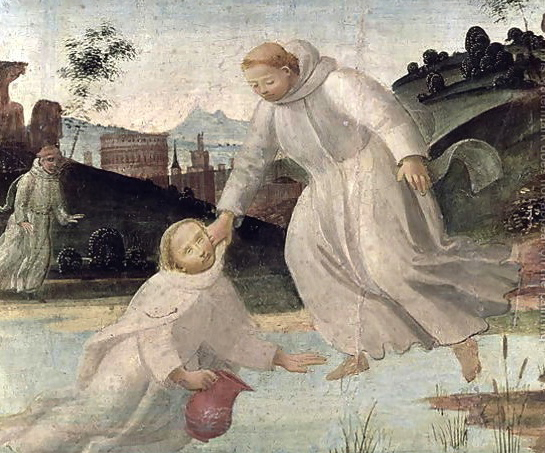
Saint Maurus Walks on Water ~ As told by Pope Saint Gregory the Great

Saint Maurus rescues Saint Placidus by Bartolomeo di Giovanni, ca. AD 1485.
In about AD 530, when Italy was ruled by the unstable successors of the Ostrogothic king Theodoric immediately prior to the Byzantine re-conquest, many noblemen of Rome entrusted their young sons to Benedictus, a holy monk who lived in the mountains of nearby Subiaco. One such boy was Maurus who is identified by Saint Gregory the Great as the son of a noble named Evitius. Another was Placidus, who was brought by Tertullius, a senator.

These two were among earliest disciples of a man who would be known to history as St. Benedict of Nursia.

Writing about 60 years after the fact in his Dialogues, Pope Saint Gregory the Great tells us that Maurus, “growing to great virtue, began to be his master's coadjutor.” Maurus is mentioned as part of several episodes in Gregory’s biography of Benedict as contained in the Dialogues. The best known of these anecdotes runs as follows:
On a certain day, as venerable Benedict was, in his cell, the foresaid young Placidus, the holy man's monk, went out to take up water at the lake, and putting down his pail carelessly, fell in himself after it, whom the water forthwith carried away from the land so far as one may shoot an arrow. The man of God, being in his cell, by and by knew this, and called in haste for Maurus, saying: "Brother Maurus, run as fast as you can, for Placidus, that went to the lake to fetch water, is fallen in, and is carried a good way off." 
Click here for more info.
A strange thing, and since the time of Peter the Apostle never heard of! Maurus, craving his father's blessing, and departing in all haste at his commandment, ran to that place upon the water, to which the young lad was carried by force thereof, thinking that he had all that while gone upon the land: and taking fast hold of him by the hair of his head, in all haste he returned back again: and so soon as he was at land, coming to himself he looked behind him, and then knew very well that he had before run upon the water: and that which before he durst not have presumed, being now done and past, he both marveled, and was afraid at that which he had done.
Coming back to the father, and telling him what had happened, the venerable man did not attribute this to his own merits, but to the obedience of Maurus: but Maurus on the contrary, said that it was done only upon his commandment, and that he had nothing to do in that miracle, not knowing at that time what he did. But the friendly contention proceeding of mutual humility, the young youth himself that was saved from drowning did determine: for he said that he saw when he was drawn out of the water the Abbot's garment upon his head, affirming that it was he that had delivered him from that great danger. 
Saint Maurus would later become famous in his own right. According to tradition, he was sent by Benedict, in company with several other monks, to found a community in the kingdom of the Franks nearby the Loire River. This became Glanfeuil Abbey and the village which grew up around it became known as Saint-Maur-sur-Loire. In the late 19th century, archaeological excavations were undertaken around the modern abbey, which had been destroyed and rebuilt several times over its history, revealing Gallo-Roman sub-structures.

Sadly, the modern abbey was abandoned in 1901 after the monks were driven out of France. It now seems to be privately owned without much external evidence of what it once was. Alas.

On the traditional calendar, the feast of Saint Maurus is commemorated on January 15 along with that of Saint Placidus. These saints are often confused with others of the same or similar names.