On this day in AD 493, Odovacar, the Scirian king of Italy concluded a treaty with Theodoric the Ostrogoth which effectively ended the war between them.
Odovacar had deposed the last Western Roman Emperor, Romulus Augustulus, in AD 476 and had ruled Italy himself under the title of "rex" or king for the next 17 years. Attempts by the Eastern Roman emperor Zeno to get Odovacar to recognize even the appearance of Roman suzerainty over Italy were continually rebuffed.
In 489, when faced with a dangerous Ostrogothic horde outside the walls of Constantinople under the command of Theodoric the Amal, Zeno made a virtue out of necessity by offering Theodoric the rule of Italy if he could wrest it from Odovacar. Theodoric accepted the offer and after plundering his way across the Balkans, he invaded Italy and defeated Odovacar in a series of battles. The treaty concluded on February 25 officially ceded Ravenna, the capital of the Western Empire, to Theodoric and allowed for joint rule of Italy between Odovacar and Theodoric.
Within a short time, however, the more powerful Theodoric had Odovacar slain and took the title of king for himself alone. He ruled Italy in his own right for nearly 40 years and was, for most of that time, considered an enlightened monarch by his Roman subjects.
In G. K. Chesterton's The Everlasting Man, we have an author of true genius and incredible literary ability covering an enormous range of subjects with the philosophical acumen of a Renaissance polymath. I, on the other hand, am an average fellow with decent reading skills and a rudimentary understanding of theology and philosophy. Therefore, it is fairly ludicrous for me to attempt a critique of this book.
But don't think that will stop me.
I read 100% of The Everlasting Man. But I readily admit that if I understood 50% of it, I did well. Like much of Chesterton's work, the book is more like 40,000 aphorisms strung together than a systematic treatise on a single subject. In it, Chesterton attempts to parallel the celebrated Outline of History by H. G. Wells which had been published in 1919, some 5 years before. But while Wells's work was a materialist history that was criticized by Hillaire Belloc as giving less space to Christ than to the Persian campaign against the Greeks, Chesterton's work focuses on how the reality of Christ and the truth of Christianity has infused all of human history.
As someone who already believes this thesis, Chesterton's work was mostly preaching to the choir in my case. So perhaps the book did not have the same impact on me as it might have on someone who subscribes to the materialist version of history going in. It certainly impacted C. S. Lewis, who gave the work a good bit of credit for his conversion to belief in Christianity.
Chesterton makes the point repeatedly that Christianity is unique and should not be compared to other religions. Unlike Jesus, the founders of other religious traditions never claimed to actually be God. Chesterton writes: "Mahomedans did not misunderstand Mahomet and suppose he was Allah. Jews did not misinterpret Moses and identify him with Jehovah." Instead, the claim made by Christ stands alone among philosophers and great lawgivers. Any others who actually did make such a claim, were deemed madmen: "No one can imagine Aristotle claiming to be the father of gods and men, come down from the sky; though we might imagine some insane Roman Emperor like Caligula claiming it for him, or more probably, for himself."
There is so much more to this book than I can do justice to here. Rather than go on at length, I will simply give the reader a few choice quotes which will exhibit Chesterton's point of view and rhetorical style far better than my continued rambling:
"Far away to the east there is a high civilization of vast antiquity in China; there are the remains of civilizations in Mexico and South America and other places, some of them apparently so high in civilization as to have reached the most refined forms of devil-worship."
"Now it is very right to rebuke our own race or religion for falling short of our own standards and ideals. But it is absurd to pretend that they fell lower than the other races and religions that professed the very opposite standards and ideals. There is a very real sense in which the Christian is worse than the heathen, the Spaniard worse than the Red Indian, or even the Roman potentially worse than the Carthaginian. But there is only one sense in which he is worse; and that is not in being positively worse. The Christian is only worse because it is his business to be better."
"The truth is that only men to whom the family is sacred will ever have a standard or a status by which to criticize the state. They alone can appeal to something more holy than the gods of the city; the gods of the hearth."
As should be readily appreciated from these quotes, there is much in this book that is directly applicable to our own times. But these are only the barest sample of Chesterton's wit and wisdom. Practically every fourth line of this book is quotable.
In short, I heartily recommend The Everlasting Man. However, let the reader beware: Chesterton assumed a level of knowledge and intellectual patience that is quite honestly beyond most of us today. As a result, I found the book to be somewhat frustrating because so much of it is so clearly over my head.
This is the kind of thing that drives me crazy. A press release is put out making the claim that a new study "debunks millennia-old claims of systematic infant sacrifice in ancient Carthage." Sounds intriguing, right?
Then, you read the release. About half-way down is this very curious statement:
"The idea of regular infant sacrifice in Carthage is not based on a study of the cremated remains, but on instances of human sacrifice reported by a few ancient chroniclers, inferred from ambiguous Carthaginian inscriptions, and referenced in the Old Testament."
Ok, do you get that? Apparently, documentary evidence in written sources dating from thousands of years ago is now considered inferior to scant archaeological remains--at least by these guys.
For the record, here is one of the pieces of documentary evidence of Carthaginian child sacrifice, taken from Diodorus Siculus:
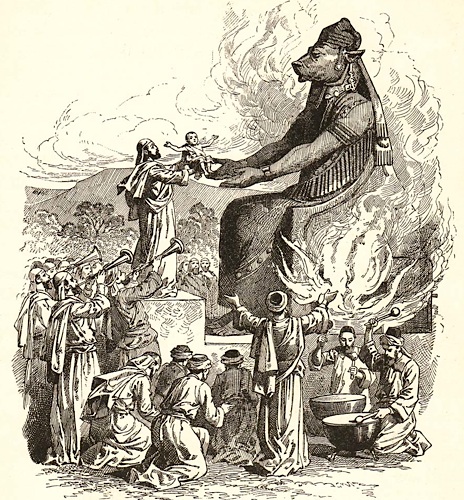
In their zeal to make amends for their omission, they selected two hundred of the noblest children and sacrificed them publicly; and others who were under suspicion sacrificed themselves voluntarily, in number not less than three hundred. There was in their city a bronze image of Cronus, extending its hands, palms up and sloping toward the ground, so that each of the children when placed thereon rolled down and fell into a sort of gaping pit filled with fire.
Child sacrifice is also mentioned in Sacred Scripture as being associated with the Caananite god, Moloch, for example:
"Thus shalt thou say to the children of Israel: If any man of the children of Israel, or of the strangers, that dwell in Israel, give of his seed to the idol Moloch, dying let him die: the people of the land shall stone him." Leviticus 20:2
Carthage was a colony of the Caananite/Phoenician trading cities.
But there is a real zinger in this press release:
"Our results show that some children were sacrificed, but they contradict the conclusion that Carthaginians were a brutal bunch who regularly sacrificed their own children."
Did you get that? So far from debunking anything, the research actually confirms that the Carthaginians did practice child sacrifice. The best this research team can do is comfort themselves with the knowledge that it may not have been on a massive scale.
On this day in AD 641, Heraclius, one of the most heroic — and tragic — late Roman emperors, died. He ruled for 30 of the most crisis-plagued years the Roman empire had ever experienced.
Under the rule of his predecessor, the cruel usurper Phocas, the Slavs had overrun the Balkans. At the same time, Syria, Egypt, and much of Asia Minor had been conquered by the Persians. The Persian king Chosroes II had even sacked Jerusalem, taking the True Cross back to Persia with him.
Rising from Africa where his father was exarch, Heraclius overthrew Phocas, but was faced with the daunting task of saving the empire from powerful enemies attacking on two fronts. Melting down gold given to him from the churches, Heraclius recruited and trained a new army. Rather than await the coming siege of the capital, Heraclius took the war to the Persians, defeating them in several pitched battles.
His campaign became a crusade. It was a fight to the death between the Christian Romans and fire-worshiping Persians — and in the end, the great Persian empire of the Sassanids lay prostrate on the ground. Heraclius recovered the relics from Jerusalem, and in AD 630, he returned to Jerusalem carrying the True Cross before him.
But his triumph was not long lived. Within six years, the Romans were again defeated in Palestine at Yarmuk by an invading army driven by a new power sweeping out of Arabia—Islam. By the end of his life, nearly all Heraclius had fought so hard to re-conquer had again been swept away, never to be recovered by the empire.
More detailed information on the eventful reign of Heraclius may be found here.
We purchased this book at the St. Katharine Drexel shrine in suburban Philadelphia. My oldest daughter, who is six, was interested in learning more about St. Katharine's life, so we sat down together a few nights each week and I read it out loud to her. The book caught her imagination immediately and never let go.
From St. Katharine's girlhood with her sisters, to their summers in the country, to their various family trips, the author captures the spirit of family life in the Drexel household with good humor that makes them come across as real people, not unapproachable models of sanctity. My daughter and I particularly enjoyed the stories of their various joys and mishaps while on their European trips. What comes through unmistakably is that the Drexel girls, though surrounded by every material comfort the world could offer, never lost their focus on God, performing their devotions, and enriching their spiritual lives.
Without doubt, this book shows the Drexels as extremely wealthy--which in fact they were. However, this is contrasted with the family's unfailing charity, starting with their practice of the Dorcas where those in need came to the backdoor of the Drexel house. Of course, the ultimate example of that generosity was Katharine herself. Like her hero St. Francis of Assisi, Katharine gave up everything--even millions of dollars--to serve God. One of the most poignant passages for me was toward the end of the book where Mother Katharine is described as wearing her habits until they were threadbare. Having been to her shrine, examples of her austerity abound there, too--such as the tiny pencils, sharpened down to mere nubs, that she used until they could no longer be held.
So in short, this is a charming story about an inspiring modern saint. If you want to encourage a love of Christian charity and an openness to the religious life in your children, read this book with them.
Fr. Rutler on EWTN's series, Christ in the City, mentioned this little story in passing, and it's just so good that I couldn't resist posting it, if only so that I can refer back to it later.
Alexander, passing through Corinth, had a curiosity to see Diogenes, who happened to be there at the time: he found him basking in the sun in the grove of Craneum, where he was mending his tub.
"I am," said he to him, "the great king Alexander."
"And I," replied the philosopher, "am the dog Diogenes."
"Are you not afraid of me?" continued Alexander.
"Are you good or bad?" asked Diogenes.
"Good," rejoined Alexander.
"And who need be afraid of one that is good?" answered Diogenes.
Alexander admired the penetration and freedom of Diogenes; and after some conversation, he said to him, "I see, Diogenes, that you are in want of many things, and I shall be happy to serve you; ask of me what you will."
"Retire, then, a little to one side," replied Diogenes, "you are depriving me of the sun."
It is no wonder that Alexander stood astonished at seeing a man so completely above every human concern.
"Which of the two is richest," continued Diogenes: "he who is content with his cloak and his bag, or he for whom a whole kingdom does not suffice, and who is daily exposing himself to a thousand dangers in order to extend it?"
The courtiers of the king were indignant that so great a monarch should thus honor such a dog as Diogenes, who did not even rise from his place. Alexander perceived it, and, turning about to them, said, "Were I not Alexander, I should wish to be Diogenes."
Taken from:
Lives of the Ancient Philosophers Translated from the French of Fenelon with notes and a life of the author by REV. JOHN Cormack, 1842, pg. 227-228
On this day in the year of our Lord 483, the relics of St. John Chrysostom were transported to Constantinople thirty years after his death. Known as a powerful and persuasive preacher, St. John, had been patriarch of Constantinople where he made a habit of speaking the truth to power in the most stark and antagonistic terms. He reserved some of his most biting criticisms for the elites of the Empire, including the Empress Eudoxia herself. His homilies soon gained him the ire of the imperial court and raised up numerous enemies within the Church as well. On two occasions, St. John was deposed and driven from the city. He died in exile in AD 407. A full biography of St. John may be found on NewAdvent.com.
Here are a few quotes:
"Remember, therefore, it matters not how many others sin, yours can never be justified before God, and where it is fashionable to sin it is likewise the fashion to go to hell. The choice is always yours to make."
"We should not bear it with bad grace if the answer to our prayer is long delayed. Rather let us because of this show great patience and resignation."
"Why sow where the ground makes it its care to destroy the fruit? where there are many efforts at abortion? where there is murder before the birth?...Why then dost thou abuse the gift of God, and fight with His laws, and follow after what is a curse as if a blessing, and make the chamber of procreation a chamber for murder, and arm the woman that was given for childbearing unto slaughter?"
Exactly 1,631 years ago today, in AD 379, Theodosius was elevated to the rank of co-emperor at the age of 32. His elevation occurred only a few months after the disastrous defeat and slaughter of a Roman field army at Adrianople by the Goths. Theodosius was given the unenviable task of quelling the Gothic invasion and restoring order, all while rebuilding the shattered army. He accomplished these goals admirably.
A Spaniard by birth, Theodosius was last emperor to rule the entire Roman Empire, both east and west. As a result of his accomplishments in both the political and religious arenas, he is known to history as Theodosius the Great.
Saint Ambrose of Milan offered the following praise of Theodosius in the funeral oration offered a few days after the emeperor's death: "I loved the man, for he preferred those who told him the strictest truth, rather than the flatterers."
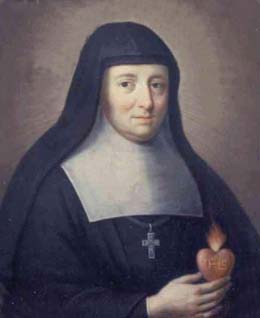
I have come to have tremendous love for and devotion to St. Francis de Sales of late, having recently read his Philothea. As a result, I have also become aware of his great friend, St. Jane Frances de Chantal.
Saint Jane was an amazing woman in her own right. The mother of six children, her husband was killed in a freak hunting accident when she was but 28 years old. Later, after her children had been properly provided for, she became a nun and foundress of the Congregation of the Visitation, an order which took in those with a vocation who had been rejected by other orders.
Saint Jane was also someone who suffered greatly in spirit. Saint Vincent de Paul wrote, of her:
“She was full of faith, yet all her life had been tormented by thoughts against it. While apparently enjoying the peace and easiness of mind of souls who have reached a high state of virtue, she suffered such interior trials that she often told me her mind was so filled with all sorts of temptations and abominations that she had to strive not to look within herself...But for all that suffering her face never lost its serenity, nor did she once relax in the fidelity God asked of her. And so I regard her as one of the holiest souls I have ever met on this earth”
This should serve as a great comfort to those of us afflicted by the same trials and temptations in today's world. They can be overcome, with God's grace. We must always remember to ask for it.
The website on which I found this quote also had a rather profound observation on interior anguish, which hit me right between the eyes.
It may strike some as unusual that a saint should be subject to spiritual dryness, darkness, interior anguish. We tend to think that such things are the usual condition of “ordinary” sinful people. Some of our lack of spiritual liveliness may indeed be our fault. But the life of faith is still one that is lived in trust, and sometimes the darkness is so great that trust is pressed to its limit.
Yes, trust. There's the key to getting beyond the suffering and making of it a worthy sacrifice. We need to trust that God sees our plight, loves us, and that somehow, good will come from it.
Today is the 1478th anniversary of the quelling of the Nika Rebellion in Constantinople. After nearly a week of rioting in which about 1/3 of the city was burnt to the ground, the rebellion ended where it had begun--in the Hippodrome, the massive chariot-racing stadium which could seat 80,000 spectators. The end result was a horrible bloodbath where an estimated 30,000 rioters were slain. Here's a link to an article I wrote on the subject a few years ago.
The one enduring result of the Nika Rebellion may be seen to this day towering above city of Istambul--Justinian’s magnificent Hagia Sophia, built over the ruins of the previous church of the same name which was destroyed by the rioters.
Young Katie Drexel was a child of privilege. Growing up during the difficult years of the Civil War and its aftermath, Katie nonetheless experienced every comfort and pleasure that life in Philadelphia and its environs could offer. Yet although her family was extraordinarily wealthy, her parents were at the same time wonderfully devout and excellent examples of parental love, charity and personal piety.
But Katie also knew sadness. Her mother had died a mere five weeks after her birth, a fact which Katie discovered at age 12. Her dear step-mother, the only mother she had ever known, died when Katie was 25. Her beloved father followed two years later. This left Katie and her two sisters heirs to a tremendous fortune. What the young Katharine Drexel did next is the stuff of miracles--for this pretty young woman with a vast inheritance and no shortage of suitors, turned away from the world and embraced the religious life, all for the sake of Christ. And 45 years after her death in 1955, she was recognized as a saint.
Katie: The Young Life of Mother Katharine Drexel is a short but excellent book. It is particularly well suited to be read with your children. I read it aloud with my oldest daughter (age 6) who had gotten it as a Christmas gift, and I noticed that my oldest son and younger daughter were lurking around as well while we read. By the end, the whole family was listening in. The writing is done in the first person, which adds a sense of familiarity to the book, as do the dozen or so black and white photos of the Drexel family. The prose is easy and approachable so that a kid over the age of 8 should be able to handle it with no problem.
The book closes with an account of the miracle which led to St. Katharine's canonization.
The story was so compelling that we decided to take a family trip to the shrine of Saint Katharine Drexel in Bensalem, PA after we finished. As this book is only about St. Katharine's early life up to her entering the religious life, you'll need to get another one to tell the rest of the story. Fortunately, the shrine has a gift shop, so we were able to walk out with Saint Katharine Drexel: Friend of the Oppressed by Ignatius Press.
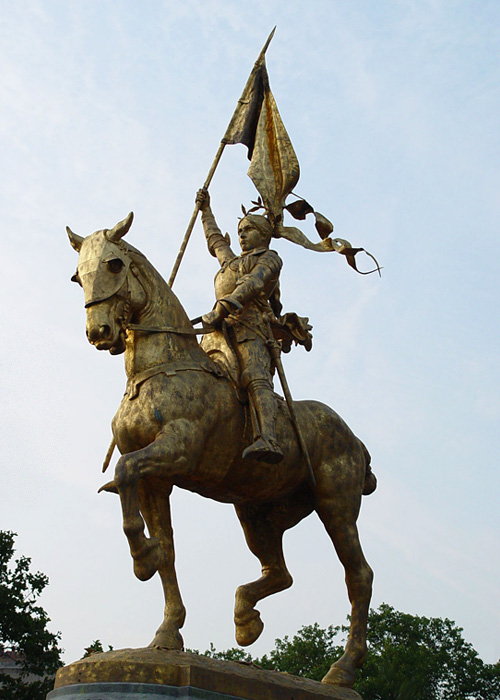
Aside from being the traditional date of the feast of the Epiphany, January 6 is also the birthday of one of my favorite saints, Joan of Arc. Here are some quotes of hers that I particularly like:
"I am not afraid ... I was born to do this."
"One life is all we have and we live it as we believe in living it. But to sacrifice what you are and to live without belief, that is a fate more terrible than dying."
"Children say that people are hung sometimes for speaking the truth."
"I would rather die than do something which I know to be a sin, or to be against God's will."
Truly a model of Christian virtue and courage. Here is a link to her full bio from the 1913 Catholic Encyclopedia.
The photo is of a statue of St. Joan in Philadelphia that I have always admired.
At a banquet of the gods on Mount Olympus, the emperors of Rome were called to account to find which of them was the greatest. When Constantine’s turn came and he recounted his long string of triumphs, Silenus, the drunken companion of Dionysus, stood and rebuked him:
“Constantine,” he said, “are you not offering us mere gardens of Adonis as exploits?”
“What do you mean,” Constantine asked, “by gardens of Adonis?”
“I mean,” said Silenus, “those that women plant in pots by scraping together a little earth for a garden bed. They bloom for a little space and fade forthwith.”
This scene appears in a satire called The Caesars written by Constantine’s great-nephew, Julian — known to history as the Apostate.
As can be inferred from this excerpt, Julian didn’t think too highly of the accomplishments of his great-uncle. In fact, his purpose in writing The Caesars was to compare Constantine unfavorably with emperors who had gone before him.
Many so-called post-Christian scholars would readily agree with Julian’s assessment. But such scholars are wrong. Constantine’s war-like deeds had a much wider impact than a mere political consolidation of the empire under his sole rule. Without the military victories of Constantine, and the missionary zeal of that emperor in the aftermath of these victories, the ultimate adoption of Christianity by the mass of citizens in the Roman world would certainly have been long postponed.
But these days, Constantine has been thoroughly “Dan-Brown-ized.” His character has been sullied, distorted, and outright falsified by modern slanderers to the point that almost nothing remains of the real man in the popular imagination.
So who was Constantine and what did his accomplishments really mean?
First and foremost, he was the outstanding soldier and general of his era. He was the son of Constantius Chlorus, a tough provincial soldier who rose through the ranks by his own merits during the chaotic 3rd century AD when the empire teetered on the brink of collapse. Constantine’s mother, Helena, was a saint—literally. When the brutal but effective Diocletian came to power, he tapped Constantius Chlorus to rule Gaul and Britain as his “Caesar” or junior emperor.
With his father in a position of power, the young Constantine was sent off to serve in the retinue of Diocletian himself, no doubt to discourage any rebellious behavior on the part of his father. In this capacity, Constantine participated in the senior Augustus’s campaigns in the Balkans and Egypt. He must have also witnessed the steadily ramped up efforts by Diocletian and his protégé, Galerius, to extirpate forever that most hated sect known as Christians.
The ecclesiastical historian Eusebius Pamphilus reported seeing the young Constantine traveling among the company of Diocletian through the city of Caesarea. “No one was comparable to him for grace and beauty of person, or height or stature,” the bishop wrote. “And he so far surpassed his compeers in personal strength as to be a terror to them.”
But if Constantine possessed physical gifts, he also had the courage and right judgment to know when to use them. While still in the east, now serving under Galerius after the retirement of Diocletian, Constantine received news that his father was dying in far off Britain. Galerius refused to let the young man depart to be at his father’s deathbed and rumors flew that the jealous emperor intended to have Constantine disgraced or executed as soon as Constantius was safely dead. Not waiting on the outcome of events, Constantine fled from the east, riding post horses at a break-neck pace and hamstringing those mounts left behind to hamper pursuit.
Constantine arrived at York just in time to embrace his father before the old man breathed his last. He was then declared emperor by his father’s army—the only legitimate Roman emperor ever to be crowned in Britain.
If Constantius had proved himself to be a solid and capable commander, his son would soon outstrip him in every way. Constantine’s first challenge was to defend the provinces his father had bequeathed to him against barbarian invasion. When Germanic raiders crossed the Rhine to test him, the new emperor met and defeated them with little difficulty.
In Italy, meanwhile, a more dangerous threat emerged. A usurper named Maxentius assumed the imperial power at Rome. Two armies were sent from the east to dislodge him, but Maxentius bribed and absorbed the first and utterly defeated the other, sending the arrogant Galerius retreating back to the Balkans in disgrace. Only Constantine, operating from his base in Gaul, was left to grapple with the tyrant.
Descending into Italy with a force of seasoned troops roughly one-third of that commanded by his opponent, Constantine launched a sequence of brilliant campaigns that soon found him encamped before the massive Aurelian walls of Rome with a trail of broken enemy armies in his path. Here, however, he was stymied, for Maxentius, despite his defeats, retained a considerable numerical advantage. Furthermore, a pagan oracle had encouraged Maxentius to remain safely behind the walls of Rome, and Constantine, possessing neither the means nor the numbers to successfully besiege the city, began to despair of victory.
It was at this moment that God quite literally intervened. Constantine himself described the famous vision to his biographer, the bishop Eusebius Pamphilus:
He said that about mid-day, when the sun was beginning to decline, he saw with his own eyes the trophy of a cross of light in the heavens, above the sun, and bearing the inscription, CONQUER BY THIS. At this sight he himself was struck with amazement, and his whole army also, which happened to be following him on some expedition, and witnessed the miracle.
What happened next is one of the great turning-points in history. Constantine, who had been a worshiper of pagan god Sol Invictus—the unconquerable sun—decided to trust in this new God Who had revealed Himself. He had his men paint the chi-rho on their shields, symbolizing the first two letters of Christ, and he had a standard created, called the Labarum, which featured a cross and the chi-rho. This device would be carried before the army into battle.
Seeing his opponent checked and appreciating his own numerical superiority, Maxentius now sent his troops out of the city to do battle, though he himself remained in Rome in accordance with the oracle to celebrate the Circensian games. Constantine himself led his army to battle and the fight raged for the better part of the day with neither side able to gain the advantage over the other.
The people of Rome were outraged to see Maxentius sitting haughtily in the imperial box at the arena while the army bled on his behalf but a short distance away. They soon began to goad him by shouting, “Constantine can not be conquered!” Fearing an outright revolt, Maxentius caused the Sybilline Books—works of ancient pagan prophecy—to be consulted. Some soothsayer, with a delicious lack of clarity, discovered a line therein which read: “On the same day, the enemy of the Romans should perish.”
Maxentius took this to mean that he would triumph over Constantine, and so bolstered took the field. But as history would demonstrate, the miraculous promise of the Christian God far outweighed the spurious and contradictory oracles of the pagans. The army of Maxentius broke and fled back toward Rome, but in order to reach the city and safety, the routed host had to traverse the Milvian bridge over the Tiber. In the crush to get across, the bridge collapsed and the tyrant and much of his cavalry were drowned.
This sight of Constantine’s army, completely victorious and marching under the standard of the Cross, was a tremendous shock to many pagan Romans. According to Eusebius, “Those who had so lately been deceived by their vain confidence in false deities, acknowledged with unfeigned sincerity the God of Constantine and openly professed their belief in Him as the true and only God.”
This incredible victory also made a deep and abiding impression on Constantine. Though he probably knew something of the faith given that his mother, Helena, was a devout Christian, the young emperor now realized without doubt that his great triumph had been achieved less by his own valor than via the salutary sign of the Cross. As a result, Constantine set his mind to the promotion and propagation of Christian devotion throughout the empire.
His piety was real. His belief in God and the saving power of Jesus Christ was not mere affectation. In an empire that was still about 85% pagan, what did he have to gain by embracing a small and historically despised minority? Rather, Constantine believed to his core that there could be no true happiness, no joy, no hope outside of Christianity. In a later edict, he set out these beliefs in his own words:
To all who entertain just and wise sentiments respecting the character of the Supreme Being, it has long been most clearly evident:…they who faithfully observe His holy laws, and shrink from transgressions of His commandments, are rewarded with abundant blessings, and are endued with well-grounded hope as well as ample power for the accomplishment of their undertakings. On the other hand, they who have cherished impious sentiments have experienced results corresponding to their evil choice.
Lest we assume that Constantine’s belief system was some simplistic notion that God punishes the wicked and rewards the pious in this life, the emperor himself explodes this accusation within the same edict:
Whoever have addressed themselves with integrity of purpose to any course of action, keeping the fear of God continually before their thoughts…such persons, though for a season they may have experienced painful trials, have borne their afflictions lightly, being supported by the belief of greater rewards in store for them.
And Constantine had many painful trials yet in store for him. Following his victory over Maxentius, he divided the empire with Licinius, the successor of the persecuting emperor Galerius who had perished in a spectacularly gruesome way—his insides being devoured by worms. Licinius began his reign as a friend of the Christians and the brother-in-law of Constantine. But the two were quickly at loggerheads, and Licinius’s enmity for Constantine soon also became a visceral hatred for Christianity.
The inevitable war between the two immediately became a religious conflict with Constantine’s legions marching under the Labarum and those of Licinius under unabashedly pagan symbols. Both sides infused their propaganda with blatant religious overtones. Constantine kept a retinue of Christian priests nearby to advise him at all times. Meanwhile, Licinius consulted pagan soothsayers who confidently predicted a total victory for him over Constantine, the despiser of the gods.
The two sides clashed in the Balkans. The climactic Battle of Cibalis was a grinding infantry struggle that the pagan historian Zosimus termed, “one of the most furious that was ever fought.” The battle lasted an entire day and the result was in doubt until Constantine’s right wing—which he himself commanded—broke through and routed Licinius’s forces.
Though defeated, Licinius was still able to muster enough strength to save himself from complete destruction. Constantine, for his part, was willing to give his brother-in-law a second chance. So the two settled down into an uneasy truce which allowed the battered empire a brief respite.
When war broke out afresh eight years later, it was to be a fight to the finish. Between the two of them, Constantine and Licinius mustered nearly 300,000 soldiers, with Licinius holding a slight advantage in overall numbers. The armies faced off at Adrianople in Thrace, where Constantine, by the use of a strategem, was able to hit the Licinian army unexpectedly and precipitate a rout. Constantine pursued Licinius to Byzantium and placed the city under siege. It was here that Constantine appreciated the strategic value of the city which would in no short time become the new capital of the empire—Constantinople.
Meanwhile, Constantine’s fleet gained a victory over the Licinian fleet. Fearing that he would be cut off from his base in the east, Licinius immediately retreated to the Asiatic shore of the Bosporus. In a final gambit, the pagan emperor threw all his available forces at Constantine at Chrysopolis near Chalcedon. The resulting battle was one of the largest and bloodiest of antiquity. Zosimus reported that of the 130,000 men that Licinius flung into battle, barely 30,000 remained to him at the end of the day.
His cause doomed, Licinius fled to Nicomedia where he was captured. He was held under house arrest but was executed a year later while trying to raise yet another army.
With this hard-fought victory, Constantine was now the sole emperor of the Roman world. For the next twelve years until his death in AD 337, he set about restoring peace and stability not only to the empire, but to the Church as well. He immersed himself in those intractable theological disputes that roiled the early Church, calling the Council of Nicaea to deal with the Arian heresy. Though he was ultimately unsuccessful in this endeavor, the Council of Nicaea came to be seen as a benchmark for councils of the universal Church and the creed it produced is still recited to this day.
But more than anything else, Constantine promoted vibrant Christianity to a weary pagan population for whom the old gods had lost the power of consolation and inspiration. He and his mother erected dozens of dazzling new churches across the empire. He issued edicts praising Christianity and condemning pagan superstitions, and he enjoined all his soldiers to recite prayers to God on Sundays.
By the end of his reign, Constantine had pruned back the rotting weeds of paganism and allowed the green shoots of Christianity to sprout up across the empire. Though subsequent Christian emperors would not match Constantine’s military prowess, Christianity would continue to thrive under them unabated from the firm roots set down during his reign.
So Constantine’s exploits were clearly not “gardens of Adonis.” But in fairness, Julian the Apostate could not have known that he himself would be the last pagan emperor of Rome. And while Julian’s vain efforts in the name of pagan revival would wither and fade immediately after his death, those of Constantine which he ridiculed would stand tall and strong through the ages, bearing abundant fruit.
[This article originally appeared in Catholic Men's Quarterly.]
Check out these other articles from my blog which delve more deeply into the fascinating character of Constantine the Great:
Having read this book, I can now understand why St. Francis de Sales is a doctor of the Church. Simply put, Philothea, or An Introduction to the Devout Life is a roadmap to Heaven. But unlike many of the theological tracts or mystical tomes which one often finds professing to do the same thing, this book is, very simply, a practical manual for living a devout life in a world that is often antagonistic to Christianity. It is also the closest many will get to having a canonized saint as one's own spiritual director.
The advice offered is excellent, grounded in sacred Scripture and the teachings of the saints, and enlivened with colorful metaphors. (St. Francis obviously had an affinity for bees.) Though St. Francis lived 400 years ago, his guidance easily translates to life in the 21st century. He had a keen insight into the workings of the human mind, the devious yet innocent-seeming temptations presented by the devil, and the challenges faced by the soul seeking to live a pious life amid the petty cares of everyday life. And his insights transcend time and culture.
No one can read this book without finding a section that directly applies to them, whatever their state of life. St. Francis's spiritual exercises, admittedly, are difficult. But who can doubt that following them to the full would have wonderfully efficacious effects on the soul? I have begun instituting a subset of them in my own life and have already reaped benefits. I hope to include more of them as time goes on and my spiritual stamina improves.
St. Francis's advice on correct behavior, attitude, and personal morality is incredibly wise. Those who read and accept these teachings will assuredly live happier, more fulfilling lives, which are more pleasing to God. The several chapters on friendship--specifically true friendship versus worldly friendship--were of particular utility to me. I think many young Catholics would do well to read and ponder St. Francis's words on the subject so as to avoid temptation and the near occasion of sin in their relationships.
In short, this book is a masterpiece of spiritual advice and I can't recommend it highly enough. Best of all, one need not read it cover-to-cover. It may be dipped into for incidental advice based on the reader's own flaws, strengths, state of life, and spiritual needs. If you are looking for a straight-forward, uncomplicated path to Christian devotion, this book is it.
Did you know that one of the greatest kings in Spanish history, Fernando III, was also a saint? I didn't. But thanks to author James Fitzhenry, I do now. Fitzhenry, who also penned El Cid: God's Own Champion, has written a detailed yet approachable biography of this fascinating and inspiring example of Catholic manhood entitled St. Fernando III: A Kingdom for Christ. Published by Lepanto Press, who have made a name for themselves by producing beautiful, high-quality Catholic books at a reasonable price, St. Fernando III is geared toward Catholic homeschooled kids, probably in the twelve and older age range. But the writing is exceptional and as a mature reader of eight-and-thirty years, the book easily held my attention.
Replete with family turmoil, civil strife, stunning miracles, romance, and dozens upon dozens of skirmishes, pitched battles, and sieges, the tremendous scope of St. Fernando's worldly accomplishments leave the reader dumbfounded. But the heart of this book is St. Fernando's total devotion to Christ and his Blessed Mother. Everything he did, he offered to God without reservation. In his willingness to suffer personal hardships, unfailing mercy toward his enemies, love for his wife and children, and care for the poor and afflicted, St. Fernando was a model of Christian virtue. In his everyday life, and especially when he faced a crisis, he turned to the Virgin and believed to the depths of his soul that she would intercede for him. And based on the magnificent achievements of his life, who can doubt that she did? For at the same time that the Christian states in the Holy Land were failing despite the best efforts of great crusading armies led by the most important crowned heads of Europe, St. Fernando was able to weld together the small kingdoms of Castile and Leon and use their combined might to reconquer almost all of Andalusia from its Muslim overlords.
So in short, this book is a gem. St. Fernando III is a Catholic hero who deserves to be more widely known. Now thanks to James Fitzhenry and his enjoyable book, he will be.
There's a vocations "crisis" in Spain. According to a Catholic News Agency article there are only 20 Jesuit novices, 5 Franciscans, and 2 Vincentians in the entire country.
How is it, then, that there are over 135 Poor Clares (average age 35) in a single convent in Lerma with 100 more on the waiting list?
Much of it is thanks to the amazing charism of one remarkable nun: Sister Veronica Berzosal. When Sister Veronica entered the convent at the age of 18, there hadn't been a vocation in 23 years. She became vocations director at the age of 28 and since then, the number of nuns at the convent has quadrupled. The Spanish newspaper El Pais calls her, "the biggest phenomenon in the Church since Teresa of Calcutta." Here's a bit more about her from the CNA article:
Sister Veronica joined the Poor Clares Convent of the Ascension founded in 1604 in Lerma (Spain) at at time when it was going through a vocations crisis. It was January 22, 1984, and Marijose Berzosa - Sr. Veronica's name prior to entering the convent - decided, at age 18, to leave behind a career in medicine, friends, nightlife and basketball.
"Nobody understood me. There were bets that it would not last, but they did not feel the force of the hurricane that drew me in," says Sr. Veronica. "I was a classic teenager looking for a way out ... and I made a decision in just 15 days."
I have always found stories like this one to be so remarkable. Who else but the Holy Spirit could inspire a young person to do something this dramatic?
Thank God for women like Sr. Veronica. God send us more of them!
Here's a site that's been put up by a dear family friend who has just gone off to college. The purpose of the site is to be a resource for Catholic parents who are looking for quality reading/viewing/listening material for their kids. Here's what the site's creator says in her own words:
I am a homeschool graduate, a compulsive doodler, an aspiring author, a Catholic, and a lover of nature, literature and science.
I am also a student at an authentically Catholic college and I set up this website to help me actually afford to go! Each time you buy something on this site, I get a commission. I've selected books, movies, and music that I have enjoyed or have some way helped in my spiritual development. I hope you like them too!
So check it out. If you have kids, the stuff she has listed on here is gold--I know, because I've seen and read most of it myself! Plus, you'll be helping to put a very worthy and excellent young woman through a real Catholic college.
And one trick--if you click through one of her links that leads to Amazon.com and buy something there that's not on her list, she still gets a commission on it. So I've made it a point to click through the Literate Octopus every time I buy something on Amazon. It's a really easy way to lend a hand to a very deserving person.
(This is an article I wrote back in March for the 2009 issue of the Tarpeian Rock literary magazine. Just getting around to posting it now. I'm a little behind schedule...)
This past November, the major news outlets triumphantly reported that Barack Obama’s victory in the presidential elections was due in no small part to the “youth vote”. The Chronicle of Higher Education reported that over 68% of voters age 18-29 cast their ballots for Obama.
For many outside that age bracket, this was seen as a disheartening turn of events. Ridiculous optimist that I am, however, I choose to see the glass as 32% full.
Even the more honest Obama supporters will openly admit that their candidate was the recipient of the most massive deluge of media-driven idol worship in American history. Yet, despite this, millions of young Americans were able to slice through the hype and vote against Obama.
Of course, within the first few months of his administration, Barack Obama has turned out to be every bit as divisive and retrograde as his critics warned he would be. His solution to every problem we face is not just big government, but colossal government. What those young voters who came out so strongly for Obama don’t yet realize is that the bill for the trillions upon trillions of dollars in government spending that Obama has already proposed will fall squarely upon them. They effectively voted themselves a gigantic promissory note.
On the issue of life, Obama has already been a catastrophe. During the campaign, he famously pronounced that he wouldn’t want to see his daughters “punished with a baby” and declared that the question of when human life begins was “above his pay grade.” Yet his supporters piously assured us that Obama cared deeply about the unborn and that his policies would actually reduce the numbers of abortions.
Anyone who voted for Obama thinking he was pro-life is eating a big crow sandwich now. Among his first acts as president was a repeal of the Mexico City policy which forbade US taxpayer dollars from funding abortions in poor countries.
Worse, Obama supports FOCA, the ill-named Freedom of Choice Act. If this travesty becomes law, every hard-fought restriction on abortion would be swept away—including the right of parents to be informed when their minor child attempts to procure an abortion and the right of doctors not to perform them.
Abortion has claimed the lives of nearly 50 million “youth voters” since 1973. One would think that outlawing this hideous practice would be a major priority for the fortunate survivors.
Finally, there’s the issue of the recently passed GIVE Act, part of which authorizes the federal government to determine the feasibility of a “mandatory service requirement for all able young people.”
There’s a word for government-imposed “mandatory volunteerism”—serfdom. I don’t think many young people voted for that when they pulled the lever for Obama. An excellent take on Obama’s “youth service corps” was filmed by students at John Paul the Great University entitled “Who do you serve?” I encourage you to check it out on YouTube:
But what do I know? I’m an old guy. Pretty soon, most of these issues won’t even affect me directly anymore. I’ll be too old to worry about procreating. I’ll be collecting government entitlements, while all those Obama-voting youth will be paying massive taxes required to keep said programs afloat. And I’ll be too decrepit to be drafted into some government-run youth slavery program.
If youth voters want real change, you’re not going to get it voting for a guy who has repackaged failed socialist ideas from the mid-20th century and slapped his own personality cult seal of approval on them.
And a politician who gets 100% ratings from the abortion industry isn’t peddling hope, for without life, there is no hope.
Here's a review of another book which purports to deal with the life and times of Constantine: The Age of Constantine the Great by Jacob Burckhardt.
Don't bother with this one. Burckhardt was a 19th century academic with an ax to grind against Constantine and a mission to rehabilitate the Christian-persecuting Diocletian. He pursues both of those ends with blind and tedious enthusiasm.
The book takes about 240 pages just to get to Constantine at all, as Burckhardt loses his focus amid 60 page digressions on pagan practices in the ancient Mediterranean world.
Perhaps most annoyingly, the modern translator has seen fit to strip out all of Burckhardt's references which makes the book into an unverifiable manifesto as opposed to a serious scholarly work.

 On this day in AD 493, Odovacar, the Scirian king of Italy concluded a treaty with Theodoric the Ostrogoth which effectively ended the war between them.